Last updated: July 19, 2026
This article reflects information available at the time of writing. Check Google Maps for the latest hours and availability.
Introduction
Osaka is a city that moves fast — conveyor-belt sushi, neon-lit arcades, takoyaki eaten standing up. Shitennoji sits in the middle of all that and simply doesn’t care. Founded in 593 by Prince Regent Shotoku, it holds the distinction of being the first Buddhist temple in Japan built under state sponsorship — which means it predates Kyoto as a city by roughly two centuries. That’s not a footnote. That’s the whole story.
In 587, a conflict erupted between the pro-Buddhist Soga clan and the anti-Buddhist Mononobe clan. Prince Shotoku supported the Soga and vowed to build a temple dedicated to the Four Heavenly Kings if they emerged victorious. After their win, Shitennoji was constructed as an expression of gratitude and a symbol of the new Buddhist era. The name has stuck ever since — and so has the neighbourhood around it. Tennoji, the district, takes its name directly from the temple.
What makes Shitennoji worth a dedicated visit rather than a quick detour is its sheer range. Most of the outer buildings are free to view, but there are three locations where you pay a fee: the Chushin Garan inner temple complex, the Treasure House, and the Gokurakujodo Garden. Each one rewards a different kind of attention — architecture, artefacts, or just somewhere quiet to sit. The grounds are normally peaceful and sparsely populated, but the atmosphere becomes lively during festivals and events. If you want the best food in Osaka nearby, the Tennoji neighbourhood delivers on that front too. This guide walks you through every major section of the complex so you know exactly what you’re walking into.
1. The Stone Torii Gate — West Entrance (石鳥居)
- 📍 1-11-18 Shitennoji, Tennoji-ku, Osaka 543-0051 (West Gate / Nishimon)
- 🕐 Outer grounds open daily, 24 hours (as of May 2026)
- 💰 Free
- 🚃 Shitennoji-mae Yuhigaoka Station (Tanimachi Line) — 5 min walk
- 🗺 Open in Google Maps
- 📋 Tabelog
The stone torii gate at the main entrance to Shitennoji dates from 1294 and is the oldest of its kind in the country. The fact that a Buddhist temple has a Shinto torii at all is the first puzzle Shitennoji throws at you — and it’s a good one. Torii gates are usually found at Shinto shrines, and Shitennoji is a Buddhist temple. Various theories exist around this stone torii at Shitennoji Temple. Most scholars point to the pre-Meiji blending of Buddhist and Shinto practice, but the temple itself offers no definitive answer. Start here, face west, and you’ll understand why this spot was historically associated with watching the sun set over what was once open sea.
2. Chushin Garan — The Inner Precinct (中心伽藍)
- 📍 1-11-18 Shitennoji, Tennoji-ku, Osaka 543-0051
- 🕐 Apr–Sep: 8:30–16:30 / Oct–Mar: 8:30–16:00 (as of May 2026)
- 💰 ¥300 per adult (inner precinct only)
- 🚃 Shitennoji-mae Yuhigaoka Station (Tanimachi Line) — 5 min walk
- 🗺 Open in Google Maps
- 📋 Tabelog
- 🌐 Official site
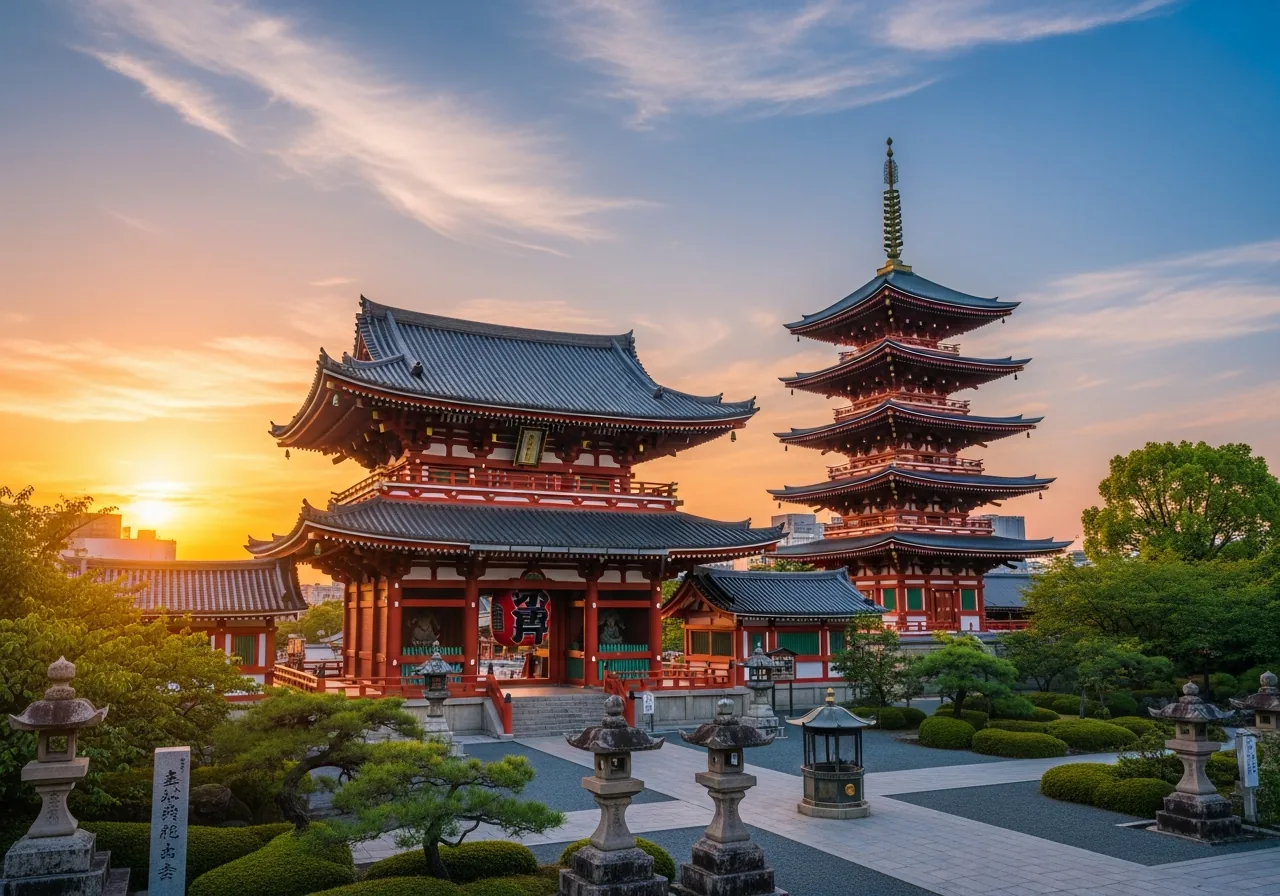
One of the most remarkable aspects of the temple is its architectural layout, which reflects ancient Asuka period (593–710) temple design. The most recent major reconstruction was completed in 1963. The current structures replicate Asuka period architecture, including the five-story pagoda, the Kondo main hall, and the Kodo lecture hall. The pebble-covered courtyard is the visual centrepiece — white gravel, vermilion columns, and the pagoda rising straight up from the middle. A major feature is the five-storied pagoda in which Prince Shotoku is enshrined as a statue of Kannon, a bodhisattva sometimes called the “Lord of Compassion.” The pagoda can be entered from the Main Hall, however, photography is not allowed inside. The climb is worth it for the view over the surrounding Tennoji rooftops alone. Note: on the 21st of each month and certain special days, the inner precinct is free to enter.
3. Gokurakujodo Garden (極楽浄土の庭)
- 📍 1-11-18 Shitennoji, Tennoji-ku, Osaka 543-0051 (northeast corner of grounds)
- 🕐 Apr–Sep: 8:30–16:30 / Oct–Mar: 8:30–16:00 (as of May 2026)
- 💰 ¥300 adults / ¥200 students
- 🚃 Shitennoji-mae Yuhigaoka Station (Tanimachi Line) — 5 min walk
- 🗺 Open in Google Maps
- 📋 Tabelog
A short walk away, the Gokurakujodo Garden was designed based on descriptions of the Western Paradise of the Amida Buddha. The garden is characterised by ponds, rock waterfalls, cherry blossoms, and stone lanterns. Unwind with a stroll along the water and enjoy the seasonal foliage. The area is also known for its abundance of basking turtles. It’s the quietest corner of the entire complex — most visitors rush past it on the way to the pagoda. Don’t. Spend twenty minutes here and the city outside the walls genuinely disappears.
4. The Treasure House (宝物館)
- 📍 1-11-18 Shitennoji, Tennoji-ku, Osaka 543-0051
- 🕐 10:00–16:00 (closed between exhibitions — check ahead) (as of May 2026)
- 💰 ¥500 adults
- 🚃 Shitennoji-mae Yuhigaoka Station (Tanimachi Line) — 5 min walk
- 🗺 Open in Google Maps
- 📋 Tabelog
The treasure house displays paintings, scriptures and other valuable belongings of the temple in periodic, themed exhibitions. The temple is the headquarters of the Washu sect of Buddhism and the Treasure House contains a number of National Treasures including swords said to have belonged to Prince Shotoku and a copy of the Heian Period Hokekyo sutra. The Treasure House also holds documents, paintings and sacred objects which are displayed in themed exhibitions throughout the year. Photography is prohibited inside to protect the delicate materials, and the museum closes earlier than the outer grounds, so visit it first if you arrive after 15:00. Critically, the Treasure House closes entirely between exhibitions — confirm it’s open before you make it a priority.
5. The Monthly Flea Market (骨董市)
- 📍 1-11-18 Shitennoji, Tennoji-ku, Osaka 543-0051 (temple grounds)
- 🕐 21st and 22nd of every month, 8:00–16:00 (as of May 2026)
- 💰 Free entry
- 🚃 Shitennoji-mae Yuhigaoka Station (Tanimachi Line) — 5 min walk
- 🗺 Open in Google Maps
- 📋 Tabelog
A large flea market is held on the grounds of Shitennoji Temple on the 21st and 22nd of each month between 8:00 and 16:00. It is a lively event and completely free to enter, with around 300 stalls selling textiles, ceramics, second-hand clothes, antiques, and all kinds of bric-a-brac. There are also plenty of food stalls selling typical Osaka foods like takoyaki, okonomiyaki, and sweet manju buns. The 22nd is Prince Shotoku’s memorial day, which means the inner precinct is free that day too — making it the single best day of the month to visit. Come early; the serious antique hunters arrive at opening.
6. Rokujido Prayer Hall (六時堂)
- 📍 1-11-18 Shitennoji, Tennoji-ku, Osaka 543-0051
- 🕐 8:30–18:00 daily (opens 8:00 on the 21st of each month) (as of May 2026)
- 💰 Free
- 🚃 Shitennoji-mae Yuhigaoka Station (Tanimachi Line) — 5 min walk
- 🗺 Open in Google Maps
- 📋 Tabelog
The Rokujido prayer hall at the northern section is recognised as an important cultural property of Japan. Unlike the reconstructed concrete of the inner precinct, this hall has genuine age to it — the current structure dates from 1623, making it one of the few buildings on the grounds that predates the modern era. It stays open later than the rest of the complex, which means you can visit at dusk when the crowds have thinned and the lanterns are lit. Free to enter, and worth every minute.
7. Taishiden Hall (太子殿)
- 📍 1-11-18 Shitennoji, Tennoji-ku, Osaka 543-0051
- 🕐 Apr–Sep: 8:30–16:30 / Oct–Mar: 8:30–16:00 (as of May 2026)
- 💰 Free (outer grounds access)
- 🚃 Shitennoji-mae Yuhigaoka Station (Tanimachi Line) — 5 min walk
- 🗺 Open in Google Maps
- 📋 Tabelog
The Taishiden is the hall dedicated specifically to Prince Shotoku himself — the man behind the entire complex. Several buildings at the temple remain from 1623, though the Kondo, five-story pagoda, Kodo, Taishiden Hall and corridor were built post-World War II in 1965 as replicas of the original 6th-century structures. Since its founding, Shitennoji Temple has been associated with health and welfare. The original temple included the Hiden-in (Welfare Institution), the Ryobyo-in (Hospital), and a Seiyaku-in (Pharmacy). The Taishiden is where that legacy is most directly honoured — it draws a steady stream of worshippers, not just tourists, which gives it a different energy from the rest of the grounds. To explore more of Osaka in the same neighbourhood, Tennoji Park and the Abeno Harukas tower are both within a fifteen-minute walk.
8. Doya Doya Festival (どやどや)
- 📍 1-11-18 Shitennoji, Tennoji-ku, Osaka 543-0051
- 🕐 January 14th annually (as of May 2026)
- 💰 Free to watch
- 🚃 Shitennoji-mae Yuhigaoka Station (Tanimachi Line) — 5 min walk
- 🗺 Open in Google Maps
- 📋 Tabelog
Shitennoji Temple is the location for the Doya Doya festival, which is held on January 14th every year. During this lively event, young men dressed in loincloths compete in a ritual that marks the end of the New Year period. It’s one of Osaka’s most visually striking winter events — chaotic, loud, and completely free to watch from the temple grounds. If your trip falls anywhere near mid-January, build your schedule around it. The MICHI Osaka travel guide covers more seasonal events worth timing your visit around.
How to Visit
Getting there: Take the Osaka Metro Tanimachi Line to Shitennoji-mae Yuhigaoka Station and use Exit 4 for a 5-minute walk to the South Gate. JR Pass holders can use Tennoji Station instead, walking about 12 minutes north.
Admission: Shitennoji uses a tiered admission system where the outer grounds are completely free, while three inner attractions charge separate fees. Adults pay ¥300 for the Inner Precinct, ¥300 for the Gokurakujodo Garden, and ¥500 for the Treasure House. Combined access to all three paid areas costs about ¥1,100 per adult, with student discounts available at most booths.
Payment: Tickets are sold at a small booth near the Chumon (Middle Gate), and staff accept Japanese yen in cash only. ATMs inside the temple grounds are limited, so withdraw enough cash before you arrive.
Free days: On the 21st of each month and on some other special days, the inner precinct is free to enter. The 22nd is Prince Shotoku’s memorial day — also free for the inner precinct, and the flea market runs both days.
Time needed: Budget 90 minutes for the inner precinct and garden. Add another 30 minutes if the Treasure House is open. On flea market days, double everything.
FAQ
Q: How much does it cost to visit Shitennoji?
A: The outer temple grounds are free to enter, but admission to the inner precinct, the Gokurakujodo Garden and the Treasure House is paid. Adults pay ¥300 for the Inner Precinct, ¥300 for the Gokurakujodo Garden, and ¥500 for the Treasure House. Seeing all three costs ¥1,100 total — less than most museum tickets in the city.
Q: Does Shitennoji have English signage?
A: Yes, to a reasonable degree. The main structures in the inner precinct have bilingual plaques, and the overall layout is straightforward enough to navigate without a guide. The Treasure House has limited English labelling, so a basic knowledge of Buddhist iconography helps.
Q: When is the best time to visit?
A: Arrive early in the morning to enjoy a peaceful visit before the crowds. Weekday mornings between 9:00 and 11:00 are the quietest. If you want atmosphere over solitude, visit on the 21st or 22nd of any month for the flea market — but expect crowds. The upper town area where Shitennoji sits is famous as a sunset spot, and early summer is considered the best season for watching the sun set slowly from the temple grounds.
Q: Is Shitennoji actually the oldest temple in Japan?
A: Shitennoji is often claimed to be the oldest temple in Japan. It was founded in 593 by Prince Shotoku, though nothing remains of the original buildings as Shitennoji has been constantly destroyed by fires and rebuilt over the centuries. Horyuji in Nara makes a competing claim. The honest answer: Shitennoji is the oldest in terms of founding date and continuous operation; Horyuji has older surviving wooden structures. Both claims are legitimate.
Information is accurate as of May 2026. We recommend checking Google Maps for the latest hours and prices before visiting.