Every year in the final days of August, the back-lanes of Osaka’s older residential wards fill with the smell of incense, the clatter of children’s games, and the soft glow of paper lanterns hung in front of small stone figures wearing hand-sewn red bibs. Jizo-bon — the neighbourhood festival held on or around the 23rd and 24th of August to honour Jizo Bosatsu, the bodhisattva of children — is almost entirely unknown east of Nagoya, yet it has been performed in Osaka and the broader Kansai region continuously since at least the early Edo period, documented in the city’s own annual-customs literature under the name Jizo-matsuri. It endures not because of any government programme or tourism board, but because the Osaka cho — the self-governing neighbourhood unit — has kept it alive block by block, statue by statue, for four centuries.
Why we can tell you this — MICHI is written and edited in Osaka, and the streets where Jizo-bon happens are streets we walk in August: the tight lanes of Namba, the old machiya blocks south of the Tanimachi subway line, the residential quarters of Tennoji-ku where stone Jizo figures stand at intersections the way fire hydrants stand in other cities. This article draws on Edo-period primary sources including the Naniwa Kagami (the annual-customs record of Osaka) and the novelist Kyokutei Bakin’s 1803 travel diary Kitabi Manroku, as well as contemporary Japanese-language scholarship from the Osaka Gas Network Energy and Culture Research Institute, the Washoku Japan cultural foundation, and the Arukikata travel archive. Where the historical record is thin — particularly on the precise mechanisms by which the festival migrated from Kyoto to Osaka’s merchant quarters — we say so plainly.
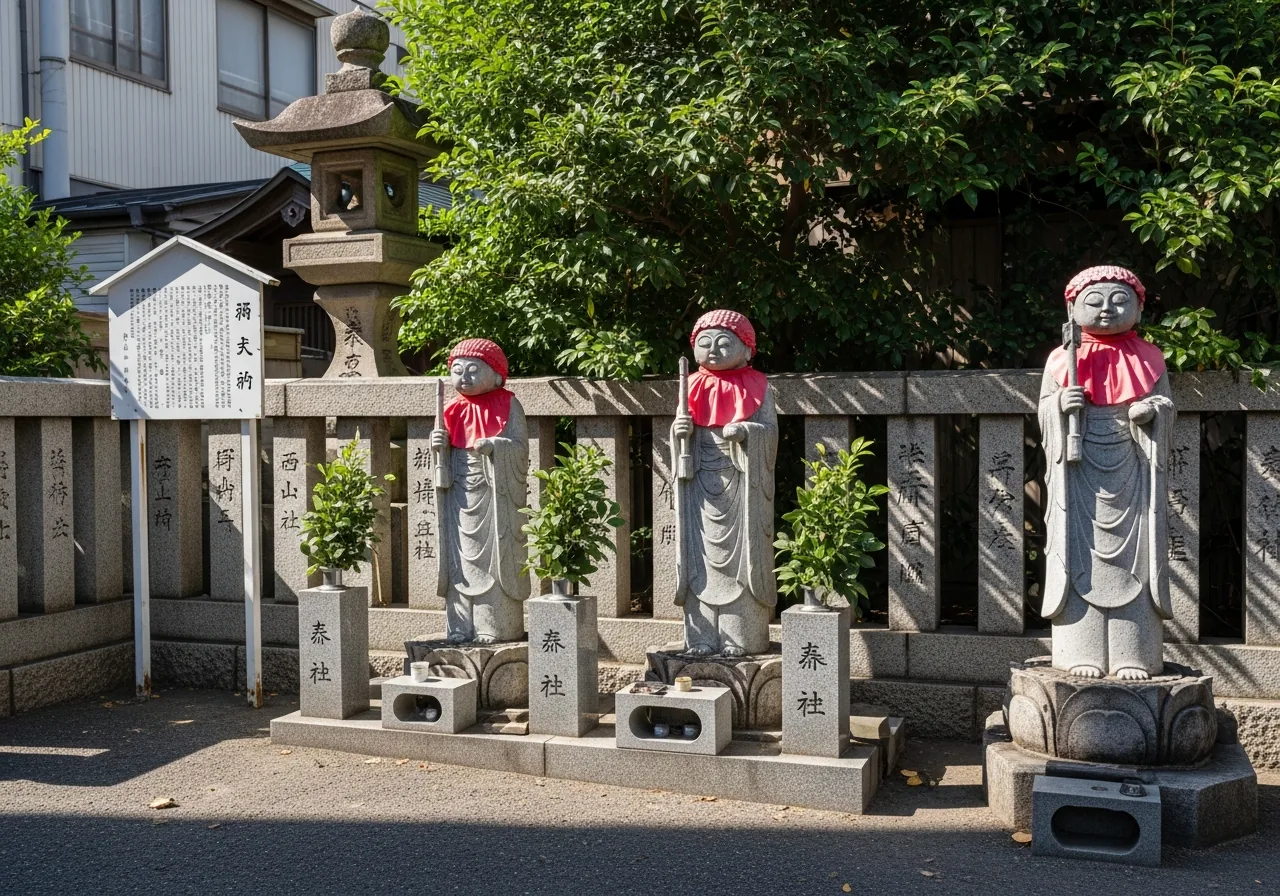
Stand at the corner of any old Osaka residential block in the last week of August and you will find it: a white tent, maybe three metres square, erected over a stone figure no taller than a child’s waist. The figure wears a fresh red bib and a knitted red cap.
Before it, someone has arranged mandarin oranges, rice crackers, and small bags of sweets. A string of red-and-white paper lanterns runs from the tent to the nearest telephone pole.
Inside the tent, a monk sits cross-legged, and around him, in a rough circle, children pass a rosary the diameter of a hula hoop, bead by bead, while he chants. The children are not solemn.
They are barely paying attention. They are thinking about the candy.
This is Jizo-bon. It is not a temple festival.
It is not a civic event. It is a neighbourhood ritual, organised by the cho-naikai — the local residents’ association — and it happens simultaneously in hundreds of locations across Osaka on the same two days each year.
No single venue, no single stage. Just the city’s own capillary network of stone guardians and the communities that have gathered around them for centuries.
To understand why this festival exists, why it is here and not in Tokyo, why it is organised the way it is, and why it is now fighting for its survival, you have to drill down through seven layers of history, theology, urban sociology, and demography. Each answer opens a trapdoor into a deeper one.
Why Does a Festival for Children Exist at All — and Why Is It Buddhist?
The first question is the most fundamental: why would a Buddhist bodhisattva become the patron of a children’s street party?
The answer begins in India, travels the Silk Road, and arrives in Japan during the Nara period (710–794). The belief in Jizo was introduced to Japan in around the eighth century, during the Nara period, and mentions of that early faith appear in a work of the period known as the Jūrinkyō (The 10-Rings Sutra).
The Sanskrit original, Ksitigarbha, translates roughly as “earth-womb” or “earth-treasury” — a bodhisattva who vowed to remain in the world of suffering until every being had been saved. Originally known as Ksitigarbha in Sanskrit, Jizo is venerated as the Bodhisattva of the Earth Treasury.
But the Jizo who arrived in Japan in the eighth century was not yet the children’s guardian we know today. Jizo scriptures were introduced to Japan during the Nara period, but it did not spread as a religious belief until the end of the Heian period (794–1185) with the development of Pure Land Buddhism, when fear of hell became stronger.
This is the crucial hinge. As Pure Land Buddhism spread through the aristocracy and then the common people, it brought with it a terrifying cosmology: those who died without sufficient merit — and children who died before their parents were considered especially vulnerable — faced punishment in hell.
In Japan since the Heian period, when the Pure Land Faith was widespread, people increasingly believed that the living things who could not be reborn in the Land of Bliss after death inevitably went to Hell, so that they had to hope from Jizo Bosatsu for relief from their suffering in Hell. The specific legend that crystallised Jizo’s role as children’s protector is the story of Sai-no-kawara — the riverbank of the dead, where children who died before their parents were condemned to stack stones as penance.
According to Japanese belief, when a child dies before their parents do, they are not able to cross the river to the afterlife and so time is spent making stone towers as an act of penance. Devils knock down these stone towers, and this is when O-Jizo-san appears to save them and look after them as a guardian in replacement of their parents.
This was not an abstract theological point in a society where child mortality was devastatingly high. In pre-modern Japan, losing a child before the age of five was not unusual; it was a statistical likelihood.
The emotional need for a protector who specifically guarded children — both the living and the dead — was acute. The popularity of Jizo grew during the Heian period (794–1185), as Japanese Buddhism incorporated elements of Esoteric Buddhism.
By the medieval period, Jizo had fused with an older, pre-Buddhist tradition: the dosojin, the wayside deity who protected travellers and village boundaries. It has been syncretized with Doso-shin, the traveler’s guardian deity, so that many stone statues were enshrined by the roadsides throughout Japan.
This syncretism explains the physical form of Jizo as we encounter him in Osaka today: a small stone figure at a crossroads or lane-end, dressed in a red bib, presiding over the boundary between one neighbourhood and the next. He is simultaneously Buddhist bodhisattva and ancient village guardian. The festival that grew up around him carries both identities at once.
Why Here? Why Kansai and Not the Rest of Japan?
Jizo statues exist all over Japan. So why is Jizo-bon a Kansai phenomenon, almost unknown in Tokyo and the Kanto region?
Jizo-bon is a custom celebrated all over Japan, but it is especially popular in the Kinki region, such as Shiga, Kyoto, and Osaka Prefecture. The geographic concentration is striking and demands explanation.
While Jizo-bon is very common in the Kansai region, it is all but unheard of in the Kanto region. Even within Osaka itself, the distribution is not uniform: in Osaka, Jizo-bon is a matter of course, but it is not held in the Kita-Setsu area, and is mainly held south of the Yodogawa River, in Osaka City and its surrounding areas.
The answer lies in urban history. Kyoto was the imperial capital and the origin point of the festival; Osaka was its commercial twin, connected to Kyoto by the Yodo River and by centuries of merchant traffic. The two cities shared a Buddhist institutional culture, a system of self-governing town blocks (cho), and a dense network of neighbourhood Jizo shrines that did not develop in the same way in Edo (Tokyo), where the Tokugawa shogunate’s administrative structure was different and where the dominant religious culture was shaped by different sects and different local traditions.
The teaching that arrived from India via the Silk Road in the Nara period was translated into Japanese as “Jizo,” and the figure of the bodhisattva who saves all beings in the six realms of existence — including children — spread from Kyoto into the Kinai region during the Muromachi period. The Muromachi period (1336–1573) is the key moment: this is when Jizo worship became a popular, street-level phenomenon rather than an elite temple practice, and it spread outward from Kyoto along the commercial and religious networks that connected the Kinai cities. Osaka, as the commercial hub of western Japan, was saturated with these networks.
The cho system also matters enormously. Osaka’s merchant quarters were organised into self-governing neighbourhood units, each responsible for their own streets, their own fire prevention, their own festivals.
Each cho had at least one Jizo statue, often more. The festival was not organised by a temple or a government; it was organised by the cho itself.
This hyper-local structure meant that Jizo-bon was embedded in the fabric of urban governance in a way that made it extremely durable — and also extremely variable from one block to the next.
Why Did the Festival Take the Form It Did? The Edo-Period Evidence
The earliest clear documentary evidence for Jizo-bon as a children’s festival in the Kansai region comes from the seventeenth century. The current name “Jizo-bon” came into use after the Meiji period; before that, in Edo-period records, it appears under the names “Jizo-matsuri” (Jizo Festival) or “Jizo-e” (Jizo Assembly). The early Edo-period record of Kyoto’s annual customs, the Hinami Kiji (1676), contains the phrase “the children of the city perform the Jizo festival.”
For Osaka specifically, the crucial source is the Naniwa Kagami — a record of the annual customs of Edo-period Osaka. The Naniwa Kagami, which explains the annual customs of Edo-period Osaka, depicts the scene of the Jizo festival, showing children and women carrying babies on their backs paying their respects before offerings placed in front of the Jizo statue.
This image — children at the centre, adults in attendance — is already the template for the modern festival. The prototype of Jizo-bon as a children’s event was already established in Osaka by the early eighteenth century at the latest.
The novelist Kyokutei Bakin, travelling between Kyoto and Osaka in 1803, left a vivid account in his travel diary Kitabi Manroku. In the Kitabi Manroku (1803), Bakin writes that in the towns of Kyoto there were Jizo festivals, with the Jizo enshrined and various offerings displayed, and people drinking sake through the night before the Buddhist image.
The all-night drinking and feasting that Bakin describes is notably adult — this was not yet the purely children’s event it would become. The transformation toward a child-centred festival happened gradually through the nineteenth century and accelerated in the Meiji period, when the name “Jizo-bon” itself became standardised.
What drove this child-centring? Partly theology — Jizo’s role as children’s guardian was always the dominant popular understanding.
Partly urban sociology — as Osaka’s merchant quarters became denser and more prosperous, the cho had more resources to devote to children’s entertainment. And partly the logic of the festival calendar: Jizo-bon falls at the very end of summer, just before the new school term, making it naturally a children’s event in the same way that Halloween in the West has become naturally a children’s event through its position in the calendar.
Jizo-bon is a festival held on weekends close to the 24th of August (the 24th of July according to the lunar calendar), the commemorative day of Jizo Bosatsu. The date is the ennichi — the sacred day — of Jizo Bosatsu, which falls on the 24th of each month in the lunar calendar.
The July 24th ennichi, falling within the Obon season, was the one that accumulated the most ritual weight. When Japan adopted the Gregorian calendar in 1873, some regions shifted Obon to July 13–16 (the “new Obon”), while others kept the lunar calendar equivalent, which now falls around August 13–16.
Jizo-bon followed the same logic, settling on August 23–24 as its standard dates in most of Kansai.
Why Does the Festival Look the Way It Does? The Ritual Architecture
Walk up to a Jizo-bon in Osaka in late August and you encounter a specific, legible ritual sequence. Understanding each element reveals a different layer of the festival’s history.
The first act is the preparation of the statue itself. The Jizo statue is cleaned and given a new red bib; the shrine or small hall is decorated with red-and-white lanterns, offerings are placed before it, and children gather.
The red bib — yodarekake — is the most visually distinctive element. Red is the colour of protection against evil in Japanese folk belief, and the bib echoes the clothing of small children.
Dressing the Jizo in a child’s garment is a form of sympathetic magic: the deity who protects children is himself dressed as a child, collapsing the distance between protector and protected.
In some areas of Kyoto, the preparation goes further: some people paint the face of Jizo in colours (keshō Jizo) and give him new red bibs or coats. In Osaka, the decoration tends to be less elaborate than in Kyoto, but the lanterns are often more numerous — a reflection of Osaka’s merchant culture, which has always expressed devotion through abundance rather than refinement.
The central ritual of the morning is the juzu-mawashi — the passing of the rosary. In some areas, ‘Juzumawashi’ is held in the morning of the day of Jizo-bon.
Children in the town sit around a big bead roll of two to three metres long, and they move the bead roll as the monk reads a sutra. The rosary used in this ceremony is not a personal prayer bead but a communal object, sometimes two or three metres in circumference, passed hand to hand around a circle of children and adults while a monk chants.
The beads vary in number, with 108 beads as a kind of standard, which bears wide symbolic significance in Buddhism. The number 108 represents the earthly passions and delusions that trap beings in the cycle of suffering — by passing the beads, the community symbolically moves through and beyond those delusions together.
The juzu-mawashi is the moment when the festival is most explicitly Buddhist, most explicitly communal, and most explicitly intergenerational. Children who cannot yet read the sutra still participate by passing the beads.
Elderly residents who can no longer kneel on the ground still participate by holding the beads as they pass. The circle is the festival’s most important shape.
After the sutra and the rosary, the festival pivots to children’s entertainment. Although the specific activities vary by neighbourhood, they typically include Buddhist monks reading sutras and giving sermons, juzu-mawashi, children’s games and raffles, and Bon Odori (a type of folk dance).
In Osaka, the entertainment often includes yo-yo tsuri (fishing for water balloons), ring-toss, puppet shows, and bingo. In some areas, as dusk falls, children’s stalls for yo-yo fishing and ring-toss appear, and puppet shows, juzu-mawashi, and bon odori are performed, wrapping the event in the heat of a summer festival.
The climax of the festival, for the children, is the distribution of osagari — the offerings that have been placed before the Jizo statue and are then given to the children as blessed food. In traditional Jizo-bon, the standard offerings were red-and-white rice cakes and rakugan (pressed sugar sweets), but in the latter half of the Showa period, assorted cheap sweets became popular and eventually became the standard.
This shift from traditional wagashi to dagashi (cheap sweets) is a small but telling index of how the festival has adapted to each generation’s childhood culture. The ritual logic remains the same — the deity’s blessing is transmitted through food — but the food itself changes with the times.
Why Osaka Specifically? The Shussejizo and the Merchant City’s Relationship with Jizo
Osaka’s relationship with Jizo has its own particular flavour, shaped by the city’s identity as a merchant capital. The most striking example is the Shussejizo — the “Career-Advancement Jizo” — in the Dotonbori district of Chuo Ward.
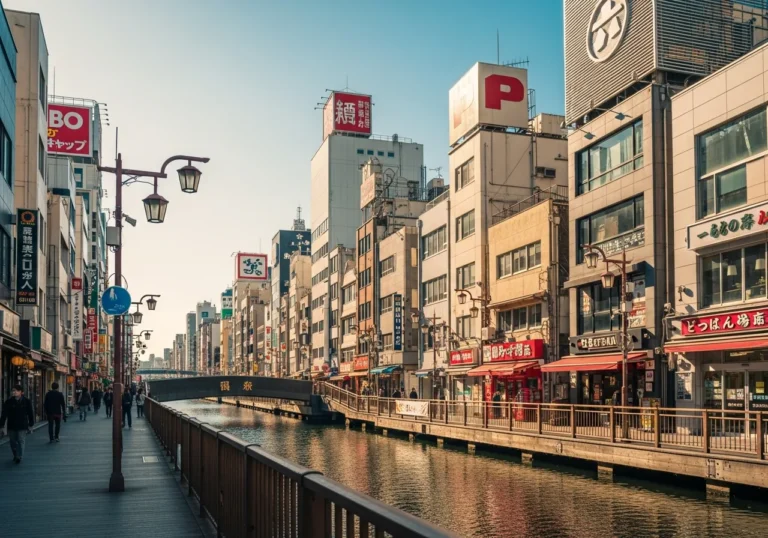
The area west of Midosuji, near present-day Dotonbori 2-chome, was known as Kuro-emon-cho and flourished as an entertainment district from the Edo period. The Jizo enshrined there from ancient times was called “Shussejizo” because geisha and actors came to pray for career advancement. The statue disappeared during the Osaka air raids but was discovered underground a few years after the war ended and is now enshrined at its current location.
This story encapsulates something essential about Osaka’s Jizo culture. In Kyoto, Jizo is primarily a children’s guardian and a neighbourhood deity.
In Osaka, Jizo acquired an additional layer of meaning: a patron of professional ambition, of the merchant and performer classes who built the city’s culture. The Shussejizo was prayed to by geiko and kabuki actors seeking success — a thoroughly Osaka conflation of the sacred and the commercial.
The Osaka air raids of March 1945 destroyed vast swathes of the city, and many Jizo statues were lost or damaged. The fact that the Shussejizo was found buried in the earth and reinstated after the war is itself a kind of parable: the city’s relationship with its neighbourhood deities survived even the firestorm.
Every year, a Jizo-bon festival is held there to pray for the healthy growth of the local children. The Shussejizo Jizo-bon is one of the most accessible for visitors, held in the heart of the tourist district yet entirely organised by and for the local community.
More broadly, Osaka has many neighbourhood-association-owned and privately-owned Jizo statues, and the festival is conducted as a neighbourhood-association event in many areas. This is the key structural difference between Osaka and Kyoto.
In Kyoto, Jizo-bon tends to be organised around temple-affiliated statues, with the temple providing institutional continuity. In Osaka, the statues are often owned by the cho-naikai or even by individual families, which makes the festival more vulnerable to demographic change — but also more deeply embedded in the texture of everyday life.
Why Does Jizo-bon Happen When It Does? The Calendar Logic of Late August
The timing of Jizo-bon is not arbitrary. It sits at a precise and meaningful point in the Japanese ritual calendar, and understanding that position explains much of the festival’s emotional power.
Obon — the festival of the dead, when ancestors’ spirits return to the world of the living — runs from August 13 to 16 in most of Kansai. Obon is one of Japan’s most important festivals, celebrated over three days in mid-August.
During this time, Japanese people pay respect to their ancestors and loved ones who have passed away through many beautiful ceremonies. Jizo-bon follows Obon by approximately ten days.
This is not coincidental.
The logic runs as follows: Obon is the festival of the adult dead — ancestors, parents, grandparents. Jizo-bon is the festival of the child dead — those who died before their parents, who cannot cross the river to the afterlife without Jizo’s help.
The two festivals together constitute a complete ritual accounting of the dead: first the ancestors, then the children. Because they are so near to the Obon period, the dates of August 23rd and 24th are known as Jizo-bon.
During Jizo-bon, local communities clean and replace the bibs of the neighbourhood’s Jizo statues.
But Jizo-bon is also positioned at the end of the school summer holiday. In Japan, the summer holiday runs from late July to early September, and Jizo-bon falls in its final days.
At the end of late August, the wind blowing at dusk begins to carry the scent of autumn. Jizo-bon is the last memory of summer vacation for children, and for adults it is a place to confirm the bonds of the community.
This dual positioning — end of the holiday, end of the ritual summer — gives Jizo-bon its particular emotional register: festive but tinged with melancholy, celebratory but aware of endings.
The novelist Wataaya Risa, a Kyoto native, captured this precisely in her fiction: the moment a character realises that Jizo-bon is not a national festival but a Kansai-specific one is described as a shock of identity, a discovery that something she assumed was universal is in fact particular to where she grew up. That shock of particularity is exactly what makes Jizo-bon interesting to the outside observer.
Why Did the Festival Survive Modernity — and Why Is It Now Under Threat?
Jizo-bon survived the Meiji modernisation, the Second World War, and the postwar economic miracle. It is now facing a threat that those earlier upheavals did not pose: the disappearance of children from Osaka’s inner-city neighbourhoods.
The festival’s survival through the twentieth century was not guaranteed. The Meiji government’s separation of Buddhism and Shinto (shinbutsu bunri) in 1868 disrupted many Buddhist folk practices, and the name change from “Jizo-matsuri” to “Jizo-bon” in the Meiji period reflects a subtle repositioning of the festival as a community event rather than a purely religious one.
The postwar American occupation brought further pressure on Buddhist institutions. Yet Jizo-bon survived both, precisely because it was organised not by temples but by neighbourhood associations.
It had no institutional superstructure to dismantle.
The postwar economic boom brought a different kind of pressure: urbanisation and the breakup of traditional neighbourhood structures. In recent years, as lifestyles have shifted from detached houses to apartment living, Jizo statues that used to be found throughout the town have been removed, or only the shrine remains, unmanaged. Neighbourhood association activities are also shrinking, and opportunities for adults and children to naturally mingle have decreased, making it harder to sustain town-wide events like Jizo-bon.
The demographic crisis is the deepest threat. The festival “Jizo-bon,” which prays for the happiness and growth of children, is now in a situation where the number of children participating in Jizo-bon is decreasing due to the declining birthrate.
Some older ladies noted that the festival used to last for two days when there were more children in the neighbourhood. Many communities have already shortened the festival from two days to one.
Some have abandoned it entirely.
In Japan, promoting the long-term settlement of child-rearing households is critical to counteract community decline driven by a falling birthrate and an aging population. Osaka is not exempt from this national trend.
The 2015 census showed Osaka’s first population decline in almost seven decades. The declines have been attributed to historically low fertility rates and deaths that have outnumbered births.
In the inner-city wards where Jizo-bon is most deeply rooted — Naniwa-ku, Nishi-ku, Tennoji-ku — the proportion of children in the population has been falling for decades.
The response has been varied. Many neighbourhoods are at a crossroads between stopping and continuing, while there is also a movement to re-evaluate Jizo-bon as a mechanism for maintaining local community.
Even if a full revival is difficult, the value of continuing on a smaller scale is being reconsidered. Some communities have invited children from outside the immediate neighbourhood.
Others have merged with adjacent cho to pool resources. A few have reframed the festival as a cultural heritage event, inviting schools and kindergartens to participate.
The tension is real and unresolved. A Jizo-bon without children is a contradiction in terms — the festival exists to pray for children’s health and to give children a community experience.
But a Jizo-bon that imports children from outside the neighbourhood is no longer quite the same thing either. The festival is being asked to adapt to a world it was not designed for.
Why the Discerning Traveller Should Care: What Jizo-bon Reveals About Japan That Nothing Else Does
There is a category of travel experience that no amount of money can buy at a museum or a heritage site: the experience of being present at a living ritual that is not performed for you. Jizo-bon is that experience.
Most of what tourists encounter in Japan is either a major national festival (Gion Matsuri, Tenjin Matsuri) scaled for spectators, or a temple or shrine visit that is essentially architectural tourism. Jizo-bon is neither.
It is a neighbourhood event that happens to be occurring in public space, organised by people who live there, for children who live there. A visitor who stumbles upon it — or who knows to look for it — is not a spectator but an accidental witness to something private made temporarily public.
What Jizo-bon reveals, more clearly than almost any other Japanese cultural practice, is the structure of the cho — the neighbourhood unit that has been the basic cell of urban life in Osaka since the Edo period. The cho is not a legal entity in the way a municipality is; it is a social one, maintained by voluntary participation, by the shared ownership of a Jizo statue, by the collective memory of who organised last year’s festival and who will organise next year’s. Jizo-bon is the annual moment when that social structure becomes visible.
It also reveals something about Japanese Buddhism that temple visits do not. Temple Buddhism in Japan is often experienced by visitors as aesthetic — beautiful architecture, incense, raked gravel.
Jizo-bon is Buddhism as social practice: a monk chanting sutras while children pass a rosary and think about candy, the sacred and the mundane in the same tent, the same circle. These events pay tribute to the Jizo statues enshrined in local neighbourhoods as a way of expressing gratitude while also praying for community safety and the healthy growth of children.
The gratitude is real, the prayer is real, and so is the candy.
For the affluent traveller who has already seen the major temples and the major festivals, Jizo-bon offers something rarer: a glimpse of the city as it is when it is not performing for anyone. The lanterns are not lit for you.
The monk is not chanting for you. The children are not dressed up for you.
You are simply there, in late August, in a back lane of Osaka, watching a city maintain its relationship with its own past.
There is also a melancholy dimension that rewards reflection. Jizo-bon is a festival that may not survive another generation in many of the neighbourhoods where it currently takes place.
The demographic forces working against it are structural and severe. To witness it now, in 2026, is to witness something that is genuinely at risk — not in the performative sense of “endangered culture” that tourism boards use to sell experiences, but in the straightforward sense that the children who would carry it forward are not being born in sufficient numbers in the neighbourhoods where it lives.
That is a fact about Japan’s present, not just its past. And it is a fact that no guidebook, no museum, and no heritage site can show you as clearly as standing in a Osaka back lane in August, watching a circle of children pass a rosary that is two metres in circumference, while a monk chants and someone’s grandmother arranges mandarin oranges on a folding table in front of a stone figure wearing a red bib.
How to Find Jizo-bon in Osaka: A Practical Note
Jizo-bon is not listed in most tourist guides because it has no single venue, no ticket, and no fixed programme. It happens simultaneously across hundreds of locations in Osaka on or around August 23–24 each year.
Currently in some areas the day of the fair is changed to Saturday or Sunday to suit people’s needs who work on weekdays. In practice, this means the festival may fall on the weekend nearest to August 23–24 in any given year.
The best strategy is simply to walk the older residential wards of Osaka — Naniwa-ku, Tennoji-ku, Nishi-ku, the older parts of Sumiyoshi-ku — in the late afternoon of the relevant weekend. Look for white tents, red-and-white lanterns, and the smell of incense. The Shussejizo in Dotonbori (Chuo-ku) is one of the most accessible locations for visitors, as it sits within the tourist district and its Jizo-bon is well-maintained by the local community.
Behaviour at Jizo-bon is simple: approach quietly, observe the ritual from a respectful distance, and do not photograph children without permission. If the neighbourhood association invites you to participate in the juzu-mawashi or offers you osagari sweets, accept gracefully.
You are a guest in someone’s neighbourhood, at someone’s festival, in front of someone’s stone guardian. Act accordingly.
FAQ
Q: When exactly is Jizo-bon in Osaka in 2026?
A: The traditional dates are August 23–24. In 2026, August 23 falls on a Sunday, so most neighbourhoods will hold their festival on that day, with some extending to Saturday August 22 or Monday August 24. Confirm with local neighbourhood associations or check local community boards when you arrive.
Q: Is Jizo-bon open to visitors?
A: Yes, in the sense that it takes place in public space and no one will turn you away. It is not, however, a tourist event — it is a neighbourhood ritual. Approach as a respectful observer, not as a spectator at a performance.
Q: What is juzu-mawashi?
A: The central ritual of Jizo-bon, in which children and adults sit in a circle and pass a very large rosary — sometimes two to three metres in circumference — from hand to hand while a Buddhist monk chants sutras. It is the moment when the festival is most explicitly religious and most explicitly communal.
Q: Why don’t they celebrate Jizo-bon in Tokyo?
A: Jizo worship exists throughout Japan, but the organised neighbourhood festival of Jizo-bon developed specifically in the Kansai region, rooted in Kyoto’s urban structure and spreading to Osaka and the surrounding cities. The Kanto region developed different neighbourhood religious practices under different historical conditions.
Q: Is Jizo-bon dying out?
A: In some neighbourhoods, yes. The declining number of children in Osaka’s inner-city wards, combined with the weakening of neighbourhood association structures, has led many communities to shorten or abandon the festival.
In others, it continues robustly. The situation varies block by block.
Q: What should I bring or wear?
A: No special clothing is required. A light summer outfit is appropriate for the August heat.
If you wish to make an offering at the Jizo shrine, a small amount of cash (a few hundred yen) placed in the offering box is appropriate. Do not bring alcohol or food unless invited to share.
Jizo-bon (Shussejizo, Dotonbori) — Visitor Information
Address: Dotonbori 2-chome, Chuo-ku, Osaka 542-0071 / 大阪府大阪市中央区道頓堀2丁目
Nearest station: Namba Station (Osaka Metro Midosuji / Sennichimae / Yotsubashi lines) — approx. 5 min. walk
Hours: Jizo-bon is held on or around August 23–24 each year (check locally for exact dates and times; typically afternoon through evening)
Admission: Free — this is a neighbourhood community event held in public space
Official site: ittoko-minami.net