Every November, over a thousand costumed participants march through the ruins of Naniwa-no-Miya Palace in central Osaka, chanting wasso — a Korean word meaning “they have come” — to re-enact the diplomatic missions that Korean and Chinese envoys made to ancient Japan from the 6th century onward. The festival is not ancient: it was invented in 1990 by Osaka’s Korean-Japanese community, nearly collapsed when its founding sponsor, the Kansai Kogin credit union, went insolvent in 2001, and was resurrected in 2004 under an NPO that now draws presidential messages from Seoul and prime-ministerial greetings from Tokyo. Its survival, and the argument it makes about whose history Osaka actually is, matter far beyond the parade route.
Why we can tell you this — MICHI is written and edited in Osaka; our team can walk from the Naniwa-no-Miya Palace ruins to Shitennoji in under twenty minutes, and we have attended the festival in person. This piece draws on the official Wasso NPO’s own website (wasso.net), the Osaka City government’s historical overview, a J-STAGE academic paper on Korean festivals and Osaka’s cultural evolution, contemporaneous Kyodo News reporting on the Kansai Kogin collapse, and multiple temple and palace-site sources. Where the record is thin — particularly on the internal politics of the 2001–2004 hiatus — we say so rather than speculate.
Stand at the red-granite column bases of the Early Naniwa Palace on a grey November morning, before the crowds arrive, and the ground tells you something the city rarely advertises. Beneath the expressway that clips the park’s northern edge, beneath the convenience stores and the apartment towers, lies the footprint of a court that once received the most sophisticated diplomats in East Asia.
The ginkgo trees are turning gold. Somewhere behind you, a truck is reversing.
And in a few hours, a thousand people in silk and lacquered headgear will process across this same earth, chanting a Korean word, and the city will briefly remember what it was.
Why Does Osaka Have a Festival About Korean Envoys at All?
The short answer is geography. Naniwa was located at the mouth of the Yodo River, opening into Osaka Bay and the Seto Inland Sea — which in the 7th and 8th centuries meant direct maritime access to the advanced Korean kingdoms of Silla and Baekje, as well as Tang China. Naniwa was Japan’s gateway.
But geography alone does not explain a festival. To understand why Wasso exists, you have to understand what Osaka actually was before it became a merchant city, a castle town, or a modern metropolis.
Most visitors arrive knowing Osaka as the place that built Japan’s commercial culture. Very few know that it was also, briefly but consequentially, the place where Japan first opened itself to the world.
Relations with China and the Korean peninsula grew and Naniwazu port was developed as an entryway into ancient Japan for visitors from the Asian continent. Naniwazu served as a base for the arrival and departure of foreign envoys. Various cultures and technologies such as ceramics, forging, construction, engineering, and religion were brought in by the Chinese and Koreans, which then eventually spread all over Japan.
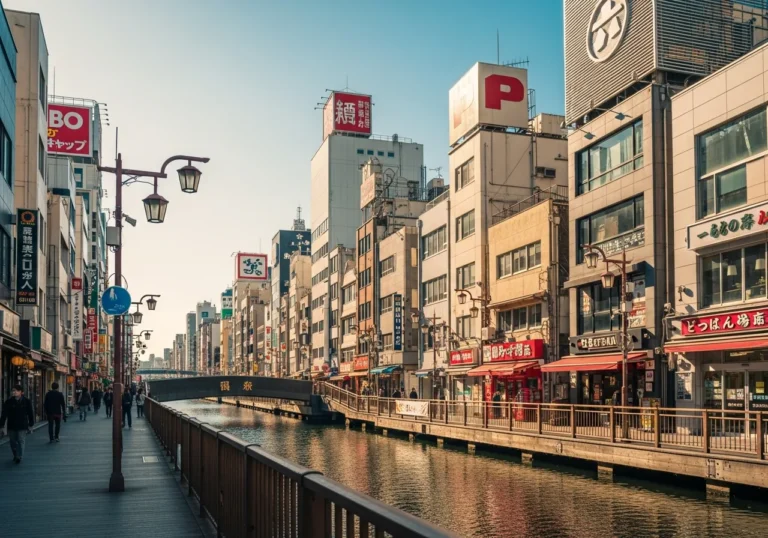
The city’s own official history acknowledges this plainly. Today there is a bridge in Osaka called Koraibashi, which is said to be named after a hall used for entertaining Korean envoys.
That bridge still carries traffic across the Higashi-Yokobori River in Chuo Ward. Most people crossing it have no idea they are walking over a name that is 1,400 years old.
Why Here? The Temple That Started Everything
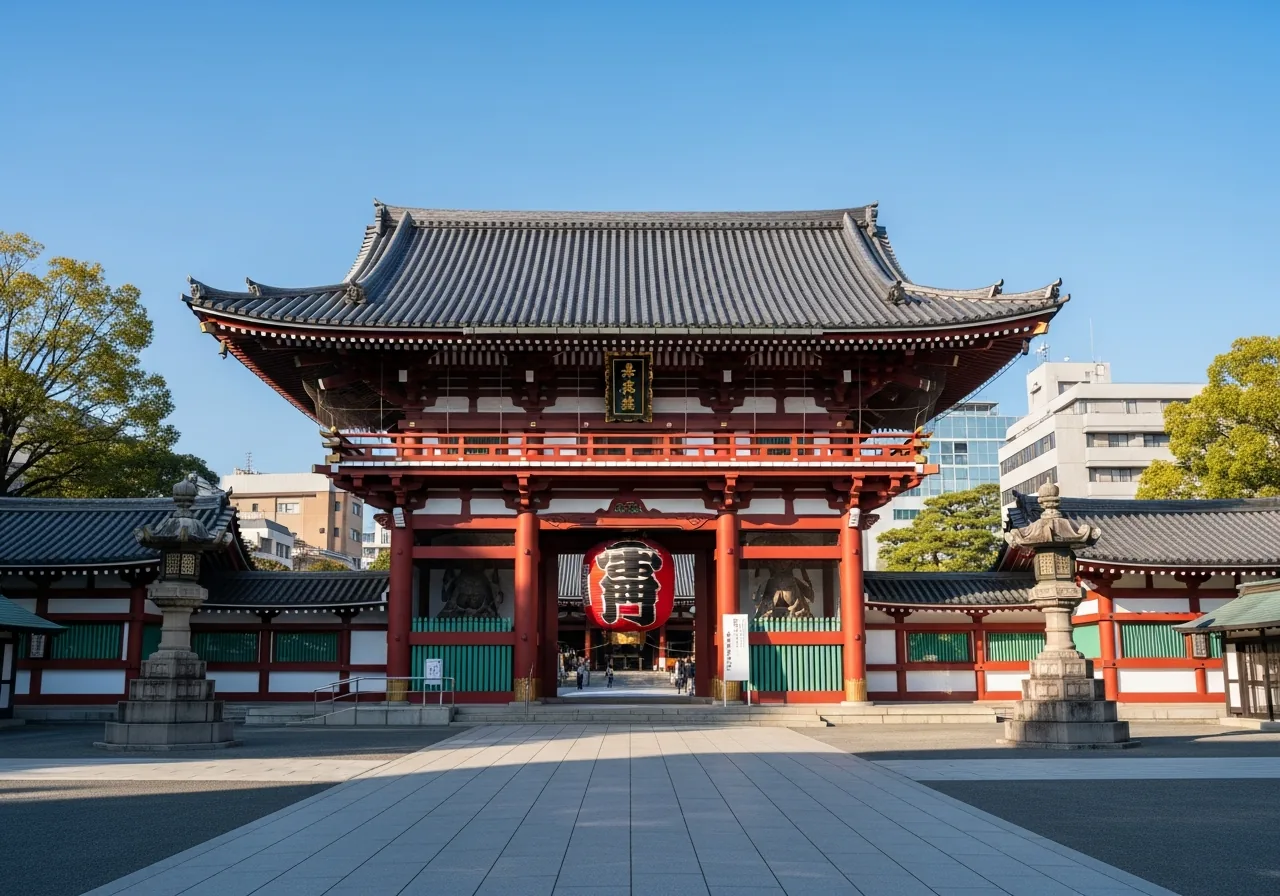
The physical anchor of Wasso is Shitennoji, and the story of the temple is inseparable from the story of Korean influence on early Japan. The temple was founded in 593 CE by Prince Shotoku, and is therefore the oldest state-sponsored temple in Japan. That founding date is not incidental — it coincides almost exactly with the moment Buddhism was being institutionalized as a state ideology, and the Korean peninsula was the conduit through which that ideology arrived.
According to the Nihon-shoki (Chronicles of Japan, circa 720, one of Japan’s oldest surviving documents), Prince Shotoku promised to build Shitennoji when he joined the forces of the Soga clan to overthrow the Mononobe clan. This was around 587.
Those opposed to the introduction of Buddhism were led by Mononobe no Moriya, whose forces fought against the Soga clan under the leadership of Soga no Umako, who battled to incorporate Buddhism as a political tool of state control. With the success of the Soga battle against Mononobe, Shitennoji Temple was founded in 593 by Prince Shotoku in Naniwa.
The temple, in other words, was a victory monument — and it was built by Korean hands. The area was central to one of the key cultural imports of the era, with Shitennoji in today’s Tennoji Ward being established in the late 6th century as Japan’s first officially commissioned Buddhist temple. Under the order of the regent Prince Shotoku, construction was even carried out by some of the area’s existing foreign residents: Korean carpenters from Baekje who went on to found Kongo Gumi, perhaps the world’s oldest continually operating company.
That last detail deserves to be held for a moment. A three-meter-long 17th-century scroll traces 40 generations of the Kongo family back to the company’s start in 578 AD, when Shigemitsu Kongo, a skilled carpenter, along with two other master craftsmen, were invited from Baekje in the Korean peninsula to build Japan’s first Buddhist temple at Shitenno-ji. Until its fall in 2006, it was the world’s oldest continuously operating family business, surviving 14 centuries of political upheavals, economic crises, and world wars.
The carpenter who built the temple that anchors Wasso came from Korea. He stayed.
His descendants maintained the building for over a millennium. The festival, when you trace it back far enough, is not commemorating a diplomatic visit — it is commemorating the moment a Korean immigrant decided not to go home.
Why Did Prince Shotoku Choose This Spot?
Under Shotoku, Buddhism became the state religion; scriptures, art, and craftsmen were brought in from Korea and Japanese monks were sent abroad to study. Temples were founded, monks were ordained, and ceremonies were held publicly.
The choice of Naniwa for the first great temple was strategic: this was the port where the Korean ships arrived. Building a temple here was a statement of intent — that Japan was open to the continent, and that the new faith would be its intellectual foundation.
One of the most remarkable aspects of the temple is its architectural layout, which reflects ancient Asuka period (593–710) temple design. The original layout, which has been faithfully preserved through successive reconstructions, includes a five-story pagoda, a main hall, a lecture hall, and a gate flanked by corridors that form a distinctive rectangular plan. This layout is known as the “Shitennoji style” and became a model for later Buddhist temple designs in Japan.
Influenced by Baekje, it has a one-pagoda, one-golden-hall layout with one five-story wooden pagoda and a golden hall. Unlike Horyuji, this arrangement in which all buildings are placed in a straight line is called Shitennoji style, and is presumed to be a typical Baekje temple layout. The architecture itself is a document of Korean influence, written in wood and stone — and rebuilt, faithfully, seven times over fourteen centuries.
Why Was Naniwa the Capital, and Why Does That Matter?
Shitennoji was built in 593. Fifty years later, the political logic of Naniwa’s location became so compelling that an emperor moved the entire court here.
The earlier palace, known as Naniwa Nagara-Toyosaki-no-Miya, was established in 645 by Emperor Kotoku. This was more than a mere court relocation; it was a revolutionary act.
It represented a decisive break from the powerful Soga clan, which had dominated politics for decades, and stood at the heart of the Taika Reforms. These reforms were a comprehensive set of policies inspired by the sophisticated bureaucratic systems of Tang Dynasty China.
Their aim was to centralize power under the emperor, create a nationalized land ownership system, and establish formal government institutions staffed by officials.
The Taika Reforms were, in essence, Japan’s attempt to become more like its continental neighbors — and Naniwa was chosen as the capital precisely because it faced those neighbors across the sea. It served as the port of entry for diplomatic missions, known as kentoshi (missions to Tang China) and kenshiragi-shi (missions to Silla). These missions brought back not only trade goods but transformative ideas in philosophy, law, art, architecture, and technology.
The palace that received those missions was enormous. The site of the Naniwa-no-Miya palace, which stood for about 150 years from the sixth to the eighth centuries, lies southwest of Osaka Castle. The remains of the complex were only discovered around 60 years ago, which is why Osaka is seldom thought of as an ancient capital when in fact it played as prominent a role as Kyoto and Nara in the nation’s early history.
That last sentence is the key to understanding why Wasso chose this location. The festival is held not at Shitennoji itself but at the Naniwa-no-Miya ruins — because, as the festival’s own organizers note, the palace is where travelers would arrive centuries ago.
The geography of the ceremony is historically precise: the envoys came by sea to Naniwazu port, were received at the palace, and were then escorted south to Shitennoji, which functioned as a kind of diplomatic guesthouse for the court. The parade route re-enacts that journey.
What Did the Envoys Actually Bring?
The question beneath the pageantry is: what, exactly, was being exchanged? The answer is almost everything that defines early Japanese civilization.
Naniwazu served as a base for the arrival and departure of foreign envoys. Various cultures and technologies such as ceramics, forging, construction, engineering, and religion were brought in by the Chinese and Koreans, which then eventually spread all over Japan.
Buddhism was the most visible import, but it was not the only one. The legal codes that structured the Taika state were modeled on Tang Chinese law.
The writing system was Chinese. The palace architecture — the symmetrical north-south axis, the tiled roofs, the vermilion pillars — was continental.
The layout of Naniwa Palace, symmetrical along a north-south axis, was a clear adoption of Chinese capital design. Japan in the 7th century was not merely trading with its neighbors; it was consciously reconstructing itself in their image.
The Korean kingdoms, particularly Baekje and Silla, were the intermediaries for much of this transmission. The sending of envoys to Japan to establish formal relations and promote religious missions, the exchange of cultural artifacts such as artworks, incense, and ceremonial objects, and collaborative efforts in religious and technological developments, notably in Buddhism and metallurgy — all of this flowed through Naniwa. The city was not just a port; it was a transformer, converting continental knowledge into Japanese practice.
Why Did the Festival Nearly Die — Twice?
Wasso was born in 1990, and its origins are as politically charged as its subject matter. The festival was created in 1990 with the purpose of helping future generations of young people and children learn and inherit a correct understanding of history.
That phrase — “correct understanding of history” — is doing a great deal of work. In the context of Japan in 1990, it was a pointed statement: that the Korean contribution to Japanese civilization had been systematically minimized, and that a community-organized festival in Osaka was going to push back against that erasure.
The founding sponsor was the Kansai Kogin credit union, a financial institution that primarily served Korean residents in Japan. For a decade, the festival ran along Tanimachi-suji, the broad avenue that connects Shitennoji to the palace ruins, drawing large crowds and considerable attention.
Then, in 2001, the sponsor collapsed. Kansai Kogin was to shoulder three-fourths of the 200 million yen cost of the Shitennoji Wasso festival.
The chances of holding it diminished after the union, which mainly served Korean residents in Japan, was declared insolvent.
The festival went dark. For three years, there was no Wasso. The question was whether it would ever return — and whether, if it did, it could survive without the financial backing of the Korean-Japanese community’s own institutions.
The answer came from an unexpected direction. The festival was restored with the support of many Japanese companies and the citizens of Osaka.
It was revived as a new festival in Osaka. The revival was not simply a rescue operation; it was a reinvention.
Key cultural figures and companies in Osaka raised their voice and showed support for the Shitennoji Wasso festival. They wanted Osaka to become more multicultural and end festivals only dedicated to the people of the city.
This led to the creation of the NPO Osaka Wasso Cultural Exchange Association in 2003 — a group of volunteers to run the festival and an education system on spreading cultural awareness.
From 2004 onward, Wasso was no longer a Korean-Japanese community event that Japanese people attended. It was an Osaka civic event, organized by an NPO rooted in the Kansai business community, that happened to be about Korean history.
The distinction matters enormously. It meant the festival could no longer be dismissed as ethnic special pleading; it had been claimed by the city itself.
Why Does the Word “Wasso” Matter?
The name of the festival is a small linguistic argument. The word “Wasso” is a Korean word, which translates to “come” in English. More precisely, it means “they have come” — the announcement of arrival, the cry that would have gone up on the Naniwazu waterfront when a Korean ship was sighted rounding the headland.
But there is a second etymology that the festival’s organizers have long promoted. Wasso means “it has come” in Korean and is said to be the origin of the Japanese chant “wasshoi” heard when revelers carry portable shrines in Japanese traditional festival processions.
This claim — that the most ubiquitous sound of a Japanese matsuri is a Korean word — is contested by linguists, and we report it as a claim rather than a fact. But the claim itself is the point: the festival is arguing that the boundary between “Japanese” and “Korean” culture is far more porous than nationalist narratives on either side would prefer.
The parade makes this argument visually. The procession features participants representing people who came to Japan from East Asian countries from ancient to medieval times, and the exchange ceremony with Japanese historical figures who came to greet them. The kingdoms represented span centuries and geography: Tamna, Gaya, Baekje, Goguryeo, Silla, the Joseon dynasty — over a thousand participants in historically researched costumes, pulling boat-shaped floats, moving to Korean traditional music, chanting the word that names the whole event.
Prince Shotoku himself appears in the procession — played, in recent years, by prominent Kansai figures — to receive the envoys. The ceremony includes the ryōdan-saibai, the most formal greeting of the ancient court, and the presentation of shōraimono: the “things brought from afar,” the cultural gifts that the envoys carried. It is a re-enactment of a diplomatic protocol that has not been practiced for over a thousand years, performed on the ruins of the palace where it actually happened.
Why Does the Korean Community’s Presence in Osaka Give This Festival Its Depth?
Wasso is not only about ancient history. It is also about the people who organized it — and their own history in this city is as layered as the palace ruins beneath their feet.
Following Japan’s defeat in World War II in 1945, a significant portion of the approximately 2 million Koreans residing in Japan chose to remain despite repatriation efforts, with many concentrating in Osaka’s Ikuno Ward (historically known as Ikaino) due to pre-existing settlement networks from colonial-era labor migration. This period saw the Korean population in the Ikaino–Ikuno area burgeon to around 40,000 nationals, forming a dense ethnic enclave amid Japan’s economic reconstruction.
Today, about 20% of Ikuno Ward’s population reportedly has Korean citizenship, but the number is likely underestimated, and many others with Japanese citizenship are wholly or partially ethnic Korean. The area is recognized as the largest Korean community in Japan, extending into neighboring Higashinari Ward. Many residents are descendants of Koreans who migrated to Japan during its annexation of Korea from 1910 until the end of World War II in 1945.
Ikuno Ward is about four kilometers from the Naniwa-no-Miya ruins. The community that organized Wasso in 1990 was not importing a foreign festival into Osaka; it was asserting a claim to a city where its members had lived, worked, and been marginalized for generations. The festival’s argument — that Korean people have been coming to Osaka for 1,400 years, that their presence is not an anomaly but a continuity — is both historical and personal.
This is why the 2001 collapse was so devastating, and why the 2004 revival was so significant. When Japanese companies and civic organizations stepped in to save Wasso, they were not just rescuing a colorful parade. They were endorsing the argument the festival makes: that Osaka’s identity is inseparable from its Korean history, ancient and modern alike.
Why Did the Festival Move to the Palace Ruins?
The original Wasso ran along Tanimachi-suji, the broad north-south avenue that connects Shitennoji to the palace district. After the revival, the event shifted its main venue to the Naniwa-no-Miya ruins park. The reasons are both practical and symbolic.
Practically, the park provides an open space large enough for a thousand-person procession, food stalls, and stage performances without requiring road closures across a major arterial. Symbolically, the shift was a statement of historical precision.
The chant “wasso” is used to remember all those who have come to Japan from across Asia. The outfits are accurate reconstructions, and the event is held at Naniwa no Miya, as this is where people would have landed when they arrived, back in the day.
The ruins themselves are a remarkable place to hold any event. The approximately 90,000 square meter area believed to be the center of the palace complex has been designated a national historic site.
The Late Naniwa Palace, constructed beginning in 726, is elevated above ground level and marked with a stone platform. The Early Naniwa Palace, constructed beginning in 650, is marked with a lower level, paved with red tiles, with red granite indicating the position of pillars, and surrounded by a camellia hedge.
Two layers of palace, two eras of Japanese history, visible simultaneously in the same park. The Wasso procession moves through both. It is, in its way, a piece of site-specific theater that no purpose-built festival ground could replicate.
The Osaka Museum of History as Context
Adjacent to the ruins stands the Osaka Museum of History, which opened in 2001 — the same year Wasso went dark — and which provides the intellectual scaffolding for everything the festival enacts. The museum traces the history of Osaka from its beginnings as Naniwa-no-miya, through the middle ages and early-modern period when it was known as the “city of waterways,” to the 1920s and 1930s, when the metropolis was a preeminent commercial and manufacturing center.
Few people know that Osaka was also an ancient capital, predating even Kyoto. The name Naniwa itself, although written with different characters over the ages, has always been associated with the city’s role as a center of waterborne trade.
The museum’s tenth floor reconstructs the Daigokuden — the great audience hall — at full scale, with vermilion pillars 70 centimeters in diameter. Standing inside it, looking out over the ruins of the actual palace, you understand what the Wasso procession is walking toward: not a park, but a throne room.
Why Should a Discerning Traveler Care?
There is a version of this festival that a certain kind of traveler will dismiss: a modern pageant, invented in 1990, organized by an NPO, featuring K-pop performances alongside historical re-enactments. That traveler would be making a category error.
Every festival is invented. The question is what it is invented to do.
Wasso was invented to make a historical argument in public space — to insist, year after year, that the story of Osaka cannot be told without Korea, and that the story of Korea in Osaka cannot begin in 1910. That argument is not sentimental; it is documented in the archaeology beneath your feet, in the temple whose layout was designed in Baekje, in the bridge whose name preserves the memory of a Korean envoy’s guesthouse.
For the traveler who wants to understand Japan rather than merely photograph it, Wasso offers something rare: a festival that is genuinely about something. The thematic focus is on what we can learn from ancient exchanges, referring to cross-pollination and knowledge-sharing in East Asia. That is not marketing language; it is a precise description of what the 7th century actually was — a period of such intense cultural transfer that the Japan which emerged from it was almost unrecognizable compared to the Japan that entered it.
The festival also offers a corrective to the way Japan is often presented to foreign visitors: as a culture of extraordinary internal coherence, developed in relative isolation. The ruins at Naniwa-no-Miya, the architecture of Shitennoji, the name of Koraibashi bridge, and the chant of a thousand costumed marchers all say the same thing: Japan was never isolated. It was always, from its very beginning as a unified state, a place where the world arrived by ship and was received, argued with, learned from, and eventually absorbed.
The 2024 festival drew messages from both the South Korean president and the Japanese prime minister — a detail that speaks to how seriously the event is now taken at the highest diplomatic levels. In a region where historical grievances between Japan and Korea remain politically live, a festival that insists on 1,400 years of mutual exchange rather than 35 years of colonial occupation is doing real diplomatic work, not just historical pageantry.
And then there is the purely sensory argument. The highlight is a grand procession featuring approximately 1,000 participants wearing historically accurate ancient costumes.
The boat-shaped floats, the Korean court music, the silk robes in the colors of Baekje and Silla, the autumn ginkgos turning gold above the red-granite column bases — it is, by any measure, one of the most visually extraordinary events in the Kansai calendar. The fact that it is also intellectually serious is not a contradiction; it is the point.
Why Does This Festival Survive When So Many Others Fade?
The question of survival is worth asking directly. Wasso nearly died once, and the conditions that nearly killed it — financial dependence on a single community institution, political sensitivity around Japan-Korea relations, the difficulty of sustaining a large-scale event on volunteer labor — have not disappeared.
What has changed is the festival’s institutional base. The festival is now organized by an NPO centered on the Kansai business community, and has been featured in a middle-school Japan-Korea joint history textbook published by Akashi Shoten.
That last detail is significant: Wasso has been incorporated into formal educational materials, which means it is no longer dependent on any single sponsor or community for its legitimacy. It has become part of the curriculum.
The festival has also benefited from a broader shift in how Osaka presents itself to the world. As Osaka prepares to host major international events in 2026, this festival serves as a perfect example of the city’s role as a bridge for international exchange, offering a fresh perspective on Japanese history and culture. The city has, in other words, found it useful to have a festival that makes exactly the argument Wasso makes — that Osaka has always been outward-facing, always been a place where the world arrived and was welcomed.
There is something quietly remarkable about that alignment. A festival born from the political frustrations of a marginalized community, nearly killed by financial collapse, has become an official emblem of the city’s international identity. The argument that Osaka’s Korean community was making in 1990 — that their presence here was not an intrusion but a continuation — has been, in the most practical sense, accepted.
What You Will Actually Experience
The festival runs on the first Sunday of November, timed to the Culture Day holiday weekend. The day’s schedule opens at 10:30, with stage performances beginning at 11:00, including brass bands from Osaka high schools and Korean traditional performing arts. The grand procession — the heart of the event — begins in the early afternoon.
The parade features participants representing kingdoms from Tamna and Gaya through Baekje, Goguryeo, Silla, and the Joseon dynasty, with over a thousand people surrounding the palanquins and boat-floats of historical figures, processing through the Naniwa-no-Miya ruins to the chant of “wasso.” The exchange ceremony follows: the formal greeting, the presentation of gifts, the moment when ancient Japan and ancient Korea meet again on the same ground where they actually met.
The event features diverse performances, including K-pop stages by Korean guests, local high school brass bands, and baton dance shows. Food stalls offer Kansai specialties like okonomiyaki, takoyaki, and yakisoba, as well as Korean favorites such as tteokbokki and pajeon.
The combination is not incongruous; it is the whole point. Ancient and contemporary, Japanese and Korean, historical argument and street food — Wasso holds all of it at once, and does not apologize for any of it.
Arrive early. The ruins park fills quickly once the procession begins, and the best vantage points — the elevated platform of the Daigokuden, the camellia-hedged outline of the Early Palace — go fast.
If you have time before the crowds arrive, walk the ten minutes south to Shitennoji itself. Since its founding, Shitennoji Temple has been associated with health and welfare.
The original temple included the Hiden-in (Welfare Institution), the Ryobyo-in (Hospital), and a Seiyaku-in (Pharmacy). The temple was not only a diplomatic guesthouse; it was a social welfare institution, the first in Japan, built on the Korean model.
That context makes the five-story pagoda, rebuilt in concrete in 1963 but faithful to the Baekje original, feel less like a tourist attraction and more like a founding document.
Then walk back north to the palace ruins, find a spot near the red-granite column bases, and wait. The drums will start before you see the procession.
The sound carries across the park, across the expressway, across the 1,400 years between the original arrival and this one. Wasso.
Wasso. They have come.
Frequently Asked Questions
Q: When exactly does Shitennoji Wasso take place?
A: The festival is held on the first Sunday of November each year, timed to the Culture Day holiday weekend. Gates open at 10:30 AM; the grand procession takes place in the early afternoon. The event is cancelled in the event of heavy rain. Always confirm the exact date on the official site at wasso.net before travelling.
Q: Is the festival held at Shitennoji Temple or at the Naniwa-no-Miya ruins?
A: The main venue is the Naniwa-no-Miya Palace ruins park (難波宮跡公園) in Chuo Ward, not at Shitennoji Temple itself. The palace is where ancient envoys would have arrived and been received; the festival’s organizers chose this site deliberately for historical accuracy. Shitennoji is a 10–15 minute walk south and is well worth visiting on the same day.
Q: Is admission free?
A: Entry to the festival grounds and the procession viewing is free. The Naniwa-no-Miya ruins park itself is always free to enter. Food stalls and some activity areas charge separately. Confirm current details on the official Wasso website.
Q: What is the historical basis for the festival — is it grounded in real events?
A: Yes. The diplomatic missions from Korean kingdoms (Baekje, Silla, Goguryeo) and Tang China to the Yamato court at Naniwa are documented in the Nihon Shoki (Chronicles of Japan, 720 CE) and corroborated by archaeological evidence at the palace site. The festival is a modern invention (founded 1990), but the events it re-enacts are historical. The specific choreography of the ceremony — the greetings, the gift-presentation — is reconstructed from historical sources rather than continuous tradition.
Q: How does Wasso relate to the broader Japan-Korea relationship?
A: The festival was founded by Osaka’s Korean-Japanese (Zainichi) community as a cultural assertion that Korean people have been present in and contributing to Japan for over 1,400 years — predating the colonial period (1910–1945) by more than a millennium. Since its 2004 revival under an NPO with broad Kansai business support, it has received official recognition from both governments; the 2024 edition drew messages from the South Korean president and the Japanese prime minister. It is one of the few public events in Japan that addresses the ancient roots of Japan-Korea cultural exchange directly and positively.
Shitennoji Wasso (Naniwa-no-Miya Ruins Park) — Visitor Information
Address: 1 Hoenzaka, Chuo-ku, Osaka 540-0006 / 大阪市中央区法円坂1番 難波宮跡公園
Nearest station: Osaka Metro Tanimachi Line, Tanimachi 4-chome Station, Exit 10 — 2 min walk; or JR/Osaka Metro Morinomiya Station — 12 min walk
Hours: Festival held first Sunday of November; gates open approx. 10:30 AM, procession early afternoon, closes approx. 5:00 PM. Cancelled in heavy rain. Confirm exact date each year on the official site.
Admission: Free (approx.; confirm on official site)
Official site: wasso.net