Kamishibai — 紙芝居, “paper theater” — was not a quaint folk survival but a mass medium that, at its postwar peak, reached an estimated five million people across Japan every single day. It was born from the collision of the Great Depression and Japan’s uniquely oral visual culture, flourished as street entertainment in Osaka and Tokyo from the late 1920s through the 1950s, and was killed not by irrelevance but by a box in the corner of the room that the Japanese themselves nicknamed denki kamishibai — electric kamishibai. The artists it displaced went on to draw the first manga and anime that conquered the world.
Why we can tell you this — MICHI is written and edited in Osaka, and the streets of Tennoji and Shinsekai where kamishibai men once clapped their wooden hyōshigi are streets we walk. This article draws on academic work published through Project MUSE and the Ohio State University’s manga studies program, the Hoover Institution’s wartime kamishibai archive, the Japan Society’s scholarship on the form, and the Kyoto International Manga Museum’s living performance program — the closest surviving institutional heir to the Osaka-based San’yūkai circle that produced kamishibai cards in this city from 1947. Where the precise Osaka-versus-Tokyo balance of early kamishibai’s origins is contested in the literature, we say so.
Picture a bicycle. It is sometime in the early 1930s, and the bicycle is moving through the back streets of what is now Tennoji-ku — past the low wooden houses, the smell of charcoal and pickled daikon, the sound of children who have nothing to do and nowhere to go because their fathers are out of work and their mothers are stretching the rice.
The bicycle carries a wooden box on its rear rack, painted and hinged like a tiny proscenium stage. The man riding it claps two wooden blocks together — hyōshigi — and the sound carries two blocks in every direction.
Within minutes, twenty children are standing in the dirt lane. He sells them candy first.
The ones who buy get the front row. Then he opens the box, and the story begins.
This was kamishibai. It was not, as it is sometimes sentimentalized, a gentle children’s pastime. It was a survival economy, a propaganda machine, a training ground for the artists who invented manga, and a cultural form so deeply embedded in Japanese urban life that when television arrived in 1953, the country reached for the only word it had: they called it the electric kamishibai.
Why Does a Paper Theater Exist at All? The Thousand-Year Question
Kamishibai has its earliest origins in Japanese Buddhist temples, where Buddhist monks from the 8th century onward used emakimono — picture scrolls — as pictorial aids for recounting the histories of monasteries, an early combination of picture and text to convey a story. That is the long answer. But the long answer conceals the real one.
Japan developed a specific cultural technology that the West never quite replicated: the live narrator standing beside the image. Magic lanterns, silent cinema, and kamishibai coexisted in Japan at the beginning of the 20th century, and the figures of the oral narrators present in these three media are intertwined with each other, deriving from a much older, transmedial storytelling practice that in Japan became known as etoki.
Etoki — literally “picture explaining” — was the practice of a priest or itinerant performer standing before a painted scroll or panel and narrating its meaning aloud. During the Edo period (1603–1868), etoki secularized and commercialized amid urban growth and cultural flourishing, with street performers adapting it for popular entertainment outside religious contexts. By the time the Meiji era opened Japan to Western influence, the country already had centuries of practice in the idea that an image is not complete without a voice beside it.
Kamishibai has deep roots in Japan’s etoki pictorial storytelling art history, which can be traced back to the 12th-century emaki scrolls, such as the Chōjū giga (“Frolicking Critters”), attributed to the priest Toba Sōjō (1053–1140). But the 20th-century street form was not simply a continuation of this tradition.
It was a reinvention, triggered by a specific economic catastrophe, shaped by a new medium — cinema — and deployed in the specific social geography of Japan’s industrial cities. Osaka was one of those cities, and its working-class neighborhoods were among the places where the form took root.
Why Here, Why Now? The Depression as Midwife
Kamishibai originated in 1930 and for the next three decades enjoyed significant popularity in Japan as an inexpensive street entertainment as well as pedagogical tool intended mainly, but not exclusively, for children of the urban working classes. That date — 1930 — is not coincidental. It is the year after the Wall Street crash sent shockwaves through Japan’s export economy.
The stock market crash and subsequent depression in America played a major role in a global recession resulting in mass unemployment and poverty across Japan. During a time when money was tight and jobs were scarce, kamishibai provided a great way to make a living, as it required little skill and equipment to become a performer. The barrier to entry was almost nothing: a bicycle, a wooden box, a set of illustrated cards rented from a kashimoto (a rental establishment), and a voice.
In 1933 there were 2,500 kamishibaiya in Tokyo alone, who performed ten times a day for audiences of up to thirty children, equaling a total of one million children a day. The Depression years were the most prosperous and vibrant for kamishibai: with 1.5 million unemployed in Tokyo in 1930, it provided a great job opportunity for many people.
Osaka’s numbers were comparable. Originating as street theatre in Tokyo and Osaka, kamishibai became a treasured part of Japanese children’s culture.
The city’s dense shitamachi-style working-class districts — the lanes around Tennoji, the factory neighborhoods of Namba’s edges, the cramped blocks of Naniwa — were exactly the terrain kamishibai required: high child density, low disposable income, outdoor life. A performer could work a circuit of five or six neighborhoods in a single day, returning to each corner on a predictable schedule so that children knew when to listen for the clapping blocks.
A survey conducted on 1,170 boys and 500 girls in Tokyo in the summer of 1936 reveals that 313 boys and 34 girls saw kamishibai twice a day; 138 boys and 53 girls, three times a day. Five boys and one girl responded staggeringly that they attended six times a day.
These are not the numbers of a niche entertainment. They are the numbers of a mass medium — one that happened to be delivered by a man on a bicycle.
By 1937, it is estimated that there were nearly 30,000 performers across Japan, performing to a minimum of one million children daily. The scale is staggering when you consider that this entire infrastructure ran on candy sales.
Why Candy? The Economics of the Wooden Box
The business model of street kamishibai — gaitō kamishibai — was elegantly simple and slightly coercive. Those who performed street kamishibai would often carry their stages affixed to a bicycle and travel around town performing to groups of children several times a day. Their financial incentive came not from charging for the performance, but rather charging children for candy — which came with a kamishibai performance.
Stopping at a convenient corner, the kamishibaiya would announce story time by beating on a drum and sounding wooden clappers. After selling candy to the neighborhood children, he would allow his best customers to stand in the front of the group.
The children who bought nothing were not turned away — but they stood at the back, craning their necks. Social pressure did the rest.
The cards themselves were not owned by the performer. Usually, the storytellers who rented out the candies and stories from the kashimoto (rental establishment) would orally relay the highlights of the next episode to the storyteller, who would then rent out that episode the following day. It wasn’t until 1938 that the authorities demanded the stories be written on the backs of the cards so that they could monitor content.
This detail matters enormously. Before 1938, kamishibai was primarily an improvisational oral art.
The cards were visual prompts; the story was the performer’s own. Prior to this regulation, kamishibai was primarily an oral-visual storytelling form that involved a liberal amount of improvisation.
A skilled performer could read his audience — slow down for a tense moment, speed up when children were restless, insert a local joke, reference a neighborhood character. The best of them were not just candy sellers.
They were performers in the tradition of rakugo and the benshi of the silent cinema.
Why the Voice Mattered: The Benshi Connection
To understand why kamishibai sounded the way it did, you have to understand what was happening in Japanese cinemas in the same years. From the very first showing of motion pictures in Japan in 1896 until the end of the silent era in 1939, a person, or a group of people, always supplied a verbal component to the motion picture show.
The most widely accepted Japanese word for this narrator is benshi. Benshi formed a central part of the “silent movie” experience in Japan by explaining what the motion picture was about, either before, during, or after the show.
In Japan, the benshi became central figures in the presentation of silent films, and some achieved a status in public popularity comparable to the film stars of later decades. They were celebrities. Children who grew up watching kamishibai in the 1930s were growing up in a culture where the authoritative, theatrical voice beside the image was the norm — in temples, in cinemas, on street corners.
The connection was direct. Silent films had entered Japan around 1910, but they were rarely silent because they almost always had a performer alongside, providing entertaining dialogue and cultural background in the case of foreign films. These movie narrators (called benshi) became celebrities, and the kamishibai street performers of the 1930s emulated their vocal styles, while the kamishibai artists copied the visual techniques of popular films, as well as the story lines.
And when sound film arrived and made the benshi redundant, the traffic ran the other way. After the advent of sound film, some benshi who had lost their jobs became kamishibai artists.
The same vocal skills — the dramatic pause, the character voices, the ability to hold a crowd — transferred perfectly from the cinema to the street corner. Kamishibai absorbed a generation of displaced professional narrators and was enriched by them.
The Japan Powered analysis of benshi culture notes that this influence lives on in unexpected ways — in the wide-angle, long-take style of Japanese cinema, in the voice-over narration common in Japanese television, in the vocal performance traditions of anime. The chain runs: Buddhist etoki → benshi → kamishibai → manga → anime. Osaka sits in the middle of that chain.
Why the Stories Were What They Were: Superheroes Before Superman
The content of street kamishibai was shaped by two forces pulling in opposite directions: the need to keep children coming back tomorrow, and the need to keep the authorities from shutting the whole thing down. The first force won, at least until the late 1930s.
Always desperate for new material to meet the daily demand for sensationalistic stories, kamishibai artists culled inspiration from every imaginable source, including Japanese folk legends about shape-shifting foxes, popular Japanese chanbara films about fighting samurai warriors and ninjas, and Western classics like Peter Pan and Frankenstein.
The most consequential of these stories was Ōgon Batto — the Golden Bat. During the 1930s, Ogon Batto enjoyed phenomenal popularity.
Resembling a caped Phantom of the Opera with a grimacing skeleton head and holding aloft a gold sword, the Golden Bat fought for peace and justice. His superhuman powers included the ability to fly through the air.
This is not a minor footnote. The story of the skull-masked hero Bat, a hero of justice, battling the evil organization led by Nazo, can be said to be the origin of the transforming hero genre that continues to this day.
As a flying hero, he appeared even earlier than the American Superman. The Golden Bat predates Superman by several years — a fact that tends to surprise Western readers who assume the superhero was an American invention exported to Japan.
The traffic, at least in this case, ran the other direction.
The prewar “Golden Bat” kamishibai was such a big hit that about 440 volumes were released between 1931 and 1935, but most of the original drawings became lost and only 37 are known to still remain. The loss is significant: most pre-war kamishibai cards were destroyed in the bombing of Japanese cities. Since most urban centers in Japan had been the targets of bombing, few pre-war kamishibai cards survived, but many of the popular series were revived after the War.
The serialized structure — the cliffhanger, the returning character, the episode that ends just before the resolution — was not borrowed from comics or television. It was kamishibai’s own invention, driven by commercial necessity.
You had to make the children come back tomorrow. The performer who could sustain a serial over weeks had a loyal audience and a reliable candy income.
The traveling picture shows, visiting the same towns each week, provided new episodes of the children’s favorite characters. This is the structure of every streaming series ever made, and it was worked out on the back streets of Osaka and Tokyo in the early 1930s.
Why the State Wanted It: Kamishibai as Propaganda Machine
The same qualities that made kamishibai irresistible to children — the live performer, the serialized narrative, the guaranteed audience, the penetration into neighborhoods that no newspaper or radio could reliably reach — made it irresistible to the Japanese military government as it moved toward total war.
After providing an introduction to the form and a history of its development in the 1930s, the study of wartime kamishibai turns to an in-depth exploration of the way kamishibai was used for propaganda purposes by governmental and quasi-governmental agencies during Japan’s Fifteen Year War, 1931 to 1945. Spanning from 1938 to 1950, these publications provide insight into how kamishibai was used as both a tool of state ideology and a medium for cultural storytelling in Japan’s changing historical context.
The mechanism was the same one that had already been used to introduce educational kamishibai. In 1938, the Nippon Kyōiku Kamishibai Kyōkai (National Association for Educational Kamishibai) was established, producing story cards with progressive, often rural-focused themes emphasizing the sincerity of the working classes. The state then co-opted this infrastructure.
During World War II, kamishibai became as important as film, radio, and other mass media for spreading the militaristic government’s agenda and convincing people of all ages of the divinity of the Imperial lineage. These “national policy,” or propaganda, kamishibai were designed for audiences of all ages and in all the languages of the occupied territories.
The Project MUSE review of Sharalyn Orbaugh’s Propaganda Performed highlights a particularly uncomfortable irony: the propaganda use of kamishibai during the Asia-Pacific War was cultivated by left-leaning progressive educators — an invaluable addition to the rich body of study on prewar leftist movements and their conspicuous relationship with Japanese “fascism” and militarism. The people who had seen kamishibai as a tool for educating poor children about social justice were the same people whose institutional framework the military government used to spread imperial ideology.
The change in the form itself was telling. Before 1938, the street performer improvised.
After 1938, published kamishibai, like all other media, had come under the control of government censors, and the stories had to closely align with the policies set forth by the Imperialist government. Whereas the gaitō street-performers had freely ad-libbed and interacted with audiences, with government policy kamishibai, performers were required to read the text on the backs of the cards precisely as written.
The improvisation — the very thing that had made kamishibai alive — was legislated out of existence. The state understood, correctly, that a performer who could depart from the script was a performer who could say the wrong thing.
Stories were developed to placate audiences in the languages of the occupied territories and to comfort soldiers at home and abroad. There were kamishibai made to instruct communities on how to build bomb shelters and what to do in case of air raids. The wooden box on the bicycle, which had once carried adventure serials and candy, now carried the architecture of total war.
Why Osaka Specifically: The San’yūkai Circle and the Postwar Moment
The war ended in August 1945. The cities were rubble.
The economy was shattered. And almost immediately, kamishibai came back.
Almost as soon as Japan surrendered in 1945, newly out of work men once again turned to street kamishibai for income. The logic was the same as it had been in 1930: the barrier to entry was a bicycle and a box, and there were millions of children who needed something to look at.
Outside of the publishing industry, the desire for cheap entertainment further stimulated the demand for kamishibai. Five million children and adults were entertained across Japan daily during the postwar period.
This is the number that stops you: five million people a day, reached by men on bicycles with illustrated cards. No algorithm, no distribution network, no advertising budget.
Just a performer who knew which corner to stop at and when.
It is in this postwar moment that Osaka’s specific contribution to kamishibai history becomes most visible. Focusing on two kamishibai picture-stories — Kurama Ko-Tengu and Abarenbō Sazen — that were produced in postwar Osaka by the association San’yūkai, founded in 1947, this thesis analyzes visual-literary themes in the picture-stories themselves that bear particular salience in articulating trends of postwar creative production and democratic participation.
The San’yūkai was not a casual collective. It was a professional production circle, based in Osaka, that created and distributed kamishibai cards to performers across the Kansai region.
The Kyoto International Manga Museum has exhibited kamishibai artwork created in the postwar period by Osaka artists Kotera Kyuho and Sakai Shichima. During their time, both artists produced kamishibai for the troupe San’yūkai, and it is the modern-day successors of this name who perform the stories — a group of kamishibai artisans committed to the inheritance of kamishibai culture.
The University of Utah thesis on postwar Osaka kamishibai devotes an entire chapter to the San’yūkai circle and the specific visual-literary culture it produced — a culture shaped by Osaka’s black market economy, its carnival traditions, and its particular relationship to popular performance. The thesis argues that Osaka kamishibai was not simply a local variant of the Tokyo form but a distinct creative tradition, rooted in the city’s long history of popular entertainment — the same tradition that had produced bunraku puppet theater, manzai comedy, and the merchant-class storytelling culture of the Edo period.
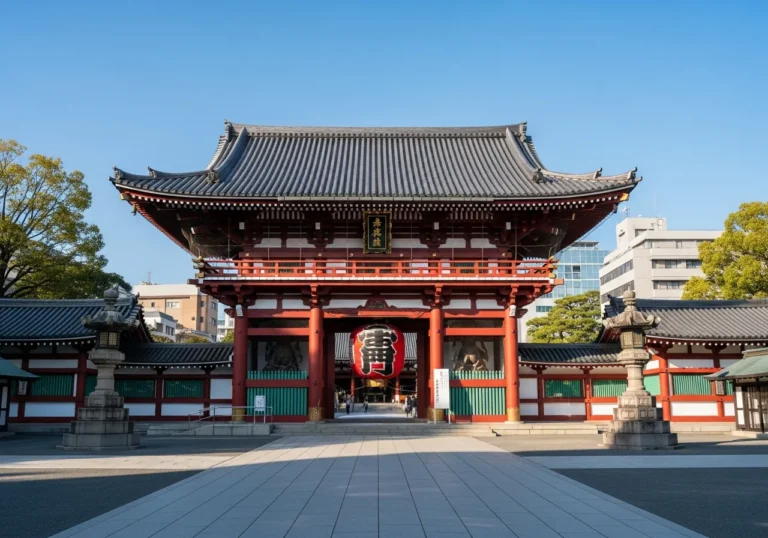
Osaka has always been a city that tells stories for money, and means it as a compliment. The kamishibaiya on his bicycle was the latest in a line that ran back through the rakugoka of the Edo-period yose theaters and the etoki priests of Shitennoji — Japan’s oldest state-sponsored Buddhist temple, founded in 593, whose grounds in Tennoji-ku still host monthly markets where the city’s appetite for street commerce and street performance has never entirely disappeared.
Why It Died: The Electric Kamishibai
The end came quickly and completely. Kamishibai experienced a significant decline with the end of the Allied occupation in 1952 and the introduction of television in 1953, which was initially known as denki kamishibai or “electric kamishibai.”
The nickname is the most revealing thing about the transition. When television first entered Japan, it was popularly called denki kamishibai (electric kamishibai), no doubt because of its similarity in size, shape, and function to the kamishibai screen.
The Japanese public recognized television not as something entirely new but as a kamishibai that had been plugged into the wall — a box with pictures and a voice, delivering serialized stories to a gathered audience. The form was so familiar that the new technology was named after it.
But the naming was also the death notice. Kamishibai may be best known today as one of the direct precursors of postwar manga and anime, but over its forty-year heyday it enjoyed enormous popularity, at times eclipsing rival entertainment media for children such as movies or radio in the 1930s and early 1940s, and manga in the 1950s. It was only the rise of television — tellingly known as denki kamishibai in its early years — that finally brought about its demise.
The economics were brutal. Many parents had reduced their children’s allowances to a level that was not enough to go to movies but sufficient for kamishibai viewings.
Television changed that calculation entirely. Once a set was in the house, the entertainment was free, unlimited, and available in all weather.
One unique aspect of the kamishibai occupation was that you couldn’t perform when it rained. Thus, one’s livelihood often depended on the weather.
Television had no such vulnerability.
With television bringing larger access to a variety of entertainment, many kamishibai artists and narrators lost their work, with the former turning to drawing gekiga, bringing new talent and narrative to this growing genre. This is the pivot point that connects kamishibai to everything that came after it.
Why It Still Matters: The Manga and Anime Inheritance
The artists who had spent the 1940s and 1950s painting kamishibai cards did not disappear when television arrived. They took their skills — the ability to tell a story in a sequence of images, to create a composition that reads at a glance, to sustain a serial narrative across episodes — and applied them to the new medium of manga.
Several key manga artists were former kamishibai painters, including Mizuki Shigeru, best known for his yōkai (preternatural creature) manga, Shirato Sanpei, the creator of the gekiga epic Kamui den (The Legend of Kamui), and Kojima Gōseki, the illustrator of Kozure ōkami (Lone Wolf and Cub). These are not minor figures. They are among the most influential artists in the history of Japanese visual storytelling.
Growing up during World War II, Japan’s seminal manga artist Osamu Tezuka was surrounded by kamishibai. Tezuka — the man who essentially invented the visual grammar of manga and anime as we know them — absorbed kamishibai as a child in the Kansai region.
The cinematic framing, the close-up, the panel that cuts away before the resolution: these techniques did not come from American comics alone. They came from the wooden box on the bicycle, from the card pulled sideways to reveal the next scene, from the performer who knew how to make thirty children hold their breath.
It is easy to see how this performance-based paper theater, which relied on hand-made boards drawn well enough to hold children’s attention, would be a natural precursor to Japan’s manga and anime. The Ohio State University’s manga studies program is direct about the lineage: from the 1930s until the 1950s, kamishibai was the most popular form of entertainment for children, so much so that when television came to Japan in the 1950s, it was referred to as “denki kamishibai” (electric kamishibai).
The Mechademia review of Eric P. Nash’s Manga Kamishibai makes the argument plainly: kamishibai played a decisive role in the development of manga and anime cultures during the postwar period.
The superhero genre, the serialized narrative, the cliffhanger episode, the visual shorthand for speed and impact — all of these were developed in kamishibai before they were codified in manga. When you watch an anime today, you are watching the grandchild of a man on a bicycle in Tennoji.
There is also a deeper structural argument. Kamishibai was primarily Western in form, if often Japanese in content, and the principal inspiration was often cinema.
This is the paradox at the heart of Japanese popular culture: it absorbed Western visual forms — cinema, comics, the proscenium stage — and ran them through the deep grammar of Japanese oral-visual tradition, producing something that was neither purely Western nor purely Japanese but distinctly its own. Kamishibai was the laboratory where that synthesis was first worked out at scale.
Why the Discerning Traveler Should Care: What Kamishibai Reveals About Osaka
There is a version of Osaka tourism that is entirely about food — the takoyaki, the okonomiyaki, the endless argument about which kushikatsu stand in Shinsekai is definitive. That version is not wrong, but it is incomplete.
Osaka’s deeper identity is not gastronomic. It is performative.
This is a city that has been telling stories to crowds for over a thousand years. The bunraku puppet theater that originated here in the 17th century, the manzai comedy tradition that made Osaka the capital of Japanese humor, the rakugo storytellers who worked the yose theaters of the Edo period — these are not separate phenomena.
They are expressions of the same civic appetite: the desire to gather in public, to be told a story by someone who knows how to tell it, and to pay for the privilege in whatever currency is available. In the 1930s, that currency was candy.
Kamishibai also reveals something about how Osaka survived its worst moments. The Great Depression, the firebombing of 1945, the postwar occupation — in each case, the city’s response included the immediate reconstitution of street entertainment.
During the Shōwa depression, which was triggered by the Great Depression in the United States, many jobless men turned to performing kamishibai for immediate income. And again after 1945, the same thing happened.
The bicycle came out, the box was mounted, the blocks were clapped. The children gathered.
The story began.
There is something in this that speaks to Osaka’s particular relationship with commerce and culture — the shōnin (merchant) spirit that the city has always claimed as its own. Kamishibai was not art for art’s sake.
It was art as livelihood, art as service, art as the thing you do when you need to feed your family and you have a voice and a box and a bicycle. The city has never been embarrassed by that combination.
It has always been proud of it.
For the traveler who wants to understand why Osaka produced the manga artists and the anime studios and the comedy traditions that it did, kamishibai is the missing piece. Kamishibai is often seen as a precursor of manga and anime, and its influence can still be felt in the distinguishing features of these later media.
But it is more than a precursor. It is the proof of concept — the demonstration that a Japanese urban audience would show up, day after day, for a serialized visual narrative delivered by a skilled performer.
Everything that came after was built on that proof.
Where to Find It Now
Street kamishibai as a commercial form is gone. The last professional street performers retired decades ago. But the form has not disappeared entirely — it has migrated into institutions and occasional revival performances.
At the Kyoto International Manga Museum, regular performances of kamishibai are held — a traditional Japanese style of story-telling with pictures that used to be popular as street entertainment. Everyone from children to the elderly can enjoy performances by the Museum’s kamishibai group, known as Yassan Ichiza. The museum, a 40-minute train ride from Osaka, is the most reliable place in the Kansai region to see a live performance.
In Osaka itself, the Osaka Prefectural Central Library in Higashiosaka City is a cultural hub boasting the largest collection of books in Osaka, and is also home to the International Children’s Literature Library, which offers a wide range of materials for children. The Children’s Resource Room, which houses children’s books, magazines, and picture-story shows, also hosts picture book readings and craft and origami classes. The library holds kamishibai cards in its collection — physical artifacts of the form, available for research.
The streets themselves are the most honest answer. Walk the lanes around Shitennoji on the 21st of any month, when the temple’s famous flea market fills the outer grounds with vendors and crowds.
Shitennoji hosts festivals on the 21st and 22nd of each month. The atmosphere — the outdoor commerce, the gathered crowd, the mix of the sacred and the mercantile — is not so different from what it was when a kamishibaiya would have worked this neighborhood.
The bicycle is gone. The wooden box is gone.
But the impulse that made kamishibai possible — the Osaka conviction that a good story, told well, in public, is worth paying for — is still entirely present.
The Association for Asian Studies notes that kamishibai has seen a revival in educational and artistic contexts globally, with practitioners in Europe, North America, and across Asia adapting the form for new audiences. The Japan Society’s scholarship on kamishibai, written by Tara M. McGowan, argues that its “almost limitless adaptability” is precisely what has kept it alive — that a form defined by a live performer, a set of images, and a gathered audience can be reborn in any context where those three elements can be assembled.
That argument is persuasive. But it also points to what is irreplaceable about the original.
The kamishibai man on his bicycle was not delivering a cultural product. He was a neighbor, working a neighborhood he knew, telling stories to children whose names he probably knew, in a city that had always understood that the best entertainment is the kind that happens on the corner, in the open air, with the smell of candy and the sound of wooden blocks.
Frequently Asked Questions
Q: What does kamishibai mean?
A: The word 紙芝居 breaks down as kami (paper) + shibai (play or drama). It is most commonly translated as “paper theater” or “paper play,” though “paper drama” is also used. The street form is more specifically called gaitō kamishibai — street-corner paper theater.
Q: Did kamishibai originate in Osaka or Tokyo?
A: The academic consensus is that the modern street form emerged in Tokyo’s shitamachi districts around 1929–1930, but Osaka was an equally important center from the beginning, and the postwar San’yūkai production circle, founded in Osaka in 1947, was one of the most significant kamishibai organizations in Japan. The form’s roots in Buddhist pictorial storytelling are associated with temples across the Kansai region, including Osaka’s own Shitennoji.
Q: Is kamishibai still performed in Osaka?
A: Regular live performances are most reliably found at the Kyoto International Manga Museum, a short train ride from Osaka. The Osaka Prefectural Central Library holds kamishibai materials in its International Children’s Literature collection. Occasional revival performances occur at festivals and cultural events across the Kansai region; the Shitennoji monthly market is one venue where street performance traditions remain alive in spirit.
Q: How is kamishibai related to manga and anime?
A: The connection is direct and well-documented. Several major manga artists — including Mizuki Shigeru and Kojima Gōseki — began as kamishibai painters.
Osamu Tezuka, the foundational figure of manga and anime, grew up surrounded by kamishibai in the Kansai region. The serialized narrative structure, the cinematic framing, and the visual shorthand for action and emotion that define manga were all developed in kamishibai before they were codified in print.
Television was even nicknamed denki kamishibai — electric kamishibai — when it arrived in Japan in 1953.
Q: What was the business model of street kamishibai?
A: Performers did not charge admission. Revenue came entirely from candy sales — children who bought candy received the best viewing positions.
The illustrated cards were typically rented from a kashimoto (rental establishment) rather than owned by the performer, keeping startup costs minimal. A skilled performer could work multiple neighborhoods per day, building a loyal audience through serialized stories that always ended on a cliffhanger.
Where to Experience Kamishibai in Osaka — Visitor Information
Kyoto International Manga Museum (closest live kamishibai performances): Karasuma-dori Oike-agaru, Nakagyo-ku, Kyoto 604-0846 / 京都市中京区烏丸通御池上ル
Osaka Prefectural Central Library — International Children’s Literature Collection (kamishibai holdings): 1-17-2 Higashisakura, Higashi-ku, Osaka 540-0003 / 大阪市東区東桜1-17-2 ※ Confirm current address on official site
Shitennoji Temple (monthly market, street performance tradition): 1-11-18 Shitennoji, Tennoji-ku, Osaka 543-0051 / 大阪市天王寺区四天王寺1-11-18
Nearest station (Shitennoji): Shitennoji-mae Yuhigaoka Station (Osaka Metro Tanimachi Line) — 3–5 min walk; or Tennoji Station (JR/Metro) — 10–12 min walk
Kyoto International Manga Museum hours: 10:00–18:00 (last entry 17:30); closed Wednesdays and New Year holidays — confirm on official site
Shitennoji hours: April–September 8:30–16:30; October–March 8:30–16:00 (monthly market: 21st–22nd of each month)
Admission: Kyoto International Manga Museum approx. ¥900 adults (confirm on official site). Shitennoji outer grounds free; inner precinct approx. ¥300 adults.
Kyoto International Manga Museum official site: kyotomm.jp
Shitennoji official site: shitennoji.or.jp