Osaka-ben sounds blunt to Tokyo ears not because it is rude, but because it was never designed for the same social purposes as standard Japanese. The dialect evolved over centuries in a merchant city where directness was a commercial virtue, and it was then deliberately demoted to “provincial” status by a Meiji government that needed a single national language — and chose Tokyo’s as the model. The result is a speech that carries the DNA of classical Japanese, the pragmatism of the trading floor, and the timing of the comedy stage, all compressed into a cadence that Tokyo-trained ears read as abrasive precisely because it strips away the hedging that standard Japanese treats as politeness.
Why we can tell you this — MICHI is written and edited in Osaka; our team walks the Namba arcades and the Kuromon market lanes where this dialect is the ambient sound of daily life. This piece draws on the Kansai Dialect Self-study Site hosted by MIT, the Wikipedia entry on the Kansai dialect (which synthesises academic linguistic scholarship), the Wikipedia article on the Genbun itchi movement, the Osaka Monhin official history, and the Osaka Entertainment City’s documentation of Namba Grand Kagetsu, among other sources cited throughout. Where the historical record is thin — particularly on the precise mechanisms by which Edo-period merchant speech diverged from Kyoto courtly speech — we say so rather than speculate.
Stand anywhere in Namba on a weekday afternoon and close your eyes. The city does not murmur; it argues, laughs, haggles, and announces itself.
The pitch of the voices around you rises and falls in patterns that feel almost Mediterranean in their expressiveness — nothing like the measured, downward-stepping cadences you hear on the Yamanote Line in Tokyo. Someone behind you says something that sounds, to an ear trained on standard Japanese, like a challenge.
It is, in fact, a greeting.
That gap — between what Osaka-ben sounds like and what it actually means — is one of the most revealing fault lines in Japanese culture. It is not a gap of rudeness versus politeness. It is a gap of history, economics, and political power, compressed into the way a city speaks.
Why Does Osaka Even Have Its Own Dialect?
The short answer is that Osaka-ben is not a deviation from standard Japanese. It is, in a very real sense, older than it.
The Kansai dialects, originating from the historic Kinai dialect (畿内方言, kinai hougen), possess a diverse linguistic heritage spanning over a thousand years. Throughout the Nara and Heian periods, where Nara and Kyoto served respectively as Imperial capitals, the Kinai dialect held the status of the default standard Japanese, exerting influence far beyond its immediate region.
The modern Kansai dialect has inherited and still holds many characteristics of classical Japanese, which was the most powerful language when Kyoto and Nara were at their respective times the seat of Japan’s early capitals and the center of Japanese politics, economy and culture. When a scholar in Heian-kyō composed a poem, or a court official issued a decree, the language they used was the ancestor of what you hear today in Osaka’s covered shopping arcades.
The Kinai dialect had an influence on all of the nation including the Edo dialect, the predecessor of modern Tokyo dialect. The literature style developed by the intelligentsia in Heian-kyō became the model of Classical Japanese language. This is the first layer of the paradox: the dialect that Tokyo speakers now perceive as rough and provincial is the one that gave Tokyo’s own speech many of its most refined features.
Even today, traces of this inheritance are visible in standard Japanese itself. The Western Japanese Kansai dialect was the prestige dialect when Kyoto was the capital, and Western forms are found in literary language as well as in honorific expressions of modern Tokyo dialect, such as adverbial ohayō gozaimasu, the humble existential verb oru, and the polite negative -masen, which uses the Kyoto-style negative ending -n. Every time a Tokyo businessperson bows and says ohayō gozaimasu, they are, without knowing it, speaking a fragment of Kansai.
Why Did the Balance of Linguistic Power Shift?
The answer is not linguistic. It is military and political.
When the political and military center of Japan was moved to Edo under the Tokugawa Shogunate and the Kantō region grew in prominence, the Edo dialect took the place of the Kansai dialect. With the Meiji Restoration and the transfer of the imperial capital from Kyoto to Tokyo, the Kansai dialect became fixed in position as a provincial dialect.
The Tokugawa shift in the early seventeenth century was the first blow. Power moved east; the samurai class, which had always spoken a rougher, more martial variant of Japanese, now set the cultural tone in Edo.
Osaka remained economically dominant — the nation’s commercial engine — but it was no longer the seat of political authority. The two cities developed in parallel, each with its own social logic, its own hierarchy, and its own speech.
The decisive blow came with the Meiji Restoration of 1868. The new government needed to build a modern nation-state, and a nation-state needs a single national language. The original “Standard Japanese” was in large part the product of political considerations during the last half of the Meiji era (1868–1912) under the Genbun itchi (the unification of the spoken and written language) movement, a movement dedicated to present a united face to the world so that Japan would be perceived as a civilized nation.
The choice of which dialect to standardize was not linguistically neutral. Standard Japanese, based on the dialect of the Tokyo Yamanote area, has personified prestige and power since the Meiji government adopted it as the national language and began standardizing language education in schools.
Yamanote — the elevated, western arc of Tokyo — was the district of the educated upper class, the bureaucrats and intellectuals who staffed the new government. Their speech became the template for a nation.
In 1903, the Ministry of Education produced primary school textbooks written in the genbun itchi style. These, of course, would be used by all students nationwide as they learned Japanese.
By giving government sanction to use the genbun itchi style in the national curriculum, the foundation of modern Japanese had been laid. Children across Japan — in Osaka, in Kyushu, in Tohoku — now learned to read and write in a language modelled on Tokyo speech.
Their own dialects became, by institutional definition, deviations from the norm.
Why Did Osaka’s Dialect Survive When Others Faded?
This is where the story becomes genuinely interesting. Many Japanese regional dialects have been substantially eroded by standardization, television, and internal migration.
Osaka-ben has not. It remains vigorous, immediately recognizable, and — crucially — a source of fierce local pride.
Why?
The first reason is economic weight. Osaka maintained the position of the national trade hub.
During the Edo period (1603–1868), it was called tenka-no daidokoro (‘Japan’s Kitchen’) and was known as the city of merchants, while Edo was the city of samurais and Kyoto was of nobles and artisans. A city that controls the flow of rice, sake, and goods across an entire archipelago does not easily surrender its sense of self.
From 1925 to 1932, Osaka was the largest city in Japan by population, exceeding Tokyo and being the sixth largest in the world. This is a fact that most people outside Japan — and many inside it — do not know.
For a crucial window of the early twentieth century, Osaka was not a provincial city deferring to Tokyo. It was the metropolis.
The second reason is the specific character of Osaka’s merchant culture, which shaped the dialect’s values in ways that made it resistant to the courtly indirectness of both Kyoto and Tokyo. For centuries, Osaka was known as tenka no daidokoro, or “the nation’s kitchen.” As Japan’s commercial hub, it was a city of merchants, traders, and artisans.
In this bustling environment, communication had to be efficient, direct, and persuasive. There was little room for the elaborate, indirect pleasantries found in the courtly language of Kyoto or the bureaucratic speech of Edo.
This is where Osaka-ben’s directness originated.
Osaka’s role as Japan’s merchant city was reinforced through official policy. During the Edo period, all rice throughout the whole of the country was required to be sent to Osaka before being redistributed.
Every daimyo domain in Japan had a warehouse in Osaka. Every major commodity passed through its markets.
The language of that commerce — quick, transactional, built on trust established fast — became the city’s native tongue.
This city was not one of samurai and aristocrats; rather, it was a city of merchants, traders, and artisans. Money, practicality, and the tangible quality of goods were the languages spoken here. In a culture where the Confucian hierarchy placed merchants at the very bottom of the social order, Osaka’s commercial class developed its own counter-culture — one that valued results over rank, and clarity over ceremony.
The third reason, and perhaps the most powerful, is comedy.
Why Did Comedy Become the Dialect’s Fortress?
The relationship between Osaka-ben and Japanese comedy is not incidental. It is structural. The dialect and the art form co-evolved, and each made the other stronger.
Originally based around a festival to welcome the New Year, manzai traces its origins back to the Heian period. In its earliest form, pairs of performers would visit houses delivering auspicious blessings. By the Edo period, the form had evolved into something recognizably comedic, with the two performers playing off each other in ways that prefigure the modern boke-and-tsukkomi dynamic.
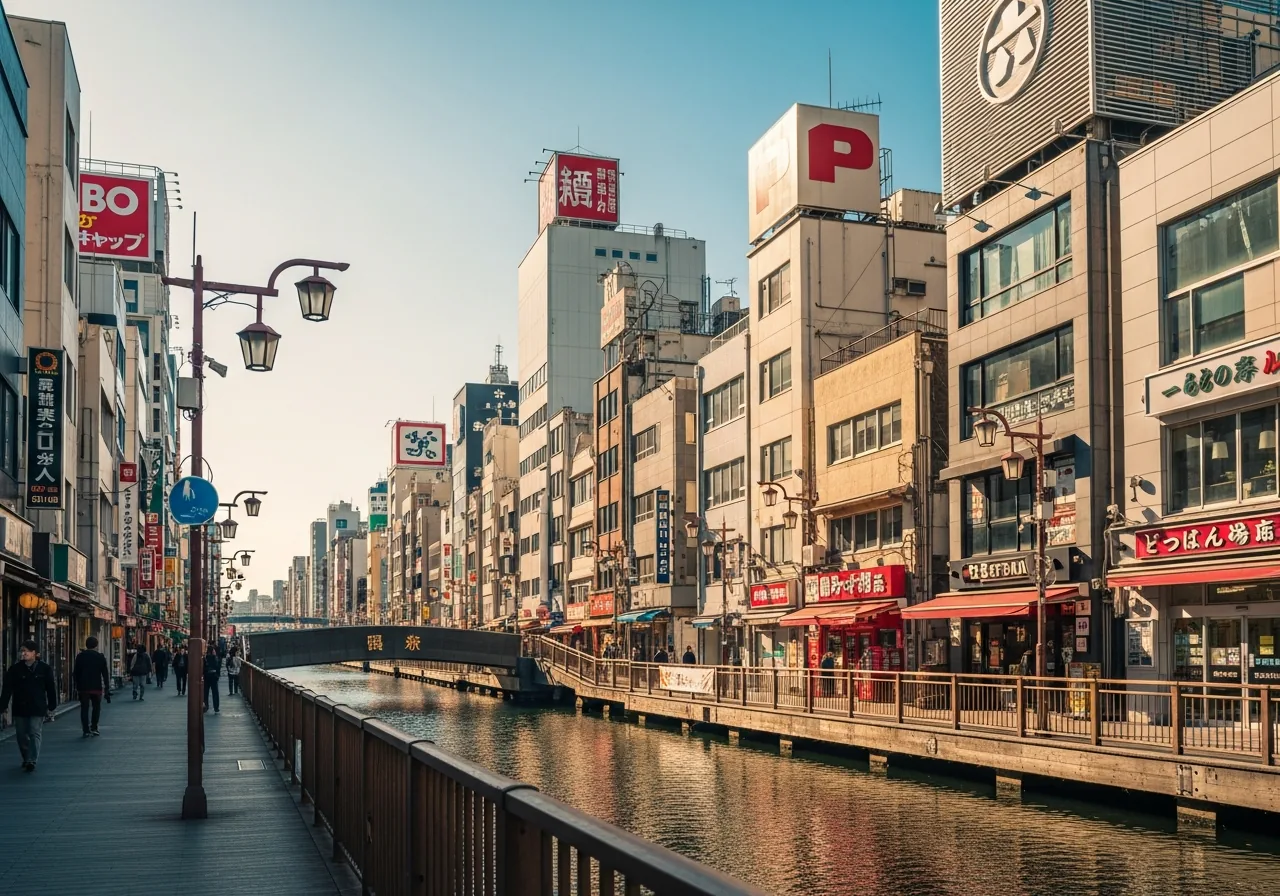
During the Edo period, manzai transitioned from ritual to a comedic vaudeville-style act, often performed in urban entertainment districts like Osaka’s Dotonbori, where duos incorporating the traditional roles added riddles, puns, and satirical commentary on daily life. Dotonbori — the canal-side strip that still defines Osaka’s entertainment identity — was already the city’s comedy laboratory three centuries ago.
The transformation into a national phenomenon came in the twentieth century, and it came through one institution. While the merchant spirit laid the foundation, one company solidified Osaka’s status as Japan’s comedy capital: Yoshimoto Kogyo. Founded in Osaka in 1912, Yoshimoto transformed the raw, folksy tradition of manzai into a nationwide entertainment empire.
In 1933, Yoshimoto Kogyo, a large entertainment conglomerate based in Osaka, introduced Osaka-style manzai to Tokyo audiences and coined the term 漫才. The timing matters.
This was the era of radio — a technology that could carry a voice, and its accent, into every home in Japan. When Yoshimoto’s comedians broadcast their routines, the entire country heard Osaka-ben for the first time as entertainment rather than as the speech of merchants or provincials.
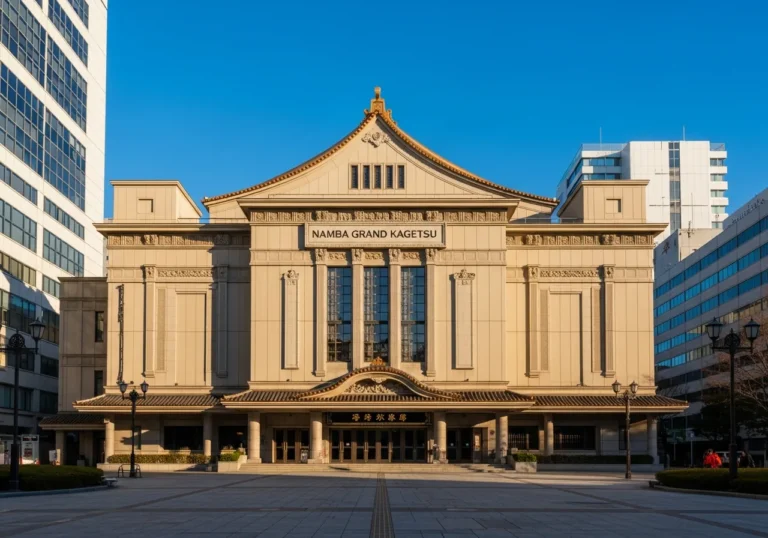
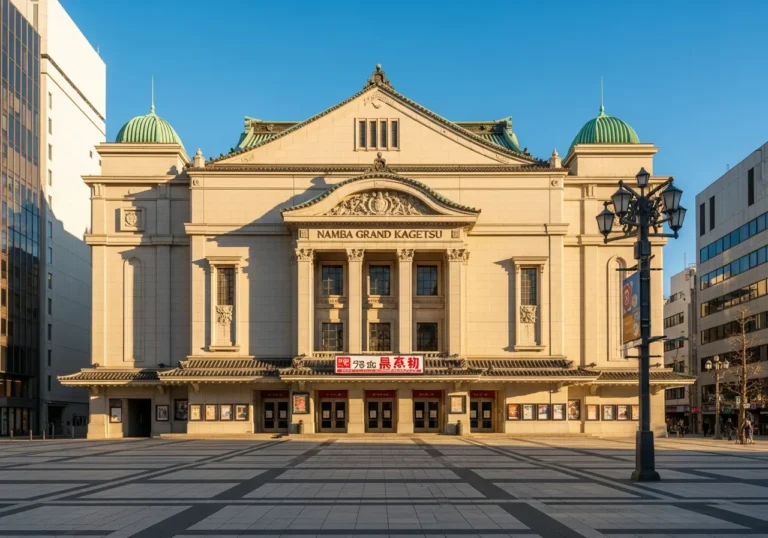
Yoshimoto built theaters, most notably the legendary Namba Grand Kagetsu (NGK), known as the Carnegie Hall of Japanese comedy. They recruited and trained generations of comedians, broadcasting their acts on radio and television until the entire country linked the Osaka dialect with laughter. This created a profound feedback loop in the city itself.
That feedback loop is the key mechanism. Children grew up watching Yoshimoto comedians on TV each weekend, idolizing famous manzai duos.
The rhythms and phrases they heard became the rhythms and phrases they used on the playground. The dialect was not just preserved; it was actively reinforced by the entertainment industry, generation after generation.
Owing to its distinctive accent, Kansai-ben was once regarded as coarse and imposing. Gradually, with the increase in stand-up comedians and TV shows, it gained a renewed light-hearted and affable image. The stigma that Meiji standardization had attached to regional speech was, in Osaka’s case, substantially reversed by the cultural power of comedy.
Why Does It Actually Sound Different? The Mechanics of Bluntness
To understand why Osaka-ben registers as blunt to Tokyo ears, you need to understand what is actually happening acoustically and grammatically. The perception of bluntness is not imaginary, but its cause is not rudeness — it is a fundamentally different pitch system and a different set of grammatical choices, both of which strip away the softening mechanisms that standard Japanese relies on.
The Pitch Architecture
Japanese is a pitch-accent language, not a stress-accent language like English. The meaning of a word can change depending on whether its syllables are delivered high or low. But the rules governing those pitches differ radically between Tokyo and Osaka.
The defining feature of Kansai-ben is its pitch accent. Standard Japanese, mainly based on the Tokyo dialect, employs a pitch-accent system where the pitch of a word typically drops after a particular mora. The position of this drop is essential for differentiating words that are otherwise spelled identically.
Kansai-ben disrupts this pattern by using what is known as the Keihan-shiki (Kyoto-Osaka style) pitch accent. Here, the initial pitch of a word is as significant as where the pitch falls. A word might begin high and drop, or start low and rise, creating an entirely different set of melodic patterns.
The practical consequence is that the same word, spoken in Tokyo and Osaka, can have opposite pitch contours. The word hashi meaning “bridge” rises in Tokyo but falls in Osaka, while hashi meaning “chopsticks” does the opposite.
A Tokyo speaker hearing Osaka-ben is not just hearing an unfamiliar accent; they are hearing a pitch system that runs counter to their every linguistic instinct. Words that should rise, fall.
Words that should fall, rise. The result is a speech that sounds, to Tokyo ears, perpetually emphatic — as if the speaker is constantly making a point.
The Tokyo accent distinguishes words only by the position of an optional pitch drop, whereas the Kansai accent distinguishes words also by initial tones, so Kansai dialect has more pitch patterns than standard Japanese. More patterns means more melodic variation, which means more expressiveness — but also more unpredictability for an outsider.
The Grammar of Directness
Beyond pitch, the grammar of Osaka-ben is built for speed and clarity in ways that standard Japanese is not. The differences are not cosmetic.
The copula — the word that links subject to predicate, equivalent to “is” in English — is one of the most fundamental elements of any sentence. In standard Japanese, it is da (だ).
The standard Japanese copula da is replaced by the Kansai dialect copula ya. The inflected forms maintain this difference, resulting in yaro for darō (presumptive) and yatta for datta (past); while darō is often considered a masculine expression, yaro is used by both men and women.
The negation system is equally distinctive. The Kansai dialect uses different verb endings, like hen (へん) for negation instead of the standard nai (ない).
Where a standard Japanese speaker says wakaranai (“I don’t understand”), an Osaka speaker says wakarahen. The Osaka version is shorter, sharper, and — to a Tokyo ear — sounds more definitive, less hedged.
The verb “to be” (for animate objects) follows a similar logic. In Kansai-ben, the negative form of iru becomes oran.
For example, neko ga inai (‘the cat is not here’) becomes neko ga oran. Similarly, the past negative inakatta (‘was not here’) becomes orankatta.
This feature relates to the use of oru instead of iru in parts of Western Japan and stands as a clear linguistic hallmark of the region.
Then there is the question of what linguists call “softening devices” — the hedges, qualifications, and polite indirections that standard Japanese deploys to avoid direct confrontation. Standard Japanese is extraordinarily rich in these. Osaka-ben uses fewer of them, not because Osakans are rude, but because the commercial culture that shaped the dialect valued transactional clarity over social cushioning.
Consider the contrast that Osakaa.net illustrates: the classic tsukkomi phrase Nande ya nen! (なんでやねん!) — the Tokyo equivalent would be something like Doushite desu ka? (どうしてですか?). The latter is polite and neutral.
The former is emotional and rhythmic. The -nen ending adds emphasis and a cadence begging to be delivered with force.
Both mean “why?” But one is a bureaucratic inquiry and the other is a human reaction.
Vowels, Not Consonants
There is also a phonetic dimension that operates below the level of conscious perception. In phonetic terms, Kansai dialect is characterized by strong vowels and contrasted with Tokyo dialect, characterized by its strong consonants, but the basis of the phonemes is similar.
Tokyo speech tends to reduce and swallow vowels; Osaka speech opens them up. The result is that Osaka-ben sounds louder and more present, even at the same volume, because the vowels are carrying more acoustic energy.
This is not aggression. It is architecture.
Why Does the Dialect Still Carry a Stigma — and Why Is That Stigma Eroding?
The perception of Osaka-ben as blunt or rough is not a neutral linguistic observation. It is an ideological position, and it has a history.
The Meiji standardization project did not merely choose Tokyo speech as the model. It framed regional dialects as obstacles to national unity and modern civilization.
The spread of standard Japanese led to a complex conflict between top-down pressures on dialect speakers to shift their speech closer to the standard language and resistance to standardization based on individuals’ pride in their local regional identities. For much of the twentieth century, speaking Osaka-ben in a formal context — a job interview, a television broadcast, a government office — carried a social cost.
The academic literature on this is pointed. Research published in the Journal of Language and Discrimination notes that Kansai dialect is known for its covert prestige due to the cultural and historical importance of its region — “covert prestige” being the sociolinguistic term for a variety that speakers value privately but that lacks official recognition. The dialect was simultaneously loved at home and stigmatized in public.
But the stigma has been in retreat for decades, and the mechanism of that retreat is, again, comedy. Since the Taishō period, the manzai form of Japanese comedy has been developed in Osaka, and a large number of Osaka-based comedians have appeared in Japanese media with Osaka dialect. Because of such associations, Kansai speakers are often viewed as being more “funny” or “talkative” than typical speakers of other dialects.
This is a double-edged transformation. The stereotype of the funny, warm, direct Osakan is more flattering than the earlier stereotype of the rough provincial — but it is still a stereotype, and it still flattens the actual diversity of the dialect and its speakers. Research has determined that the traditional stereotypes are no longer dominant because the Osaka dialect is not associated with any particular social group, and its use can imply different social meanings depending on context.
What has emerged instead is something more interesting: a dialect with genuine cultural authority. The Kansai dialect is thought to symbolize the strong local identity of the people within the Kansai domestic culture.
They tend to think of their dialect as the “opposite” of the standard Japanese, rather than merely one of the regional dialects in Japan. They are proud to be of the Kansai people, and of the Kansai local culture.
Why Does the Tokyo-Osaka Linguistic Rivalry Run So Deep?
The linguistic tension between Tokyo and Osaka is not merely about speech patterns. It maps onto a much older rivalry between two cities with fundamentally different self-conceptions.
Tokyo is the city of the state: of bureaucrats, samurai, and the apparatus of national power. Its speech reflects that inheritance — measured, hierarchical, calibrated to manage social distance.
Osaka is the city of commerce: of merchants, entertainers, and the people who actually moved goods and money around the archipelago. Its speech reflects that inheritance — direct, warm, built for the rapid establishment of trust.
By the eighteenth century, Osaka merchants controlled significant liquidity. Tokyo may have held political power, but Osaka held financial gravity. The linguistic rivalry is, at its root, a rivalry between two kinds of power: the power of the state and the power of the market.
That rivalry has never fully resolved. The difference between Kansai dialect and Tokyo dialect represents the most famous linguistic split in Japan. These two regions have historically been cultural and economic rivals, and their speech patterns reflect distinct identities.
There is also a class dimension that rarely gets discussed openly. The Meiji standardization project chose the speech of the Tokyo Yamanote — the educated upper class — as the national norm.
This meant that the speech of Osaka’s merchant class, however economically powerful, was coded as socially inferior. The bluntness that Tokyo ears hear in Osaka-ben is partly the bluntness of a class that never learned — or never needed — the elaborate indirections of courtly speech.
During the Edo period, the wealthy merchant class of Osaka was restricted by strict laws from showing off their wealth through fancy clothes or architecture. Instead, they poured their money into lavish, high-quality dining. The same logic applies to language: unable to perform status through the usual markers, Osaka’s merchant class performed it through wit, generosity, and the quality of their hospitality — all of which are encoded in the dialect’s characteristic warmth and humor.
Why Should a Discerning Traveler Care?
A visitor who arrives in Osaka having learned standard Japanese from a textbook or a language app will find themselves in an interesting position. They will understand most of what is said to them. But they will miss the texture.
The texture is where the city lives. When a shopkeeper in Kuromon Market says maido — a greeting unique to Osaka that roughly translates as “thank you for your continued custom” — they are not just saying hello.
They are invoking a commercial relationship that implies mutual respect and ongoing connection. It is the sound of a merchant’s friendly “maido” resonating in a market, the sharp, rhythmic punchline of a tsukkomi in a Namba theater, and the warm, melodic “ookini” exchanged between neighbors over a garden fence.
Understanding why Osaka-ben sounds the way it does transforms the experience of being in the city. The directness that might initially read as curtness is, once you understand its history, a form of respect: the assumption that you are capable of handling a straight answer. The humor that punctuates even serious conversations is not frivolity; it is a social technology refined over centuries in a city where making a stranger laugh was the fastest way to establish trust.
The representation of dialects in fictional texts often reflects real language attitudes and ideologies towards non-standard varieties. The same is true of travel.
How you hear a place’s language shapes how you understand its people. A traveler who hears Osaka-ben as blunt will have a fundamentally different experience of the city than one who hears it as direct, warm, and historically layered.
There is also something philosophically significant about the survival of Osaka-ben in the age of mass media and national standardization. Most of the world’s regional languages and dialects are in retreat.
This situation is called diglossia, where people code-switch between the standard language and their local dialect depending on context. Young people especially tend toward standard Japanese, leading to what linguists call dialect leveling.
Osaka-ben has resisted this leveling more successfully than almost any other Japanese regional variety.
That resistance is not accidental. It is the product of a city that has always known who it is, even when the state tried to tell it otherwise. The dialect is the sound of that knowledge.
For the affluent traveler who can go anywhere, Osaka offers something that few cities can: a place where the language itself is a living argument about power, identity, and the right to be different. You do not need to speak a word of Japanese to feel it. You just need to stand in Namba and listen.
The Dialect Today: Resilience, Revival, and the Comedy Pipeline
As of September 2026, Osaka-ben is not a museum piece. It is the working language of one of Japan’s most economically and culturally productive cities.
The decline of stigmas around using their regional dialect, combined with the explosion in the popularity and linguistic prestige of the Osaka dialect in particular, means these speakers may feel more pride in their dialect and less shame in using a stronger and less standardized version of it. Younger Osakans, far from abandoning the dialect in favor of standard Japanese, are in many respects using it more assertively than their parents did.
The comedy pipeline remains the most powerful engine of this revival. With 858 seats, Namba Grand Kagetsu is the largest comedy theater in Japan, and the retro-style interior creates a “good old Japan” atmosphere.
In 2016, the number of annual visitors exceeded one million, making it a true “hall of comedy” where people of all ages and genders can enjoy the best comedy. Every performer on that stage speaks Osaka-ben.
Every laugh the audience produces is, in a small way, a vote for the dialect’s continued vitality.
The M-1 Grand Prix — Japan’s most prestigious manzai competition, run annually by Yoshimoto Kogyo — is now one of the most-watched television events in the country. The M-1 Grand Prix is an annual manzai competition planned by Shinsuke Shimada and run by Yoshimoto Kogyo.
As of 2024, it is the most prevalent manzai competition in Japan. When the finalists perform, they perform in Osaka-ben.
The entire nation watches, and laughs, in a dialect that the Meiji government once tried to suppress.
There is also a subtler form of the dialect’s influence: its seepage into standard Japanese itself. The Kansai dialect’s idioms are sometimes introduced into other dialects and even standard Japanese.
Words like meccha (very, extremely) — pure Osaka-ben — are now used by young people across Japan, including in Tokyo. The dialect that was supposed to be absorbed by the standard is, in small but measurable ways, absorbing it instead.
This is not surprising when you consider the underlying dynamic. In the Kansai region the dialect evolved to retain its own features, developing an identity separate from “official Japanese.” Kansai’s reputation as a warm, direct, and humorous area — especially notable in traditional Japanese comedy or television — helped cement the dialect as a symbol of regional character: expressive, lively, colloquial.
A dialect that is the sound of a city’s soul does not disappear easily. Osaka-ben has survived the Meiji standardization project, the postwar media homogenization, and the digital age.
It has done so because it is not merely a way of speaking. It is a way of being — one that the city has defended, consciously and unconsciously, for over a thousand years.
The next time you hear it and think it sounds blunt, consider the alternative reading: that you are hearing a language that has never learned to apologize for itself.
Frequently Asked Questions
Q: Is Osaka-ben difficult to understand if I speak standard Japanese?
A: For native Japanese speakers, Osaka-ben is generally intelligible, though the pitch accent, vocabulary, and verb endings can cause confusion. For learners of standard Japanese, the dialect adds a layer of complexity — particularly the reversed pitch patterns and the negation forms like -hen instead of -nai. Most Osakans will switch to something closer to standard Japanese if they sense you are struggling.
Q: Is Osaka-ben the same as Kansai-ben?
A: Not exactly. Kansai-ben is the umbrella term for the dialects of the entire Kansai region, including Kyoto, Kobe, Nara, and Osaka.
Osaka-ben is the specific dialect of Osaka city, and it is the most widely recognized variety — partly because of its association with manzai comedy. Kyoto-ben, by contrast, tends to be perceived as more refined and indirect, reflecting the city’s courtly heritage.
Q: Why do Tokyo people sometimes find Osaka-ben funny?
A: The association between Osaka-ben and comedy is so deeply embedded in Japanese popular culture — through decades of manzai on radio and television — that the dialect itself has acquired a comedic connotation. The pitch patterns, the directness, and the characteristic vocabulary all carry associations with humor that have been reinforced by generations of Yoshimoto Kogyo performers.
Q: Can I experience Osaka-ben as a traveler who doesn’t speak Japanese?
A: Absolutely. The best way is to attend a performance at Namba Grand Kagetsu, where the physical comedy of manzai and Yoshimoto Shinkigeki transcends language.
The rhythm and expressiveness of the dialect are perceptible even without comprehension. Walking through Kuromon Market or the Namba arcades and simply listening is also rewarding — the ambient sound of the city is the dialect in its natural habitat.
Q: Is Osaka-ben in decline?
A: The evidence suggests the opposite. While some lexical features have been leveled toward standard Japanese, the core phonological and grammatical features of Osaka-ben remain robust, and younger speakers show signs of increased dialect pride rather than assimilation. The continued dominance of Yoshimoto Kogyo in national entertainment ensures that the dialect retains a powerful cultural platform.
Namba Grand Kagetsu — Visitor Information
Address: 11-6 Namba Sennichimae, Chuo-ku, Osaka-shi, Osaka 542-0075 / 大阪府大阪市中央区難波千日前11-6
Nearest station: Osaka Metro Namba Station (Exit 4) — approx. 5 min walk; Kintetsu Nippombashi Station — approx. 2 min walk
Hours: Performances daily; weekdays approx. 11:00 and 14:30; weekends and holidays approx. 10:00, 13:30, and 17:00. Schedule varies — confirm on the official site before visiting.
Admission: Approx. ¥4,800–¥5,000 (1F reserved seat); ¥4,300–¥4,500 (2F reserved seat). Special performance surcharges apply during Golden Week, Obon, and New Year. Prices approximate as of September 2026 — confirm on the official site.
Official site: ngk.yoshimoto.co.jp