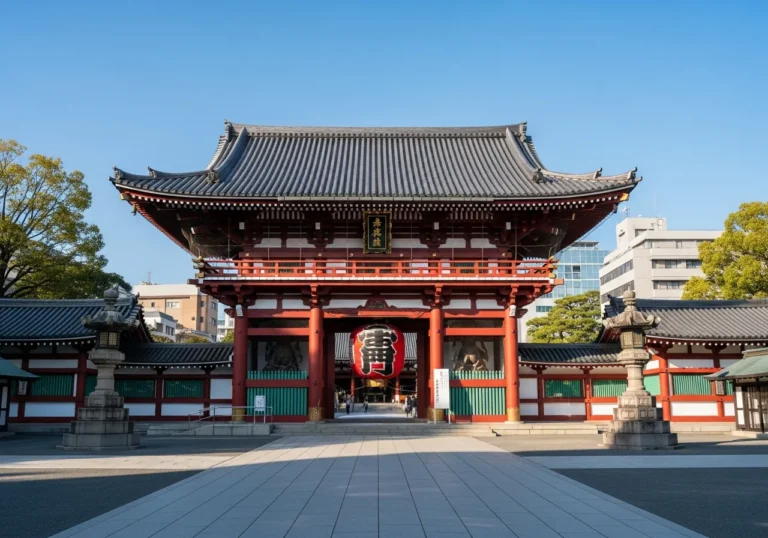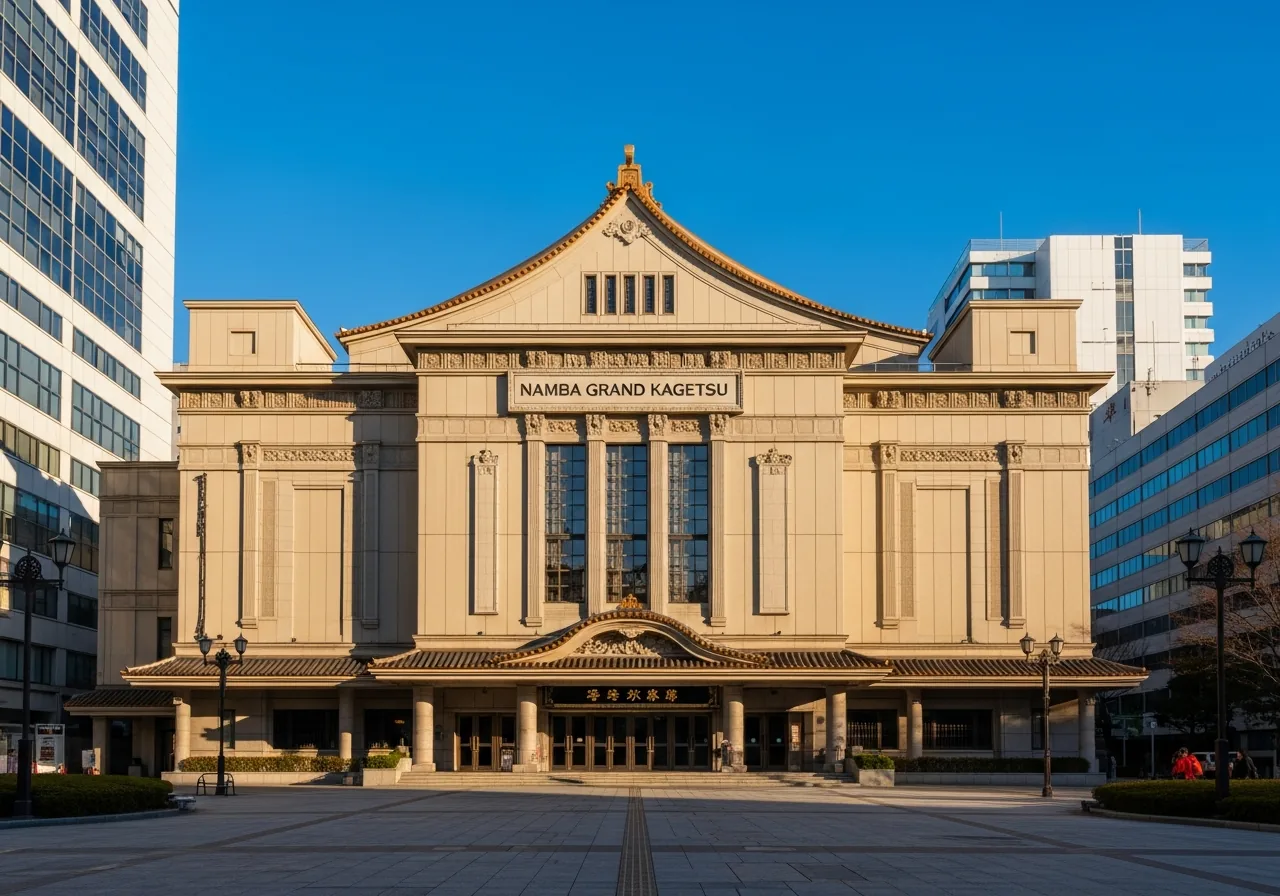
Yoshimoto Kogyo did not simply discover Japanese comedy — it manufactured the form that comedy takes. When Kichibei and Sei Yoshimoto bought a small rakugo hall in Osaka on April 1, 1912, they were merchants entering show business; within two decades, their company had coined the very word manzai, redesigned the art’s visual grammar around Western suits and rapid-fire dialogue, and exported Osaka’s sense of humor to the entire nation. Today the conglomerate manages more than 6,000 performers, controls Japan’s dominant comedy competition, and owns the television channel, radio station, and flagship 858-seat theater through which the country’s comedic imagination flows.
Why we can tell you this — MICHI is edited in Osaka, and our writers can walk from the office to Namba Grand Kagetsu in under ten minutes — past the same Sennichimae blocks where Yoshimoto’s earliest theatres stood. This piece draws on the company’s own corporate timeline as documented by Wikipedia’s Yoshimoto Kogyo entry, the Cambridge University Press chapter on manzai and Yoshimoto vaudeville in A History of Japanese Theatre, contemporary reporting in The Japan Times, and a 2025 Forbes interview with the company’s current president. The wartime period remains the least-documented chapter in English-language sources; we have relied on verified corporate chronology rather than speculation.
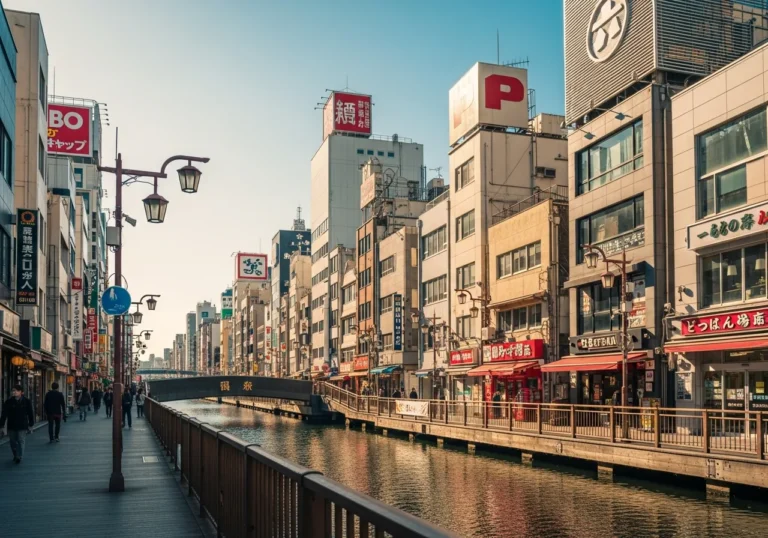
Stand at the corner of Sennichimae and Midosuji on any given weekday morning and you will hear the city before you see it. Osaka speaks faster than Tokyo, laughs louder, and treats the punchline as a civic obligation.
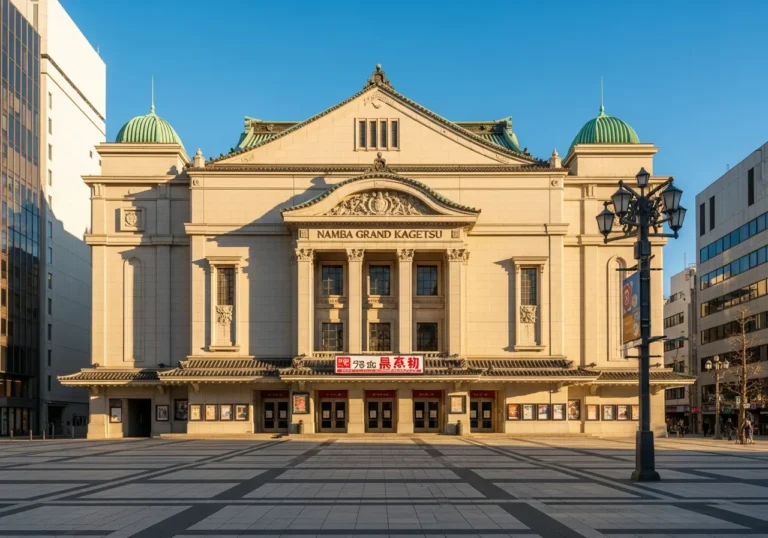
The neon facade of Namba Grand Kagetsu — the NGK, as every local calls it — rises above the intersection like a declaration of municipal identity. Inside, three performances run daily, morning through evening, and the 858 seats fill with schoolchildren on excursions, retirees who have been coming since the 1970s, and tourists who don’t speak a word of Japanese but laugh anyway because the physical comedy is universal.
This building is the visible tip of something much larger: a 113-year-old Osaka company that did not merely reflect Japanese comedy but actively constructed it, argument by argument, kanji by kanji, scandal by scandal.
Why Did a Merchant City Become the Capital of Laughter?
The question of why Yoshimoto Kogyo exists at all begins not with the company but with the city. Osaka was Japan’s commercial center — the tenka no daidokoro, the nation’s kitchen — for centuries before the Meiji Restoration. It served as a thriving commercial center where rice, produce, and goods from across Japan were traded, and in this highly competitive setting, merchants needed more than just quality products — they needed personality.
This is the structural root of Osaka’s humor. For centuries, Osaka was a city of merchants, artisans, and dealmakers.
While Tokyo’s culture developed around stoic samurai and strict bureaucrats who prioritized protocol and hierarchy, Osaka’s culture was shaped in the marketplace. For a merchant, quickly building rapport is crucial to making a sale.
Humor is the most efficient social lubricant ever created.
The contrast runs deeper than personality. Samurai culture valued stoicism and restraint; merchant culture valued cleverness, humor, and the good life.
In Edo-period Osaka, the dominant social figure was not the warrior but the akindo — the trader — and the akindo‘s primary tool was language: fast, persuasive, funny language that could close a deal before the other party had time to reconsider. The boke-tsukkomi style, with its rapid-fire setup and punchline, was the perfect conversational model for a city that valued speed, efficiency, and a human touch.
This merchant spirit prized honne — a person’s true feelings and intentions — over the polite facades of tatemae common in the capital.
By the time Kichibei and Sei Yoshimoto arrived on the scene in 1912, Osaka already had the cultural raw material. What it lacked was an institution capable of industrializing it.
Why Did Two Outsiders Build Japan’s Greatest Comedy Empire?
On April 1, 1912, Kichibei Yoshimoto and his wife Sei Yoshimoto purchased the Second Arts Building in Osaka. They later established Yoshimoto Kogyo-bu in January 1913 in Shinsaibashi.
Neither of them had any background in entertainment. They were, in the most Osaka sense of the word, merchants who spotted a market.
Though Kichibei and Sei Yoshimoto were new to the world of entertainment and comedy, they strove to create a business that welcomed new forms of comedy. To give itself the needed edge to compete against larger and more established entertainment theatres, Yoshimoto Kogyo marketed itself as “the cheapest place for laughs” by offering tickets to comedy shows at a third of the cost of its competitors. Along with its affordable entry price, the company ensured audiences varied comedic performances by continuously showcasing and nurturing new talent.
This was a deliberate, commercial calculation. Yoshimoto was not founded by an impresario with artistic vision; it was founded by people who understood that laughter was a product with a market, and that the market was underserved.
The decision to undercut competitors on price — to democratize access to comedy — is the founding logic that still shapes the company today. Yoshimoto has always been, at its core, an Osaka business: practical, populist, and relentlessly focused on the audience.
The early theatre hosted rakugo, the traditional solo storytelling art in which a single performer, seated on a cushion with only a fan and a small cloth as props, voices multiple characters across an extended comic narrative. Yoshimoto Kogyo was started in Osaka in 1912 as a yose, a theater that hosts the traditional storytelling known as rakugo.
But rakugo, for all its sophistication, was a conservative form — it required years of apprenticeship, a deep knowledge of classical material, and an audience willing to sit in patient appreciation. It was not, by nature, a mass-market product.
The company’s genius — and its lasting historical significance — was recognizing this limitation and doing something about it.
Why Did Yoshimoto Invent Modern Manzai?
To understand what Yoshimoto did to manzai, you first need to understand what manzai was before they touched it. Beginning in the Heian period (794–1185), manzai was a magico-religious rite evoking good fortune and long life, performed by a group or duo of tayū (lead role) and saizō (subordinate role), who would sing or chant, dance, and play a shoulder drum in celebration of the New Year. In the spirit of the Japanese expression “good fortune comes to a merry gateway,” the performances included humorous and auspicious qualities, grounded in the foolish saizō‘s dancing and misinterpretation of solemn words, and antagonistic reactions of the tayū.
Over centuries, this ritual form drifted toward entertainment. During the Edo period (1603–1868), manzai transitioned from ritual to a comedic vaudeville-style act, often performed in urban entertainment districts like Osaka’s Dotonbori, where duos incorporating the traditional roles added riddles, puns, and satirical commentary on daily life.
By the early twentieth century, manzai was a variety act — two to six performers combining comic banter, songs, dances, and physical arts. It was popular but diffuse, regional but not national, entertaining but not yet a defined genre with a recognizable grammar.
Then came radio, Westernization, and two comedians named Entatsu and Achako.
Yokoyama Entatsu (1896–1971) and Hanabishi Achako (1896–1974) are generally credited as the first to perform purely dialogue-based, stand-up comedy — called shabekuri-manzai — while working under the Yoshimoto Entertainment Company. What they did was strip manzai down to its essential mechanism: two people talking, one saying something absurd, the other correcting them, at speed.
No instruments, no costumes beyond ordinary clothes, no props. Just language.
But the clothes were not ordinary. In an era when most performers and audiences were still wearing kimono, Entatsu sported a Western suit, small mustache, and round spectacles, as he and Achako stood like a couple of pedestrians chatting on an urban street corner. Their style was influenced by Western comic film stars such as Charlie Chaplin, Harold Lloyd, and Laurel and Hardy.
This was not accidental. Credit can be given to Shonosuke Hayashi, the brother of the company co-founder Sei Yoshimoto, as he instructed Entatsu and Achako to wear Western suits to mimic the characters from film comedies from England and America. He also suggested to Entatsu to “wear glasses like Lloyd’s” and “a moustache like Chaplin’s.” Yoshimoto’s management was consciously engineering a new visual identity for Japanese comedy — one that signaled modernity, urbanity, and accessibility to a population that was rapidly Westernizing in the 1920s and 1930s.
As the Cambridge History of Japanese Theatre notes, Entatsu and Achako “stood like a couple of pedestrians chatting on an urban street corner” — a radical departure from the formal staging of traditional Japanese performance arts, and a deliberate signal that this comedy belonged to the modern city.
The timing was crucial. The modern iteration of manzai as we can commonly see it today really got going in the late 1920s and 1930s, thanks mainly to radio and other technological advancements bringing more and more entertainment to the masses.
Radio meant that a performance in Osaka could be heard simultaneously across the Kansai region — and eventually the nation. The spoken-word format of shabekuri-manzai was perfectly suited to the medium in a way that traditional manzai, with its songs and dances and physical comedy, was not.
Yoshimoto had, whether by design or instinct, created the right product at the right technological moment.
Then they did something that cemented their dominance: they named it. When an advertising department was established in Yoshimoto Kogyo in January 1933, they announced in their publication Yoshimoto Engei Tsushin that they would change the description in kanji to 漫才. It is now widely accepted that Tetsuhiko Hashimoto, who was managing the advertising department at the time, started using the kanji 漫才 to describe manzai.
By 1933, Yoshimoto had formalized this Osaka-style manzai, coining the term and promoting it nationwide, which by 1935 supported over 1,300 talents across more than 40 theaters. This standardization elevated manzai from regional folk entertainment to a cornerstone of urban comedy, influencing subsequent performers and embedding Kansai dialect humor into national consciousness.
The act of renaming was an act of ownership. By choosing new kanji — 漫 (meaning “rambling” or “comic”) and 才 (meaning “talent”) — Yoshimoto was not merely updating a word; it was branding an entire art form. The company that coined the term controlled the definition, and the definition shaped the industry.
Why Did the War Nearly Destroy Everything — and Why Didn’t It?
By the early 1940s, Yoshimoto was a national institution. It had grown from a small rakugo hall in Osaka to owning more than 40 theatres nationwide, including opening an office in Tokyo and launching the popular Asakusa Kagetsu theatre in the entertainment district of Asakusa. Then the war intervened, and the company’s relationship with the military state became one of the most complicated chapters in its history.
In 1941, in collaboration with the national intelligence agency and the Imperial Rule Assistance Association, Yoshimoto Kogyo established the Yoshimoto Theatre Caravan and began tours across the nation. Entertainment companies across Japan were pressed into service as instruments of wartime morale, and Yoshimoto was no exception. Its comedians toured military bases and occupied territories, their laughter now conscripted into the service of the state.
The physical losses were severe. On February 13, 1943, Tsūtenkaku, a landmark tower owned by Yoshimoto, suffered a fire which severely damaged it.
Rather than repairing the structure, it was disassembled with the steel and other materials used for the war effort. On March 10, 1945, several theatres owned by Yoshimoto Kogyo were destroyed or severely damaged due to the bombing of Tokyo.
The postwar reorganization was equally dramatic. In October 1946, the Yoshimoto Kogyo headquarters in Tokyo split off from the main company to form its own entity. In November 1946, this entity established the Oizumi Eiko Kabushiki Gaisha, which later joined several other companies to form Toei Company — one of Japan’s major film studios, a lineage that most film historians have overlooked.
Why did Yoshimoto survive when so much else was destroyed? The answer is structural.
The company’s core asset was not its buildings or its equipment — it was its relationships with performers and its institutional knowledge of how to produce comedy at scale. That knowledge could not be bombed.
The moment the occupation ended and theatres reopened, Yoshimoto had the talent, the organizational infrastructure, and the audience recognition to rebuild faster than any competitor.
In 1959, the company established its own comedy troupe theater group, Yoshimoto Shinkigeki. The Shinkigeki — literally “new comedy” — became a signature Osaka institution: ensemble sketch comedy with recurring characters, slapstick, wordplay, and the kind of warm, domestic humor that Osaka audiences recognized as their own. It was, and remains, the theatrical equivalent of a long-running television sitcom, with new productions staged weekly and a rotating cast of veterans and newcomers.
Why Did Yoshimoto Build a School Instead of Just Signing Talent?
For most of its first seven decades, Yoshimoto operated on the traditional Japanese apprenticeship model. For many years, the road to becoming a professional comedian in Japan was limited. The only way one could become one was to study under an established master and become a live-in apprentice where individuals could “steal” skills and techniques while doing chores for their master.
This system produced brilliant comedians, but slowly and unpredictably. It was also, by the 1970s, increasingly at odds with a society in which young people expected formal education rather than feudal servitude.
When the 1980s rolled around it was clear that the old system was outdated and people began to question whether it was necessary for young comedians to be spending their time living with a master and walking their dog. This resulted in the establishment of Yoshimoto New Star Creation, or more commonly known as NSC.
The Yoshimoto New Star Creation, commonly called NSC or Yoshimoto Academy, is the comedy school established by Yoshimoto Kogyo in Japan. There are currently two campuses, the original NSC, established in 1982 in Osaka, and the Tokyo branch NSC established in 1995. Students enroll for the purpose of becoming a comedian, and the school is meant to be a systematic entry into the entertainment industry as a Yoshimoto Kogyo affiliated comedian after graduation.
The NSC was a stroke of institutional genius. By creating a school, Yoshimoto accomplished several things simultaneously.
It industrialized the pipeline of new talent, ensuring a constant supply of trained performers. It created a new revenue stream — students pay tuition.
It standardized the aesthetic and technical vocabulary of Yoshimoto comedy, ensuring that graduates arrived on stage already fluent in the company’s preferred forms. And it built loyalty: comedians who trained at NSC tend to remain Yoshimoto artists, because the school’s network is the industry.
Each graduation class is considered as a generation — for example, the comedy duo Downtown were one of the first graduates of the school as the 1st generation at NSC Osaka in 1982.
Downtown — Hitoshi Matsumoto and Masatoshi Hamada — became the most consequential comedians of their generation. Amongst the class of 1982, there were two teenagers from the Kansai region who went on to become the most popular comedians of their generation. Together the two formed a manzai duo known as Downtown, and their raw talent was quickly noticed: by 1987 they were hosting their first TV program.
In the 1980s, the baton was passed from Yasu-Kiyo to the young duo who called themselves Downtown. Thanks to the huge popularity they have enjoyed, these Kansai natives have made the region’s dialect almost the de-facto language of comedy in Japan.
This is not a small claim. It means that the Kansai accent — the rolling vowels, the distinctive intonation, the particular rhythm of Osaka speech — became the sound of comedy itself in the national imagination.
When Japanese people hear Kansai-ben, they are primed to laugh. Yoshimoto trained the ears of an entire nation.
Why Did Yoshimoto Create a Competition to Crown Its Own Champions?
The M-1 Grand Prix is the most watched comedy competition in Japan, broadcast nationally every December, drawing tens of millions of viewers and generating the kind of cultural conversation that the Super Bowl generates in America. It is also, in its origins, a Yoshimoto project.
The M-1 Grand Prix is an annual manzai competition planned by Shinsuke Shimada and run by Yoshimoto Kogyo. The competition originated from Shinsuke Shimada’s concept of “giving back to manzai,” which he materialized into the idea of “a contest to decide who is the funniest” through conversations with Hitoshi Matsumoto.
It was held for ten editions from 2001 to 2010, and after being revived in 2015, it has continued to the present. The competition annually selects the winning manzai duo, with the champion receiving a trophy and a prize of 10 million yen.
The scale of the preliminary rounds is staggering. The televised finals feature the handful of duos that beat out over 4,600 others in preliminary rounds.
For aspiring comedians across Japan, the M-1 is the defining ambition of a career — the competition that can transform a struggling duo performing in small Osaka clubs into a nationally recognized act overnight. Initiatives like the M-1 Grand Prix, launched in 2001, have elevated competitive manzai, drawing millions of viewers and inspiring a surge in aspiring comedians while refining the genre’s quality through judged elimination formats.
The strategic logic here is elegant and slightly vertiginous: Yoshimoto runs the school that trains the comedians, manages most of the comedians who compete, owns the theater where the winners perform, and organizes the competition that determines who wins. It is a vertically integrated comedy economy, and the M-1 is its annual championship event. Critics have noted the circularity; defenders point out that the quality of the competition is genuinely high, and that non-Yoshimoto acts have won.
Why Does Yoshimoto Keep Surviving Its Own Scandals?
No account of Yoshimoto is complete without confronting the company’s recurring crises, which have a pattern that reveals something important about its structure.
The most damaging recent scandal came in 2019. Eleven celebrities under the company were suspended, one of whom included Hiroyuki Miyasako.
Shinya Irie, a member of the comedy duo Karateka, was fired earlier for arranging their appearances at the party without the agency’s permission. President and CEO Akihiko Okamoto also admitted that the company had found out about the connection between the comedians and the anti-social forces but pressured the comedians to stay silent.
The phrase “anti-social forces” is Japanese corporate and legal shorthand for organized crime. The revelation that Yoshimoto had known about its comedians’ connections to yakuza-linked parties and had suppressed the information rather than acting on it was devastating — not merely as a corporate governance failure, but as a betrayal of the trust that is the foundation of the company’s relationship with its performers and its audience.
Yoshimoto received scathing criticism of its management and corporate culture. Broadcasters with variety programs featuring the comedians edited them out of scenes and put their shows on hiatus as punishment. This was also swiftly followed by a public apology from President Akihiko Okamoto, who took a hefty 50% pay cut for the year.
Why did the company survive this, as it has survived previous scandals? The answer lies in the depth of its institutional embeddedness.
One would have to be a hermit, literally shut off from all media, to avoid exposure in Japan to the comedians and other entertainers managed by Yoshimoto Kogyo. Besides appearing on the numerous television variety and comedy shows and radio programs that dominate the airwaves, Yoshimoto’s comedians publish best-selling novels and essays, record hit music albums, and even direct films that in some cases win international recognition.
Yoshimoto is not merely a talent agency that could be replaced by another talent agency. It is the infrastructure of Japanese comedy.
Removing it would require rebuilding the school, the theaters, the competition, the television relationships, and the century of accumulated institutional knowledge simultaneously. No competitor is positioned to do that.
The company’s monopolistic position is, paradoxically, both its greatest vulnerability and its greatest protection.
The ownership structure reinforces this. The company’s owners include Fuji Media Holdings (12.13%), Nippon TV (8.09%), Tokyo Broadcasting System Television (8.09%), and TV Asahi (8.09%).
Japan’s major commercial broadcasters are, in effect, co-owners of the company that supplies most of their comedy content. The incentive to let Yoshimoto fail is essentially zero.
Why Does the Kansai Dialect Sound Like Comedy?
One of Yoshimoto’s most profound and least-discussed achievements is linguistic. Yoshimoto is said to be almost single-handedly responsible for the development of Japanese manzai after World War II, and the kanji that are now used for the word manzai were introduced by Yoshimoto in 1933. Although pure manzai is no longer the dominant form of entertainment in Japan, Yoshimoto’s influence remains and the spirit of manzai lives on in modern Japanese comedy, as can be seen by the prevalence of the Kansai dialect in many owarai productions.
This is a remarkable cultural achievement. Standard Japanese — the Tokyo-based dialect that is taught in schools, used in news broadcasts, and associated with formal communication — is not the language of comedy.
Kansai-ben is. Manzai routines are usually performed in the Kansai dialect.
This is not because Kansai-ben is inherently funnier than standard Japanese; it is because Yoshimoto spent a century training comedians in Osaka, broadcasting their performances nationally, and conditioning the Japanese audience to associate the sounds of Kansai speech with laughter.
The feedback loop this created is now self-reinforcing. Young people who want to be comedians move to Osaka to attend NSC, because that is where comedy is made.
They absorb the dialect, the rhythm, the cultural references. They perform in Osaka clubs, graduate to Namba Grand Kagetsu, and eventually appear on national television speaking Kansai-ben to audiences who have been trained since childhood to find it funny.
Yoshimoto recruited and trained generations of comedians, broadcasting their acts on radio and television until the entire country linked the Osaka dialect with laughter. This created a profound feedback loop in the city itself.
Comedy wasn’t just an activity; it became a key export and a core part of civic identity.
The dialect is now so thoroughly associated with comedy that Yoshimoto’s president, Akihiko Okamoto, reflected on this in his 2025 Forbes interview: “There was a feeling that Osaka comedy was known nationwide. In that sense, it wasn’t hard to work in Tokyo after coming from Osaka. I do feel that it is thanks to my predecessor and the comedians themselves who established that kind of environment in the first place before I came to Tokyo, such as what style of Osaka comedy would be prevalent on TV stations in Tokyo.”
Why Should a Discerning Traveler Care About a Talent Agency?
The question is fair. Yoshimoto Kogyo is, on one level, a talent management company — the kind of institution that exists in every entertainment industry and rarely merits serious cultural attention. But the comparison to, say, a Hollywood agency or a London management firm misses what makes Yoshimoto historically significant.
Most talent agencies represent artists who have already developed their voice and their form. Yoshimoto did something different: it created the form.
The company did not discover manzai and sign its practitioners; it redesigned manzai from the ground up, gave it a new name, a new visual identity, a new structural grammar, and then distributed it nationally through every available medium. It built the school that trains the artists, the theater where they perform, the competition that ranks them, and the television relationships that broadcast them.
It is less like a talent agency and more like what would happen if a single company had invented jazz, opened the conservatory, built Carnegie Hall, and organized the Grammy Awards.
For the traveler who wants to understand Japan’s cultural geography, Yoshimoto is essential. The company explains why Osaka and Tokyo feel so different — why Osaka is louder, funnier, more direct, more willing to make a fool of itself in public.
It explains why the Kansai accent sounds the way it does on television. It explains the particular texture of Japanese variety shows, with their panels of comedians commenting on everything from cooking to politics, their elaborate physical gags, their rapid-fire verbal exchanges.
All of this flows from decisions made in Osaka between 1912 and 1933.
The company has evolved into one of Japan’s largest talent agencies, managing over 6,000 performers — predominantly comedians — and producing more than 5,000 live events annually, with a focus on manzai duo comedy and variety shows. Those 5,000 events are not abstract statistics; they are the daily texture of Japanese cultural life, the background hum of laughter that runs through television, radio, streaming platforms, and live theater simultaneously.
And the physical center of all of this is a theater in Namba that you can walk to from most of the city’s major hotels. The Namba Grand Kagetsu, which inherited Yoshimoto’s legacy and was opened in November 1987, continues to bring laughter to the world as a base for Yoshimoto Kogyo’s proud comedy culture.
With 858 seats, it is the largest comedy theater in Japan, and the retro-style interior creates a “good old Japan” atmosphere, making it popular not only with Japanese people but also with people from overseas. In 2016, the number of annual visitors exceeded 1 million, making it a true “hall of comedy” where people of all ages and genders can enjoy the best comedy.
You do not need to understand Japanese to attend a performance at NGK. The physical comedy of Yoshimoto Shinkigeki — the slapstick, the pratfalls, the elaborate misunderstandings — crosses language barriers with ease. What you will experience is something that no museum exhibit or cultural tour can replicate: a living art form, performed daily, in the city that invented it, by artists trained in an institution that has been refining the craft for over a century.
Why Is Yoshimoto’s Future Both Secure and Uncertain?
The company’s expansion into digital media reflects both its ambition and its anxiety. In 2015, it signed a production agreement with Netflix to develop original Japanese programming ahead of the streamer’s market entry.
The Netflix collaboration produced Hibana (Spark), a drama based on a novel by Yoshimoto alumnus Naoki Matayoshi. The show is available in 190 countries and territories and subtitled in 19 languages, making it a major export for Japan.
In 2024, it launched the Fany D app in partnership with Fany Corp., specializing in one- to three-minute dramas to capitalize on short-form video trends. The company is also expanding internationally, pursuing partnerships in Asia and the United States, and has begun signing non-Japanese performers — a significant departure from its century-long focus on domestic talent.
The uncertainty is structural. Yoshimoto’s dominance depends on the continued centrality of live performance and broadcast television in Japanese cultural life.
Streaming platforms, social media, and the rise of individual content creators all represent potential disintermediation — a world in which a comedian can build an audience directly, without the school, the theater, or the agency. The company is aware of this; its digital investments are a hedge against it.
But there is a deeper reason for confidence. Yoshimoto’s most durable asset is not its roster or its real estate or its television contracts.
It is the city it comes from. As Hiroshi Osaki, a former president of Yoshimoto Kogyo, once said: “In Japan, Yoshimoto equals comedy.
All you have to do is drop our name and someone might laugh.” That equation — Yoshimoto equals comedy — was built over 113 years in Osaka, and it will not be disrupted by an algorithm.
The city and the company are now so thoroughly identified with each other that to visit Osaka without engaging with Yoshimoto’s world is to miss the deepest layer of what makes this place different. The merchant city that turned humor into a business tool, the company that turned a folk art into a national institution, the theater in Namba where the whole history is performed fresh every morning — these are not separate things. They are the same story, told in Kansai-ben, at speed, with a punchline you didn’t see coming.
Frequently Asked Questions
Q: When was Yoshimoto Kogyo founded, and by whom?
A: On April 1, 1912, Kichibei Yoshimoto and his wife Sei Yoshimoto purchased the Second Arts Building in Osaka, establishing what would become Japan’s dominant entertainment conglomerate. Neither had a background in entertainment; they were merchants who identified an underserved market.
Q: What is the difference between rakugo and manzai?
A: Rakugo is a solo storytelling art in which a single performer, seated on a cushion, voices multiple characters in an extended comic narrative. Manzai is a style of stand-up comedy in Japan which usually involves two performers — a straight man (tsukkomi) and a funny man (boke) — trading jokes at great speed. Most of the jokes revolve around mutual misunderstandings, double-talk, puns, and other verbal gags.
Q: What is the NSC, and how does it work?
A: The Yoshimoto New Star Creation, commonly called NSC or Yoshimoto Academy, is the comedy school established by Yoshimoto Kogyo in Japan. There are currently two campuses, the original NSC established in 1982 in Osaka and the Tokyo branch NSC established in 1995. Students enroll for the purpose of becoming a comedian, and the school is meant to be a systematic entry into the entertainment industry as a Yoshimoto Kogyo affiliated comedian after graduation.
Q: Can non-Japanese speakers enjoy a performance at Namba Grand Kagetsu?
A: Yes. Performances are held here morning to night daily, featuring a diverse array of veterans and newcomers in manzai, rakugo, and the Yoshimoto Shinkigeki television program.
The Shinkigeki sketch comedy relies heavily on physical humor and slapstick that transcends language. Manzai is more verbal and dialect-dependent, but the energy and timing are legible even without comprehension.
Q: What is the M-1 Grand Prix?
A: The M-1 Grand Prix is an annual manzai competition planned by Shinsuke Shimada and run by Yoshimoto Kogyo. The Asahi Broadcasting Corporation broadcasts it live throughout Japan via the All-Nippon News Network. It is held every December and is one of the most-watched television events of the year in Japan.
Namba Grand Kagetsu (NGK) — Visitor Information
Address: 11-6 Nanbasennichimae, Chuo-ku, Osaka-shi, Osaka 542-0075 / 大阪府大阪市中央区難波千日前11-6
Nearest station: Osaka Metro Namba Station (Exit 3) — approx. 5 min walk; Kintetsu Nippombashi Station — approx. 2 min walk
Hours: Weekdays: performances at 11:00 AM and 2:30 PM. Weekends & holidays: 10:00 AM, 1:30 PM, and 5:00 PM. Special programs during Golden Week, Obon, and New Year. Confirm current schedule on the official site before visiting.
Admission: Approx. ¥4,800–¥5,000 (1st floor); ¥4,300–¥4,500 (2nd floor). Prices vary by performance and season — confirm on the official site.
Official site: ngk.yoshimoto.co.jp