In 1913, a railway president named Kobayashi Ichizō drained a failed indoor swimming pool at the end of his Osaka train line, nailed a stage to the changing-room wall, and hired sixteen teenage girls to sing for the tourists he desperately needed to attract. That improvised act of commercial desperation became the Takarazuka Revue — today Japan’s oldest continuously operating musical theater company, a wholly owned subsidiary of Hankyu Railway, and a cultural institution that has spent more than a century quietly interrogating what gender means while officially insisting it does nothing of the sort.
Why we can tell you this — MICHI is written and edited in Osaka, and the Hankyu Umeda terminus — the nerve center of Kobayashi’s entire empire — is where many of us begin our commutes. The Takarazuka line runs from that station directly to the Grand Theater, making this a story we can trace on foot as much as in archives.
This piece draws on the Takarazuka Revue’s own official history pages, reporting from Nippon.com and Playbill, the Routledge Encyclopedia of Modernism, the Hankyu Hanshin Department Store’s corporate history, and academic work on gender performance in Japanese theater. Where the record is genuinely contested — particularly around Kobayashi’s intentions versus the Revue’s lived reality — we say so plainly.
Stand at Hankyu Umeda Station on any weekday morning and watch the trains depart. One platform sends commuters toward Kobe; another toward Kyoto.
The third, on the far right, runs northwest along a route that Kobayashi Ichizō built through farmland and pine forest to a village hot spring that almost nobody wanted to visit. That line, and the peculiar chain of failures that followed its construction, produced one of the strangest and most durable institutions in the history of world theater.
The story of Takarazuka is not, at its origin, a story about art. It is a story about a railway company that could not fill its trains.
Why Did a Railway Company Need a Theater at All?
When the rail connection to Takarazuka was established in 1910, the city was just a village with a mediocre hot springs resort on the right bank of the Muko River. The land on the opposite bank, where the Grand Theater now stands, had only a few farmhouses scattered here and there by a peaceful pine forest stretching along the river.
The train line was built by Minō Arima Electric Railway, a forerunner of Hankyu Railway, but it had few passengers at first, since areas near the stations were sparsely populated and tourists were rare. The competitive pressure was immediate and brutal: in 1905, a rival company, Hanshin Electric Railway, established a line linking the major cities of Osaka and Kobe, which was far more popular than the urban-rural Osaka-Takarazuka connection.
Kobayashi’s response was to think about what a railway actually sells. It does not sell transportation in the abstract — it sells reasons to travel.
In order to boost passenger numbers, he put into action his long-considered plan of building housing along the line and opening a mass entertainment facility. This was the founding logic of what urban planners now call transit-oriented development, and such a business model established by Kobayashi was followed by other railway companies across Japan.
He opened the Takarazuka Shin-Onsen hot spring resort in 1911 as an effort to increase domestic tourism along the Hankyu train lines. The marble baths were magnificent.
Its marble baths and magnificent buildings made it a huge hit. But the attached indoor pool — the centerpiece of a leisure complex called “Paradise” — was a disaster.
As Kobayashi later wrote in his autobiography, the pool received no direct sunlight and was too cold to swim in for even five minutes. The resort had to close after two months.
That is when the idea of using this venue to provide theatrical entertainment struck Kobayashi, and the Takarazuka Revue was born.
The theater, in other words, was not a vision. It was a renovation.
Why Girls? Why All-Female? Why Here?
After draining the water, Kobayashi renovated the pool into a seating area and the changing rooms into a stage, thus creating a space where girls could sing and perform. The choice of an all-female cast was deliberate and calculated on several levels simultaneously.
The obvious comparison was kabuki — Japan’s dominant theatrical tradition, which had been all-male since 1629, when the Tokugawa shogunate banned women from the stage on grounds of public morality. Since Western song and dance shows were becoming more popular and Kobayashi considered the kabuki theater to be old and elitist, he decided that an all-female theater group might be well received by the general public. He was positioning himself not against kabuki but beside it — offering a modern, Western-inflected alternative that the kabuki establishment could not easily claim as its own territory.
There was also a moral calculus. When Kobayashi founded the Revue, stage acting was regarded as something only loose women did.
By establishing a performing arts school with the motto “Purity, Honesty, Beauty,” he helped to transform acting into a respectable profession for women. The all-female cast was, paradoxically, a guarantee of propriety: during a time when public kissing was frowned upon, the fact that such scenes were implied rather than acted out, and that both actors were women, made such scenes acceptable to the general public.
And there was a third calculation, one that Kobayashi was quite open about. He wished his performers to embody the highest vision held by many Japanese men of a neat, dignified, and modest woman who would support her man with unswerving devotion.
All of the performers, including the otokoyaku, were expected to become good wives and mothers after leaving the company. This was part of the dream Kobayashi was selling on stage.
The founder of the world’s most famous all-female theater company built it, explicitly, as a finishing school.
Why Did the Revue Survive Its Own Founder’s Intentions?
In 1913, Kobayashi hired sixteen girls in their mid-teens. The next year they performed three times as the Takarazuka Girls’ Revue. These productions, presented to audiences free of charge, took place at a theater converted from an indoor swimming pool in a building attached to the main resort.
Visitors to the resort were granted free admission to the musical theater performances, which soon won over the audiences. During the two-month period of performances, the theater was full to capacity every day.
The commercial logic was immediately confirmed. Kobayashi had found his reason to ride the train.
But the institution he created almost immediately began to exceed his intentions. It is worth noting that Kobayashi did not simply throw together a group of girls and rush them up on to the stage.
He selected girls who enjoyed singing, taking care that they were from what he considered to be good families. He also paid them higher-than-average wages and took responsibility not only for their musical training but also for their education in morals and manners.
The training infrastructure he built to enforce propriety became, over time, the engine of genuine excellence. Since 1919, all Revue actors must graduate from the two-year Takarazuka Music School.
They remain among the best-trained musical theater performers in Japan. The school’s curriculum, as described by the Takarazuka Wiki, covers various forms of Western and Japanese dance, acting theory, music, classical instruments including shamisen, koto, and piano, English conversation, and tea ceremony — a curriculum that is simultaneously conservative and cosmopolitan.
All members of the Takarazuka Revue are first required to go through the rigorous two-year training of the Takarazuka Music School. The school only accepts approximately forty students a year from a pool of over a thousand applicants, aged fifteen to eighteen. The historical peak acceptance ratio, according to Japan Today, reached 48 applicants per available place — a selectivity that rivals Japan’s most prestigious universities, for teenagers who have often been training since early childhood.
The Takarazuka Revue Company can be viewed as an example of the modernization and Westernization of Japanese theater and the industrialization of its business during the early 20th century by rejecting the traditional kabuki style as well as introducing female performers to the Japanese stage and adopting Western subject matter and theatrical practices by establishing multiple performance groups to meet audience demands. — Routledge Encyclopedia of Modernism
Why Did Kobayashi’s Empire Extend So Far Beyond the Theater?
To understand why Takarazuka survived and thrived, you have to understand the full architecture of Kobayashi’s ambition. The Revue was never a standalone venture — it was one instrument in an integrated economic machine that no one had built before.
Founder Ichizo Kobayashi created the original model for Japan’s private railway management, which integrated urban development and distribution businesses centered around the railway to create synergistic effects. The logic was elegant: build housing along the line so that people live there; build a department store at the terminus so that they shop there; build entertainment at the far end so that they travel there on weekends. Every transaction feeds the railway.
Before Hankyu Railway, integrated real estate development was virtually nonexistent. Kobayashi pioneered the concept of affordable housing along railway lines, facilitating modern suburban living in Japan. His vision fostered a new social class, where homeownership represented dignity and personal achievement, drawing inspiration from Western ideals.
The department store at Umeda was the commercial crown of this system. In April 1929, Hankyu Department Store was born as the world’s first railway terminal department store.
At the time, many Japanese department stores originated as kimono shops, and there were no examples of railway companies operating department stores directly, even outside of Japan. The Hankyu model — department store above the tracks, theater at the end of the line — is now so ubiquitous in Japan that it is invisible.
Every time you exit a Japanese train station into a shopping complex, you are living inside a business model that Kobayashi invented.
The Revue, within this system, served a function that went beyond ticket sales. Having a solid corporation like Hankyu Railway as a parent company meant that the Revue faced hard times in its century of existence, but Hankyu backed the undertaking with an extraordinary amount of money and enthusiasm over the years.
For Hankyu Hanshin Holdings, Takarazuka remains the public face of the company, as important as the Hanshin Tigers baseball team it also sponsors. A theater company that loses money in a given year is not a failure when it is also the brand identity of a railway conglomerate.
Why Did the Revue Become a National Phenomenon Rather Than a Local Attraction?
The Revue’s growth in its first two decades was rapid and deliberate. The popularity of the Revue among tourists led the performances to be held regularly, four times a year. In 1918, the girls appeared at the Imperial Theater in Tokyo, and by 1924 they had their own Takarazuka Grand Theater with a capacity of around 4,000.
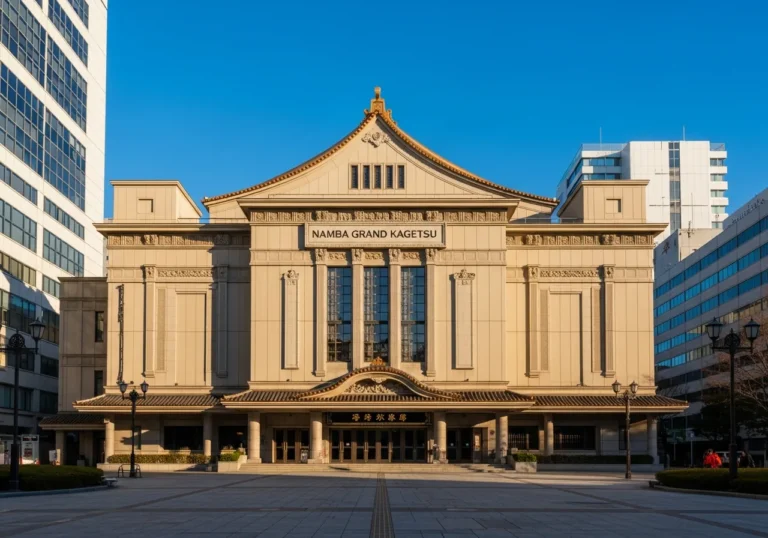
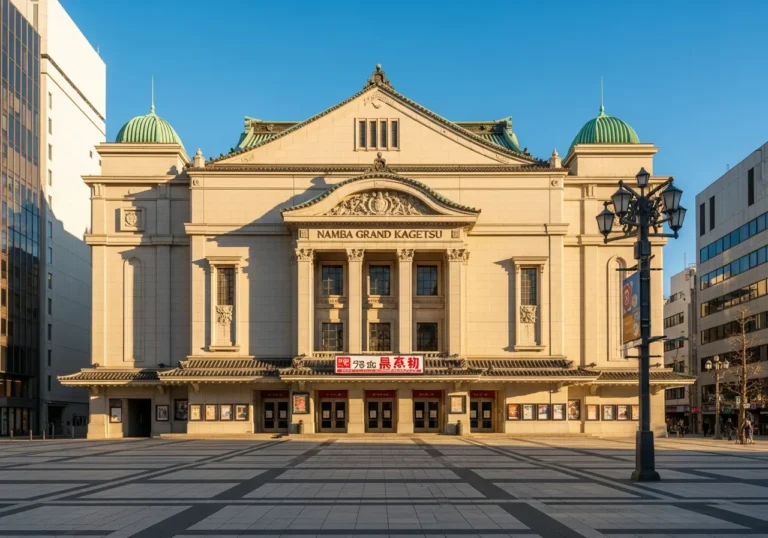
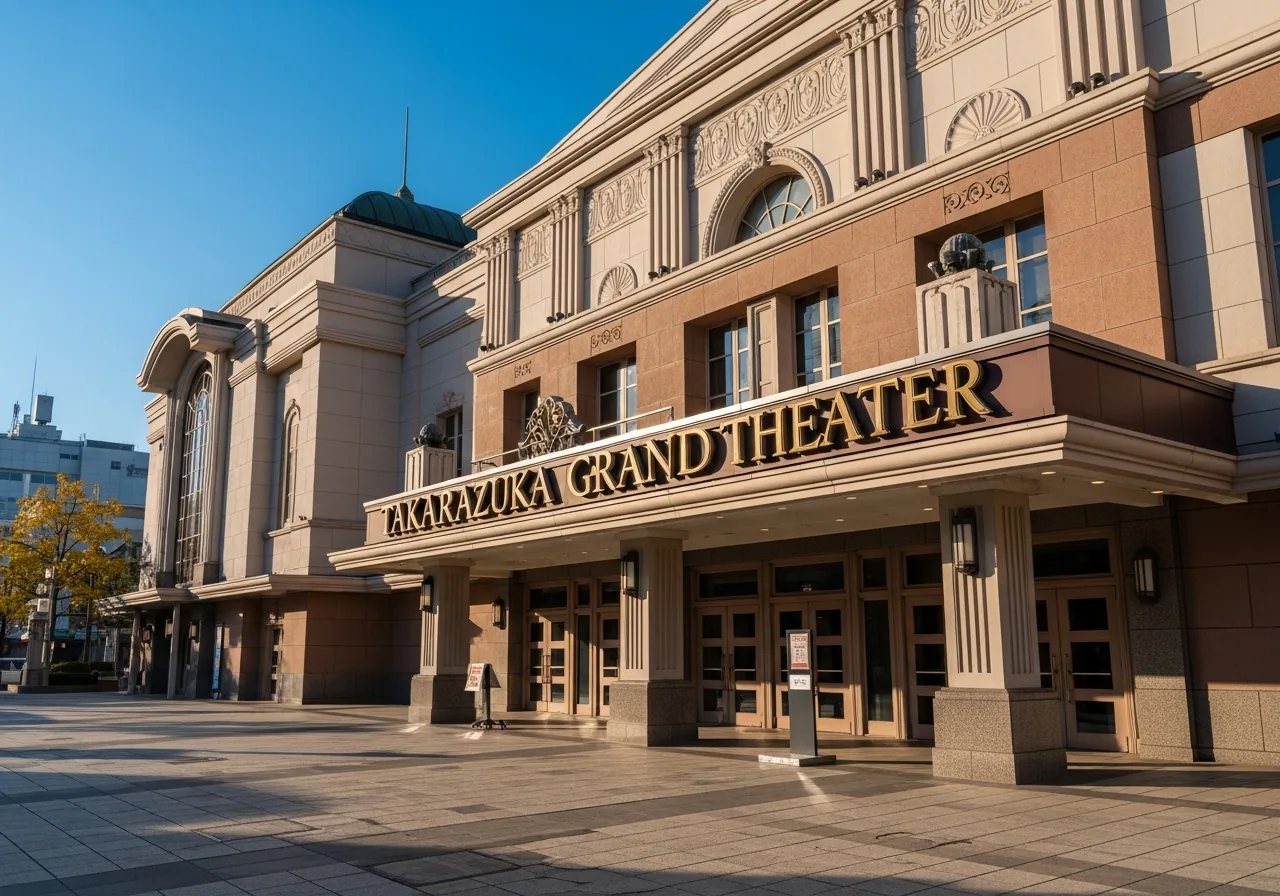
The current Grand Theater, rebuilt in 1993, combines Spanish Colonial-inspired architecture with state-of-the-art theatrical technology. The venue’s famous apron stage, known as the Silver Bridge, curves gently between the stage and audience, creating an intimate connection between performers and spectators. The theater’s luxurious interior showcases red carpets, crystal chandeliers and marble floors that transport visitors into a world of glamour and elegance.
The critical artistic breakthrough came in 1927. The theater company put on the first revue in Japan, and the Takarazuka Revue became a nationwide phenomenon.
In 1927, the performance of “Mon Paris” was the first revue in Japan. The revue format — a spectacular sequence of song, dance, and spectacle rather than a single narrative — was then the height of Parisian entertainment, and Takarazuka imported it wholesale.
This was the golden age of the “revue” that appears in the name of the company, a spectacular concoction of song and dance that was popular then, especially in France. The chorus lines and grand staircases, still so essential to Takarazuka productions, appeared at this time.
The performers were called Takarasiennes — a portmanteau of “Takarazuka” and “Parisienne” — and the name tells you everything about the cultural aspiration. Collectively, the Takarazuka performers are called “Takarasiennes.” This name derives from the revue’s fondness of the French revues and the word “Parisienne.” In the 1930s, the Revue was performing to packed houses in Tokyo, had launched its own magazine, and was touring abroad: the first foreign tour took place in 1938, visiting Europe — Germany, Italy, and Poland. That tour, it should be noted, reflected the political context of the Axis alliance as much as any artistic ambition.
Why Did the War Almost Destroy It — and Why Did It Survive?
The Second World War was the most severe test the Revue had faced. The Revue faced many challenges during World War II.
They were only allowed to perform in the Japanese language, forced to perform militaristic shows, and their theater was requisitioned by the military late in the war. They could not reopen until 1946, after the war ended.
The institutional geography of the occupation was almost surreal. During WWII, the Takarazuka Grand Theatre in Hyōgo was requisitioned by the Japanese Navy, and following the war, the Tokyo Takarazuka Theatre was taken over by the Allied Occupation’s General Headquarters.
The Tokyo Takarazuka Theater was renamed the Ernie Pyle Theater and used to put on performances to entertain the American occupation forces. The same stage that had showcased Kobayashi’s vision of Japanese femininity was now entertaining the men who had defeated his country.
Efforts from various stakeholders resulted in the re-opening of the Takarazuka Revue on 22nd April 1946, with the Snow Troupe’s performances of Carmen and Spring Dance. The speed of the revival was remarkable. During the Second World War, every form of amusement suffered various losses and Takarazuka was not an exception, but soon after the war it revived earlier than any other theatres.
The reason for the rapid recovery was structural: the Revue had Hankyu behind it. A theater company with a railway conglomerate as its parent does not need to survive on ticket sales alone during a reconstruction period. The Revue was rebuilt because it was worth rebuilding — not as art, but as brand.
Why Did the Otokoyaku Become the Heart of the Revue — and What Does That Mean?
The most intellectually interesting thing about Takarazuka is not its history but its central mechanism: the otokoyaku, the woman who plays men.
Part of the novelty of Takarazuka is that all the parts are played by women, based on the original model of kabuki before 1629 when women were banned from the theater in Japan. The women who play male parts are referred to as otokoyaku (男役, “male role”) and those who play female parts are called musumeyaku (娘役, “girl role”).
Performers are assigned a stage gender that, with rare exceptions, they stick to and perform as throughout their time with the company. Women who play women on stage are referred to as musumeyaku, while those who portray men are called otokoyaku. When comparing images of otokoyaku over time there is a palpable shift in appearance, from a look that seeks to portray a convincing male to a more androgynous aesthetic.
This shift is not accidental. Takarazuka’s adaptations blend androgynous aesthetics with traditional narratives, often reflecting contemporary gender discussions.
This adaptation process not only preserves original stories but also reinterprets gender roles to resonate with modern audiences. The otokoyaku is not trying to pass as a man; she is performing an idealized, heightened masculinity that no actual man could embody — precisely because she understands it from the outside.
Kobayashi had intended the otokoyaku role as a training exercise: he saw, particularly in otokoyaku roles, the perfect kind of training for educating his yet-unmarried actresses in what men would want and expect of their women. What he got instead was something far more subversive.
The otokoyaku became the star of the show, the figure around whom the predominantly female audience organized its devotion. Only otokoyaku can go on to become a top star in the troupe, and they generally have more fans and more attention; so the competition to become an otokoyaku is very high.
The audience dynamic is worth dwelling on. These leading ladies playing men, called otokoyaku, were immensely popular, but were popular almost exclusively with female fans.
In fact, almost all Takarazuka fans were women. A theater founded to teach women to be good wives had created a space where women came, in their thousands, to watch other women perform idealized masculinity — and to desire it, or to desire to be it, or both simultaneously.
Though Takarazuka Revue gives the appearance of having been created to grant Japanese women freedom from social oppression, it was created with the opposite intention. However, although Takarazuka embodies the ideal that the actresses become “good wives and wise mothers” upon leaving the company, it also simultaneously represents progressive feminist points of view. Some believe that its appeal to the female audience is on account of the perceived link to freedom from traditional Japanese society’s imposed ideas of gender and sexuality.
Why Did The Rose of Versailles Change Everything?
If the otokoyaku is the structural heart of Takarazuka, then The Rose of Versailles — Berusaiyu no Bara, universally known in Japan as Berubara — is the moment when that heart found its perfect expression.
In 1974, an adaptation of a manga serial about a beautiful girl raised as a man, Berusaiyu no bara (The Rose of Versailles), gave the Takarazuka Revue its biggest hit ever. The production, now inextricably associated with Takarazuka, made a huge contribution to the company’s current popularity and has been restaged numerous times.
The manga, written by Riyoko Ikeda and serialized from 1972, tells the story of Oscar François de Jarjayes — a woman raised as a man to serve as a royal guard captain in the court of Marie Antoinette, navigating the years leading to the French Revolution. Subverting kabuki’s male-exclusive format since 1913, Takarazuka had constituted itself as a feminist space, occasionally taken up as a scandal in conservative Japanese society. Enacting revolution on the stage, Oscar became the perfect model for otokoyaku — the concept of a “male role” — and an inspiration for female audiences questioning existing gender norms.
The fit between source material and theatrical form was almost uncanny. Set against the backdrop of the French Revolution, the musical performance centers on the hero(ine) Oscar, a girl who was raised as a boy to inherit her father’s estate, and portrays her relationship with a childhood friend, André, as well as the relationship between Queen Marie Antoinette and the Swedish Count Axel von Fersen.
Oscar is an otokoyaku — a woman performing masculinity as a daily, lived condition rather than a theatrical role. The character and the performer collapsed into each other.
The Revue had their prime in the 1970s when The Rose of Versailles was performed. There was an unprecedented boom: the annual number of audiences exceeded 1,400,000. The production’s revenue impact was staggering: according to research cited in the Peitho Journal, in 2011, the Takarazuka brought in revenue of 25.7 billion yen, thanks in part to the continuous performance of The Rose of Versailles.
Ikeda herself was not a passive licensor. Takarazuka is known for crossovers with manga, but Riyoko Ikeda, herself a singer and performer, personally wrote and directed lavish expansions to her own story for its productions. With a background in philosophy and initial aims to be a scholar, the sophistication of her shōjo manga even earned her France’s Legion of Honor in 2008 for cultural awareness of French history.
Not only did Takarazuka’s adoption of the story and characters influence the internal structure of the theatre, but the figure of Oscar has, in many ways, become synonymous with the role of the otokoyaku (male role player), due to the juggling of gender and sexuality that is an intrinsic part of the character. — Rose of Versailles Regular
Why Did Takarazuka Shape Japanese Popular Culture Far Beyond the Stage?
The Revue’s influence on Japanese popular culture is so pervasive that it is difficult to see clearly — like trying to notice the air. The connection to manga and anime runs particularly deep.
Osamu Tezuka, the foundational figure of modern manga, drew directly on his childhood memories of watching Takarazuka with his mother when he created Princess Knight in the 1950s — the first major shōjo manga, featuring a princess who presents as a boy. For inspiration on how to write for girls, he drew from his memories watching the Revue with his mother.
Princess Knight is the story of the heroine Sapphire, who is technically a girl and a princess but presents herself as a boy and a prince due to magical and political circumstances. She crossdresses as a man and performs idealized aspects of masculinity in public, much like how an otokoyaku dresses and performs on stage.
The lineage runs from Tezuka to Ikeda to the entire tradition of the “girl prince” archetype in shōjo manga and anime — the gender-crossing protagonist who inhabits masculinity without being male. The Rose of Versailles’s continued performances prevail as a romantic sensation, with a lasting influence upon later anime classics like Revolutionary Girl Utena.
The Revue also influenced the structure of Japanese popular music. The idol industry — with its training academies, strict codes of conduct, hierarchical seniority systems, and devoted female fan bases — is recognizably descended from the Takarazuka model. The pipeline from audition to training school to debut to stardom, the prohibition on romantic relationships during active service, the intense parasocial bonds between performers and fans: all of these were Takarazuka’s inventions, later adopted and industrialized by the pop music business.
Amid Japan’s economic miracle, the revue’s glamorous productions attracted growing audiences seeking relief from reconstruction hardships, with strict internal hierarchies that paradoxically became part of the appeal — a world of absolute order and absolute beauty, hermetically sealed from the messiness of ordinary life.
Why Does the Revue’s Dark Side Matter?
No honest account of Takarazuka can avoid what happened in September 2023. An actor from the Takarazuka Revue committed suicide on September 30, 2023, as a result of power harassment, or bullying, at Takarazuka.
In February 2024, Takarazuka admitted that about half of the incidents stemmed from power harassment, including long working hours and excessive demands. It wasn’t until the end of March that Hankyu Hanshin Holdings itself acknowledged that negligence by the management at the Takarazuka Revue led to the situation by imposing burdens on the theater members for many years and that they bore full responsibility for the situation.
The settlement reached in early 2024 was a reckoning that had been building for decades. The formalized training, characterized by demanding regimens including daily cleaning duties for first-year students, perpetuated prewar disciplinary structures that promoted loyalty and technical proficiency. The seniority system — in which junior students defer absolutely to seniors in matters ranging from rehearsal protocol to personal conduct — is a direct inheritance from the military-adjacent culture of wartime Japan, preserved in amber by an institution that had never been forced to examine it.
The tragedy illuminates the central tension that has always run through Takarazuka: the same institutional structures that produce extraordinary artistic discipline also produce conditions for abuse. Despite Ichizo Kobayashi’s intentions to make the Takarazuka Revue an institution of modern Western accoutrement but traditional Japanese spirit, the very nature of an all-girls theater that includes actresses who play male roles complicated the reality of his grand vision.
The parent company, Hankyu Hanshin Holdings, acknowledged the harassment and agreed to compensate the family. The competitive ratio for the music school’s next class was the lowest since 2000, reflecting perhaps the challenges the institution faces in the wake of the controversy. The Revue is, as of this writing in September 2026, in a period of genuine institutional reform — reducing performance schedules, establishing external oversight, and attempting to dismantle the seniority culture that the 2023 death made impossible to ignore.
Why Should a Discerning Traveler Care?
The question a serious traveler should ask about Takarazuka is not “is it worth seeing?” — the answer to that is obviously yes, if you can get a ticket. The question is: what are you actually watching when you watch it?
You are watching the product of a single man’s commercial desperation, transformed over 112 years into something he never intended and could not have predicted. You are watching a theater company that was built to teach women to be good wives, which instead became one of the most important spaces in modern Japan for the performance and exploration of gender. You are watching an institution that shaped manga, anime, idol culture, and the architecture of Japanese retail — all while officially presenting itself as wholesome family entertainment.
The costumes, set designs, and lighting are lavish and the performances melodramatic. Side pathways extend the already-wide proscenium accommodating elaborate processions and choreography. Regardless of the era of the musical presented, period accuracy is relaxed for costumes during extravagant finales which include scores of glittering performers parading down an enormous stage-wide staircase, known as the ōkaidan, and a Rockette-style kick line.
The experience of attending a performance at the Grand Theater is unlike anything else in Japan. The audience is overwhelmingly female, ranging from schoolgirls to women in their eighties who have been attending for sixty years.
The devotion is intense and specific — fans follow individual performers across troupes, know the graduation rankings of every current top star, and maintain the kind of detailed institutional knowledge that Western sports fans reserve for statistics. This is not passive consumption; it is a community organized around a shared aesthetic and emotional world.
The thirty-minute train ride from Umeda on the Hankyu Takarazuka Line is itself part of the experience. You are traveling the route that Kobayashi built, through the suburbs he developed, to the theater he created from a failed swimming pool.
The commercial promotion was such a success that the city is now better known for the Takarazuka Revue than for its hot springs. The hot springs still exist; nobody talks about them.
For the traveler who wants to understand how modern Japan was built — how a railway company became a cultural empire, how commercial calculation produced genuine art, how an institution designed to enforce gender norms became a space where those norms were perpetually interrogated — Takarazuka is not a detour. It is a primary source.
Frequently Asked Questions
Q: Do I need to speak Japanese to enjoy a Takarazuka performance?
A: The performances are in Japanese, but the visual spectacle — the costumes, choreography, grand staircase finales, and sheer theatrical scale — communicates across language barriers. Many visitors recommend seeing a show even without Japanese comprehension; synopses are available in English at the theater.
Q: How far is the Takarazuka Grand Theater from central Osaka?
A: It takes around 30 minutes to get to the city of Takarazuka from Osaka’s Umeda Station via a Hankyu Railway express train. The theater is then a ten-minute walk from Takarazuka Station.
Q: Can I visit the theater without a performance ticket?
A: Yes. In addition to watching the performances, you can find many things to do inside the building. From a museum, through original merchandise shops, to even a stage studio called Salon de Takarazuka where you can try costumes on, Takarazuka offers an all-immersive experience.
Q: What is the Takarazuka Music School, and can visitors see it?
A: The Takarazuka Music School is a prestigious two-year Japanese performing arts academy located in Takarazuka City, dedicated to training young women as singers, dancers, and actors exclusively for the all-female Takarazuka Revue Company. Founded in July 1913 as the Takarazuka Shōka-tai (Takarazuka Choir) by Kobayashi Ichizō, it served as the initial training ground for performers in the nascent Takarazuka Revue. The school building faces the Grand Theater; it is not open to the public, but its exterior is visible from the theater precinct.
Q: Is Takarazuka appropriate for children?
A: The Revue was explicitly designed as family entertainment, and Kobayashi’s founding motto was “popular theatrical entertainment that the whole family can enjoy together.” Productions range from fairy tales to historical epics; the content is generally suitable for older children and above, though the performances run long.
Takarazuka Grand Theater — Visitor Information
Address: 1-1-57 Sakaemachi, Takarazuka-shi, Hyōgo 665-8558 / 〒665-8558 兵庫県宝塚市栄町1丁目1−57
Nearest station: Takarazuka Station (Hankyu Takarazuka Line or JR Takarazuka Line) — approx. 10 minutes on foot
Hours: Box office and facilities open from 10:00; closing times vary by performance schedule. Closed Mondays and on designated performance changeover days. Confirm current schedule on the official site before visiting.
Admission: Performance tickets vary by seat and production (approx. ¥3,500–¥15,000); museum and shop areas are free to enter. Prices are approximate — confirm on the official site.
Official site: kageki.hankyu.co.jp