Kamigata rakugo — the comic storytelling tradition rooted in the streets and shrine precincts of Osaka and Kyoto — is not a regional variant of Tokyo’s rakugo: it is a separate art that developed on its own trajectory, born from outdoor performance for merchant crowds rather than indoor recitation for samurai patrons, and that difference in origin explains almost everything about why it sounds, looks, and feels the way it does. The tradition traces a continuous line from a Buddhist monk’s joke-laced sermons in 1623, through three and a half centuries of merchant culture, wartime near-extinction, and a citizen-funded revival in 2006, to a living theater beside Osaka Tenmangu Shrine where a performer still clacks wooden clappers to wake up anyone who has dozed off.
Why we can tell you this — MICHI is written and edited in Osaka, which means we can walk to Tenma Tenjin Hanjōtei in under twenty minutes and have sat through both the matinée and the evening program. This piece draws on academic work published in Japanese Studies and New Voices in Japanese Studies, the University of Hawaiʻi doctoral research on Kamigata rakugo’s distinct traditions, the Kamigata Rakugo Association’s own institutional record, and the official OSAKA-INFO visitor documentation for the Hanjōtei. Where the historical record is genuinely contested — particularly around the precise founding dates of the earliest yose theaters and the exact lineage of the Katsura family’s earliest generations — we say so rather than paper over the gaps.
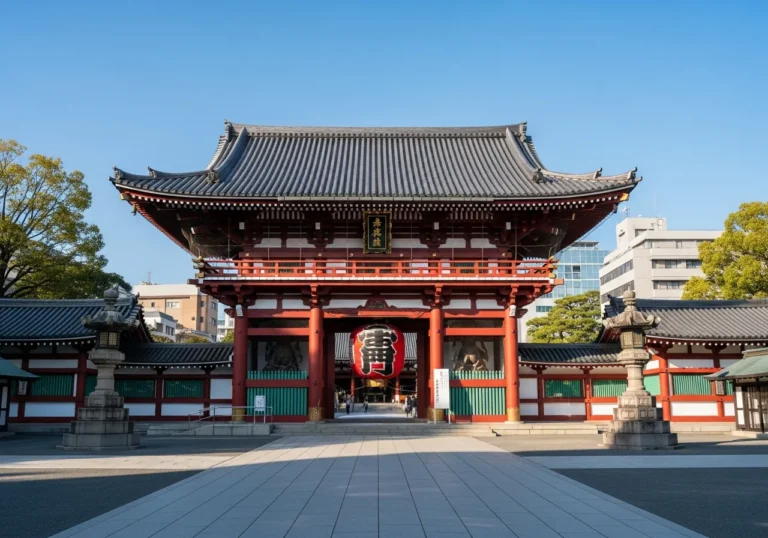
Stand at the north gate of Osaka Tenmangu Shrine on a weekday afternoon and you will hear, before you see anything, the sharp crack of wooden clappers — the kobyōshi — cutting through the noise of Tenjinbashisuji shopping arcade. The sound comes from a low, red-fronted building that looks almost too modest to be the home of a four-hundred-year tradition.
Inside, a performer in a dark kimono sits on a cushion behind a small lacquered table, a folding fan in one hand, a cotton tenugui tucked into his sash. He is playing, simultaneously, a dim-witted apprentice, his exasperated master, and a neighbor who has wandered in at the wrong moment.
The audience — a mix of retired salarymen, university students, and a pair of bewildered tourists who wandered in from the arcade — is laughing hard enough that the wooden benches shake.
This is Kamigata rakugo. And the question worth asking — the question no guidebook bothers with — is why it exists at all, why it exists here specifically, and why the answer to those questions illuminates something essential about Osaka itself.
Why Did a Buddhist Monk Start Telling Jokes?
The origin of rakugo is, appropriately, a story about someone trying to keep an audience awake. Anrakuan Sakuden (1554–1642) was a priest of the Jōdo-shū sect of Buddhism, famous as the author of the Seisuishō — a collection of humorous anecdotes whose title translates, with perfect self-awareness, as “Laughs to Wake You Up.”
He was skilled at talking in a humorous manner, inducing laughs even during his sermons, and at the request of Shigemune Itakura, Governor-General of Kyoto, he wrote the Seisuishō, a pioneering work in the field of collections of funny stories. The collection, compiled in 1623, contained over a thousand comic tales. The Seisuishō is considered a major progenitor of the popular Edo-period literary genre called hanashibon — books of humorous stories.
Why did a senior Buddhist cleric spend his retirement compiling dirty jokes and comic anecdotes? Because the Jōdo sect’s mission was popular accessibility.
Sakuden’s humor was a pedagogical tool — a way of making doctrine stick in the minds of ordinary people who had neither the education nor the patience for abstract theology. The joke was always in service of something larger.
That tension between entertainment and instruction, between the laugh and the lesson, never entirely left the art form he inadvertently founded.
The otogishū — scholars, Buddhist monks, and tea masters who served daimyo — had a duty to give lectures on books to their lords and to be partners in conversation. Anrakuan Sakuden, who was an otogishū and a monk of the Jōdo-shū, is often said to be the originator of rakugo, and his eight volumes of Seisui Shō contain 1,000 stories, including the original stories of rakugo.
When the Sengoku wars ended and the Tokugawa peace settled over Japan, the otogishū lost their role as advisors to warlords. Some therefore began entertaining people on the street with comic stories in exchange for compensation.
Stories thus told on the street became known as tsujibanashi. The court entertainer had become a street performer.
The salary had become a collection plate. And the audience had changed from a single feudal lord to whoever happened to be passing.
Why Here? The Geography of Laughter
Around 1670 in the Edo period, three storytellers appeared who were regarded as the first rakugoka. Tsuyuno Gorobe in Kyoto, Yonezawa Hikohachi in Osaka, and Shikano Buzaemon in Edo built simple huts around the same time and began telling funny stories to the general public for a price. Three cities, three founding figures, three traditions — but the divergence that matters most is the one between Osaka and Edo.
Both Kamigata rakugo and Edo rakugo emerged during the seventeenth century, but Edo rakugo was performed indoors while Kamigata rakugo was performed outdoors. This is not a trivial distinction. It is the single fact that explains almost every subsequent difference between the two traditions.
In Edo, rakugo developed as wealthy patrons invited performers to their residences and other venues to tell stories. It thus became a “parlor art” where performers did not need to employ noise-making tools, so it became a more subtle recitation for subdued spectators.
The audience was captive, already seated, already paying. The performer could afford restraint.
In Osaka, the performer was competing with the noise of the street, the smell of food stalls, the indifference of passersby who had somewhere else to be. The rakugoka performing in the Kamigata style had to devise ways through which they could attract people passing by and hold their attention throughout the performance. This is why Kamigata rakugo, with its stories imbued with traditional Osaka merchant culture, tends to be more flamboyant and cheerful than Edo rakugo.
Since Edo rakugo was performed indoors, patrons were required to pay a fee before being admitted into the theater to watch the performance. With Kamigata rakugo, the performers collected money from the audience members who were still standing around after the performance had concluded.
The business model itself shaped the art. You had to earn the money at the end, which meant you had to keep people there until the end.
Every technique Kamigata rakugo developed — the clapper, the table, the exaggerated gesture, the musical accompaniment — was originally a tool for holding a crowd that had not yet paid.
Why Did Osaka’s Merchant Class Make This Art What It Is?
To understand why Kamigata rakugo took the specific shape it did, you have to understand what Osaka was during the Edo period. Osaka’s economic prosperity during the Edo period fostered the formation of a wealthy merchant class — the chōnin — who became the main patrons of the arts.
It was in Osaka that theatrical genres such as Bunraku puppet theater and Kabuki theater originated and flourished. The city became the center of a vibrant and dynamic urban culture, largely distinct from the more aristocratic culture of Kyoto or the samurai culture of Edo.
The first major flowering of chōnin culture occurred in Osaka during the Genroku era (1688–1704), marked by the rise of jōruri puppet theater and kabuki drama. This was the world that rakugo grew up in: a city of merchants who were officially at the bottom of the Confucian social hierarchy but who controlled the national economy, lent money to daimyo, and had both the wealth and the leisure to demand entertainment that spoke to their experience.
The chōnin were not samurai. They did not want stories about honor, duty, and self-sacrifice.
They wanted stories about people like themselves — or rather, about the comic disasters that befell people like themselves. Kamigata rakugo is “merchant-centered.” There are any number of stories in the repertoire set in and around merchant homes.
Even stories that are not tend to have references to the merchant world or contain qualities beneath the surface that can be associated with Osaka’s historic chōnin class.
But here is the twist that makes the humor actually work. Merchant stories in Kamigata rakugo usually do not reflect the idealized way merchants are perceived to act, think, and feel.
Instead of being presented as hard workers, innovative, and skilled, they are regularly portrayed as unskilled, obtuse, and irresponsible. This incongruity creates the basis for much of the humor in Kamigata rakugo stories, but also points to a transgressive undercurrent in the art.
The merchant class laughed at a satirical portrait of itself. The joke was always partly on the audience — and the audience knew it, and loved it.
This is the specific flavor of Osaka humor that persists to this day: self-deprecating, quick to puncture pretension, suspicious of anyone who takes themselves too seriously. The Osaka personality type that Westerners often encounter — the insistence on being funny, the reflexive deflation of pomposity — has deep roots in three centuries of merchant culture and the art form that merchant culture made.
Why Does Kamigata Rakugo Sound and Look Different?
The physical apparatus of Kamigata rakugo is worth examining in detail, because every element of it has a reason. In Kamigata rakugo, performers use not only a sensu (folding fan) and a tenugui (hand towel), as in Edo rakugo, but also additional props such as a kendai (a small wooden table), a hizakakushi (a knee screen), and hyoshigi (wooden clappers).
A storyteller may strike the kendai with the hyoshigi to produce a sound effect when changing scenes. This practice is believed to have originated from the fact that Kamigata rakugo was often performed outdoors in the past, requiring performers to attract the attention of passersby.
The clapper is a fossil of the street. It was kept indoors long after the performances moved inside because it had become part of the grammar of the form — a punctuation mark that audiences had learned to read.
Kamigata performers move around a great deal, so the hizakakushi (knee screen) is used to hide the performer’s legs from the audience in case their kimono becomes disheveled. The physicality of Kamigata performance — the broader gestures, the more animated facial expressions, the greater bodily movement — is another inheritance from the street. When you are performing for a crowd that can walk away, you perform with your whole body.
Then there is the music. This is perhaps the most striking difference between the two traditions, and the one least known outside Japan.
Although yose theaters are associated with spoken rather than musical events, music is an integral component of Kamigata rakugo performance. It is central both to the rendering of a storyteller’s performance and to creating the overall atmosphere.
Kamigata storytellers consider music to be an integral component of rakugo performance, as demonstrated by the inclusion of debayashi (theme songs played when a performer enters), ukebayashi (withdrawal songs), hamemono (music and musical sound effects), and aibayashi (joining tunes). The yose-bayashi ensemble — shamisen, drums, flutes — sits offstage and responds to the story in real time.
When the storyteller says, for example, “I’m going to Shin-machi, a very merry place,” the musicians in the backstage begin to play the shamisen, expressing the glamour of the district. When a character walks along a deserted street at night, the shamisen player makes a gentle sound to evoke a desolate scene. Background music is often used to represent emotional landscapes, though it can also simulate sounds of various objects.
This is closer to film scoring than to anything in the Western stand-up comedy tradition. The music does not illustrate — it amplifies, colors, and sometimes ironizes.
A performer describing a pompous merchant might have the shamisen play something slightly too grand, and the gap between the music’s grandeur and the character’s actual ridiculousness is itself a joke. It is Osaka rakugo’s origins as a mode of street art that, unlike the more indoor Tokyo rakugo, prompted it to develop the distinctive hade (colorful, flamboyant) style that is characteristic of its kimono and bodily performance as well as its music and sound.
The language is the final and perhaps most fundamental distinction. Kamigata rakugo is performed in the Kansai dialect, while Edo rakugo uses “Edo-kotoba” — the dialect of Edo.
This is not a cosmetic difference. The Kansai dialect — with its distinctive pitch accent, its particular vocabulary, its rhythms that fall differently from standard Japanese — is itself a character in every story.
Characters are portrayed in an intimate manner using dialects from Osaka, Kyoto, and elsewhere, not standard Japanese. When a performer drops into a particularly thick Namba accent, the Osaka audience responds with recognition and warmth.
The dialect is a signal: this story is about us, set in our streets, told in our voice.
Why Did the Tradition Nearly Die — and Why Did It Survive?
The history of Kamigata rakugo in the twentieth century is a story of near-extinction followed by improbable revival, and understanding both requires understanding the specific pressures that bore down on the art.
The first pressure was commercial. In Osaka from the Meiji period to the early Shōwa period, at least ten yose theaters specialized in rakugo.
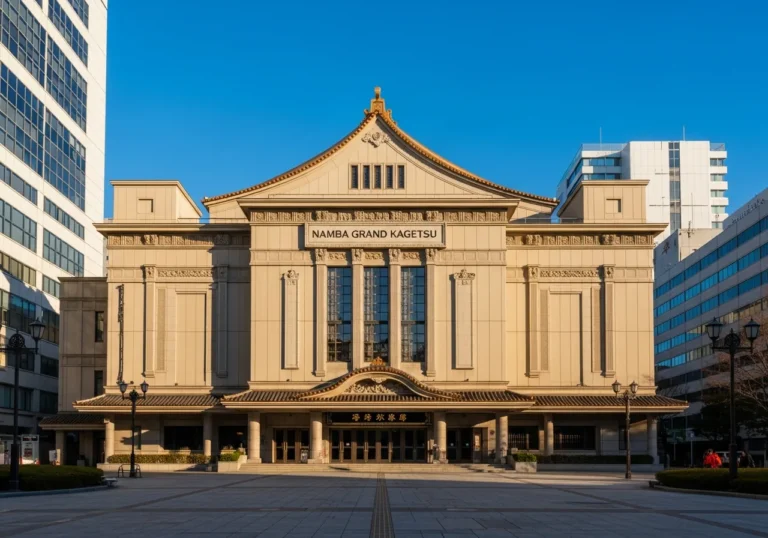
After that, Yoshimoto placed a priority on manzai for performances in yose, and promoted exclusive contracts with rakugo storytellers, having them perform only in “Kagetsu,” a yose that Yoshimoto operated. Consequently, the yose culture in Kamigata rakugo was effectively extinguished.
Yoshimoto Kōgyō — the entertainment conglomerate that now dominates Japanese comedy — was itself born in the neighborhood around Osaka Tenmangu, in a playhouse that later became one of the city’s great rakugo venues. The environs of the current Hanjōtei theater had once been called Tenma Hachiken and been thronged with yose theaters and shibai-goya playhouses.
One of these, a playhouse called the Daini Bungeikan, is said to have been the birthplace of the Yoshimoto Kōgyō entertainment conglomerate. The company that eventually helped strangle the yose tradition was born inside it.
The second pressure was the war. The bombing of Osaka in 1945 destroyed much of the physical infrastructure of the city’s entertainment districts.
There used to be eight vaudeville theaters in the Osaka Tenmangu area, but they disappeared one after another after the war. The performers survived, but the dedicated venues did not.
After 1957, when the last theater closed due to financial difficulties, the yose culture in Osaka was kept by local supporters in the style of “local yose” by using temples, civic halls, and soba-noodle shops as rakugo theaters. The art retreated into borrowed spaces — the back rooms of restaurants, the halls of neighborhood associations, the precincts of local shrines. It survived because it was cheap to stage and because the performers refused to stop performing.
The postwar revival was driven by a generation of extraordinary artists. A postwar giant of Kamigata rakugo, Katsura Beicho captivated audiences with refined narration and profound performances.
Katsura Beicho revitalized Kamigata rakugo for the modern era, leaving an indelible mark. Beicho — designated a Living National Treasure — was the figure who most clearly articulated what was at stake: not just the survival of an entertainment form, but the preservation of a specific way of seeing Osaka, a specific relationship between performer and audience, a specific language of laughter that belonged to this city and nowhere else.
During the 1950s and 1960s, rakugo experienced a revival, thanks in part to its adaptation to new media. Storytellers began appearing on radio and television, bringing rakugo to a broader audience.
The medium changed; the form adapted. Overcoming power schism, Kamigata rakugo united and formed the Kamigata Rakugo Association in 1957, heading for its miraculous revival.
Why Did It Take Until 2006 to Get a Permanent Home?
The question of the Tenma Tenjin Hanjōtei is, at its core, a question about institutional will and civic identity. For nearly half a century after the war, Kamigata rakugo had no permanent dedicated venue. The art survived, but it was homeless.
In 2003, the inaugurated Kamigata Rakugo Association chairman, Katsura Sanshi, made a request to Tenjinbashisuji Shopping Street for a vacant store in an attempt to revive theater as a means of revitalizing the area in addition to passing down and further developing the culture of traditional performing arts. Thanks to the kindness of Osaka Tenmangu’s chief priest, a space on the site of the shrine was offered at no charge, and that was how a venue specializing in rakugo came to be there.
The Kamigata Rakugo Association and the local shopping district started a fundraising campaign calling for the revival of yose with the aim of passing on and developing the performing arts culture and revitalizing the town. It opened in 2006, the first time in 60 years, with donations from citizens.
The location was not accidental. The area around where the Hanjōtei stands used to be called “Tenma Hakken,” where yose theaters and playhouses used to be crowded.
The theater was built on the ghost of the tradition it was reviving. And the fact that it required citizen donations — that the people of Osaka reached into their own pockets to fund a rakugo theater — says something important about the relationship between this city and this art form.
It is not a government-subsidized heritage project. It is something Osaka wanted badly enough to pay for itself.
The Hanjōtei is the first Kamigata rakugo performance venue to be revived in the Kansai region in the 60 years since the end of World War II. Since its opening in September 2006, it has been loved by many people and has become a bustling new landmark in Osaka.
The revival was also driven by a broader institutional campaign. From 2004 to 2017, Kamigata Rakugo Kyōkai — the professional comic storytelling guild for the Osaka area — issued the magazine Nna aho na (“That’s ridiculous”). Concurrent with the tenure of one of the art’s most recognizable and progressive artists, Katsura Bunshi VI, as chairperson, the magazine hailed Kamigata rakugo’s “new era.” It heralded the first dedicated rakugo hall open in Osaka in 60 years, as well as several other major enterprises.
Why Does the Apprenticeship System Matter?
One of the most misunderstood aspects of rakugo — and one of the most important for understanding why the tradition has survived at all — is the ichimon system: the network of artistic families through which knowledge, stories, and technique are transmitted from master to disciple.
In rakugo, stories and music are transmitted through oral interaction from master to apprentice storyteller. All Kamigata storytellers and the majority of ohayashi musicians belong to an ichimon — an artistic family — in which all performers follow and abide by a strict autocratic hierarchical structure.
In order to become a recognized professional rakugo storyteller, an apprenticeship with a rakugo master must be completed. The master gives the apprentice a stage name.
The strict apprenticeship lasts for three years and, depending on the master, the apprentice may not drink, smoke, go on dates, and may have a curfew. The apprentice must clean the master’s house, do laundry, cook, prepare and fold kimonos, and other chores.
They learn the art of storytelling by watching and imitating the master’s performances.
The Kamigata apprenticeship is notably shorter than its Tokyo counterpart. Kamigata rakugo practitioners engage in an apprenticeship lasting three years.
Their counterparts in Tokyo endure an apprenticeship program which can last a grueling fifteen years. This difference reflects the different character of the two traditions: Kamigata rakugo prizes accessibility and entertainment over refinement and exclusivity.
The art is meant to be learned quickly enough that you can get out there and make people laugh.
Throughout their career, performers are only allowed to perform a given story once permission to do that story has been granted by a master storyteller. This is not bureaucratic gatekeeping — it is the mechanism by which the oral tradition maintains its integrity.
A story is not just a text; it is a performance tradition, a set of choices about timing and emphasis and character that has been refined over generations. When a master grants permission to perform a story, they are transmitting not just the words but the accumulated wisdom of everyone who has performed it before.
As part of their apprenticeship, apprentice storytellers are required to learn a narimono instrument — either percussion or flute. Learning an instrument is fundamental to rakugo training, as it aids in developing a sense of rhythm that is integral in storytelling. The musician and the storyteller are trained together, which is why the music in Kamigata rakugo feels so integrated rather than incidental.
The great Kamigata families — the Katsura and the Shōfukutei — have been the backbone of the tradition for centuries. Alongside the Katsura family, the Shōfukutei family forms a major family of modern Kamigata rakugo.
It already existed between the Tenpō and the Ansei eras, though details of its founder, Shōchiku Shōfukutei, are unknown. Four families — Katsura, Shōfukutei, Tachikawa, and Hayashiya — constituted the mainstream of Kamigata rakugo up to the Meiji period.
Why Does Kamigata Rakugo Matter to Osaka’s Identity Today?
The term “Kamigata rakugo” itself is relatively recent. According to the “Dictionary of Backstage Slang in the Rakugo Theater” by Kurimaru Kagetsutei, the term “Kamigata rakugo” first appeared in the nineteenth issue of the journal Kamigata, published on July 1, 1932. Until then it was called “Osaka rakugo” or “Kyoto rakugo.” The naming of the tradition was itself an act of identity formation — a declaration that this was a unified art with a shared character, not just a collection of local practices.
Today, Kamigata rakugo refers to Osaka rakugo, as the Kyoto counterpart died out. The Kyoto tradition is gone.
What remains is specifically Osaka’s — and Osaka knows it. The Hanjōtei is not just a theater; it is a civic institution, a place where the city’s self-image is performed and renewed every afternoon.
The stories themselves are a living archive of the city. Many of the stories told in Edo and Tokyo were originally imported from Osaka.
The traffic of influence ran westward to east, not the other way around — a fact that tends to surprise people who assume Tokyo has always been the cultural center of Japan. Kamigata rakugo was the source, not the tributary.
Kamigata rakugo is characterized by light storytelling, comical acting, and content that reflects modern society. The story unfolds one after another, and the clever pauses keep the audience entertained.
The tradition has never been static. New stories — shinsaku rakugo — are written and performed alongside the classical repertoire, and the tension between the two is itself a productive creative force.
Even though the style of performance and presentation of rakugo has changed very little since the art form was formally established in the late eighteenth century, calling it Japan’s traditional art gives it a sense of inflexibility. On the contrary, rakugo, unlike Noh and kabuki, is very adaptable.
The adaptability extends to language. Recently, Japan has seen the rise of storytellers performing in English, including Katsura Kaishi. Also active on the scene is Diane Kichijitsu, an Osaka-based bilingual rakugoka who was born in Liverpool in Britain and fell in love with the art after coming to Japan in 1990.
The most internationally visible figure in this movement is Katsura Sunshine, a Canadian who became the first Western professional practitioner of the Kamigata tradition. On September 1, 2008, he was accepted as an apprentice to the great rakugo storytelling master Katsura Bunshi VI, and received from his master the rakugo name Katsura Sunshine. Sunshine is the first-ever Western rakugo storyteller in the history of the “Kamigata” rakugo tradition, based in Osaka, and only the second ever in the history of Japan.
Katsura Sunshine completed his grueling traditional apprenticeship in rakugo comic storytelling under the great rakugo master Katsura Bunshi VI in 2011. He has since performed on five continents, bringing Kamigata stories to audiences who have never set foot in Osaka. The fact that the stories translate — that a joke about a dim-witted Osaka merchant can make a New York audience laugh — is itself evidence of something the tradition has always known: the human comedy is universal, even when it is told in the most specific possible local voice.
Why Should a Discerning Traveler Care?
There is a category of cultural experience that travel writing tends to oversell: the “authentic” encounter with a tradition that turns out to be a performance staged for tourists. Kamigata rakugo at the Hanjōtei is not that.
The matinée audience on any given weekday is overwhelmingly Japanese, mostly local, and entirely unimpressed by the presence of foreign visitors. The performers are not performing for you.
They are performing for Osaka.
That is precisely why it is worth attending. Kamigata rakugo offers fun and laughter along with chances to learn about the dialect and culture of the Kamigata area centered around Osaka and Kyoto — a form of traditional performance with an air of casual informality.
The informality is real. This is not the hushed reverence of a Noh performance or the elaborate ritual of kabuki.
People eat snacks. They laugh loudly.
They occasionally fall asleep, and the performer will clack the kobyōshi to wake them.
A recent survey found that 26.4% of Japanese people had attended a rakugo performance, putting it ahead of other disciplines such as kabuki, nōgaku, and buyō (traditional dance). Rakugo is more popular than kabuki.
It is more popular than Noh. It is the most widely attended traditional performing art in Japan, and it is almost entirely unknown in the West.
That gap between its domestic importance and its international obscurity is itself a reason to seek it out.
For the non-Japanese speaker, the language barrier is real but not absolute. The physical comedy — the mime of pouring sake, the pantomime of a man trying to sneak out of a house, the exaggerated double-take of a character confronted with an unexpected situation — reads across languages.
Every rakugo story traditionally ends with a final ochi, often translated as a “punchline,” though it is closer to a clever wrap-up that makes everything click. Unlike stand-up comedy, where humor builds toward multiple punchlines, rakugo locates its comedy within the storytelling itself: the characters, their quirks, and the relatable absurdities of everyday life.
What you are watching, even if you cannot follow every word, is a performer doing something that no technology can replicate: conjuring an entire world — multiple characters, a specific place, a particular moment in time — using only a fan, a cloth, and the resources of their own body and voice. Rakugo has been described as “a sitcom with one person playing all the parts.” That description is accurate, but it undersells the craft.
A sitcom has writers, directors, sets, costumes, and a cast. A rakugoka has a cushion and thirty years of training.
The deeper significance is this: Kamigata rakugo is one of the few places in contemporary Osaka where you can hear the city’s self-image articulated in its own voice, in its own dialect, through stories that have been refined by the specific pressures of this specific place. The merchant who is too clever by half and ends up outwitting himself.
The apprentice who misunderstands every instruction. The neighbor who cannot mind his own business.
These are Osaka archetypes, and they have been Osaka archetypes for three hundred years. Sitting in the Hanjōtei, you are not watching a museum piece.
You are watching a city laugh at itself, which is what cities do when they are confident enough in their own identity to find it funny.
Frequently Asked Questions
Q: Do I need to speak Japanese to enjoy Kamigata rakugo at the Hanjōtei?
A: Japanese fluency helps, but is not essential. The physical comedy, mime, and timing are legible across languages, and the Hanjōtei occasionally hosts multilingual or English-friendly performances. Arriving with some basic knowledge of the stories being performed — many are available in English summary online — significantly enriches the experience.
Q: What is the difference between Kamigata rakugo and manzai?
A: Manzai is a two-person comedy dialogue form — the boke (fool) and tsukkomi (straight man) — that is fast, loud, and built on rapid-fire exchanges. Kamigata rakugo is a solo form in which one performer plays all the characters in a sustained narrative. Both are deeply Osaka arts, and both appear on the Hanjōtei program, but they are structurally and temperamentally distinct.
Q: How long is a typical performance at the Hanjōtei?
A: Rakugo performances are held every day, with daytime performances changing weekly and nightly performances changing daily. The daytime matinée runs approximately two and a half hours and typically includes eight acts, of which two are non-rakugo variety performances such as manzai or magic.
Q: How much does it cost to attend?
A: Daytime yose tickets cost 2,500 yen in advance or 2,800 yen at the door for adults; students pay 1,000 yen in advance or 1,500 yen at the counter. Evening show prices vary by program. Confirm current pricing on the official site before visiting.
Q: Is Kamigata rakugo a dying art?
A: The evidence suggests the opposite. 62.1% of Japanese people in their twenties first experienced rakugo at school, and the Hanjōtei has been consistently popular since its 2006 opening.
The international English-language performances of artists like Katsura Sunshine have introduced the form to new audiences on five continents. The tradition is alive, contested, and evolving — which is exactly what a healthy art form looks like.
Tenma Tenjin Hanjōtei — Visitor Information
Address: 2-1-34 Tenjinbashi, Kita-ku, Osaka 530-0041 / 〒530-0041 大阪市北区天神橋2丁目1-34
Nearest station: Minamimorimachi Station (Osaka Metro Tanimachi Line / Sakaisuji Line), Exit 4-B — 3-minute walk; Osakatemmangu Station (JR Tozai Line), Exit 3 — 3-minute walk
Hours: Daytime yose approx. 2:00 pm – 4:30 pm daily; evening shows from approx. 6:30 pm or 7:00 pm (times vary by program — confirm on official site)
Admission: Daytime approx. ¥2,500 advance / ¥2,800 at door (adults); ¥1,000 advance / ¥1,500 at door (students); evening prices vary. Figures approximate as of September 2026 — confirm on official site before visiting.
Official site: hanjotei.jp