Looking for the Danjiri Festival in Osaka? This guide covers everything you need to know — what it is, when it runs, where to watch, and how to get there. The main event is in Kishiwada, about 40 minutes from central Osaka, and it happens twice a year: a massive September run and a quieter October edition. If you can only do one, go in September.
MICHI’s Pick — Selected by our Osaka-based team, based on places we’ve visited and on research using Tabelog and Google Maps ratings. In Japan, a Tabelog score of 3.4+ is genuinely high — Japanese reviewers are famously strict, and most locals consider anything above 3.4 a place worth a detour. We feature venues meeting at least one of: Tabelog 3.4+, Google Maps 4.3+, or 100+ reviews — the kind of spots locals quietly trust.
Tabelog and Google Maps scores are accurate as of the time of writing.
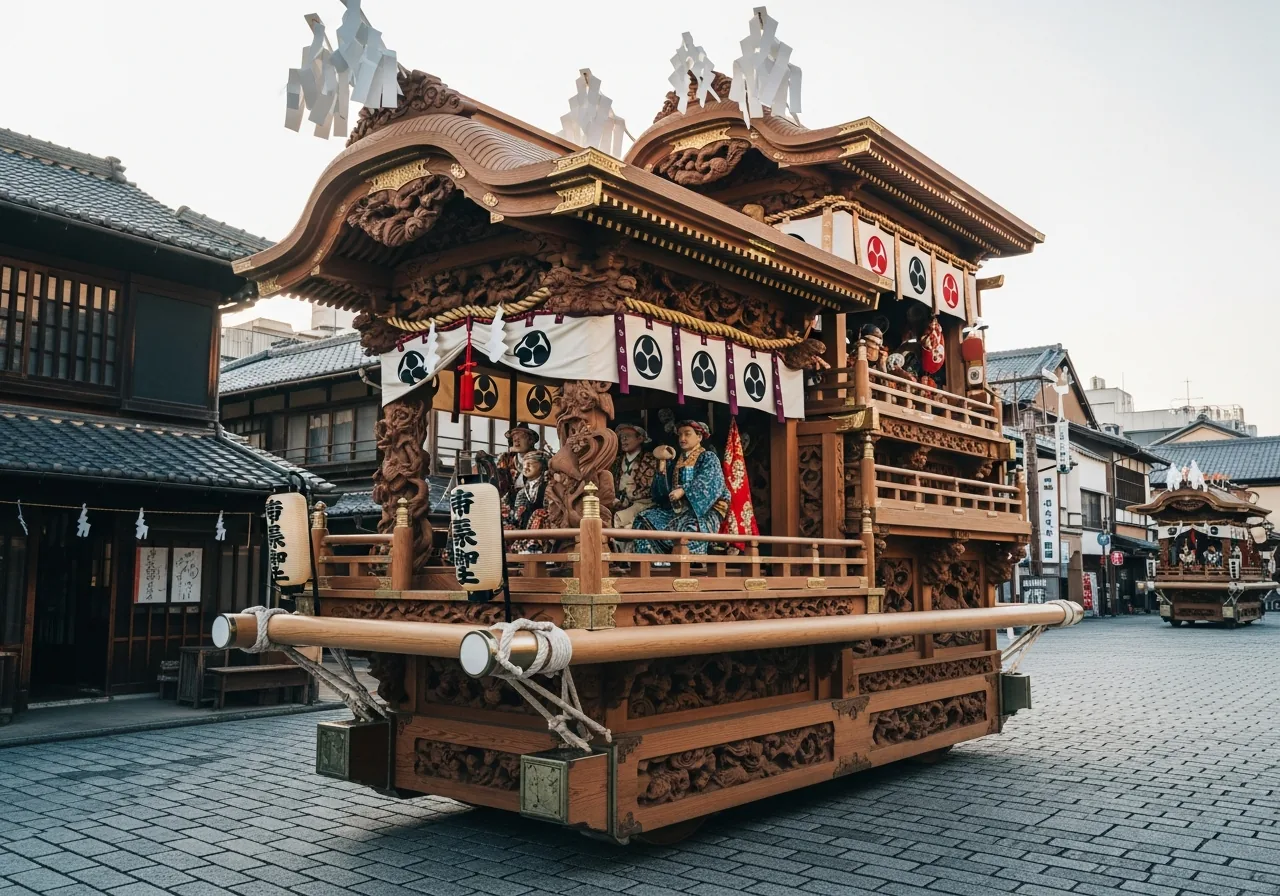
The Danjiri Festival (だんじり祭り) is one of the most viscerally exciting things you can witness in Japan — and one of the most genuinely dangerous. The Kishiwada Danjiri Matsuri is the largest danjiri festival in Japan, where neighbourhoods compete by racing 35 four-tonne floats through the streets of Kishiwada. This isn’t a polished parade. Each float represents a different competing district, and the teams that pull them rush fearlessly through the streets, taking corners at frightening speeds — it is not unusual for people to be hurt, and in the past people have even been killed. That’s not a warning to stay away. It’s the whole point.
For everything else to do and eat while you’re in the area, check out the best food in Osaka — Kishiwada’s old town has solid options for a post-festival meal.
1. The September Festival — The Main Event (9月祭礼)
📍 Around Kishiwada Station and Kishiwada Castle, Kishiwada City, Osaka Prefecture
🕐 Eve of Festival (Yomiya): 6:00 AM–10:00 PM; Main Festival (Honmiya): 9:00 AM–10:00 PM (as of May 2026)
💰 Free to watch standing / Paid grandstand seats from ¥1,000
🚃 Kishiwada Station (Nankai Main Line) — 5 min walk to main route
🗣 English menu: N/A (outdoor festival)
🗺 Open in Google Maps
📋 Tabelog
What to order: Food stalls (yatai) line the festival route — takoyaki and yakitori from ¥400–¥700
The 2026 Kishiwada Danjiri Festival runs September 18–20, with the September edition considered the main event. Teams of hundreds of men pull massive wooden floats weighing four tonnes through narrow streets at full sprint, with the signature moment being the yarimawashi — when the danjiri are swung around street corners at high speed, with a dancer performing acrobatics on the roof. Get there early on the first day: on day one, a parade takes place in front of Kishiwada Station from 6 AM to 10 PM.
2. The October Festival — Smaller, Calmer, Worth It (10月祭礼)
📍 Around JR Kumeda, Shimomatsu, and Higashi-Kishiwada Stations, Kishiwada City, Osaka Prefecture
🕐 Eve of Festival: 6:00 AM–10:00 PM; Main Festival: 7:00 AM–10:00 PM (as of May 2026)
💰 Free to watch standing
🚃 JR Kumeda Station (JR Hanwa Line) — 5 min walk
🗣 English menu: N/A (outdoor festival)
🗺 Open in Google Maps
📋 Tabelog
What to order: Local yatai snacks along the route — ¥400–¥800
The Kishiwada Danjiri Matsuri is held twice a year, with the larger celebration in mid-September and a smaller one in early October in a different part of the city — the September festival is staged on the Hamate (beach) side, while the October version unfolds on the Yamate (hilly) side. The October festival offers a different atmosphere from September’s, with a more local community focus. Crowds are thinner, you can actually move, and the photography is better for it.
3. The Yarimawashi — Where to Stand (やりまわし観覧)
📍 Kankan-ba intersection and Sakaimachi intersection, central Kishiwada, Osaka Prefecture
🕐 Throughout festival hours (as of May 2026)
💰 Free (standing) / Grandstand seats from ¥1,000
🚃 Kishiwada Station (Nankai Main Line) — 8 min walk
🗺 Open in Google Maps
📋 Tabelog
What to order: N/A — this is a viewing spot, not a venue
The highlight of the festival is the yarimawashi, where a danjiri weighing approximately four tonnes makes a sharp turn at intersections at full speed, drawing loud cheers from spectators. The Kankan-ba intersection is the prime spot — paid grandstand seats face it directly. Stay behind barriers and follow staff instructions: the danjiri are heavy and fast, and this is not a casual stroll.
4. The Daikugata — The Man on the Roof (大工方)
📍 Visible throughout the festival route, Kishiwada, Osaka Prefecture
🕐 Throughout festival hours (as of May 2026)
💰 Free to watch
🚃 Kishiwada Station (Nankai Main Line) — 5 min walk to main route
🗺 Open in Google Maps
📋 Tabelog
What to order: N/A — this is a performance element, not a venue
Perched on top of each float is the star of the show — the daikugata (carpenter), who dances wildly on the danjiri roof. The most famous move is the “Hikokinori” (Airplane Dance), and the highly privileged and dangerous position is reserved exclusively for local carpenters. Each float weighs close to four tonnes and is yanked through narrow streets at breakneck speed by teams of 500 or more locals. Watching the daikugata hold his balance through a yarimawashi corner is the single most jaw-dropping moment of the entire festival.
5. The Night Lantern Procession — Chochin Hikiko (提灯曳行)
📍 Festival route through central Kishiwada, Osaka Prefecture
🕐 From dusk on both festival days (as of May 2026)
💰 Free to watch
🚃 Kishiwada Station (Nankai Main Line) — 5 min walk
🗺 Open in Google Maps
📋 Tabelog
What to order: N/A — evening street food stalls nearby from ¥400
Most visitors leave after the afternoon runs and miss the best part. At night, the floats are strewn with lanterns, which make an impressive sight. The pace slows, the energy shifts from adrenaline to something more ceremonial, and the whole float glows red against the dark streets. Stay for it.
6. Kishiwada Danjiri Kaikan (岸和田だんじり会館)
📍 11-23 Honmachi, Kishiwada City, Osaka Prefecture
🕐 10:00 AM–5:00 PM (closed Mondays) (as of May 2026)
💰 Adults ¥600 / Children ¥300 (combo ticket with Kishiwada Castle and Nature Museum: ¥700)
🚃 Takojizo Station (Nankai Main Line) — 7 min walk
🗣 English menu: Yes (foreign language support available)
⭐ Rating: Google 4.2 (800+ reviews) (as of writing)
🗺 Open in Google Maps
📋 Tabelog
🌐 Official site
What to order: N/A — museum admission ¥600
The Kishiwada Danjiri Kaikan is a facility where you can witness the festival’s long history and power — and in March 2024, it was renovated to incorporate the latest video technology. You can get up close with the oldest Kishiwada-type danjiri float in existence, as well as antique floats from the Edo and Meiji periods, and the large multi-vision video near the entrance is a must-see. If you can’t make it in September, this is the next best thing — and even if you can, come here first to understand what you’re about to watch.
7. Kishiwada Castle — Festival Backdrop (岸和田城)
📍 9-1 Kishikicho, Kishiwada City, Osaka Prefecture
🕐 10:00 AM–5:00 PM (closed Mondays) (as of May 2026)
💰 Adults ¥300 / Free for junior high school students and under (combo ticket with Danjiri Kaikan and Nature Museum: ¥700)
🚃 Takojizo Station (Nankai Main Line) — 7 min walk
⭐ Rating: Google 4.2 (3,000+ reviews) (as of writing)
🗺 Open in Google Maps
📋 Tabelog
What to order: N/A — castle admission ¥300
During the September festival, 15 danjiri enter Kishijo Shrine inside the castle grounds, and the yarimawashi up the Konakara-zaka slope from the old Ote-mon Gate ruins is the most spectacular part of the entire event. The Kishiwada Danjiri Kaikan is located adjacent to the castle, so you can knock out both in a single morning. Outside festival season, the castle’s garden — a nationally designated scenic beauty spot — is worth the ¥300 on its own.
8. Getting There from Osaka — Access Guide (アクセス)
📍 Kishiwada Station, Kishiwada City, Osaka Prefecture
🕐 Trains run throughout the day (as of May 2026)
💰 ¥580–¥830 from Namba (Nankai Line)
🚃 Kishiwada Station (Nankai Main Line) — main festival hub
🗺 Open in Google Maps
📋 Tabelog
What to order: N/A — transport hub
Head to Kishiwada Station on the Nankai Line — it’s 25 minutes from Shinimamiya Station, which can be reached on the Osaka Loop Line. From Osaka Station the journey takes around 45 minutes. Alternatively, catch a direct Nankai train from Namba Nankai Station, taking 25 minutes. On festival days, trains run frequently but get packed — aim to arrive before 8 AM if you want a decent spot. Do not drive. Road closures are extensive and parking is essentially nonexistent near the route.
Want to plan your full trip around the festival? The MICHI Osaka travel guide covers accommodation, transport, and day-trip logistics. And for everything beyond the festival itself, explore more of Osaka — the city has enough to fill a week on either side of the September dates.
FAQ
Q: What is the best Danjiri Festival experience in Osaka?
A: The September festival in Kishiwada is the one to prioritise. Station yourself at the Kankan-ba intersection for the yarimawashi, arrive before 8 AM on the first day, and stay until after dark for the lantern procession — those are the three moments that define the whole event.
Q: How many Danjiri festivals are there in Osaka?
A: The Kishiwada Danjiri Matsuri runs twice a year — September and October — and is by far the most famous. Smaller danjiri festivals take place at shrines across Osaka Prefecture throughout autumn, but none match Kishiwada’s scale or intensity.
Q: Do Osaka festival areas have English support?
A: The Kishiwada Danjiri Kaikan museum offers foreign language support, and signage around the main festival route has some English. The festival itself is an outdoor public event — no ticket or registration required to watch from the street, so language is rarely a barrier.
Q: What should I watch for at the Danjiri Festival in Osaka?
A: Three things: the yarimawashi (the sharp-corner sprint), the daikugata dancer on the roof, and the evening lantern procession. The yarimawashi is the headline act — a four-tonne float taking a 90-degree corner at full speed is something you genuinely cannot prepare yourself for until you see it.
Last updated: July 19, 2026 · Corrections: [email protected]