Looking for the story of Osaka’s chonin merchants? This deep-dive covers the merchant class that turned Osaka into Japan’s commercial engine — who they were, how they operated, what they built, and why their influence still shapes the city you’re walking through today.
MICHI’s Pick — Selected by our Osaka-based team, based on places we’ve visited and on research using Tabelog and Google Maps ratings. In Japan, a Tabelog score of 3.4+ is genuinely high — Japanese reviewers are famously strict, and most locals consider anything above 3.4 a place worth a detour. We feature venues meeting at least one of: Tabelog 3.4+, Google Maps 4.3+, or 100+ reviews — the kind of spots locals quietly trust.
Tabelog and Google Maps scores are accurate as of the time of writing.
Who Were the Chonin?
Chonin (townspeople) emerged as a distinct social class during the Edo period of Japanese history. The word covers merchants, craftsmen, and tradespeople — anyone who wasn’t a samurai, a farmer, or a noble. Positioned third in the traditional social order — below samurai and farmers — the chonin inhabited designated city wards in castle towns like Edo, Osaka, and Kyoto, where they supplied luxury goods, crafts, and commercial services to samurai, nobility, and growing urban populations.
On paper, they sat near the bottom of the hierarchy. In practice, they ran the economy. The Edo period saw a dramatic shift from a land-based economy to a monetary one, creating fertile ground for merchants to thrive. Merchants grew increasingly powerful during the Edo period, in spite of their social standing, and the top merchants commanded a certain amount of respect, with Osaka and later Edo becoming centres of trade and manufacturing.
Osaka was their capital. Osaka and Kyoto became busy trading and handicraft production centres, while Edo was the centre for the supply of food and essential urban consumer goods. The city earned the nickname “the nation’s kitchen” — not because it grew food, but because it processed, financed, and distributed it to the rest of Japan. If you want to explore more of Osaka, understanding the chonin is the best place to start.
The Dojima Rice Exchange: The World’s First Futures Market
The Dojima Rice Market in Osaka was particularly influential, dealing in rice futures and having a nationwide impact on rice prices. This wasn’t a simple marketplace where farmers sold sacks of grain. Right in the middle of this rice economy, something extraordinary happened: the world’s first organised futures market was born at the Dojima Rice Exchange. Merchants didn’t just trade physical rice — they traded “rice coupons” representing future harvests. This was sophisticated financial engineering centuries before Wall Street existed.
Approximately 10% of all wholesalers in the city worked in the rice exchange. At this time there were 9,000 private rice brokers and another 2,300 independent rice agents. It is estimated that 10 million bushels of rice were traded each year in Osaka alone. Very little rice was eaten in Osaka. Most was shipped to Edo (Tokyo) for consumption.
During the Edo period, Nakanoshima and its surrounding area grew into a vital hub of commerce and logistics, its influence extending well beyond Osaka itself. It was packed with kurayashiki (storehouse-residences) used by daimyo (feudal lords) to manage, store, and sell rice collected as tax. At its peak in the early 1800s, Osaka housed more than 110 of such kurayashiki. Chonin kuramoto oversaw the storage and sale of rice, and kakeya acted as financial agents, operating much like modern bankers. Walk through Nakanoshima today and you’re standing on what was once the most sophisticated commodity-trading district in the pre-industrial world.
The Great Merchant Houses: Mitsui, Sumitomo, and Konoike
The most powerful merchant houses, including the Mitsui, Sumitomo, and Konoike families, not only continued into modern times but also played a significant role in samurai finances. These weren’t just wealthy traders — they were proto-bankers, logistics operators, and political power brokers, all while officially ranking below farmers in the social order.
Firms originating in the 17th century, such as Sumitomo — founded by Masatomo Sumitomo with a Kyoto book and medicine shop in the early 1600s — and Mitsui, which opened its Edo textile store Echigoya in 1673, leveraged accumulated capital and commercial networks to finance heavy industries like mining, shipping, and banking during the rapid modernisation drive.
The great houses — Mitsui, Sumitomo, Konoike — didn’t survive by luck or force. They survived by following strict family precepts (kakun) that were passed down like sacred texts. Some became wealthy to the point where they could lend money to impecunious local daimyo. Many peasants and samurai were heavily indebted to the chonin, resulting in considerable resentment and social tension. The samurai had the swords; the merchants had the ledgers. The ledgers won.
By the mid-18th century, this dynamic had elevated select chonin families, such as Mitsui and Sumitomo, to positions of substantial wealth accumulation, laying groundwork for their enduring influence. These entities provided the financial backbone for state-led initiatives, enabling Japan to transition from agrarian feudalism to export-oriented manufacturing by the 1890s, with zaibatsu controlling over half of banking assets and key sectors by 1910. The Sumitomo Group’s donation of the Ataka Collection to Osaka City — now housed in the Museum of Oriental Ceramics on Nakanoshima — is a direct, visible legacy of that wealth.
Chonindo: The Merchant Code
Chonindo (the way of the townspeople) emerged as a way of life of the chonin during the Edo period of Japanese history. It was a distinct culture that arose in cities such as Osaka, Kyoto, and Edo. It encouraged aspiration to bushido qualities — diligence, honesty, honour, loyalty, and frugality — while blending Shinto, Neo-Confucian, and Buddhist beliefs.
This wasn’t just philosophy. It was competitive strategy. It required an incredible level of trust (shin’yo), credit, and mutual accountability — values that are still the backbone of Kansai business today. The principle of sanpo yoshi — “good for the seller, good for the buyer, good for society” — originated with Omi merchants and was widely adopted across Osaka trading houses. It’s the reason Osaka business culture still prizes long-term relationships over short-term wins.
Most significantly, the chonin had no political representation or influence within the samurai-led government. Despite their limitations, merchants found certain advantages in their position. Lacking political power, they were generally left to their affairs, which allowed them to accumulate wealth and establish their way of life. In fact, they acquired a form of indirect political influence through their control of key aspects of the national economy.
The Culture They Built: Kabuki, Bunraku, and the Floating World
Osaka’s economic prosperity during the Edo period fostered the formation of a wealthy merchant class, who became the main patrons of the arts. It was in Osaka that theatrical genres such as Bunraku puppet theatre and Kabuki theatre originated and flourished. The city became the centre of a vibrant and dynamic urban culture, largely distinct from the more aristocratic culture of Kyoto or the samurai culture of Edo.
The first major flowering of chonin culture occurred in Osaka during the Genroku era (1688–1704), marked by the rise of joruri puppet theatre and kabuki drama, exemplified by the plays of Chikamatsu Monzaemon. Ihara Saikaku (1642–1693), a prominent Osaka-based writer, pioneered the ukiyo-zoshi genre in the 1680s, producing novels that vividly portrayed chonin life amid urban prosperity. In works such as Nihon eitaigura (1688), Saikaku chronicled a merchant family’s multi-generational wealth accumulation through rigorous frugality and calculated risks, satirizing excesses like lavish spending that led to financial ruin.
Edo fashion was marked by a constant tension between the lavish kimonos of wealthy merchants and the sumptuary laws of the shogunate, which regularly attempted to prohibit the lower classes from wearing overly luxurious clothing. In response, the chonin developed an aesthetic of discreet refinement — luxurious in its understated appearance, particularly manifested in the inner lining of the kimono: plain on the outside to adhere to the codes, but dazzling on the inside to subtly assert wealth. That instinct for hidden quality over visible ostentation is still very much alive in Osaka today — you’ll find it in the best food in Osaka, where the most extraordinary meals often happen behind unmarked doors.
For the first time, urban populations had the means and leisure time to support a new mass culture. Their search for enjoyment became known as ukiyo (the floating world), an ideal world of fashion and popular entertainment. Chonin acted as sponsors of arts and sciences. The term chonin-bunka refers to a new style of urban and popular culture that thrived thanks to the wealthy merchants who contributed to the flourishing of kabuki, ukiyo-e, joruri and literary genres such as chonin-mono.
From Merchants to Industrialists: The Meiji Transformation
The end of the Edo period in 1868 could have been the end of Osaka’s merchant story. The Tokugawa shogunate fell. The new Meiji government moved the capital to Tokyo, and the old rice-based economy that had made Osaka the Nation’s Kitchen suddenly lost its foundation.
It didn’t end. It pivoted. Osaka became the “Manchester of the Orient” — a nickname earned through textiles, shipbuilding, and machinery. By the early 20th century, companies like Toyobo, Kanebo, and Matsushita (later Panasonic) were born or grew dramatically in Osaka. The city briefly surpassed Tokyo in population and economic power.
Sumitomo and Mitsui reinvented themselves as zaibatsu conglomerates, then keiretsu groups, always keeping the family precept of “trust first, profit second.” Quite a few big Japanese enterprises, many still in existence, were founded by rich chonin. The names on Osaka’s corporate skyline — Sumitomo, Panasonic, Sharp — trace directly back to the merchant houses of the Edo period.
Where to See the Chonin Legacy Today
The chonin didn’t just leave behind corporate logos. They left a physical city. Here are the places in Osaka where their story is most tangible.
Nakanoshima Island (Kita Ward): The three-kilometre sandbank between the Dojima and Tosabori rivers was the nerve centre of Edo-period commerce. During the Edo period, Nakanoshima and its surrounding area grew into a vital hub of commerce and logistics, its influence extending well beyond Osaka itself. It was packed with kurayashiki — storehouse-residences used by daimyo to manage, store, and sell rice collected as tax. Today it’s home to the Osaka City Central Public Hall (1918), the Museum of Oriental Ceramics, and Nakanoshima Park — all built on the same ground where rice coupons once changed hands by the millions.
The Museum of Oriental Ceramics, Osaka: Founded in November 1982, the museum was established by Osaka City, commemorating the donation of the world-renowned Ataka Collection by the twenty-one companies of the Sumitomo Group. A celadon bottle passed down through the wealthy Osaka merchant family, the Konoike, during the Edo period is among the highlights. The collection is a direct material trace of chonin wealth and taste.
Osaka Museum of History (Otemae): The museum vividly portrays the vibrant merchant culture, known as chonin, with detailed dioramas of bustling street scenes, traditional shops, and period clothing. You’ll see genuine artefacts from daily life, including household items, tools, and intricate crafts that speak to the ingenuity of Osaka’s artisans. The tenth-floor view over Osaka Castle and the surrounding city puts the whole story in geographic context.
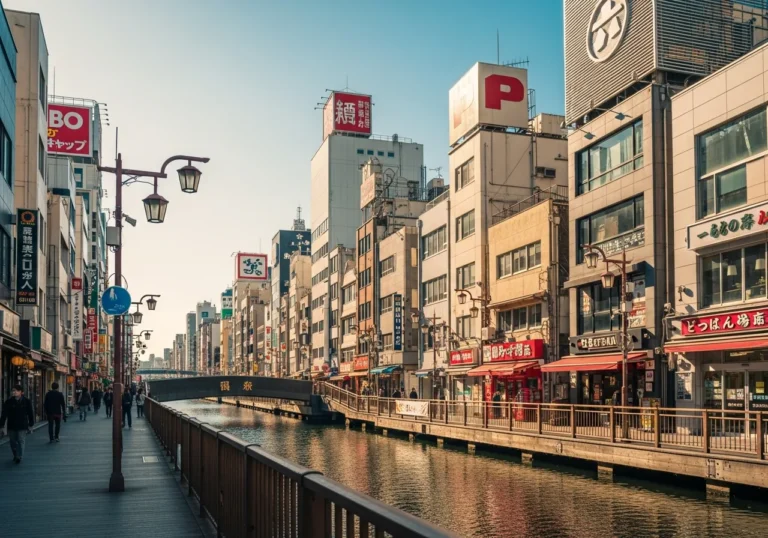
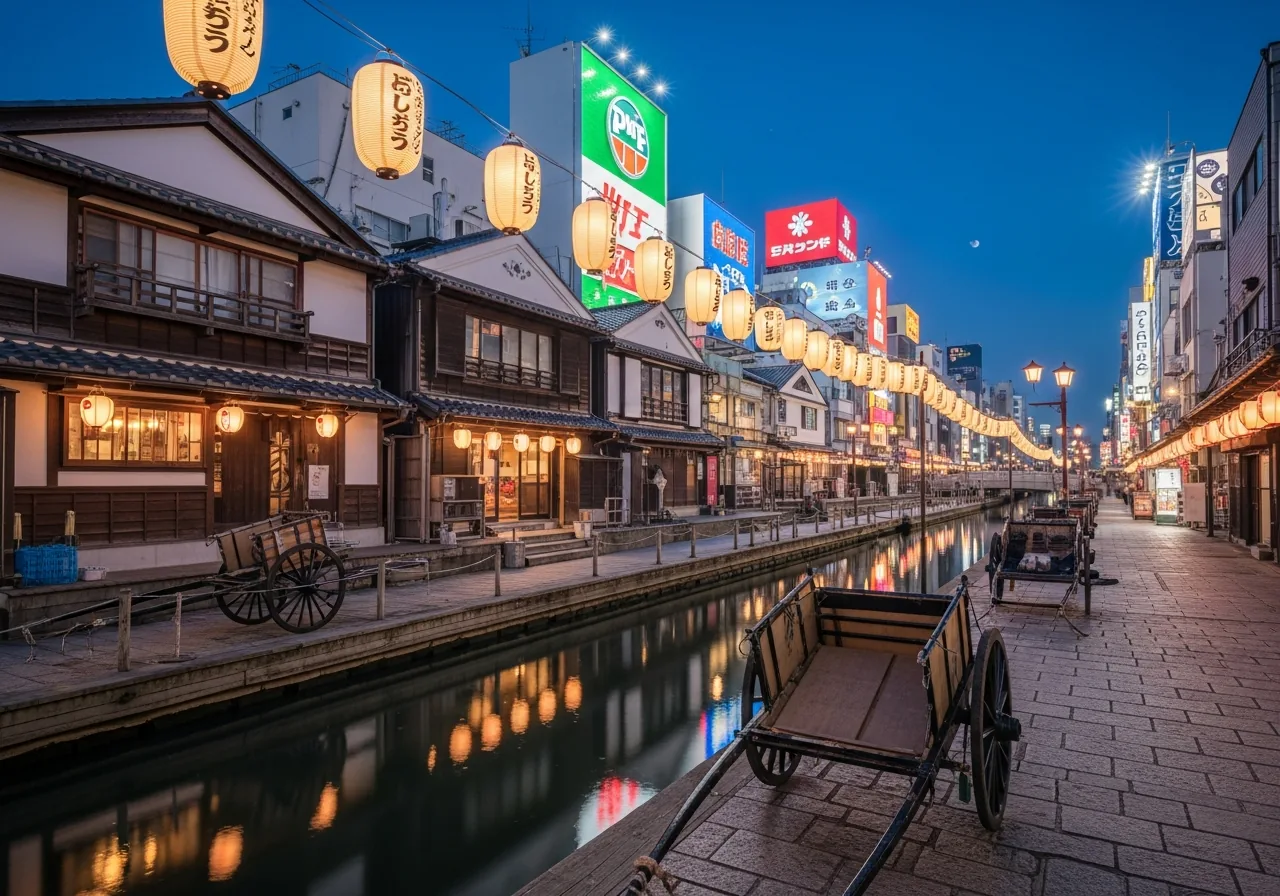
Dotonbori: The spirit of the Edo era can be felt in the layout of districts such as Dotonbori, which originated in the 17th century as an entertainment quarter with Kabuki and Bunraku theatres. The neon and the noise are modern, but the impulse — merchants spending their money on spectacle and pleasure — is four centuries old.
National Bunraku Theatre (Nipponbashi): Bunraku puppet theatre was the chonin’s art form. The National Bunraku Theatre in Nipponbashi still stages regular performances of the same plays that Osaka merchants packed into theatres during the Genroku era. Tickets run ¥2,000–¥6,000 depending on the programme. Check the Japan Arts Council website for the current schedule.
The Chonin Mindset in Modern Osaka
Spend a week in Osaka and you’ll notice something that doesn’t quite exist in Tokyo: a civic pride rooted in commerce rather than politics or culture. Locals will tell you, only half-joking, that Osaka people greet each other with “mokarimakka?” — “are you making money?” It’s a city that has never been embarrassed by trade.
In 2026–2027, when you sit down with a Kansai partner — whether for a business meeting or a deep-tech joint venture — you are still sitting in the shadow of the Dojima Rice Exchange. The same values are at play: speed after trust is built, mutual benefit above all, and a quiet belief that good relationships create more lasting value than any contract clause.
The Edo period is not simply a bygone historical period: it is the foundation upon which much of contemporary Japanese culture rests. Understanding the Edo period means understanding why Japan is what it is today, with all its particularities, paradoxes, and incomparable cultural richness. In Osaka, that’s especially true. The MICHI Osaka travel guide covers the city’s living culture in depth — but the chonin are where it all started.
FAQ
Q: Who were the chonin merchants of Osaka?
A: The chonin were the merchant and artisan class of Edo-period Japan (1603–1868). In Osaka, they dominated the national rice trade, ran proto-banking operations, and funded the arts. Despite sitting near the bottom of the official social hierarchy, they effectively controlled the country’s economy and gave Osaka its identity as Japan’s commercial capital.
Q: What was the Dojima Rice Exchange?
A: The Dojima Rice Exchange in Osaka was the world’s first organised futures market, where merchants traded paper rice coupons representing future harvests rather than physical grain. It operated from the late 17th century until 1939 and set rice prices across the entire country.
Q: Which modern Japanese companies trace back to Osaka’s chonin merchants?
A: Sumitomo, Mitsui, and the Konoike family were the three dominant Osaka merchant houses of the Edo period. Sumitomo and Mitsui both evolved into zaibatsu conglomerates after the Meiji Restoration and remain among Japan’s largest corporate groups today. Panasonic (founded by Konosuke Matsushita in Osaka in 1918) is a later example of the same merchant-city tradition.
Q: Where can I learn about Osaka’s merchant history in person?
A: The Osaka Museum of History in Otemae has detailed chonin-era dioramas and artefacts. The Museum of Oriental Ceramics on Nakanoshima holds pieces donated by the Sumitomo Group and the Konoike family. Nakanoshima Island itself — the former site of over 110 daimyo storehouses — is walkable in under an hour and free to explore.
Last updated: July 19, 2026 · Corrections: [email protected]