Looking for the story of Chikamatsu Monzaemon (近松 門左衛門) in Osaka? This guide covers the playwright’s life, legacy, and the real Osaka sites tied to his work — from the theatre he called home to the shrine where his most famous love story unfolds. Whether you’re a first-time visitor or a returning one, these spots make his 300-year-old world feel immediate.
MICHI’s Pick — Selected by our Osaka-based team, based on places we’ve visited and on research using Tabelog and Google Maps ratings. In Japan, a Tabelog score of 3.4+ is genuinely high — Japanese reviewers are famously strict, and most locals consider anything above 3.4 a place worth a detour. We feature venues meeting at least one of: Tabelog 3.4+, Google Maps 4.3+, or 100+ reviews — the kind of spots locals quietly trust.
Tabelog and Google Maps scores are accurate as of the time of writing.
Who Was Chikamatsu Monzaemon?
Chikamatsu Monzaemon (近松 門左衛門; 1653–6 January 1725), born Sugimori Nobumori (杉森 信盛), was a Japanese dramatist of joruri — the form of puppet theater that later came to be known as bunraku — and the live-actor drama, kabuki. The Encyclopædia Britannica has written that he is “widely regarded as the greatest Japanese dramatist.”
The Shakespeare comparison gets thrown around a lot in Japan, and for once it’s not entirely wrong. He became the first professional playwright in Japan as, unlike his predecessors, he never performed in any of his plays. He wrote for the audience, not for himself — and that audience was Osaka’s merchant class, people who worked in shops and teahouses and recognised their own lives on stage.
Chikamatsu was born into a samurai family, but his father apparently abandoned his feudal duties sometime between 1664 and 1670, moving the family to Kyoto. In 1705 or 1706, Chikamatsu left Kyoto for Osaka, where puppet theater was even more popular. He spent the rest of his working life there, and the city shaped everything he wrote.
The Plays That Made Him
The characters who populate Chikamatsu’s domestic tragedies are merchants, housewives, servants, criminals, and prostitutes — all the varieties of people who lived in the Osaka of his day. Most of his domestic tragedies were based on actual incidents, such as double suicides of lovers.
Sonezaki Shinju (1703; The Love Suicides at Sonezaki), for example, was written within a fortnight of the actual double suicide on which it is based. That speed of response — ripping a real tragedy from the headlines and turning it into art before the city had finished grieving — is what separated Chikamatsu from every playwright before him. The 1703 premiere at the Takemoto-za drew on a recent double-suicide incident in Osaka and sparked a surge in popularity for puppet theater, often termed a “Chikamatsu boom” that revitalized the struggling venue. Performed just weeks after the event, the play’s immediate appeal saved Takemoto-za from financial crisis.
Chikamatsu’s popularity peaked with his domestic plays about love suicides and with the blockbuster success of The Battles of Coxinga in 1715. It played at the Takemoto-za for seventeen months, despite competition by kabuki troupes who presented the same theme in Kyoto, Osaka, and Edo. By any measure — box office, cultural impact, longevity — that’s a hit.
Currently, 130 plays have been verified as Chikamatsu’s work, and another 15, mostly early kabuki works, are suspected to also have been penned by him. Today, the plays of this major literary figure are performed on kabuki and bunraku stages as well as in the modern theater, and forty-nine films of his plays have been made, thirty-one of them from the silent era.
His philosophy of art was equally sharp. Some of Chikamatsu’s views on the art of the puppet theatre have been preserved in Naniwa miyage, a work written by a friend in 1738. There Chikamatsu is reported to have said, “Art is something that lies in the slender margin between the real and the unreal.” Three hundred years later, that line still holds.
Where to Find Chikamatsu’s Osaka Today
Chikamatsu’s Osaka is not a museum exhibit. It’s a living city, and several of the places tied to his life and work are still standing, still operating, and still worth your time. Here are the key spots — and what to actually do at each one.
1. National Bunraku Theatre (国立文楽劇場)
📍 1-12-10 Nipponbashi, Chuo-ku, Osaka 542-0073
🕐 Performance-dependent; exhibition room open on performance days (as of May 2026)
💰 ¥1,000–¥6,000 (tickets, depending on show and seating)
🚃 Nippombashi Station (1 min walk)
🗣 English menu: English audio guides (¥700 rental + ¥1,000 deposit), English leaflets, and English earphone guides available
⭐ Rating: Google 4.3+ (500+ reviews) (as of writing)
🗺 Open in Google Maps
📋 Tabelog
🌐 Official site
What to see: A live bunraku performance (¥1,000–¥6,000); free exhibition room with puppets and costumes on performance days
The National Bunraku Theater was established in 1984 as the home of bunraku in the Kansai region. This is the direct institutional heir to the Takemoto-za where Chikamatsu spent the last two decades of his career — and it’s the single best place in the world to see his plays performed as they were intended. Performances are usually held in three-week runs in January, April, June, July/August, and November. Check the schedule before you go; the theatre is dark between runs. About five bunraku plays are shown at the theater each year, and occasionally it also holds a special “Bunraku for Beginners” introductory event for overseas visitors with explanation given in English, Chinese, French, Spanish, and Korean. English audio earphone guides with full commentary are also available for bunraku shows for a fee of ¥700. There is also an exhibition room which has a free display of puppets, costumes, photographs, and videos of performances with explanations written in English as well as Japanese. Even if you can’t catch a performance, the exhibition room alone is worth the detour. For more on what to eat and drink in the neighbourhood, see the best food in Osaka.
2. Tomb of Chikamatsu Monzaemon (近松門左衛門の墓)
📍 Myohoji Temple, Chuo-ku, Osaka (near Tanimachi 6-chome)
🕐 Daylight hours (as of May 2026)
💰 Free
🚃 Tanimachi 6-chome Station (5 min walk)
⭐ Rating: Google 4.0 (50+ reviews) (as of writing)
🗺 Open in Google Maps
📋 Tabelog
What to see: The playwright’s grave, tucked inside the precincts of Myohoji Temple
Chikamatsu died at the Nichiren sect Buddhist temple called Kosai, in present-day Amagasaki City, near Osaka, at the age of seventy-two. His tomb, however, ended up in Osaka — at Myohoji Temple in Chuo-ku, a quiet spot that most visitors to the city walk straight past. It’s a small, unassuming grave for a man who wrote 130 plays and essentially invented the idea of tragedy for ordinary people. Worth five minutes of your time, especially if you’re already in the Tanimachi area.
3. Literary Monument of Chikamatsu Monzaemon (近松門左衛門文学碑)
📍 Near National Bunraku Theatre, Nipponbashi, Chuo-ku, Osaka
🕐 Always accessible (as of May 2026)
💰 Free
🚃 Nippombashi Station (2 min walk)
⭐ Rating: Google 4.2 (30+ reviews) (as of writing)
🗺 Open in Google Maps
📋 Tabelog
What to see: A stone literary monument erected in Chikamatsu’s honour
This literary monument was erected for Monzaemon Chikamatsu, the famous Edo period writer, to commemorate the completion of the National Bunraku Theatre in 1984. It sits just outside the theatre, making it a natural first stop before a performance. The inscription is in Japanese, but the location — right at the heart of Osaka’s bunraku district — does the talking. Combine it with the theatre’s free exhibition room for a complete picture of the man and his world.
4. Ikukunitama Shrine — Joruri Shrine (生國魂神社・浄瑠璃神社)
📍 13-9 Ikutamacho, Tennoji-ku, Osaka 543-0071
🕐 Open daily, 9:00–17:00 (shrine office hours) (as of May 2026)
💰 Free
🚃 Tanimachi 9-chome Station (5 min walk)
⭐ Rating: Google 4.3 (1,000+ reviews) (as of writing)
🗺 Open in Google Maps
📋 Tabelog
What to see: The Joruri Shrine sub-shrine, which enshrines Chikamatsu and other bunraku spirits; the setting of The Love Suicides at Sonezaki
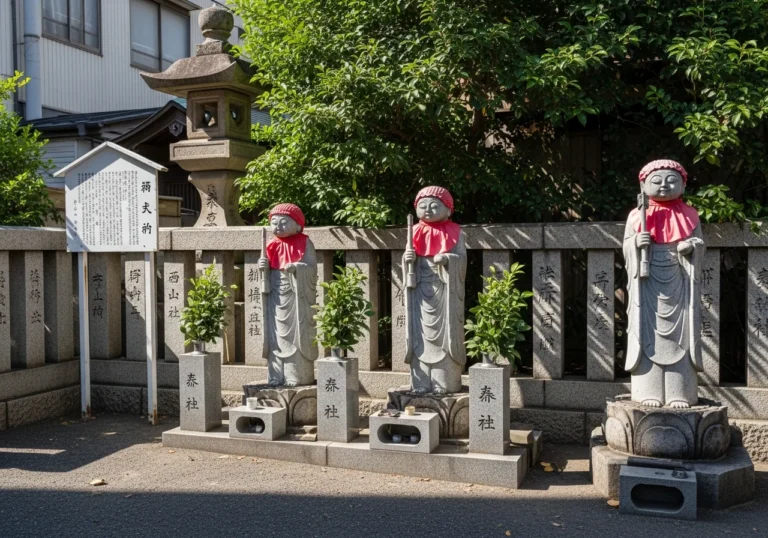
The Joruri Shrine enshrines Monzaemon Chikamatsu and other spirits related to bunraku. The shrine is also worshipped as a god for the improvement of training in dancing, playing, singing, and speaking. Incidentally, Monzaemon Chikamatsu’s Sonezaki Shinju was set in this shrine. That’s not a minor detail — it means the ground you’re standing on is the same ground where Chikamatsu imagined his most famous lovers meeting for the last time. The oldest shrine in Osaka, founded about 2,700 years ago, has a main shrine with a unique architectural style, as well as a number of auxiliary shrines. The Joruri Shrine is a small sub-shrine within the larger complex, easy to miss if you don’t know to look for it. Look for it.
5. Sonezaki Shrine — Ohatsu Tenjin (曽根崎天神・お初天神)
📍 2-5-4 Sonezaki, Kita-ku, Osaka 530-0057
🕐 Open daily, 6:00–24:00 (as of May 2026)
💰 Free
🚃 Higashi-Umeda Station (5 min walk)
⭐ Rating: Google 4.3 (3,000+ reviews) (as of writing)
🗺 Open in Google Maps
📋 Tabelog
What to see: The shrine where the real-life double suicide of Ohatsu and Tokubei took place in 1703 — the event that inspired The Love Suicides at Sonezaki
Sonezaki Shinju (1703; The Love Suicides at Sonezaki) was written within a fortnight of the actual double suicide on which it is based. The shrine — popularly known as Ohatsu Tenjin — sits in the middle of Umeda’s bar district, surrounded by izakayas and office workers on lunch breaks. The contrast is jarring and somehow perfect. There is a monument for Ohatsu and Tokubei, the main characters of the most famous sewamono, Sonezaki Shinju, written by Chikamatsu Monzaemon. The monument draws couples who come to pray for love — which is either touching or ironic, given that the original story ends in a double suicide. Either way, it’s one of the most atmospheric spots in Osaka, and it’s free. To explore more of Osaka beyond the Chikamatsu trail, the surrounding Sonezaki neighbourhood has some of the city’s best standing bars and yakitori counters.
6. Dotonbori — Chikamatsu’s Stage (道頓堀)
📍 Dotonbori, Chuo-ku, Osaka
🕐 Always accessible (as of May 2026)
💰 Free (to walk)
🚃 Namba Station (3 min walk)
⭐ Rating: Google 4.4 (10,000+ reviews) (as of writing)
🗺 Open in Google Maps
📋 Tabelog
What to see: The entertainment district where Chikamatsu’s plays were performed; the Takemoto-za once stood near here
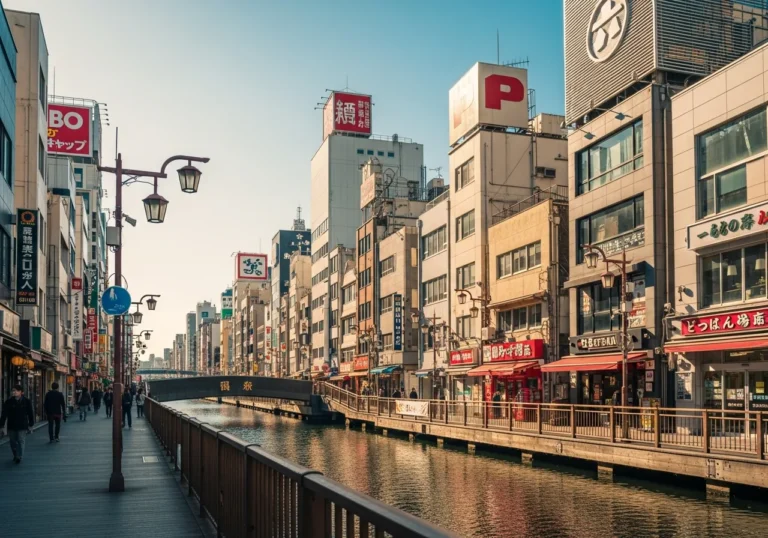
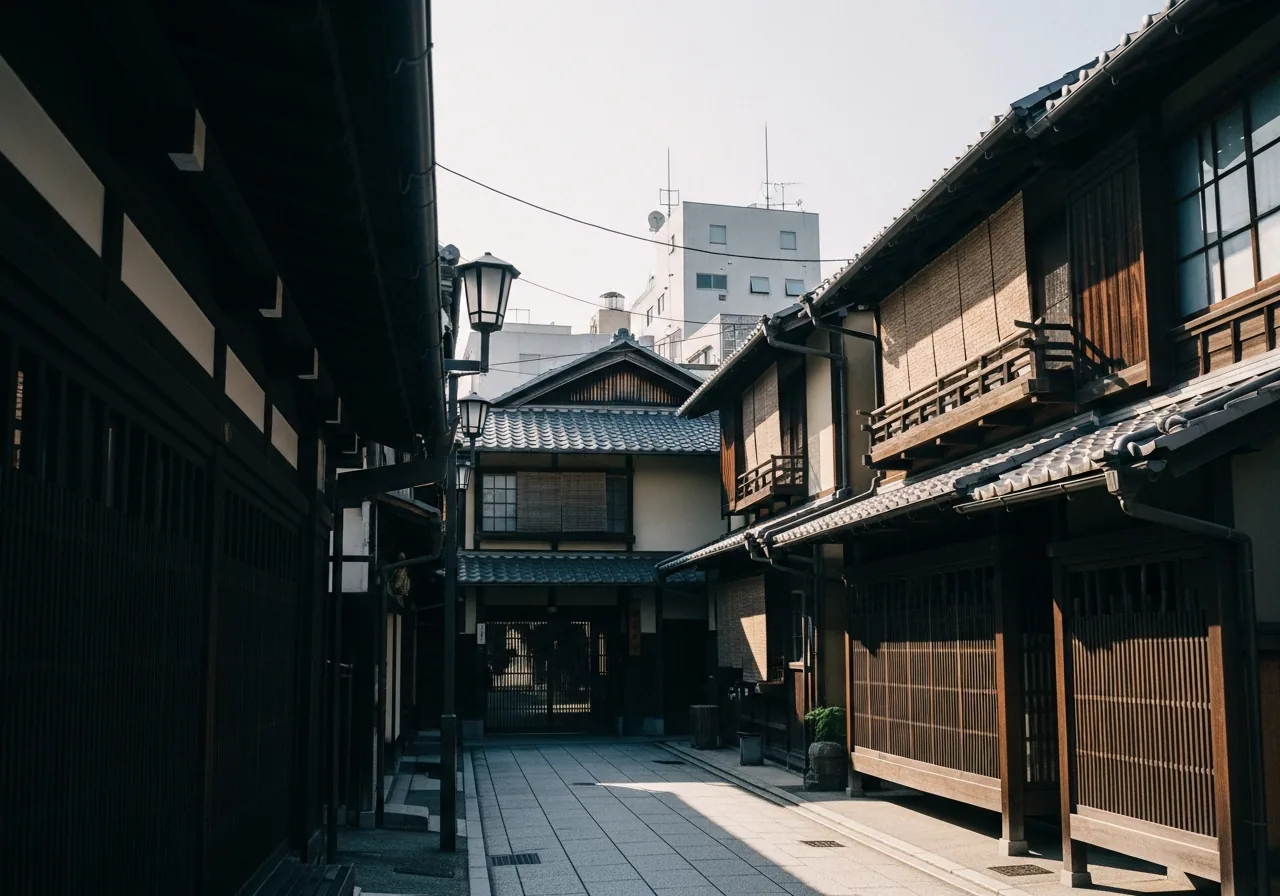
Chikamatsu Monzaemon had most of his stories played in the theaters of Dotonbori. Dotonbori is an area known to be filled with lots of culture and hints of Japan’s Edo period. The Takemoto-za — the puppet theatre where Chikamatsu worked as resident playwright from 1706 until his death — no longer stands, but the entertainment district it anchored is still very much alive. Osaka has been the capital for bunraku, traditional Japanese puppet theater, for many centuries. The popularity of the theater form had grown in the city during the Edo Period when bunraku — like kabuki — was a rare kind of art entertainment for the common public, as opposed to entertainment for the nobility. Walking Dotonbori today, with its neon signs and food stalls and crowds, you’re walking the same stretch of city that Chikamatsu’s audiences walked after a show. The geography hasn’t changed much. The entertainment has.
7. Amijima — Setting of The Love Suicides at Amijima (網島)
📍 Amijima area, Miyakojima-ku, Osaka (near Osaka Business Park)
🕐 Always accessible (as of May 2026)
💰 Free
🚃 Osaka Business Park Station (10 min walk)
🗺 Open in Google Maps
📋 Tabelog
What to see: The neighbourhood where Chikamatsu set his greatest domestic tragedy; the Daichoji Temple, referenced in the play, still stands nearby
The Love Suicides at Amijima is generally regarded as the greatest of his domestic plays. Jihei first stabs Koharu on a bank near the temple of Daichoji in Amijima (now part of the city of Osaka) before strangling himself with her obi belt at a nearby sluice gate. The neighbourhood is now largely industrial and residential — no tourist infrastructure, no English signage — but Daichoji Temple still stands, and the area retains a quiet, working-class character that Chikamatsu would have recognised. This one is for the committed reader rather than the casual visitor. If you’ve read the play, it’s worth the detour. If you haven’t, read it first. The MICHI Osaka travel guide can help you plan the rest of your day around it.
FAQ
Q: What is the best place to experience Chikamatsu Monzaemon’s legacy in Osaka?
A: The National Bunraku Theatre in Nipponbashi is the definitive answer — it’s the institutional home of the art form Chikamatsu shaped, and it still performs his plays. If you can only visit one site, make it this one. Check the performance schedule before you go, as the theatre is dark between runs.
Q: How many sites connected to Chikamatsu Monzaemon are there in Osaka?
A: At least half a dozen verifiable sites are spread across the city — from his tomb in Chuo-ku to the Joruri Shrine in Tennoji-ku to the Ohatsu Tenjin shrine in Umeda. Most cluster in the Chuo-ku and Tennoji-ku areas, within easy reach of each other on the Tanimachi subway line.
Q: Do Osaka sites related to Chikamatsu have English information?
A: The National Bunraku Theatre is the most English-friendly, with audio guides, leaflets, and exhibition materials all available in English. The shrines and outdoor monuments have little to no English signage, but the Osaka Chuo-ku official tourism site (osaka-chushin.jp/en) has basic English descriptions of the tomb and literary monument.
Q: What should I read or watch before visiting Chikamatsu’s Osaka?
A: Start with The Love Suicides at Sonezaki — it’s short, it’s set in Osaka, and it was written in two weeks based on a real event. Donald Keene’s translations are the standard English versions. If you want to see the plays performed, the National Bunraku Theatre’s English audio guide makes even a first-time viewer’s experience genuinely rewarding.
Last updated: July 19, 2026 · Corrections: [email protected]