Last updated: July 19, 2026
This article reflects information available at the time of writing. Check Google Maps for the latest hours and availability.
Introduction
Say “Namba” to anyone who’s spent time in Osaka and you’ll get an immediate reaction — it’s the district that most visitors picture when they think of the city. The neon of Dotonbori, the crush of Shinsaibashi-suji, the smell of takoyaki drifting out of a dozen competing stalls. But the name itself is older than any of that. It predates the neon, the railways, the castle, and arguably the city as we know it. The best food in Osaka may be what draws most people to Namba today, but the district’s name carries a story that stretches back more than a thousand years — through ancient imperial courts, Edo-period theater, and a surprisingly contentious debate about whether to spell it with a “b” or a “v.”
This guide unpacks that story section by section: where the name came from, what it meant to the people who first used it, how the area transformed across different eras, and why you’ll still see it spelled three different ways depending on which train line you’re standing on. If you want to explore more of Osaka, understanding Namba — its name, its layers, its contradictions — is as good a place to start as any.
1. The Name Itself: Naniwa, Nanba, Namba
- 📍 Namba District, Chuo Ward and Naniwa Ward, Osaka City, Osaka Prefecture
- 🗺 Open in Google Maps
- 📋 Tabelog
The name “Namba” derives from the characters for “Naniwa” — the old name for Osaka — read using their modern on’yomi (Chinese-derived) pronunciation. So Namba and Naniwa are, at root, the same word written the same way, just read differently depending on the era and context.
The etymology of Naniwa itself is contested. One theory traces it to the old Japanese word for “fish garden” (Nanipa), referencing the abundant fish in the nearby waters. Another connects it to “swift waves” (Nami-haya), describing the fast-flowing currents of the bay. A third reading, “浪花” (Naniwa or Namba), translates loosely as “wave flowers” — a more poetic rendering of the same coastal geography.
The name Naniwa, although written with different characters over the ages, has always been associated with the city’s role as a center of waterborne trade. That connection to water isn’t incidental. The Yodo River from Lake Biwa and the Yamato River from the Nara Basin both flow westward into Osaka Bay on either side of the Uemachi Plateau. Over centuries, they deposited sediment that formed a broad delta — the site of Naniwazu, the most important port in ancient Japan.
2. An Ancient Imperial Capital
- 📍 Naniwa-no-miya Historic Site, Chuo Ward, Osaka City, Osaka Prefecture
- 🗺 Open in Google Maps
- 📋 Tabelog
Long before Osaka was Osaka, this stretch of coastline was the political and commercial heart of the Japanese archipelago. Naniwa served as a major port — Suminoe-tsu and Naniwa-tsu — for domestic and overseas ships engaged in trade and diplomacy with China and Korea. Its position at the mouth of the Yodo River made it the natural gateway between the interior of the country and the sea.
The site of the Naniwa-no-miya palace, which stood for approximately 150 years from the sixth to the eighth centuries, lies southwest of Osaka Castle. In the early part of the eighth century, Naniwa was one of the capitals of Japan. Emperors built their residences here precisely because of that port access — the ability to receive tribute, conduct diplomacy, and move goods made Naniwa strategically indispensable.
The capital eventually shifted to Nara and then Kyoto, but the name — and the commercial energy — never really left. Modern archaeological excavations confirmed that the site of Ishiyama Honganji Temple, later the location of Osaka Castle, was also the site of Naniwa-no-miya Palace during the seventh and eighth centuries. The layers of history here are literal as well as figurative.
3. The Edo Period: Theater, Canals, and the Birth of Minami
- 📍 Dotonbori, Chuo Ward, Osaka City, Osaka Prefecture
- 🗺 Open in Google Maps
- 📋 Tabelog
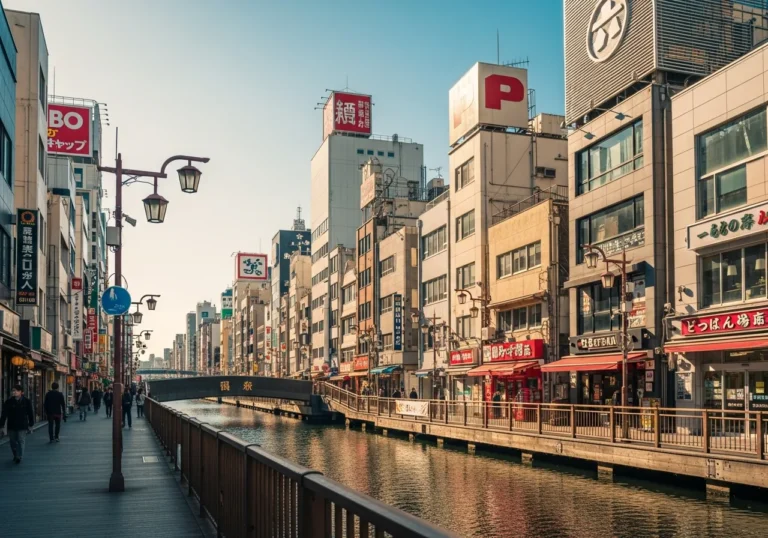
The Namba we recognize today — dense, loud, built for pleasure — took shape during the Edo period. In 1612, a merchant called Yasui Doton began digging an east-west channel to link two branches of the Yokobori River. He was killed at the Siege of Osaka Castle in 1615 before the work was finished. His cousins completed it and named the canal after him: Doton-bori, “Doton’s moat.”
Dotonbori was designated as the theater and entertainment district of Osaka in 1621. By 1662, it counted no fewer than six Kabuki theaters, five Bunraku theaters, and a Karakuri mechanical puppet theater. The Shogunate allowed 47 teahouses and restaurants to open to supply theatergoers with food and drinks — an arrangement that, in retrospect, looks like the founding charter of Osaka’s food culture.
Puppet theater companies Takemoto-za and Toyotake-za established operations here, becoming venues where celebrated playwright Chikamatsu Monzaemon premiered most of his masterworks, including “The Love Suicides at Sonezaki.” The area south of the canal — what would become the core of Namba — developed as the residential and commercial overflow from all that theatrical activity. The name “Minami” (south) came to describe this whole zone, and it stuck.
4. “Namba” vs. “Nanba”: Why the Spelling Keeps Changing
- 📍 Namba Station Area, Chuo Ward, Osaka City, Osaka Prefecture
- 🗺 Open in Google Maps
- 📋 Tabelog
If you’ve spent any time navigating Osaka, you’ve noticed the inconsistency. “Namba” on one sign, “Nanba” on another, “Naniwa” on a third — all referring to the same place, all technically correct. The confusion is baked into the kanji itself.
The names of both major stations are written in hiragana on signage within the stations, precisely because the kanji “難波” can also be read “Naniwa.” However, both stations officially use the kanji form on train tickets. The hiragana is a workaround — a way of specifying the “Nanba” reading without ambiguity.
In romanization, “Namba” follows the standard Hepburn system for rendering the Japanese syllable “ば” (ba). “Nanba” is an alternative romanization that some operators and institutions prefer. Neither is wrong. Nankai Electric Railway uses “Namba.” Osaka Metro uses “Namba.” The ward itself is called “Naniwa-ku.” Namba sits in the Minami (south) area of Osaka, and its name is a variation on the former name of the city itself — Naniwa. The spelling debate is, in a sense, a compressed version of the whole city’s identity: ancient name, modern pronunciation, multiple valid interpretations.
5. The Modern District: Transport Hub, Entertainment Zone, Food Capital
- 📍 Namba, Chuo Ward and Naniwa Ward, Osaka City, Osaka Prefecture
- 🗺 Open in Google Maps
- 📋 Tabelog
The railways arrived in the late nineteenth century and transformed Namba from a theater district into a transit nexus. Hankai Railway Namba Station opened in 1885, and JR Namba Station, Nankai Railway Namba Station, and Osaka Metro Namba Station followed, making Namba into Osaka’s second biggest transportation hub. Today the station complex is one of the most complicated in Japan — four separate stations operated by different companies, connected by underground shopping malls that stretch for over a kilometre.
Namba is a bustling commercial district spanning the southwestern part of Chuo Ward and Naniwa Ward in Osaka City, encompassing the area around Nankai Electric Railway’s Namba Station. Department stores, specialty shopping streets, theaters, and restaurants cluster here, forming part of Osaka’s Minami entertainment district.
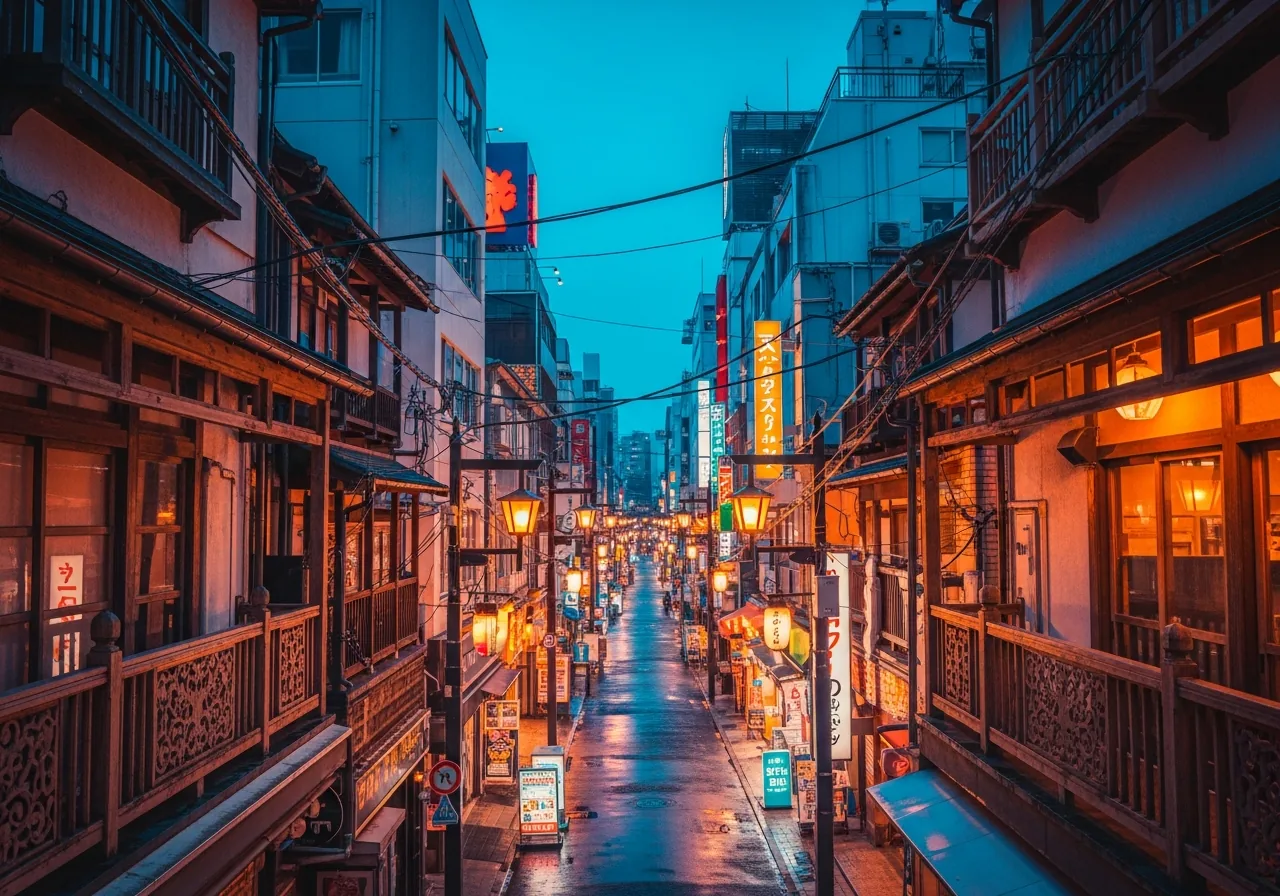
The food culture that the Edo-period teahouses started never stopped. Dotonbori today is the most concentrated stretch of restaurants, street food stalls, and izakayas in the city — possibly in the country. The district has earned its reputation as the epicenter of “kuidaore” culture — literally “eat until you collapse.” The MICHI Osaka travel guide covers the full breadth of what to eat here, but the short version is: arrive hungry.
6. Naniwa-ku: The Ward That Kept the Old Name
- 📍 Naniwa Ward (Naniwa-ku), Osaka City, Osaka Prefecture
- 🕐 Public ward office: Mon–Fri 9:00–17:30 (as of May 2026)
- 🚃 Namba Station (Osaka Metro) (5 min walk)
- 🗺 Open in Google Maps
- 📋 Tabelog
While the district uses the “Namba” reading, the ward that contains part of it — Naniwa-ku — preserves the ancient pronunciation. This isn’t an accident. When Osaka reorganized its administrative wards in the modern era, planners chose “Naniwa” deliberately, as a nod to the area’s pre-Edo identity as the old capital zone.
As a formal place name, Namba is located in Chuo Ward, with addresses running from 1 to 5 chome. In Naniwa Ward, the Nanbanaka area runs from 1 to 3 chome. So the same kanji — 難波 — governs addresses in two different wards, read two different ways. Visitors trying to navigate by address alone will find this genuinely confusing. The practical takeaway: when searching maps, use the hiragana “なんば” rather than the kanji, and you’ll land in the right place.
7. Dotonbori: The Name Within the Name
- 📍 Dotonbori, Chuo Ward, Osaka City, Osaka Prefecture
- 🕐 Streets open 24 hours; individual venues vary
- 🚃 Namba Station (Osaka Metro / Nankai) (5 min walk)
- 🗺 Open in Google Maps
- 📋 Tabelog
Dotonbori is technically a sub-district of Namba, but it has its own distinct etymology. The name comes from Nariyasu Doton, who began construction of the canal in 1612, putting forth his own fortune. Doton died during the Siege of Osaka (1614–1615) and never saw the canal’s opening. His name became the canal’s name, and the canal’s name became the district’s name.
In later years, playhouses from all over Osaka were gathered on the south side of Dotonbori based on the city planning of the Edo Shogunate, and with permits granted for 47 teahouses, Dotonbori flourished for a long time as the leading place for Japanese theater. By the late seventeenth century, prominent theaters including Nakaza, Kadoza, and Naniwa-za had opened their doors, sparking a kabuki renaissance.
The theaters are mostly gone now — their popularity gradually declined after World War II, and all the theaters were closed after the bubble economy burst — but the entertainment instinct never left. The neon signs and restaurant queues are the direct descendants of those Edo-period teahouses.
8. The Name as a Mirror of the City
- 📍 Namba District, Osaka City, Osaka Prefecture
- 🗺 Open in Google Maps
- 📋 Tabelog
What’s striking about the name “Namba” is how much it compresses. Namba — sometimes Namihaya or Naniwa — used to be the name of Osaka itself in the old times. The district didn’t borrow its identity from the city; in a real sense, the city grew out of the district. The ancient port, the imperial palace, the merchant canals, the theater district, the railway hub — all of it happened in roughly the same few square kilometres, layered on top of each other across fourteen centuries.
The spelling inconsistency — Namba, Nanba, Naniwa — isn’t sloppy. It’s a record of how the same place has been understood by different people at different times: as an ancient toponym, as a phonetic rendering, as a modern brand. Every train operator that spells it differently is, in a small way, staking a claim on which version of the story matters most.
For visitors, the practical answer is simple: all roads lead to the same place. But knowing why the name keeps shifting — and what it was before any of the current signs went up — makes the walk from the station to Dotonbori feel a little different. You’re not just crossing a busy street. You’re walking across the oldest address in Osaka.
How to Navigate Namba
Namba is served by four separate railway stations operated by different companies: Nankai Namba, Osaka Metro Namba, Osaka Namba (Kintetsu/Hanshin), and JR Namba. They are not all in the same building. Osaka Metro Namba is the most central for most sightseeing. Nankai Namba is the terminus for trains from Kansai International Airport — if you’re arriving from the airport by train, this is where you’ll land.
The underground shopping malls Namba Walk and Namba Nannan connect several of the stations and are useful in rain, but they’re easy to get turned around in. When in doubt, surface and navigate above ground — the streets are more legible and the landmarks (the Glico Running Man sign, the Don Quijote Ferris wheel) are visible from a distance.
Namba’s core streets — Dotonbori, Shinsaibashi-suji, and Namba Parks — run roughly north-south and east-west from the station. The area is compact enough to cover on foot. Most of what you’ll want to see is within a 15-minute walk of Osaka Metro Namba Station.
FAQ
Q: Is “Namba” or “Nanba” the correct spelling?
A: Both are correct romanizations of the same Japanese name. Nankai Electric Railway uses “Namba”; Osaka Metro also uses “Namba.” The variation comes from different romanization conventions, not a difference in the underlying Japanese. Either spelling will get you to the right place.
Q: What’s the difference between Namba and Naniwa?
A: They’re the same kanji — 難波 — read two different ways. “Naniwa” is the classical Japanese reading (kun’yomi), used for the ancient place name and the modern ward name (Naniwa-ku). “Namba” is the Chinese-derived reading (on’yomi), used for the modern district and station names. Same characters, different eras.
Q: Is Dotonbori the same as Namba?
A: Dotonbori is a sub-district within the broader Namba area, located a few blocks north of Namba Station along the canal of the same name. Most visitors use the names interchangeably, and Osakans won’t correct you. Technically, Dotonbori refers specifically to the canal street; Namba is the larger surrounding district.
Q: When is the best time to visit Namba?
A: Evenings from around 18:00 onwards are when the district is at its most atmospheric — the neon is up, the restaurants are full, and the streets are busy without being impassable. Weekday evenings are noticeably calmer than weekends. If you want to see Dotonbori without the crowds, early morning (before 9:00) is surprisingly peaceful.
Information is accurate as of May 2026. We recommend checking Google Maps for the latest hours and prices before visiting.