Last updated: July 19, 2026
This article reflects information available at the time of writing. Check Google Maps for the latest hours and availability.
Introduction
The name alone raises eyebrows. You’re in Japan — why would you go somewhere called “American Village”? But that mild confusion is exactly the point. Amerika-mura, or Ame-mura to anyone who’s spent more than a weekend in Osaka, is one of the most genuinely interesting urban pockets in the country, and its story has almost nothing to do with America.
It covers the west side of Shinsaibashi Station, spreading from Nagahori Street down to Dotonbori Street — a compact grid that somehow contains over 2,500 shops offering vintage clothing, urban apparel, and hip-hop wear. Back in the 1960s the area was called Sumiyamachi — “Charcoal Shop Town” — and was mainly filled with warehouses and lumber yards. In the 1970s, those warehouses were converted into stores selling used clothes, records, and miscellaneous goods imported from the West Coast of the United States. The name stuck. The American goods eventually didn’t.
What you’ll find today is a district that has been shaping Kansai youth culture for over fifty years — street art, vintage shops, live music, skate culture, and a concrete triangle of a park that functions as the neighbourhood’s living room. If you want to understand the best food in Osaka and the city’s creative underbelly in one afternoon, this is where to start. This guide covers the key landmarks, what they mean, and how to make the most of a visit.
For a broader look at the city beyond Ame-mura, explore more of Osaka with our full area guide.
1. Triangle Park — Sankaku Koen (御津公園)
- 📍 1 Chome-7 Nishishinsaibashi, Chuo Ward, Osaka
- 🕐 Open 24 hours (as of May 2026)
- 💰 Free
- 🚃 Shinsaibashi Station (5 min walk)
- 🗺 Open in Google Maps
- 📋 Tabelog
The heart of Amerika-mura is Sankaku Koen (Triangle Park), a concrete area with benches that serves as the best people-watching spot in the city. It became the heart of the neighbourhood, used for fashion shows, live music performances, and as a spot for skaters and hip-hop dancers — and it’s still a popular place to meet people and hang out, as well as the centre of the annual Halloween festivities. Come on a Saturday afternoon and you’ll likely catch a street performer, a flea market stall, or just a very committed outfit. There’s no entry fee and no agenda. That’s the whole point.
2. Peace on Earth Mural (ピース・オン・アース)
- 📍 Dotonbori Substation wall, Nishishinsaibashi, Chuo Ward, Osaka
- 🕐 Viewable 24 hours (as of May 2026)
- 💰 Free
- 🚃 Shinsaibashi Station (5 min walk)
- 🗺 Open in Google Maps
- 📋 Tabelog
The mural commonly known as “Peace on Earth” by Kuroda Seitaro (1939–) is the symbol of Amerika-mura. Painted in 1983 by Kuroda — an artist from Dotonbori active in illustration, mural painting, and live painting — it covers the wall of the Dotonbori Substation of Kansai Electric Power Company, a building in the centre of the district. At first, the plan was to preserve the mural for a limited period, but as media coverage grew, the decision was made to keep it permanently. It has since become a landmark of the neighbourhood. The dove and bold lettering are impossible to miss — and worth a proper look rather than a passing glance.
3. Big Step (心斎橋ビッグステップ)
- 📍 1 Chome-6-14 Nishishinsaibashi, Chuo Ward, Osaka
- 🕐 Shops: 11:00–21:00; restaurants vary (as of May 2026)
- 💰 Free entry; shopping and dining costs vary
- 🚃 Shinsaibashi Station (3 min walk)
- 🗺 Open in Google Maps
- 📋 Tabelog
- 🌐 Official site
Opened in 1993, Big Step remains one of Amerika-mura’s most iconic landmarks, boasting a variety of shops and restaurants as well as a fitness club, movie theatre, and the beloved live music club Big Cat. On the B2F, you’ll also find Kuroda Seitaro’s gallery and atelier “KAKIBA” (Paint Studio) — the same artist behind the Peace on Earth mural outside. Eight floors of fashion, food, and live culture, all under one roof with glass elevators and murals at every turn. It’s the neighbourhood’s anchor, and still earns it.
4. Mini Statue of Liberty (自由の女神像)
- 📍 Rooftop, Nishishinsaibashi 2-chome area, Chuo Ward, Osaka
- 🕐 Viewable from street level at any time (as of May 2026)
- 💰 Free
- 🚃 Shinsaibashi Station (5 min walk)
- 🗺 Open in Google Maps
- 📋 Tabelog
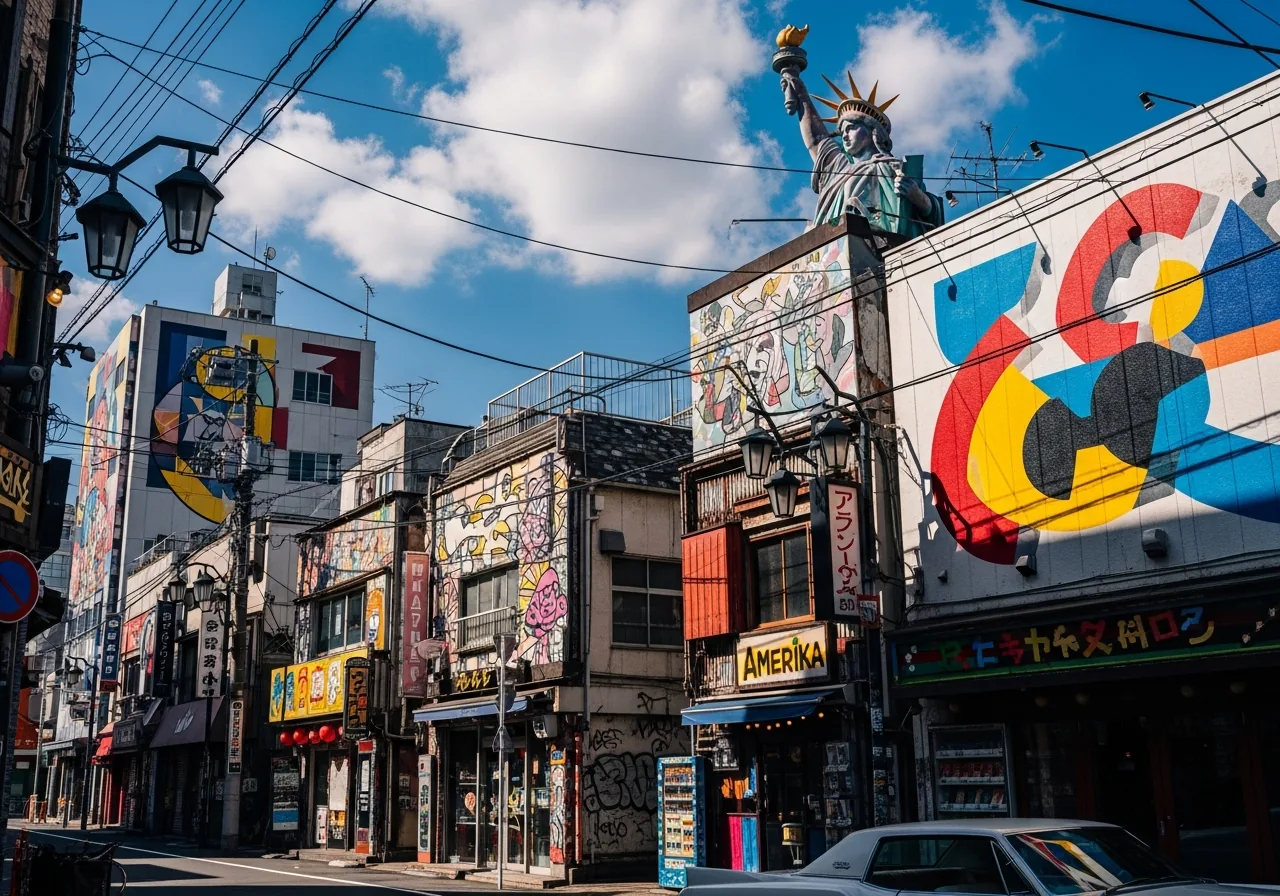
This small-scale reproduction of the Statue of Liberty marks the entry to the area. It sits on a rooftop, torch raised, presiding over a neighbourhood that borrowed America’s aesthetic and then made it entirely its own. Around every corner in Ame-mura there’s something new to see — a rooftop Statue of Liberty, a punk-inspired mural, or a cafe with standout latte art. The statue is easy to miss if you’re not looking up. Look up.
5. Mitsu Hachimangu Shrine (御津八幡宮)
- 📍 2 Chome-9-9 Nishishinsaibashi, Chuo Ward, Osaka
- 🕐 Open daily, dawn to dusk (as of May 2026)
- 💰 Free
- 🚃 Shinsaibashi Station (5 min walk)
- 🗺 Open in Google Maps
- 📋 Tabelog
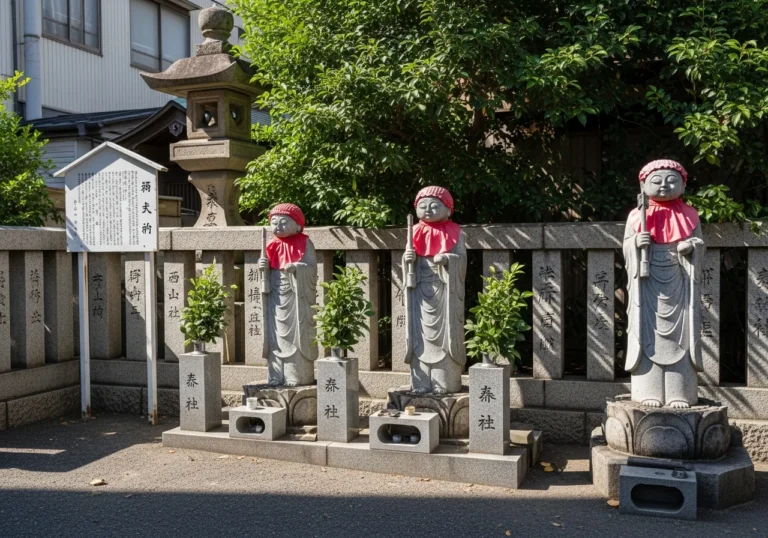
Dating back to 749 — present around the time the Great Statue of Buddha was being erected in Nara — it is considered one of the guardians of Osaka and, in particular, of the American Village’s surrounding area. Mitsu Hachimangu was destroyed in the air raids of 1945 and rebuilt in 1960. It’s a genuinely ancient site tucked between streetwear shops and ramen counters — the kind of contrast that makes Osaka so hard to summarise. Worth two minutes of quiet before you dive back into the noise.
6. Amerika-mura Street Art Walk
- 📍 Nishishinsaibashi 1–2 Chome, Chuo Ward, Osaka (self-guided)
- 🕐 Any time; best in daylight (as of May 2026)
- 💰 Free
- 🚃 Shinsaibashi Station (5 min walk)
- 🗺 Open in Google Maps
- 📋 Tabelog
Ame-mura’s streets are an open-air gallery. Around Triangle Park you’ll spot massive building murals, graffiti-covered alleys, and hand-painted storefronts. Look for street lamps resembling stick-figure people, some painted by artists; the Peace on Earth mural (1983), painted by Osaka artist Seitaro Kuroda; and, of course, the mini Statue of Liberty. The best approach: start at Triangle Park and work outward through the side streets, keeping your eyes at rooftop level as much as pavement level. There’s no map that captures all of it — that’s the point.
7. Shinsaibashi OPA (心斎橋OPA)
- 📍 1 Chome-4-3 Nishishinsaibashi, Chuo Ward, Osaka
- 🕐 11:00–21:00 daily (as of May 2026)
- 💰 Free entry; shopping costs vary
- 🚃 Shinsaibashi Station (3 min walk)
- 🗺 Open in Google Maps
- 📋 Tabelog
- 🌐 Official site
With the opening of the Shinsaibashi branch of OPA in 1994, Ame-mura reached the peak of its popularity and became popular with overseas visitors too. It’s a mainstream fashion complex by today’s standards, but it marks the moment the neighbourhood crossed over from underground to cultural institution. You’ll find it close to Exit 7 of Shinsaibashi Station, right on the edge of the Ame-mura grid — useful as a landmark to orient yourself before heading deeper into the side streets.
8. Amerika-mura Weekend Flea Market (アメ村フリーマーケット)
- 📍 Triangle Park (御津公園), Nishishinsaibashi, Chuo Ward, Osaka
- 🕐 Weekends, approx. 10:00–17:00 (weather permitting) (as of May 2026)
- 💰 Free to browse
- 🚃 Shinsaibashi Station (5 min walk)
- 🗺 Open in Google Maps
- 📋 Tabelog
A weekend flea market takes place regularly in the streets of Amerika-mura. At weekends, Sankaku Koen is often a venue for street performances, flea markets, or fashion shows. Stalls lean toward vintage clothing, records, handmade accessories, and the occasional genuinely strange find. It runs on good weather and good vibes — check the morning before you go, as it doesn’t always materialise in the rain. The MICHI Osaka travel guide has more on seasonal events across the city.
How to Get Around
Amerika-mura covers the west side of Shinsaibashi Station, spreading from Nagahori Street to Dotonbori Street. The whole area is walkable in under 20 minutes end to end, but the real experience is in getting lost in the side streets rather than following a straight line. Start at Triangle Park — it’s the natural centre — and radiate outward from there.
The nearest station is Shinsaibashi on the Osaka Metro Midosuji and Nagahori Tsurumi-ryokuchi lines. Exit 7 puts you closest to OPA and the northern edge of the district. From Namba Station, it’s a 10-minute walk north along Midosuji. Most of the landmarks in this guide are within a 5-minute walk of each other, so there’s no need to plan a route — just wander.
Evenings shift the energy considerably. At night, the area comes alive as young people gather at clubs and live music venues. If you’re coming for the street art and landmarks, daytime is better for visibility and photography. If you’re coming for the atmosphere, Friday and Saturday nights are when Ame-mura is most itself.
FAQ
Q: Is Amerika-mura worth visiting if I’m not into fashion or shopping?
A: Yes. The landmarks — Triangle Park, the Peace on Earth mural, Mitsu Hachimangu Shrine, the street art — are all free and genuinely interesting regardless of whether you buy anything. Budget two to three hours for a proper wander.
Q: Do shops and venues in Amerika-mura have English signage?
A: Inconsistently. The major complexes like Big Step and OPA have some English, but most independent shops don’t. That said, the area is well-trafficked by international visitors and staff at most places are used to non-Japanese speakers. Google Translate’s camera function handles most situations.
Q: When is the best time to visit?
A: On weekends, nearly 200,000 young visitors come to Ame-mura to enjoy live music performances, comedy shows, flea markets, street stalls, galleries, tattoo and piercing parlours, nightclubs, and various dining options. Weekday afternoons are quieter and better for photography. Weekend evenings are the most atmospheric but also the most crowded. Halloween in late October is a phenomenon unto itself — the whole district turns into a costume parade.
Q: Is Amerika-mura safe at night?
A: Yes, by any reasonable standard. It’s a busy entertainment district with plenty of foot traffic late into the night. Standard city-sense applies — watch your belongings in crowds — but there’s nothing to be concerned about.
Q: How does Amerika-mura compare to Dotonbori?
A: Dotonbori is louder, more tourist-facing, and built around food and spectacle. Ame-mura is smaller, younger, and more local in character. While mainstream shopping areas have taken over most Osaka neighbourhoods, Ame-mura remains staunchly unconventional. They’re a 10-minute walk apart — do both.
Information is accurate as of May 2026. We recommend checking Google Maps for the latest hours and prices before visiting.