Every January, a shrine that occupies barely a city block in Osaka’s Naniwa Ward draws over one million people across three days — more than twenty times its normal annual footfall — because it houses the only god in Japan’s pantheon of luck who originated purely on Japanese soil, and because Osaka’s entire commercial identity was built, over fourteen centuries, on the premise that he listens. The festival is called Toka Ebisu: literally, “the Tenth-Day Ebisu.” It exists because Osaka was Japan’s rice exchange, its wholesale hub, its “kitchen of the nation,” and its merchants needed a ritual that matched the scale of what they stood to gain or lose in a single trading year.
Why we can tell you this — MICHI is written by an Osaka-based editorial team who can walk from Namba to the shrine gates in under fifteen minutes, and who have stood in that January queue more than once. This piece draws on the shrine’s own English-language history pages at imamiya-ebisu.jp, the Osaka Convention & Tourism Bureau’s official shrine profile, the Japan National Tourism Organization’s festival record, academic mythology sources on Ebisu’s pre-Shinto origins, and contemporary Japanese-language reporting on the festival’s cultural-property designation. Where the historical record is genuinely thin — particularly around the precise Edo-period origins of the fukumusume tradition — we say so rather than paper over it.
On the morning of January 10th, the streets between Namba Station and Imamiya Ebisu Shrine fill before dawn. By the time the sun clears the low rooftops of Naniwa Ward, the queue already stretches back toward Dotonbori.
A million people will pass through this precinct over three days, and almost every one of them is carrying — or intending to carry home — a bamboo branch hung with gold coins, miniature rice sacks, and tiny red sea bream. They are not tourists performing a quaint ritual.
They are company presidents, sole traders, restaurant owners, and salaried workers, and they are here because this is what you do in Osaka at the start of a new commercial year. The question worth asking — the question this city has been answering for fourteen centuries — is why.
Why Does a Shrine This Small Draw a Million People?
The first thing that strikes any visitor who arrives outside of festival season is the scale mismatch. GaijinPot Travel puts it plainly: on any ordinary day, Imamiya Ebisu is a peaceful place, easily overlooked.
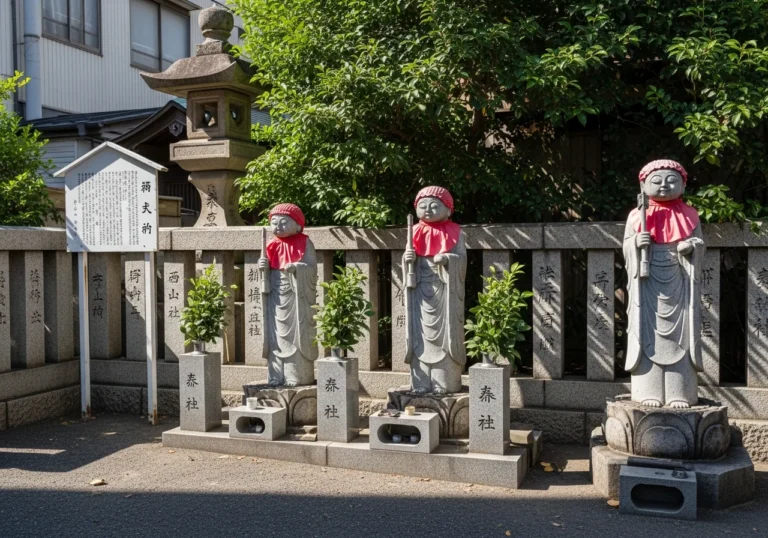
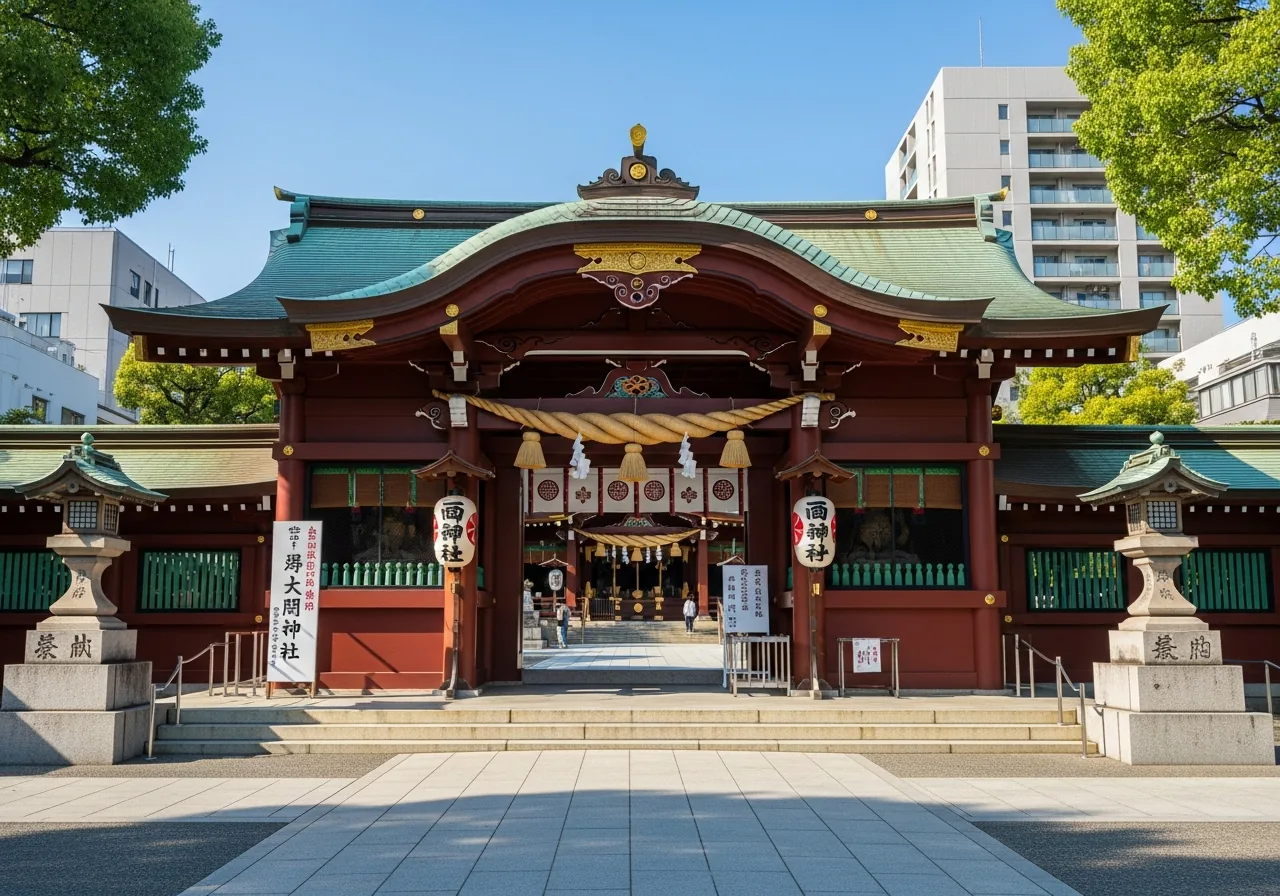
The grounds are compact. The main hall is handsome but not monumental.
There is no sweeping approach avenue, no dramatic hilltop position, no UNESCO designation to signal its importance to the passing visitor.
And yet, the shrine bustles with a crowd of over a million worshippers during the three-day Toka-Ebisu Festival, which is the first festival of the year. That figure — one million people in seventy-two hours, in a precinct that on a Tuesday afternoon might hold two hundred — is not a rounding error or a boast. It is the product of a specific, layered history that begins not with the shrine itself, but with the city it grew up inside.
The answer to the scale question is not religious in the narrow sense. It is economic, geographic, and deeply Osakan. To understand why a million people queue here every January, you have to understand why Osaka became what it became, and why a smiling, slightly deaf god of fishermen ended up as the patron saint of Japanese commerce.
Why Here? The Geography of a God’s Address
The shrine was established in what is now the Naniwa Ward of Osaka in 600 CE. It was constructed as the western guardian shrine of Shitenno-ji Temple by Prince Shotoku. According to tradition, Shotoku Taishi prayed to these gods and goddesses that they would protect the market in the area as guardian deities.
That founding date — 600 CE, the eighth year of Empress Suiko’s reign — places the shrine at the very moment Japan was self-consciously constructing its first Buddhist institutional infrastructure. Shitenno-ji, completed in 593 CE, was one of the earliest Buddhist temples in Japan. A guardian shrine to its west was standard protective cosmology: evil was believed to approach from the western direction, and a Shinto kami was needed to hold the perimeter.
But the location was not only cosmologically significant. It was commercially strategic.
Early Imamiya Ebisu Shrine was located near the shore. The shore in the ancient Osaka area was so much further east than today.
Ebisu has been worshipped since ancient times, originally as a “kami” who protected fishermen. Over time, the coastline of Osaka Bay moved further west.
And then the shrine became famous on its own for its thriving local market.
This is the first trapdoor. The shrine was not built in a commercial district — it was built on a shoreline, and the commercial district grew around it.
In ancient times, this area was located along the coast, where “markets” were held to barter products from the sea, villages, and fields, and Ebisu-san was enshrined as the guardian god of these markets. This became the basis for the later belief in Ebisu as a god of prosperity.
The sea retreated westward as Osaka’s land was reclaimed and its rivers were channeled. The shrine stayed put.
The market that had gathered around the god of the shoreline became the market of a city. And the city, over the following millennium, became the commercial capital of Japan.
Why Ebisu? The Mythology of the Only Native Lucky God
Of Japan’s Seven Lucky Gods — the Shichifukujin, that familiar cluster of deities who arrive on the Takarabune treasure ship each New Year — six are imports. Daikokuten comes from Hindu-Buddhist tradition via China.
Bishamonten is a Buddhist guardian deity. Benzaiten is the Hindu goddess Saraswati in Japanese dress.
Only one of the seven is purely, originally Japanese.
Ebisu is a Japanese god of luck, wealth, and prosperity, particularly where the sea is concerned; he is also the patron god of fishermen. Perpetually smiling and often dressed as a fisherman, Ebisu is one of the Seven Lucky Gods, and is in fact the only one original to Japan.
His origin story is among the most poignant in the Shinto canon. Born with the name Hiruko, he is the eldest child of Izanagi and Izanami and the first of the Shinto kami.
Because of a mistake his parents made during the wedding ceremony, Hiruko was born without bones, and his parents set him adrift on the sea. He was adopted by an Ainu and grew to be a happy, if crippled, god of fortune.
The mythology is layered with historical sediment. Ebisu is represented by many kanji, including 恵比須, 恵比寿, 夷, and 戎.
The first two of these can be translated to mean “a favorable yield (in perpetuity).” Interestingly, 夷 and 戎 are kanji used for the Ainu, Japan’s indigenous population. The god of the outsider, the castaway, the one who arrived from the sea — this is who Osaka’s merchants chose as their patron.
There is something fitting in that. Osaka was always a city of arrivals, of goods and people flowing in from the sea.
Scholars note that the Hiruko origin story may be a later theological overlay. It is believed that Ebisu first arose as a god among fishermen and that his origin as Hiruko was a much later conception, after the worship of him had spread to merchants and farmers.
It is also theorized that he was originally a god known as “Kotoshironushi no Mikoto,” son of Ōkuninushi. The shrine at Imamiya Ebisu enshrines him under this second identity: the kami enshrined here included Amaterasu, Kotoshironushi (事代主命, also known as Ebisu), Susanoo-no-Mikoto, Tsukuyomi-no-Mikoto, and Wakahiru-me.
There is one more detail about Ebisu that matters enormously for understanding the festival’s rituals: he is slightly deaf. He remains slightly crippled and deaf, but mirthful and auspicious nonetheless — hence the title, “The laughing god.” A god who cannot quite hear you requires a worshipper who makes themselves heard. That theological fact generated one of the most distinctive prayer customs in Japan.
Why Did Ebisu Become the God of Commerce? The Muromachi Pivot
The transformation of Ebisu from fishing deity to commercial patron did not happen overnight. It was a gradual process that accelerated during a specific period of Japanese history. As you can imagine from the fact that he is holding a sea bream and a fishing rod, Ebisu-sama was originally the “god of fishing.” It wasn’t until the Muromachi period, when the belief in the Seven Lucky Gods became widespread in Japan, that he became known as the “god of prosperity in business.”
The Muromachi period (1336–1573) was when the Shichifukujin grouping crystallized as a popular devotional concept. Merchants, who occupied the lowest rung of the Confucian social hierarchy despite their growing economic power, needed divine legitimacy for their work.
The Seven Lucky Gods gave them that. And of the seven, Ebisu — the native one, the fisherman, the one who understood the sea’s bounty and the market’s unpredictability — became their particular favorite.
The Ebisu-kō tradition originated sometime in the early Edo period as a way to alleviate the guilty conscience of merchants who bought cheap and sold high. Since Ebisu is the God of Fair Dealing, merchants apparently began offering bargain sales as a penance and apology to Ebisu.
This detail from Traditional Kyoto is remarkable: the festival was partly an act of commercial self-correction, a ritual acknowledgment that the pursuit of profit required ethical accountability. The god of fair dealing demanded fair dealing.
The January timing has its own logic. January 10 is particularly celebrated in western Japan because, in the past, markets were held on the 1st, 10th, and 20th of the month.
Since the market on January 1 could not be held due to New Year’s celebrations, the market on the 10th was the first of the year and was of particular importance. The festival name itself encodes this: “Toka” means the tenth day.
The first market of the commercial year was the natural moment to invoke the god of commerce.
Why Osaka? The City That Made Commerce Sacred
To understand why Toka Ebisu became the phenomenon it is — rather than simply a local shrine festival — you have to understand what Osaka was doing economically during the Edo period. No other city in Japan had the same relationship to commerce, and no other city needed a commercial god quite so urgently.
Osaka’s role as Japan’s merchant city was reinforced through official policy. During the Edo period, all rice throughout the whole of the country was required to be sent to Osaka before being redistributed. This made it a vibrant city for business and gave rise to its moniker as “the kitchen of the nation” (天下の台所, tenka no daidokoro).
The Dojima Rice Exchange, established in the late seventeenth century, was the world’s first commodity futures market — a fact that still astonishes economic historians. The price in the Dojima Rice Market was recognized as the standard price for the nation. Osaka was not merely a trading city; it was the price-setting mechanism for the entire Japanese economy.
Despite this, merchants were still considered to be at the bottom of the Confucian hierarchy put in place by the ruling samurai. Over time, this social distinction gave rise to a unique Osaka mercantile culture which separated the city from Edo, its eastern rival.
The tension between economic power and social status is crucial. Osaka’s merchants were fabulously wealthy and officially disdained.
They needed their own cultural forms — their own theater (Bunraku, Kabuki), their own literature (Ihara Saikaku’s merchant novels), and their own sacred calendar. Toka Ebisu was the anchor of that calendar.
Osaka’s economic prosperity during the Edo period fostered the formation of a wealthy merchant class (chonin), who became the main patrons of the arts. It was in Osaka that theatrical genres such as Bunraku puppet theatre and Kabuki theatre originated and flourished. The city became the centre of a vibrant and dynamic urban culture, largely distinct from the more aristocratic culture of Kyoto or the samurai culture of Edo.
Into this world, Imamiya Ebisu Shrine stepped as the spiritual headquarters of commercial Osaka. During the Toyotomi period, the common people’s faith in Ebisu-sama became even stronger, and Toyotomi Hideyori ordered Katagiri Katsumoto to build the shrine as a contractor. In the Edo period, Osaka became even more prosperous as a commercial town, and Imamiya Ebisu Shrine came to be revered as a god protecting Osaka’s commerce.
The shrine’s historical record in the oldest surviving Osaka guidebook reinforces this. The oldest extant guide to Osaka, “Ree-bun-bune,” dated 1675 (Enpo 3), depicts a scene from the Tokaebisu festival, which shows the high historical value of the festival that has continued since the Edo period.
By the late seventeenth century, Toka Ebisu was already established enough to appear in the city’s first tourist literature. In the field of literature and art, Konishi Raizan, a haiku poet from the early Edo period, wrote about Imamiya in his collection of haiku, and Ota Shokusanjin wrote about Toka Ebisu in his travelogue in the mid-Edo period.
Why the Rituals Work: The Logic of the Deaf God
Every element of the Toka Ebisu festival, examined closely, turns out to be a solution to a specific theological or commercial problem. The rituals are not arbitrary. They are a system.
Start with the most distinctive prayer custom at Imamiya Ebisu: the ura-mairi, or “back-side visit.” It is called “Ura-mairi” (reminder mairi). In this method, after praying at the front main hall as usual, visitors go around to the back side of the main hall and strike the gongs to pray again. This method of praying was born out of the Osaka idea of “reminding” the deity.
The theological justification is Ebisu’s deafness. This method of praying was born out of the Osaka idea of “reminding” the deity.
Since Ebessan is said to be a little deaf, it is believed that by ringing the gong from nearby, the deity’s wishes will be heard. But there is a second explanation that is even more characteristically Osakan.
The main shrine building was built facing south, which has an interesting anecdote. The main shrine building faces south when viewed from Semba, the center of business in the Edo period, so a unique way of praying was created in the hope that the shrine would face this way at least during festivals.
Semba — the great wholesale district that was the nerve center of Edo-period Osaka commerce — lay to the north of the shrine. The main hall faces south, away from Semba.
So Osaka’s merchants, with characteristic pragmatism, simply walked around to the back and knocked. If the god won’t face you, you go to where the god is facing.
This is not irreverence; it is the Osakan commercial instinct applied to theology.
Worshipping a deaf god gave rise to the practice of clapping one’s hands loudly or striking the walls of the sanctuary to get Ebisu’s attention before beginning worship. The gongs installed in the shrine precinct — a unique facility not often seen at other shrines — are the architectural expression of this theology. The shrine is literally designed around the god’s disability.
Then there is the fukuzasa, the lucky bamboo branch that is the festival’s central material object. Fukuzasa is a tribute to the fact that Ebessan’s fishing rod was made of bamboo, and also to the merits of bamboo, a plant with high vitality even in flood-prone waters.
The bamboo itself carries meaning: it stays green in winter, bends without breaking, and grows rapidly. The focal point of Toka Ebisu is the ritual of acquiring fukuzasa — lucky bamboo branches that symbolize growth, resilience, and prosperity.
Visitors select a simple bamboo stalk and embellish it with charms chosen with care: coins for financial health, mallets for success, protective amulets for family and business.
The charms attached to the fukuzasa are a precise vocabulary of commercial aspiration. A bamboo branch that you “buy” or receive is adorned with charms such as rice sacks, treasure mallets, daikon, sea bream, miniature gold coins (kobans), and other symbols of success. The red sea bream (tai) carries a double meaning: the pronunciation of red snapper (Tai) is the same as the end of the word for “fortunate” or “worthy of celebration” (Medetai), and the red snapper is known for living a much longer life than other fish and is seen as a symbol of long life.
The fukuzasa is not a one-time purchase. People get “fukuzasa” at the shrine and pray for good fortune, then continue the ritual the following year by returning it and getting a new one.
The old branch is returned and ritually burned, the new one acquired. This annual renewal is not merely ceremonial — it is a commitment to return, to re-engage, to begin the commercial year with intention.
Many businesses around Osaka store these objects year-round in a visible place, usually high up on the wall or shelf. Walk into any traditional Osaka shop or restaurant in February, and you will see last month’s fukuzasa still hanging above the register, its gold coins catching the light.
Why the Fukumusume? The Human Face of Fortune
The festival’s most photographed element is the fukumusume — the “lucky daughters” who distribute the bamboo branches and attach the charms. They are young women in matching kimono, wearing the distinctive gold eboshi hat that makes them instantly recognizable in the crowd. But their role is more than ceremonial.
The fukumusume (“daughters of fortune”) are the shrine maidens of Imamiya Ebisu Shrine, one of Osaka’s oldest shrines and believed to be the home of Ebisu, the deity of trade and commerce. A group of young women are selected each year to join the fukumusume and perform New Year’s rituals at the shrine that pray for thriving business in the coming year, and they also appear at various other events. The fukumusume are an integral part of Osaka’s culture and have a long history of over 60 years.
The selection process is competitive. After a rigorous selection process, young women, typically aged between 18 and 24 and unmarried, are chosen to represent good fortune.
Their role is to help spread Ebisu’s blessings to the visitors at the shrine. One former fukumusume, writing for Japan Wellness Travel, described the process: out of 800 applicants, she was chosen as one of the 30 fukumusume after writing essays and having interviews.
These are distributed by fukumusume, young women dressed in matching kimono, gold eboshi hats, and chihaya robes. Their distinctive call — “Shobai Hanjo de Sasa Motte Koi!” (“Prosper in business, come and get your bamboo!”) — is one of the defining sounds of the Osaka January, as recognizable to locals as the Dotonbori crowds on New Year’s Eve.
On the main day, January 10th, the fukumusume join a larger procession. A grand parade of more than 500 people, including geisha and fukumusume, takes to the streets, distributing good-luck charms to visitors. Today, the parade features floats carrying sea bream and notable figures, traveling from the famous Ebisu Bridge in Dotonbori, through the streets of Minami, and to the shrine, accompanied by the rhythmic chant “Hoe-kago, hoe-kago.”
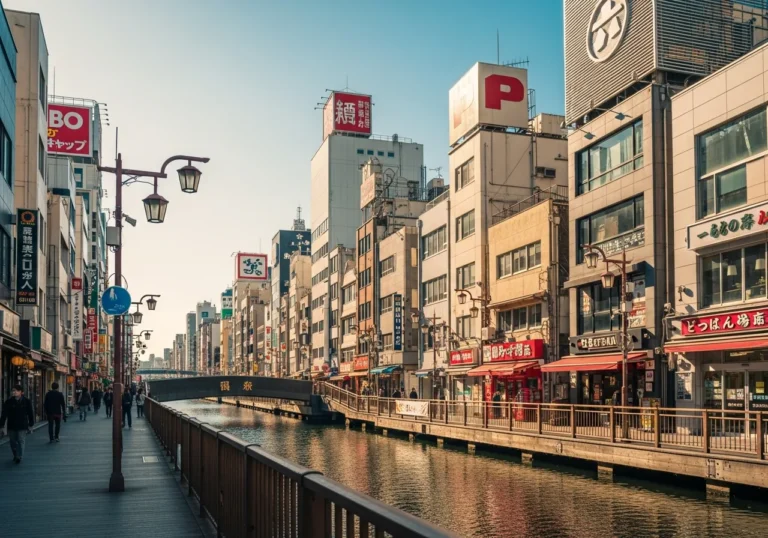
The route itself is significant. The parade begins at Ebisubashi — Ebisu Bridge — in Dotonbori, one of the most commercially active streets in Japan, and moves south to the shrine.
It traces the geography of Osaka’s commercial heart, connecting the entertainment district to the sacred precinct, reminding the city that commerce and culture and faith are not separate domains here. They never have been.
Why Three Days? The Structure of Sacred Time
The festival’s three-day structure is not arbitrary. Each day has a distinct character and name that reflects a different relationship to fortune.
Toka Ebisu begins with “Yoi Ebisu” on January 9th, followed by “Hon Ebisu” on the 10th, and concludes with “Nokori Ebisu” on the 11th. Yoi means “eve” or “good” — the anticipatory night before the main event. Hon means “main” or “true.” Nokori means “remaining” — the last chance to receive what fortune has not yet been distributed.
The naming of the third day as “Nokori Fuku” — remaining fortune — is a particularly Osakan touch. The 11th is referred to as the “Last Helping of Luck,” offering visitors one final chance to pray to Ebisu.
The implication is that fortune is a finite resource that can run out, and that the late-arriving worshipper is claiming what others have left behind. It is a commercial metaphor dressed as theology: the late buyer still finds value in the market.
The festival runs almost around the clock. You can purchase fukusasa and request prayers from 7 a.m.
to 1 a.m., while the shrine remains open 24 hours a day during the Toka Ebisu Festival. The streets between the shrine and Namba Station — roughly one kilometer — are lined with yatai food stalls for the entire duration.
The streets surrounding the shrine are packed with yatai stands, offering the likes of takoyaki, yakisoba, grilled pork skewers and more.
The food stalls are not incidental. They are part of the festival’s economic logic.
Toka Ebisu generates significant commercial activity in the surrounding neighborhood — the irony of a festival dedicated to commercial prosperity also being a major commercial event is not lost on Osakans. The god of fair dealing presides over a market in his own honor.
Why Did It Survive? The Festival Through War and Modernity
The shrine that stands today is not the original structure. The shrine building of Imamiya Ebisu Shrine was once destroyed by fire during the war, but was rebuilt after the war.
The bombing of Osaka in 1945 was devastating — the city lost a larger proportion of its built environment than almost any other Japanese city. The shrine was among the casualties.
That it was rebuilt, and that the festival resumed, tells you something important about the relationship between Osaka and its commercial deity. The festival was not a relic that survived through institutional inertia.
It was actively reconstituted because the city needed it. Imamiya Ebisu Shrine was designated as a cultural property by Osaka City in 2013, and its historical and cultural value is officially recognized.
In particular, the festival of Tokaebisu and the culture of fukuzasa (lucky bamboo branches) are important intangible cultural assets that symbolize Osaka’s commercial culture.
The cultural-property designation is significant. It means the city government has formally recognized that Toka Ebisu is not merely a religious event but a piece of Osaka’s identity — as much a part of the city’s heritage as Osaka Castle or the Bunraku theater. The festival is protected not because it is old but because it is alive, and because its aliveness is inseparable from what Osaka is.
The festival also survived the COVID-19 pandemic, though in altered form. The fukumusume tradition, which had been suspended during the pandemic years, resumed — a return that was itself treated as a significant civic event.
The fukumusume are an integral part of Osaka’s culture and have a long history of over 60 years. At their first gala dinner appearance in three years, the fukumusume greeted and took photos with guests at the entrance of the venue.
Their return was news.
Why the Numbers Keep Growing: Commerce, Community, and the Ritual of Intention
The million-person attendance figure deserves interrogation. Why does a festival that is, at its core, a prayer for business prosperity draw not just business owners but ordinary workers, students, and tourists? What is the broader appeal?
Part of the answer is that the festival’s scope has always been wider than pure commercial prayer. During Tokaebisu, people visit Ebisu shrines to pray for success in business, happiness in family, and good health for the year ahead. The commercial framing is the dominant one, but Ebisu’s blessings are understood to extend to the household, to health, to relationships.
Part of the answer is also that the festival is genuinely spectacular. The vibrant colors of the lucky fukusasa or kumade bamboos, combined with the shouts of the fukumusume, create a powerful, exuberant festival that truly embodies the energetic, colorful culture of Osaka.
This is a city that does not do things quietly. The January streets around Imamiya Ebisu are among the most sensory-dense environments in Japan: the smell of takoyaki and grilled squid, the sound of the fukumusume’s chant, the press of bodies, the flash of gold eboshi hats in the winter light.
But the deepest answer is about the ritual of intention itself. Toka Ebisu is not only about asking for luck.
By visiting the shrine, offering prayers, and bringing fukuzasa back to their workplace, people are quietly making a promise. In this sense, Toka Ebisu is a blend of faith, gratitude, and personal commitment — a deeply Japanese approach to business and life.
The act of going — of standing in the queue, of making the effort, of choosing which charms to attach to your bamboo branch — is itself a form of commitment to the year ahead. The ritual externalizes intention.
It makes the private aspiration public, witnessed by a god and by a million fellow worshippers. There is something psychologically powerful about beginning a commercial year with a physical act of dedication, however the theology is understood.
Why the Discerning Traveler Should Care: What Toka Ebisu Reveals
For the visitor who can go anywhere, Toka Ebisu offers something that most festivals do not: direct access to a living civic theology. This is not a performance staged for tourists.
The million people in that queue are not there because it is picturesque. They are there because it matters to them, in the most practical sense — because their businesses, their livelihoods, their sense of how a year begins, are bound up in this ritual.
What you are witnessing, if you stand in that queue in January, is the commercial culture of Osaka made visible. This deeply rooted event in the Kansai region, where merchant culture has flourished since the Edo period, is characterized by a wide range of worshippers including corporations, sole proprietors, and shop owners who visit with the intention of boosting economic fortune.
The company president and the ramen shop owner are standing in the same line, seeking the same blessing, carrying the same bamboo branch. The festival is one of the few remaining public spaces where Osaka’s commercial democracy — the city’s long tradition of merchant self-organization — is still enacted in real time.
There is also the question of what the festival reveals about the relationship between Shinto and commerce in Japan. When commercial cities such as Osaka, Sakai, and Hyogo developed during the Edo period, Ebisu faith spread rapidly, and many merchants began visiting Imamiya Ebisu and Nishinomiya Shrine for “New Year wishes at the beginning of the year.” The faith did not constrain commerce; it legitimized it.
The god of fair dealing gave merchants a moral framework for their work. The festival was the annual renewal of that framework.
For the traveler interested in how cities work — how they construct identity, how they manage the relationship between money and meaning — Toka Ebisu is a masterclass. The Toka Ebisu Festival is more than a vibrant street celebration — it’s a 1,400-year-old tradition rooted in Osaka’s identity as a city of merchants. That identity was not given; it was built, festival by festival, year by year, bamboo branch by bamboo branch.
The shrine itself, visited outside of festival season, rewards the curious traveler with a different kind of experience. Despite being an urban shrine, Imamiya Ebisu Shrine has a unique charm and cultural value that has been cultivated over a long history.
Although the shrine grounds are not large, they reflect the weight of over 1,400 years of history and Osaka’s commercial culture. The gongs at the back of the main hall are there year-round.
You can perform the ura-mairi on any quiet Tuesday. The god is still slightly deaf.
The Osaka instinct to walk around to the back and knock harder is still the correct response.
And if you visit in January — if you join the queue, accept a fukuzasa from a fukumusume in her gold eboshi hat, and choose your charms from the stalls along the approach — you will be doing something that Osaka’s merchants have been doing, in this spot, since the Edo period. The bamboo branch you carry home will hang above your desk or your kitchen shelf for the year, a small gold-hung reminder that intention, expressed publicly and renewed annually, is itself a form of luck.
By the way, Imamiya Ebisu Shrine usually receives around 50,000 visitors on New Year’s Day, but during the “Toka Ebisu” festival, it is said that the shrine receives 20 times as many visitors — approximately 1 million people. That twenty-fold multiplication is the measure of what commerce means to this city.
Frequently Asked Questions
Q: When exactly does Toka Ebisu take place, and which day is the most important?
A: Toka Ebisu begins with “Yoi Ebisu” on January 9th, followed by “Hon Ebisu” on the 10th, and concludes with “Nokori Ebisu” on the 11th. January 10th is the main day, with the largest crowds and the full parade of over 500 participants. If you want atmosphere without maximum crush, the evening of the 9th or the morning of the 11th are more manageable.
Q: What is a fukuzasa and do I need to buy one?
A: Bamboo branches are handed out free of charge. Decorate them with special “kiccho” decorations to make your own fukusasa or kumade.
Many businesses around Osaka store these objects year-round in a visible place, usually high up on the wall or shelf. The base branch is free; the individual charms — gold coins, sea bream, rice sacks — are purchased separately from stalls in the precinct.
Q: How long should I budget for the visit during the festival?
A: Given the large crowds that congregate around the shrine every year, budget two to three hours minimum for your journey. It may take 20 to 30 minutes to enter the shrine, but the surrounding stalls of food, souvenirs and charms will provide enough entertainment to keep you interested while you slowly make your way forward.
Q: Can I visit the shrine outside of the festival period?
A: Yes, and it is a genuinely different experience. A visit to the shrine on any day outside of the festival will be a quiet one.
Wander the grounds and observe the lovely shrine buildings at your own pace, enjoying the calm atmosphere. The ura-mairi gongs are accessible year-round, and the shrine’s regular hours are 9 a.m.
to 5 p.m.
Q: Is Imamiya Ebisu the only shrine that holds Toka Ebisu?
A: No. Osaka’s Imamiya Ebisu Shrine, Nishinomiya Shrine, and Kyoto Ebisu Shrine are called the “Three Great Ebisu Shrines” and attract many worshippers annually. Nishinomiya Shrine in Hyogo Prefecture is actually considered the head shrine of all Ebisu shrines in Japan, and is famous for its dawn gate-opening race on January 10th. Imamiya Ebisu is the Osaka shrine, and its character — louder, more commercial, more densely urban — is distinctly of this city.
Q: What is the ura-mairi and should I do it?
A: It is called “Ura-mairi” (reminder mairi). In this method, after praying at the front main hall as usual, visitors go around to the back side of the main hall and strike the gongs to pray again.
Yes, do it. It is the most Osakan thing you can do at a shrine — pragmatic, slightly irreverent, and entirely sincere.
Imamiya Ebisu Shrine — Visitor Information
Address: 1-6-10 Ebisunishi, Naniwa-ku, Osaka 556-0003 / 大阪府大阪市浪速区恵美須西1丁目6-10
Nearest station: Imamiyaebisu Station (Nankai Koya Line) — 2-minute walk; Ebisucho Station (Osaka Metro Sakaisuji Line) — 8-minute walk; Daikokucho Station (Osaka Metro Midosuji/Sakaisuji Lines) — 8-minute walk
Hours: Regular hours 9:00 a.m. – 5:00 p.m. daily. During Toka Ebisu (Jan. 9–11), the shrine is open 24 hours; fukuzasa available 7:00 a.m. – 1:00 a.m.; fukumusume present 9:00 a.m. – 9:00 p.m. Hours subject to change — confirm on the official site before visiting.
Admission: Free entry to shrine grounds. Fukuzasa bamboo branches are distributed free of charge; individual lucky charms (kiccho) are purchased separately at stalls (prices vary). Approx. figures only — confirm current pricing on the official site.
Official site: imamiya-ebisu.jp