In 1730, the Tokugawa shogunate officially sanctioned two forms of rice trading at the Dojima district of Osaka — a spot market in rice coupons (shomai) and a fully organised futures market settled by margin and book-entry (choaimai) — making the Dojima Rice Exchange the world’s first officially authorised futures exchange, predating the Chicago Board of Trade by 118 years. The exchange grew from a structural crisis in Japan’s rice-denominated feudal economy: samurai were paid in grain, daimyo needed to convert tax rice into cash, and price volatility threatened the entire political order. The mechanisms Dojima pioneered — standardised contracts, margin deposits, cash settlement, clearing, membership, and a nationally broadcast benchmark price — are the direct ancestors of every futures exchange operating today.
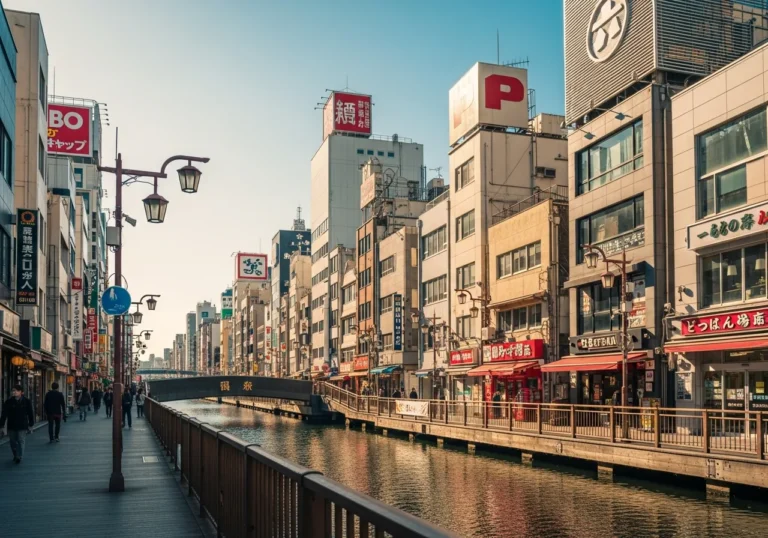
Stand on the north bank of the Dojima River on a grey Osaka morning and the water does what it has always done: it moves. The expressway overhead is loud and indifferent.
Below it, half-hidden by the concrete abutment of the Nakanoshima Garden Bridge, sits a three-metre sculpture of a rice grain in pale stone — a striking stone marker shaped like a large rice grain, designed by Tadao Ando, installed in 2018. Most people walk past it.
A few stop to read the plaque. Almost none of them realise they are standing on the ground where the modern financial world was invented.
The Dojima Rice Exchange is not a curiosity of Japanese economic history. It is the origin point of a technology — the futures contract — that now underpins the pricing of oil, wheat, interest rates, and stock indices across every time zone on earth.
That it happened here, in Osaka, in 1730, is not an accident of geography or a lucky coincidence. It was the inevitable outcome of a specific political economy, a specific crisis, and a specific city. The question is why.
Why Did a Rice Market Arise in Dojima at All?
The Feudal Arithmetic of Tax Rice
In the Edo period (1603–1867), most of the rice collected by feudal domains as tax was transported to major cities, such as Osaka. This was not a matter of preference.
The Tokugawa system of governance was built on nengu (年貢), the annual land tax, levied overwhelmingly in rice. Daimyō domains collected annual land taxes, known as nengu, predominantly in rice, typically amounting to 30–40% of peasant harvests, which was then transported via coastal shipping routes to central markets like Osaka for liquidation into cash.
The arithmetic was brutal and inescapable: a domain lord might govern a territory assessed at 100,000 koku of rice per year, but he could not pay his retainers’ salaries, his Edo residence bills, or his infrastructure costs in grain. He needed coin. And to get coin, he needed Osaka.
This system supported the sankin-kōtai alternate attendance policy, requiring daimyō to maintain residences in Edo and fund extensive entourages, often necessitating the sale of tax rice in Osaka’s warehouses to cover monetary expenditures estimated at millions of koku annually across domains. The political genius of sankin-kōtai — keeping feudal lords perpetually in transit between their domains and the capital, too busy and too broke to plot rebellion — was also its economic engine. It created a permanent, structural demand for a market that could convert rice into money at scale.
Nakanoshima and the Geography of Inevitability
During the Edo Period, Nakanoshima and its surrounding area grew into a vital hub of commerce and logistics, its influence extending well beyond Osaka itself. It was packed with kurayashiki (蔵屋敷), storehouse-residences used by daimyo to manage, store, and sell their tax rice.
At its peak in the early 1800s, Osaka housed more than 110 of such kurayashiki. The majority were on Nakanoshima and neighboring islands, including Dōjima.
The geography was not coincidental. Nakanoshima is a narrow sandbar dividing the Kyū-Yodo-gawa into the Tosabori and Dojima rivers, giving it direct water access from both sides.
Rice barges could unload directly into the compounds’ private harbours — known as funa-iri (舟入), they facilitated unloading cargo. Small canals connected them to the river.
Feudal domains sold tax rice stored at kurayashiki (combined warehouses and residences) around Nakanoshima to rice brokers through auctions and issued rice bills (notes promising to exchange for rice) to successful bidders. These bills — kome-kitte (米切手) — were the first instrument.
Each coupon was a warehouse receipt, a claim on a specific quantity of physical rice. But a receipt that can be traded is already, in embryo, a security. And once you have securities, you have a market.
From Kitahama to Dojima: The Move of 1697
The market did not begin at Dojima. In the Edo era rice trade was first made on the street of Kitahama, along the shore of Tosabori River, where kurayashiki (warehouses) were standing in a row.
The informal market coalesced around the premises of the wealthy merchant Yodoya, whose shop on the south side of what is now Yodoyabashi became the first gathering point for rice brokers and domain agents. This market was called “Yodoya-Komeichi,” which was the first securities trading in the nation. Later on, the market was moved to Dojima in 1697 and officially approved as “Dojima Rice Exchange” by Japan’s shogunate government in 1730.
The move to Dojima around 1697 was partly administrative and partly organic: the Japanese economy grew rapidly throughout the 17th century, culminating in the period known as Genroku (1688–1704) during which merchants prospered like never before. It was at this time that rice brokers and moneychangers (両替商, ryōgaeshō) gathered their shops and warehouses in the Dōjima area; the Rice Exchange can be said to have been established in 1697, the year it received a license from the shogunate.
The Dojima riverbank, on the north side of Nakanoshima, offered more space, better water access, and proximity to the growing merchant quarter. The market had found its address.
Why Was a Concept Like “Futures” Needed?
The Samurai’s Impossible Position
To understand why futures trading was not merely useful but structurally necessary, you have to understand the fiscal trap in which the entire samurai class was caught. Since members of the samurai class, including daimyō (feudal lords) were paid in rice, not cash, the rice brokers and moneychangers played a crucial, and incredibly profitable, role in the emerging early modern economy of Japan.
A samurai’s stipend was denominated in koku — one koku being roughly 180 litres of rice, the theoretical annual food requirement of one adult. But samurai did not eat their stipends.
They sold them. And the price at which they could sell depended entirely on the market at the moment of sale.
This created a structural vulnerability of extraordinary depth. A samurai with a stipend of 100 koku might receive the equivalent of, say, 60 silver momme per koku in a good harvest year, and 30 momme in a bad one — a 50% swing in real income with no change in rank, duties, or expenses.
At a time when there were no diverse industries like there are today, agriculture was the center of the economy, and rice in particular held a significance that went beyond mere food. The finances of the various domains depended on the proceeds from the sale of tax rice, and the stipends of samurai were also paid in rice. The samurai class was, in modern terms, massively long a single commodity with no ability to hedge.
The Rice Coupon and the Birth of the Forward Contract
The merchants who bought tax rice from the kurayashiki auctions received kome-kitte — but they quickly discovered that these receipts could be traded before the rice was physically collected. The various domains sold the tax rice accumulated in their warehouse residences to rice brokers through bidding and issued securities called “rice coupons” (kome-kitte). These rice coupons were securities that could be exchanged for rice at the warehouse residences, but they gradually developed into credit transactions that did not involve the actual physical goods.
The next step was conceptually decisive. Particularly noteworthy is the emergence of a trading method called “deferred trading” (nobe-baibai).
This was a contract to postpone the delivery of rice and settle the price difference at maturity, which was futures trading itself. Even more striking: forward contracts, termed nobemai (延べ米, meaning “extended rice”), originated in the 1620s as bilateral agreements between merchants for the future delivery of rice at predetermined prices, often involving an advance payment of around 10 percent. These contracts allowed maturities up to 18 months, despite bakufu (shogunate) restrictions limiting them to as short as 10 days in 1663.
The shogunate’s repeated attempts to ban or restrict these instruments tell you everything about how powerful they had become. For many years, the Japanese government had prohibited the trade of futures bills because it was widely regarded as a form of gambling that caused rice prices to rise.
But prohibition was futile. The instruments existed because they solved a real problem — the mismatch between a rice-denominated income and a money-denominated world — and no decree could make that problem disappear.
By 1710, the year 1710 marks the beginning of this development, which also brought with it the emergence of the concept of trading in futures (延べ米 nobemai). The exchange was trading futures whether the government liked it or not. The question was whether the government would pretend otherwise, or find a way to profit from the reality.
Why Did the Shogunate Officially Sanction It in 1730?
Yoshimune and the Crisis of the Rice Price
The Kyōhō Reforms (享保の改革, kyōhō no kaikaku) were an array of economic and cultural policies introduced by the Tokugawa shogunate between 1722–1730 during the Edo period to improve its political and social status. These reforms were instigated by the eighth Tokugawa shōgun of Japan, Tokugawa Yoshimune, encompassing the first 20 years of his shogunate.
Yoshimune was a pragmatist of unusual intelligence — a man who understood that the shogunate’s survival depended on fiscal solvency, and that fiscal solvency depended on rice prices. He earned the nickname Kome Shogun, the Rice Shogun, for his obsessive attention to the grain market.
The crisis that forced his hand was a price collapse. At the time of his inauguration in 1716, a series of good harvests led to a drop in rice prices, and the various domains that depended on tax rice revenue fell into financial difficulties.
By the late 1720s, the situation had become acute. When the price of rice fell to record lows in the late 1720s, the samurai (whose income was tied to the value of rice) saw their economic position fall relative to the merchant class, whose growing economic power worried the nation’s elites.
This was not merely an economic problem. It was a political one.
The Confucian social order placed merchants at the bottom of the four-class hierarchy — below samurai, farmers, and artisans. A world in which merchants grew rich while samurai grew poor was a world in which the ideological foundations of Tokugawa rule were visibly crumbling.
Legitimation as Control
Yoshimune’s response was characteristically indirect. Rather than simply legalising the futures market, he first tried to create rival exchanges staffed by Edo merchants — examples include the “Exchange for Official Rice and Currency” established by Kinokuniya Genbei and others in 1725, and the “Dojima Eirai-cho Official Exchange” established by Nakagawa Seizaburo and others in 1727.
However, all of these exchanges were forced to cease operations within a short period. The Osaka merchants were simply better at this than anyone the shogunate could install. Their networks, their credit relationships, their knowledge of the rice trade — none of it could be replicated by decree.
The merchants of Osaka then petitioned directly. In 1730, Japanese merchants petitioned shogun Tokugawa Yoshimune to officially authorize trade in rice futures at the Dojima Exchange, the world’s first organized (but unsanctioned) futures market.
The shogunate’s calculation was clear: if you cannot beat the market, regulate it. Sanctioning Dojima gave the bakufu supervisory authority — the Tokugawa shogunate officially recognizes the Dojima Rice Market in Osaka; and bakufu supervisors (nengyoji) are appointed to monitor the market and to collect taxes — while simultaneously channelling all futures activity into a single, observable venue.
With this proclamation, the establishment of the Dojima Rice Exchange was officially permitted, and the operation of the rice market, including futures trading, was officially approved. At the same time, the Fuyuki Exchange was ordered to cease operations, and the establishment of rice markets outside of Dojima was prohibited, making Dojima the only officially recognized futures market in the country.
The proclamation was issued on the 13th day of the 8th month of Kyoho 15 — 24 September 1730 by the Western calendar — in the name of Ooka Tadasuke, Yoshimune’s celebrated magistrate of Edo. In 1730, the Tokugawa shogunate authorized a spot market to trade rice bills and a futures market to trade representative brands of rice on a book in Dojima.
The two markets were formally distinct: shomai (正米商い) for spot trading of physical rice coupons, and choaimai (帳合米商い) for the futures market, settled entirely on the books by cash difference — no rice needed to change hands. Trading participants could trade futures by contract for difference (CFD) simply by preparing a margin called “shikigin.”
The Architecture of the Exchange
What the 1730 authorisation created was not merely a legal permission but a complete institutional architecture. The authorization formalized a membership system with licensed rice merchants, initially numbering around 500 in 1731 and expanding to 1,300 by late 1732 through subsequent registrations.
Contracts were standardised: futures contracts were standardized at 100 koku (approximately 150 metric tons) of rice per unit, traded during three annual periods — a spring, summer, and winter session — with margins ranging from 5% to 30% to mitigate default risk. Trading sessions had defined opening and closing rituals.
Each contract had a fixed volume and a clear deadline for its expiration: Spring contracts were from Jan. 8 to April 28; Summer contracts were from May 7 to Oct. 9; Winter contracts from Oct. 17 to Dec. 24. Settled in cash, the delivery dates, futures prices, parties’ names and rice volumes were recorded for each transaction, and suppliers were not obliged to physically deliver the rice at the end of the trading period. This is, in every structural sense, a modern futures exchange.
“This marked the inception of an official market known as Dojima Rice Exchange, which was equipped with a membership system and clearing function similar to exchanges in the modern era and is widely known as the forerunner to organized futures exchanges in the world.” — Japan Exchange Group, Dojima Rice Exchange
Why Was This 118 Years Before the Chicago Board of Trade?
What “First” Actually Means
The Chicago Board of Trade (CBOT), established on April 3, 1848, is one of the world’s oldest futures and options exchanges. It is the institution that most Western financial histories treat as the origin of organised futures trading.
The claim is not dishonest — the CBOT was genuinely foundational for the global financial system as it developed through the 19th and 20th centuries. But it is incomplete. Japan has a unique place in the history of futures trading, as the Dojima Rice Market in Osaka, established in 1697 and authorized in 1730, is said to be the first case in the world that a futures market for any commodity was operated under the official government permission.
The gap is 118 years. Dojima’s 1730 authorisation predates the CBOT’s 1848 founding by more than a century.
And the CBOT itself did not introduce standardised futures contracts immediately: in 1864, the CBOT listed the first standardized “exchange traded” forward contracts, which were called futures contracts. That makes the gap between Dojima’s fully standardised, margin-settled, book-entry futures market and the CBOT’s equivalent not 118 years but 134.
The word “officially” in Dojima’s claim matters. Informal forward contracts existed in ancient Mesopotamia, in medieval European grain markets, and in the Dutch tulip trade of the 1630s.
What Dojima achieved in 1730 was something qualitatively different: a state-sanctioned, institutionally organised exchange with standardised contracts, a clearing function, a membership system, defined trading periods, and a margin requirement. Many of the trading rules and practices developed in Dojima were carried over to commodity, equity, and financial futures exchanges afterwards. The CBOT was not built in ignorance of Dojima — the CBOT, which is the oldest commodity exchange in the United States and has the largest futures market in the world, is said to have been developed based on the Osaka Dojima market.
Why the West Didn’t Know
Japan’s self-imposed isolation under the Tokugawa sakoku policy meant that Dojima’s innovations were invisible to European and American financial thinkers. The exchange operated, refined its mechanisms, survived crises, and shaped the entire Japanese economy for over two centuries — all without a single Western observer taking notes.
When the CBOT’s founders sat down in Chicago in 1848, they were solving the same problem Dojima had solved in 1730: how to create a reliable, liquid market for a storable commodity in a world where harvest timing and transport costs created dangerous price volatility. They arrived at essentially the same solution independently. The parallel invention is itself a kind of proof that the futures contract is not a cultural artefact but a logical necessity — the form that markets take when they reach a certain level of complexity.
Why Is the Birth of Candlestick Charts Told the Way It Is? — A Question of Evidence
The Popular Story
Ask any trader about the history of candlestick charts and you will hear a confident story: Honma Munehisa (also known as Sokyu Honma or Sokyu Homma, 1724–1803) was a rice merchant from Sakata, Japan who traded in the Dōjima Rice Exchange in Osaka during the Tokugawa Shogunate. He is sometimes considered to be the father of the candlestick chart, a form of technical analysis used in financial markets.
The story continues: Honma published a book on market psychology in 1755, accumulated legendary wealth, was awarded the title of samurai, and developed the visual candlestick form that traders worldwide use today. The Fountain of Gold – The Three Monkey Record of Money (Japanese: San-en Kinsen Hiroku), published in 1755 in Sakata, Japan, stands as Honma Munehisa’s seminal contribution to trading literature.
This concise 37-page work draws directly from his experiences at the Dōjima Rice Exchange in Osaka, where he amassed his fortune through rice futures trading during the Edo period. Aimed primarily at educating merchant apprentices within his family business, the book combines practical trading strategies with profound insights into market dynamics.
This story was introduced to the Western world by Steve Nison, who published the books “Japanese Candlestick Charting Techniques” and “Beyond Candlesticks” in the early 1990s, in which he introduced and described the concept of candles and candlestick patterns, making candlestick charts more prominent in Western markets. Nison’s work was genuinely important — he translated a Japanese analytical tradition for a global audience — and his attribution of the candlestick’s origins to Honma became the standard account in Western trading literature.
諸説ある — Accounts Differ
Here is where intellectual honesty requires a harder look. The Honma-invented-candlesticks story has several problems that are rarely acknowledged in the popular trading literature.
The first is chronological. Honma Munehisa was born in 1724.
The Dojima Rice Exchange was officially sanctioned in 1730, when Honma was approximately six years old. He could not have shaped the exchange’s founding or its early trading culture. His active trading career at Dojima came decades later, in the mid-18th century, well after the exchange’s institutional architecture was established.
The second problem is more fundamental. According to Steve Nison, candlestick charting first appears sometime after 1850.
Much of the credit for candlestick development and mapping goes to a legendary rice trader named Honma from the town of Sakata. His original ideas are likely modified and refined over many years of trading, eventually resulting in the system of candlestick charting used today.
This is Nison’s own position, cited in academic literature — and it is devastating to the popular myth. Honma died in 1803.
If candlestick charting as a visual system did not appear until after 1850, then Honma cannot have invented it. He died nearly half a century before the form existed.
The Japanese Wikipedia page cites Steve Nison for believing Honma likely did not invent said chart, but the chart was invented sometime in the early Meiji era in the late 1800s. This is a significant scholarly position, and it aligns with the chronological evidence.
Numerous legends have surrounded Honma Munehisa, portraying him as possessing divine trading abilities that earned him the moniker “God of the Markets.” These tales often stem from rumors of his extraordinary success, including a purported streak of over 100 consecutive winning trades at the Dōjima Rice Exchange, which contributed to his near-mythical status among contemporaries. Such stories, while emphasizing his innovative market insights, likely exaggerate the consistency and scale of his achievements to elevate him to a folk hero figure.
What seems more defensible is a nuanced middle position. Honma was a real and probably exceptional trader.
His 1755 book on market psychology — emphasising that price is driven by human emotion as much as by supply and demand — was genuinely ahead of its time. Homma’s books about the markets were said to have been written in the 1700s.
His trading principles, as applied to the rice markets, evolved into the candlestick methodology currently used in Japan. The key word is “evolved.”
Honma’s conceptual insights about market psychology may have seeded a tradition that later generations refined into the visual candlestick form — but the form itself, with its filled and hollow bodies, its wicks and shadows, appears to be a later development, probably post-1850. The direct claim that “Honma invented candlestick charts at Dojima” is very likely a retrospective legend, a story that collapses a century of gradual development into a single heroic inventor.
It is a good story. It is probably not history.
“Many legends and myths have developed around the person and trading of Munehisa Homma over the years.” — FTMO, Technical Analysis: History of Candlestick Charts
Why Osaka and Not Edo?
Two Cities, Two Functions
The question seems almost too obvious to ask — and yet it contains the whole logic of Edo-period Japan. Edo (modern Tokyo) was the political capital, the seat of the shogunate, the city of samurai.
It was the largest city in the world by the early 18th century, with a population approaching one million. Why did the world’s first futures exchange not arise there?
The answer is structural. During the Edo period (1603–1868), Osaka earned the nickname “the nation’s kitchen” (tenka no daidokoro), as rice and other goods from all over the country flowed here for further distribution.
Edo was a consumption city — it consumed the output of the rest of Japan, but it did not originate or organise that output. Osaka was a distribution city.
During the Edo period, all rice throughout the whole of the country was required to be sent to Ōsaka before being redistributed. This made it a vibrant city for business and gave rise to its moniker as “the kitchen of the nation” (天下の台所 tenka no daidokoro).
The Water Network Argument
Geography was decisive. Osaka’s rare urban form — rivers such as the Dojima, Tosabori, Dotonbori, Higashi-Yokobori, and Kizu flowing around the center like a square loop — helped make water transport remarkably productive.
With a frequently cited figure of around 10% of the city’s area covered by rivers and water surfaces, Osaka benefited enormously from this geography. Before railways, bulk commodities moved by water.
Osaka’s canal network was not merely convenient — it was the reason the city existed as a commercial hub at all. A network of rivers and canals facilitated efficient logistics, solidifying Osaka’s role as an economic powerhouse in Japan.
Edo had no equivalent. It was a planned political capital, built on a bay, with a river system designed for defence and administration rather than commerce.
The kurayashiki — those combined warehouse-residences that were the physical infrastructure of the rice market — many of the kurayashiki were concentrated in Osaka and the rice stored there was sold to rice brokers through auctions. Daimyo sent their rice to Osaka because that was where the buyers were, where the credit networks were, where the moneychangers operated. The market followed the infrastructure, and the infrastructure followed the water.
The Merchant Class and Its Culture
Flourishing during the Edo Period (1603–1868) as a merchant city, Osaka was the commercial and logistical center of feudal Japan. Its convenient geographical location next to the former capital Kyoto, and the fact that a large number of sailing routes converged there, led to a concentration of trading merchants at this strategic port.
Osaka’s merchant culture — pragmatic, numerate, commercially aggressive — was the human capital that made Dojima possible. The Osaka merchants developed not just trading techniques but an entire financial ecosystem: credit instruments, exchange rates, insurance, and eventually the rice coupon system that became the foundation of futures trading. An incredible proportion of the nation’s monetary transactions were handled through the private, independent, merchants of Dōjima, who stored rice for most of the daimyō, exchanging it for paper money.
Edo’s merchant class existed, but it operated in the shadow of samurai power. In Osaka, the merchants were the power — not politically, but economically.
Tokyo may have held political power, but Osaka held financial gravity. That distinction — between political authority and financial gravity — is the key to understanding why the world’s first futures exchange was born in a merchant city, not a political one.
Why Does This Still Run Through Modern Global Finance?
The DNA of the Modern Exchange
The mechanisms that Dojima pioneered in 1730 are not historical curiosities. They are the operating system of every futures exchange on earth.
Consider the list: standardised contracts, defined trading periods, margin deposits (shikigin), cash settlement by difference, a clearing function, a membership system, and a nationally broadcast benchmark price. Rules, customs and function in Dojima form the basis of that in the modern exchange.
The price dissemination system alone was remarkable. The rice price formed at Dojima Rice Exchange was disseminated by couriers or flag signals across hundreds of kilometers, reaching the capital and other major cities.
The flag-signal system — hatafuri tsūshin (旗振り通信) — used relay stations on hilltops to transmit price information optically, at speeds that astonished contemporaries. A price set at Dojima in the morning could reach Kyoto within minutes and Edo within hours. This was, in effect, a real-time market data feed — the Edo-period equivalent of a Bloomberg terminal.
The Clearing Function and the Problem of Trust
Perhaps the most sophisticated of Dojima’s innovations was its clearing function. The decree restricted off-exchange futures trading, channeling activity to Dōjima’s 50 established clearinghouses to stabilize rice prices amid economic pressures from low yields and merchant speculation.
A clearinghouse solves the fundamental problem of futures trading: counterparty risk. If I agree to sell you rice in three months at today’s price, and the price falls, I have an incentive to default.
The clearinghouse stands between us, guaranteeing performance. Clearinghouses assumed guarantee roles, facilitating daily price settlement. This is precisely the function that the CBOT’s Board of Trade Clearing Corporation performed when it was established in 1925 — nearly two centuries after Dojima had already solved the same problem.
The Living Lineage: ODEX and JPX
The institutional lineage from Dojima to the present is direct and unbroken, if not always linear. Reorganized in the Meiji period along with nearly every other element of the economy and polity, the Dōjima Rice Exchange was formally dissolved in 1939, when its function was overtaken and replaced by the Government Rice Agency.
But the exchange’s DNA survived. The Osaka Grain Exchange, established in the tradition of Dojima, eventually became the Osaka Dojima Commodity Exchange, which was reorganised as a joint-stock company in 2021 and renamed the Osaka Dojima Exchange (ODEX). The DNA of Dojima Rice Exchange (which traded the rice as a futures contract) is being passed down to ODEX, which is currently aiming to develop a wide range of derivative financial products as a comprehensive exchange.
In August 2024, the connection became explicit: ODEX listed Dojima Rice Average futures, Japan’s first-ever rice futures price index, linked to the Dojima Rice Average, which is published on the top page of the ODEX homepage on the last business day of each month. Rice futures, at Dojima, in Osaka, in 2024.
The circle closes. The Japan Exchange Group (JPX), which now operates the Osaka Securities Exchange as part of its integrated structure, also maintains the Dojima memorial site and commissioned the Tadao Ando monument unveiled in 2018. The site of Dojima Rice Exchange is preserved by OSE, Osaka Dojima Commodity Exchange, Tokyo Commodity Exchange, Inc., Japan Securities Dealers Association, Daido Life Insurance Company, and Daibiru Corporation.
The Deeper Through-Line
The most important thing Dojima contributed to global finance is not any specific mechanism but a conceptual breakthrough: the idea that you can trade time. A futures contract is not a contract to buy or sell a commodity.
It is a contract to buy or sell a commodity at a specified future moment, at a price agreed today. This separates the act of pricing from the act of delivery.
It allows producers to hedge against price falls, consumers to hedge against price rises, and speculators to provide the liquidity that makes hedging possible. This practice enabled participants to hedge against price fluctuations and engage in economic planning for the future. Every oil futures contract traded in New York, every wheat contract in Chicago, every interest rate swap in London, every equity index option in Tokyo — all of them are descendants of the insight that Osaka merchants formalised on the north bank of the Dojima River in 1730.
“The rules, customs, and functions in Dojima formed the basis of those now in place at modern exchanges. The CBOT (Chicago Board of Trade), which is the oldest commodity exchange in the United States, and the predominant futures market in the world, is said to have been developed based on the Osaka Dojima market.” — Wikipedia, Osaka Dojima Exchange
MICHI’s Pick
We walk this riverbank regularly, and we want you to understand something that the monument’s plaque — however well-intentioned — cannot quite convey. The Dojima Rice Exchange was not a proto-stock market that happened to be Japanese. It was the solution to a specifically Japanese political crisis: a ruling class paid in grain, a merchant class paid in coin, and a government terrified of both. The futures contract was not invented by financial genius. It was invented by necessity — by the gap between a rice-denominated world and a money-denominated one. Stand here and look at the water. The Dojima River is narrow and unremarkable. But in the 18th century, rice barges moved through it constantly, from the kurayashiki of Nakanoshima to the brokers’ offices on this bank. The price agreed in those offices — for rice that had not yet been harvested, in a season that had not yet arrived — was transmitted by flag relay to Kyoto and Edo before the day was out. That is the world’s first real-time financial data network. The next time you check a futures price on your phone, you are using a technology that was born here, on this unremarkable stretch of water, in a city that has always understood that the real business of the world is not politics. It is commerce.
Dojima Rice Market Monument (堂島米市場跡碑) — Visitor Information
Address: 1-3 Dojimahama, Kita-ku, Osaka 530-0004 (大阪市北区堂島浜1丁目3) — at the north-east end of the Nakanoshima Garden Bridge (中之島ガーデンブリッジ北東詰), beneath the expressway.
Nearest station: Kitashinchi Station (JR Tozai Line) approx. 5 min walk; Higobashi Station (Osaka Metro Yotsubashi Line) approx. 5 min walk; Osaka City Bus “Dojima” stop approx. 300 m east.
Hours: Outdoor riverside monument — viewable at all times. (Confirm locally; no formal opening hours.)
Admission: Free. (No charge; confirm on the official site before visiting.)
Official site: jpx.co.jp/dojima · city.osaka.lg.jp
Frequently Asked Questions
Q: Was the Dojima Rice Exchange really the world’s first futures exchange?
A: It is widely recognised as the world’s first officially sanctioned organised futures exchange. Japan Exchange Group and the Harvard Business School case study on Dojima both describe it as the world’s first organised (though initially unsanctioned) futures market, formally authorised by the Tokugawa shogunate in 1730 — 118 years before the Chicago Board of Trade was founded in 1848. Informal forward contracts existed earlier in other cultures, but Dojima was the first to combine standardised contracts, margin deposits, cash settlement, a clearing function, and a membership system under official government authorisation.
Q: Did Honma Munehisa really invent candlestick charts at Dojima?
A: This is contested — 諸説ある, accounts differ. Honma (1724–1803) was a real Sakata rice trader who wrote on market psychology in 1755 and traded at Dojima, but he was only about six years old when the exchange was officially founded in 1730. More significantly, Steve Nison — who introduced candlestick charting to the West — has himself written that candlestick charting as a visual system probably did not appear until after 1850, nearly half a century after Honma’s death. The direct claim that Honma invented the candlestick chart is very likely a later legend; his conceptual insights about market psychology may have seeded a tradition that later generations developed into the visual form we know today.
Q: Why did the futures market develop in Osaka rather than Edo (Tokyo)?
A: Osaka was Japan’s distribution hub — the city where tax rice from across the country was sent to be sold and converted into cash — while Edo was the political and consumption capital. Osaka’s extensive canal and river network made it the natural centre for bulk commodity logistics, and its large merchant class had the credit networks, financial expertise, and commercial culture to develop sophisticated trading instruments. The kurayashiki (domain warehouse-residences) that were the physical infrastructure of the rice market were concentrated around Osaka’s Nakanoshima, not in Edo.
Q: What happened to the Dojima Rice Exchange after the Edo period?
A: The exchange survived the Meiji Restoration of 1868, was reorganised under the new government, and continued operating as a rice futures market into the 20th century. It was formally dissolved in 1939 when Japan’s wartime government imposed strict controls on rice distribution. Its institutional lineage continues today through the Osaka Dojima Exchange (ODEX), which in August 2024 listed Japan’s first rice futures price index — the Dojima Rice Average futures — directly invoking the exchange’s 294-year heritage.
Q: Where exactly is the Dojima monument, and is it worth visiting?
A: The monument — titled “A Grain of Light” and designed by Osaka-born architect Tadao Ando — stands at 1-3 Dojimahama, Kita-ku, Osaka, at the north-east end of the Nakanoshima Garden Bridge, beneath the expressway. It is a free, outdoor site, always accessible. It is slightly off the main streets and easy to miss, but the combination of Ando’s minimalist rice-grain sculpture, the riverside setting, and the explanatory plaque makes it a genuinely rewarding stop for anyone interested in financial history — arguably the most important unmarked site in the history of global markets.