Between March 13 and August 14, 1945, the United States Army Air Forces struck Osaka eight times, burning out roughly one-third of the city, killing more than 10,000 civilians, and destroying some 340,000 homes — yet the city that rose from those ashes was not simply restored but fundamentally redesigned, its postwar planners seizing the blank ground to widen roads, reconfigure the port, and lay the infrastructure that would carry Osaka to the 1970 World Expo and beyond. The raids did not merely destroy a city; they created the conditions under which a new one was built, and the tension between those two facts — catastrophe as opportunity, grief as foundation — is the deepest thing a visitor can understand about modern Osaka.
Why we can tell you this — MICHI is written and edited in Osaka, which means we can stand at the south exit of Kyobashi Station where the cenotaph sits, walk the grid streets of Namba that were laid out by postwar planners, and visit Peace Osaka in Osaka Castle Park on an ordinary Tuesday morning. This article draws on the Wikipedia synthesis of the Bombing of Osaka (itself built on U.S.
Strategic Bombing Survey records and Japanese government casualty tallies), the Asia-Pacific Journal scholarship of historian Mark Selden, the Georgetown University urban-history project on Osaka and War, and the Bureau International des Expositions’ account of Expo 1970 Osaka. Where casualty figures vary between Japanese government records and U.S.
survey data, we note the discrepancy rather than paper over it.
Shortly before midnight on March 13, 1945, the first pathfinder aircraft crossed the Osaka coastline and dropped its napalm load on Minato Ward. The city below was dark under blackout, but within minutes the southern waterfront was lit from within, a beacon for the 273 B-29s still inbound from Guam, Tinian, and Saipan.
By 3:25 in the morning it was over. The fire had consumed 8.1 square miles of the city in a single night.
That is the fact most people know, if they know anything. What they rarely ask is the chain of questions underneath it: why Osaka specifically, why incendiary bombs rather than high explosives, why the raids continued for five more months after the city was already broken, and — most consequentially — why the city that was rebuilt looks so different from the one that burned. Each answer opens a trapdoor into a deeper one.
Why Was Osaka the Target It Was?
Osaka was the second-largest city in Japan, with a population of 3,252,340 in 1940, and was traditionally the most important industrial concentration in the Far East. That description is not hyperbole. For centuries Osaka had been Japan’s commercial engine — the city of merchants, the place where rice was priced and credit extended — and when the Meiji government began industrializing Japan after 1868, it chose Osaka as the site of its primary weapons complex.
The Osaka Arsenal was a state weapons factory of the Imperial Japanese Army, operational from 1870 to 1945. In the Meiji period, self-supply of the armed forces with modern weapons was a high concern for the government, and the military leader Ōmura Masujirō proposed building a garrison with gun and ammunition production facilities at Osaka Castle. The central location of Osaka favored transport routes over land and water.
By the time war came to the Pacific, that arsenal had grown into something extraordinary. During the Pacific War, the workforce of the arsenal grew steadily, reaching over 60,000 employees, and the arsenal developed into one of the largest military factories in the Japanese Empire. As it provided some 20% of the Imperial Army’s ordnance, it was a lucrative target.
Osaka was one of the principal centers of heavy industry, noted for its shipbuilding, iron, steel, rolling stock works, as well as non-ferrous metals enterprises. In addition, it was noted for its production of aircraft propellers and propeller governors, munitions and ordnance, textiles, special steels, wires, and electrical equipment. The city was, in the language of American targeting planners, a “target-rich environment.”
But targeting Osaka was not simply a matter of pointing bombers at a factory. The industrial geography of the city made it uniquely difficult to hit with precision.
The U.S. Army had conducted indiscriminate bombardments since the industrial locations appeared mixed up within residential and commercial areas, a fact highlighting Japan’s mixed land-use system.
Workshops producing war materiel were embedded in the same blocks as homes, temples, and market stalls. You could not burn one without burning the other.
Why Incendiary Bombs? The Logic of the Firestorm
The decision to use incendiary rather than high-explosive bombs was not made in haste. It followed from a cold-eyed analysis of Japanese urban construction — and from the failure of earlier precision raids.
Initial attempts to target industrial facilities using high-altitude daylight “precision” bombing were ineffective in significantly degrading the Japanese war economy. Much of the Japanese military industry’s early-stage manufacturing process was carried out in small, geographically disparate workshops and private homes, reducing the effectiveness of bombing larger factories. Partially in an attempt to address this, beginning February 1945 the USAAF transitioned to a strategy of low-altitude nighttime firebombing against urban areas.
Most Japanese residential structures were built of wood and tar paper, which made them particularly vulnerable to fire. In addition, these structures were densely clustered in many Japanese residential areas. American planners had, in fact, constructed a replica Japanese village at Dugway Proving Grounds in Utah to test which incendiary bombs would work most effectively against this type of construction.
The United States Strategic Bombing Survey determined that, in urban attacks, incendiaries proved four to five times more destructive per ton than high explosives, as fires spread indiscriminately beyond initial impact zones, overwhelming fire defenses and causing secondary conflagrations. The arithmetic was brutal and deliberate.
General Curtis LeMay, who took command of the XXI Bomber Command in January 1945, understood this arithmetic precisely. LeMay was appointed commander of the 21st Bomber Command in the Pacific on January 20, 1945. Capture of the Marianas, including Guam, Tinian and Saipan in summer 1944 had placed Japanese cities within effective range of the B-29 “Superfortress” bombers, while Japan’s depleted air and naval power and a blockade that cut off oil supplies left it virtually defenseless against sustained air attack.
Tokyo was hit first, on the night of March 9–10, 1945. Then came Osaka, four days later.
In the ten-day period beginning on March 9, 9,373 tons of bombs destroyed 31 square miles of Tokyo, Nagoya, Osaka and Kobe. The campaign was not improvised.
It was a system.
The Night of March 13–14: What Actually Happened
The first air raid on Osaka lasted for about three and a half hours from 23:57 on March 13, 1945, to 03:25. A total of 274 B-29 heavy bombers attacked Osaka. They came in three waves, each from a different island base in the Marianas, each targeting a different ward of the city.
The first bombers dropped incendiary bombs at targets in Minato Ward, which started a firestorm. The second wave of 107 bombers of the 313th Bombardment Wing arrived from Tinian and attacked Naniwa Ward.
Finally, 124 bombers of the 878th Bombardment Squadron from Saipan arrived and attacked Kita and Nishi Wards. The sequencing was deliberate: the first wave lit the fire, the second and third waves fed it.
The 274 aircraft dropped a total of 1,733 tons of bombs on the urban area of Osaka. The destruction was almost entirely concentrated in one area southwest of Osaka Castle. That geography matters: the area southwest of the castle was the densest residential and commercial fabric of the old city, the warren of wooden machiya townhouses and small workshops that had made Osaka the merchant capital of Japan.
This bombing raid resulted in 3,987 dead and 678 missing and destroyed 8.1 square miles of the city. The U.S.
lost two aircraft, one in an accident on takeoff. The asymmetry is staggering.
This raid alone razed over 50,000 structures, many of which were small-to-medium industrial workshops integral to Japan’s war production, as Osaka accounted for roughly 15% of national combat aircraft output and 20% of aircraft engine production prior to the attacks.
Why Did the Raids Continue for Five More Months?
After March 13, Osaka was not finished. It was struck again on June 1, June 7, June 15, June 26, July 10, July 24, and finally — in the raid that carries the most terrible irony — on August 14, 1945, the day before Japan’s surrender.
On the first day of June, 521 B-29s escorted by 148 P-51s were dispatched in a daylight raid against Osaka. While en route to the city the P-51D Mustangs flew through thick clouds, and 27 of the fighters were destroyed in collisions. Nevertheless, 458 heavy bombers and 27 P-51s reached the city and the bombardment killed 3,960 Japanese and destroyed 3.15 square miles of buildings.
Osaka was bombed for the fourth time in the month on June 15 when 444 B-29s destroyed 1.9 square miles of the city and another 0.59 square miles of nearby Amagasaki; 300,000 houses were destroyed in Osaka. By this point the city was, in the words of one American POW who witnessed the raids from a camp barely a city block from the waterfront, “a non-functional city. Although much of its industrial and commercial area had not been seriously damaged, its work force had been dispersed.”
The raids continued because the campaign’s logic was cumulative. By July 1945, production across bombed urban areas including Osaka had declined to 33% of the October 1944 peak, reflecting the cumulative strain on dispersed and underground facilities. The goal was not to destroy any single factory but to collapse the entire system — the supply chains, the workforce, the will to continue.
The Last Raid: Kyobashi Station, August 14, 1945
The final raid on Osaka is the one that haunts the city most. Osaka became the target of American air strikes from 1945. The Osaka Arsenal was initially only slightly damaged, but on August 14, 1945, a day before the capitulation of Japan, there was a devastating air raid that destroyed 90% of the arsenal.
But it is not the arsenal that people remember. On August 14, 1945, just one day before Japan announced its surrender in World War II, several one-ton bombs intended for the nearby Osaka Arsenal fell on the adjacent Kyobashi Station.
At that moment, the station was packed with civilians, and two trains were stopped at the platforms. The devastation was absolute, claiming the lives of an estimated 700 to 800 people.
Kyobashi was one of the last sites to be bombed in Japan during World War II, followed only by the bombing of Akita later the same day. A memorial was erected on the site in 1947, and anniversary services have been held at the station every year since 1955.
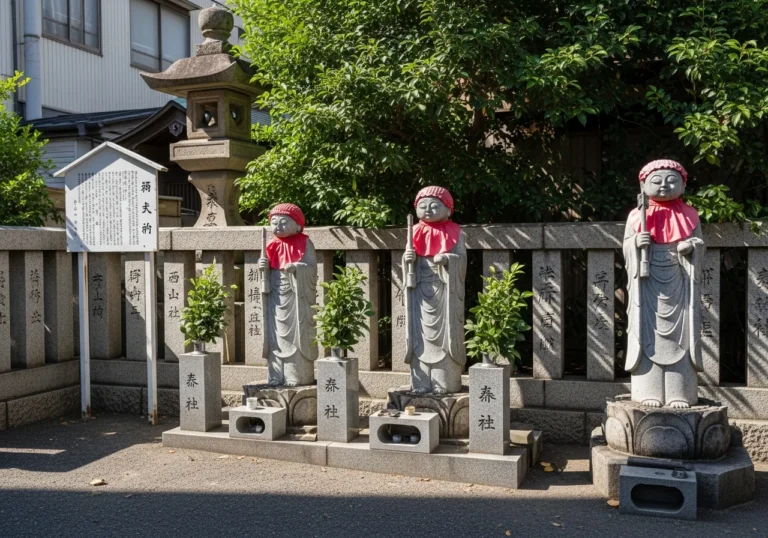
The memorial stands today at the south exit of Kyobashi Station — a busy commuter hub, one of the fourth-busiest in the JR West network — easy to miss in the morning rush. The “Heiwa yo Eien nare” (Peace Forever) memorial statue and the cenotaph for the air raid victims offer a space for reflection amidst the urban clamor.
These memorials serve as a powerful and permanent reminder that the peace enjoyed today was built upon an immense sacrifice. The bombs fell less than twenty-four hours before the Emperor’s surrender broadcast.
The war was already, in effect, over.
Why Did the City Burn So Completely? The Urban Logic of Catastrophe
To understand why Osaka burned the way it did, you have to understand what Osaka looked like before it burned. The city was not simply dense; it was dense in a specific way that made it catastrophically vulnerable.
The prewar city was built almost entirely of wood. Machiya townhouses — narrow, deep, timber-framed — lined the commercial streets.
Behind them, in the blocks between canals, were the workshops: small metalworking shops, textile looms, chemical processors. The U.S.
Army had conducted indiscriminate bombardments since the industrial locations appeared mixed up within residential and commercial areas. There were no clean lines between factory district and residential district, because Osaka had never been planned that way.
The city’s canal network, which had made it the “Venice of the East” and the engine of its commerce, now worked against it. Canals created natural firebreaks in theory, but the bridges across them — hundreds of them — allowed fire to jump. The wind off Osaka Bay, which had driven the city’s merchant ships for centuries, now drove the flames inland.
Casualties totaled 3,987 killed and 678 missing, primarily civilians in the targeted districts, with over 300,000 rendered homeless amid the collapse of traditional firefighting methods against the inferno. The firefighting infrastructure of a city built for a different era of risk was simply overwhelmed.
The total human cost across all eight raids is contested between different counting methodologies. The United States Strategic Bombing Survey estimated total casualties at 45,881 persons, of whom 12,620 were dead or missing across multiple attacks.
Japanese government records, as reported in contemporary analyses, tally approximately 10,388 confirmed deaths from all raids on the city, reflecting variations in accounting for unidentified remains and indirect fatalities from burns, suffocation, and collapse. The Osaka kushu blog, drawing on local records, places the figure higher still: by one account, the human cost to Osaka from all the raids was about 15,000 people killed.
Some 340,000 houses were destroyed, and an estimated 1.2 million people lost their homes and/or were driven from the city.
The discrepancy between these figures is not a matter of sloppy record-keeping. It reflects the genuine difficulty of counting the dead in a city where so many bodies were unidentifiable, so many people had already fled, and so many died not in the raids themselves but in the weeks afterward from burns, infection, and starvation.
Why Was the Osaka Arsenal Spared Until the Last Day?
One of the stranger facts about the bombing campaign is that the Osaka Arsenal — the single most important military target in the city, the complex that had been producing 20% of the Imperial Army’s ordnance — survived largely intact through most of the raids, only to be destroyed on the final day of the war.
The answer lies in the logic of the campaign itself. The early raids were area incendiary attacks, designed to destroy the residential and light-industrial fabric of the city.
The arsenal, with its brick and reinforced-concrete structures, was relatively resistant to incendiary bombs. Specific facilities like the Sumitomo Metal Industries suffered measurable structural damage, with 11.3% of roof area affected despite the arsenal experiencing minimal impact.
The August 14 raid was different in character: the eighth bombing raid on Osaka took place on August 14, just one day before the end of the war, when about 150 B-29 bombers attacked the city and dropped about 700 2,000-lb bombs, targeting the Japanese army’s factories in the eastern part of Osaka. These were high-explosive bombs, not incendiaries — the right tool for hardened structures.
The arsenal was initially only slightly damaged, but on August 14, 1945, a day before the capitulation of Japan, there was a devastating air raid that destroyed 90% of the arsenal. The death toll on the arsenal site was relatively low at 382 dead, as most of the workers, with the exception of air defense, had left the area after the air alarm.
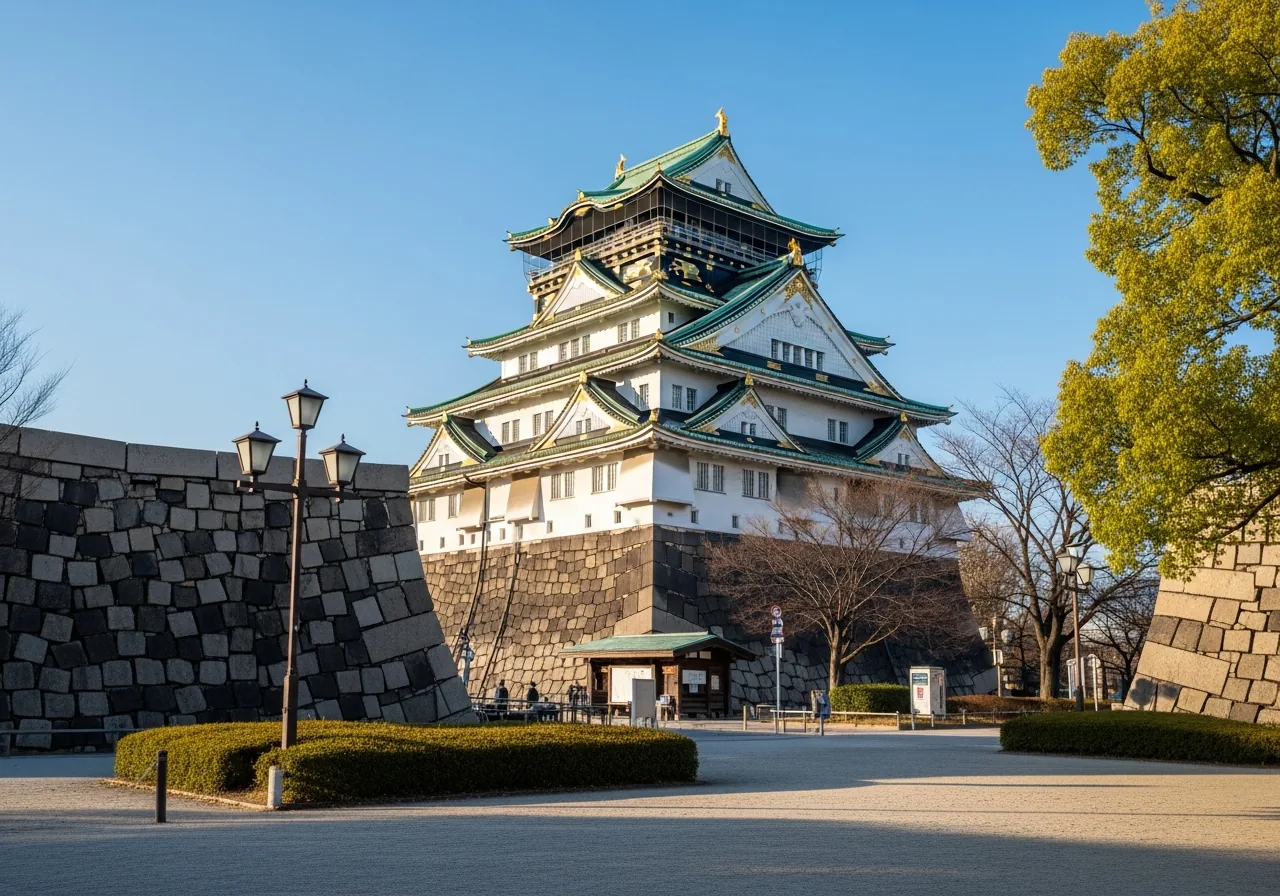
The arsenal’s 75-year history ended in a single afternoon. The arsenal’s grounds were later reborn as the Osaka Business Park and the Osaka Castle Park.
Today the area has many high-rise buildings and is a center for business and entertainment. A few remnants survive — a brick chemical laboratory building, a quay gate — but they are easy to walk past without knowing what they are.
Why Did Postwar Osaka Look So Different from What Burned?
This is the question that most guidebooks never ask, and it is the most consequential one. The Osaka that was rebuilt after 1945 was not a restoration of the city that burned. It was a new city, built on the same ground, using the destruction as a planning opportunity that peacetime politics would never have permitted.
One-third of Osaka was destroyed by American air raids during World War II, including many commercial and industrial districts. That destruction created something that urban planners rarely get: blank ground in the middle of a major city, at a moment when the political will to rebuild was absolute and the old property interests that had blocked reform for decades had been literally burned away.
The port was the most dramatic example. According to Mizuuchi, 40–50% of privately owned land was appropriated for a 1949 land redevelopment project partially meant to rebuild the port from the war damage but also meant to build up defenses against natural disasters that plagued the port and surrounding region. Ultimately the destruction of Osaka’s ports during WWII offered Osaka city planners a chance to do what few city planners abroad had been able to accomplish, which was to almost fully redevelop and expand the destroyed port.
The street grid was also transformed. Prewar Osaka had grown organically, its streets following the lines of old canals and property boundaries.
The postwar reconstruction plans, drawn up under the War Damage Rehabilitation Law of 1946, imposed wider roads, larger blocks, and a more rational grid — the kind of planning that had been discussed for decades but that property owners had always resisted. The municipality took advantage of the post-war situation.
Landowners and residents were forced to move out of their lands during land readjustment projects without having much knowledge of their rights.
This is a morally uncomfortable fact. The same destruction that killed thousands of civilians also cleared the ground for a more functional, more legible, more economically productive city.
The people who lost their homes and their lives did not consent to be the price of urban modernization. But the city that emerged from their loss is the one that visitors walk through today.
The Umeda Transformation
Nowhere is this more visible than in Umeda, the northern commercial hub around Osaka Station. The prewar Umeda had been a chaotic tangle of rail yards, small shops, and wooden buildings.
The postwar reconstruction created the framework for what Umeda is today. Efforts focused initially on the south side of JR Osaka Station, where key commercial and office structures were rebuilt, including the Hanshin Department Store, Nippon Life Building, Marunouchi Building, and the 1st and 2nd Ekimae Buildings, which facilitated the resumption of business activities amid material shortages and urban planning constraints.
Pre-war establishments like the Hankyu Department Store, opened in 1929, were repurposed as distribution centers for food and clothing by U.S. occupation forces, aiding immediate post-war logistics and commerce revival. By the late 1940s and 1950s, these initiatives transformed Umeda into a burgeoning commercial nucleus, leveraging the station’s centrality to integrate rail access with retail and office spaces, which accelerated Osaka’s industrialization during Japan’s high-growth era.
The buildings that went up in Umeda and across central Osaka in the 1950s and 1960s are now themselves becoming objects of architectural appreciation. Modern pre-war architecture such as the Osaka City Central Public Hall and the Shibakawa Building are often praised, but many distinct, expressive buildings were also built during the rapid economic growth of the 1950s to the 1970s. These are the buildings of the reconstruction generation — functional, optimistic, sometimes brutalist, always purposeful.
Why Did Osaka Recover So Fast? The Economic Logic of Reconstruction
The speed of Osaka’s recovery is one of the most remarkable facts in twentieth-century urban history. A city that was one-third destroyed in 1945 was hosting the world’s largest international exposition by 1970. The question is not simply “how” but “why” — what structural conditions made that trajectory possible?
The first answer is that Osaka’s commercial culture was not destroyed by the bombs. The merchant networks, the trading relationships, the institutional knowledge of how to move goods and credit — these survived because they existed in people’s heads, not in buildings.
Osaka had been a city of merchants for a thousand years. That did not burn.
The second answer is that the Korean War (1950–1953) provided an enormous economic stimulus to Japanese industry, and Osaka’s surviving heavy industry was positioned to benefit. American procurement orders flooded into the Kansai region.
Thanks to postwar reconstruction plans and the positive attitude of Osaka’s people, the city regained its pre-war vitality. That official formulation understates the role of geopolitical accident, but it is not wrong about the outcome.
The third answer is that the destruction had, paradoxically, modernized the city’s industrial base. The old workshops and cottage industries that had been embedded in residential neighborhoods were gone.
What replaced them were larger, more efficient, better-capitalized factories built on the cleared land of the port district and the eastern industrial zones. The reconstruction was not a restoration; it was an upgrade.
Central Osaka was reduced to rubble in World War II, but the city made a remarkable recovery in the postwar era. The 1970 Osaka Expo, held in the Senri Hills to the north of the city with the theme of “Progress and Harmony for Mankind,” became a symbol for Japan’s high-growth period.
Why the 1970 Expo Was the Proof
The 1970 World Exposition in Osaka — Expo ’70 — was not simply a trade fair. It was a statement, made twenty-five years after the city had been one-third destroyed, that Japan had not merely survived but had become something new.
The Ministry of International Trade proposed the Expo to the Bureau International des Expositions in 1964 as a showcase for Japanese post-war recovery and modernisation, as a stimulus to further infrastructure development for the Kansai region, just as the 1964 Tokyo Olympics had stimulated redevelopment for Tokyo and the Kantō region.
Under the theme “Progress and Harmony for Mankind,” the record-breaking Expo welcomed 77 participating countries and received over 64 million visitors — a figure that would not be outstripped until Expo 2010 in Shanghai. Alongside the Tokyo Olympics held in 1964, Expo 1970 is remembered by many people as a national project that symbolised Japan’s successful post-war recovery and return to the international community.
The site chosen for the Expo — the Senri Hills, north of the city — was itself a product of postwar planning. The infrastructure built to serve the Expo, including new rail lines and expressways, became the skeleton of the modern metropolitan region. The Expo generated an estimated 3.5 trillion yen nationally, equivalent to 11 trillion yen in today’s terms, with 1.1 trillion yen boosting the Kansai region alone.
But the Expo also carried a shadow that its organizers did not advertise. The city that hosted it had been built on the ruins of the city that burned.
The infrastructure that made it possible had been financed partly by the land readjustments that had dispossessed thousands of families. The “progress” on display at Expo ’70 was real, but it was not free.
Where the Memory Lives: Peace Osaka and the Politics of Remembrance
Every city that has been bombed must eventually decide what to do with the memory. Osaka’s answer has been complicated, contested, and — in recent years — politically charged.
The Osaka International Peace Center, also known as Peace Osaka, is a peace museum established in August 1991 in the city of Osaka. It focuses on the destruction of the city during World War II and the broader themes of the tragedy of war and the importance of peace. Located within Osaka Castle Park, Peace Osaka is a museum that tells the story of the tragedy of the Osaka air raids and prays for peace.
The museum’s original design was deliberately broad in its moral scope. Before 2015, a plaque stated that Japan “caused great hardships on the peoples of the Asia and Pacific regions” and declared that the museum was a place for “dispassionate and unpretentious reflection.” The original exhibitions included material on Japan’s own wartime conduct in Asia alongside the suffering of Osaka’s civilians.
In 2015, that changed. After pressures by members of the Japan Innovation Party, exhibits were changed.
The section on Japan’s conduct in Asia was significantly reduced. The museum was renovated to focus more narrowly on the experience of Osaka’s own residents during the war.
As Peace Osaka’s analysis in 1991 stated, “Lasting global peace, humankind’s most fervent and elusive aspiration, can be achieved only if the peoples of the world can gather to share and discuss their first-hand experiences of the devastating consequences of war.” Whether the 2015 renovation serves that aspiration is a question the museum’s visitors must answer for themselves.
The museum’s current structure — Zone A covering the appearance of Osaka in 1945 and now; Zone D, “Osaka Reduced to Ashes”; Zone E, “Osaka After the War” — tells a coherent story of destruction and recovery. What it tells less fully is the story of what Osaka was doing in the years before the bombs fell, and what the people of other Asian cities experienced at Japanese hands during the same period.
That gap is not unique to Osaka; it is a feature of war memory everywhere. But it is worth naming.
Why the Discerning Traveler Should Care
There is a version of Osaka tourism that is entirely about the present: the food, the nightlife, the shopping, the castle. That version is not wrong. Osaka in 2026 is one of the most enjoyable cities on earth, and it earns that description on its own terms.
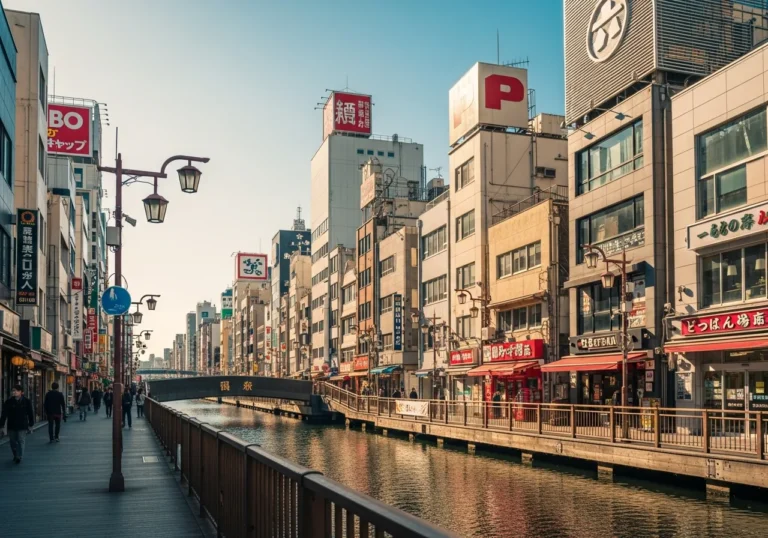
But the city you are walking through is a postwar city. The wide streets of Namba and Shinsaibashi that make it so easy to navigate were not always there; they were laid out by reconstruction planners working on cleared ground.
The port that handles the cargo that sustains the Kansai economy was rebuilt from scratch after 1949. The Osaka Business Park east of the castle, with its gleaming towers and manicured lawns, sits on the footprint of the arsenal that once employed 60,000 workers and produced a fifth of the Imperial Army’s ordnance.
Understanding this does not diminish the pleasure of the city. It deepens it.
When you eat at a restaurant in Namba, you are eating in a district that was rebuilt from ash. When you take the Keihan line through Kyobashi, you are passing through a station where 700 people died on the last day of a war that was already lost.
When you look at the Tower of the Sun in Expo Commemorative Park — Taro Okamoto’s strange, defiant sculpture, still standing in the Senri Hills — you are looking at an object that was built to announce that Japan had come back, twenty-five years after the fires.
The traveler who knows this is not a more somber traveler. They are a more complete one.
The grief and the vitality are not in opposition; they are the same story, told from different angles. Osaka is a city that has been destroyed and rebuilt, more than once, and that has each time come back louder and more itself than before.
That is not a tourist pitch. It is a fact of urban history, and it is the deepest thing the city has to teach.
Frequently Asked Questions
Q: How many times was Osaka bombed in World War II?
A: There were bomb raids on June 1, 6, 7, 15, 26, July 10, 24, and August 14, in addition to the first major raid on March 13–14, 1945. In total, Osaka was struck eight times in major raids, with additional smaller attacks.
Q: How many people died in the Osaka air raids?
A: The figures vary by source and methodology. The United States Strategic Bombing Survey estimated total casualties at 45,881 persons, of whom 12,620 were dead or missing.
Japanese government records suggest approximately 10,388 confirmed deaths. Some local accounts place the total as high as 15,000.
The discrepancy reflects genuine difficulties in counting the dead in a city where many bodies were unidentifiable.
Q: What was the Osaka Arsenal, and where was it?
A: The Osaka Arsenal was a state weapons factory of the Imperial Japanese Army, established in February 1870 on the northeastern part of Osaka Castle grounds. It was destroyed on August 14, 1945. Its former site is now Osaka Castle Park and the Osaka Business Park.
Q: Where is Peace Osaka, and is it worth visiting?
A: Located within Osaka Castle Park, Peace Osaka opened in a corner of the park in 1991. It is a serious museum with English-language materials, and it rewards a visit of at least two hours.
The exhibits on the March 1945 raid are particularly detailed. Be aware that the 2015 renovation narrowed the museum’s scope; visitors seeking a fuller picture of the war’s context may want to supplement their visit with additional reading.
Q: Can I visit the Kyobashi Station memorial?
A: Yes. Kyobashi Station is one of Osaka’s busiest transportation hubs.
Tucked away quietly at the south exit stands a solemn place of remembrance. The “Heiwa yo Eien nare” (Peace Forever) memorial statue and the cenotaph for the air raid victims offer a space for reflection amidst the urban clamor.
It takes five minutes to find and five minutes to stand at. It is worth both.
Peace Osaka (Osaka International Peace Center) — Visitor Information
Address: 2-1 Osakajo, Chūō-ku, Osaka 540-0002 / 大阪府大阪市中央区大阪城2-1
Nearest station: Morinomiya Station (Osaka Metro Chuo/Nagahori Tsurumi-ryokuchi lines) — approx. 3 minutes on foot from Exit 1
Hours: 9:30 am – 5:00 pm (last entry 4:30 pm); closed Mondays, days following national holidays, last day of each month, and New Year period
Admission: Approx. ¥250 adults (confirm current pricing on the official site before visiting)
Official site: peace-osaka.or.jp