In 1838, a physician named Ogata Kōan opened a private school in a merchant’s townhouse in Osaka’s Semba district and, over the next twenty-four years, trained the men who would build modern Japan: the founder of Keio University, the father of the Imperial Japanese Army, and the architect of the nation’s public health system all passed through its second-floor classroom. Tekijuku worked not because it was officially sanctioned — it wasn’t, not at first — but because Osaka’s position on the trading road between Nagasaki and Edo made it the one city in Japan where Western knowledge, commercial pragmatism, and meritocratic ambition could converge in a single building.
Why we can tell you this — MICHI is written and edited in Osaka; the Tekijuku building at 3-3-8 Kitahama is a ten-minute walk from our office, and we have visited the preserved second-floor dormitory and the sword-scarred central pillar that students left behind. This article draws on the institutional history published by Osaka University’s Tekijuku Memorial Centre, the Centre’s own scholarly pages on the school and its founder, the Osaka Convention & Tourism Bureau’s site record, and the National Diet Library’s biographical archive of Meiji-era figures. Where the student register lists 636 names but oral tradition and secondary sources suggest more than a thousand, we say so plainly rather than resolving the ambiguity in either direction.
Walk north from Osaka’s Kitahama station, turn off the main boulevard, and you will find yourself standing in front of a two-storey wooden townhouse that looks as though it has been quietly waiting for someone to notice it. On either side, glass-and-steel office towers press in.
The building’s latticed façade, its deep eaves, and the bronze statue of a seated scholar in the adjacent park are the only signals that anything of consequence happened here. But consequence is exactly the right word.
The decisions made inside this structure — about what to teach, who could attend, and how knowledge should be organised — reverberated through every institution Japan built in the half-century after 1868.
Why Did Japan Need a Secret Classroom at All?
To understand Tekijuku, you first have to understand the peculiar intellectual predicament of Edo-period Japan. Rangaku — literally “Dutch learning” — was the body of knowledge Japan developed through its contact with the Dutch enclave at Dejima in Nagasaki harbour, the only point of sustained European presence permitted under the Tokugawa shogunate’s policy of national isolation (sakoku).
The Dutch traders at Dejima were the only Europeans tolerated in Japan from 1639 until 1853, and through rangaku, some people in Japan learned many aspects of the scientific and technological revolution occurring in Europe at that time, helping the country build up the beginnings of a theoretical and technological scientific base — which helps explain Japan’s success in its radical and speedy modernisation following the forced American opening of the country to foreign trade in 1854.
The channel was extraordinarily narrow. Rangaku was a concerted effort by Japanese scholars during the late Tokugawa period to learn the Dutch language so as to be able to learn Western technology; with the exception of the Dutch trading post on the island of Deshima in Nagasaki Harbour, Japan remained inaccessible to all European nations for some 150 years after 1639, and Dutch was therefore the only medium by which the Japanese in the late 18th century could study European technology.
This was not a comfortable situation for anyone with intellectual ambitions. Because access was so restricted, rangaku developed through translation, observation, and copying rather than broad travel or direct study abroad.
Japanese scholars worked from Dutch books, instruments, and medical texts, then tried to fit that information into Japanese intellectual life. The result was a community of scholars who were simultaneously indispensable to the state — because someone had to understand Western military technology and medicine — and politically suspect, because Western ideas threatened the Confucian orthodoxy on which Tokugawa authority rested.
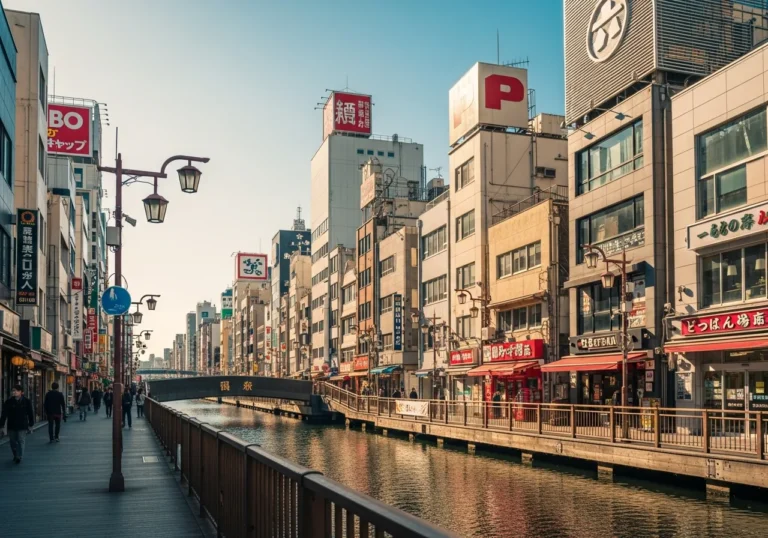
Into this tension, Osaka inserted itself as the only plausible solution. The city was Japan’s commercial capital, its warehouses holding the rice revenues of hundreds of domains, its merchants accustomed to dealing in information as readily as in goods. Around the year 1700, the Semba area flourished as people would proudly boast that “70% of Japan’s wealth is in Osaka, and 80% of Osaka’s wealth is in Imabashi.” A city built on the pragmatic exchange of value was, it turned out, the natural home for a school built on the pragmatic exchange of knowledge.
Why Here, in a Merchant’s Townhouse in Semba?
Tekijuku was located in Osaka’s traditional merchant neighbourhood of Semba (船場) on the main trading route between Nagasaki and Edo. That geographical fact is not incidental. Semba sat at the junction of two flows: the commercial flow of goods moving between Japan’s only port of Western contact and the shogunal capital, and the intellectual flow of Dutch books and instruments that travelled the same road.
Tekijuku was bordered on the west by the copper mint (Dōza), which was used as an accommodation for Philipp Franz von Siebold and Dutch Factory employees. In addition, books written in Dutch were traded there.
The school did not exist in isolation from commerce; it was embedded in it. The same neighbourhood that handled the physical trade in copper and marine products also handled the intellectual trade in European science.
In Osaka in the later pre-modern period, scholars including Asada Gōryū, Takahashi Yoshitoki, and Naka Tenyū — who taught Kōan at his private school — achieved progress in natural science-related studies, extending the frontiers of astronomy and medical science. It is said that another factor contributing to this scientific advancement was economic development and the resulting maturation of a merchant society, in which townspeople respected practicability and embraced rationality.
Osaka’s merchant culture, in other words, had already cultivated an intellectual disposition that was unusually receptive to empirical, practical knowledge. The city that invented the rice futures market was not going to be squeamish about foreign anatomy textbooks.
Who Was Ogata Kōan, and Why Did He Come Back to Osaka?
Ogata was born in 1810 to a family of low-ranking samurai of Ashimori Domain in Bitchū Province. He moved to Osaka in 1825 with his father, and began studies in rangaku and medicine at a private academy run by Naka Tenyū from 1826. In 1831, he relocated to Edo to continue his studies in western medicine, returning to Nagasaki in 1836 to study under the Dutch doctor Erdewin Johannes Niemann, despite the Tokugawa shogunate’s strict national isolation policy.
The trajectory is worth dwelling on. Kōan spent over a decade moving between the three nodes of Japanese intellectual life — Osaka, Edo, Nagasaki — absorbing everything each could offer.
By the time he returned to Osaka in 1838, he was arguably the most comprehensively trained Western-medicine physician in Japan. In 1838, Ogata returned to Osaka to establish his medical practice, and in the same year established the Tekijuku, an academy of rangaku studies, where he taught medicine, natural history, chemistry and physics for the next 24 years.
Ogata used his small but precious collection of Dutch books, including a Dutch-Japanese dictionary and a Dutch encyclopedia, to teach his pupils to read scientific Dutch texts.
Why Osaka rather than Edo or Nagasaki? Partly because Osaka was where he had his roots and his network.
But also because Osaka was the one city where a private school could attract students from across the country without requiring official domain sponsorship. In Edo, education was tightly controlled by the shogunate.
In Nagasaki, access to Dutch sources was jealously guarded by hereditary interpreters. In Osaka, a physician could simply rent a house, hang out a sign, and teach.
Although he hailed from Ashimori-han, Bicchū, in 1838 he came to Kawara-machi, Osaka, and built a private school and clinic called Tekijuku. Seven years later, he moved Tekijuku to Kasho-machi (currently, 3 Kitahama, Chuo-ku, Osaka) where much of the original school building still remains. The building you can visit today is the second location, purchased in 1845 when the school had outgrown its original premises — a measure of how quickly the enterprise succeeded.
Why Did the School Work? The Radical Pedagogy of Tekijuku
The most striking thing about Tekijuku, once you understand the social context of Edo Japan, is what it refused to do. It refused to sort students by domain, by rank, or by birth.
In 1838, a year following Ōshio Heihachirō’s rebellion, and after the fire that had scorched nearly a quarter of Osaka city, the physician Ogata Kōan founded an academy to teach medicine, healing and rangaku, or Dutch Studies. The school was called Tekijuku, where distinction of status was unknown and competition abounded.
Ogata encouraged this competitive learning, especially of the Dutch language to which he had dedicated much of his own study.
This was genuinely radical. In a society where a samurai from Chōshū domain and a merchant’s son from Osaka would never sit in the same classroom, Tekijuku put them side by side and ranked them purely on their ability to read Dutch.
Fukuzawa cultivated the foundations of his scholarship at Tekijuku, a meritocratic school free from the constraints of social rank. The school’s internal ranking system — students were graded on their progress through Dutch texts and could rise or fall in the dormitory hierarchy accordingly — was a direct inversion of the feudal order outside its walls.
The pedagogy itself was peer-driven in a way that anticipates modern problem-based learning. Students were not primarily taught by Kōan lecturing at them; they were expected to work through Dutch texts together, helping each other decode vocabulary and grammar before bringing their questions to the master. Tekijuku’s pedagogy and educational principles were influential in studies of other languages such as English — the school’s methods became a template for how Japan would approach foreign-language acquisition in the decades that followed.
The intensity of study was legendary. Yukichi Fukuzawa stated in his autobiography “Fukuo Jiden” that he bought cheap fish at Temmabashi and used his desk as a cutting board.
He was at his desk from morning to evening, even sleeping at his desk through the night. The building’s second floor served as a communal dormitory where students lived, ate, argued, and studied together around the clock.
The most famous room in the building used to hold the school’s only Dutch–Japanese dictionary and is said to have been lit around the clock to accommodate even the most committed of students.
The competitive pressure occasionally spilled over. The competition escalated and eventually students bent to the rigorous pressure of the academy, acting recklessly to vent frustrations — slashing their swords against the central pillar of the main boarding hall, leaving gashes and nicks.
Those sword marks are still visible today on the wooden post in the second-floor room. They are not vandalism; they are the physical record of young men under enormous intellectual pressure, in a building that was simultaneously a school, a dormitory, and the front line of Japan’s encounter with modernity.
In those days, a Dutch-Japanese dictionary was very valuable, and the one that’s exhibited has curled-up pages and worn-out letters, which graphically convey the students’ enthusiasm. — Osaka Convention & Tourism Bureau
Kōan’s own ethical framework permeated the school’s atmosphere. The book Kōan compiled has statements such as: “The quintessence of the medical profession is living life not for oneself, but for others,” “See patients as patients,” and “Don’t see rank and class in people.” These are extremely important precepts for doctors.
Kōan passed these commandments on to his Tekijuku students. The school was not merely transmitting technical knowledge; it was forming a particular kind of person — empirically rigorous, socially egalitarian, and oriented toward public service rather than personal advancement.
Why Did Tekijuku Produce the Architects of Modern Japan?
636 student names can be found in the student register. However, some historical materials refer to there being numerous unregistered students.
Likely, the total number of students exceeded 1,000. From that cohort, the concentration of consequential figures is almost implausible.
Consider what three of them went on to do.
Fukuzawa Yukichi: The Mind of Meiji
He spent three and a half years at Tekijuku, the Dutch studies school of physician Kōan Ogata, devoting himself to his studies day and night. Starting with his departure to Nagasaki at age 19 to study Dutch studies, he went on to study at Ogata Kōan’s Tekijuku in Osaka, where he eventually became the President. From Tekijuku, Fukuzawa went to Edo, opened his own Dutch studies school, and then — crucially — made three trips to Europe and America in the 1860s.
He has been described as the Japanese Voltaire, and compared by others to Benjamin Franklin, and though he is undoubtedly one of the most important and influential thinkers of Japan’s modernisation period, Fukuzawa Yukichi is not a well known name outside of Japan, which is somewhat surprising, if one considers that almost all visitors to Japan carry around a picture of him in their wallets as his portrait is on the 10,000 yen banknote.
The Dutch scholar Fukuzawa Yukichi stood at the starting point of the globalisation that continues to this day, and from his time at Tekijuku, he explored the principles of technology that would support the coming world. It was precisely because this experience and scholarship existed at his foundation that he was able to present a political vision for Japan’s civilisation and independence in the Meiji period. The school was one of the predecessors of Osaka University and Keio University, through the work of the most notable people Ogata Kōan and Fukuzawa Yukichi, respectively.
Ōmura Masujirō: The Soldier Who Abolished the Samurai
If Fukuzawa reshaped Japan’s mind, Ōmura Masujirō reshaped its body — specifically, its military body. From a young age, Ōmura had a strong interest in learning and medicine, travelling to Osaka to study rangaku under the direction of Ogata Kōan at his Tekijuku academy of western studies when he was twenty-two. He continued his education in Nagasaki under the direction of German physician Philipp Franz von Siebold.
He was the “Father” of the Imperial Japanese Army, launching a modern military force closely patterned after the French system of the day. What made Ōmura’s achievement so historically significant was not merely that he modernised Japan’s weapons and tactics, but that he did something far more socially explosive: after his return to Chōshū, Ōmura not only introduced modern western weaponry, but he also introduced the concept of military training for both samurai and commoners. The concept was highly controversial, but Ōmura was vindicated when his troops routed the all-samurai army of the Shogunate in the Second Chōshū Expedition of 1866.
A physician’s training at a Dutch-studies school in Osaka had produced the man who ended the military monopoly of the samurai class. Ōmura was eventually assassinated by a group of samurai — which tells you everything about how threatening his ideas were to the old order. He died in Osaka in 1869, in a hospital not far from the school where his transformation had begun.
Nagayo Sensai: The Man Who Gave Japan the Word “Hygiene”
The third great Tekijuku alumnus is less famous outside Japan but arguably had the most direct impact on ordinary Japanese lives. In 1854, Sensai’s grandfather sent him to Tekijuku, a school founded by Ogata Kōan, a scholar of Dutch medicine and other Western science subjects. He excelled at his studies, and eventually became the school’s eleventh head, as successor to Fukuzawa Yukichi.
After the Meiji Restoration, Nagayo was selected to accompany the Iwakura Mission on its around-the-world journey to the United States and Europe. He was especially impressed from what he saw of modern medical practices in Germany and the Netherlands during his visit. On his return to Japan, he established the modern Japanese medical establishment with the creation of the Medical Affairs Bureau — the predecessor of the Ministry of Health, Labour and Welfare — initially under the Ministry of Education, and later under the Home Ministry.
It was Sensai who coined the Japanese term eisei, equivalent to “hygiene,” borrowing a word from the ancient Chinese Taoist text Zhuangzi. Nagayo established the basis of Japan’s public health administration, founded the Drug Control Laboratory, formulated a medical administration system, and introduced epidemic prevention and quarantine systems. The entire infrastructure of Japanese public health — the systems that would allow Japan to industrialise without being destroyed by epidemic disease — traces back to a man who learned to read Dutch in a Semba townhouse.
Why Did Kōan Himself Matter Beyond the Classroom?
It would be a mistake to reduce Tekijuku to a talent factory for its famous graduates. Ogata Kōan himself was a practitioner of consequence, and his work outside the classroom shaped the school’s ethos as much as anything he taught inside it.
Ogata was the author of Byōgakutsūron (病学通論), which was the first book on pathology to be published in Japan. That alone would be a significant achievement.
But Kōan’s most urgent work was in public health. In those days, people were faced with the great threat posed by the prevalence of smallpox.
In 1849, Kōan, together with other doctors, built Shuto-sho (later renamed Osaka Jōto-kan) in Furute-machi, Osaka, and started vaccinating people using Edward Jenner’s method of vaccination against smallpox.
From December 1849, he struggled to gain acceptance of the new smallpox vaccination, eventually opening 186 vaccination centres from Edo to Kyushu, and obtaining official recognition of the method in 1858. This was a public health campaign conducted against institutional resistance, across the length of Japan, by a man who was simultaneously running a school and a medical practice. The scale of it is staggering.
Then cholera arrived. In 1858, Japan had its second cholera outbreak brought from overseas.
Breaking out in an American ship in May, it gradually spread in Nagasaki, Hiroshima and Osaka, and broke into the city of Edo in July. In a mass of confusion, Ogata Kōan made efforts to translate foreign books regarding cholera and finally compiled them into a volume.
Kōan made this report by writing down what J. L.
C. Pompe van Meerdervoort, a Dutch naval doctor, taught him about cholera, as well as by translating books by several German physicians.
The cholera handbook Kōan produced was not an academic exercise. It was emergency medicine, rushed into print to give physicians across Japan something to work with while the epidemic raged.
Kōan taught not only Western learning, but also the social responsibility of a doctor and how to live as a human being through his actions. His students watched him do this in real time, and it shaped them.
For the next 24 years, Tekijuku was a centre for vaccination research and cholera treatment. Kōan established “Jōtokan” in 1846, which became the first smallpox vaccination institution recognised by the Edo government in 1858. — The University of Osaka, institutional history
Why Did the School End, and What Replaced It?
Tekijuku’s closure was not a failure; it was a promotion. The Edo government summoned Kōan to Edo in 1862 and appointed him as a government doctor and president of “seiyo gakumonjo” — Place of Learning of Western Scholarship.
The shogunate, which had for decades tolerated and occasionally harassed rangaku scholars, had finally concluded that it needed Western medicine at the centre of its own apparatus. Kōan’s school had become too important to leave in private hands.
While Kōan was away, his brother-in-law, children, and students managed Tekijuku. It prospered and developed branches; however, its continued expansion was brought to an end with the introduction of a new education system initiated by the Meiji government.
Kōan himself never returned to Osaka. In 1862, Ogata was appointed personal physician to shōgun Tokugawa Iemochi, who supported the introduction of western medicine and the establishment of a western medicine research institute in Edo.
However, Ogata died a few months later in July 1863 of acute haemoptysis, caused by the tuberculosis he had suffered from for many years. He was fifty-two.
The institutional lineage continued without him. The newly created Meiji government established the Osaka Medical School in 1869, with the help of Ogata’s son Koreyoshi and the Dutch doctor Antonius Franciscus Bauduin.
This was part of the massive effort in Japan to modernise. In time, Tekijuku evolved into Osaka Prefecture Medical School, then into Osaka Prefecture University Hospital and finally into today’s Osaka University.
The chain of institutional descent is direct and unbroken: a rented townhouse in Semba in 1838 became, by 1931, Japan’s sixth imperial university. Although officially founded in 1931 as Japan’s 6th imperial university, Osaka University’s roots reach back to 1838 and Tekijuku, a private “place of learning” founded by Ogata Kōan.
Why Does the Building Survive When So Much of Edo-Period Osaka Does Not?
Osaka was bombed heavily in the Second World War. The city lost most of its pre-modern fabric in the air raids of 1945. The survival of the Tekijuku building is therefore not a given — it is a small miracle of circumstance and deliberate preservation.
The Tekijuku building, located in the business district in Kitahama, Chuo-ku, Osaka, is Japan’s only Edo-period school building of Western learning still in existence. The building, designated as a National Historical Landmark and as a National Important Cultural Asset, is currently open to the public.
The building has survived several disasters and still retains almost its original appearance. The interior recreates the spaces where students lived and learned, allowing visitors to imagine what life was like back then. In particular, the large hall on the second floor is where the students lived and ate together, and where many discussions took place.
The site is administered by Osaka University, which operates a Tekijuku-focused research centre on the premises. This arrangement — a living university maintaining the building where its own institutional history began — gives the preservation a quality of genuine continuity rather than mere museumification. The scholars who study in the adjacent research centre are, in a real sense, the intellectual descendants of the students who once slept on the floor above.
Tekijuku is conveniently located a few minutes’ walk from both Kitahama and Yodoyabashi Stations of Keihan, one street off the main street on Uchi-Kitahama Dori, and although surrounded by buildings, its historic exterior is striking. A bronze statue of Ogata Kōan stands in the adjacent park. The building, which still retains the atmosphere of the Edo period, is filled with replicas of portraits, hanging scrolls, letters, and explanatory notes.
Why Should a Discerning Traveller Care?
There is a category of historical site that rewards the visitor who arrives with context, and Tekijuku is the purest example of it in Osaka. It is not visually spectacular.
It does not have the scale of Osaka Castle or the sensory overload of Dōtonbori. What it has is density of meaning — a small building that contains, in compressed form, the entire story of how a feudal society decided to transform itself.
The question Tekijuku poses is one that remains live: how does a society absorb foreign knowledge without losing itself? Kōan’s answer was specific and practical.
You build a school that is meritocratic rather than hereditary, that teaches people to read primary sources rather than summaries, and that embeds intellectual rigour in a community of practice rather than a hierarchy of credentials. You put it in a commercial city rather than a political one, because commercial cities are better at valuing things for what they do rather than what they represent.
The Meiji Restoration is often narrated as a top-down revolution — the emperor restored, the samurai abolished, the Western advisers imported. But Tekijuku tells a different story: the transformation of Japan was prepared, over twenty-four years, in a private school that the shogunate did not control and could not quite bring itself to suppress.
The men who built modern Japan’s army, its universities, and its public health system were not products of official policy. They were products of a physician’s decision to open a school in a merchant’s house in Osaka.
For the traveller who wants to understand not just what Japan became but how it became it — through what specific mechanisms of human organisation and intellectual courage — there is no better thirty minutes in the city than the ones spent in this building. Stand in the second-floor room.
Look at the sword marks on the pillar. Look at the worn pages of the Dutch dictionary in its case.
These are not relics of a distant past; they are the physical evidence of the process by which Japan decided what kind of country it was going to be.
The Osaka that exists today — its university, its pharmaceutical industry concentrated in the Dōshōmachi district a few streets away, its tradition of practical, empirical intelligence — is in measurable part the product of what happened in these rooms. Thanks to Tekijuku, the passion for scholarship of Osaka citizens and the spirit of “For people, for society, and for benevolence” were passed on to the University of Osaka. That spirit is not a slogan; it is a documented inheritance from a man who vaccinated a country against smallpox while simultaneously teaching its future leaders to read Dutch.
Frequently Asked Questions
Q: What exactly is Tekijuku, and is it a museum today?
A: Tekijuku (適塾) was a private school of Western learning (rangaku) founded in 1838 by physician and scholar Ogata Kōan. The original building at 3-3-8 Kitahama, Chuo-ku, Osaka, is now open to the public as a preserved historic site and is designated both a National Historical Landmark and a National Important Cultural Asset. It is administered by Osaka University, which operates a research centre on the premises.
Q: How long did Tekijuku operate?
A: The school operated for twenty-four years, from 1838 until 1862, when Kōan was summoned to Edo by the shogunate. He died in 1863, and the school formally wound down as the Meiji government introduced a new national education system.
Q: Who were the most famous students?
A: The most celebrated alumni include Fukuzawa Yukichi (founder of Keio University and the face on Japan’s ¥10,000 note), Ōmura Masujirō (founder of the modern Imperial Japanese Army), and Nagayo Sensai (architect of Japan’s modern public health system and the man who coined the Japanese word for “hygiene”). The student register lists 636 names, but the total number of students likely exceeded 1,000.
Q: What did students actually study at Tekijuku?
A: The curriculum centred on reading and translating Dutch scientific texts, with medicine as the primary focus. Students also studied astronomy, chemistry, physics, and natural history. The pedagogy was peer-driven: students worked through Dutch texts together before consulting Kōan, and were ranked internally by their progress rather than by social status.
Q: How does Tekijuku connect to Osaka University?
A: The institutional lineage is direct. After Tekijuku closed, its successor institutions evolved through the Osaka Medical School (1869), Osaka Prefecture Medical School, and Osaka Prefecture University Hospital, eventually becoming Osaka University when it was formally established as Japan’s sixth imperial university in 1931. The university explicitly traces its founding to 1838 and Tekijuku.
Q: Is the building worth visiting if I only have limited time in Osaka?
A: Yes, particularly if you have any interest in the history of Japan’s modernisation. The visit takes about thirty to forty-five minutes, the admission is modest, and the building is genuinely preserved rather than reconstructed.
The sword marks on the second-floor pillar and the displayed Dutch-Japanese dictionary are among the most evocative material objects in Osaka’s historical landscape. The site is a five-minute walk from Kitahama station, making it easy to combine with the nearby Nakanoshima area.
Tekijuku — Visitor Information
Address: 3-3-8 Kitahama, Chuo-ku, Osaka 541-0041 / 大阪府大阪市中央区北浜3丁目3−8
Nearest station: Kitahama Station (Osaka Metro Sakaisuji Line / Keihan Main Line) — approx. 5 minutes on foot; Yodoyabashi Station (Osaka Metro Midosuji Line / Keihan Main Line) — approx. 5 minutes on foot
Hours: 10:00–16:00 (last entry 15:30). Closed Mondays (open if Monday is a public holiday, then closed the following day), the day after public holidays, and New Year holidays (28 December–4 January). Hours subject to change — confirm before visiting.
Admission: Approx. ¥400 (adults); ¥200 (high school and university students); free for junior high school students and younger. Prices approximate — confirm on the official site before visiting.
Official site: tekijuku.osaka-u.ac.jp