Around 1640, a seventeen-year-old merchant named Tomomochi Sumitomo opened a copper refinery in Shimanouchi, Osaka — a plot of land cupped between the Dotonbori and Nagahori canals — and in doing so planted the seed of what would become one of the longest-lived business enterprises in human history. The refinery survived two shogunates, a world war, and a forced dissolution by American occupiers, and the corporate descendants of that canal-side furnace still operate today as a multi-trillion-yen keiretsu spanning banking, chemicals, mining, and electronics. The secret was not capital or connections alone, but a stolen metallurgical technique, a philosophy written by a Buddhist monk, and an Osaka geography that made the city the only place in Japan where copper could legally be refined for export.
Why we can tell you this — MICHI’s editorial team is based in Osaka, and the monument to Sumitomo’s original copper refinery stands in Shimanouchi 1-chome, Chuo Ward — a ten-minute walk from our office. This article draws on the Sumitomo Group Public Affairs Committee’s own historical archive (sumitomo.gr.jp), the Osaka City official heritage record for the refinery site, corporate histories published by Sumitomo Metal Mining and Sumitomo Corporation, and academic work on the Edo-period copper trade held in Project MUSE and the NBER. Where the precise founding date of the Shimanouchi refinery is given as “around 1640” rather than a single year, that uncertainty is the historical record’s, not ours.
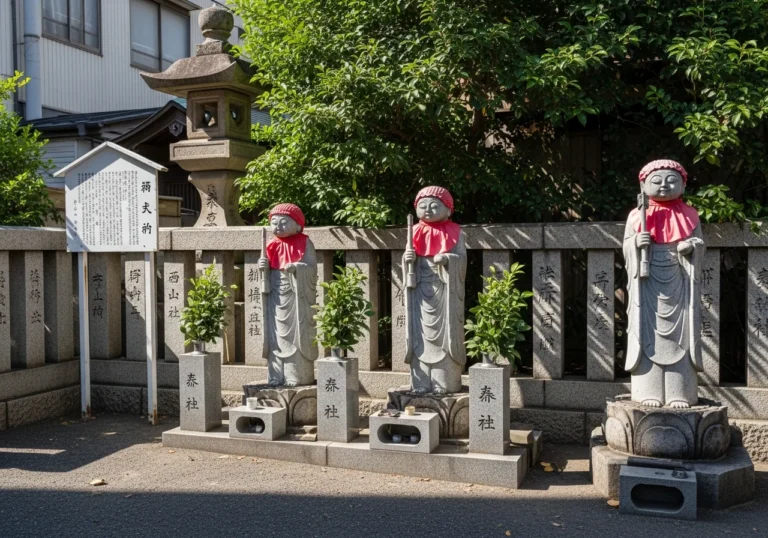
Stand at the corner of Shimanouchi 1-chome in Osaka’s Chuo Ward on any weekday morning and you will see nothing remarkable: a low park, a stone monument, the usual urban compression of convenience stores and office blocks. Taxis idle on Nagahori-dori.
A delivery truck reverses into a loading bay. Nothing here announces that this patch of ground was once the industrial heart of a global commodity trade, that the furnaces that stood here refined a third of all the copper produced in Japan, and that the men who ran them were, by any reasonable measure, the most consequential merchants in East Asian history.
The monument is easy to miss. Most people do. But the story it marks is one of the great untold business histories of the early modern world — a story about technology transfer, shogunal monopoly, ecological catastrophe, and the peculiar durability of an institution that has now outlasted the political order that created it by more than 150 years.
Why Did a Copper Refinery End Up in Osaka at All?
The answer begins not in Osaka but in Kyoto, and not with copper but with a technique learned from strangers.
In 1590, at the age of nineteen, Riemon Soga opened a copper refinery and workshop in Gojo, Teramachi, Kyoto, under the name of Izumiya. The name means “spring shop,” and the diamond-shaped well-frame that became Sumitomo’s emblem derives from it. Riemon was a craftsman in a city of craftsmen, and copper refining in Japan at that moment was, as the Sumitomo Group Public Affairs Committee’s history puts it, “still in its infancy.”
The infancy had a specific, embarrassing problem. Japanese refineries at this time lacked the technology to remove small, naturally occurring quantities of gold and silver from copper.
These precious metals were sold to foreign traders as copper and were later extracted overseas at a great profit. Japan was, in effect, giving away silver.
Every bar of copper that left Nagasaki harbor carried hidden wealth that the buyer, not the seller, would eventually pocket.
Riemon Soga decided to fix this. After hearing from foreign traders of a way to separate silver from copper, Riemon experimented over and over until he finally hit on a process — called nanban-buki — that would mark an important advance in the history of Japanese mining and industry.
The word nanban means “southern barbarians,” the Japanese term for the Portuguese and other Europeans who had arrived in the sixteenth century. Buki means “blowing” or “smelting.” The technique was European in origin, learned from the Portuguese, and it worked by exploiting the different melting points of lead, silver, and copper.
Nanban-buki is a refining method of extracting silver and other substances from unrefined copper, using lead. First, lead and unrefined copper containing silver are melted together and cooled to make an alloy.
This alloy is then heated to separate silver-containing lead, which melts at a lower temperature than copper. The lead is then heated on ash, which absorbs the lead, leaving the silver.
This process produces high-purity copper and silver.
The technique was a competitive weapon of the first order. Prior to the development of this technology, copper was exported with high levels of silver impurities, which sharply reduced potential smelting profits. The competitive advantage gained from this more advanced technology helped Sumitomo to establish a highly profitable base of operations.
But here is the move that made Sumitomo great, and it was counterintuitive: Riemon and his son Tomomochi did not hoard the technique. Tomomochi Sumitomo, the eldest son of Riemon, who became a family member of the House of Sumitomo by marrying a daughter of Masatomo, extended the business to Osaka, and disclosed the nanban-buki technology to other copper smelters.
They gave it away. And in giving it away, they became the acknowledged masters of it — the “head family of nanban-buki,” as contemporaries called them — and the entire industry came to orbit around them.
Why Osaka, and Not Kyoto or Edo?
Tomomochi’s decision to relocate from Kyoto to Osaka around 1623 was not sentimental. It was logistical and political, and it reveals something essential about how Osaka became what it became.
He decided to shift the business from Kyoto, which lacked a port, to Osaka whose port offered access to other parts of Japan and to the world for Sumitomo’s growing business. Copper refining required lots of water and ships would be the most convenient and efficient means of transport for refined copper.
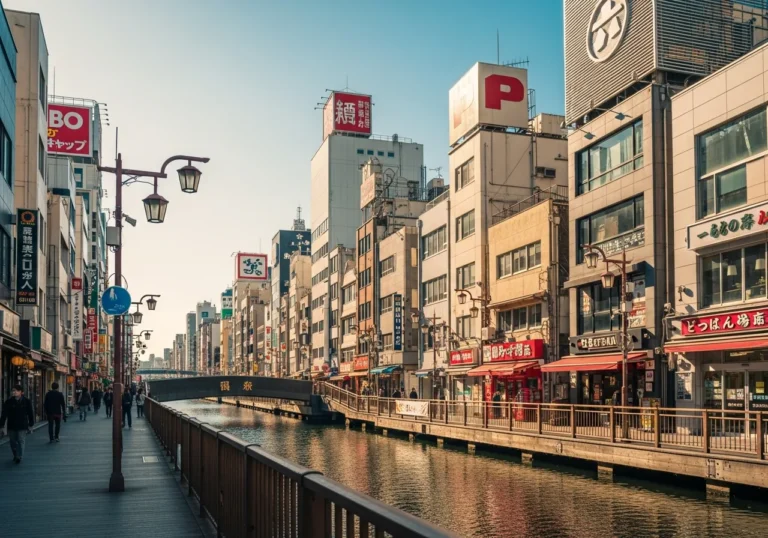
The site he chose was not random. He opened a large copper refinery in Shimanouchi, on a site virtually surrounded by water at the confluence of the Higashi-yokobori and Nishi-yokobori rivers and Dotonbori and Nagahori canals.
The canals were not merely convenient; they were the circulatory system of the city. Raw ore arrived by boat from mines across Japan.
Refined copper bars left by boat for Nagasaki, where they would be loaded onto Dutch and Chinese vessels. Water was also essential to the refining process itself — to cool the molten metal, to power bellows, to quench the furnaces.
But geography alone does not explain why Osaka became Japan’s copper capital. The shogunate made it so by decree.
Copper processing was a government-controlled industry. All copper had to be refined in Osaka, by decree of the shogunate, which wanted to be sure that no copper ore left the country with silver in it.
The Tokugawa government had watched Japan’s silver drain away through unrefined copper exports and was determined to stop it. The nanban-buki technique, once it became known, gave the shogunate a solution: mandate that all copper pass through Osaka refineries before export, and the silver would stay in Japan.
The technique caught the attention of the shogunate, which decreed that domestically produced copper that had not been refined in Osaka using nanban-buki could not be exported. As a result, Osaka prospered as a major locus of copper refining.
The consequences were staggering. From 5,400 tons of copper refined annually came 2.6 tons of silver.
Osaka had one copper refiner to every 300 residents, it was claimed at the time. The city was not merely a commercial hub; it was an industrial one, its canals lined with furnaces, its air thick with the particular smell of hot metal and charcoal.
And at the center of this industry stood Sumitomo.
Why Did the Shogunate’s Copper Policy Make Sumitomo Indispensable?
The relationship between Sumitomo and the Tokugawa shogunate was one of mutual dependency dressed up as patronage. The shogunate needed Sumitomo’s technical expertise and its organizational capacity.
Sumitomo needed the shogunate’s legal monopoly to keep competitors at bay. Each party understood the arrangement perfectly.
Of sixteen copper-refiners selected by the ruling shogunate for copper guild membership, four were the Sumitomo’s. Considerable expansion of the family business followed.
Four out of sixteen guild seats — a quarter of the entire licensed industry — in the hands of one family. The refinery at Shimanouchi was not just a factory; it was a political institution.
The global stakes were considerable. Chinese merchants and the Dutch United East India Company (VOC) exported copper from Nagasaki, and Japanese traders exported it through Tsushima.
Exports rapidly increased due to the prohibition of silver exports from Japan in 1668. In the late seventeenth century the Japanese copper trade reached its peak.
In the 1690s, Chinese merchants on average annually exported 2,826 tons of copper, while the VOC exported 1,098 tons, and the Japanese sent 344 tons to Korea. Japanese copper was consumed worldwide.
It went to China to be minted into coins. It went to India and Southeast Asia for household goods and religious objects.
It went to Europe aboard VOC ships. Silver and gold were the primary export item from Nagasaki in the early Edo period, then copper later replaced them as the main export item.
The copper exported from Japan was sold in regions where demand was high, such as Coromandel in India, Bengal, and Ceylon, where it was transformed into coins, as well as household and building ornaments.
The Shimanouchi refinery sat at the upstream end of this entire global supply chain. Every ton of copper that left Nagasaki for Amsterdam or Canton had, by law, passed through an Osaka furnace. Many of those tons had passed through Sumitomo’s furnace specifically.
During the Edo period, Osaka was central to the copper smelting industry, and the Sumitomo Copper Smelting Works was the largest refinery in Japan. In its prime, the refinery had premises covering an area of about 2,500 m², where more than 100 workers smelted copper ore, producing about one third of Japan’s copper output.
The refinery was also a diplomatic venue. Sumitomo’s copper refinery frequently hosted eminent visitors, including high-ranking officials of the Tokugawa shogunate and the heads of the Dutch Trading Post at Dejima, Nagasaki, en route to Edo Castle.
Among the foreign visitors was Philipp Franz Balthasar von Siebold, a German physician who introduced Western medicine to Japan. Capitalizing on these relationships, Tomomochi increased copper trading with the Netherlands and China.
The VOC’s annual journey from Nagasaki to Edo — the so-called Edo sankin, or court journey — passed through Osaka, and the Dutch traders stopped at Shimanouchi. The refinery was, in this sense, one of the few places in Tokugawa Japan where the global economy and the domestic one met face to face, where a Dutch merchant and a Japanese refinery master could look at the same bar of copper and calculate, in their respective currencies, what it was worth.
Why Did the Discovery of Besshi Change Everything?
The Shimanouchi refinery was already the largest in Japan when, in 1690, everything changed.
A mineworker at the Tatsukawa Copper Mine in Iyo (Ehime Prefecture) discovered an exposed copper vein on the trackless southern slope of the Besshi mountains, which upon investigation was found to be part of a rich deposit. The Sumitomo family moved quickly.
Sumitomo sought the Tokugawa shogunate’s permission to exploit the immense deposit found in the Akaishi Mountain Range in Iyo. Granted permission in August 1691, Sumitomo opened the Besshi Copper Mines.
The scale of what they had found was extraordinary. The new mine was soon producing more than one-quarter of the nation’s output — 1,520 tons of 6,000 — at a time when Japan was a leading world producer of copper. Besshi was not merely a mine; it was a geological windfall that transformed Sumitomo from a large refinery into something approaching a national institution.
1691 stands out as a watershed year in the broad sweep of Sumitomo’s history of more than 400 years. During the almost 300 years from the mines’ inauguration to their closure in 1973, despite the fluctuating fortune of the Besshi Copper Mines, they always remained one of the foremost sources of copper in Japan.
The mine created a new logistical chain. Blister copper was carried down from the mountain by porters, loaded onto ships, and transported to Sumitomo Copper Refinery in Osaka where the purity was increased to 99%.
Finally, refined copper was molded into copper bars. The Shimanouchi refinery was now the downstream terminus of a supply chain that began in the mountains of Shikoku, crossed the Seto Inland Sea, and ended at the Nagasaki docks.
The Besshi mine also changed the character of Sumitomo’s business in a deeper way. Before Besshi, Sumitomo was primarily a refiner and trader — it processed other people’s ore and sold the product.
After Besshi, it controlled the entire chain from extraction to export. This vertical integration, centuries before the term existed, was the structural foundation of the zaibatsu that Sumitomo would eventually become.
Based on this Besshi Copper Mine business, Sumitomo advanced into various related businesses one after another such as forestry, coal mining, construction, machinery, chemicals, and electric cable manufacturing. The “Ryogae-gyo” (money exchange) business that Sumitomo operated during the Edo period was also developed into a more complex financial business, such as banking, warehousing, insurance, and trust by leveraging funds generated from the Besshi Copper Mines.
Why Did the Meiji Restoration Nearly Destroy Sumitomo — and Why Didn’t It?
The Meiji Restoration of 1868 was an existential threat to every institution that had derived its power from the Tokugawa order. Sumitomo had derived more than most.
The shogunate had been Sumitomo’s patron, its regulator, and its largest customer. Sumitomo’s business during the Edo period had been dependent on the administration of the Tokugawa Shogunate, which had been the exclusive purchaser of copper for export from Nagasaki.
When the shogunate fell, that entire framework collapsed. The new Meiji government was suspicious of the old merchant houses, and there were factions within the government who wanted to nationalize the Besshi mine outright.
Sumitomo had to endure a serious crisis as Japan was racked by social convulsions from the end of shogun rule. Threatened by warehouse seizures and the requisition of the Besshi mine, the company faced possible collapse.
What saved it was a single man’s argument, made at exactly the right moment.
When Koichiro Kawada — a samurai from the victorious Tosa clan who later became governor of the Bank of Japan — came to requisition the mine, Hirose argued forcefully that, while Besshi had been subject to Tokugawa shogunate rule, the Sumitomo family had always managed it independently. It would not be in the national interest to confiscate the Besshi mine and put it in the hands of somebody with little experience of its operations.
Kawada was impressed by Hirose’s argument. The two men sought and obtained the formal approval of the new Meiji government to continue operations under Sumitomo control.
That man was Saihei Hirose (1828–1914), the general manager of Besshi and later the first Director-General of the Sumitomo zaibatsu. Saihei Hirose was a Japanese mining businessman and former head of the board of directors of Sumitomo Zaibatsu from 1877 to 1894. Prior to that, he was manager of the Besshi Copper Mine, which he extensively modernised using Western technology.
Hirose’s argument to Kawada was not merely pragmatic; it was a statement of institutional philosophy. Hirose had a vision of the future shaped by his recognition that the copper business was essential for Japan’s development. In dealings with the Tosa Domain, which the new government put in charge of negotiations concerning the Besshi Copper Mines, Hirose expressed his conviction that the House of Sumitomo’s continued ownership and management of the Besshi Copper Mines would be in the national interest.
Having secured the mine, Hirose then transformed it. The Besshi Copper Mines suffered from a fall in the price of copper while at the same time contending with a sharp rise in operational costs during the turmoil of the Meiji Restoration, plunging the mine into financial difficulties. To overcome this problem, Saihei Hirose, then the mine’s General Manager, modernized mine operations by adopting Western technologies and succeeded in dramatically increasing output.
In 1874, Hirose was appointed buridainin and the responsibility for hiring a French mining engineer was delegated to him. Hirose hired Louis Larroque, who formulated the Besshi Copper Mines Masterplan for modernization of the mines. A French engineer in the mountains of Shikoku, drawing up a modernization plan for a mine that had been operating since 1691 — this is what the Meiji period looked like from the inside of a Japanese industrial enterprise.
The Shimanouchi refinery in Osaka, meanwhile, operated until around 1873, when it was closed as the refining operations were consolidated closer to the mine itself. This refinery lasted until the 6th year of Meiji and later became a residence of the Sumitomo family. The industrial site became a domestic one — a fitting symbol of the transition from Edo commerce to Meiji modernity.
Why Did Sumitomo Survive the Zaibatsu Dissolution?
The second great existential threat came in 1945, from the other direction.
The four oldest and biggest zaibatsu — Mitsubishi, Mitsui, Yasuda, and Sumitomo — controlled some 25 percent of all industrial capital. To the American occupation authorities, this concentration of economic power was not merely a business problem; it was a political one.
The zaibatsu had financed and supplied Japan’s military expansion. Breaking them up was, in SCAP’s analysis, a precondition for genuine democratization.
On August 6, 1946, SCAP had the Japanese government set up the Holding Company Liquidation Committee, which promptly dissolved sixteen of the biggest holding companies and restructured thirty-seven others. Sumitomo was among the targets.
Realizing that it would inevitably be subject to this policy, Sumitomo moved to face the coming changes squarely. It took active steps in the direction of the occupation administration’s policy by notifying companies under its umbrella that they could no longer use the Sumitomo trade name and trademark while at the same time exploring the dissolution of its central holding company or offering its shares to the public, and renewing the top management.
The dissolution was real. Family control was broken.
The holding company was liquidated. The Sumitomo name was temporarily banned from use by the constituent companies.
And yet — here is the paradox — the enterprise did not die. It reconstituted itself.
Complete dissolution of the zaibatsu was never achieved by Allied reformers, mostly because, in an effort to reindustrialize Japan as a bulwark against Communism in Asia, the U.S. government rescinded the SCAP orders to deconcentrate Japan’s large companies.
The Cold War, in other words, saved the zaibatsu’s successors. After the dissolution, many former zaibatsu companies reformed into keiretsu, allowing for some continuity in Japanese business practices despite the initial breakup.
Horizontal keiretsu, such as the Mitsubishi or Sumitomo groups, span multiple industries with member firms holding small but cumulative equity stakes in one another — typically 1–3% per pair, aggregating to effective control blocks — while relying on a “main bank” for monitoring and liquidity provision during crises.
The Sumitomo keiretsu that emerged from the dissolution was legally distinct from the zaibatsu that preceded it. But the companies that composed it — Sumitomo Metal Mining, Sumitomo Chemical, Sumitomo Electric, Sumitomo Mitsui Banking — were the same institutions, carrying the same institutional memory, guided by the same founding philosophy.
In line with zaibatsu dissolution after the war, each of the companies originally belonging to the Sumitomo zaibatsu became independent, and began to go its own way. The establishment of new companies and the completion of mergers led to the current Sumitomo Group.
Each of the companies conducts its own business independently in its industry, but the corporate philosophy that originated in Masatomo’s memorandum titled Monjuin Shiigaki is still being observed by all Group companies.
Why Did the Philosophy Outlast the Politics?
This is the deepest question, and it requires going back to the beginning — not to the refinery, but to the monk.
The history of Sumitomo dates back to Masatomo Sumitomo (1585–1652), who opened a book and medicine shop in Kyoto in the 17th century. Masatomo was not a copper man; he was a former Buddhist monk turned merchant, and his contribution to the enterprise was not technical but ethical. The origin of Sumitomo’s Business Philosophy can be traced back to The Aphorisms of Monjuin (Monjuin Shiigaki), an instructional missive that Masatomo Sumitomo, the founder of the Sumitomo family business, bequeathed to posterity some 350 years ago.
Known as the Founder’s Precepts, the Monjuin Shiigaki offers guidance on how a merchant should conduct business, expressing Masatomo’s views grounded in the teachings of Buddhism as to how to survive and prosper in the world. The document is brief — five articles — but its implications are large. Article 1 emphasizes the utmost importance of integrity, while Article 2 advocates the importance of having an enterprising spirit to generate profits quickly and faithfully while adapting to a changing society, and renovating business operations while avoiding the pursuit of easy gains or acting carelessly.
One of the credos that emerged from this tradition is particularly striking in its ambition: “Benefit for self and others, private and public interests are one and the same.” This is not merely a platitude. It is a claim about the nature of commerce — that legitimate profit and public benefit are not in tension but identical. For a seventeenth-century merchant operating under a shogunal monopoly, this was both a moral position and a practical one: the only way to sustain the monopoly was to be seen as serving the national interest, not merely extracting from it.
The philosophy was tested most severely during the Meiji transition. When Hirose argued before Kawada that Sumitomo’s continued ownership of Besshi was in the national interest, he was not merely making a business case.
He was invoking the Monjuin Shiigaki — the idea that a well-run private enterprise and a well-functioning state are not adversaries but partners. The argument worked because it was coherent, and it was coherent because it had been articulated and practiced for two and a half centuries before Hirose ever made it.
The same logic applied, in a different register, to the postwar dissolution. Sumitomo did not resist the occupation’s reforms; it cooperated with them, because cooperation was consistent with its philosophy of adapting to changing circumstances without abandoning core principles.
The name was temporarily surrendered. The holding company was dissolved.
But the philosophy — the Monjuin Shiigaki, the commitment to integrity and long-term thinking — was not a legal entity and could not be dissolved. It survived in the institutional culture of each successor company.
Why Did Besshi’s Environmental Crisis Become a Model for Corporate Responsibility?
There is a darker thread in this story that deserves its own examination, because it complicates the narrative of enlightened capitalism in instructive ways.
While the Besshi Copper Mines brought prosperity to Sumitomo, a negative effect was also apparent. The rapid modernization of the copper mine led to deforestation of the surrounding mountains, and sulfur dioxide gas discharged from the smelting plant caused trees to die off and damaged crops.
The Meiji-era industrialization of Besshi was, by any modern standard, an environmental catastrophe. The mountains around the mine were stripped bare.
Farmers downstream saw their crops fail. The landscape was transformed from forested mountain to industrial wasteland.
What happened next is genuinely unusual in the history of industrial capitalism. Based on the belief that doing nothing about the devastation of the Besshi mountains was against the moral principles governing the universe, Teigo Iba (1847–1926), the second Director General of Sumitomo, decided to embark on a huge project to relocate the smelting plant to an uninhabited island located 20 km off the coast. The island was Shisaka-jima, and the relocation — moving an entire industrial smelting operation to an offshore island to protect the mainland environment — was an extraordinary undertaking for the 1890s.
Iba also commissioned a reforestation program. In 1894, reforestation work got underway.
As a result of the reforestation, which saw two million trees planted a year at its peak, the mountain forest has now recovered to a state of abundant greenery and nurtures a diverse ecosystem. The Besshi mountains today are green again.
The mine closed in 1973 after 282 years of operation, and the landscape has largely healed.
This episode matters not because it makes Sumitomo saintly — the damage was real, and the response came only after years of harm — but because it illustrates how the Monjuin Shiigaki philosophy operated under pressure. The principle that private and public interests are one and the same was not merely decorative; it created a framework within which environmental destruction could be recognized as a business problem, not just a moral one.
Iba’s decision to relocate the smelter was expensive and operationally complex. He made it anyway, because the philosophy demanded it.
Why Should a Discerning Traveler Care About a Stone Monument in Shimanouchi?
The honest answer is that the monument itself is not the point. It is a marker, not a destination. What it marks, however, is something that most visitors to Osaka never think to ask about: the industrial and commercial infrastructure that made this city the economic capital of Japan for three centuries.
Osaka is usually sold to visitors as a food city, a castle city, a city of merchants and comedians and a particular kind of blunt, practical warmth. All of that is true.
But the warmth and the food and the commercial energy did not emerge from nowhere. They emerged from a specific economic history — one in which Osaka was the place where Japan’s most valuable commodity was processed, where the shogunate’s fiscal policy was implemented, where the global copper trade touched the domestic economy.
The Sumitomo refinery was not peripheral to that history; it was central to it.
The Osaka City heritage record for the refinery site notes that archaeological excavation found “an underground safe to receive gold and silver, as many as 80 hearths and many pieces of Chinese ceramics.” Eighty hearths. The scale of the operation, even on a 2,500-square-meter plot, was industrial in the modern sense of the word — a factory, not a workshop. And the Chinese ceramics found at the dwelling site speak to the cosmopolitan life of the merchants who ran it: people who traded with the Dutch and the Chinese, who hosted VOC directors and Tokugawa officials, who were, in their own way, citizens of the early modern world.
There is also a contemporary relevance that goes beyond heritage tourism. The Sumitomo Group companies that descended from this refinery are, as of 2026, among the largest corporations in Japan.
By the early 21st century, the Sumitomo group comprised several dozen firms, and all of the major firms were large multinational corporations based in Tokyo or Osaka, such as the Sumitomo Mitsui Financial Group, Sumitomo Chemical, Sumitomo Electric, and other mining and metals companies. The copper that was once refined in Shimanouchi is now processed at the Toyo Smelter and Refinery in Ehime Prefecture, which began operations in 1971 and boasts one of the world’s largest single flash furnaces.
The chain is unbroken.
What the monument in Shimanouchi represents, then, is not merely a local curiosity but a case study in institutional longevity — in how a business survives the collapse of the political order that created it, the forced dissolution of its corporate structure, and the transformation of its core industry, and still emerges, four centuries later, as a going concern. The answer, Sumitomo’s history suggests, is philosophy: a set of principles specific enough to guide decisions under pressure, and general enough to survive the specific circumstances that produced them.
The Monjuin Shiigaki was written by a Buddhist monk in seventeenth-century Kyoto. It is still, according to the Sumitomo Group Public Affairs Committee, the foundation of the business philosophy observed by all Group companies.
That is a remarkable fact — more remarkable, in its way, than the copper production figures or the zaibatsu dissolution statistics. It suggests that the most durable thing Sumitomo ever made was not refined copper but a way of thinking about what commerce is for.
Frequently Asked Questions
Q: Where exactly was the Sumitomo copper refinery in Osaka?
A: The refinery was located in Shimanouchi 1-chome, Chuo Ward, Osaka — a site surrounded by the Higashi-yokobori and Nishi-yokobori rivers and the Dotonbori and Nagahori canals. The nearest subway station is Matsuyamachi on the Nagahori Tsurumi-ryokuchi Line. A stone monument and small park mark the site today.
Q: When did the Shimanouchi refinery close?
A: The refinery operated until approximately 1873 (the 6th year of the Meiji era), after which the site became a Sumitomo family residence. The building was later destroyed in wartime bombing.
Q: What is nanban-buki and why did it matter?
A: Nanban-buki (“Western smelting”) is a technique for extracting silver from crude copper using lead as a separating agent. Developed by Riemon Soga around 1596–1615 after learning the principle from Portuguese traders, it allowed Japan to stop exporting silver hidden in unrefined copper — a significant economic gain. The shogunate subsequently mandated that all export copper be refined in Osaka using this technique, making the city the center of Japan’s copper industry.
Q: What happened to Sumitomo after World War II?
A: The Sumitomo zaibatsu was dissolved by the Allied occupation authorities in 1946, its holding company liquidated and the Sumitomo name temporarily banned from use by its constituent companies. The companies subsequently reformed as a looser keiretsu network, linked by cross-shareholdings and a shared banking relationship rather than family ownership. The Sumitomo Group today comprises several dozen independent multinational corporations.
Q: Can visitors see anything of the original refinery today?
A: The site at Shimanouchi 1-6-7, Chuo Ward, is maintained as a small park with a stone monument. A refining furnace that once belonged to the facility is exhibited at the site. The Osaka City official heritage page documents the archaeological finds from the site, including 80 hearths and an underground vault for gold and silver.
Site of the Sumitomo Copper Refinery — Visitor Information
Address: 1-6-7 Shimanouchi, Chuo-ku, Osaka 542-0083 / 大阪市中央区島之内1丁目6-7
Nearest station: Matsuyamachi Station (Nagahori Tsurumi-ryokuchi Line, N17) — approx. 5 minutes on foot
Hours: Outdoor monument and park; accessible at all times
Admission: Free
Official site: city.osaka.lg.jp