When the Meiji government seized control of Japan’s mines in 1868, a forty-year-old manager named Saihei Hirose stood between Sumitomo and extinction — persuading the new regime, against the wishes of his own employers, to let a private merchant house keep the Besshi Copper Mine on Shikoku. That single act of defiance preserved what would become the engine of Japan’s first great industrial conglomerate, and Hirose spent the next quarter-century turning a debt-ridden mountain operation into a modern enterprise that gave the country its first mountain railway, its first private-sector corporate governance code, and the copper wire that would eventually light Meiji Japan. He died in 1914 having never held a government title, never borrowed recklessly, and never stopped believing that a merchant who benefited the nation was worth more than any bureaucrat.
Why we can tell you this — MICHI is written by an Osaka-based editorial team, and Sumitomo’s story is inseparable from this city: the family’s great copper refinery once stood in Shimanouchi, a short walk from Dotonbori, and the Nakanoshima district still carries the architectural imprint of Sumitomo’s Meiji-era ambitions. This piece draws on the official biography series published by the Sumitomo Group Public Affairs Committee, the corporate history pages of Sumitomo Metal Mining, the Hirose Memorial Museum in Niihama, and peer-reviewed environmental history research published on J-STAGE. Where the record is thin — particularly regarding Hirose’s inner motivations and the precise political negotiations of 1868 — we say so plainly rather than speculating.
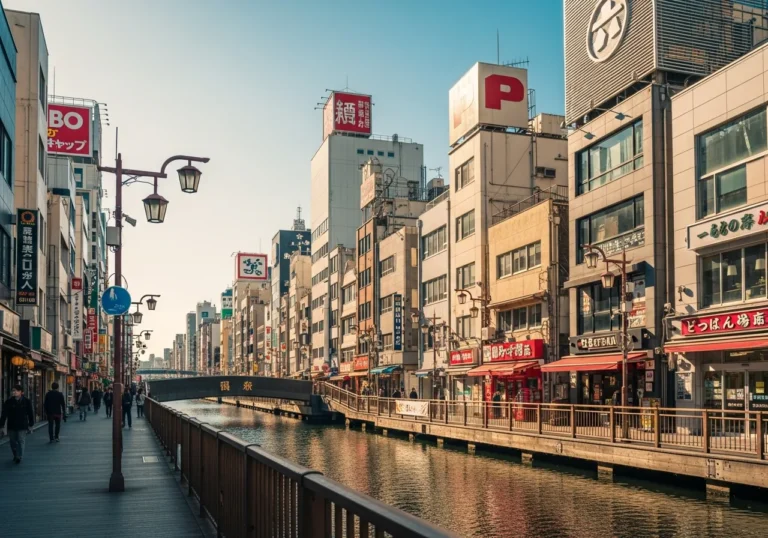
Stand in Shimanouchi today, in the dense retail grid south of Shinsaibashi, and nothing announces that this was once the nerve centre of Japan’s copper industry. The canal that once cooled Sumitomo’s furnaces has been filled in.
The refinery that employed more than a hundred workers and covered 2,500 square metres is a convenience store and a car park. But the money that flowed from this spot — and from a mountain in Shikoku two hundred kilometres away — built the banks, the chemical plants, the electric cable factories, and the insurance companies that still carry the Sumitomo name into the twenty-first century.
Understanding how that happened means understanding one man who arrived at a copper mine at the age of nine and spent the rest of his life refusing to let it die.
Why Did Sumitomo Need Saving at All?
The House of Sumitomo was, by the mid-nineteenth century, one of the most powerful merchant dynasties in Japan. Its origins lay in a copper refinery opened in Kyoto around 1590 by Riemon Soga, whose son Tomomochi later moved the operation to Osaka and married into the Sumitomo family. The Sumitomo Group’s own account of its founding records that Tomomochi expanded the business so successfully that people said “No one in Osaka can compete with Izumiya” — Izumiya being the trade name under which the family operated.
The competitive advantage was technical. Riemon had learned from European traders the nanban-buki method — a lead-based process for extracting silver from unrefined copper — and the family had made this technique available to the broader Osaka copper guild, cementing its position as the guild’s head family. Sumitomo’s own historical tour of Osaka notes that the refinery hosted eminent visitors including high-ranking Tokugawa officials and the heads of the Dutch Trading Post at Dejima, en route to Edo Castle.
In 1691, the family obtained permission from the Tokugawa Shogunate to open the Besshi Copper Mine on Shikoku. Sumitomo Corporation’s global history records that the mine continued operations for 283 years, forming the backbone of Sumitomo’s business. At its peak, Besshi was producing more than a quarter of Japan’s entire copper output — some 1,520 tons out of a national total of 6,000 — at a time when Japan was one of the world’s leading copper-producing countries.
The arrangement worked because the Tokugawa system made it work. All copper had to be refined in Osaka by shogunal decree, and the shogunate was the exclusive purchaser of copper for export through Nagasaki.
Sumitomo was, in effect, a licensed monopolist operating within a closed system. The family grew rich, the shogunate got its copper, and the arrangement persisted for nearly two centuries.
Then, in 1868, the arrangement collapsed entirely.
Why Was 1868 an Existential Moment?
The Meiji Restoration did not merely change the government. It dissolved the entire economic architecture within which Sumitomo had operated.
Encyclopedia.com’s account of Sumitomo’s history puts the structural problem plainly: during the Tokugawa period, Sumitomo had chartered the Besshi mine from the bakufu, which owned all mines in the country. When the new Meiji government came to power, it inherited those ownership claims — and initially moved to assert them.
The financial situation was simultaneously catastrophic. The Sumitomo Group’s biography of Hirose records the precise arithmetic of ruin: former daimyo owed Sumitomo 180,000 ryō, while Sumitomo itself owed the government 88,500 ryō for rice supplied to feed the miners.
Copper prices were falling. The price of rice — the staple of the miner’s diet — was rising.
Miners were being paid in paper and wooden tokens rather than money. The mine faced bankruptcy, and the Sumitomo family, unable to collect on its loans to warlords, was forced to mortgage its household goods.
The family’s response was to consider selling the mine and closing the enterprise. It was the rational calculation of people who had watched their world dissolve in a matter of months. What they had not counted on was their own mine manager.
The Man Who Said No to His Employers
The Sumitomo Group’s biography of Hirose records that he was born on June 16, 1828, in Yabu-mura, Yasu-gun in Omi Province — present-day Yasu City in Shiga Prefecture — the second son of a physician. He was adopted by his uncle Jiemon Kitawaki in 1834, and in 1836, at the age of nine, he moved to the Besshi Copper Mines accompanying his uncle.
Two years later he was apprenticed to the House of Sumitomo. He had, in the most literal sense, grown up inside the mine.
That biographical fact matters enormously. Hirose did not arrive at Besshi as an outside manager with a mandate to restructure.
He had spent his entire conscious life there. He knew the mountain’s geology, its labour dynamics, its seasonal rhythms, its debts.
When the family proposed selling, he was not defending an abstraction — he was defending the only world he had ever known, and he was doing so with the conviction of someone who understood its potential better than its owners did.
The Sumitomo Group’s analysis of Hirose’s significance records that when it was proposed in 1868 that the Besshi Copper Mines should be sold, Hirose “adamantly opposed the plan, stated how unreasonable such a course of action would be, and rallied Sumitomo’s executives against the shocking plan.” He then went further: he argued the case directly to the new Meiji government.
In dealings with the Tosa Domain, which the new government had put in charge of negotiations concerning the Besshi Copper Mines, Hirose expressed his conviction that Sumitomo’s continued ownership and management of the mines would be in the national interest. He made the same argument to Tomomi Iwakura, one of the leading statesmen of the Meiji era.
The argument was not merely self-interested — it was strategic. Hirose understood that copper was essential to Japan’s industrialization, and that a private operator with generations of expertise could develop the mine more effectively than a government bureaucracy.
He was right, and he was persuasive. The House of Sumitomo retained ownership and management of the mines.
Why Did Hirose Choose Western Technology Rather Than Tradition?
Saving the mine from sale or confiscation was only the first crisis. The second was operational: the Besshi mine, after nearly two centuries of extraction, was running into the limits of its own methods.
The Sumitomo Group’s history of the Besshi mine’s middle period describes the specific technical problems: shafts had been excavated so deep that groundwater was constantly welling up, constraining the miners’ freedom of action. The old-fashioned smelting method was adequate for rich ore with high copper content, but could not handle lower-grade ores with copper content of around three percent — which meant vast quantities of ore were being left unexploited.
Hirose’s response was methodical and, for its time, radical. In 1871, the Meiji government ordered him to inspect the Ikuno mine, where he met a French engineer named Coignet and observed modern mining techniques using black powder. Sumitomo Metal Mining’s corporate history records that “this trip convinced Hirose that he had no other choice but to introduce Western methods at Besshi to ensure the firm’s revival.”
In 1874, Hirose hired French mining engineer Louis Claude Bruno Larroque. The salary was extraordinary: Encyclopedia.com’s account of Sumitomo Metal Mining records that Larroque was paid the very high salary of US$600 a month — six times Hirose’s own salary, according to the Sumitomo Group’s own records. Larroque spent twenty-two months at Besshi, inspecting 165,000 square metres of workings and preparing a comprehensive masterplan covering mining, transportation, and smelting.
Then Hirose did something that reveals the precise quality of his mind: he declined to renew Larroque’s contract. Instead, he sent two of his own employees to France to study mining and metallurgy.
Encyclopedia.com’s entry on Sumitomo Corp notes that “he saw the need for a scientific approach, but he also wanted to avoid excessive dependence on foreign experts.” The distinction is crucial. Hirose was not a technological nationalist who rejected Western knowledge — he was a strategic thinker who understood that knowledge transferred to Japanese engineers would compound over time, while knowledge held by a foreign contractor would leave with him.
What the Masterplan Actually Changed
On February 24, 1876, Hirose presented his formal plan for modernizing the Besshi Copper Mines, based on Larroque’s masterplan. The changes were comprehensive and sequential.
Dynamite was first used for tunneling at Besshi in 1882. Rock drills were introduced in 1891.
Railway construction began in 1890. A steam-powered ship was purchased to haul copper and supplies between the Shikoku mine and the ports of Osaka and Kobe.
Coke replaced charcoal in the smelting process.
The results were measurable and dramatic. Encyclopedia.com’s account records that annual copper production increased from 420 tons in 1868 to over 1,800 tons in 1888. By the mid-1890s, Japan as a whole was mining four times what it had produced in 1880.
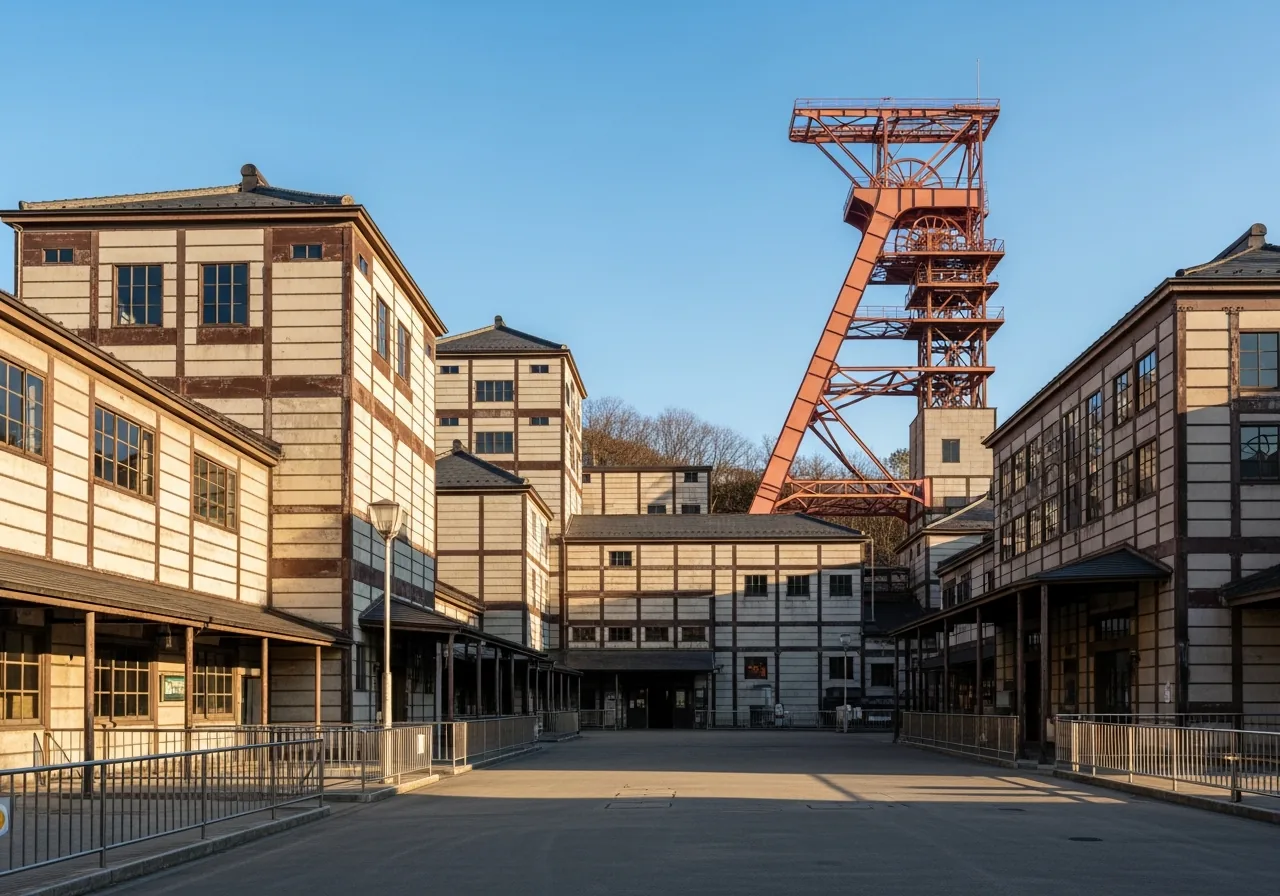
The Toen Inclined Shaft — a project that took almost two decades to complete — was the centrepiece of the underground transformation. The Sumitomo Group’s mine history records that Adit No. 1, completed in 1886 after four years of excavation, ran 1,021 metres with “hardly any errors in terms of the direction and the altitude.” A tramway was laid in the tunnel for wagons drawn by labourers and horses. Despite many suggestions that foreign assistance should be sought for this project, Hirose insisted on accomplishing it solely through the efforts of Japanese engineers.
In 1889, Hirose made a trip to Europe and North America that would shape the final phase of his career. In Colorado, he inspected a mountain railway hacked into sheer cliffs at a mine in the Rocky Mountains. The Sumitomo Group’s biography records that “this experience boosted his confidence concerning prospects for constructing a railway to serve the Besshi Copper Mines.” In 1894, two lines opened: a lower railway traversing the Niihama lowlands and an upper railway running along a mountainside 1,000 metres above sea level — Japan’s first mountain railway serving a mine.
“The experience of touring Europe and North America in 1889 not only impressed on Hirose the importance of steelmaking and chemicals but also deepened his conviction that the House of Sumitomo should seize the initiative by undertaking projects beneficial to the nation from a long-term perspective.” — Sumitomo Group Public Affairs Committee, Saihei Hirose: Part 3
Why Did Hirose Invent Corporate Governance Before the Term Existed?
The technological transformation of Besshi is the story most often told about Hirose. But his institutional innovations may have been equally consequential, and they are less often examined.
The House of Sumitomo in the early Meiji era was still organized as a traditional merchant house: the family head held ultimate authority, and managers acted as agents of the family rather than as officers of an institution. This worked when the business was a copper refinery and a mine. It was inadequate for a diversifying industrial enterprise operating across multiple sectors in a rapidly changing economy.
The Sumitomo Group’s account of leadership in the early modern era records the precise moment of institutional change: on February 14, 1877, the Sumitomo family head Tomochika appointed Saihei Hirose soridainin — prime agent — delegating to him “authority to manage all my affairs and all the administration related to the commercial code and to supervise numerous employees.” The Sumitomo Group notes, with some pride, that “when Japan’s first prime minister was appointed in 1885, Sumitomo had already been using the term ‘sori’ for eight years.”
In 1882, Hirose went further. Sumitomo Corporation’s 2014 Annual Report records that “when serving as Director-General, Hirose formulated the Rules Governing the House of Sumitomo, which consisted of 19 sections and 196 articles, to reflect the business philosophy the family had followed over its 250-year history.” The Rules codified what had previously been tacit — the principle that Sumitomo should practice sound management, adapt to changing times, and under no circumstances pursue easy gains or act imprudently.
This was not merely a statement of values. It was a structural separation of ownership from management — the family would reign, but professional managers would govern. The same Sumitomo Corporation report notes that in 1891, the Rules were separated into two parts — a family code and a family constitution — “to distinguish ownership from business operations.” This is the architecture of the modern corporation, assembled in Osaka in the 1880s by a man who had started his career as a nine-year-old apprentice in a mountain mine.
The Maxim That Explains Everything
A calligraphic work by Hirose from 1913, the year before his death, has survived and is held at the Hirose Memorial Museum in Niihama. It bears his lifelong favourite maxim: Gyakumei rikun, kore wo chu to iu — “Disobey your master’s order and benefit him. That is loyalty.”
The phrase is not a licence for insubordination. It is a precise statement of the manager’s obligation: if an order from above is contrary to the interests of the institution or the nation, the loyal response is to refuse it and explain why.
Hirose had lived this maxim in 1868, when he defied the Sumitomo family’s wish to sell the mine. He had lived it again when he refused to renew Larroque’s contract against the advice of those who wanted continued foreign expertise.
He had lived it a third time when he insisted on Japanese engineers completing the Adit No. 1 tunnel without foreign assistance.
The maxim also explains the one moment when Hirose’s authority was finally overridden. In 1894, a conflict arose within the House of Sumitomo — the sources are not specific about its nature — and it was concluded that only Hirose’s retirement could resolve the impasse.
Kinmochi Saionji, a biological elder brother of the Sumitomo family head, counselled Hirose to step down so as not to set a bad example for the future of the House. Hirose acceded.
The Sumitomo Group’s biography records his distress in a letter to his nephew Teigo Iba: “Although I do my utmost as an elderly man, I am frustrated and cannot sleep well.” On November 15, 1894, at the age of sixty-seven, he resigned.
The institution he had built was strong enough to survive his departure. That was precisely the point.
Why Did Hirose Refuse to Diversify When His Rivals Did?
One of the most revealing aspects of Hirose’s management philosophy is what he chose not to do. In the 1880s, the Meiji government sold off a large number of state-owned enterprises — mines, factories, shipyards — at prices that made them attractive acquisitions for ambitious merchant houses. Mitsui, Mitsubishi, Furukawa, and Fujita all moved aggressively to acquire these assets, building the diversified industrial empires that would define the zaibatsu era.
Hirose did not bid. Encyclopedia.com’s account notes that “Hirose stayed on as Sumitomo’s main manager but handled the enterprise’s affairs with a conservative strategy, not diversifying into other fields as its competitors Mitsui and Mitsubishi had, and not bidding on enterprises sold by the government in the 1880s.” The Sumitomo Group’s own analysis adds a pointed observation: Mitsui, Mitsubishi, Furukawa, Fujita, and Kuhara were “only able to develop heavy industry after acquiring mines previously managed by the government” — whereas Sumitomo had always owned Besshi privately.
Hirose’s logic was that Sumitomo’s competitive advantage lay in copper, and that dispersing capital across unfamiliar industries would dilute that advantage without creating equivalent returns. The Sumitomo Group’s biography records his policy explicitly: “to steadily promote business development by using internally sourced funds. Unlike Mitsui, Mitsubishi, Furukawa, or Fujita, Sumitomo did not borrow heavily to acquire mines but instead plowed all its surplus financial resources into modernization of the Besshi Copper Mines.”
This was not timidity. It was a calculated bet that depth beats breadth — that mastering one industry completely would generate more durable value than spreading thinly across many.
The bet paid off. When copper prices rose in the 1890s and the government freed copper trading in 1896, Sumitomo was positioned to benefit immediately.
The Sumitomo Group’s biography notes that in April 1896, Hirose resigned from his position as a government official in order to focus on modernizing the Besshi Copper Mines — “far from relishing the status and accolades that he could expect as a government official, he was eager to contribute to the nation through achievements in the business world.”
The Osaka Dimension: Building a City’s Commercial Infrastructure
Hirose’s conservatism at Sumitomo coexisted with remarkable civic entrepreneurialism in Osaka. The Sumitomo Group’s biography records that a leading government minister’s letter from 1881 described Hirose as “not just my right-hand man but also my left-hand man.” He became vice president of the Osaka Chamber of Commerce in 1878, deputy president of the Osaka Securities Exchange in 1879, and president of what would become the Osaka Shosen shipping company — later OSK Lines — in 1884.
In 1870, to secure funds for modernizing Besshi, Hirose had invested in Osaka Kawasekaisya, described as Japan’s first bank, and secured a loan. When that institution collapsed in 1873 under bad debts, Hirose took charge of the liquidation and managed to recover a considerable amount for distribution to investors.
This was not a profitable exercise — it was a reputational one. Hirose understood that Sumitomo’s long-term position in Osaka depended on being seen as a trustworthy actor in the city’s financial ecosystem.
In 1892, Hirose was among the first cohort of private-sector leaders to be awarded the Order of the Sacred Treasure, Fourth Class — alongside Eiichi Shibusawa, the great Meiji-era industrialist, and Ichibee Furukawa, promoter of the Ashio Copper Mine. The Sumitomo Group’s analysis notes that this recognition came at a time when “whereas bureaucrats were the focus of the greatest respect, members of the merchant class had a much less exalted position in the social hierarchy.” The award was a signal that the Meiji state was beginning to recognize that private enterprise, not just government initiative, was driving Japan’s modernization.
Why Did the Mine’s Success Create an Environmental Crisis?
The story of Besshi’s modernization is also, inescapably, a story about what modernization costs. The same smelters that drove copper production upward were discharging sulfur dioxide gas across the surrounding farmland.
Sumitomo Metal Mining’s environmental history records that “sulfur dioxide gas discharged from the prosperous Niihama refinery spread toxins to the crops in the surrounding areas, creating unforeseen circumstances.” By 1893, local farmers were outraged. The problem was raised in the national Diet, which identified the Besshi Copper Mines as the major pollution source in western Japan — the Ashio Copper Mine in the east being the other.
This crisis fell primarily to Hirose’s successor and nephew, Teigo Iba, to resolve. But it had its roots in the modernization programme that Hirose had driven.
The decision to relocate the smelter to Shisaka Island — an uninhabited island some twenty kilometres off the coast of Niihama — was taken by Iba and cost approximately 1.7 million yen, equivalent to two years of the mine’s net earnings. Sumitomo Metal Mining’s history of the 1890s onward records that the Shisaka smelter began operations in 1905, but the relocation did not immediately solve the problem — sulfur dioxide from the island smelter, depending on weather conditions, spread damage across an even wider region than before.
The full resolution took decades. Sumitomo Corporation’s account of the Besshi mines’ legacy records that “Teigo Iba’s decision to relocate the smelter to Shisaka Island, followed by continued research and countermeasures, ultimately led to zero emissions by 1939.” The mountains around Besshi, stripped bare by deforestation and acid rain during the peak production years, have since been reforested — a project that Iba initiated and that Sumitomo Forestry has continued for over a century.
The environmental chapter of the Besshi story is worth dwelling on, because it complicates the triumphalist narrative of modernization. Hirose’s achievement was real and substantial.
But the copper that funded Japan’s industrialization also poisoned the rice fields of Ehime Prefecture for a generation. The Sumitomo Group’s willingness to acknowledge this — and to frame the eventual resolution as an expression of its founding philosophy — is itself a form of institutional honesty that is unusual in corporate history.
Why Does Hirose’s Story Matter to Osaka Specifically?
Hirose spent most of his working life not in Osaka but in Niihama, on Shikoku. Yet his story is fundamentally an Osaka story, for reasons that go beyond the fact that Sumitomo’s head office was here.
Osaka in the Meiji era was navigating an identity crisis. The city had been the commercial capital of Tokugawa Japan — the place where rice was traded, where daimyo warehouses lined the canals, where the great merchant houses had accumulated wealth that rivalled the feudal lords.
The Meiji Restoration threatened to transfer economic power to Tokyo, where the new government was based and where Mitsui and Mitsubishi were building their empires. Osaka’s merchants needed to demonstrate that they could operate in the new industrial economy, not just the old commercial one.
Hirose was one of the people who made that demonstration. His involvement in the Osaka Chamber of Commerce, the Osaka Securities Exchange, and the shipping company that became OSK Lines was not incidental to his work at Sumitomo — it was part of a deliberate effort to build the institutional infrastructure of a modern commercial city. The Sumitomo Group’s historical tour of Osaka traces how the copper refinery in Shimanouchi — the physical anchor of Sumitomo’s Osaka presence — gave way to a broader financial and industrial presence that eventually produced the Nakanoshima Library, the Sumitomo Bank, and the architectural legacy that still marks the island district today.
The Sumitomo Bank, founded in 1895 — the year after Hirose’s retirement — was the direct institutional descendant of the money-exchange business that Sumitomo had operated since the Edo period. Britannica’s account of the Sumitomo Group notes that the bank “functioned as the main financial instrument of the Sumitomo zaibatsu” and eventually became one of the largest banks in the world before merging into what is now Sumitomo Mitsui Financial Group.
The copper from Besshi funded the bank. The bank funded the zaibatsu.
The zaibatsu built modern Osaka.
Why Should a Discerning Traveller Care About a Mine Manager Who Died in 1914?
The honest answer is that Saihei Hirose is not a figure who rewards casual interest. He left no famous speeches, no dramatic personal narrative, no romantic biography.
He was a manager — extraordinarily gifted, but a manager nonetheless. His achievements were institutional: a mine saved, a technology transferred, a governance structure invented, a philosophy codified.
These are not the materials of legend.
But for a traveller who wants to understand how Osaka actually works — why this city has the particular texture it has, why its commercial culture differs from Tokyo’s, why the Sumitomo name appears on banks and chemical plants and electric cable companies and real estate firms across Japan — Hirose is indispensable. He is the hinge between the Edo-period merchant city and the Meiji industrial city. He is the reason Sumitomo survived the Restoration when it might easily have been absorbed into the state apparatus, as so many other merchant houses were.
There is also something specifically instructive about his method. In an era when the temptation was to borrow heavily, acquire aggressively, and diversify rapidly — the strategy that built Mitsubishi’s empire and eventually contributed to the zaibatsu system’s worst excesses — Hirose chose depth over breadth, internal funding over debt, Japanese expertise over permanent foreign dependency.
Sumitomo Corporation’s own articulation of its business philosophy traces this directly to Hirose: “We shall practice sound management in order to cope effectively with the changing times. Under no circumstances, however, shall we pursue easy gains or act imprudently.”
That sentence, written into the Rules Governing the House of Sumitomo in 1882, is still cited in Sumitomo Group corporate communications in 2026. It is one of the oldest continuously operative corporate principles in the world, and it was written by a man who had started his career as a nine-year-old apprentice in a mountain mine on Shikoku.
For a traveller who cares about the relationship between institutional design and long-term value — about why some organisations survive centuries while others collapse in decades — Hirose’s story is not a footnote to Osaka’s history. It is one of its central arguments.
The Boenro: Smoke as Symbol
There is one image that captures Hirose’s sensibility better than any biography. In his residence in Niihama — now preserved as the Hirose Memorial Museum, a nationally designated Important Cultural Property — there is a room on the second floor called the Boenro, the Smoke Viewing Observatory. From this room, Hirose could look out over Niihama City and the Seto Inland Sea and watch the smoke rising from the mine’s chimneys and from the steamships crossing the bay.
He loved that smoke. He wrote a poem about it.
To him, it was not pollution — it was evidence. Evidence that the mine was running, that the smelters were firing, that the ships were moving, that the project he had devoted his life to was alive and producing.
The museum’s own description notes that the Boenro “symbolized the growing prosperity of Niihama” in Hirose’s eyes.
The irony is that the smoke he loved was also the smoke that would poison the surrounding farmland and force his successor to spend two years of the mine’s earnings relocating the smelters to an island. Progress and its costs were, in Hirose’s lifetime, inseparable. The Sumitomo Group’s willingness to hold both truths simultaneously — to celebrate Hirose’s achievement and acknowledge the environmental damage it caused — is part of what makes its institutional history more honest than most.
The residence itself embodies the same duality. The museum’s description records that it “maintains traditional Japanese architectural style” while incorporating “the new cultural elements of a fireplace, Western-style toilet, glass windowpanes, and a lightning rod.” Hirose lived in a house that was neither fully traditional nor fully modern — a physical expression of the transitional moment he inhabited and, in significant ways, shaped.
Frequently Asked Questions
Q: Who was Saihei Hirose and why is he important?
A: Saihei Hirose (1828–1914) was the general manager of the Besshi Copper Mine and the first Director-General of the House of Sumitomo. He saved the mine from sale or government confiscation during the Meiji Restoration, modernized it using Western technology, and created the institutional framework — including a formal corporate governance code — that allowed Sumitomo to grow into one of Japan’s great industrial conglomerates.
Q: What is the Besshi Copper Mine and where is it?
A: The Besshi Copper Mine is located in the mountains of Ehime Prefecture on Shikoku, near the city of Niihama. It opened in 1691 and operated for 283 years until 1973, producing approximately 700,000 tons of copper and forming the backbone of Sumitomo’s business for three centuries. The site is now partly open to the public as Minetopia Besshi.
Q: What did Hirose actually change at Besshi?
A: Hirose introduced dynamite for tunneling (1882), rock drills (1891), railway construction (1890), steam-powered ships, and Western-style blast furnaces. He hired French engineer Louis Larroque to produce a modernization masterplan, then sent Japanese engineers to France to learn the methods — deliberately avoiding permanent dependence on foreign expertise. Annual copper production rose from 420 tons in 1868 to over 1,800 tons by 1888.
Q: What is the Hirose Memorial Museum and can visitors go there?
A: The Hirose Memorial Museum in Niihama, Ehime Prefecture, comprises a modern exhibition hall and Hirose’s former residence, which is a nationally designated Important Cultural Property. The residence was built between 1877 and 1889 and combines traditional Japanese architecture with early Western features including a fireplace, glass windowpanes, and a lightning rod. The museum is open to the public; admission is approximately 520 yen for adults (confirm current prices on the official site).
Q: How does Hirose’s story connect to Osaka?
A: Sumitomo’s head office was in Osaka, and Hirose was deeply involved in building the city’s commercial infrastructure — serving as vice president of the Osaka Chamber of Commerce, deputy president of the Osaka Securities Exchange, and president of what became OSK Lines. The copper revenue from Besshi funded the Sumitomo Bank (founded 1895), which eventually became part of Sumitomo Mitsui Financial Group. The Nakanoshima district of Osaka still carries the architectural legacy of Sumitomo’s Meiji-era ambitions.
Q: Why did Hirose refuse to diversify Sumitomo when rivals like Mitsui and Mitsubishi did?
A: Hirose believed Sumitomo’s competitive advantage lay in copper and that dispersing capital across unfamiliar industries would dilute that advantage. He funded modernization entirely from internal resources rather than borrowing, and concentrated all surplus capital on improving Besshi. This conservative strategy proved correct: when copper prices rose and trading was liberalized in 1896, Sumitomo was better positioned than rivals who had spread themselves thin.
Where to Experience Saihei Hirose’s Legacy in Osaka and Beyond — Visitor Information
Sumitomo’s Osaka roots (Shimanouchi): The site of Sumitomo’s historic copper refinery, Shimanouchi, Chuo-ku, Osaka 542-0082 / 大阪府大阪市中央区島之内
Nearest station (Shimanouchi): Shinsaibashi Station (Osaka Metro Midosuji / Nagahori Tsurumi-ryokuchi lines) — 5 minutes on foot
Hirose Memorial Museum (primary site): 2-10-24 Uwabara, Niihama-shi, Ehime 792-0046 / 愛媛県新居浜市上原2丁目10-24
Nearest station (Hirose Memorial Museum): Niihama Station (JR Yosan Line) — approx. 15 minutes by taxi or local bus
Hours: 9:00–17:00 (entry until 16:30); closed Mondays (or following Tuesday if Monday is a public holiday) and New Year holidays — confirm on official site before visiting
Admission: Approx. 520 yen for adults, 260 yen for elementary/junior high students (confirm current prices on official site)
Official site: sumitomo.gr.jp