Osaka became the fulcrum of Japan’s sugar trade not by accident but by structural design: every gram of imported sugar that entered Japan through Nagasaki’s Dejima island in the Edo period (1603–1868) was auctioned to merchants who, in the overwhelming majority of cases, shipped it onward to Osaka — the shogunate’s designated national clearinghouse — before it reached any other city. That single logistical fact, compounded over two and a half centuries, explains why Osaka’s confectionery culture is deeper, stranger, and more commercially sophisticated than anywhere else in Japan, and why a city famous today for takoyaki and okonomiyaki was, at its economic peak, the nation’s sugar capital.
Why we can tell you this — MICHI is written and edited in Osaka; our team can walk the Nakanoshima riverbank where the kurayashiki (domain warehouses) once lined the water, stand in the Dojima district where the world’s first futures exchange operated, and visit Chidoriya Souke — an Osaka wagashi house founded in 1630 — in a single afternoon. This article draws on the Japan Exchange Group’s Dojima Rice Exchange archive, the National Diet Library’s Edo-period trade records, the Kikkoman Food Forum’s historical survey of sugar in Japan, the Wikipedia article on Sugar in Japan (which aggregates peer-reviewed scholarship including the Oxford Companion to Sugar and Sweets), and the Visit Fukuoka Sugar Road documentation. Where the historical record is thin — particularly on the precise internal accounting of Osaka’s sugar-tonya guilds — we say so rather than speculate.
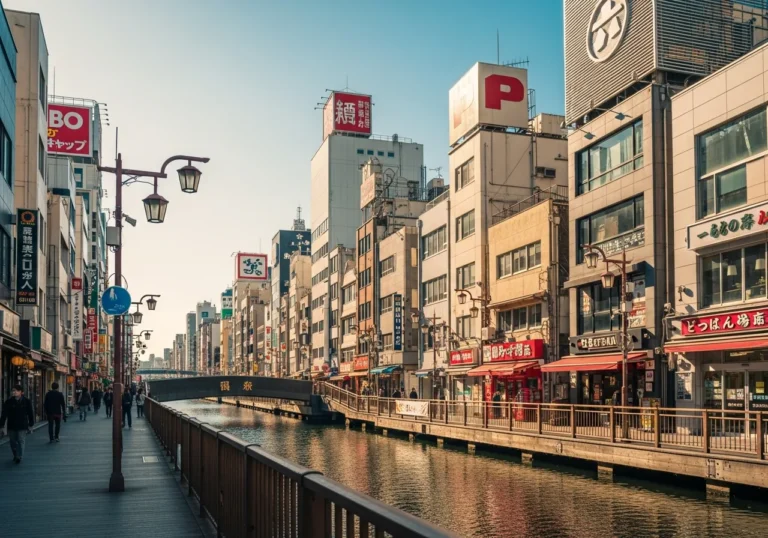
Stand on the north bank of the Dojima River on a grey November morning and you are standing on one of the most consequential stretches of urban waterfront in economic history. The office towers of Nakanoshima rise behind you.
The river is quiet, crossed by a graceful stone bridge. Nothing here announces itself.
But beneath the surface of this ordinary Osaka morning lies the ghost of an entire commodity system — a system that once moved sugar from the hold of a Dutch East India Company vessel in Nagasaki harbour to the shelves of a confectionery shop in Edo in a chain of transactions so precisely organised that it prefigured the mechanics of modern commodity futures trading by nearly two centuries.
Sugar did that. Not rice, not silk, not copper — though all three mattered. Sugar, the one commodity that arrived in Japan as a foreign luxury and left as a cultural necessity, was the thread that connected Dejima to Dojima, Nagasaki to Nakanoshima, and the ledgers of Satsuma domain to the wooden molds of an Osaka wagashi artisan.
To understand why Osaka became Japan’s sugar capital, you have to drill down through seven layers of causation. Each answer opens a trapdoor into a deeper one.
Why Did Sugar Have to Pass Through Osaka at All?
The short answer is that the Tokugawa shogunate made it so. When Ieyasu consolidated power after Sekigahara in 1600 and his successors built the sakoku (closed country) system into law, they designated Osaka as tenryō — direct shogunal territory, free from any local daimyo’s interference. As the Osaka Language Solutions historical survey explains, this gave the city something priceless: the institutional breathing room to become the commercial heart of the nation.
All substantial domains were required to maintain commercial operations in Osaka, the national market, in order to sell rice and other commodities and raise the cash required by the sankin-kōtai alternate-attendance system. Every feudal lord in Japan had to spend alternate years in Edo with his retinue — an enormously expensive obligation — and the only practical way to fund it was to convert provincial rice into Osaka coin.
The result was a city of warehouses. Feudal domains sold tax rice stored at kurayashiki (combined warehouses and residences) around Nakanoshima to rice brokers through auctions, issuing rice bills — notes promising to exchange for rice — to successful bidders.
Those bills circulated as a form of paper money. Osaka was not merely a market; it was the nation’s financial clearing system, operating decades before any comparable institution existed in Europe.
Into this infrastructure, sugar slotted perfectly. Sugar imported to Nagasaki by foreign vessels, particularly Dutch and Chinese ships, was first landed on Dejima island.
It would then be bought wholesale by Nagasaki Kaisho — the Tokugawa shogunate agency that oversaw trade in the port — and auctioned off to Japanese merchants. The majority of those merchants carried their sugar onward to Osaka by ship.
This was not coincidence. It was the only rational commercial decision available.
Osaka had the warehouses, the brokers, the guilds, the price-discovery mechanisms, and the onward distribution networks. To sell sugar anywhere else first would have been like trying to clear a cheque at a branch that had no connection to the central bank.
Why Was Sugar Worth Routing Through an Entire National Logistics System?
Because for most of the Edo period, sugar was extraordinarily scarce and correspondingly valuable. Cane sugar entered Japan in the eighth century. Over the following millennium, Japanese people consumed it rarely, and when they did, primarily as a medicine. The Buddhist priest Eisai (1141–1215), writing about sugar, described its flavor as not merely the finest sweetness but the greatest flavor of all — a statement that reads less like a food review and more like a pharmacopoeia entry.
Rather than sugar, when cooks desired sweet flavors they used sweeteners like honey, rice glucose, or syrups made from vines called amazura, or sweet arrowroot. Sugar was so rare that when the scholar-priest Ganjin (688–763) — the Chinese monk who founded Tōshōdaiji Temple in Nara — brought cane sugar to Japan from China, it was recorded as a diplomatic gift of extraordinary significance.
The Portuguese changed the equation in the sixteenth century, but only partially. When Nagasaki port opened to trade in 1571, some 100 kilograms or more of sugar began to be imported annually, and it spread into the towns of northern Kyushu.
The Portuguese also introduced nanbangashi — “southern barbarian confectionery” — including konpeitō (from the Portuguese confeito) and kasutera (castella sponge cake). These exotic sugar and egg-loaded confections were only for the nobility.
Then the Portuguese were expelled. Under the sakoku policy, Dutch and Chinese ships carrying goods from Asia and Europe started to arrive instead.
One of their key products was sugar, of which bulk importation began in the 18th century. The Dutch East India Company — the VOC — sourced sugar from its plantations in Java and Taiwan. Chinese merchants brought sugar from the Fujian coast.
Both streams converged on Dejima, the artificial island in Nagasaki harbour that was Japan’s sole sanctioned point of contact with the outside world.
The main imported goods included Chinese raw silk, silk fabric, sugar, scented wood, pepper, shark skin, and medicines, while the main exports were copper bars — mostly refined in Osaka — and later ceramics and lacquerware. Sugar and copper were, in a sense, mirror commodities: one came in, the other went out, and Osaka sat at the centre of both flows.
“With what would now equate to twenty million dollars’ worth of sugar being imported and sent up Sugar Road each year at its peak, significant amounts filtered into the surrounding regions.” — Highlighting Japan, June 2015
Twenty million dollars’ worth of a single commodity, at peak, flowing through a single port. The pressure that created on Osaka’s distribution infrastructure — and the commercial opportunity it represented — was immense.
Why Osaka and Not Kyoto, Edo, or Nagasaki Itself?
This is the question that reveals the deepest structural logic. Kyoto was the imperial capital, Edo the shogunal seat, Nagasaki the port of entry. Why did none of them become the sugar entrepôt?
Kyoto was a consumer city, not a commodity-processing city. Its merchants were sophisticated, but its infrastructure was oriented toward silk, lacquerware, and the luxury trades of the imperial court. It had no equivalent of the kurayashiki system, no futures market, no national clearing function.
Edo was politically supreme but commercially dependent on Osaka. The Dojima rice exchange at Osaka was operating on much the same principles as a modern futures exchange almost two centuries before Frankfurt (1867), Chicago (1871), and London (1877). Edo had no comparable institution. Its merchants were powerful, but they were downstream of Osaka in the commodity chain.
Nagasaki was the point of entry but was deliberately kept small and controlled. The Nagasaki Kaisho — the shogunate’s clearinghouse — auctioned sugar to merchants, but it had no interest in allowing Nagasaki to become a commercial hub that might develop independent economic power. The sugar had to move on, and the only place with the infrastructure to receive it was Osaka.
Geography reinforced policy. Before railways, Osaka’s arteries were waterways.
Canals connected rice warehouses, merchant houses, port terminals, and financial districts. The city’s network of rivers and canals — the same network that earned it the nickname “the Venice of the East” — made it uniquely suited to bulk commodity handling. A ship from Nagasaki could unload sugar directly into a canal-side warehouse in Nakanoshima.
No other city in Japan could offer that.
Why Did the Merchant Guilds Make Sugar Their Business?
By the middle of the Edo period, Osaka’s commercial life was organised into a dense web of specialised guilds — the kabunakama and tonya — each controlling a specific commodity or trade route. Wholesale freight shippers operating out of Osaka, transporting goods to Edo, numbered at least 24 in 1700, and a great many guilds existed specialising in the handling of individual types of goods, such as cotton, sugar, or paper.
The sugar guilds were among the most lucrative. The sanction of specific trade guilds, including silk and sugar, soon followed the establishment of the rice market infrastructure. A sugar tonya in Osaka’s Semba district — the great wholesale quarter that ran along the Honmachi axis — could buy at the Nagasaki auction price and sell at the Edo retail price, with the entire national distribution network as his instrument.
The profits were extraordinary, and they were reinvested in exactly the way Osaka merchants always reinvested surplus capital: into the city’s food culture. During the Edo period, the wealthy merchant class of Osaka was restricted by strict laws from showing off their wealth through fancy clothes or architecture.
Instead, they poured their money into lavish, high-quality dining. This is the origin of kuidaore — “eat until you drop” — the philosophy that still defines Osaka’s food culture today. Sumptuary laws that forbade merchants from wearing silk or building ostentatious houses had the unintended consequence of channelling enormous wealth into cuisine and confectionery.
A sugar merchant who could not display his wealth in architecture could display it in the quality of the wagashi he served at a tea ceremony. The finest sweets required the finest sugar.
The finest sugar was expensive. The circle was self-reinforcing.
Why Did Satsuma’s Sugar Monopoly Change Everything — and Why Did It Flow Through Osaka?
The imported sugar from Nagasaki was only one stream. The other, and ultimately the larger one, came from the south — from the Ryūkyū Kingdom (Okinawa) and the Amami Islands, both under the control of the Satsuma domain (present-day Kagoshima Prefecture).
Brown sugar in Okinawa began in 1623 when Gima Shinjo learned sugar manufacturing techniques from China and brought them back to Japan. In the Edo period, Okinawa came under the control of the Satsuma clan, and brown sugar became the subject of large payments to the Satsuma clan as annual tribute. The system was brutal for producers: especially in the first half of the 18th century, brown sugar was sometimes used as a tax payment material instead of rice, which was a heavy burden for the farmers. Records show that the labor and tax burden for brown sugar production was so severe that it was known as “brown sugar hell.”
For Satsuma domain, however, it was a financial lifeline. The Shimazu clan won effective control over the Ryūkyū Kingdom for most of the Edo period, benefiting from lucrative trade in the islands’ sugar. In 1746 the domain began collecting all taxes in sugar. In 1777 it established a state monopoly on sugar, making private sales punishable by death.
This was not merely agricultural policy. It was fiscal engineering of the highest order.
Satsuma was assessed at 770,000 koku — the second-highest domain valuation in Japan after Kaga — but its actual cash revenues were perpetually strained by the enormous cost of maintaining samurai retainers (one in four Satsuma residents was a samurai, against a national average of one in ten) and the sankin-kōtai obligations. Sugar was the solution.
And the sugar, once collected, had to be sold — which meant it had to go to Osaka.
There were groups such as the Satsuma Tonya who specialised in the handling and transportation of goods; Satsuma controlled trade with the Ryūkyū Kingdom and, through them, trade with Qing China. The Satsuma Tonya in Osaka were the commercial arm of the domain’s sugar monopoly — agents who converted Ryūkyūan cane into Osaka coin and Osaka coin into the cash that kept the Shimazu clan solvent.
The reformer Zusho Hirosato (1776–1849), who served as the Satsuma domain’s chief financial officer from the 1820s, made the sugar trade the centrepiece of his fiscal rescue plan. He renegotiated Satsuma’s debts, expanded sugar production in the Amami Islands, and tightened the monopoly’s enforcement — all with the Osaka market as the ultimate destination for the domain’s output. The sugar revenues he generated helped fund the modernisation programme that would eventually produce the Meiji Restoration’s Satsuma faction: Saigō Takamori, Ōkubo Toshimichi, and the men who dismantled the very shogunate that had made the sugar trade possible.
Why Did Domestic Production Emerge, and What Did It Do to Osaka?
The shogunate watched the silver drain caused by sugar imports with increasing alarm. Japan was paying for sugar with copper and silver — the same metals it needed for its own monetary system. By the early eighteenth century, the trade deficit in sugar had become a political problem.
In the first half of the 18th century, Tokugawa Yoshimune promoted domestic production of sugar to reduce Japan’s trade deficit, ordering that sugarcane be planted across Japan. By 1800 Japan was producing more sugar than it was importing. Yoshimune — the eighth shogun, who ruled from 1716 to 1745 and is remembered as one of the most capable administrators of the Edo period — understood that the sugar problem was fundamentally a balance-of-payments problem. His solution was import substitution: grow it at home.
The results were transformative, and nowhere more so than on Shikoku island. The eighth Tokugawa shogun Yoshimune encouraged the cultivation of sugar cane, and by the end of the eighteenth century, domestically produced white sugar had widely circulated in the market. Most notably, in Shikoku’s Sanuki and Awa provinces (present-day Kagawa and Tokushima prefectures, respectively), refining techniques were advanced enough around the 1800s to produce the fine, white wasanbon sugar that is still prized today as an ingredient in high quality Japanese confectionery.
Wasanbon — the name derives from wa (Japanese) and sanbon (three trays, referring to the triple-refinement process) — is a sugar unlike any other. Wasanbon sugar has played a big part in the development of wagashi and has long been cultivated in the prefectures of Tokushima and Kagawa in eastern Shikoku. During the Edo period, when today’s commonly used white sugar was not widely available, wasanbon’s restrained sweetness and faint aroma gave wagashi its distinctive taste.
The production process is extraordinarily labour-intensive. Wasanbon is traditionally made entirely by hand and can take up to three weeks, or sometimes more, to prepare. The sugarcane juice is boiled, cooled, crystallised, wrapped in cloth, pressed under heavy stones, kneaded by hand on wooden trays, and refined three times — a process that removes so much material that only about 40 percent of the original mass remains as finished sugar. The result dissolves on the tongue in under a second, leaving a clean, faintly floral sweetness that is the antithesis of the blunt sweetness of refined white sugar.
Wasanbon reached Osaka through the same commercial channels that had handled imported sugar for a century. One popular theory is that the name wasanbon derives partly from Sanbonmatsu Port in Kagawa, from where the sugar was sent out to all parts of Japan. Osaka was the primary destination. The sugar tonya of Semba received Shikoku wasanbon just as they had received Nagasaki imports, and distributed it to confectioners across the Kinai region and beyond.
The domestic production revolution had a second, equally important consequence: it made sugar cheap enough for the merchant class, and eventually for ordinary townspeople, to consume regularly. Sugar consumption grew across the 19th century, as workers in Japan developed the habit of tea breaks, creating demand for snacks that could be served as accompaniments. This was the moment when wagashi ceased to be an aristocratic luxury and became a mass-market product — and Osaka, as the distribution hub, was perfectly positioned to supply that market.
Why Did Osaka’s Sugar Trade Produce a Distinct Confectionery Culture?
The connection between sugar commerce and confectionery culture is not metaphorical. It is direct, mechanical, and traceable through specific institutions and specific dates.
The demand for and production of wagashi exploded during the Edo period due to widespread commercialisation throughout the country and a significant improvement in agricultural productivity. But the explosion was not uniform across Japan. It was concentrated in cities with access to sugar — and no city had better access than Osaka.
Increased domestic sugar production and improved distribution networks allowed confectionery, previously the preserve of aristocrats and samurai, to gradually spread to the common people. Distinct regional styles emerged, such as the elegant “Kyōgashi” centred in Kyoto and the “Jōgashi” developed in Edo. Osaka’s style was different from both. Where Kyoto’s kyo-gashi was refined, seasonal, and oriented toward the tea ceremony aesthetic of the imperial court, and where Edo’s jōgashi was practical and accessible, Osaka’s confectionery culture was mercantile — driven by the tastes and the purchasing power of the chōnin, the townspeople, who were the city’s dominant social class.
The Osaka merchant’s relationship to sweetness was shaped by the same commercial logic that governed everything else in the city. During the Edo period, the wealthy merchant class of Osaka was restricted by strict laws from showing off their wealth through fancy clothes or architecture.
Instead, they poured their money into lavish, high-quality dining. Wagashi was one of the primary vehicles for this displaced expenditure. A merchant who could not wear silk could serve his guests the finest wasanbon higashi at a tea ceremony.
The sweetness was the status signal.
The tea ceremony connection is crucial. In parallel with the spread of sugar, the tea ceremony culture also flourished, where serving delicious sweets became one of the most critical aspects of the ceremony. The logic of the pairing is physiological: the bitterness of matcha requires a preceding sweetness to prepare the palate, and the sweetness of wagashi requires the subsequent bitterness of matcha to cleanse it.
The two are not merely traditional companions; they are designed for each other. And because Osaka’s merchant class had both the money to afford good tea and the access to good sugar, the city became one of the great centres of tea-ceremony culture — a fact that surprises visitors who associate the practice primarily with Kyoto.
The institutional evidence is concrete. Chidoriya is a wagashiya based in Osaka that has been making various types of wagashi, such as its flagship Honchidori Manju, for over 380 years. Chidoriya Souke was established in 1630 — just 27 years into the Edo period, at the very moment when the sugar trade infrastructure was being assembled.
The shop’s longevity is not sentimental; it is commercial. A wagashi house that has survived nearly four centuries in Osaka’s competitive market has survived because the city’s appetite for quality confectionery has never faltered.
The Dojima Rice Exchange itself had a direct relationship with sugar. The Osaka Grain Exchange, successor to the Dojima Rice Exchange, included a sugar market among its trading divisions — a detail that makes explicit what was always implicit: that sugar was, in Osaka’s commercial imagination, a commodity of the same order as rice, to be traded, hedged, and speculated upon with the same financial instruments.
The Kuidaore Paradox: How Sumptuary Laws Made Osaka Sweet
There is a paradox at the heart of Osaka’s confectionery culture that deserves its own examination. The Tokugawa sumptuary laws — the edicts that forbade merchants from wearing fine fabrics, building elaborate houses, or displaying wealth ostentatiously — were intended to keep the merchant class in its place at the bottom of the Confucian social hierarchy. They had the opposite effect on food culture.
When you cannot spend money on architecture or clothing, you spend it on what you eat and what you serve to guests. The Osaka merchant’s table became the arena of competitive display that his wardrobe and his house were not permitted to be.
This is the origin of kuidaore — not merely a love of food, but a historically specific redirection of commercial wealth into culinary excellence. And within that culinary excellence, confectionery occupied a special place, because confectionery was the most visible, most portable, and most giftable expression of refined taste.
The gift economy of wagashi in Osaka was — and remains — elaborate. Sweets were given at New Year, at Obon, at weddings and funerals, at the conclusion of business deals, at the beginning of new relationships.
Wagashi has made its way into the milestones of life, from weddings to funerals, as well as the passing of the seasons. In a city where commercial relationships were the foundation of social life, the quality of the sweets you gave said something precise about who you were and how seriously you took the relationship. A sugar merchant who gave inferior wagashi was, in a very real sense, undermining his own commercial reputation.
Why Did the Sugar Trade Collapse — and Why Did the Sweet Tooth Survive?
The Meiji Restoration of 1868 dismantled the institutional framework that had made Osaka’s sugar trade possible. The shogunate fell.
The sankin-kōtai system ended. The domain monopolies — including Satsuma’s sugar monopoly — were abolished.
The kurayashiki warehouses along the Nakanoshima riverbank were repurposed or demolished. The Dojima Rice Exchange was reorganised under new rules and eventually dissolved into the Government Rice Agency in 1939.
More damaging still, the Meiji government opened Japan to free trade, and cheap refined sugar from Taiwan — which Japan acquired after the Sino-Japanese War of 1895 — flooded the market. The Meiji Restoration profoundly affected Japan’s sugar industry, introducing competition from inexpensive imported sugars that flooded the market and diminished demand for domestically refined varieties like wasanbon. The artisanal sugar producers of Shikoku, who had built their industry on the back of Yoshimune’s domestic-production initiative, found themselves undercut by industrial-scale Taiwanese production.
Yet the confectionery culture survived, and in some respects deepened. The reason is that by 1868, wagashi had ceased to be merely a function of sugar supply and had become a cultural institution in its own right — embedded in the tea ceremony, in the gift economy, in the seasonal calendar, and in the identity of cities like Osaka. The development of the five major highways also helped local confectionery specialties become known nationwide. Osaka’s wagashi houses had national reputations that survived the collapse of the trade infrastructure that had made them possible.
The term wagashi was born during the Meiji era, during the era of rapid modernisation and westernisation. Like how washoku was a term to distinguish from foreign food cultures, wagashi — wa (Japanese) and kashi/gashi (sweets) — were born. The naming of the tradition was itself a response to threat: when Western confectionery arrived with the Meiji opening, Japanese confectioners needed a term that distinguished their product and asserted its cultural value. The word wagashi is, in this sense, a defensive formation — a cultural immune response to the pressure of industrialised Western sweets.
The response worked. Ever since traditional Japanese cuisine (washoku) was added to the UNESCO list of the world’s intangible cultural heritage in 2013, there has been increased interest in wagashi. Wasanbon, which had nearly disappeared under the pressure of cheap imported sugar, has been revived as a premium ingredient — sought after precisely because it is artisanal, labour-intensive, and irreplaceable by industrial substitutes.
Why the Discerning Traveller Should Care: Sugar as a Key to Osaka’s Character
The sugar trade is not a footnote to Osaka’s history. It is one of the primary mechanisms through which the city’s character was formed. Understanding it changes how you see almost everything else about Osaka.
The city’s famous kuidaore culture — the compulsive, joyful, slightly reckless commitment to eating well — is not a natural disposition. It is a historically specific response to the conditions of Edo-period merchant life: the sumptuary laws that redirected wealth into food, the sugar access that made confectionery possible, the commercial culture that made gift-giving central to social life. When you eat a piece of wagashi in Osaka today, you are eating the product of a supply chain that ran from a Dutch East India Company vessel in Nagasaki harbour through the auction rooms of the Nagasaki Kaisho, along the coastal shipping routes to Nakanoshima, through the hands of a sugar tonya in Semba, and into the kitchen of a confectioner whose shop may have been standing since 1630.
The sugar trade also explains why Osaka’s confectionery culture is different from Kyoto’s. Kyoto’s kyo-gashi is aristocratic — oriented toward the imperial court, the tea ceremony grandmasters, the seasonal aesthetics of the old capital.
Osaka’s wagashi is mercantile — more varied, more accessible, more willing to innovate, more interested in the gift economy than in the ceremony. The difference is not one of taste; it is one of social function.
Kyoto’s sweets were made for contemplation. Osaka’s were made for commerce, for gifts, for the daily transaction of social life in a city of merchants.
The Dojima district, where the world’s first futures exchange operated, is now a financial and restaurant quarter. The Nakanoshima riverbank, where the kurayashiki once lined the water, is now a park and museum district.
The Semba wholesale quarter, where the sugar tonya operated their guilds, is now the Semba Center Building — a kilometre-long shopping complex that still houses wholesale and retail traders, a direct institutional descendant of the Edo-period guild system. The Semba district was once home to many textile wholesalers, and before them, to the commodity merchants who handled sugar, cotton, and paper.
The building is unglamorous, but it is one of the most historically resonant structures in Osaka.
For the traveller who wants to understand Osaka rather than merely experience it, the sugar trail offers a route through the city’s commercial history that no other commodity can match. Rice built the financial infrastructure.
Copper funded the Dutch trade. But sugar — sweet, foreign, medically prestigious, culturally transformative — is the commodity that most directly shaped what Osaka eats, how it gives gifts, and why it has always believed, with a conviction that borders on the theological, that the quality of what you put in your mouth is the most honest expression of who you are.
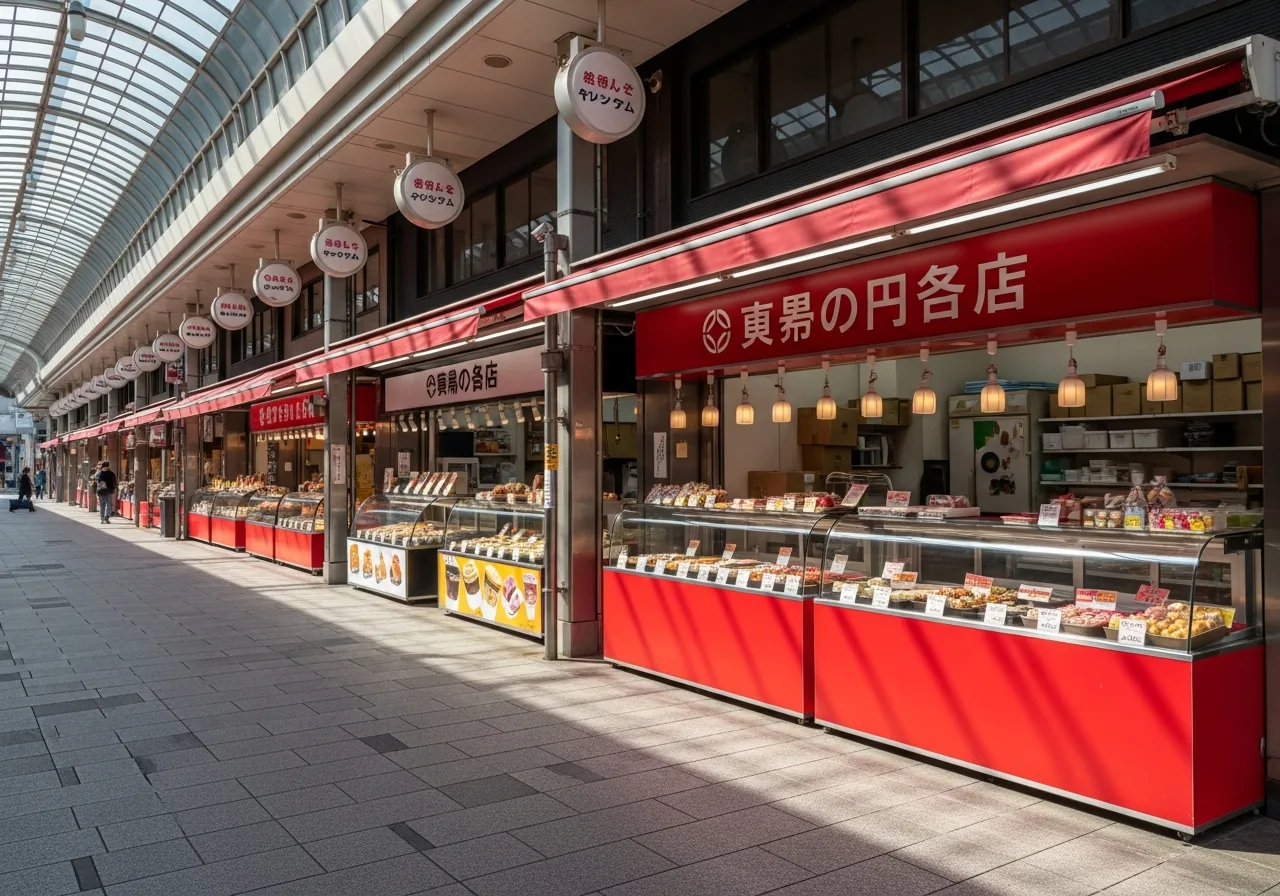
Stand in front of a wagashi counter in a Nakanoshima department store on a Tuesday afternoon. Watch the artisan press nerikiri into a maple-leaf mold.
The sugar in that confection — probably a blend of domestic white sugar and, if the shop is serious, a measure of wasanbon — has travelled a shorter distance than it once did. But the logic that put it there, the commercial and cultural infrastructure that made Osaka the kind of city that takes its confectionery seriously, was built over two and a half centuries by Dutch ships, Ryūkyūan farmers, Satsuma domain officials, Nagasaki auctioneers, Osaka sugar tonya, and the sumptuary laws of a shogunate that inadvertently redirected an entire city’s wealth into its mouth.
Frequently Asked Questions
Q: Where did Japan’s imported sugar come from during the Edo period?
A: Primarily from two sources: Dutch and Chinese merchant ships that unloaded at Dejima island in Nagasaki, bringing sugar from Java, Taiwan, and the Fujian coast; and from the Ryūkyū Kingdom (Okinawa) and the Amami Islands, controlled by Satsuma domain, which extracted sugar as tribute from local farmers and sold it through Osaka.
Q: Why was Osaka the centre of the sugar trade rather than Nagasaki or Edo?
A: Because the Tokugawa shogunate designated Osaka as the national commodity clearinghouse, requiring all domains to sell their rice and other goods there. Osaka had the warehouses, the guilds, the price-discovery mechanisms, and the canal infrastructure to handle bulk commodities. Sugar merchants had no rational alternative to routing through Osaka.
Q: What is wasanbon, and why does it matter to Osaka’s confectionery culture?
A: Wasanbon is a fine-grained, triple-refined sugar produced by hand in Kagawa and Tokushima prefectures on Shikoku island. It dissolves almost instantly on the tongue, leaving a clean, faintly floral sweetness. It became the premium ingredient for high-quality wagashi — particularly the dry sweets (higashi) served at tea ceremonies — and was distributed to Osaka’s confectioners through the same commercial channels that had handled imported sugar for a century.
Q: How did the Edo-period sumptuary laws shape Osaka’s food culture?
A: The laws forbade merchants from displaying wealth through fine clothing or elaborate architecture. Unable to spend surplus capital on visible status symbols, Osaka’s merchant class redirected it into food and confectionery — the arena where competitive display was permitted. This is the historical origin of kuidaore (“eat until you drop”), Osaka’s defining food philosophy.
Q: Where can I experience Osaka’s wagashi culture today?
A: Chidoriya Souke (founded 1630) is the city’s most historically significant wagashi house, with locations across Osaka including at major train stations. The Nakanoshima district — where the old kurayashiki warehouses once stood — now has several high-quality wagashi shops and tea rooms. The Semba district, the old wholesale quarter, retains its commercial character and houses specialty food retailers.
Chidoriya Souke (千鳥屋宗家) — Visitor Information
Address: Multiple locations across Osaka; main accessible branch at JR Osaka Station Antre Marché 1F, 3-1-1 Umeda, Kita-ku, Osaka 530-0001 / 大阪府大阪市北区梅田3-1-1 JR大阪駅アントレマルシェ1F
Nearest station: JR Osaka Station — inside the station building (0 min walk)
Hours: Approximately 8:00–21:00 (station branch); hours vary by location — confirm on the official site before visiting
Admission: Free to enter; sweets priced individually (approx. ¥200–¥2,000 per item)
Official site: chidoriya.co.jp