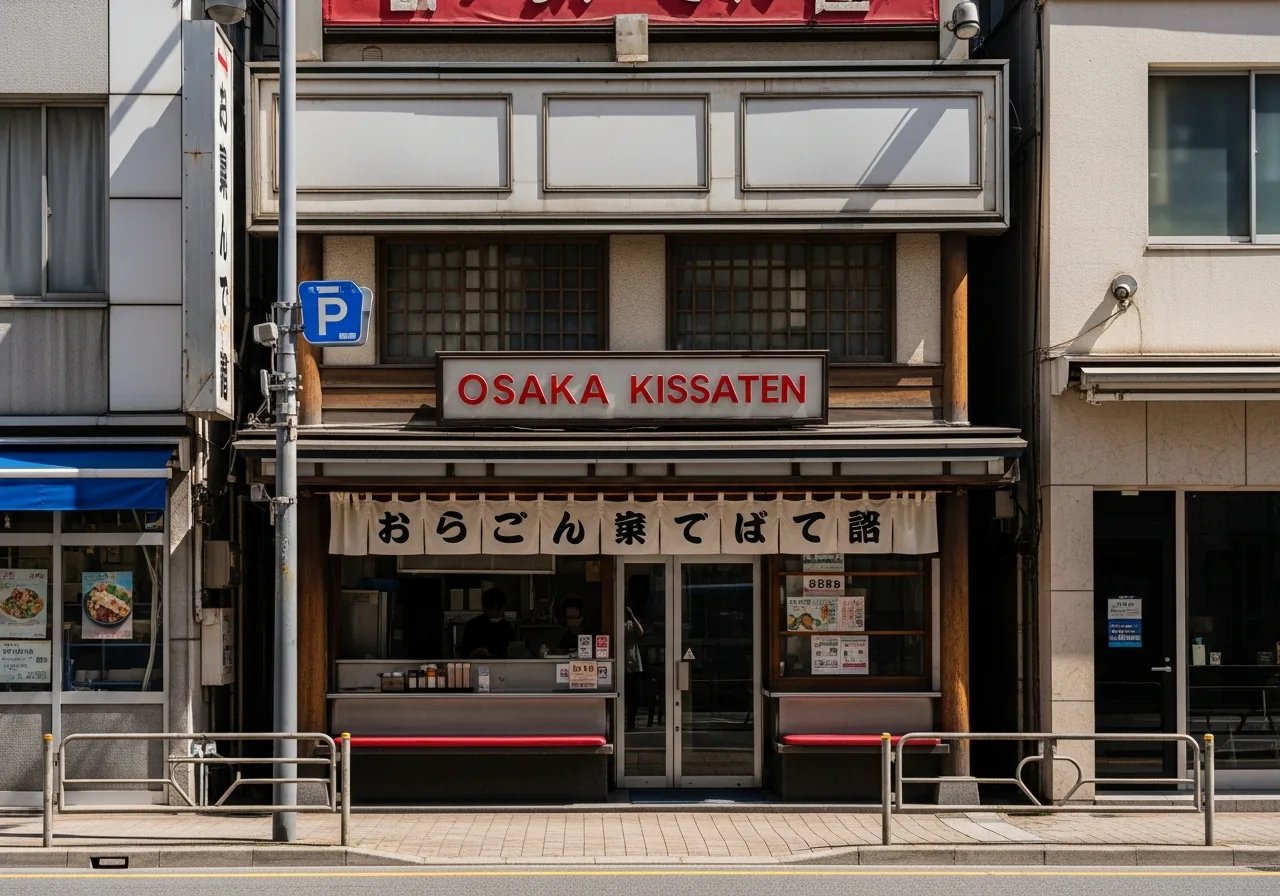
Osaka did not simply adopt the kissaten — it metabolised it. When the first coffee shops appeared in the city during the Taisho era, they landed in a place already wired for the kind of commercial sociability that a coffeehouse demands: a merchant city whose entire civic identity had been built on the idea that a deal, a conversation, and a shared table were inseparable. The result is a coffee culture that is distinctly Osakan — louder than Tokyo’s, more value-obsessed, more communal — and that has survived a century of disruption to remain one of the most alive expressions of the city’s character.
Why we can tell you this — MICHI is written and edited in Osaka, and the kissaten described in this piece are places our team walks past, argues about, and returns to. This article draws on the corporate history published by UCC Ueshima Coffee — the Kansai-born company that industrialised Japanese coffee culture — alongside institutional research from Japan House Los Angeles, contemporary English-language scholarship on Osaka’s merchant tradition, and on-the-ground reporting from the city’s surviving kissaten. Where the historical record is thin — particularly on the precise moment kissaten culture crossed from Tokyo into Osaka — we say so rather than paper over the gap.
Walk down any side street in Honmachi at eight in the morning and you will smell it before you see it: the dense, slightly bitter perfume of coffee that has been roasting in the same pot, by the same method, for over a hundred years. The door to Hiraoka Coffee is narrow.
The interior is darker than the street outside. A man in an apron is doing something unhurried with a cloth filter and a flame.
Nobody is on a laptop. Nobody is in a hurry.
This is not nostalgia performing itself for tourists. This is simply Tuesday.
Why Does a City Famous for Food Have Such a Deep Coffee Habit?
The question sounds almost impertinent. Osaka is the city of takoyaki, of okonomiyaki, of the phrase kuidaore — “eat until you drop.” Coffee is not food.
And yet Hotel Resol Trinity’s profile of Hiraoka Coffee notes plainly that Osaka “has had the most number of coffee shops in the country for many years.” That is not a coincidence. It is a structural consequence of what Osaka is.
In modern times, Osaka was called Tenka no Daidokoro — the kitchen of the nation. An active economic development nurtured a rational spirit among the people’s minds, and the people became more interested in learning and thought.
That rationalism had a physical address. The Kaitokudō was a merchant academy located in Osaka during the Tokugawa period; although it opened its doors in 1724, it was officially founded in 1726.
The Kaitokudō began as a small meeting group of Osaka merchants who met to discuss virtue, or moral education, through the reading and study of classic texts. Merchants who built academies to argue about ethics were, in a deep sense, already kissaten people — they just hadn’t been given the right beverage yet.
Chōnindō — the “way of the townsman” — emerged as a way of life of the merchant class during the Edo period, a distinct culture that arose in cities such as Osaka, Kyoto, and Edo. Its core values were diligence, frugality, and the idea that commerce was a moral act.
Osaka merchants especially loathed losses and focused on how to minimize them; calculation meant establishing one’s profits and losses without wasting even a small amount of money. This is the same city that would later invent the morning set — a full breakfast included in the price of a single cup of coffee — and regard it not as a loss leader but as a statement of values.
The merchant city needed a neutral ground. Deals were struck not in offices (Osaka’s merchant class was famously horizontal, not hierarchical) but in shared spaces.
By the eighteenth century, Osaka merchants controlled significant liquidity. Tokyo may have held political power, but Osaka held financial gravity.
When coffee arrived as a Western import and the kissaten format emerged as its vessel, it slotted into a social infrastructure that had been waiting for it for two hundred years.
Where Did Coffee Come From, and Why Did It Take So Long to Arrive?
The story of coffee in Japan begins, as so many Japanese stories do, at Dejima — the artificial island in Nagasaki harbour where Dutch traders were confined during the Edo period’s isolationist centuries. It is said that coffee arrived in Japan around the year 1700, from Dutch traders operating in Dejima, Nagasaki. Records show that Japanese people of the day felt coffee was bitter and unpleasant, and it failed to take hold in Japan until the end of national isolation.
The bitterness was not merely gustatory. Coffee was foreign in the most literal sense — a substance associated with the Dutch, who were themselves confined to an island precisely because Japan wanted to keep Western culture at arm’s length.
According to records, although Dutch scholars introduced coffee to Japan, citing its beneficial effects and exotic culture, it was not widely accepted by the general public. Due to differences in taste and the deeply rooted tea culture, coffee was treated as a “rare medicine.”
The German physician Philipp Franz von Siebold, one of the few non-Dutch Westerners permitted contact with Japanese citizens at Dejima, helped shift that perception. In a book dictated to Japanese physician and Dutch studies scholar Kou Ryousai, Siebold recommended coffee consumption for better health and a longer life.
A medical endorsement from a European scholar carried weight in a culture that had been importing Dutch scientific knowledge for generations. But the real transformation waited for the Meiji Restoration.
It wasn’t until the Meiji period that coffee really began to take root in Japan. Western culture spread to urban areas on the wave of modernization, and coffee began to play an important role in that.
The Meiji government’s programme of rapid Westernisation — railways, Western dress, Western architecture, Western institutions — created a context in which drinking coffee was not merely a preference but a statement of modernity. To drink coffee in 1890 was to signal that you were a person of the new Japan.
Who Built the First Coffee House, and What Was It Actually For?
Japan’s first coffee house opened in 1888 when Tei Ei-kei, who had studied at Yale University, established Kahi Chakan in Tokyo. Inspired by London’s “penny universities” where intellectuals gathered over coffee, Ei-kei envisioned a social club complete with newspapers, billiards, and public baths. The founder’s biography is itself a compressed history of Japan’s encounter with the West: a man of Chinese-Japanese heritage, descended from a family that had served as interpreters at Dejima for generations, who went to Yale and came back with a vision of the coffeehouse as a democratic intellectual space.
During the Meiji and Taisho periods, cafés became central symbols of Japan’s embrace of modernity and Western culture, in part because of the exotic nature of the hot beverage, which had originally been introduced to Japan by Dutch traders around 1700 but had, like most European practices of that era, failed to catch on. More significantly, at the turn of the twentieth century, cafés offered something revolutionary: public spaces where individuals could experience private, personal time away from small or crowded homes or offices.
Though this establishment is said to have closed soon afterwards in 1893, the concept took root in Japan’s cities. The failure was financial — coffee was still expensive, the audience still small — but the template had been laid.
Over the next few decades, more accessible kissaten began to appear in Tokyo and Osaka. Unlike the more glamorous kafe of the same era, which were often associated with showgirls and musical performances, kissaten positioned themselves as respectable and restrained.
They were introspective spaces. Quiet, sometimes smoky.
A place where a writer might nurse a single drink while drafting the next chapter of a novel.
This distinction matters enormously. The kafe — the entertainment café — and the kissaten — the pure coffee house — diverged early, and the divergence was moral as much as commercial.
Junkissa emerged as the “pure” coffee house in the late 1920s to distinguish itself from hostess-staffed cafés tied to nightlife and entertainment. In Osaka, where the merchant class had always maintained a sharp distinction between productive sociability and mere pleasure, the junkissa found particularly fertile ground.
Why Did the Kissaten Become a Taisho-Era Phenomenon, and Why Did Osaka Embrace It?
The kissaten we know today emerged during the Taisho period (1912–1926), an era marked by liberalism, artistic exploration, and new waves of Western influence. Early establishments were modeled after Viennese and Parisian salons, serving as spaces where writers, poets, and thinkers gathered, often reading newspapers for hours, or debating political ideology over endless cups of coffee.
The Taisho period was Japan’s brief democratic interlude — a window between the rigid nationalism of late Meiji and the militarism that would follow. The kissaten was its physical expression.
In the early twentieth century, kissaten provided one of the few public places where women could gather without being associated with nightlife or hostess entertainment work. It was considered a “more respectable” and neutral alternative to bars.
This was not a trivial social function. In a city like Osaka, where women ran shops, managed accounts, and participated in commercial life in ways that their counterparts in more rigidly hierarchical Tokyo did not, the kissaten’s respectability was a genuine asset.
Osaka received the kissaten format not as a novelty imported from Tokyo but as something that fitted the existing grain of the city. Chujiro Ogawa founded Hiraoka Coffee Shop in Osaka in 1921.
At the time, coffee shops were not yet common in Osaka, but Chujiro continued to carefully brew each cup of coffee, making use of the spirit of handiwork he had cultivated through soy sauce production. Osaka is a city where “coffee shop culture” has been deeply rooted since ancient times, and its history dates back to before the war, loved as a place where people gather and chat.
In fact, Osaka has had the most number of coffee shops in the country for many years.
The detail about soy sauce is worth pausing on. The first owner of what would become Osaka’s oldest surviving kissaten came not from a café background but from food production — from the careful, patient craft of fermentation and flavour.
He brought that sensibility to coffee. The cup he made was not a transaction.
It was a product of accumulated skill, offered with the same care a craftsman brings to anything he has spent years learning to do well.
What Made the Kissaten a Social Institution Rather Than Just a Coffee Shop?
Kissaten emerged in nineteenth-century Japan as emblems of modernity in city life — a “third space” away from homes and offices that offered a unique blend of solitude, community, and connoisseurship. The concept of the “third space” — sociologist Ray Oldenburg’s term for the informal gathering places that sustain civic life — was not available to Taisho-era Japanese, but they understood the need it described.
Homes were small. Offices were hierarchical.
The kissaten was neither.
For university students living in cramped, thin-walled lodging rooms, kissaten served as a welcome escape — providing heated spaces in winter, air conditioning in summer, and crucially, comfortable alternatives to their crowded homes. Salarymen used them as neutral venues for business meetings, away from office hierarchies.
In Osaka, that last function was especially important. The city’s commercial culture had always preferred the horizontal deal — the negotiation between equals — over the vertical command.
A kissaten was the perfect venue for it: no one’s territory, everyone’s space.
Music kissaten, or “ongaku kissa,” solved a major problem: how to hear great music when stereo systems and record collections cost a fortune. These establishments became musical havens — for example, Santa Claus for jazz lovers, NIKO NIKO-TEI for rock fans, and classical cafés for symphony enthusiasts. For the price of coffee, customers could spend hours listening to full albums on high-quality sound systems without interruption.
The jazz kissaten deserves particular attention in the Osaka context. In Osaka, known for its outgoing culture, jazz bars tend to be more relaxed and sociable, mixing laughter and conversation with the tunes.
This is the Osaka difference in miniature: where Tokyo’s jazz kissaten enforced near-silence — treating the music as something almost sacred — Osaka’s version allowed the music to be a backdrop for human connection. The coffee was the same.
The room was different.
Often working alone or with minimal staff, kissaten proprietors — commonly called “masters” — took personal responsibility for every aspect of their coffee service. From the start of kissaten culture in the 1920s, some favored the theatrical siphon method using glass vessels that bubbled and steamed like laboratory equipment, while others specialized in “nel drip,” a technique pioneered in Japan using flannel filters instead of paper that produced an exceptionally smooth brew. Each establishment developed its signature house blend, with the master carefully selecting and roasting beans to match their regular customers’ preferences.
How Did the War and Its Aftermath Shape What Osaka Drinks?
The Second World War interrupted everything. Due to the effects of the war, coffee bean imports ceased and the tea-drinking culture declined significantly. During the chaotic period of the war and after the war, coffee substitutes became popular, and there was a long period when coffee tasted far from the “real thing.” The kissaten that had survived the Taisho and early Showa years — including those in Osaka — either closed or served ersatz brews that bore little resemblance to what their masters had spent years perfecting.
But the postwar recovery, when it came, was extraordinary. During World War II, Japan banned the import of coffee from the West, but following the war, kissaten experienced remarkable growth, reaching over 150,000 establishments by the 1970s and diversifying into various specialized genres.
The reasons were multiple. American occupation culture brought a renewed interest in Western goods.
The economic miracle of the 1960s put disposable income in the hands of a new urban middle class. And the kissaten, with its promise of warmth, privacy, and a cup of something carefully made, answered a deep psychological need in a country rebuilding itself from rubble.
In the Kansai region, the postwar coffee story has a specific geography. In 1868, the port of Kobe was opened, and along with it entered a range of elements of Western culture that quickly took root in Japan.
In 1933, Tadao Ueshima, who had founded a wholesale business in Kobe dealing in butter, jam, and other Western food products, was amazed when he sampled his first cup of coffee at a shop. Was there anything else as delicious and deep as this?
In Kobe, where the locals loved the latest and the greatest, coffee was sure to sell, he thought. With this instinct as his compass, Tadao immediately set about launching a roasted coffee business.
Tadao Ueshima, founder of the UCC Group, established “Ueshima Tadao Shoten” in Kobe in May 1933. He devoted his whole life to coffee and in 1969 invented the world’s first canned coffee, establishing coffee as a drink to be enjoyed anytime, anywhere.
The canned coffee’s moment of mass adoption came, fittingly, in Osaka. Canned coffee was popular at the 1970 Expo in Osaka.
UCC began to sell this coffee, but at first it did not sell as well as expected, perhaps because people were not accustomed to seeing coffee in a can. It was not until 1970, at the World Exposition in Osaka, that canned coffee began to catch on.
The Osaka Expo of 1970 was the hinge point. The Expo ’70 was the decisive stroke, sending canned coffee sales skyrocketing.
Taking the Expo hall as a large market ripe for the seizing, Tadao revealed the drink and was met with cries of “Delicious!” with orders flooding in. Quality products will always sell.
This was the turning point that would make coffee a familiar product to people nationwide. Osaka, the merchant city, had done it again: turned a product into a market.
What Is the Morning Set, and Why Is It an Osaka Idea?
Ask any Osakan to explain the kissaten and they will eventually get to the morning set. It is the most compressed expression of the city’s commercial philosophy: maximum value, minimum waste, maximum human warmth.
This is “Morning Service,” or mōningu sābisu, a daily ritual that serves as one of the most potent and revealing windows into the soul of Osaka. In Tokyo, coffee is a transaction, a caffeine delivery system designed for speed and efficiency.
In Osaka, it’s the opening bid in a negotiation of value, community, and unwritten social rules.
For the price of a single cup of coffee, around 400 or 500 yen, you received a whole tray: a cup of dark, aromatic brew, a slice of impossibly thick toast, a perfectly boiled egg, and sometimes a tiny salad. The economics of this arrangement are not accidental.
It’s a deal that almost seems too good to be true, and that’s intentional. It’s a gesture of goodwill from the Master, designed to build loyalty and maintain a steady flow of customers.
For the customer, it’s a smart, economical, and satisfying way to begin the day.
It is worth noting that the morning set in its most extreme form — where the food is entirely free with the coffee — is actually a Nagoya invention. The most widely accepted origin story traces back to the textile industry of Ichinomiya City and Toyohashi City in Aichi Prefecture.
During the 1950s and 60s economic boom, textile traders held many of their negotiations inside coffee shops. To thank customers who lingered for hours of business talk, shops began adding a slice of toast on the house.
As competition between coffee shops intensified, the “service war” escalated — boiled egg, salad, fruit — until what started as a small thank-you turned into an unofficial breakfast plate.
In Tokyo or Osaka, kissaten will normally charge a separate “morning set” fee on top of the drink. The Osaka version is paid for — but it is priced to feel like a gift.
This embodies the essence of Osaka’s mindset: kosupa, or cost performance. Obtaining a full meal for the price of a coffee (around 400 to 500 yen) represents peak value.
To an Osakan, this isn’t just a cheap breakfast; it’s a clever deal, a practical and efficient way to begin the day. The merchant city’s ancient philosophy — good for the buyer, good for the seller, good for society — expressed in toast and a boiled egg.
How Did the Kissaten Survive the Chains, and What Did It Cost?
The 1980s were the kissaten’s peak and the beginning of its long decline, and the two things happened almost simultaneously. Kissaten peaked at nearly 155,000 shops in 1981 and had spawned many different types, such as late-night, self-service, and specialty coffee shops. Then the chains arrived.
Although the kissaten had been cultural icons for decades, the 1980s and 1990s brought challenges. Domestic corporate coffee chains like Doutor arrived with standardized menus, faster service, and savvy real estate strategies that secured prime locations in Japan’s expensive cities, and simultaneously, younger customers increasingly viewed traditional kissaten as outdated. The arrival of international chains in the 1990s — Starbucks opened its first store in Tokyo’s Ginza district in 1996 — created even more competition for kissaten.
There was a substantial decline from 155,000 cafés in 1981 to 89,000 by 2001. Many aging kissaten proprietors faced the reality that their establishments might not survive them, as their intimate customer knowledge and carefully developed house coffee blends could not be easily transferred.
By 2021, just 40 years after the height of its popularity, the number of kissaten had taken a nosedive to 58,700. The biggest reason is simple: owners got older, and many had no one to hand the business to.
The Osaka kissaten proved somewhat more resilient than the national average, for reasons that go back to the city’s character. While kissaten have declined across the country, in western Japan, they’re just as popular as ever.
The merchant city’s attachment to value — and to the kind of human relationship that a regular kissaten provides — meant that the chains never fully displaced the originals. A Starbucks is efficient.
It is not the same as a place where the master knows your order before you sit down.
Today, a new generation is rediscovering kissaten — not just as retro novelties, but as essential antidotes to digital burnout and fast-paced urban life. New cafés have begun borrowing their look and feel: faux wood paneling, analog menus, and vintage dishware. Still, the real Japanese kissaten experience can’t be duplicated.
Osaka’s Surviving Kissaten: Three Addresses That Tell the Whole Story
The oldest kissaten in Osaka — and one of the oldest in the Kansai region — is Hiraoka Coffee in Honmachi, which has been operating since 1921. The biggest feature of Hiraoka Coffee Shop is that it brews coffee using the boiling method, which has remained unchanged since the shop first opened.
The boiling method involves slowly boiling coarsely ground beans in a 100-year-old pot passed down from the founder, then carefully filtering them through a plain-woven cotton cloth made of thick threads. This cotton cloth has a fine weave, which is said to suppress impurities while bringing out the natural sweetness and aroma of the beans.
Boiling creates a mellow, rich flavour, resulting in a cup with a soft mouthfeel and a gentle aftertaste.
The pot is a hundred years old. The method is unchanged.
Currently, the shop is run by third-generation owner Ogawa Ryusui, who values “offering high-quality coffee” above all else. Three generations of the same family, in the same building, making coffee the same way.
This is not stubbornness. It is a form of argument: that the method is correct, that the cup it produces is worth the wait, and that the customer who understands this is the customer worth having.
Across the city in Sennichimae, near Namba, stands Marufuku Coffee — founded in 1934, making it one of the oldest continuously operating kissaten in Osaka. About ninety years have passed since Marufuku Coffee was founded by Tadao Ibuki in Osaka in 1934.
What started as a small coffee shop has grown into a popular café chain with numerous branches, not only in Osaka but also in other areas, including Tokyo. Located in Chuo Ward, Marufuku Coffee Sennichimae Honten has been loved by all for generations since 1934.
This kissa is the setting of the famous Japanese novel Bara no ame by Seiko Tanabe. When you step into the building, you can see elegant lamps and stained glass, creating a retro atmosphere that is sure to put your mind at ease.
That a kissaten should become the setting of a novel is not incidental. The kissaten was always a literary space — a place where people came to think, to write, to be alone in public. Tanabe’s novel, set in this specific room, is a reminder that the physical space of the kissaten is not merely a backdrop but a character in its own right.
Then there is Nakazakicho, the neighbourhood one stop north of Umeda on the Tanimachi Line, which offers a different kind of kissaten story. While much of Osaka was destroyed in World War II, this small enclave astonishingly endured, preserving its pre-war architecture and layout.
The buildings you see are authentic — they are not replicas. Nakazakicho has an extraordinary concentration of independent cafés for such a small area — many in converted wooden townhouses with low-beamed ceilings, old wooden furniture, and carefully curated music.
You might find a traditional kissaten coffee shop, seemingly untouched since the 1960s, just steps away from a sleek, minimalist café specialising in artisanal drip coffee. This is Nakazakicho’s particular gift: it holds both the original and the revival in the same street, without either cancelling the other out.
When Taiyo no To opened in 2002, Nakazakicho was still known more for its quiet backstreets and old-school kissaten than for the independent cafés that would later define the area’s identity. The neighbourhood became a laboratory for what happens when the kissaten spirit — unhurried, owner-operated, deeply personal — is carried forward by a new generation.
What Is the Kissaten’s Relationship to Craft, and Why Does It Matter?
The kissaten master is one of the most distinctive figures in Japanese food culture, and one of the least discussed outside Japan. Coffee remained the core offering, and kissaten owners turned brewing into a serious discipline and art form. Often working alone or with minimal staff, these proprietors took personal responsibility for every aspect of their coffee service.
From the start of kissaten culture in the 1920s, some favored the theatrical siphon method using glass vessels that bubbled and steamed like laboratory equipment, while others specialized in “nel drip,” a technique pioneered in Japan using flannel filters instead of paper that produced an exceptionally smooth brew. These are not trivial distinctions. The choice of brewing method in a kissaten is a statement of philosophy — about what coffee should taste like, about how long a cup should take to make, about the relationship between the maker and the drinker.
A cup of hand-drip coffee in a kissaten might take ten minutes to prepare — that deliberateness is the point. In a city that moves as fast as Osaka, the ten-minute cup is a provocation.
It says: this is worth waiting for. It says: you have time.
It says: the person making this knows something you don’t, and you should sit still long enough to find out what it is.
The use of binchotan charcoal for coffee roasting — sumiyaki — is a Japanese specialty that hasn’t transferred meaningfully to other countries’ coffee cultures. The technique is preserved and practiced primarily in Japan.
Several Osaka kissaten still use charcoal roasting, and the cup it produces — with its particular depth and the faint mineral note that charcoal imparts — is genuinely unlike anything produced by a gas or electric roaster. It is a flavour that exists only here, made by a method that exists only here, in a room that exists only here.
Why Should a Discerning Traveller Care — What Is the Deeper Significance?
The affluent traveller who has been to Tokyo, who has drunk excellent coffee at a third-wave roaster in Kiyosumi-Shirakawa, who has read about Japanese hospitality and thinks they understand it — that traveller has not yet sat in an Osaka kissaten at eight in the morning and watched the master prepare a cup that has been prepared the same way for fifty years. It is a different experience, and the difference is not aesthetic. It is philosophical.
The kissaten is one of the few places in the modern world where the logic of efficiency has been consciously refused. Today’s surviving kissaten have adapted while maintaining their essential character.
They continue providing what can be so rare in city life: spaces that balance solitude with community, where time moves differently, and where individual craft creates experiences that cannot be replicated. This is not a small thing.
In a world where every coffee experience is being optimised, standardised, and scaled, the kissaten is a standing argument for the opposite.
For Osaka specifically, the kissaten is also a key to the city’s self-understanding. Osaka’s identity as a merchant city has always embraced innovation while respecting tradition.
Coffee culture here reflects that balance: kissaten heritage — family-run cafés where strong drip coffee and retro interiors preserve the Showa-era atmosphere. The city that invented futures trading and canned coffee is also the city that has kept a hundred-year-old boiling pot in daily use.
These are not contradictions. They are the same city, expressing the same values in different registers.
Osaka’s kissaten culture rejects the approach of strict specialisation. Instead, it embraces hybrid spaces that function as part restaurant, part office, part community centre, and part living room.
The morning set is the adhesive that binds these roles together. The traveller who spends a morning in a kissaten is not consuming a heritage experience.
They are participating in the actual daily life of the city — the same life that has been lived in these rooms, at these counters, over these cups, for a hundred years.
A recent counter-trend suggests that these traditional coffee shops might be having a bit of a comeback. Recently, there’s been a junkissa boom, especially among younger customers and women in their twenties and thirties who love the old-school atmosphere.
Social media has done a lot of the work here. Popular junkissa items like cream soda, Napolitan spaghetti, and custard pudding are all extremely photogenic — perfect for sharing online.
The irony is not lost on anyone: the kissaten, which was always a refuge from the noise of the world, is now being discovered through the noisiest medium ever invented. But the discovery is real, and the rooms are filling up again.
As of August 2026, Osaka’s kissaten culture sits at an interesting inflection point. The oldest establishments — Hiraoka, Marufuku, Arabiya — are still there, still making coffee the way they always have.
The Nakazakicho neighbourhood has become a kind of living laboratory where the kissaten spirit is being carried forward by younger owners who understand what they are inheriting. And the city itself, which has always known the value of a good deal and a good conversation, shows no sign of abandoning the institution that has served both for a century.
The pot at Hiraoka Coffee is a hundred years old. It will probably outlast us all.
Frequently Asked Questions
Q: What is the difference between a kissaten and a modern café in Japan?
A: Kissaten and junkissa differ from cafés in more than just name — they are legally distinct, with kissaten licensing limiting food sales to lightly heated food, while cafés can run broader food service. In practice, the difference is also atmospheric: a kissaten is owner-operated, unhurried, and built around a single master’s vision of what coffee should be.
Q: Is Osaka’s coffee culture different from Tokyo’s?
A: The Osaka café culture differs subtly from Tokyo’s: the atmosphere is slightly warmer and less stylistically self-conscious, and staying for three or four hours over two coffees is entirely normal. The morning set culture, the emphasis on value, and the more sociable atmosphere of even the most traditional kissaten all reflect Osaka’s merchant-city character.
Q: What should I order at an Osaka kissaten?
A: Start with the house blend — most kissaten have one, developed over decades. Characteristic kissaten drinks include syphon-brewed coffee, which uses vapour pressure for a remarkably clean cup; iced coffee brewed hot and flash-chilled over ice; and American coffee, a lighter roast style. If you arrive before 11am, order the morning set.
Q: Are kissaten disappearing?
A: Surviving kissaten increasingly serve niche markets: traditional kissaten preservationists, Japanese-culture tourists, customers explicitly seeking the Showa-era experience. The kissaten tier has shrunk but stabilised at a sustainable smaller size; the institutional culture isn’t going extinct, just contracting.
Q: What is the best neighbourhood in Osaka to experience kissaten culture?
A: Honmachi for the oldest surviving establishments; Nakazakicho for the most concentrated mix of original kissaten and their spiritual successors; and Namba/Sennichimae for Marufuku Coffee, which has been serving the city’s entertainment district since 1934.
Marufuku Coffee Sennichimae Honten — Visitor Information
Address: 1 Chome-9-1 Sennichimae, Chuo Ward, Osaka 542-0074 / 大阪府大阪市中央区千日前1丁目9-1
Nearest station: Nippombashi Station (Osaka Metro Sennichimae Line / Kintetsu Namba Line) — approx. 3 min walk; Namba Station — approx. 5 min walk
Hours: Daily 8:00–23:00 (hours may vary; confirm on the official site before visiting)
Admission: Free entry; coffee from approx. ¥590, morning set approx. ¥700–¥800. Prices approximate — advise confirming on the official site.
Official site: marufukucoffee.com