Looking for the big picture on Osaka in Japan? This is the deep-dive you need — a cultural, historical, and culinary breakdown of the rivalry between Osaka and Tokyo that has shaped everything from how people talk, eat, and cheer to how modern Japan itself is organised. One city runs the country; the other insists it does it better.
MICHI’s Pick — Selected by our Osaka-based team, based on places we’ve visited and on research using Tabelog and Google Maps ratings. In Japan, a Tabelog score of 3.4+ is genuinely high — Japanese reviewers are famously strict, and most locals consider anything above 3.4 a place worth a detour. We feature venues meeting at least one of: Tabelog 3.4+, Google Maps 4.3+, or 100+ reviews — the kind of spots locals quietly trust.
Tabelog and Google Maps scores are accurate as of the time of writing.
The Setup: Two Cities, One Country, Zero Agreement
Japan is a small island nation, but the distance between its two great cities is measured in more than kilometres. Each area boasts a unique culture, and people tend to divide Japan into two major cultural zones: Kanto in the East and Kansai in the West. Tokyo and its metropolitan area make up Kanto, the centre of Japan’s politics and economics since Tokyo became the country’s capital in 1869. Its counterpart is Kansai, centred on Kyoto, the ancient capital from 794 to 1869. Osaka sits at the commercial heart of Kansai — and it has never quite forgiven Tokyo for taking over.
The rivalry is not really about hatred. It’s more like a long-running argument between siblings who grew up in the same house but turned out completely differently. Tokyo people often say they don’t recognise Osaka as their rival — they don’t even think about Osaka at all. But ask an Osakan what they think of Tokyo, and you may get a surprisingly passionate reaction: “Tokyo people are all cocky, they don’t understand true humour, the food in Tokyo is not tasty but so expensive.” That asymmetry — Osaka cares deeply, Tokyo barely notices — is itself a source of Osakan grievance, and has been for centuries.
How It Started: Merchants vs. Samurai
Osaka is much older than Tokyo. It was founded as a merchant city and became Japan’s capital in 645. Osaka Castle was built in 1583, and the city subsequently became Japan’s major rice trading centre. For most of Japanese history, Osaka was the economic engine of the country — the place where goods moved, deals were struck, and fortunes were made.
Then came the Tokugawa era. When the Tokugawa Shogunate finally wrested political control from Osaka and moved the seat of power to Edo in 1615, few could have imagined that four hundred years later animosity and hostilities between the two cities would remain. Edo — now Tokyo — became the home of the samurai class and the political establishment. Tokyo is where the samurai class was based in the Edo period, and the culture has a long history of obedience, duty, and following rules. Osaka, stripped of political power but not commercial clout, doubled down on what it did best: trade, food, and talking to strangers.
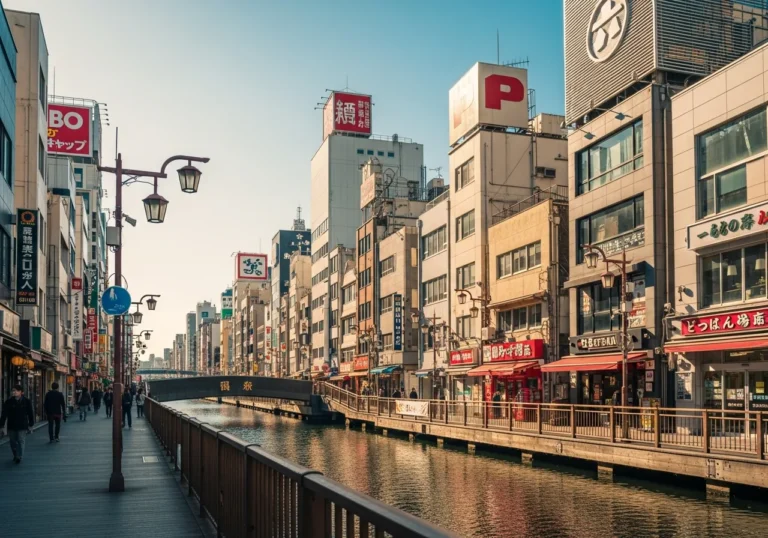
Osakan friendliness has its roots in the absence of samurai and the presence of a large number of merchants. As one Osakan told the Japan Times: “Merchants consider everyone a potential customer. They don’t want to run the risk of losing you as a customer, so they go out of their way to be friendly.” That instinct is still alive in every Dotonbori takoyaki stall and every izakaya where the owner pulls up a stool to chat.
The decisive shift came much later. For the first two-thirds of the twentieth century, Tokyo and Osaka were relatively balanced in economic power and prestige. Tokyo was the nation’s political capital, with government ministries, major universities, and much economic clout. But it was not until the 1960s — the decade of the Tokyo Olympics, the Shinkansen bullet train, and Japan’s sudden burst of GNP growth — that the centre of gravity tipped decisively to Tokyo. Like France, Greece, and Mexico, Japan became decidedly unipolar, and Osaka and the Kansai region slipped to second-city status. Osaka has been making its case ever since.
The Personality Gap
Osaka was historically a merchant city, leading to a more open, casual, and unpretentious culture. People here pride themselves on being wittier and less focused on social rules than in Tokyo. Tokyo was historically the home of the Japanese court and its samurai. This has left a legacy of formality and orderliness that still colours daily life today.
The contrast plays out in small, daily ways. People in Osaka are said to be more talkative than people in Tokyo. People from Tokyo are quiet on the train, whereas people from Osaka chat a lot on the train. Kansai has an image of being open-hearted and frank. People from Kansai have no issues talking to strangers, chatting candidly — you’ll even come across the occasional grandma who plops down next to you on the train and offers you candy and tangerines. Especially Osaka is known for this.
There’s also the escalator question, which sounds trivial until you realise it encapsulates everything. In Tokyo, people stand on the left of escalators and pass on the right. The opposite is true in Osaka. Nobody fully agrees on why. But every Osakan will tell you, with some satisfaction, that their way makes more sense.
Osakans have been called the “Latins of Japan.” They produce many of Japan’s funniest comedians and are known for enjoying good food, wearing bright clothes, and hating Tokyo and Tokyoites. Their appetite for life is summed up by the local word “kuidaore” — literally “to eat yourself to bankruptcy.” It’s a phrase that doubles as a civic philosophy.
The Language Divide
Language is where the rivalry gets genuinely structural. In the Meiji era, the capital of Japan moved from Kyoto to Edo (now known as Tokyo). The Japanese administration at that time wanted to establish a standard language — the one we hear in Tokyo today. The original style of speech continued in Kyoto even after the capital was moved to Tokyo. That’s why places in the Kansai region like Kyoto and Osaka retain the more casual Kansai dialect, with each city having its own variation.
In Tokyo, the dialect close to standard Japanese is the mainstream, characterised by relatively polite speech and clear pronunciation — sentences commonly end with “desu” or “masu.” Meanwhile, in Osaka, a unique dialect known as Kansai-ben is widely used, with unique sentence endings and the frequent use of “-ya” and “-yade,” giving off a relaxed atmosphere and humour. To a Tokyoite, the Osaka dialect can sound rough. To an Osakan, Tokyo speech sounds stiff and a little cold. Both are correct, and neither is budging.
Osakans are very stubborn about keeping their dialects even after living years in Tokyo. The Osakan dialect is almost like the Japanese equivalent of cockney English — full of colourful expressions and the source of amusement in many comedy routines. The comedy connection is not incidental. Osaka is known as the “City of Laughter,” a place where comedy and manzai are popular. The manzai double-act format — one straight man, one fool, rapid-fire banter — is Osaka’s greatest cultural export, and it runs entirely on the Kansai dialect.
The Food War
This is where Osaka stops being defensive and goes on the offensive. Osaka, known as a major gourmet hot spot, is often called the “kitchen of Japan.” That reputation is not marketing — it’s centuries of merchant-class food culture, where eating well was both pleasure and social currency. For the best food in Osaka, you don’t need a Michelin guide; you need to know which street to walk down.
In general, Tokyo cuisine is richer, bolder, and saltier, whereas Osaka food is milder and sweeter. You’ll find more seafood dishes in Tokyo but a wider variety of vegetables in Osaka. Whether it’s okonomiyaki vs monjayaki or triangular vs round onigiri, the inter-city rivalry is very pronounced in the kitchen.
The concept of kuidaore — “eat till you drop” — is strongly associated with Osaka, reflecting a love of good food and a lively atmosphere. Osaka’s culinary landscape is characterised by dishes like takoyaki and okonomiyaki, known for their affordability and satisfying flavours. Tokyo counters with its Michelin star count — Tokyo has more Michelin-star restaurants than Osaka and has more diversity when it comes to cuisine, especially from around the world. Osaka’s response: who needs a Michelin star when a ¥500 bowl of udon at a standing counter is that good?
Osaka answers Tokyo’s ramen scene with Takaida Black, Higashi-Osaka’s signature style notorious for its pitch-black soup. Menya Joroku Namba’s elevated version combines a chicken and pork broth with chicken-based flavour oil and a rich soy sauce blend. Every category has its local champion, and Osakans will tell you about theirs at length, unprompted.
The Baseball Proxy War
If you want to understand the Osaka-Tokyo rivalry at its most visceral, go to a Hanshin Tigers vs. Yomiuri Giants game. The Tigers-Giants rivalry is considered the national Japanese rivalry, on par with the Dodgers-Giants and Yankees-Red Sox rivalries in Major League Baseball, or El Clasico in Spanish football.
The longstanding rivalry with the Yomiuri Giants, rooted in regional and cultural divides dating back to the pre-war era, added intensity to matchups, with Hanshin fans viewing victories over the Giants as symbolic triumphs for western Japan. For the last half-century, the Hanshin Tigers have been the second most popular professional baseball team in Japan. They are based on the edge of the country’s second city, Osaka, and over those decades, their rivalry with the Tokyo Yomiuri Giants has borne the frustrations of regional subordination to the national centre.
The mythology runs deep. In 1985, after the Tigers won the Japan Series, fans celebrated by having people who looked like Tigers players jump into the Dotonbori Canal. Because none of the fans resembled first baseman Randy Bass, fans grabbed a life-sized statue of the KFC mascot, Colonel Sanders, and threw it into the river. According to urban legend, the desecration angered the spirit of Colonel Sanders, who purportedly cursed the Tigers with perpetual failure, explaining their subsequent 38-year championship drought from 1985 to 2023. The Tigers finally broke the curse in 2023 — and fans jumped into the Dotonbori Canal again, because of course they did.
It also doesn’t help that Yomiuri, the newspaper that owns the Giants, often calls the Giants “Japan’s Team.” To an Osakan, that phrase is a provocation. To a Tokyoite, it’s simply a statement of fact. The gap between those two reactions is the Osaka-Tokyo rivalry in miniature.
Who’s Winning in 2026?
Politically and economically, Tokyo wins — and has for sixty years. Tokyo is the main economic powerhouse. There are many more jobs in Tokyo and salaries are higher, although the cost of living is certainly higher as well. The concentration of government, finance, and media in Tokyo is total and shows no sign of reversing.
But Osaka is not standing still. The city hosted World Expo 2025, a major signal of its ambitions as an international destination. A new casino resort and integrated entertainment complex is in development on Yumeshima island. And Osaka’s food scene, nightlife, and sheer livability continue to attract both domestic migrants and international visitors who find Tokyo exhausting.
Salaries tend to be higher in Tokyo due to the concentration of major corporations and finance-related jobs. However, the cost of living, particularly housing, is also significantly higher in Tokyo. Osaka offers a more affordable lifestyle. For a growing number of people — especially younger Japanese — that trade-off is starting to look attractive.
The rivalry, then, is not really about which city is objectively better. It’s about two different ideas of what Japan should be: formal or casual, hierarchical or horizontal, rule-following or rule-bending. Tokyo represents the Japan that the world expects. Osaka represents the Japan that Japan actually enjoys. Explore more of Osaka and you’ll find that tension alive in every neighbourhood — in the dialect, the food, the comedy, and the very particular pride of a city that has been number two for sixty years and refuses to act like it.
FAQ
Q: What is the Osaka vs Tokyo rivalry really about?
A: At its core, it’s a centuries-old tension between Japan’s political capital and its historic commercial heart. Tokyo holds the power; Osaka holds the attitude. The rivalry plays out in food, language, sport, and everyday culture — and Osakans feel it far more keenly than Tokyoites do.
Q: How different are Osaka and Tokyo culturally?
A: Very. The dialects are mutually intelligible but tonally worlds apart. The food philosophies diverge sharply — Tokyo goes for refinement and prestige, Osaka for flavour and value. Even the escalator etiquette is reversed. The differences are real, not just tourist-brochure colour.
Q: Do Osaka restaurants have English menus?
A: Increasingly yes, especially in Dotonbori, Namba, and Shinsaibashi. Street food stalls often have picture menus or plastic food displays that make ordering easy regardless of language. Outside the main tourist corridors, English menus are less common but staff are generally patient and helpful.
Q: What should I order at restaurants in Osaka?
A: Start with takoyaki (octopus balls) and okonomiyaki (savoury pancake) — these are Osaka originals and the benchmark for the city’s food philosophy. Kitsune udon, kushikatsu (deep-fried skewers), and Takaida-style black ramen are all worth tracking down. For a deeper look, the MICHI Osaka travel guide covers the best spots by neighbourhood.
Last updated: July 19, 2026 · Corrections: [email protected]