In November 1900, Sumitomo Kichizaemon Tomoito — the fifteenth head of Japan’s most powerful merchant dynasty — formally proposed to the Osaka Prefectural Government that he would build the city a library at his own expense: not a cash donation, but a complete building, handed over as a finished gift, together with a 50,000-yen endowment for books. The building that opened on 25 February 1904 was the first serious public library Osaka had ever possessed, and it remains, as of August 2026, one of the finest pieces of Meiji-era civic architecture still in active use anywhere in Japan. The reason a copper-mining family built a Greek temple on a river island to hold books is a story about what wealth is for — and about what Osaka has always believed it owes itself.
Why we can tell you this — MICHI is written from Osaka, and the Nakanoshima Library is a building our editorial team visits on foot, crossing the Naniwabashi bridge from the south bank of the Dojima River. This article draws on the Sumitomo Group Public Affairs Committee’s dedicated archive on the library’s founding, the official building guide published by Osaka Prefectural Library, the Osaka Bunkazai Navi cultural property record, and the Sumitomo Corporation’s corporate history. Where the record is thin — particularly around the precise political negotiations between Tomoito and the prefectural assembly in 1900–1901 — we say so rather than speculate.
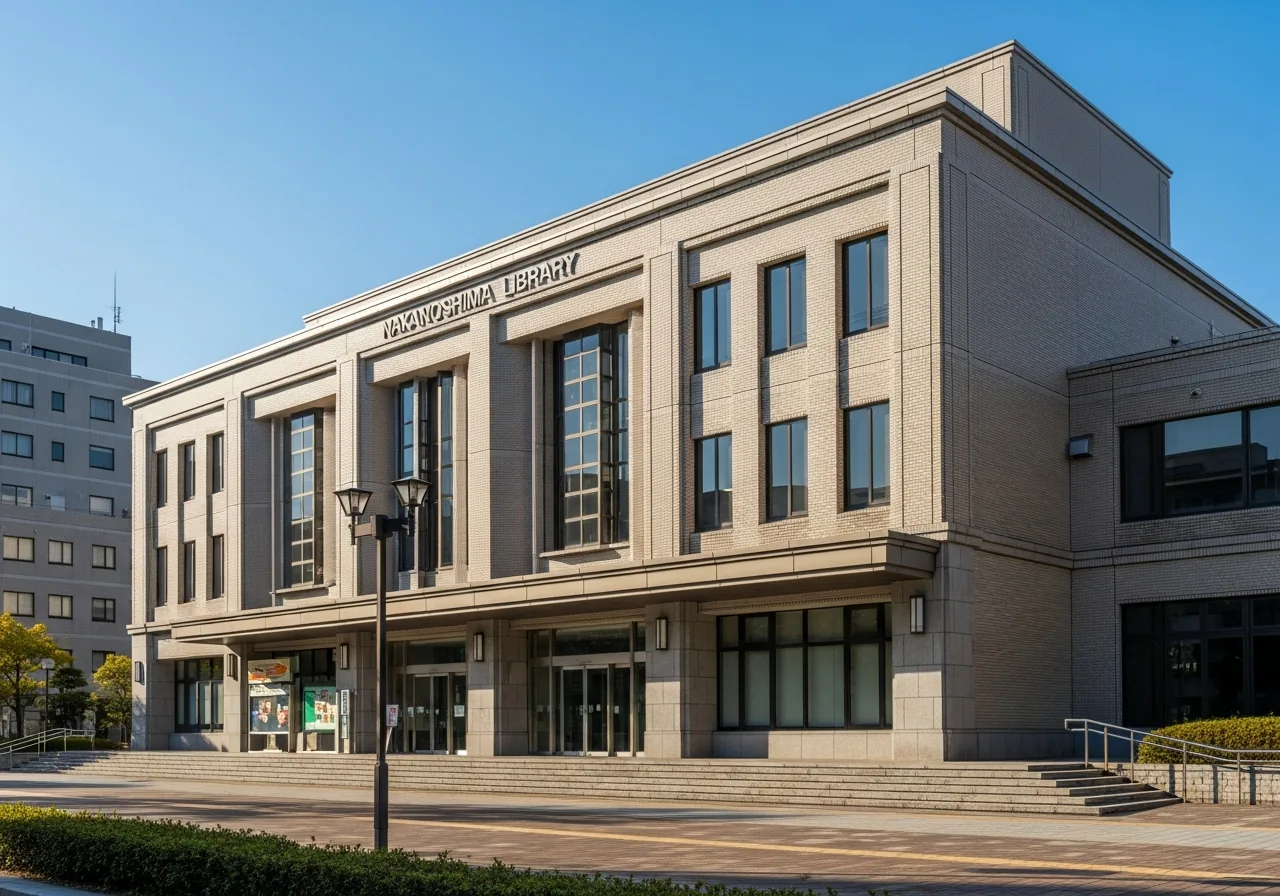
Stand at the foot of the nineteen stone steps that lead up to the portico and look at what is in front of you. Four Corinthian columns, each capital carved with acanthus leaves so precise they could have been lifted from a temple on the Athenian Acropolis.
A triangular pediment. A bronze dome that has turned the particular green of aged copper — which is fitting, because it was copper money that paid for all of it.
The building does not look like it belongs in Osaka. That is entirely the point.
Nakanoshima is a long, narrow sandbar — roughly three kilometres east to west, fifty hectares in area — pinched between the Dojima River to the north and the Tosabori River to the south. On a map, this area is a long, narrow island stretching approximately 3km east to west and covering an area of approximately 50 hectares, sandwiched between the Dojima River and the Tosabori River.
Today it holds city hall, the Osaka Central Public Hall, the Museum of Oriental Ceramics, and the Nakanoshima Museum of Art. In 1904 it held something more consequential: the first real public library in the largest commercial city in western Japan.
Why Did Osaka Have No Library at All?
The question sounds almost absurd. By 1900, Osaka was a city of one million people, the undisputed commercial capital of Japan, home to the world’s first futures exchange at Dojima and to merchant houses whose wealth rivalled the shogunate itself. And yet it had no public library worth the name.
The answer begins with the particular character of Osaka’s intellectual culture. The culture of Osaka was such that merchants were eager to learn.
Without relying on the authorities, merchants took the initiative to acquire, accumulate, and share knowledge. This thirst for knowledge explains why merchant families retained so many books and other items.
Books in Osaka were private property, kept in the fireproof kura storehouses that were the merchant’s most sacred space. Knowledge was a competitive asset, not a civic amenity.
There was also a structural reason. Daimyōs (feudal lords) received most of their income in the form of rice.
Merchants in Osaka thus began to organize storehouses where they would store a daimyō’s rice in exchange for a fee, trading it for either coin or a form of receipt; essentially a precursor to paper money. Nakanoshima itself was the physical address of this system.
During the Edo Period, Nakanoshima and its surrounding area grew into a vital hub of commerce and logistics, its influence extending well beyond Osaka itself. It was packed with kurayashiki (蔵屋敷), storehouse-residences used by daimyō (feudal lords) to manage, store, and sell rice collected as tax, and regional specialties.
At its peak in the early 1800s, Osaka housed more than 110 of such kurayashiki.
This was a city organised around the movement and storage of goods, not the circulation of ideas. The Meiji Restoration of 1868 swept away the daimyo storehouses, but it did not immediately replace them with civic institutions.
During the Edo period, Osaka was nicknamed “the world’s kitchen” because Nakanoshima was home to storehouses from various feudal domains across the country, where rice and other commodities were traded. In the Meiji period, cultural facilities such as libraries and the Central Public Hall were completed, and the area played a role not only as a commercial center but also as a hub for modern information and culture.
That transformation, from rice warehouse to reading room, did not happen automatically. Someone had to decide it should happen, and then pay for it.
The copper plaque mounted in the central hall of the library — the Kenkan Kifuki, or “Record of the Building Donation” — preserves Tomoito’s own explanation in his formal petition to the prefectural governor. The copper plaque displayed on the wall of the central hall bears the words of Tomoito: “Osaka, the largest city in Kansai, is home to one million people.
In this city richly endowed with financial resources and goods, several educational institutions have been established and are engaged in friendly rivalry. However, Osaka lacked a library and the prefectural government wished to remedy this deficiency.
I wished to contribute by donating a library as well as some books and an endowment.”
The diagnosis was accurate. Osaka had universities, technical schools, and merchant academies.
It had private collections of extraordinary depth. What it lacked was a place where any citizen — not just the wealthy merchant with his own kura — could sit down and read.
Why the Sumitomo Family? Why This Man, at This Moment?
The Sumitomo family did not arrive at philanthropy by accident. Their story begins, as all great Osaka merchant stories do, with a specific technical advantage and the willingness to exploit it ruthlessly.
The history of Sumitomo dates back to Masatomo Sumitomo (1585–1652), who opened a book and medicine shop in Kyoto in the 17th century. The commercial pivot came through his brother-in-law.
Around the same time, Masatomo’s brother-in-law Riemon Soga (1572–1636), who ran a copper refining and coppersmithing business in Kyoto (under the trade name Izumiya), developed, with considerable effort, a copper refining technology called “Nanban-buki (Western Refining)” to extract silver from crude copper. This technique — learned from European traders at Nagasaki — allowed Sumitomo to extract silver that other refiners left behind in the ore.
It was, in the language of the time, a proprietary process.
Tomomochi Sumitomo (1607–1662), the eldest son of Riemon, who became a family member of the House of Sumitomo by marrying a daughter of Masatomo, extended the business to Osaka, and disclosed the “Nanban-buki” technology to other copper smelters. Sumitomo/Izumiya thus came to be looked up to as the “head family of Nanban-buki,” and Osaka subsequently took the lead in the copper refining industry in Japan.
The decision to share the technology rather than hoard it was not altruism — it was strategy. By becoming the acknowledged master of the technique, Sumitomo positioned itself at the centre of Japan’s copper trade.
The decisive event came in 1690. The event that made the fortunes of the house of Sumitomo was the discovery in 1690 of the huge Besshi Copper mine on the island of Shikoku.
Besshi continued to produce copper for 283 years (a total of 700,000 tons), supporting Sumitomo’s business as its backbone. By the time the Meiji era opened in 1868, Sumitomo was not merely a merchant house — it was a proto-industrial conglomerate, the largest private mining operation in Japan.
The Meiji Restoration created both opportunity and danger for a family like Sumitomo. Saihei Hirose (later head of the board of directors), then general manager of the Besshi copper mine, and his fellow workers continued to operate the mine during the turmoil of the Meiji Restoration (1868).
They introduced technologies and equipment from abroad at their earliest opportunities, dramatically increasing productivity. The “Ryogae-gyo” (money exchange) business that Sumitomo operated during the Edo Period was also developed into a more complex financial business, such as banking, warehousing, insurance, and trust by leveraging funds generated from the Besshi Copper Mines.
Sumitomo thus grew into a modern conglomerate focusing on two major areas — mining/manufacturing and financing.
But the Meiji government was watching the great merchant houses carefully. The new state needed capital and cooperation, and it expected something in return: visible civic commitment. The zaibatsu that survived and flourished were those that understood philanthropy as a form of political insurance as much as genuine generosity.
Into this context came Sumitomo Kichizaemon Tomoito, born in 1865, the fifteenth head of the family. He was not born a Sumitomo — he came from the aristocratic Tokudaiji family and was adopted into the merchant house, which gave him an unusual double perspective: the cultural refinement of the Kyoto court nobility and the commercial pragmatism of Osaka’s merchant class.
Traveling through Europe and the U.S. from April to November 1897 (30th year of the Meiji era), Tomoito was struck by the evident prosperity of commerce and industry as well as the managerial revolution underway.
At the same time, he deepened his understanding of art, architecture, and other aspects of culture, including the lifestyles and mores of the upper echelons of European and American society. He was particularly impressed by the philanthropy of wealthy Europeans and Americans who were so generous in their support of institutions and activities beneficial to society.
These experiences and observations bore fruit in his decision to build and endow the Nakanoshima Library.
The European model Tomoito encountered was not abstract. In the 1890s, Andrew Carnegie was building public libraries across the English-speaking world; the Boston Public Library had opened its magnificent McKim, Mead & White building in 1895; the Bibliothèque nationale de France had been reorganised under Henri Labrouste’s great iron reading room.
Tomoito saw what civic wealth looked like when it was made permanent in stone and books. He returned to Osaka determined to replicate it.
In 1900 (33rd year of the Meiji era), Tomoito proposed his philanthropic scheme to the Osaka Prefectural Government. He would build a library for the benefit of the people of Osaka, donating the library building together with an endowment of 50,000 yen to support the institution.
This was a pioneering philanthropic initiative in Japan. Warmly welcomed by the prefectural assembly, Tomoito’s proposal was unanimously approved.
The formal petition was submitted on 10 February 1900. Construction began in November of that year. The building opened on 25 February 1904 — three years and three months of work, on a sandbar in the middle of a river, in the middle of a city that had never had anything like it.
Why Build a Greek Temple in Osaka?
The architectural choice was not decorative. It was a statement about what knowledge is, and what a city that honours knowledge looks like.
The consensus among historians of architecture is that it was not until the early years of the twentieth century that Japanese architects achieved a good grasp of Western architecture, some 30 years after the establishment of the Engineering Education Institute. It was in the opening years of the new century that Magoichi Noguchi achieved prominence as one of the first generation of Japanese architects who possessed a profound knowledge and appreciation of Western architecture.
Noguchi was Tomoito’s man. Noguchi graduated with distinction from the Department of Architecture, College of Engineering, Imperial University, in 1894 (27th year of the Meiji era) and researched earthquake-resistant structures in graduate school.
The well-known architect Kingo Tatsuno, whose notable commissions included the Bank of Japan building and the Marunouchi building of Tokyo Station, had high expectations of Noguchi. Tatsuno would later serve as architectural advisor on the Nakanoshima Library project itself — a remarkable endorsement from the man who had effectively defined what a serious Meiji public building should look like.
Shortly after Noguchi started working for Sumitomo under contract, he was sent to Europe and the U.S. to familiarize himself with architectural developments.
This opportunity was arranged at the urging of Tomoito, the head of the Sumitomo family, who himself attached great importance to what he had experienced during his travels in the West. Noguchi’s itinerary included visits to many buildings of architectural distinction, ranging from modern edifices to the works of classical antiquity, which surely inspired Noguchi in his subsequent career.
Based in London, he traveled throughout Europe and the U.S. for about a year.
The result of that education is visible in every detail of the building. Osaka Library, present-day Osaka Prefectural Nakanoshima Library, was completed in 1904 (37th year of the Meiji era).
Faithful to the tenets of Greco-Roman temple architecture, this library is a fine example of the late flowering of neoclassicism in Japan. One ascends to the stately portico, a porch leading to the main entrance at the front of the building, via 19-step stairs.
The Corinthian capitals of the portico’s four columns support a large triangular pediment.
The acanthus motif on those capitals is worth pausing over. Acanthus leaves are the motif ornamenting the column capitals.
Acanthus mollis is a Mediterranean plant and the national flower of Greece. The Romans took the acanthus motif, so typical of architecture of the Corinthian order, with them wherever they roamed.
It could be seen on buildings throughout their empire. The gorgeous acanthus motif of Nakanoshima Library is extraordinarily detailed.
Noguchi did not simplify for a Japanese audience. He carved the full complexity of the classical order, as if to say: we are not imitating Western culture — we are joining it.
The building is thought to be influenced by libraries in the U.S. Indeed, in everything from its grand conception to its finest details, this splendid building has much in common with American neoclassicism.
The American connection is significant. The great American public libraries of the 1890s — Boston, New York, Chicago — were themselves making a democratic argument: that the republic’s knowledge belonged to all its citizens, not just those who could afford private collections.
Noguchi and Tomoito were importing that argument into Osaka.
The interior contradicts the exterior in the most productive way. While the exterior of the library is in the well-proportioned Renaissance style, the interior is in the Neo-Baroque style, with its many curves and ornate decorations.
The gently curving staircase in the main building and a pair of elaborately designed columns convey these characteristics. Whereas the exterior faithfully adheres to classical models, the Main Hall, that is, the domed atrium, is in a baroque style with a wealth of ornamental flourishes.
The atrium’s curvilinear wall mirrors the shape of the dome. At the center of the space is an impressive imperial staircase that widens as it descends and divides into two symmetrical flights as it ascends to the next floor.
The frieze running around the upper gallery of the central hall carries the names of eight sages, inscribed in a circle: Sugawara no Michizane, Confucius, Socrates, Aristotle, Shakespeare, Kant, Goethe, Darwin. The central hall gallery’s upper frieze bears, likening the building to a new Hall of Eight Sages, the names of eight philosophers inscribed clockwise from the top of the staircase: Sugawara Michizane, Confucius, Socrates, Aristotle, Shakespeare, Kant, Goethe, and Darwin.
East and West, ancient and modern, literary and scientific — the selection is a manifesto. This building was not meant to be a repository for Japanese texts alone.
It was meant to be a window onto the whole of human thought.
The construction cost tells its own story. The construction of Nakanoshima Library took three years, making it a rather lengthy project for its scale.
The construction cost of 200,000 yen greatly exceeded the initial budget of 150,000 yen, which may well have reflected Tomoito’s uncompromising pursuit of quality and meticulous attention to detail. A third more than budgeted, absorbed without complaint.
When you stand inside the dome and look up at the coffered ceiling, you understand where the money went.
The library was built with a donation from the Sumitomo family to the Osaka Prefectural Government for the purpose of sharing knowledge for the city’s modernization effort. It was designed by Magoichi Noguchi of the Temporary Building Department of the Sumitomo Head Office, the predecessor of Nikken Sekkei Ltd. — Nikken Sekkei, one of Japan’s largest architectural firms, which traces its institutional lineage directly to the team that built this building.
Why Here, on This Specific Island?
The choice of Nakanoshima was not sentimental. It was strategic, and it reflected a deliberate ambition to transform the island’s identity.
For two and a half centuries, Nakanoshima had been the logistical heart of Japan’s rice economy. The daimyo storehouses that lined its banks were not merely warehouses — they were the physical infrastructure of feudal taxation.
This environment enabled the kurayashiki not only to sell goods but also to obtain items unavailable within the daimyō’s own domains. The commercial market resulting from this trade was crucial to the domains’ financial management.
More significantly, Osaka held an exceptionally strategic position. It stood at the eastern end of one of Japan’s busiest transportation routes, the Seto Inland Sea.
It also sat at the mouth of the Yodogawa River, linking it to the imperial capital of Kyoto and Lake Biwa’s hinterland.
After the Meiji Restoration abolished the daimyo domains in 1871, the kurayashiki emptied. The island that had been the engine of feudal commerce was suddenly available for reinvention. The Meiji government and the new Osaka municipal authorities saw an opportunity to build a modern civic district on the cleared land — a Japanese equivalent of the grands boulevards of Haussmann’s Paris or the Ringstrasse of Vienna.
After the Meiji Restoration, many of the storehouse districts were rebuilt into the modern metropolis that exists today, with new buildings like the Osaka Ward Office, the Osaka City Central Public Hall, the Osaka Prefectural Nakanoshima Library and Nakanoshima Park. The library was the first major piece of this new civic landscape, opening in 1904.
The Central Public Hall — another donation, this time from a stock trader named Iwamoto Eiichirou — followed in 1918. City Hall came in 1921.
By the 1920s, Nakanoshima had been completely reinvented: from rice warehouse to government precinct, from feudal logistics hub to modern civic island.
The library’s position within this transformation was not accidental. For such a prestigious project, the first large modern library in Osaka, which was also the first authentic Western-style building to be built by Sumitomo, Tomoito and Noguchi would have had much to discuss.
Noguchi designed the main building in a cruciform plan — a cross shape — specifically because the site at that time had no large neighbouring structures to compete with, and he wanted the building to read beautifully from every angle. The dome was visible from the river.
The portico faced south, toward the commercial city. The building announced itself to Osaka as a whole.
Why Did Tomoito Give the Building Rather Than the Money?
This is the question that cuts deepest into the character of the gift. Tomoito did not write a cheque to the prefectural government and let bureaucrats commission a building. He built the library himself, through the Sumitomo Temporary Architecture Department, and then handed over a finished institution.
It is revealing that Tomoito chose to donate the library rather than simply donate the funds for its construction. Tomoito’s personal involvement in the project reflects his commitment to the creation of an enduring institution, a cultural beacon in the commercial city of Osaka. Moreover, the artistic heritage that he had encountered while traveling abroad found eloquent aesthetic expression in the splendid building he commissioned in his native city.
The distinction matters enormously. A cash donation produces whatever the recipient chooses to build.
A building donation produces exactly what the donor intends. Tomoito intended a temple — not of religion, but of civic knowledge — and he was not willing to leave that intention to chance or committee.
The benefactor for Nakanoshima Library was Kichizaemon Tomoito Sumitomo, the 15th head of the Sumitomo family, who chose to donate the library rather than simply donate the funds for its construction. He donated not only 50,000 yen to fund the purchase of books but also imported encyclopedias and the Sumitomo Collection, comprising around 20,000 Western books on the natural sciences. This munificence reflected Tomoito’s wish to see the people of Osaka broaden their horizons.
Twenty thousand Western books on the natural sciences. In 1904.
In a city that had, until that moment, no public library at all. The collection was not assembled to fill shelves — it was assembled to make an argument about what Osaka should become.
A commercial city that understood science. A merchant culture that could read Darwin and Kant in the original languages.
It is revealing that Tomoito chose to donate the library rather than simply donate the funds for its construction. Tomoito’s personal involvement in the project reflects his commitment to the creation of an enduring institution, a cultural beacon in the commercial city of Osaka.
The Sumitomo family’s founding precepts — the Founder’s Precepts written by Masatomo Sumitomo in the seventeenth century — had always insisted that commerce and ethics were inseparable. The origin of Sumitomo’s philosophy can be found in the “Founder’s Precepts,” which Masatomo Sumitomo, the founder of the Sumitomo family, wrote and left behind to describe how a merchant should conduct business.
The library was the most visible expression of that philosophy in stone and copper.
There is also a more pragmatic reading. By 1900, the Sumitomo zaibatsu was under scrutiny.
While the Besshi Copper Mines brought prosperity to Sumitomo, a negative effect was also apparent. The rapid modernization of the copper mine led to deforestation of the surrounding mountains, and sulfur dioxide gas discharged from the smelting plant caused trees to die off and damaged crops.
The environmental damage at Besshi was a genuine scandal, and Sumitomo’s response — relocating the smelter to an offshore island, funding reforestation — was partly genuine and partly reputational management. The library, built in the same decade, served a similar dual purpose: a sincere act of civic generosity that also demonstrated, publicly and permanently, that Sumitomo was a responsible steward of Osaka’s future.
Why Did the Building Survive — and What Almost Ended It?
The Nakanoshima Library has survived things that destroyed most of its contemporaries. The Great Kanto Earthquake of 1923 did not reach Osaka.
The firebombing of Osaka in 1945 — one of the most devastating air campaigns of the Pacific War, which destroyed roughly half the city — left the library standing. The historical building of Osaka Prefectural Nakanoshima Library survived the Osaka air raids and, in 1974, was designated a national important cultural property.
The survival was partly luck and partly the building’s own solidity. A three-storey stone structure with a copper dome is not easily destroyed by incendiary bombs designed to ignite wooden buildings. The library’s construction — heavy masonry, stone walls, minimal timber in the structural elements — gave it a resilience that the surrounding city’s wooden townhouses lacked entirely.
In 1922, eighteen years after the original opening, the Sumitomo family returned with a second gift. In 1922, the left and right wings were added with donations from the Sumitomo family.
Yutaka Hidaka, who had followed in Noguchi’s footsteps as a student at the Imperial University, joined Sumitomo upon establishment of the Temporary Architecture Department, becoming Noguchi’s right-hand man. He was in charge of the project to extend Osaka Library in 1922 (11th year of the Taisho era).
Identical right and left wings were connected to the main building of the library. These wings enhanced the overall integrity and dignity of the library.
The splendid harmony with the main building designed by Noguchi shows what a good combination Noguchi and Hidaka were. Noguchi himself had died of tuberculosis in 1915 at the age of 46, never seeing the completed ensemble.
Hidaka finished what his mentor had begun.
In 1974, it was designated an Important Cultural Property along with the main building. The designation was recognition of what had been obvious for decades: this was not merely a functional building but a work of art, and one of the finest surviving examples of Meiji-era civic architecture in Japan.
The near-death experience came not from bombs or earthquakes but from a politician with a spreadsheet. In 2012, Osaka Mayor Tōru Hashimoto and Osaka Prefecture Governor Ichiro Matsui — both members of the reformist Osaka Ishin no Kai — proposed abolishing the library as part of a sweeping rationalisation of prefectural services.
The proposal was that the library’s functions could be consolidated into the newer Osaka Prefectural Central Library in Higashiosaka, opened in 1996, and the Nakanoshima building repurposed or closed. Reports at the time described the plan as “Mayor Hashimoto and others moving to abolish Nakanoshima Library.”
The public reaction was immediate and fierce. The building’s status as a designated Important Cultural Property complicated any demolition or radical repurposing.
The Osaka Prefectural Board of Education ultimately decided to continue the library’s operation, and the proposal was shelved. In 2014, seismic reinforcement and exterior renovation work was completed, and the library reopened in April 2015.
The 2012 episode revealed something important: the library’s survival was not guaranteed by its age or its beauty. It required active defence, and it received it — from citizens, from scholars, and from the weight of its own designation.
Since 2015, the library has operated under a designated management system, with the private company Asuwell Co., Ltd. handling day-to-day operations. A café — Smørrebrød Kitchen Nakanoshima, serving Danish open sandwiches — now occupies part of the ground floor, an incongruity that has become, in its own way, characteristic of the building’s ability to absorb the present without surrendering the past.
What Does the Library Actually Hold?
The collection is the other reason the building matters. Strip away the dome and the Corinthian columns, and you still have one of the most significant repositories of pre-modern Japanese texts in the country.
Nakanoshima Library specializes in materials related to Osaka, classic books, and business books. That description undersells it considerably. The library holds approximately 550,000 volumes, with a particular concentration in Edo-period and early Meiji texts donated by merchant families who understood, as the library’s founding donor did, that private knowledge becomes more valuable when it is made public.
The library’s holdings were augmented by many donations in the years following its opening in 1904, that is, during the late Meiji era and the Taisho era (1912–1926). Most of those books had been kept in kura, traditional storehouses, where they were preserved. Osaka Prefectural Nakanoshima Library houses numerous classics, scrolls, and other rare items donated by Sumitomo.
Among the treasures: Among the library’s many storybooks, Koshoku Seisuiki (Rise and Fall of an Amorous Man) by Ihara Saikaku is the sole copy of that title in Japan. It is a novel popular among servants and other household retainers.
Such books were bestsellers in their day but because they were discarded without a thought, original copies are rare. The library also holds a copy of Ihara Saikaku’s Nippon Eitaigura (The Eternal Storehouse of Japan), the great Edo-period novel about merchant success and failure.
Nippon Eitaigura contains references to Sumitomo. For example, “There is a family that mined copper and grew wealthy.” Nippon Eitaigura was a popular motivational novel in the Edo period describing how some people grew wealthy while others lost their fortunes.
The book that describes the Sumitomo family’s rise is held in the library that the Sumitomo family built. The circularity is not accidental.
Among scholars, “If you are looking for items produced in premodern Japan, you need look no further than the National Diet Library in the east and Nakanoshima Library in the west” is a common refrain. The library’s holdings of waka poetry, classical Chinese texts, and early modern commercial literature make it indispensable for researchers working on the Edo period. The business support services added in 2004 — providing market research, industry reports, and commercial databases to entrepreneurs and executives — are a direct continuation of the founding logic: this is a library for a commercial city, and it should serve commerce.
The third floor Memorial Room deserves particular attention. Despite refurbishment of the library over the years, the Memorial Room on the third floor of the main building still features furniture and furnishings from the Meiji and Taisho eras, taking one back in time.
The fanlight, a classically proportioned semicircular window, is most impressive. It was in this room that the notables of Osaka perused books and sometimes entertained distinguished guests from overseas.
The handmade glass in the fanlight produces a slight distortion of the view outside — a visual reminder that you are looking at the present through the lens of 1904.
Why Should a Discerning Traveller Care?
The easy answer is the building itself. The exquisite proportions of Nakanoshima Library enhance its architectural distinction.
It is considered a milestone in the history of Western architecture in Japan, which began in the mid-19th century. Far from being a soulless copy of classical models, this superbly proportioned building is nourished aesthetically and philosophically by the classical tradition that it faithfully interprets for a later era.
You can walk in for free, sit in the reading room, look up at the dome, and spend an hour in one of the most beautiful interiors in Osaka without paying a single yen.
But the deeper reason to care is what the building represents about the relationship between private wealth and public culture in Japan — and about Osaka specifically. The Nakanoshima Library was not built by the government.
It was not built by a committee or a foundation or a cultural ministry. It was built by one man, from one family, who had made an enormous fortune from copper and who decided that the right thing to do with some of that fortune was to give his city the institution it most conspicuously lacked.
The culture of Osaka was such that merchants were eager to learn. Without relying on the authorities, merchants took the initiative to acquire, accumulate, and share knowledge.
They donated them to the library so that they would be utilized as a shared resource for the benefit of the community. It was widely held that merchants who grew prosperous through commerce had a responsibility to engage in philanthropy.
This is not a uniquely Japanese idea, but it has a particular Osaka inflection. The city’s merchant culture — the culture that produced the Dojima futures exchange, the great trading houses, the concept of tenka no daidokoro (the nation’s kitchen) — was always a culture of mutual obligation as well as individual profit.
The library is the most beautiful surviving expression of that obligation.
For the traveller who has come to Osaka to understand what the city actually is, rather than merely to eat its food and photograph its castle, the Nakanoshima Library is essential. It sits at the intersection of every major theme in Osaka’s history: the merchant wealth of the Edo period, the modernising ambition of the Meiji era, the civic pride that survived the war, and the ongoing negotiation between preservation and utility that defines the city today.
The building also offers something rarer than historical significance: it offers quiet. Nakanoshima is not a quiet island — the city hall is next door, the traffic on the bridges is constant, the café terraces along the river are busy from spring through autumn.
But inside the library, under the dome, with the light coming through the stained glass and the sound of the city reduced to a murmur, there is a quality of stillness that feels earned. This is what 200,000 yen and three years of construction and 120 years of continuous use produces: a room where the noise of the present is held at a respectful distance.
The client with his artistic sensibility and the richly talented architect with his profound understanding of Western architecture cultivated a close relationship. Nakanoshima Library, a milestone in the history of modern architecture in Japan, owed much to their encounter and fruitful collaboration.
Tomoito died in 1926. Noguchi had died eleven years earlier.
The building they made together is still open every weekday until eight in the evening, and every Saturday until five. You do not need a library card to walk in and look up at the dome.
You only need to climb nineteen steps.
Frequently Asked Questions
Q: Is the Nakanoshima Library free to enter?
A: Yes. Entry to the building and the reading rooms is free of charge.
Borrowing books requires a library card, available to residents, workers, and students in the Kinki region. Visitors can browse and read materials on-site without a card.
Q: Can I visit just to see the architecture, without using the library?
A: Absolutely. The central hall with its dome and imperial staircase is accessible to any visitor during opening hours. Free guided tours of the building are held on Saturdays — check the official library site for the current schedule.
Q: What is the best time to visit?
A: Weekday mornings are quietest. The building is particularly beautiful in autumn and spring, when the light through the dome is at its most dramatic. Avoid the second Thursday of March, June, and October, when the library is closed for maintenance.
Q: Is the Sumitomo family still connected to the library?
A: The library has been a public institution under Osaka Prefecture since its founding in 1904. The Sumitomo Group maintains a historical and reputational connection through the Sumitomo Group Public Affairs Committee, which documents the library’s history as part of Sumitomo’s civic legacy, but has no operational role in its management.
Q: What is the café inside the library?
A: Smørrebrød Kitchen Nakanoshima, on the ground floor, serves Danish open sandwiches (smørrebrød) and was the first restaurant in western Japan specialising in this dish when it opened in 2017. It is open during library hours and offers seating in a space that retains the building’s original architectural character.
Osaka Prefectural Nakanoshima Library — Visitor Information
Address: 1-2-10 Nakanoshima, Kita-ku, Osaka City, Osaka 530-0005 / 〒530-0005 大阪府大阪市北区中之島1丁目2番10号
Nearest station: Osaka Metro Midosuji Line / Keihan Main Line, Yodoyabashi Station (Exit 1) — approx. 300 m northeast; Keihan Nakanoshima Line, Naniwabashi Station (Exit 1) — approx. 300 m west
Hours: Monday–Friday 9:00–20:00; Saturday 9:00–17:00. Closed Sundays, national holidays, the 2nd Thursday of March, June & October, and year-end/New Year holidays. Hours subject to change — confirm on the official site before visiting.
Admission: Free (building entry and on-site reading). Approx. — confirm on official site.
Official site: library.pref.osaka.jp