Matsuyamachi’s identity as Osaka’s wholesale street for children’s goods was not planned — it was assembled, layer by layer, across four centuries of accident, disaster, and commercial opportunism. The street’s origins lie in the rubble of the 1615 Siege of Osaka, when tile craftsmen who had come to rebuild a burned city found, once the rooftops were finished, that their clay-working skills translated perfectly into doll-making. What followed was a slow accumulation: candy wholesalers in the Edo period, doll merchants in the Meiji era, toy traders flooding in after the 1930s Midosuji road-widening displaced their predecessors from Senba, and then a postwar baby boom that turned a quiet wholesale lane into the children’s emporium of western Japan.
Why we can tell you this — MICHI is written by an Osaka-based editorial team that can walk Matsuyamachi-suji on a Tuesday morning in April, when the carp-streamer banners are going up outside the doll shops and the wholesale buyers from rural Kansai are already haggling at the counter. This piece draws on the official Osaka City historical overview, the Chuo Ward tourism portal, the Japanese-language Wikipedia entry for 松屋町 (which cites the 1872 municipal consolidation and the Midosuji-era relocations), the corporate history published by Osaka Gangu K.K.
(founded 1951), the Osaka Doll Wholesalers’ Cooperative website, and the institutional pages of Masumura Doll Store — one of the street’s oldest surviving businesses, founded in 1941. Where the pre-Meiji record is thin, we say so; the tile-craftsmen origin story is a local tradition corroborated by multiple Osaka tourism sources but not independently documented in surviving Edo-period registers.
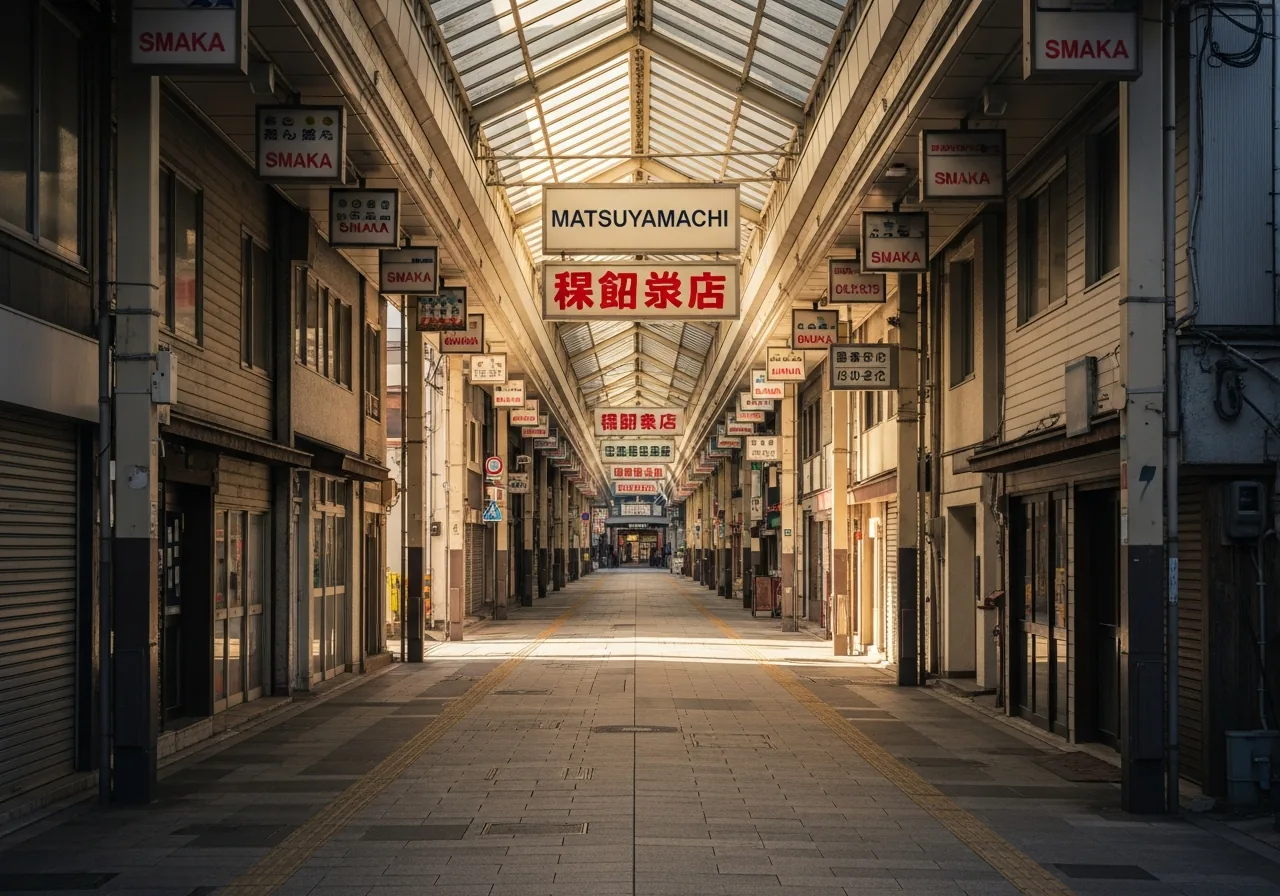
Stand on Matsuyamachi-suji on the last Saturday of February and you will understand, viscerally, what this street is for. The shop fronts are stacked three metres high with tiered platforms of Hina dolls — the Emperor and Empress in silk brocade, their court arrayed below them in descending ranks of lacquer and gold — and the pavement is so thick with families that you have to turn sideways to pass.
Grandmothers argue price with shopkeepers in the particular Osaka dialect that turns every transaction into a performance. Children press their faces against glass.
A delivery truck idles in the one-way lane, its driver resigned to the chaos. This is not a tourist attraction that has been dressed up as a local institution.
It is a local institution that tourists have recently discovered, and the difference is everything.
Why Does a Toy Street Exist Here at All?
The question sounds almost too simple, but it is the right place to start, because the answer is not “because someone decided to open toy shops.” Along Matsuyamachi-suji, which stretches about one kilometre north to south in Osaka’s Chuo Ward, there are over 100 wholesale and specialty shops selling a wide variety of items, including Hina dolls, toys, candy, and Japanese paper. That concentration — a hundred-plus specialist traders in a single kilometre — does not happen by market forces alone. It requires a prior geography, a prior industry, and usually a prior catastrophe.
The prior geography is the Uemachi Plateau, the low limestone ridge that runs north to south through central Osaka and that, in a city built almost entirely on river delta mud, provided the only reliably dry ground. Matsuyamachi-suji runs along the western escarpment of this ridge.
The Higashi Yokobori river, Nishi Yokobori river, Awahori river, and other rivers were excavated to make Osaka a base for marine transportation. The canal network that made Osaka the “Kitchen of Japan” ran to the west and south of the ridge; the ridge itself was where you built things that needed to stay dry — temples, warehouses, workshops.
Matsuyamachi sat at the edge of both worlds: close enough to the canal system to receive goods, elevated enough to store them without flooding.
The prior industry was tile-making. The Matsuyamachi neighbourhood was traditionally a hub for roof tile manufacturing.
By the early 1600s, much of Osaka had been destroyed in fighting between rival warlord-led families. As the Tokugawa clan emerged victorious and established a shogunate to consolidate its rule over Japan, the city’s reconstruction picked up speed, causing a spike in the need for construction materials.
Tile artisans flocked to Osaka to satisfy this demand, settling in Matsuyamachi in great numbers.
The prior catastrophe was the Osaka Natsu-no-Jin — the Summer Siege of 1615. The battle in May–June 1615 was Toyotomi Hideyori’s final battle, where his army lost against Tokugawa Ieyasu’s army at Osaka Castle.
Tokugawa burnt down the castle, and Toyotomi Hideyori committed seppuku. The castle and the castle town went with it.
What followed was one of the largest urban reconstruction projects in Japanese history, and it needed roof tiles by the tens of thousands.
Why Did Tile-Makers Become Doll-Makers?
This is the pivot on which the entire story turns, and it is a more logical transition than it first appears. Roof tile production in early Edo-period Japan was a clay craft: you dug, you shaped, you fired.
The same hands, the same kilns, the same understanding of how clay behaves under heat could produce a fired figurine as easily as a curved roof tile. Once the city had been rebuilt and roof tiles were less urgently required, the tilemakers began applying their skills to crafting unglazed dolls, and Matsuyamachi eventually came to be known as the Town of Dolls.
The parallel with other Japanese doll-making traditions is instructive. The tradition of Hakata dollmaking reportedly began in the early 1600s when a tile maker working on a castle used some leftover clay to make a doll that was so admired that he decided to devote himself to the art form and train some apprentices to continue it. The same logic operated in Matsuyamachi: surplus skill, surplus material, and a city full of people who had survived a war and wanted, perhaps, something beautiful and small to put in their homes.
There was also a ritual logic pulling demand toward dolls specifically. The tradition of displaying ornate Hina dolls in homes and public spaces dates back to the Edo Period (1603–1868).
Hina Matsuri is a day dedicated to daughters, as parents pray for their continued health and happiness. The festival’s roots are even older: the Shangsi Festival was originally held as a festival to ward off badness by setting dolls on a river, so that they could drift away with the participant’s misfortunes, in a ritual called nagashibina.
As time went by, these dolls took on more prominence and instead of setting them on rivers, they were placed inside homes as decorations. Eventually, these dolls came to be known as hina dolls and were used among the aristocrats as toys in pretend play activities.
The critical shift came during the Edo period itself, when the Tokugawa shogunate formalised the five seasonal festivals — the gosekku — and assigned March 3 as the girls’ festival and May 5 as the boys’ festival. During the Edo period, the Tokugawa shogunate set five official seasonal festivals.
May 5, Tango no Sekku, became a festival for boys, while March 3 became a special day for girls. This made the Hinamatsuri Festival an important tradition to celebrate girls’ health and happiness.
Official sanction created official demand. Every family with a daughter needed a set of hina dolls; every family with a son needed a set of warrior dolls for Tango no Sekku.
Matsuyamachi, already making fired clay figurines, was positioned to supply both.
It is said that the first time hina dolls were shown in the manner they are now as part of the Peach Festival was when the young princess Meisho succeeded to the throne of her abdicating father, Emperor Go-Mizunoo, in 1629. Because empresses regnant in Japan at the time were not allowed to get married, Meisho’s mother, Tokugawa Masako, created a doll arrangement showing Meisho blissfully wedded.
Hinamatsuri then officially became the name of the festival in 1687. From that point, doll-making was not a cottage industry but a culturally mandated one, and the craftsmen of Matsuyamachi were already in place to meet it.
Why Here, and Not Somewhere Else in Osaka?
Osaka in the Edo period was not a single undifferentiated commercial city. It was a city of districts, each with its own specialisation, its own guild logic, its own supply chains.
Osaka was restored from the ashes of war into an economic hub and became known as the “Kitchen of Japan” during the Edo era. The Senba district, immediately to the west of Matsuyamachi, was the great wholesale heart of the city — textiles, medicines, paper, dry goods.
Merchants and craftsmen moved to the city in droves, laying the foundations for the prosperity that continues to this day. Osaka rapidly developed into a trade centre and came to be called the “kitchen of the nation.”
Matsuyamachi’s position adjacent to Senba was not incidental. 松屋町一帯は江戸時代から菓子問屋の集中する町だったが、人形、玩具、紙、文房具などの問屋は明治以降に移転してきたもので、とりわけ御堂筋拡幅の際の移転が多い。 In translation: the Matsuyamachi area had been a concentration of confectionery wholesalers since the Edo period, but the doll, toy, paper, and stationery wholesalers moved in from the Meiji era onward — and a particularly large wave came during the Midosuji road-widening. The candy wholesalers were the anchor tenants, so to speak, and the toy and doll merchants followed, drawn by proximity to the existing sweet-goods supply chain and to the Senba wholesale network just to the west.
This matters because it explains the street’s peculiar product mix, which still puzzles first-time visitors. Why are fireworks sold next to Hina dolls, which are sold next to dagashi penny sweets, which are sold next to washi paper?
Because all of these goods share a distribution logic: they are seasonal, they are small, they are bought in bulk by small retailers across the Kansai region, and they have been traded in this neighbourhood since before the Meiji Restoration. The street is not a theme park of childhood; it is a wholesale infrastructure that happens to deal in things associated with childhood celebration.
Why Did the Midosuji Road-Widening Change Everything?
The single most consequential event in Matsuyamachi’s modern history was not a festival or a fire but a road project. The widening of Mido-suji started in 1930, and after a long and daunting period of construction work, it was opened in 1937.
The ginkgo trees lining the street, which have long been delighting pedestrians, were planted upon its completion. The scale of the project was extraordinary: the construction of the subway coincided with the widening of the road from 6 to 44 metres, making Osakans joke that an airplane could land on the newly named Midosuji Avenue.
To widen a street from six metres to forty-four metres in a densely built city, you demolish everything in the way. Hundreds of businesses that had been established along the old Midosuji corridor — many of them in the Senba wholesale district — were forced to relocate.
松屋町筋一帯はもともと江戸時代から菓子問屋が集中する町でした。人形・玩具・紙・文房具などの問屋が集まるようになったのは明治時代以降で、御堂筋拡幅の際に他地域から移転してきた店が多いと言われています。 In translation: the area around Matsuyamachi-suji was originally a town concentrated with confectionery wholesalers since the Edo period. The gathering of doll, toy, paper, and stationery wholesalers came from the Meiji era onward, and many of the shops are said to have relocated from other areas during the Midosuji widening.
The displaced merchants needed somewhere to go. Matsuyamachi-suji, running parallel to Midosuji just a few blocks to the east, was the obvious destination: it was already a wholesale street, already had the infrastructure of loading docks and storage, and already had the confectionery trade that made it a natural complement to the toy and doll businesses being pushed out of Senba. The Midosuji widening, in other words, did not create Matsuyamachi’s toy trade — it concentrated and accelerated it.
The subway that ran beneath the new boulevard compounded the effect. The oldest subway line in Osaka and the second oldest in Japan, the Midōsuji Line opened on May 20, 1933, initially as a 3.1-kilometre segment between a temporary Umeda Station and Shinsaibashi Station, marking the debut of underground rail service in the city.
Better transit connectivity across the city meant that small retailers from Osaka’s outer wards, and eventually from across the Kansai region, could reach Matsuyamachi more easily to buy wholesale. The street’s catchment area expanded with every new subway extension.
Why Did the Postwar Period Make Matsuyamachi What It Is Today?
The Midosuji relocations gave Matsuyamachi its critical mass of toy and doll wholesalers. But the street’s golden age came later, in the two decades after 1945, when three forces converged simultaneously: a baby boom, an economic recovery, and a television advertising revolution.
Japan’s postwar baby boom was demographically intense. The first Japanese Baby Boom Generation (1947–1949) is the core of this cohort, which saw births exceed 2.6 million annually, peaking with nearly 2.7 million births, for a total of about 8 million children born in just three years.
Those eight million children needed toys. They needed Hina dolls and warrior dolls for the seasonal festivals.
They needed dagashi sweets and summer fireworks. And their parents, rebuilding their lives in a country that had been bombed flat, were determined to give their children the childhood rituals that the war had interrupted.
玩具店が松屋町筋に多く並ぶようになったのは、第二次世界大戦後のことです。戦後の子どもたちに玩具を届け — toy shops began lining Matsuyamachi-suji in large numbers after the Second World War, as the street’s merchants set about delivering toys to the postwar generation of children. The timing is confirmed by the founding dates of the street’s surviving institutions. 大阪玩具株式会社が創業した1951年は、ちょうどこの玩具問屋街が本格的に形作られた時期にあたります。 Osaka Gangu K.K., which has published its own account of the street’s history, was founded in 1951 — precisely the period when the toy wholesale district was taking its definitive shape.
The economic recovery provided the purchasing power. It was only in 1954, after the Occupation had ended, that Japan began to experience an “economic miracle” due to its supplying of munitions and logistics to US forces during the Korean War.
Japan ultimately saw a return to pre-war production levels by the 1950s as the country began to undergo mass industrialisation. Rising household incomes meant that the seasonal doll sets — which had always been expensive — came within reach of working-class families for the first time.
A five-tier Hina set that had once been a luxury became an aspiration, and then a norm.
Television did the rest. 船場の問屋街に隣接することから、明治期に菓子店やおもちゃ問屋が軒を連ねていたところに、50年前後のベビーブームが到来。利益の大きさに目を付けた店が競うように人形の小売りを始め、テレビなどでの宣伝で一気に「まっちゃまち」が知られる。 As reported by the Nikkei Shimbun: adjacent to the Senba wholesale district, where confectionery shops and toy wholesalers had lined up since the Meiji era, the baby boom arrived around the 1950s. Shops that noticed the profitability began competing to start doll retail, and television advertising rapidly made “Matchamachi” a household name.
The Osaka Doll Wholesalers’ Cooperative, founded to coordinate the street’s merchants, began running television commercials from around 1965 specifically to promote the seasonal doll trade. 昭和40年頃から組合による節句人形のPRを目的としたテレビコマーシャルが始まり、松屋町が人形の町として周知され、買い物客が増えるきっかけとなっていきました。 From around 1965, the cooperative began television commercials aimed at promoting seasonal festival dolls, and this is what made Matsuyamachi widely known as the Town of Dolls, triggering an increase in shoppers.
The commercials worked. Families across Kansai came to associate “buying the Hina set” with a trip to Matchamachi, and that association has proven remarkably durable.
Among the shops that benefited most from this television era was Masumura Doll Store, which had been founded in 1941 by its first president, Masumura Masaharu. 昭和16年に初代社長である増村正晴が「増村正晴商店」を開業したのがその始まり。 The store grew to become one of the street’s most recognisable institutions, its television commercials — featuring the then-president repeating the store name in a memorably insistent cadence — becoming part of the cultural memory of every Kansai family that bought a doll set in the 1970s and 1980s. 増村人形店は、その激戦区・松屋町で80年以上商いをさせて頂いている老舗の人形店です。全店舗合計15フロア以上、日本最大級の展示数展示面積です。 Today Masumura operates across more than fifteen floors of exhibition space across its Matsuyamachi locations — one of the largest doll display operations in Japan.
Why Does the Street Operate on a Seasonal Calendar Rather Than a Fixed One?
One of the most distinctive things about Matsuyamachi, and one of the things that most surprises visitors who arrive expecting a conventional shopping street, is that it does not sell the same things all year. The street reinvents itself every two to three months, following a ritual calendar that has governed Japanese domestic life for centuries.
Just before May, the area is overflowing with people looking to buy May dolls, and once that is over, the area transforms into a place filled with summer goods like fireworks and swim rings. The rhythm is precise: Hina dolls from January through early March for Hinamatsuri on March 3; warrior dolls and carp streamers from March through late April for Children’s Day on May 5; fireworks, water toys, and festival supplies from May through August; New Year goods from October onward. The street does not merely stock these items — it becomes them, its window displays and pavement stalls reorganised entirely around the approaching festival.
This seasonal logic is not a marketing strategy. It is the direct expression of the gosekku system — the five seasonal festivals — that the Tokugawa shogunate codified in the early seventeenth century and that has structured Japanese domestic consumption ever since.
Hinamatsuri is one of the five seasonal festivals that are held on auspicious dates of the lunisolar calendar: the first day of the first month, the third day of the third month, and so on. After the adoption of the Gregorian calendar, these were fixed on 1 January, 3 March, 5 May, 7 July, and 9 September.
For a wholesale street, this seasonality creates a particular commercial intensity. Matsuyamachi is busiest around the festivals of Hinamatsuri in March and Children’s Day in May, when traditional dolls are lined up in the shop windows along the street, attracting hordes of onlookers.
The concentration of buying into a few weeks before each festival means that the street’s merchants must manage inventory, staffing, and cash flow around predictable but intense peaks. It also means that the street’s quieter months — June, September, November — have a different character entirely: the wholesale buyers are in, the retail browsers are fewer, and the shopkeepers have time to talk.
The doll sets themselves are not cheap, and this is part of what makes the wholesale model so important. A set of hina-ningyo is usually fairly expensive — $1,500 to $2,500 for a five-tier set, depending on quality — and may be handed down from older generations as heirlooms.
The wholesale prices available at Matsuyamachi — even to individual retail buyers, since most shops sell both wholesale and retail — represent a meaningful saving on department store prices. This is why Osaka families have been making the trip to Matchamachi for generations rather than buying from a department store: the savings are real, and the selection is incomparably deeper.
Why Did Osaka Develop Doll-Making as a Distinct Craft Tradition?
It is worth pausing on the craft itself, because Osaka’s doll-making tradition is not simply a retail phenomenon — it is a manufacturing one, with roots that predate the wholesale street by several centuries. 大阪の人形作りは400年以上の歴史があり、もともとは瓦職人が副業で素焼きの人形を作っていたものが、質が良いと評判になり次第に専業化していきました。松屋町は、その人形の集散地として発展してきた街です。 Osaka’s doll-making has more than 400 years of history, originating with tile craftsmen who made unglazed dolls as a sideline; as the quality became renowned, they gradually specialised. Matsuyamachi developed as the distribution centre for those dolls.
The craft specialisation that emerged over the Edo period was not uniform. Kyoto developed its own tradition of court dolls — the kyō-ningyō — characterised by extreme refinement of fabric and facial expression, drawing on the city’s long proximity to imperial culture.
Osaka’s tradition was more commercial, more varied, and more responsive to popular demand. 京都は平安王朝以来、室町期まで日本の首都であり、文化の中心地でした。宮廷の雅な文化のなかで育くまれた京人形は、洗練された伝統美が宿る最高級品として愛されてまいりました。 Kyoto, as the imperial capital from the Heian period through the Muromachi era, nurtured a court doll tradition of refined traditional beauty regarded as the finest quality.
Matsuyamachi’s merchants understood this, and many of the street’s leading shops — including Masumura — built their reputations specifically on stocking Kyoto-made dolls rather than competing with Kyoto craftsmanship directly.
This division of labour — Kyoto makes, Osaka distributes — is itself a reflection of the two cities’ historic economic relationship. The increased wealth of townspeople during the Edo period allowed many residents to devote time to scholarship and the appreciation of art, literature, and performances of kabuki and ningyō jōruri puppet theater.
Osaka’s merchant culture was oriented toward distribution and trade, not toward the production of luxury goods for their own sake. The city’s genius was logistics, not manufacture.
Matsuyamachi expressed that genius perfectly: it was never primarily a place where dolls were made, but a place where dolls from across Japan were assembled, priced, and sent out to the retailers of the Kansai region.
Why Did Japan’s Postwar Toy Industry Matter to the World — and to This Street?
The toy trade that flourished in Matsuyamachi after 1945 was not happening in isolation. Japan’s postwar toy industry was, for a period, the most consequential in the world.
These more versatile toys were a huge hit in the United States, helping to make Japan the world’s top toymaker for over 20 years. During this period, Japan made 95% of the world’s battery-operated toys.
These years were considered the “golden age” of these innovative toys.
The heyday of Japanese tin toys — the wind-up robots, the lithographed cars, the battery-powered spacecraft — ran roughly from 1952 to 1962. The heyday of these toys was about 1952–1962.
After 1962, plastic became the material of choice for toys and tin fell out of favour. Matsuyamachi was not a manufacturing centre for these export toys — the factories were in Tokyo and Nagoya — but it was a distribution node for the domestic market, and the aesthetic sensibility of the street’s toy trade was shaped by the same postwar cultural moment that produced the tin robot and the plastic Ultraman figure.
The connection to manga and anime culture is direct and important. At the core of postwar Japanese popular culture is the first manga and its character Tetsuwan Atomu, or Astro Boy in English, which debuted in 1951.
The creator of the manga, Tezuka Osamu, was just eighteen years old when the war ended. Crucially, Tezuka Osamu joined a group of young artists and small publishers in Osaka.
The manga revolution that would eventually produce the character merchandise flooding Matsuyamachi’s shelves today had its origins, in part, in the same postwar Osaka that was rebuilding the toy wholesale street. The city was simultaneously creating the cultural content and the distribution infrastructure for the goods that content would generate.
By the 1970s and 1980s, Matsuyamachi’s toy shops had evolved to carry not just traditional festival goods but the full range of character merchandise, plastic models, and electronic toys that Japan’s entertainment industry was producing. The street became, in effect, a wholesale clearinghouse for Japanese childhood culture in its entirety — traditional and modern, ritual and recreational, handcrafted and mass-produced.
Why Does the Street Face Pressure Now, and Why Has It Survived Anyway?
The pressures on Matsuyamachi are real and well-documented. Japan’s birth rate has been falling for decades; fewer children means fewer families buying seasonal doll sets.
Online retail has made it possible to purchase wholesale-priced goods without travelling to the street. The broader decline of Japan’s wholesale district model — the problem of redevelopment and rising land values in central Osaka — has affected the street’s physical fabric.
松屋町筋商店街には人形店や玩具店ばかり立ち並んでいるわけではない。松屋町筋商店街は、問屋街として発展しているのだ。全国的に問屋街の再開発は遅れる傾向にあるのだが、それはここ大阪でも変わらないようだ。 Wholesale districts nationally tend to lag behind in redevelopment, and Matsuyamachi is no exception — old buildings remain standing not because they are protected but because the economics of redevelopment in a wholesale district are complicated.
And yet the street has not collapsed. 老舗問屋が集結する松屋町筋では、3割以上の店舗が通販にも対応しており、オンラインと現地の”いいとこ取り”も叶います。 More than 30% of the established wholesalers on Matsuyamachi-suji now offer online ordering, allowing the street’s merchants to capture both the in-person and the remote buyer. The street has adapted rather than resisted.
The survival of Matsuyamachi also reflects something specific about the goods it sells. A Hina doll set is not a commodity that most families buy online without seeing it first.
The price points are significant — a quality five-tier set can cost several hundred thousand yen — and the decision involves questions of craftsmanship, fabric quality, and facial expression that are genuinely difficult to assess from a photograph. 毎年、何万人ものお客様がこの町に節句人形をお求めに来られます。 Tens of thousands of customers come to this town every year to purchase seasonal festival dolls.
The physical experience of the street — the ability to compare dozens of sets side by side, to ask the shopkeeper about the provenance of the Kyoto craftsman who made the empress figure, to negotiate — remains irreplaceable for this category of purchase.
The street has also found an unexpected new audience. In recent years, it seems that an increasing number of young people have been coming to see the old row houses that remain in the area.
The machiya townhouses that survive along the side streets off Matsuyamachi-suji have become objects of architectural interest, drawing a younger urban demographic that is less interested in buying a Hina set than in experiencing a streetscape that has not been entirely consumed by the redevelopment that has transformed most of central Osaka. The street’s commercial slowness has, paradoxically, preserved its physical character.
The dagashi wholesale trade has proven particularly resilient. 戦後で食料が少なかった時期に、「食べものや甘いものなら一生廃れへん」という想いからオープンした、駄菓子問屋の藤田商店。問屋さんやけど、昔から小売りもしていたんやて。置いてある駄菓子は1000種類以上。 Fujita Shoten, one of the street’s candy wholesalers, was opened in the postwar period with the conviction that “food and sweets will never go out of fashion.” It stocks over 1,000 varieties of dagashi and has always sold retail as well as wholesale. That combination — the institutional wholesaler that also serves the individual customer — is the model that has kept Matsuyamachi commercially viable long after the pure wholesale model became economically precarious.
Why Should the Discerning Traveller Care?
The honest answer is that Matsuyamachi will not give you what most Osaka tourism gives you. There is no dramatic architecture, no Michelin-starred kitchen, no Instagram backdrop engineered for the purpose. What it gives you instead is something rarer: a working commercial district that has been doing the same thing, in the same place, for the better part of four centuries, and that has survived not because it was preserved as a heritage site but because it remained genuinely useful.
To walk Matsuyamachi-suji in late February, when the Hina doll season is at its peak, is to understand something about Japanese domestic culture that no museum exhibit can convey. The number of tiers and dolls a family may have depends on their budget.
Families normally ensure that girls have a set of the two main dolls before their first Hinamatsuri. The dolls are usually fairly expensive — $1,500 to $2,500 for a five-tier set, depending on quality — and may be handed down from older generations as heirlooms.
When you watch a grandmother and her daughter-in-law arguing, in the particular compressed Osaka dialect, over which empress figure has the more auspicious expression, you are watching a ritual that has been performed in this neighbourhood for generations. The grandmother’s grandmother probably had the same argument in the same street.
The street also gives you access to the wholesale pricing that is one of Osaka’s great commercial gifts to the visitor. The street sells kids’ toys in bulk and one by one.
Great for small presents to take overseas. The dagashi shops in particular — selling individually priced penny sweets at wholesale quantities — are an extraordinary resource for anyone who wants to bring back something genuinely Japanese rather than something manufactured for the tourist trade.
A bag of mixed dagashi from Matsuyamachi costs almost nothing and represents a more authentic souvenir of Osaka’s commercial culture than anything sold in the airport.
For the intellectually curious traveller, the deeper significance is historical. Matsuyamachi is one of the few places in central Osaka where the city’s pre-war commercial geography is still legible.
The Midosuji widening of the 1930s, the wartime bombing, the postwar reconstruction, and the subsequent decades of urban redevelopment have erased most of the physical evidence of how Osaka’s wholesale economy was organised. Matsuyamachi, because it was slightly off the main axes of redevelopment, has retained enough of its original fabric — the narrow shopfronts, the machiya side streets, the wholesale loading culture — to give a serious visitor a genuine sense of how the city worked before it became the city it is now.
There is also something worth noting about the street’s relationship to time. The area is also fun to visit in summer, when the shops do a roaring business in fireworks, yo-yos and other summer festival essentials, bought up by neighbourhood organisers from throughout the Kansai region.
The seasonal rhythm of Matsuyamachi is not a retail gimmick. It is the rhythm of the Japanese year, expressed in commercial form.
To visit the street in different seasons is to see different aspects of the same culture: the solemnity of the Hina doll season, the martial energy of the Children’s Day warrior dolls, the exuberance of the summer fireworks trade. The street is, in this sense, a calendar made physical.
And then there is the matter of what the street represents about Osaka itself. 松屋町の歴史は古く、江戸時代にはすでに駄菓子問屋が軒を連ねる町だったそうです。家庭にも季節の人形を飾る習慣が定着した明治時代以降は、日本有数の問屋街として大いに栄えました。扱う品が小さくて多岐にわたるため、ついた別称が「ごっちゃまち」。大阪らしい発想です。 The nickname “Gocchamachi” — the jumbled-up town, the everything-town — is, as one Japanese travel writer noted, a very Osaka idea.
The city has always been more interested in usefulness than in elegance, more interested in getting things to the people who need them than in the prestige of the goods themselves. Matsuyamachi embodies that ethos completely.
It is not a beautiful street. It is a useful one.
And in Osaka, that is the higher compliment.
Frequently Asked Questions
Q: Is Matsuyamachi-suji open to individual shoppers, or is it wholesale only?
A: Most shops sell both wholesale and retail. Individual visitors can buy single items at prices that are typically lower than department store equivalents. Some shops have minimum order quantities for certain product lines, but the majority welcome walk-in retail customers.
Q: When is the best time to visit?
A: Late January through early March for the Hina doll season (peak is the two weeks before March 3); late March through late April for Children’s Day warrior dolls and carp streamers; July and August for summer festival goods including fireworks. Weekday mornings are quieter; weekends in peak season are extremely busy.
Q: Are the shops cash-only?
A: Many traditional wholesalers remain cash-preferred, though an increasing number accept IC cards and major credit cards. Bring cash to be safe, particularly for smaller purchases.
Q: How does Matsuyamachi compare to Tokyo’s Asakusabashi doll district?
A: Both are wholesale doll and toy districts with Edo-period roots. Asakusabashi is larger in absolute terms and has a stronger connection to the Edo-period craft tradition of the Kanto region. Matsuyamachi is more compact, more seasonally dramatic, and more integrated with the broader Osaka wholesale culture — including the dagashi and festival goods trades that give the street its particular character.
Q: Can I visit the Masumura Doll Store as a tourist even if I’m not buying?
A: Yes. The store’s multi-floor showrooms are open to browsers, and the display of Kyoto-made hina sets at the peak of the season is genuinely impressive as a cultural experience, regardless of whether you intend to purchase.
Matsuyamachi-suji Shopping Street — Visitor Information
Address: Matsuyamachi-suji, Chuo-ku, Osaka-shi, Osaka 〒542-0067 / 大阪府大阪市中央区松屋町筋(中央区松屋町周辺)
Nearest station: Matsuyamachi Station (Osaka Metro Nagahori Tsurumi-ryokuchi Line) — 1 minute walk; Sakaisuji-Honmachi Station (Osaka Metro Chuo/Sakaisuji Lines) — approx. 8 minutes walk
Hours: Most shops open approximately 9:00–18:00; many close Sunday and/or Monday. Hours vary significantly by shop and season — confirm with individual stores before visiting.
Admission: Free to walk the street. Individual shop purchases at retail or wholesale prices (approx. — confirm on official site or in store).
Official site: osaka-info.jp