Konamon — the collective name for Osaka’s flour-based foods — is not an ancient tradition but a surprisingly recent cultural construction, assembled across three distinct historical ruptures: the Edo-period merchant city that made dashi the default cooking liquid; the 1935 street-stall invention of takoyaki in Nishinari ward; and the post-1945 flood of American surplus wheat that turned a working-class snack into a civic identity. The word “konamon” itself did not exist in common usage until food researcher Mana Kumagai coined it for her Japan Konamon Association, founded on 7 May 2003 — meaning the category that now defines Osaka’s global culinary reputation is barely two decades old.
Why we can tell you this — MICHI is written and edited in Osaka, which means we can stand at the Aizuya counter in Nishinari where takoyaki was invented in 1935, walk the Dotonbori strip where the dish spread, and read the iron griddles of the city as primary sources rather than tourist props. This article draws on Japan’s Ministry of Agriculture, Forestry and Fisheries regional cuisine records, the Osaka Convention & Tourism Bureau’s gastronomy documentation, the Japan Konamon Association’s own institutional history, Wikipedia’s sourced entry on the Dōjima Rice Exchange, and reporting by Zentis Osaka based on interviews with Kumagai herself. Where the historical record is genuinely contested — particularly around the precise lineage from choboyaki to rajioyaki to takoyaki — we say so rather than flatten the debate.
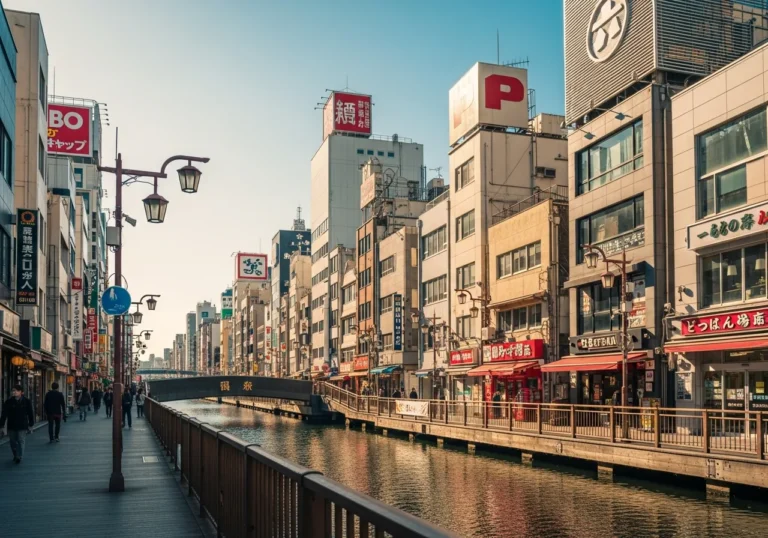
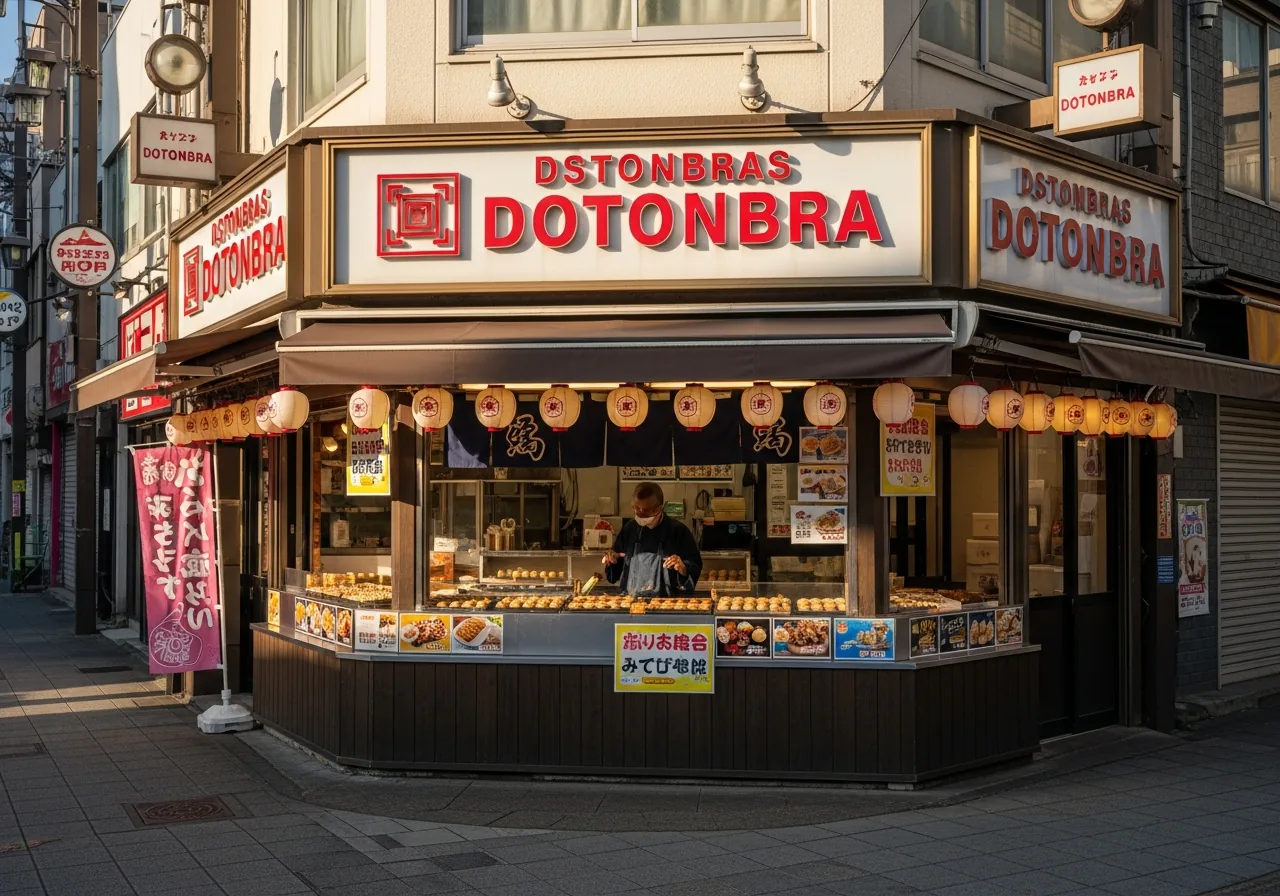
Stand on the Ebisubashi bridge on any evening and watch the Dotonbori crowd. Someone is always holding a paper tray of takoyaki, the eight spheres steaming, the bonito flakes trembling in the heat as if still alive.
The scene feels ancient, inevitable, as if the city has always eaten this way. It has not.
The dish in that tray is younger than jazz. The word for the category it belongs to is younger than the iPhone.
And the chain of events that made flour the foundation of Osaka cooking runs through a rice market, a street vendor from Fukushima, an American general’s surplus wheat, and a food researcher who needed a catchy name for her association. Pull on any one of those threads and you find yourself somewhere unexpected.
Why Does a Rice City Eat Flour?
The Dōjima Rice Exchange in Osaka was the centre of Japan’s system of rice brokers during the Edo period, and since members of the samurai class — including feudal lords — were paid in rice rather than cash, the brokers and moneychangers who converted that rice into coin played a crucial, and enormously profitable, role in the emerging economy.
During the Edo period, Osaka became the central hub where rice, seafood, and medicinal goods from all over Japan were gathered and traded, which is why it came to be called “the Nation’s Kitchen.” The establishment of the Dojima Rice Market, the Zakoba Fish Market, and the Tenma Vegetable Market gave the city immense economic influence, with the kura storehouses of feudal domains depending on it.
This is the paradox at the heart of konamon: the city that built its identity on rice is the city that made flour food its soul. To understand why, you have to understand what Osaka’s rice economy actually produced — not just grain, but a merchant class with money, time, and an appetite for something other than the commodity they traded.
The city’s identity is defined by the concept of kuidaore, often translated as “eating until you drop,” or more precisely, “to ruin oneself by extravagance in food.” This philosophy reflects the deep-seated passion Osakans hold for fine ingredients and plentiful dining — a commitment so strong that people from Osaka would “bankrupt themselves on food,” prioritising gastronomy over expenditure on transient status symbols like clothes or shoes. This culture of lavish consumption was fuelled by the accumulation of wealth by the burgeoning merchant class, the chōnin, during the Edo period.
The merchants and traders who ran this system developed a food culture that prioritised value and quantity alongside quality. You were not eating to signal status; you were eating because the food was good and there was a lot of it.
That distinction matters enormously. Kyoto ate to demonstrate refinement.
Edo ate to demonstrate rank. Osaka ate because the food was good and because eating well was, for a merchant class barred from most other forms of conspicuous display, the one arena where they could spend freely and be respected for it.
Why Did Flour Arrive So Late?
Wheat has a long history in Japan, but for most of that history it was not a food for ordinary people. The practice of making wheat into flour for culinary uses is said to date to the Nara period in the eighth century, when the technique of using millstones to process wheat into flour was introduced to Japan from China.
For centuries after that introduction, wheat flour remained a luxury. Wheat flour at that time was a precious commodity, so it wasn’t until later in the Edo period that enjoyment of it was within the reach of common folk. Toward the end of the Edo period — around the 1850s to 1860s — the practice of making a batter with wheat flour and water and cooking it with a bunch of other ingredients mixed in became widespread.
The timing is not coincidental. Japan’s forced opening to Western trade in the 1850s brought not just gunboats but commodities, including cheaper imported wheat. The Meiji Restoration of 1868 accelerated this, as the new government actively promoted Western-style eating as part of its modernisation project.
By the Meiji period — around the late 1800s and early 1900s — a dish called yoshoku-yaki made with flour, cabbage, and a special sauce made a hit with the common classes, who were attracted to “Western-style” yoshoku eateries. The dish came to be known familiarly as Issen Yoshoku, the “issen” referring to its price at the time: just a hundredth of a yen. In the pre-war days, lots of food stands popped up selling it, and the dish took hold as the quintessential flavour associated with the working class.
Issen Yoshoku — “one-sen Western food” — is the hinge on which the entire konamon story turns. It was almost nothing: a thin batter of flour and water, grilled flat, topped with green onion and a splash of Worcestershire sauce.
Before World War II, Issen Yoshoku gained popularity among children in Osaka’s penny candy stores. It was a simple dish made by thinly grilling wheat flour dissolved in water and spreading Worcestershire sauce on it — a popular and affordable snack.
But “almost nothing” was exactly the point. In a city built on merchant pragmatism, a dish that cost one sen and filled a stomach was not a failure of ambition — it was a design specification.
Why Here, Why Dashi?
Before flour could become Osaka’s foundation, something else had to happen: the city had to develop its signature flavour infrastructure. That infrastructure is dashi — the kelp-and-bonito stock that runs through virtually every konamon dish like a hidden structural beam.
In the Edo period, when maritime traffic thrived, large amounts of kelp found their way into Osaka when the Nishimawari Koro — the westbound route connecting the region with Hokkaido — was established. This route is now sometimes referred to as the “Konbu Road.” The rise in popularity of konbu dashi in Osaka was also helped by the fact that the water in Osaka was soft, so the conditions were in place for delicious dashi to be made from konbu.
This is a geographical accident with enormous culinary consequences. Soft water extracts umami from kelp more efficiently than hard water. Osaka’s water chemistry, shaped by the geology of the surrounding mountains, made the city’s dashi categorically better than what could be produced in Edo, where harder water favoured the sharper, darker flavours of bonito-dominant stocks.
During the Edo period, when Kitamaebune ships were in operation, kelp harvested in Hokkaido was transported via the “Konbu Road” of the Sea of Japan, then via the Nishikigoi route from Shimonoseki to the Seto Inland Sea, bound for Osaka and Sakai, “the Kitchen of the Nation.” It is said that Osaka shipping wholesaler Konbuya Ihei brought kelp back from Hokkaido on the Kitamaebune ships, trading it for specialty products like Kawachi cotton.
The connection to konamon is direct. It’s believed that after Osakans discovered this marriage of dashi broth and konamon foods through kake-udon, they next came to use dashi to appetising effect in dishes like okonomiyaki and takoyaki as well.
Udon was the gateway drug. Once cooks understood that dissolving flour in dashi rather than water produced something qualitatively different — lighter, more complex, with a depth that plain batter could never achieve — the logic extended naturally to every flour-based dish that followed.
The key to the Kansai flavour is the soup stock. A soup stock made with kelp and bonito is the key to the “Kansai” flavour.
Although the prices are completely different, casual takoyaki stalls and fancy traditional Japanese restaurants both use the Kansai soup stock. That is the remarkable thing about Osaka’s food culture: the same flavour logic applies at every price point.
The dashi in a ¥500 paper tray of takoyaki and the dashi in a ¥30,000 kaiseki course are philosophically identical. They are both expressions of the same city.
Why Did Takoyaki Happen in 1935?
The specific invention of takoyaki is one of the few moments in Japanese food history with a name, a date, and an address attached to it. Takoyaki was first popularised in Osaka, where a street vendor named Tomekichi Endo is credited with its invention in 1935.
The man widely believed to be the creator of takoyaki is Endo Tomekichi (1907–1997), the founder of Aizuya in Osaka. In the early 1930s, he was searching for a snack that customers could enjoy either hot or cold with a beer.
Endo had moved to Osaka from Aizu in Fukushima Prefecture — the name Aizuya, which his shop still carries today, is a homesick tribute to his hometown. He moved to Osaka in 1933 and opened a small food stall.
His first product was not takoyaki but rajioyaki — “radio balls” — named after the then-fashionable technology of the radio. Rajioyaki is made with thinly sliced beef cooked in soy sauce, konjac, and green spring onions.
The pivot to octopus came from a customer. In 1935, a customer said these words after eating rajioyaki: “Osaka uses beef?
In Akashi, we use octopus in our dumplings.” The founder was inspired by this comment. He whipped up a batch with octopus in place of beef and konnyaku, creating what we now know as takoyaki.
The reference to Akashi matters. The later addition of octopus was influenced by a popular local dish in nearby Akashi, Hyōgo Prefecture, known as Akashiyaki.
Akashiyaki is older than takoyaki and uses a richer, egg-heavy batter, served by dipping in dashi broth rather than being sauced. Endo took the octopus from Akashi and the dashi-enriched batter logic from Osaka’s existing flour culture, and produced something new.
Octopus was the only ingredient used in the original takoyaki recipe. There was no red pickled ginger, katsuobushi, mayonnaise, or green seaweed.
The dish we know today — lacquered with sweet-savoury sauce, zigzagged with mayonnaise, dusted with bonito and aonori — came later. The style of accenting it with condiments such as takoyaki sauce, mayonnaise, aonori, and skipjack flakes is said to be an influence from okonomiyaki following the end of the Second World War.
Endo’s original recipe survives. Endo’s takoyaki shop, named Aizuya after his hometown, still exists today and serves the original takoyaki without sauce or mayonnaise.
Aizuya’s takoyaki has always been served without sauce, maintaining a simple yet juicy flavour. This method reflects the original philosophy of the founder, who wanted the takoyaki to be easy to eat, even when cold, and without getting your hands dirty.
Eating one is a genuine act of historical archaeology.
The Evolutionary Chain: Choboyaki → Rajioyaki → Takoyaki
The clean narrative of a single inventor obscures a messier and more interesting evolutionary chain. While a number of theories exist as to who is the originator of takoyaki, its roots are said to lie in precursor dishes such as choboyaki and rajioyaki. Choboyaki was made by drizzling a flour and water-based batter into the half-spherical cups lining a copper or cast-iron griddle — reminiscent of today’s takoyaki — and then adding red pickled ginger, konjac, onions, and shoyu before grilling the mixture into dumplings.
Sold at venues including mom-and-pop candy stores, choboyaki was likely known at the time as a sort of children’s snack. Taking its hint from this dish, its successor takoyaki involved dissolving the flour in dashi instead of water, and then adding octopus in order to extend the appeal of the snack to adults as well as children.
The hemispherical mould — the takoyaki pan — is itself a piece of technology with a history. The pan is typically a griddle made of cast iron with hemispherical molds, similar to a traditional Yorkshire pudding tray.
The heavy iron evenly heats the takoyaki, which are turned with a pick during the heating process to pull the uncooked batter to the base of the rounded cavity. The iron is not incidental.
Iron pots are used even though they are very difficult to maintain. Iron conducts heat and cools down slowly.
Copper pots are used in many other stores, but with copper, heat transmission becomes too strong, which leads to a heavy, floury aftertaste. The choice of material is a flavour decision.
Why Did the War Change Everything?
Takoyaki existed before the war. But the version of konamon culture that Osaka now claims as its identity was largely created by the war’s aftermath. The mechanism was American wheat.
In March 1946, General Douglas MacArthur authorised the release of 7,000,000 pounds of surplus Allied wheat flour — originally for occupation forces — to the Japanese government, marking an initial push to integrate wheat-based products into civilian rations. Japan’s domestic rice production had plummeted by 68.8% in 1945 due to wartime disruptions, drought, and crop failures.
Shortages worsened after World War II — in the postwar period Japan approached the brink of mass starvation — and American emergency aid began to arrive in the form of wheat flour and lard. Beyond humanitarianism, the Truman Administration’s motives included winning over Japan’s working classes and deterring Japan from Communism.
The political logic of the wheat shipments is worth sitting with. The Americans were not simply feeding a hungry population; they were shaping a food culture.
The school lunches included a main course with a bread roll and a glass of milk. The bread was not donated because of its health benefits, but because Americans wanted to divest excess wheat to foreign markets to increase their profits.
A generation of Japanese children grew up eating bread at school, and their palates shifted accordingly.
In the wake of the U.S. bombing of Hiroshima and Japan’s loss in the war, the grilled pancake became a practical and cheap way to feed a starving population with limited food supplies.
This is largely due to the influx of flour into Japan, a cheap and available grain, as a form of aid from the US government. This was further bolstered by an agreement between the US and Japan in the 1950s, stipulating that Japan would buy surplus wheat from the US.
The rise of konamon is closely tied to Japan’s post-war history. After World War II, Japan faced severe food shortages.
Wheat flour, supplied through U.S. food aid, became a vital and inexpensive ingredient.
People began creating flour-based dishes to feed their families, giving birth to a new kind of comfort food culture. These meals were cheap, filling, and satisfying, and they quickly became part of everyday life in Osaka.
The post-war transformation of okonomiyaki is the clearest example of this dynamic. After the end of the war, when wheat flour was supplied as aid from the United States, Issen Yoshoku gradually evolved into a dish that could satisfy adults as well.
Pioneers who quickly opened shops in entertainment districts added a small amount of pork to the popular Issen Yoshoku, changed its name to “okonomiyaki,” and made it acceptable as an adult food. At the time, rice — the staple food — was still expensive, and the common people had no choice but to rely on inexpensive flour-based foods to fill their stomachs.
The name change from Issen Yoshoku to okonomiyaki is itself a piece of social history. “Issen” meant one sen — poverty pricing.
“Okonomiyaki” means “grill what you like” — it implies abundance, choice, pleasure. The dish was the same; the aspiration had changed.
Japan was rebuilding, and it needed food that felt like progress.
Okonomiyaki became widely known throughout Japan as a specialty of Osaka in the late 1950s to the 1960s. The expansion of chain okonomiyaki restaurants that marketed it as an “Osaka specialty” is considered a contributing factor to its popularity. The 1970 Osaka World Exposition — Expo ’70 — accelerated this further, bringing millions of visitors to the city and cementing okonomiyaki’s national identity as an Osaka dish.
Why Did the Word “Konamon” Need to Be Invented?
Here is the most counterintuitive fact in this entire history: the category that supposedly defines Osaka’s ancient food culture was named in 2003 by a food researcher who needed a catchy title for her association.
Mana Kumagai, president of the Japan Konamon Association, had her experience writing a graduation thesis on takoyaki as a university student compel her to continue research on takoyaki in earnest. Issuing her first monograph, “Takoyaki,” in 1993, Kumagai has since published a number of other titles. In 2003, she founded the Japan Konamon Association with aims of spreading awareness of konamon culture and passing on knowledge of its traditions.
In fact, not even 20 years had passed since the term gained footing, and none other than Kumagai herself is said to have been a central player in spreading its awareness. “The terms ‘konamono’ (foods made with flour) and ‘konemono’ (kneaded foods) seem to have originally been used in flour-producing regions throughout Japan. ‘Konamon’ itself, though, doesn’t appear in the dictionary of Osaka dialect words, and it isn’t really Osaka-ben.”
“‘Konamon’ has a mascot character kind of ring to it. It carries some impact, and that’s why it was chosen for the name of the association. Then the media has started picking up more stories featuring our association, Osaka konamon cuisine and so on since.”
This is how food traditions are actually made. Not by ancient decree but by someone, at a specific moment, deciding that a set of related practices deserves a name and a story. The Japan Konamon Association — whose official site is at konamon.com — was established on 7 May 2003, a date chosen because “5-7” can be read as “ko-na” in Japanese numerical wordplay, making it “Konamon Day.” The association has since trained over 20,000 people in flour-based cooking and works with the Japanese government’s Agency for Cultural Affairs on food culture preservation.
The invention of the category did not invent the foods. Takoyaki and okonomiyaki existed long before 2003.
What the category did was provide a framework — a way of understanding these disparate dishes as expressions of a single civic philosophy rather than as unrelated street snacks. Once you have the framework, you can see the pattern everywhere: the dashi logic, the iron griddle, the working-class price point, the Osaka preference for food that is simultaneously cheap and technically demanding.
Why Does Osaka’s Flour Culture Look Different From Everywhere Else?
Japan has flour-based foods in every region. Tokyo has monjayaki.
Hiroshima has its own layered okonomiyaki. Akashi has its egg-rich dumplings.
What makes Osaka’s version distinctive is not the flour but what the flour is dissolved in, and what that dissolving implies about the city’s values.
Mana Kumagai, president of the Japan Konamon Association, says that the roots of flour-based foods lie in the culture of dashi stock that has continued in Osaka since the Edo period. This is the technical distinction that separates Osaka konamon from its regional cousins.
In Tokyo’s monjayaki, the batter is primarily water-based, producing a runnier, more liquid result. In Osaka, the batter is dashi-based, which means every bite carries the umami of kelp and bonito even before any topping is applied.
Okonomiyaki was born in the “layered” style, where ingredients and batter are layered and cooked, as in Hiroshima, but in Osaka, the “mixed” style has taken root. The Osaka method — mixing everything together before it hits the griddle — reflects a different philosophy.
Hiroshima’s layered style is architectural, precise, each component visible. Osaka’s mixed style is democratic: everything goes in together, and the result is a unified whole rather than a hierarchy of ingredients.
The same logic applies to takoyaki. Since long ago, konamons had to be that gooey on the inside to satisfy the Kansai taste.
The specific texture — crisp shell, molten interior — is not an accident of technique but a deliberate target. The batter itself is deceptively simple: wheat flour, eggs, and dashi stock whisked together into a thin, almost crepe-like consistency.
This is crucial because the batter needs to flow freely into the hemispherical molds of the takoyaki pan and cook into a shell that is crisp on the surface yet nearly liquid at the core.
The contrast between exterior and interior is, in a sense, a metaphor for Osaka itself: a city that presents a hard commercial surface to the world but is, at its centre, warm and yielding.
Why Does the Konamon Repertoire Keep Expanding?
Takoyaki and okonomiyaki are the canonical konamon dishes, but the category is not closed. Mentions of Osaka konamon cuisine call to mind images of okonomiyaki as well as takoyaki, udon, ikayaki (squid “pancakes”), kushikatsu (deep-fried skewered meat and vegetables).
Strictly speaking, kushikatsu is a deep-fried dish, but since its batter uses flour and breadcrumbs, it’s often grouped with konamon. It consists of bite-sized pieces of meat, vegetables, seafood, or fish paste skewered and fried until crispy. The Shinsekai area in Osaka’s downtown is famous for kushikatsu.
The inclusion of kushikatsu in the konamon family is philosophically interesting. Kushikatsu is not griddled; it is deep-fried.
Its flour coating is a breadcrumb crust rather than a batter. But it shares the essential konamon qualities: it is cheap, it is eaten standing up or at a communal counter, it requires technical skill to execute well, and it is inseparable from a specific Osaka neighbourhood — Shinsekai — in the same way that takoyaki is inseparable from Dotonbori and Nishinari.
The expansion of the category reflects something real about how Osaka thinks about food. The region’s development into a culinary centre was fundamentally driven by the productive tension between two seemingly contradictory forces: the merchant-led philosophy of kuidaore (extravagance) and a simultaneous, deeply ingrained ethos of resourcefulness and waste elimination.
Konamon dishes are, almost without exception, expressions of that second force — they take cheap ingredients and transform them through technique into something that feels luxurious. The luxury is not in the raw materials; it is in the skill and the dashi.
Why Should a Discerning Traveller Care?
The affluent traveller who arrives in Osaka having eaten at three-Michelin-star restaurants in Tokyo is sometimes puzzled by the city’s insistence on its street food. Why does a city with serious kaiseki restaurants and world-class sushi define itself through a ¥600 paper tray of octopus balls?
The answer is that konamon is not a consolation prize for people who cannot afford better. It is a deliberate aesthetic position.
What co-exists in this land of entertainment, which has always been bustling and busy, is the culture of traditional Japanese cuisine as seen in the nickname of Osaka as “the kitchen of the nation,” as well as the culture of fast food, most notably the takoyaki. The key to connecting the two seemingly contradictory food cultures was the taste of broth that’s unique to the Kansai region, and the desire to entertain the customers.
The dashi that runs through a bowl of kaiseki soup and the dashi that runs through a takoyaki batter are philosophically identical. They are both expressions of the Osaka conviction that flavour is not a function of price.
Wealthy merchants frequently used restaurants to conduct business negotiations, which led to chefs honing their skills and the refinement of their cuisine. But those same merchants also ate at street stalls.
The city never developed the rigid hierarchy between high and low food that characterises Tokyo or Kyoto.
For a traveller who wants to understand a city rather than merely consume it, konamon is the most efficient entry point Osaka offers. What made takoyaki catch on was not just its flavour but its accessibility.
The ingredients were inexpensive, the cooking equipment was portable, and the portions were perfectly sized for eating on the go. Within a decade, takoyaki stalls had become fixtures at festivals, train stations, and busy commercial streets throughout Osaka.
Watch a skilled takoyaki chef work for five minutes. The speed of the wrist rotation, the precise moment of the flip, the way the batter is coaxed into a sphere rather than forced — this is technique developed over decades, passed between generations, refined by competition.
Today, Osaka alone is estimated to have over 5,000 takoyaki vendors — and the competition keeps the quality remarkably high. Five thousand vendors competing for the same customer’s loyalty produces a level of craft that no Michelin star can manufacture.
There is also the question of what konamon tells you about the post-war Japanese experience. That legacy remains today — every bite of okonomiyaki or takoyaki carries with it a story of resilience and creativity born in tough times.
These are not nostalgic foods. They are foods that were invented or radically transformed during a period of genuine hardship, and they carry that history in their texture and their price.
Eating them is not a tourist activity; it is a form of historical understanding.
The discerning traveller who stands at the Aizuya counter in Nishinari and orders the original takoyaki — no sauce, no mayonnaise, just dashi-enriched batter and octopus — is eating something that has not changed since 1935. They are also eating the product of a rice economy, a kelp trade route, an American surplus wheat programme, and a food researcher’s decision to give a category a name. That is a lot of history for ¥620.
Frequently Asked Questions
Q: What exactly is konamon?
A: In Japan, the word “konamon” (粉もん) refers to all kinds of dishes made primarily with wheat flour. The term is especially common in the Kansai region — particularly Osaka — where it literally means “things made from flour.” But konamon is more than just “flour dishes”: for the people of Osaka, it represents something deeper — a soul food that brings warmth, comfort, and a sense of community.
Q: Is konamon an ancient Osaka tradition?
A: The dishes are old, but the category name is not. The word “konamon” has now come to be familiar in all parts of Japan.
In fact, not even 20 years had passed since the term gained footing, and none other than Mana Kumagai herself is said to have been a central player in spreading its awareness. The Japan Konamon Association was founded in 2003.
Q: What is the difference between Osaka-style and Hiroshima-style okonomiyaki?
A: The Osaka (Kansai) style mixes everything — the shredded cabbage, batter, egg, and chosen proteins — together before it hits the flat teppan. Hiroshima-style layers the ingredients instead; Osaka folds them. The Osaka method produces a unified pancake; the Hiroshima method produces a visible stratigraphy of components.
Q: Where can I eat the original, sauce-free takoyaki?
A: It all started at Aizuya, a historic takoyaki shop located in Tamade, Nishinari Ward, Osaka City. Founded in 1933, this long-standing establishment has been captivating people for over 90 years. The shop also has branches in Namba and Umeda for visitors who cannot reach Nishinari.
Q: Why does Osaka takoyaki taste different from takoyaki elsewhere in Japan?
A: The key is the soup stock. A soup stock made with kelp and bonito is the key to the “Kansai” flavour. Outside Osaka, many shops use water-based batters or bonito-only stocks; the Osaka version uses kombu-and-bonito dashi, which produces a lighter, more complex flavour that persists even without sauce.
Q: How did American wheat aid shape Osaka’s food culture?
A: The US sent food aid in the form of flour to postwar Japan, despite flour being far less of a staple in Japanese cuisine. Enterprising chefs in Japan tried to make the most of using and adapting it to more familiar forms. The result was a dramatic expansion of flour-based cooking, transforming what had been working-class snacks into the defining dishes of the city’s identity.
Where to Experience Konamon in Osaka — Visitor Information
Aizuya (Original Takoyaki): 2-3-1 Tamade Nishi, Nishinari-ku, Osaka 557-0014 / 大阪府大阪市西成区玉出西2丁目3-1 (Main store; Namba and Umeda branches also available)
Nearest station (main store): Tamade Station (Osaka Metro Yotsubashi Line) — approx. 5 min walk
Hours: 11:00–21:00 daily (hours vary by branch; confirm before visiting)
Admission: No entry fee; takoyaki from approx. ¥620 for 12 pieces (prices approximate — confirm on official site)
Official site: aiduya.com
Also recommended: Mizuno Okonomiyaki, 1-4-15 Dotonbori, Chuo-ku (est. 1945; Namba Station, 5 min walk) — one of Osaka’s oldest surviving okonomiyaki restaurants