Ichizo Kobayashi did not merely build a railway — he invented the template for how a private rail company could manufacture an entire urban civilization around its own tracks. Between 1910 and 1932, working outward from Osaka’s Umeda terminus, he sequenced suburban housing estates, a hot-spring resort, an all-female theater troupe, the world’s first railway terminal department store, and a film studio into a single, self-reinforcing economic machine. Every Japanese commuter suburb that exists today — and, by extension, every Hong Kong MTR mall, every Seoul metro retail concourse — descends from the logic he assembled on the unpopulated hills north of Osaka.
Why we can tell you this — MICHI is written by an Osaka-based team, and the Hankyu Takarazuka Line runs through our daily lives: we board it at Umeda, pass through Ikeda, and can walk to Kobayashi’s former residence, Gazoku Sanso, in under ten minutes from the station where his first suburban plots went on sale in 1910. This article draws on the Hankyu Hanshin Holdings corporate history, the Hankyu Hanshin Department Store official archive, the Takarazuka Revue’s own institutional record, the peer-reviewed academic study published in Home Cultures on Hankyu’s suburban housing development (Nozawa and Lintonbon, 2016), and the Nippon.com biographical essay by Nagasawa Takaaki. Where the record is thin — particularly around Kobayashi’s inner motivations and the precise financial mechanics of his early land sales — we say so rather than speculate.
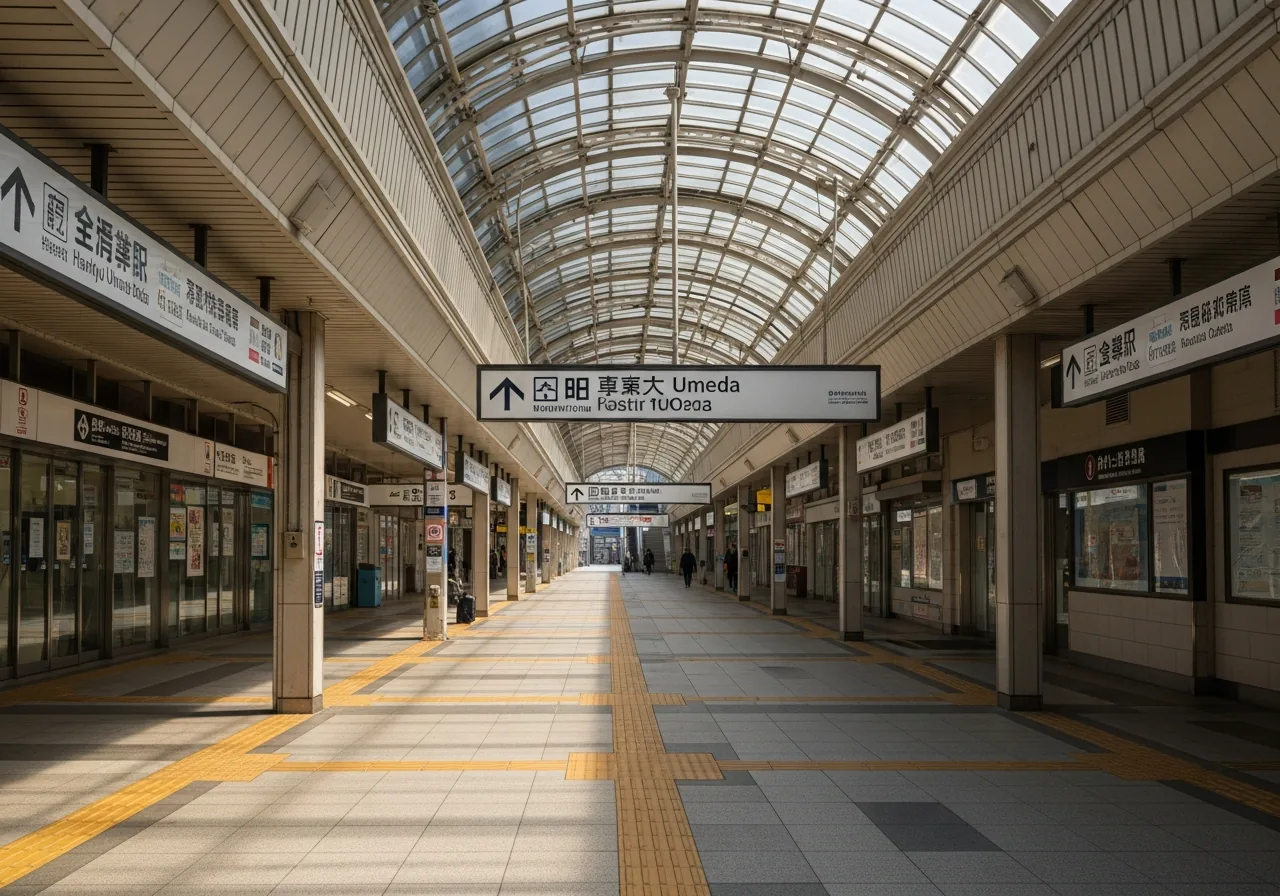
Stand at Hankyu Osaka-Umeda Station on a Friday evening and watch what happens. The trains arrive from Takarazuka, from Kobe, from Kyoto, disgorging tens of thousands of people who do not simply pass through the concourse and leave.
They turn left into a department store. They ride escalators past food halls and fashion floors.
They carry bags home on trains that will deposit them at stations surrounded by residential neighborhoods the railway company itself built. The whole choreography — commute, shop, return to suburb — is so naturalized that it feels like geography.
It is not. It is a business model, and one man designed it.
Why Did a Banker from Yamanashi End Up Reshaping Osaka?
Ichizo Kobayashi was born on January 3, 1873, in Kawarabe village in Yamanashi Prefecture, to a merchant family that traded under the name “Nunoya.” He was born into a wealthy merchant family, but his mother died immediately after his birth and his father left the family, leaving Kobayashi under the care of his uncle. The name Ichizo — “one-three” — was given for his birthday. It is the kind of biographical detail that feels almost too neat: a man defined by precision and system, named for a date.
After graduating from Keio Gijuku, Kobayashi joined Mitsui Bank in 1893. He was among those Keio graduates recruited by Hikojiro Nakamigawa to join the Mitsui family business, becoming one of prewar Japan’s leading salaried managers. Fourteen years in banking gave him something more valuable than capital: it gave him a financier’s instinct for risk, and a clear-eyed understanding of how land, credit, and population flows interact.
The Japan he was navigating in 1907 was in the grip of a post-Russo-Japanese War recession. The establishment of the Mino-Arima Electric Railway, with the right to build a railroad connecting Osaka, Minoh, Arima, Takarazuka, and Nishinomiya, was thought problematic.
There was difficulty in underwriting securities owing to the post-Russo-Japanese recession and a low number of expected passengers given the small population along the rail line. Nobody wanted to invest in a line to nowhere.
Kobayashi saw that as the opportunity.
After leaving Mitsui Bank in 1907, Ichizo became involved in the establishment of the Minoh-Arima Electric Railway (later known as Hankyu Railway) near Osaka. The question that defined the next half-century of his life was simple: how do you make a railway profitable when the land it runs through has almost no one living on it? His answer was to put people there himself.
Why Build Houses to Sell Train Tickets?
The conventional railway logic of the era was reactive: you built a line between two existing population centers and charged for the journey. Kobayashi reversed the causality. When Ichizo Kobayashi founded the Mino-Arima Electric Railway Company, he realised that expanding demand for transportation services would depend on creating residential districts in areas alongside the lines, which were ideal for such developments.
The first line opened on March 10, 1910, running from Umeda in central Osaka to Takarazuka and from Ishibashi to Minoh. In Ikeda-Muromachi, on the early Takarazuka Line, he started a land and housing subdivision sale business immediately after the launch of railway services. By accepting the long-term monthly-instalment payment method, which at the time was revolutionary, he was able to capture rapidly emerging demand.
This was not a minor innovation. In 1910, Japanese urban workers did not own homes.
They rented. Homeownership was a prerogative of the wealthy or the rural.
Before Hankyu Railway, integrated real estate development was virtually nonexistent. Kobayashi pioneered the concept of affordable housing along railway lines, facilitating modern suburban living in Japan.
His vision fostered a new social class, where homeownership represented dignity and personal achievement, drawing inspiration from Western ideals.
The Ikeda-Muromachi residential area, launched in 1910, represented Japan’s first major private railway-sponsored suburban estate, emphasizing detached homes, green spaces, and integrated amenities to attract middle-class commuters from Osaka. This modernization was spearheaded by the Hankyu Railway, whose extension to Ikeda in 1910 facilitated large-scale suburban housing projects. Ikeda sits roughly 16 kilometers from central Osaka — close enough for a daily commute, far enough for a garden.
Unlike houses in the middle of big cities, Kobayashi’s homes were spacious, open, and, most importantly, affordable. To fill them with people, the industrialist proposed selling the houses through a program of low-interest loans created specifically for the working man, all to help ordinary people achieve their dream of owning their own homes.
The installment plan was the key mechanism. It democratized a transaction that had previously required a lump sum most salaried workers could never accumulate.
The academic study published in Home Cultures by Nozawa and Lintonbon, drawing on Hankyu’s own housing catalogues and the company’s monthly magazine Sanyō-suitai, shows how deliberately Kobayashi constructed not just houses but an aspirational identity around them. The cultural production of Japanese suburban housing between 1910 and 1939 was informed by changing perceptions of family and self in relation to domestic space and the everyday. Hankyu presented itself as a cultural authority for middle-class families in a wide range of enterprises, including the construction of suburban estates.
Hankyu’s monthly magazine Sanyō-suitai, published between 1912 and 1917, urged readers to admire the changing seasons and rustic scenery through gardening, strolling, and visiting local festivals. This quasi-didactic periodical served as an event calendar that ordered kinds of recreational activities according to the seasons.
Kobayashi was not selling square footage. He was selling a way of life — and the railway was the only way to access it.
The Self-Reinforcing Loop
Kobayashi developed a powerful idea: acquire or build a railway line, develop real estate along the route, attract residents and businesses, and then reinvest the profits back into the railway. Better trains increased land value, which funded further development — a self-reinforcing cycle.
This loop is now so familiar in East Asian urban development that it is easy to forget it had to be invented. Before Kobayashi, no one had assembled all the pieces in sequence.
The land sales funded the railway operations. The railway operations made the land valuable.
The rising land value justified further residential development. Each new resident was a permanent, recurring passenger.
The model was not a railway business with a real estate sideline — it was a single integrated organism.
Why Did a Failed Swimming Pool Produce Japan’s Most Famous Theater Company?
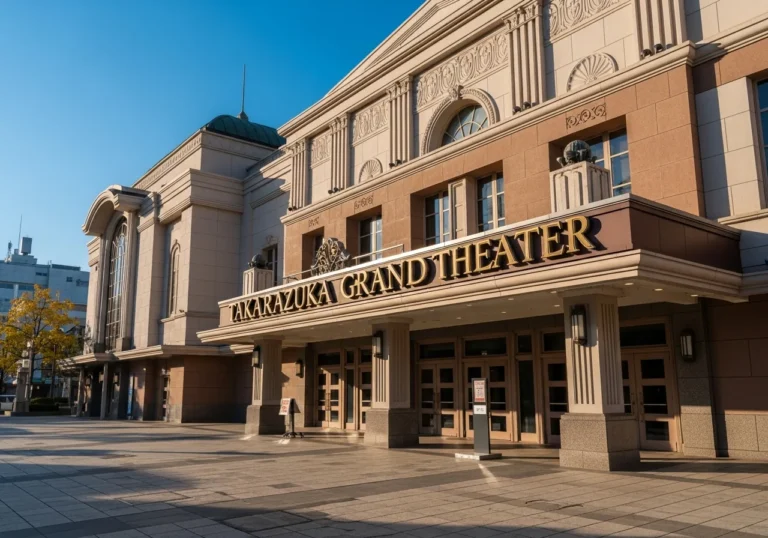
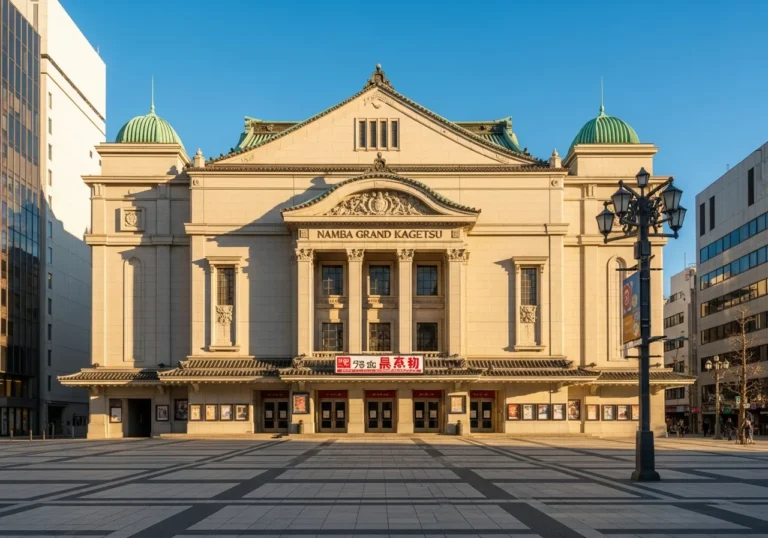
The Takarazuka Revue is now one of the most recognizable cultural institutions in Japan, performing to millions of fans annually at its Grand Theater in Hyogo and its Tokyo venue. Its origin is considerably more bathetic.
When the rail connection was established in 1910, Takarazuka was just a village with a mediocre hot springs resort on the right bank of the Muko River. On the left bank, where the Takarazuka Grand Theater now stands, there were only a few farmhouses scattered here and there by a peaceful pine forest stretching along the river.
Kobayashi needed a reason for Osaka residents to ride his train to the end of the line. Kobayashi opened a hot spring resort in Takarazuka in 1912, hoping the attraction would encourage Osaka city dwellers to use his railway line.
The resort’s marble baths were a genuine success. But the indoor swimming pool attached to the “Paradise” leisure complex — built to extend the resort’s appeal — was not.
The resort had to close after two months. That is when the idea of using this venue to provide theatrical entertainment struck Kobayashi, and the Takarazuka Revue was born.
The indoor pool was converted into a theater. The first performance was held on April 1, 1914, in Paradise Theater, the indoor pool that was converted into a theater hall.
The date — April Fool’s Day — was not chosen for irony. It was simply when the girls were ready.
Why girls? And why all-female?
Since Western song and dance shows were becoming more popular and Kobayashi considered the kabuki theater to be old and elitist, he decided that an all-female theater group might be well received by the general public. There was also a practical calculation: an all-female troupe performing clean, family-friendly shows could be marketed to exactly the demographic Kobayashi was building his suburbs for — respectable middle-class families who would not attend the more risqué entertainment available in the city.
Kobayashi took inspiration from the youth ensemble that the Mitsukoshi Department Store had used to attract customers in Tokyo. This group of 20 to 30 fresh-faced teenage boy musicians, wearing Western-style clothes and feathered hats worn at an angle, were highly successful in publicizing the store. He adapted the concept, substituting girls for boys, and adding theatrical performance to musical entertainment.
In 1913, Kobayashi hired 16 girls in their mid-teens. The next year they performed three times as the Takarazuka Girls’ Revue. These productions, presented to audiences free of charge, took place at a theater converted from an indoor swimming pool in a building attached to the main resort.
The motto he gave the company — Kiyoku, Tadashiku, Utsukushiku, rendered in English as “Modesty, Fairness, Grace” — was not merely aesthetic. His goal with the revue company was to offer “popular theatrical entertainment that the whole family can enjoy together.” The Revue was engineered to be safe for the same suburban families who were buying his houses. It was, in the most precise sense, a vertically integrated cultural product.
From Pool to Grand Theater: The Revue’s Explosive Growth
The popularity of the Revue among tourists led the performances to be held regularly, four times a year. In 1918, the girls appeared at the Imperial Theater in Tokyo, and by 1924 they had their own Takarazuka Grand Theater with a capacity of around 4,000. The growth from a converted swimming pool to a 4,000-seat purpose-built theater in a decade is one of the more remarkable institutional expansions in Japanese cultural history.
The Takarazuka was the first troupe to introduce the revue-style show to Japan with their 1927 performance, “Mon Paris.” By the late 1930s, the company was touring Europe and North America. In the 1930s, the Takarazuka Revue pursued expansion amid Japan’s militaristic shift, opening the Tokyo Takarazuka Theater in January 1934 to broaden domestic access and launching its first overseas tour to Europe from late 1938 to early 1939. This tour, dubbed the “Germany-Italy Art Mission,” featured 30 performers across 25 cities in Germany, Poland, and Italy.
What had begun as a device to sell train tickets to Takarazuka had become a national institution — and a geopolitical instrument. The railway logic had long since been transcended by the cultural logic. The Revue now generated its own gravity.
Why Put a Department Store Inside a Train Station?
By the mid-1920s, Kobayashi had a problem that was, in the best sense, a success problem. His Umeda terminus in Osaka was handling enormous passenger volumes.
People were arriving and departing in their hundreds of thousands. And then they were leaving the station and going to shop somewhere else.
The conventional wisdom of the era held that retail and railway infrastructure should be kept separate. During the early 20th century, Japanese clothing stores and restaurants used to be located far from train stations, supposedly so that the noise wouldn’t bother customers.
Kobayashi found this logic absurd. The noise was not the problem.
The distance was the problem.
In 1925, under the direction of Ichizo Kobayashi, Hankyu Market, the predecessor to Hankyu Department Store, opened in Umeda as a directly managed market division of Hankyu Corporation. He first invited the established kimono-store-based department store Shirokiya to operate within the Hankyu Umeda Building, and when that proved successful, he terminated the contract and launched his own operation. Based on the accumulated data and know-how, in 1929 he established “Hankyu Department Store,” Japan’s first directly operated department store by a railway company.
“In April 1929, Hankyu Department Store was born as the world’s first railway terminal department store. At the time, many Japanese department stores originated as kimono shops, and there were no examples of railway companies operating department stores directly, even outside of Japan.” — Hankyu Hanshin Department Store official history
This innovative design, spearheaded by Kobayashi, allowed commuters to access trains from within the store, capitalizing on the hundreds of thousands of daily passengers to drive foot traffic. The store was not adjacent to the station.
It was the station. Trains terminated inside the building.
You stepped off the platform and into a retail floor.
It became the first railway terminal department store, designed to serve several hundred thousand daily commuters, and as such heralded a new wave of Japanese retailers. This wave was characterized by the opening of department stores by railroad companies on prime sites along the railway lines, in particular at important terminals and main interchange stations, and using capital from their parent companies.
The pricing strategy was as deliberate as the architecture. Even more popular were the prices, which, like the houses along the train line, were more affordable than what was available in most stores, all for the sake of the common man.
Kobayashi was not building a luxury emporium for the elite. He was building a department store for the same middle-class families who lived in his Ikeda suburbs and rode his trains every day.
The whole system was calibrated to the same customer.
Founder Ichizo Kobayashi created the original model for Japan’s private railway management, which integrated urban development and distribution businesses centered around the railway to create synergistic effects. The department store was the capstone of that integration.
The suburb generated the commuter. The commuter generated the passenger.
The passenger generated the shopper. The shopper funded the railway.
The railway made the suburb viable. The circle was complete.
Why Did He Need a Film Studio in Tokyo?
By 1932, Kobayashi’s Osaka empire was mature. The railway ran.
The suburbs were populated. The department store was profitable.
The Revue was famous. A lesser entrepreneur would have consolidated.
Kobayashi expanded — into Tokyo, and into film.
Toho was created by the founder of the Hankyu Railway, Ichizō Kobayashi, in 1932 as the Tokyo-Takarazuka Theatre Company. It managed much of the kabuki in Tokyo and, among other properties, the eponymous Tokyo Takarazuka Theatre and the Imperial Garden Theater in Tokyo.
The logic was an extension of the Osaka model. Kobayashi aimed to build a vertically integrated entertainment empire encompassing theater, production, distribution, and exhibition, leveraging his railway business model. In Tokyo, he did not have a railway to anchor the enterprise — but he had the Takarazuka brand, which was already nationally famous, and he had the financial architecture to acquire and develop theater real estate in the capital’s most desirable entertainment districts.
Japan’s first all-female entertainment troupe was a spectacular success, and Kobayashi soon acquired the prestigious Nihongekijo Theater (Nichigeki) in Tokyo and opened its doors to the public for a lower admission price than that of his rivals, an unprecedented move in the business at that time. The democratizing instinct — lower prices, broader access — was consistent across every sector he entered.
Founded in 1932 by Ichizō Kobayashi as the Tokyo-Takarazuka Theatre Company amid Japan’s burgeoning entertainment industry, Toho expanded into film through the integration of studios like Photo Chemical Laboratories (PCL) and became a dominant player in motion pictures by the late 1930s. The studio that would eventually produce Akira Kurosawa’s films, the Godzilla franchise, and Studio Ghibli’s theatrical releases was, at its origin, a device to extend the Hankyu brand into the national capital.
The Toho corporate history frames the founding mission as “to widely provide inspiring entertainment to the general public” — language that could have been lifted directly from Kobayashi’s Takarazuka manifesto. The mission was identical. Only the medium changed.
Why Did the Model Survive the War — and Then Conquer Japan?
Kobayashi’s political career was brief and, by his own standards, unsuccessful. In 1940, he became the first private citizen appointed as minister of commerce and industry when he joined the cabinet of Konoe Fumimaro. However, disagreements with future Prime Minister Kishi Nobusuke led to his resignation after less than a year.
The specific disagreement was revealing. The plan formulated by Planning Board chief Hoshino aimed to take economic power from the zaibatsu and concentrate it in the government, but this was denounced as “communistic” by industry minister Ichizo Kobayashi and the Keidanren.
Kobayashi was, at his core, a private-sector man. He believed in the market — specifically, in the kind of market he had built, where private capital created public goods.
State control of industry was antithetical to everything he had constructed.
Following the end of World War II, in 1945 he was appointed minister of state and president of the War Damage Rehabilitation Board, but he was quickly purged from this position. The American occupation’s purge of wartime figures swept him out of public life. He returned to Ikeda, to his house, to his art collection, and to his companies — which had survived the war largely intact.
The survival of the Hankyu model through the war and into the postwar economic miracle was not accidental. The model was structurally resilient because it was not dependent on any single revenue stream.
When the department store was requisitioned by occupation forces as a distribution point for food and clothing, the railway kept running. When the Takarazuka theater was taken over by the military and then by the Allied occupation, the suburban housing estates kept generating passengers.
The diversification that Kobayashi had built for commercial reasons turned out to be a hedge against catastrophe.
More Kobayashi land and housing projects followed the laying of railway lines nationwide, creating a business model for the whole private railway industry. In the postwar decades, every major Japanese private railway operator — Tokyu, Odakyu, Seibu, Keio in Tokyo; Kintetsu and Nankai in the Kansai region — adopted variations of the Hankyu model.
Other companies emulated Hankyu’s example: Tokyo Disneyland is a collaboration between Disney and the Keisei Railway, while Hanshin in Osaka owns the Hanshin Tigers baseball team. The amusement park at the end of the line, the department store at the terminus, the residential estates along the route — these are all Kobayashi’s inventions, replicated across the entire country.
Such a business model established by Kobayashi was followed by other railway companies in Japan. The Springer academic study on Kobayashi’s urbanization leadership places him alongside Yasuzaemon Matsunaga — the architect of Japan’s postwar electricity system — as one of the two figures most responsible for Japan’s transition to a mass consumer society.
The biggest change was rapid progress in urbanization and electrification, improving the standard of living and giving rise to a mass consumer society — a growth track ultimately leading to prosperity fully realized after World War II. The leaders in that transition were Ichizo Kobayashi in urbanization and Yasuzaemon Matsunaga in electrification.
Why Does Any of This Matter to a Traveler in 2026?
The question a discerning traveler should ask is not “what did Kobayashi build?” but “what kind of city did he make possible?” The answer is the city you are standing in.
Osaka’s Umeda district — the dense, layered, commercially exuberant quarter around the northern railway terminals — is Kobayashi’s creation more than any other individual’s. Osaka’s Hankyu Umeda Station stands as the busiest station in southwestern Japan, serving over 2 million people daily.
This vibrant transportation hub is not only a gateway to the city but also teems with shopping complexes, restaurants, and panoramic views of Osaka. The specific form of that density — retail stacked above platforms, commuters flowing through commercial space, the station as the center of civic life rather than merely a transit point — is Kobayashi’s invention.
The Takarazuka Revue, which still performs to packed houses more than a century after that first April Fool’s Day performance in a converted swimming pool, is one of the most singular cultural institutions in the world. One of the most unique aspects of the Takarazuka Revue is that all theatrical company members are women.
As such, women play both male and female roles on stage. The gender dynamics of the Revue — the otokoyaku who specialize in male roles, the musumeyaku who play female roles, the intense fan culture built around both — have generated a substantial body of academic analysis and remain genuinely unlike anything else in global theater.
It is accessible from Umeda in thirty minutes on a Hankyu express.
The suburban residential character of the Hankyu corridor — the quiet, tree-lined streets of Ikeda, Toyonaka, Nishinomiya, and Ashiya that feel so different from the industrial density of inner Osaka — is also Kobayashi’s work. This was Japan’s first example of comprehensive suburban development aimed at the middle class. Ikeda became the prototype for all of Japan’s modern “bedroom communities.” When you walk through those neighborhoods today, you are walking through the physical realization of a business plan drawn up in 1907 by a banker who had never built a house.
For the intellectually curious traveler, what Kobayashi offers is something rarer than a monument or a museum: a legible system. You can ride the Takarazuka Line from Umeda to Ikeda, step off at the station, walk to the Muromachi district where the first suburban plots were sold in 1910, visit the Kobayashi Ichizo Memorial Museum in his former residence, and then ride back through the department store concourse at Umeda — and the entire logic of modern Japanese urban life will have passed through your hands.
The city is the argument. You just have to know what you are looking at.
The Man Himself: What Kind of Person Builds All This?
Kobayashi was not a romantic visionary in the mold of a Meiji-era nation-builder. He was a pragmatist with aesthetic sensibilities — a combination that is rarer and more productive than either quality alone.
The company was the brainchild of Kobayashi Ichizō, the founder of the Hankyū Tōhō Group and a brilliant businessman. Kobayashi was also known as a man of culture with a love of the tea ceremony, fine art, and theater.
His pseudonym, Itsuo, was the name under which he collected art. The collection, built up by founder Kobayashi Ichizō, whose pseudonym was Itsuō, comprises some 5,500 works, including fifteen Important Cultural Properties and twenty Important Art Objects.
The Itsuo Art Museum in Ikeda, which houses this collection, is a short walk from his former residence.
He wrote more than twenty theatrical pieces for the Takarazuka Revue himself. He designed one of the tea rooms at his Ikeda residence, Sokuan, in a chair-style that blended Japanese and Western aesthetics.
His former residence, “Gazoku Sanso,” a reinforced-concrete structure blending Japanese and Western styles, features a half-timber exterior, Tudor-style interiors, and a Japanese-style tiled roof; it was built in 1937. The building is a physical expression of his sensibility: Western structure, Japanese surface, the two held in productive tension.
He was also, by the standards of his era, a democrat in his commercial instincts. Every major initiative — the installment-plan housing, the affordable department store, the family-friendly theater, the lower-priced Tokyo venues — was oriented toward the middle class and the working man rather than the elite.
His vision fostered a new social class, where homeownership represented dignity and personal achievement, drawing inspiration from Western ideals. This was not philanthropy.
It was market strategy. But the effect was genuinely democratizing.
He died on January 25, 1957, in Ikeda — the city he had built — at the age of 84. The Kobayashi Ichizo Memorial Museum opened in 2010 as a facility showcasing the achievements of Kobayashi Ichizo, centered around his former residence, the Western-style building “Gasoku Sanso.” The museum is quiet, unhurried, and almost entirely unknown to foreign visitors. It is one of the most rewarding half-days available in the Osaka metropolitan area.
The Deeper Why: What Does the Kobayashi Model Mean?
Strip away the specifics — the Takarazuka girls, the marble baths, the maroon trains — and what Kobayashi invented was a method for making urban infrastructure self-financing through the creation of demand rather than the satisfaction of existing demand. He did not build a railway to serve a population. He built a population to serve a railway.
This inversion has enormous implications. It means that private capital can build cities — not just buildings within cities, but the social and economic fabric of urban life itself.
It means that entertainment, retail, and residential development are not separate industries but components of a single system. And it means that the quality of urban life is, at least in part, a function of the quality of the business model underlying it.
In the early 20th century, private railway companies didn’t just run trains — they built cities. This model was most clearly articulated by Kobayashi Ichizō, the founder of Hankyu Railway. Kobayashi developed a powerful idea: acquire or build a railway line, develop real estate along the route, attract residents and businesses, and then reinvest the profits back into the railway.
The model has been exported far beyond Japan. The MTR Corporation in Hong Kong, which operates one of the world’s most financially successful metro systems, explicitly credits the Kobayashi model — rail plus property development — as the foundation of its business strategy. The integrated transit-retail-residential developments that now define urban cores from Singapore to Seoul to Shanghai all descend, in some measure, from the logic that a former Mitsui banker assembled on the unpopulated hills north of Osaka in 1910.
When you stand at Umeda and watch the evening crowds move through the Hankyu concourse — the commuters, the shoppers, the families heading home to the suburbs — you are watching a system that has been running, in its essential form, for more than a century. It works because one man understood that a railway is not a transport service.
It is a city-building machine. And he was the first person anywhere to build one deliberately.
Frequently Asked Questions
Q: Who was Ichizo Kobayashi?
A: Ichizo Kobayashi (1873–1957) was a Japanese industrialist and the founder of Hankyu Railway, the Takarazuka Revue, and Toho. He is credited with inventing the integrated private railway business model — combining suburban housing development, terminal retail, and destination entertainment — that became the template for Japanese urban development and influenced transit-oriented development worldwide.
Q: What is the Kobayashi business model?
A: Kobayashi’s model involved building a railway into underpopulated areas, then simultaneously developing affordable suburban housing estates along the line, creating leisure destinations at the terminus to attract passengers, and eventually placing a department store at the urban terminal. Each element generated revenue that supported the others, creating a self-reinforcing economic loop.
Q: What did Kobayashi invent that was genuinely new?
A: Three things with no clear precedent: the private railway-sponsored suburban housing estate sold on installment plans (Ikeda-Muromachi, 1910); the railway terminal department store integrated directly into the station building (Hankyu Umeda, 1929); and the use of a purpose-built entertainment company (the Takarazuka Revue) as a permanent passenger-generation device for a railway line.
Q: Can I visit places connected to Kobayashi in Osaka?
A: Yes. The Kobayashi Ichizo Memorial Museum in Ikeda (his former residence, Gazoku Sanso) is the primary site.
The Hankyu Umeda Department Store in Osaka is the direct descendant of his 1929 terminal store. The Takarazuka Grand Theater in Takarazuka is accessible in 30 minutes from Umeda on the Hankyu Takarazuka Line — the same line Kobayashi opened in 1910.
Q: How did Kobayashi’s model influence cities outside Japan?
A: The most direct international application is Hong Kong’s MTR Corporation, which explicitly uses a “rail plus property” model derived from the Hankyu precedent. Transit-oriented development strategies in Singapore, Seoul, and numerous Chinese cities also reflect the core Kobayashi logic of using railway infrastructure to anchor and finance residential and commercial development.
Kobayashi Ichizo Memorial Museum — Visitor Information
Address: 7-17 Tateishicho, Ikeda, Osaka 563-0053 / 〒563-0053 大阪府池田市建石町7-17
Nearest station: Hankyu Takarazuka Line — Ikeda Station, approx. 8 minutes on foot
Hours: Typically 10:00–17:00 (last entry 16:30); closed Mondays and year-end/New Year. Hours are variable — confirm on the official site before visiting.
Admission: Approx. ¥500–¥700 (subject to change; confirm on official site). The garden and exterior are partially viewable without admission.
Official site: hankyu-bunka.or.jp