Godai Tomoatsu (五代友厚) did not merely participate in Osaka’s modernization — he engineered it from scratch, arriving in a city whose merchant class had been financially gutted by the Meiji Restoration and building, within fifteen years, the institutions that still define Osaka’s commercial identity: the Stock Exchange, the Chamber of Commerce, the Mint, and the university that became Osaka Metropolitan University. He died in 1885 at forty-nine, having transformed a city on the verge of collapse into what contemporaries called “the Manchester of the East” — and he did it not as a bureaucrat, but as a samurai who had been taken prisoner by the British Royal Navy and decided, in that moment of captivity, that Japan had to change.
Why we can tell you this — MICHI is written by an Osaka-based editorial team; we can walk from Kitahama Station to the bronze statue of Godai that stands in front of the Osaka Exchange building, and from there to the Mint Museum on the Okawa riverbank, and trace his institutional legacy in a single afternoon. This piece draws on the National Diet Library’s biographical record of Godai, the official institutional history of Osaka City University (now Osaka Metropolitan University), the Japan Mint’s own historical account, academic work on the Anglo-Satsuma War, and contemporary Japanese-language reporting. Where the record is genuinely contested — particularly around the Hokkaido scandal of 1881 — we say so plainly.
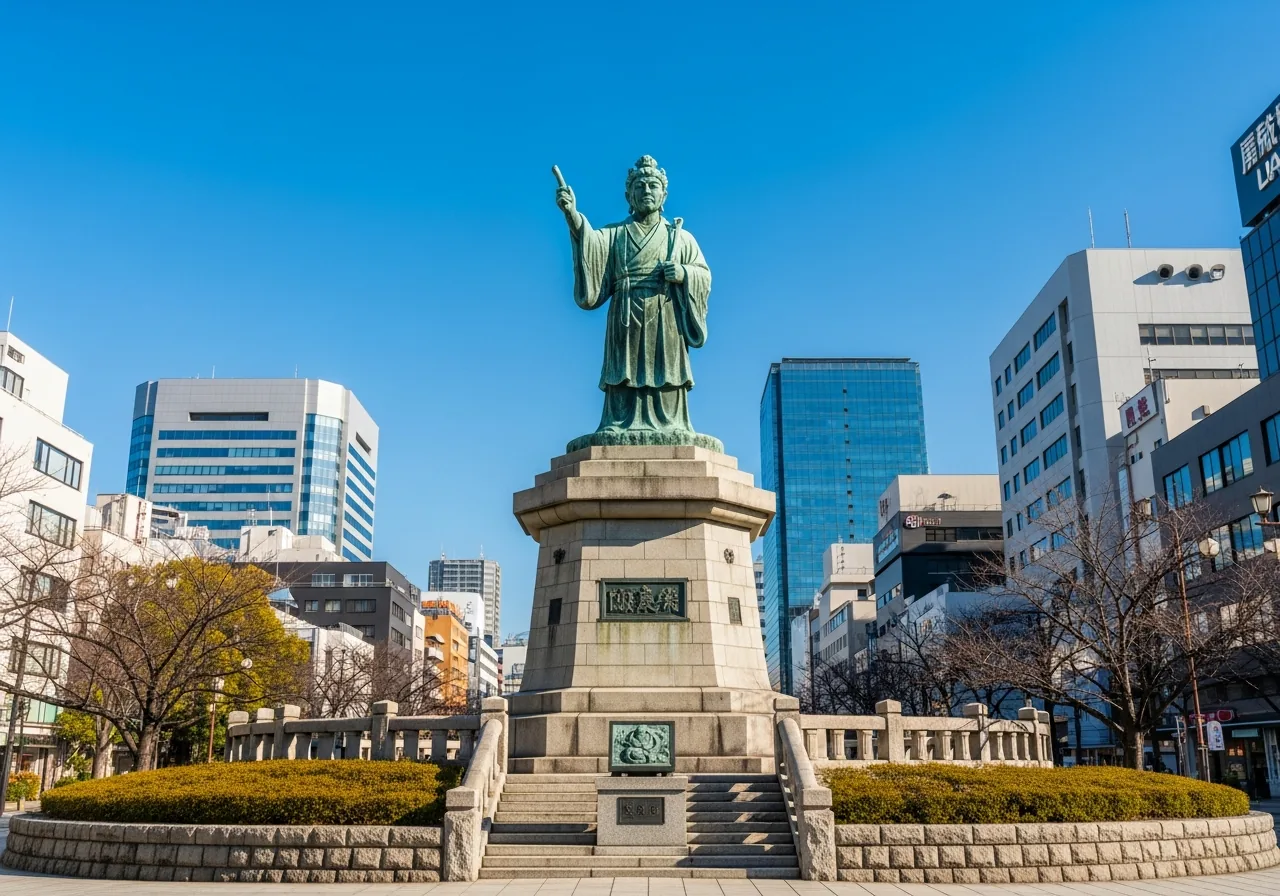
Stand at the Kitahama intersection on a weekday morning and the city moves around you in the particular way that financial districts do: purposeful, slightly compressed, the air smelling of the Tosabori River just behind you. The Osaka Exchange building rises on the corner — its 1935 cylindrical facade preserved inside a glass tower rebuilt in 2004 — and in front of it, cast in bronze and standing 7.8 metres tall, is a man in Western dress looking south toward the water.
Most people who pass him are on their phones. A few tourists stop for photographs.
Almost nobody, in our experience, knows the full story of what he actually did, or why it required someone who had been a prisoner of the Royal Navy to do it.
Why Was Osaka on the Verge of Collapse in 1868?
To understand what Godai rescued, you first need to understand what Osaka had been — and what the Meiji Restoration did to it.
During the Edo period (1603–1868), Osaka earned the nickname “the nation’s kitchen” (天下の台所, tenka no daidokoro), as rice and other goods from all over the country flowed here for further distribution. This was not a metaphor.
Every domain in Japan sent its annual rice tax to Osaka. It arrived in huge warehouses (kurayashiki) owned by powerful merchant families.
From there, rice was sold, traded, loaned, and turned into the lifeblood of the entire economy.
The city’s merchants — the chōnin — had grown extraordinarily sophisticated. Right in the middle of this rice economy, something extraordinary happened: the world’s first organized futures market was born at the Dojima Rice Exchange.
Merchants didn’t just trade physical rice — they traded “rice coupons” (choaimai) representing future harvests. This was sophisticated financial engineering centuries before Wall Street existed.
But the Confucian social order of the Tokugawa shogunate placed merchants at the bottom of the hierarchy, below samurai, farmers, and artisans. Despite Osaka’s commercial dominance, merchants were still considered to be at the bottom of the Confucian hierarchy put in place by the ruling samurai.
And the daimyo — the feudal lords — had spent two centuries treating Osaka’s merchant houses as a convenient treasury. The governments of the shogun and daimyo habitually forced merchants to “loan” money to them, but never paid it back, thereby hindering the growth of the merchant class.
When the Meiji Restoration arrived in 1868, it did not liberate Osaka’s merchants. It destroyed them.
Osaka was the largest commercial city in Japan in the feudal years, though it was on the verge of collapse. Because most of the super-wealthy merchants in Osaka, who supported the prosperity of that region, went bankrupt due to daimyo-gashi — meaning forced cancellation of money lending to feudal lords.
The new government simply repudiated the debts that the old domains owed to Osaka’s merchant houses. Centuries of accumulated credit evaporated overnight.
The political capital had already shifted to Tokyo (formerly Edo). Now the financial logic that had sustained Osaka — the flow of domain rice revenues through its warehouses — was dismantled along with the domain system itself. Godai himself would later say that Osaka’s economy was “just about to collapse.”
This is the context in which Godai Tomoatsu arrived in Osaka in 1868, aged thirty-two, as the newly appointed head of the Osaka Customs Department. He was not a local.
He was a Satsuma samurai from Kyushu, a man who had been to Britain, survived a naval bombardment, and spent years in Europe studying how modern economies actually worked. And he had a plan.
Why Did a Samurai from Kagoshima End Up Rebuilding Osaka?
The answer begins with a cannon shot in August 1863.
Tomoatsu Godai was a Japanese samurai who served as a feudal retainer of the Satsuma clan at the end of the Edo period, and a businessman in the Meiji period. He was born in the castle town of Kagoshima, Satsuma domain, as the second son of a local magistrate holding the hereditary title of atai (regional administrator) and a strict Confucianist.
His childhood name was Tokusuke. He was sent to cram school at the age of eight and later educated in both sciences and martial arts.
In 1857, his domain sent him to Nagasaki to study naval science and technology.
Nagasaki was, at the time, Japan’s only sanctioned window onto the outside world. Godai attended the Nagasaki Naval Training Center and in 1862 went to Shanghai to procure a German steamboat.
He captained it himself. He was already, by his mid-twenties, a man who moved between worlds that most Japanese of his era never glimpsed.
Then came the war that changed everything. The Bombardment of Kagoshima, also known as the Anglo-Satsuma War (薩英戦争, Satsu-Ei Sensō), was a military engagement fought between Britain and the Satsuma Domain in Kagoshima from 15 to 17 August 1863.
The British had come to extract compensation following the Namamugi Incident of 1862, in which a British merchant had been killed by Satsuma samurai. The engagement began when a Royal Navy fleet commanded by Sir Augustus Kuper was fired on from Satsuma coastal batteries near Kagoshima.
The British retaliated by bombarding the city, but were unable to gain a conclusive victory and retreated two days later.
At the outbreak of the Anglo-Satsuma War of 1864, Godai was appointed captain of the Ten’yū Maru. Along with Matsuki Koan, he was taken prisoner by the Royal Navy when his ship was captured. Released, he was forced to hide, as some in Satsuma suspected him of betraying them to England.
This is the pivot point. Most samurai of his generation experienced the encounter with Western military power as humiliation — and responded with intensified xenophobia.
Godai responded differently. With a sense of urgency, Godai submitted a written report to the Satsuma clan regarding the reforms aimed at modernizing Japan, around June of 1864.
He said that people should study abroad and learn Western technology so that they could help facilitate the modernization of Japan, otherwise Japan would be behind the times.
The domain listened. Surprisingly, the bombardment led to a rapid reconciliation between the two parties, with Satsuma agreeing to pay the demanded reparations and even entering into a productive trade relationship with Britain. And Godai was at the centre of that new relationship.
Why Did Britain Become Godai’s Classroom?
In 1865, Godai led one of the most consequential covert missions in Japanese history. He was one of the Satsuma students of 1865 who were smuggled out of Bakumatsu period Japan to study in Great Britain — in direct defiance of the Tokugawa shogunate’s national seclusion policy. He was chosen as one of fifteen students to be sent to Great Britain to study at University College London.
The group’s contact in Britain was the Scottish merchant Thomas Blake Glover, who had already helped the Chōshū Five — a group that included the future prime minister Itō Hirobumi — reach England. Glover later went on to help nineteen samurai from Satsuma reach England in 1865. The leader of the Satsuma party was Godai Tomoatsu, who later reigned as the doyen of the Osaka business world.
What Godai saw in Britain was not merely technology. It was a system.
In 1865, Godai made contact with Thomas Glover who steered negotiations with the Platt textile machinery giant in Oldham, Lancashire, England. This visit led to the establishment of the Kagoshima Mill in Satsuma in 1867 — reputed to be Japan’s first modern factory.
Godai’s UK visit also included the Manchester Chamber of Commerce — reputed to have inspired the foundation of the pioneering Osaka Chamber of Commerce and Industry.
This detail matters enormously. The Manchester Chamber of Commerce was not just a trade association; it was a model of how private-sector interests could organize themselves to lobby government, set standards, resolve disputes, and collectively shape economic policy.
Godai filed it away. He would reproduce it in Osaka fifteen years later, almost exactly.
Godai also negotiated with the Belgian-French diplomat Charles Montblanc to establish a joint commercial venture. This French-Satsuma trading company attracted French investment into the Satsuma domain to establish a steamship shipyard and textile (silk) spinning factories and to send promising students from Satsuma overseas. The company enabled Satsuma to participate as if it were an independent country in the Paris Exhibition of 1867, much to the consternation of the Tokugawa-government representatives.
That last point is worth pausing on. A feudal domain — technically a subordinate of the Tokugawa shogunate — presenting itself as a sovereign entity at a world exposition in Paris. Godai had turned commercial diplomacy into a form of political subversion.
Why Did He Choose Osaka Over Tokyo?
After the Meiji Restoration, Godai’s choices were not obvious. He had connections at the highest levels of the new government — the Satsuma and Chōshū clans that had overthrown the shogunate were now running Japan, and Godai was one of their most internationally experienced men.
In 1868, he became a san’yō (junior councilor) and an official in charge of foreign affairs in the newly formed Meiji government. He worked at Osaka to serve as Assistant Judicial Officer of the foreign affairs office and Osaka prefectural judge, and handled diplomatic issues.
He could have stayed in government. He could have gone to Tokyo, where the political action was.
Instead, he resigned from government service in 1869, and turned his full attention to business. Why?
The answer is partly strategic and partly ideological. Strategically, Godai understood that Osaka’s crisis was an opportunity.
The city’s merchant class had been devastated, its institutional infrastructure was primitive by Western standards, and the new government had neither the resources nor the expertise to rebuild it from Tokyo. Someone with capital connections, government relationships, and a vision of what modern commercial infrastructure looked like could fill that vacuum.
Ideologically, Godai had seen what private-sector-led development looked like in Britain. He was not a socialist or a statist; he believed in organized capitalism, in joint-stock companies, in chambers of commerce, in stock exchanges. These were the tools he wanted to deploy — and they required a commercial city, not a political capital.
Basing himself in Osaka, he created several major joint stock companies involved in international trade, commerce, and shipping, which he operated simultaneously. He made efforts to establish institutions such as the Osaka Stock Exchange, the Osaka Chamber of Commercial Law, and the Osaka Commercial Training Institute, and companies such as Osaka Seido (copper metallurgy), Kansai Boeki (trading), Kyodo Unyu (transport), Kobe Sanbashi (shipping), Osaka Shosen (shipping), and Hankai Railway (the predecessor of Nankai Electric Railway).
The breadth of that list is staggering. In the space of roughly fifteen years, Godai built or co-founded the institutional skeleton of a modern industrial city — from the exchange where capital was raised, to the chamber where merchants coordinated, to the school where the next generation of businesspeople would be trained, to the railways and shipping lines that moved goods in and out.
Why Did Osaka Need a Mint — and Why Did Godai Build It Here?
Before any of those institutions could function, Osaka needed something more fundamental: a reliable currency.
The Tokugawa monetary system had been chaotic for decades. Different domains issued different currencies; the shogunate had debased coinage repeatedly; and the arrival of Western trade had introduced silver-denominated international commerce that the existing system could not handle. Amongst the first acts of the Meiji government was the establishment of the Imperial Japanese Mint as a constructive step towards modernising Japan’s circulating currency.
The Mint was established in Osaka in 1871, and Godai’s role in bringing it there was direct. The embossing machine on the left at the Mint Museum was purchased from the Hong Kong Mint thanks to the efforts of Tomoatsu Godai, who was known for leading the Osaka economy during the Meiji Restoration.
There was no technology of manufacturing money in Japan in those days when the Meiji government established the Mint Bureau in Osaka. Tomoatsu Godai and others purchased a set of machines from the Hong Kong Mint Bureau, which was in a closed state.
Why Osaka and not Tokyo? Suggested reasons for the mint being founded in Osaka rather than Tokyo or elsewhere include concerns over public order in Tokyo, the then-recent proposals by some that Osaka should be the new capital, and an attempt to repay Osaka merchants whose financial backing the new government required in order to carry out its far-reaching reforms.
That last reason is the most revealing. The new Meiji government needed money to function, and the surviving Osaka merchant houses — even in their weakened state — were still the most sophisticated financial actors in Japan. Placing the Mint in Osaka was a political gesture as much as a logistical one: a signal that the new government valued the city’s commercial tradition and intended to rebuild it, not simply strip it for parts.
The inaugural ceremony was held on April 4th, 1871, and minting was commenced with Western-style facilities that were epoch-making in Japan in those days. Since heavy industry had not yet developed in Japan at that time, all heavy equipment had to be imported.
In addition, factories were built within the Mint compound for the production of sulfuric acid, soda, coal gas, and coke. The Mint was not merely a coin factory; it was Japan’s first integrated industrial complex, producing its own chemical inputs and training its own workforce.
It is generally said that Osaka, now the country’s center of commerce and industry, is indebted to the Mint for the city’s subsequent prosperity.
Why Did Osaka Need a Stock Exchange in 1878?
The Mint gave Osaka a currency. But currency alone does not create capital markets. For that, you need a place where ownership stakes in enterprises can be bought and sold — a mechanism for aggregating the savings of many investors into the large pools of capital that industrial enterprises require.
Japan had nothing of the kind in 1868. The Dojima Rice Exchange had been the closest thing — a sophisticated futures market for rice — but it was a commodity market, not an equity market.
The transition of Kitahama from an Edo-period hub to a modern capitalist engine was formalized in 1878 with the founding of the Osaka Securities Exchange. Crucially, the exchange was established on the site of the former Gold Exchange (金兌換市場), signaling a direct evolution from old-world currency exchange to modern shareholding.
The architect of this transition was Godai Tomoatsu. A visionary Meiji entrepreneur, Godai’s impact on the financial heart of Osaka cannot be overstated.
Godai, who was born in Kagoshima Prefecture in 1836, founded the Osaka Stock Exchange in 1878 with like-minded Osaka businessmen. As the first chairman, he devoted himself to promoting industrial modernization and laying the foundation for Osaka’s economic development.
The timing was not accidental. By 1878, Japan’s early Meiji industrial projects — railways, textiles, mining — had demonstrated that large-scale enterprise was possible.
But they had been funded primarily by the government, which was running out of money. By 1881, the government was on the brink of bankruptcy.
The only sustainable path to continued industrialization was private capital — and private capital required a market where it could be deployed and, crucially, liquidated.
The Stock Exchange was Godai’s answer to that problem. It was not just a building on a riverbank; it was the infrastructure of a new economic order, one in which private investors — not feudal lords, not the government — would allocate capital to productive enterprises.
The Chamber of Commerce: Organizing the Merchants
In the same year, 1878, Godai also founded the Osaka Chamber of Commerce — the institution that would become the Osaka Chamber of Commerce and Industry, which still operates today. In 1878, Godai Tomoatsu established the Osaka Chamber of Commerce (Osaka Shōkō Kaigisho), serving as its inaugural president and promoting collaborative business practices amid Japan’s rapid industrialization. This institution facilitated coordination among merchants, advocated for commercial policies, and supported Osaka’s emergence as an economic hub, reflecting Godai’s vision of organized private sector growth independent of direct government control.
The inspiration, as we noted, was Manchester. Godai’s UK visit had included the Manchester Chamber of Commerce — reputed to have inspired the foundation of the pioneering Osaka Chamber of Commerce and Industry.
But the context in Osaka was different from Manchester in one crucial respect: Osaka’s merchants had been atomized and demoralized by the Restoration. They needed not just a lobbying organization but a community — a place where trust could be rebuilt, disputes resolved, and collective interests articulated.
Godai ranked with Eiichi Shibusawa, who established the Tokyo Chamber of Commerce, being described as “Shibusawa and Godai were great contributors to the economy in Eastern and Western Japan, respectively.” The comparison is apt and the geography deliberate: while Shibusawa built the institutional infrastructure of capitalist Tokyo, Godai did the same for Osaka — and the two cities’ different commercial characters today, Tokyo’s more bureaucratic and Osaka’s more mercantile, reflect in part the different personalities of the men who shaped them.
Why Did He Build a University?
The Exchange and the Chamber addressed the immediate crisis of capital and coordination. But Godai was thinking further ahead. In 1880, he co-founded what would become one of the most consequential educational institutions in western Japan.
Osaka City University traces its beginnings back to 1880 with the founding of the Osaka Commercial Training Institute, the center of commercial and industrial study in Osaka. It was founded by sixteen people who strongly influenced the Osaka business world at that time, including the father of Osaka’s Economy, Tomoatsu Godai, who created the Osaka Chamber of Commercial Law and the Osaka Stock Exchange. At a time when business was “more about experience than learning” amongst the citizens of Osaka, Godai established the Osaka Commercial Training Institute with the words, “To compete with the developed countries of Europe and America, merchants also need to learn.”
That phrase — “merchants also need to learn” — is worth dwelling on. It was a direct challenge to the traditional Osaka merchant culture, which prized practical experience and hereditary knowledge over formal education.
Godai had seen, in Britain, that the industrial economy required a different kind of knowledge: systematic, theoretical, transferable. You could not run a joint-stock company or navigate international trade law on apprenticeship alone.
The institution developed into Osaka City Commercial School and Osaka University of Commerce in the pre-WWII educational system before becoming Osaka City University in 1949. After being reorganized into Osaka Metropolitan University in 2022, it continues as it is today.
Currently, a statue of Tomoatsu Godai has been erected in front of the School of Business building. This symbolizes that the Graduate School of Business and the School of Business have the most important position in Osaka Metropolitan University.
There are, as of 2026, five statues of Godai Tomoatsu in Osaka. No other figure in the city’s modern history has been commemorated so repeatedly or so publicly. The statues are not mere civic decoration; they are a collective acknowledgment, renewed across generations, that this man built the city’s economic foundations.
Why Did the Scandal of 1881 Not Destroy Him?
Godai’s story is not one of uncomplicated heroism. In 1881, he became the central figure in one of the most damaging political scandals of the early Meiji period.
In 1881, Godai Tomoatsu became centrally implicated in the Kaitakushi Kanyūbutsu Haraisage Jiken (Hokkaido Colonization Office Assets Disposal Incident), a major political scandal that contributed to the downfall of Prime Minister Kuroda Kiyotaka’s administration. The controversy arose from plans to sell off Kaitakushi assets — valued at approximately 20 million yen in investments — to Godai’s Kansai Trading Company for just 380,000 yen, a fraction of their supposed worth, amid the office’s impending abolition.
Critics, including opposition newspapers and figures aligned with the Freedom and People’s Rights Movement, decried the deal as cronyism, noting Godai’s shared Satsuma clan origins with Kuroda and alleging undue favoritism toward politically connected merchants (seishō). A scandal in 1881 relating to the sale of Commission assets at a heavy loss to a consortium of the Director’s associates, including Godai Tomoatsu, led to the abolition of the Hokkaidō Development Commission the following year.
The seishō label — “political merchant” — stuck to Godai and has never entirely been shaken off. His companies had such close links with the government that they were called seishō (political merchants).
While Godai defended the deals as necessary for efficient asset liquidation amid fiscal pressures, contemporaries and later historians critiqued them as emblematic of seishō exploitation, where political loyalty translated into economic windfalls without equivalent accountability. No formal charges were brought against Godai personally, but the affair tarnished his reputation and highlighted tensions between rapid modernization and equitable governance in early Meiji Japan.
Why, then, did the scandal not destroy his legacy? Partly because no charges were ever filed.
Partly because the institutions he had built — the Exchange, the Chamber, the school — were already functioning and clearly beneficial to Osaka, regardless of how they had been funded. And partly because the alternative reading of Godai’s career — that he was a man who used every tool available, including political connections, to build something that genuinely served the public interest — has always had its adherents.
The tension is real and unresolved. Godai was simultaneously a visionary institution-builder and a man who benefited enormously from his proximity to power. He was, in this sense, a recognizably modern figure: the kind of entrepreneur who operates in the grey zone between public interest and private gain, and whose legacy depends on which side of that line you choose to emphasize.
Why Did He Die So Young — and What Did He Leave Behind?
On September 25, 1885, at the age of forty-nine, Godai died of diabetes and was buried in Abeno Cemetery in Osaka. He had been ill for some time; the pace at which he had worked — running multiple companies simultaneously, founding institutions, navigating political crises — had taken its toll. He was awarded the Order of the Rising Sun, 4th class, shortly before his death.
The city mourned him publicly. Osaka locals erected his bronze statues after his death in front of the Chamber of Commerce and Industry of Osaka as well as the Osaka Exchange.
Both of the institutions were established by him about 150 years ago. The statues were not government commissions; they were paid for by the Osaka business community, by the merchants and industrialists whose city Godai had rebuilt.
What he left behind was not just a list of institutions. It was a model of how a commercial city could reinvent itself — not by waiting for the state to act, but by building the infrastructure of capitalism from the ground up: the exchange, the chamber, the school, the mint, the railways, the shipping lines. Each institution addressed a specific market failure; together, they constituted a system.
With the advent of the Meiji era in the late 19th century, Osaka began to rapidly transform into an industrial centre, earning the nickname “Manchester of the East.” That transformation was not inevitable. It required someone who had seen Manchester, understood what made it work, and had the will and the connections to reproduce its essential logic in a city that had been brought to its knees.
Why Should a Discerning Traveler Care About a Man Dead for 140 Years?
The honest answer is that Godai’s story illuminates something about Osaka that no amount of takoyaki tourism can reach: the city’s deep, structural commitment to commerce as a form of civic identity.
Osaka is not commercially minded because its people happen to like money. It is commercially minded because, at a specific historical moment, a specific man made a series of specific decisions that embedded commercial institutions into the city’s DNA. The Osaka Exchange, the Osaka Chamber of Commerce and Industry, and Osaka Metropolitan University are not background scenery; they are the direct descendants of choices Godai made between 1869 and 1885.
When you walk through Kitahama — past the 1935 Exchange building, past the Meiji-era banking facades, along the Tosabori River — you are walking through the physical residue of that project. His statue, standing outside the exchange, serves as a bridge between the feudal merchant tradition and the modern market. That is not hyperbole; it is a precise description of what Godai actually was.
There is also something in his biography that speaks to a broader question about how societies modernize. Godai was not a Westernizer in the simple sense — a man who wanted Japan to become Britain.
He was something more interesting: a man who had been taken prisoner by the British, studied their institutions carefully, and then selectively reproduced the ones that would work in a Japanese context. The Manchester Chamber of Commerce became the Osaka Chamber of Commerce.
The London Stock Exchange became the Osaka Stock Exchange. University College London’s model of commercial education became the Osaka Commercial Training Institute.
Each transplant was adapted, not copied.
That capacity for selective, intelligent adaptation — taking what works from elsewhere and making it your own — is arguably the defining characteristic of Osaka’s commercial culture. Godai did not invent it, but he institutionalized it at the moment when it mattered most.
Finally, there is the question of the seishō problem — the uncomfortable fact that Godai’s institution-building was entangled with political favoritism and, in the Hokkaido case, something that looks very much like corruption. This is not a reason to dismiss him; it is a reason to take him seriously as a historical figure rather than a civic monument.
The tension between public benefit and private advantage, between visionary entrepreneurship and crony capitalism, is not a Meiji-era curiosity. It is the permanent condition of capitalism everywhere, and Godai’s career is one of its earliest and most instructive Japanese case studies.
Stand in front of his statue at Kitahama and look at the building behind him — the Exchange that still bears his institutional DNA, now part of the Japan Exchange Group, now trading derivatives rather than cotton futures, but still on the same corner, still facing the same river. The city he rebuilt is still here. The question of how he rebuilt it, and at what cost, is still worth asking.
Frequently Asked Questions
Q: Where can I see Godai Tomoatsu’s statue in Osaka?
A: The most prominent statue stands in front of the Osaka Exchange building at 1-8-16 Kitahama, Chuo Ward — directly connected to Kitahama Station on the Osaka Metro Sakaisuji Line. Additional statues can be found at the Osaka Metropolitan University School of Business campus and at other locations across the city; Osaka has erected five statues in his honour in total.
Q: What institutions did Godai Tomoatsu found?
A: His major institutional legacies include the Osaka Stock Exchange (1878, now the Osaka Exchange), the Osaka Chamber of Commerce (1878, now the Osaka Chamber of Commerce and Industry), the Osaka Commercial Training Institute (1880, the predecessor of Osaka Metropolitan University), and his involvement in establishing the Japan Mint in Osaka (1871). He also co-founded multiple trading, shipping, mining, and railway companies.
Q: Was Godai Tomoatsu from Osaka?
A: No. He was born in Kagoshima, Satsuma domain (present-day Kagoshima Prefecture), in 1836. He arrived in Osaka in 1868 as a Meiji government official and chose to remain there after resigning from government in 1869, making the city the base for his entrepreneurial career.
Q: What was the Hokkaido Colonization Office Scandal?
A: In 1881, Godai’s Kansai Trading Company was implicated in a plan to purchase Hokkaido Development Commission assets — valued at approximately 20 million yen — for just 380,000 yen. The deal was seen as cronyism, given Godai’s Satsuma connections to the commission’s director.
Public outrage contributed to the downfall of Prime Minister Kuroda Kiyotaka’s administration. No formal charges were brought against Godai personally, but the affair damaged his reputation.
Q: How did Godai Tomoatsu die?
A: He died of diabetes on September 25, 1885, aged forty-nine, and was buried at Abeno Cemetery in Osaka. He was awarded the Order of the Rising Sun, 4th class, shortly before his death.
Q: Is Godai Tomoatsu famous in Japan today?
A: He is well known in Osaka and the Kansai region, where he is called “the father of the modern Osaka economy.” His national profile was significantly boosted by the 2015 NHK morning drama Asa ga Kita (Sunshiny Asa), in which actor Dean Fujioka portrayed him as a charismatic supporting character. The drama introduced him to a new generation of Japanese viewers.
Statue of Godai Tomoatsu / Osaka Exchange — Visitor Information
Address: 1-8-16 Kitahama, Chuo Ward, Osaka 541-0041 / 大阪府大阪市中央区北浜1丁目8-16
Nearest station: Kitahama Station (Osaka Metro Sakaisuji Line / Keihan Main Line) — directly connected via Exit 1B; approx. 1 minute on foot
Hours: The statue is outdoors and accessible at all times. The Osaka Exchange OSE Gallery (ground floor) is open on weekdays; hours vary — confirm on the official site before visiting.
Admission: Free to view the statue and exterior. OSE Gallery entry is free; free guided tours (Japanese, English, Chinese) available by prior reservation — confirm current availability on the official site.
Official site: jpx.co.jp/ose/en