Fukuzawa Yukichi — the man whose face appeared on Japan’s ¥10,000 note for decades and whose 1872 declaration that “Heaven does not create one person above another” became the intellectual cornerstone of Meiji egalitarianism — was not formed in Tokyo or Kyoto but in a cramped merchant townhouse in Osaka’s Kitahama district, between 1855 and 1858, where he slept at his desk, ate cheap fish bought at Temmabashi, and decoded Dutch-language physics texts by the light of a lamp that never went out. The three years he spent at Ogata Kōan’s Tekijuku school are almost always compressed into a single paragraph in accounts of his life, yet they were the crucible in which his ideas about meritocracy, empirical inquiry, and the irrelevance of birth rank were first hammered into shape — not as abstract philosophy but as daily, competitive, exhausting practice.
Why we can tell you this — MICHI is written and edited in Osaka, which means we can walk to Tekijuku in Kitahama in under twenty minutes from our office, stand in the same second-floor dormitory room where Fukuzawa slept at his desk, and read the admission register in which his name appears in his own hand. This article draws on Osaka University’s official Tekijuku archive and heritage pages, Keio University’s primary-source essays on Fukuzawa’s Osaka years, the Chuo Ward heritage panel series for Semba, Fukuzawa’s own autobiography (Fukuō Jiden, 1899) as preserved in the public domain, and the Osaka-Info municipal tourism authority’s verified site data. Where dates are contested between sources — Fukuzawa’s birth year is variously given as 1834 and 1835 in different records — we note the discrepancy rather than paper over it.
Stand on the corner of Uchi-Kitahama Dori on a weekday morning and you will see the same thing you always see in this part of Osaka: suited office workers moving fast, the glass towers of the financial district catching the light off the Tosabori River, a bronze statue of a bearded man that most passersby ignore. The statue is Ogata Kōan.
The building behind it — two storeys of dark timber, tile roof, latticed windows — is Tekijuku. It is the only Edo-period school of Western learning still standing anywhere in Japan.
And it is the place where a broke, furious, low-ranking samurai from a provincial backwater spent three years becoming the most consequential intellectual of modern Japan.
Why Was Fukuzawa in Osaka at All? The Accident That Changed Everything
Fukuzawa Yukichi was born in Osaka on 10 January 1835, the youngest child of a low-ranking samurai family of the Nakatsu domain. His father, Fukuzawa Hyakusuke, served as the domain’s overseer of the treasury in Osaka. The family’s presence in the city was not a matter of choice or ambition — it was a function of the Edo-period system by which every domain maintained a kurayashiki, a warehouse-residence on the Nakanoshima waterfront, to convert tax rice into cash.
At its peak in the early 1800s, Osaka housed more than 110 such kurayashiki, the majority on Nakanoshima and neighboring islands including Dōjima. The Nakatsu domain’s warehouse was one among scores, and Fukuzawa’s father was its accountant — a man of learning trapped in a clerical role, resenting every day of it.
His father was a Confucian scholar who opposed his children learning practical skills like mathematics, considering them the “tool of merchants” and demeaning to their samurai status. Hyakusuke died in 1836, forcing the family to return to their home castle town of Nakatsu in Kyushu.
Fukuzawa was eighteen months old. He would not return to Osaka for nearly two decades.
The years in Nakatsu were formative in the worst possible way. Nakatsu was a place Fukuzawa hated for its “narrow stiffness.” Although the best student in his class, he had to address the children of higher-ranking samurai respectfully, while they treated him with contempt. The feudal hierarchy was not an abstraction to him — it was a daily humiliation, administered by boys no smarter than he was, simply because their fathers outranked his.
As he later wrote in Fukuō Jiden, it was a time when “in the domain of Nakatsu, not only was there no one who could read Western script, but there was no one who had even seen it.” This was the intellectual desert from which he was desperate to escape.
The escape route opened in 1854, when Commodore Perry’s arrival forced the shogunate to confront the reality of Western military technology. Shortly after Perry’s arrival, Fukuzawa’s brother, the family patriarch, asked Fukuzawa to travel to Nagasaki, where the Dutch colony at Dejima was located.
Fukuzawa was instructed to learn the Dutch language in order to study European cannon designs and gunnery techniques. The mission was military, not intellectual.
But Nagasaki would not hold him.
Due to the machinations of Iki Okudaira, the son of a chief retainer of the Nakatsu domain, he was forced to leave Nagasaki the following year. The details are those of a provincial soap opera: Fukuzawa had outshone his host, who arranged for a false letter claiming his mother was ill to be sent, forcing him out. Fukuzawa saw through the ruse but left anyway, intending to go to Edo.
The boat trip across the Inland Sea took two weeks owing to the numerous stops. En route, Fukuzawa disembarked and walked through the night to reach the Osaka domanial warehouse where his brother, Sannosuke, was stationed. He persuaded Fukuzawa to stay and enrol in a Dutch-language school at Tekijuku, which was run by a physician, Ogata Kōan.
This is the pivot on which everything turns. Fukuzawa arrived in Osaka in the third month of 1855, when he was twenty-two years old, intending to pass through.
He would stay three years. Those three years would determine the shape of modern Japan.
Why Osaka? Why Not Edo, or Nagasaki, or Kyoto?
The question is worth pressing. Edo was the political capital.
Nagasaki was the only port open to the Dutch. Kyoto was the cultural heart.
Why was Osaka — a merchant city, a city of rice brokers and wholesale traders — the place where Japan’s most radical intellectual tradition was incubating?
The answer lies in the peculiar logic of Edo-period commerce. During the Edo period, Osaka was known as the “kitchen of the nation”: it was the commercial, transportation, and financial center of Japan.
Goods from every domain were gathered and sold here, only to be sent out across Japan or, through Nagasaki, exported overseas. This made Osaka a city of information as well as goods.
Merchants who needed to know the price of rice in Kyushu, the weather in the north, the demand for cotton in Edo — they needed systems for gathering and processing knowledge quickly.
At the time, Osaka was a center not only for economy and commerce but also for the development of Dutch studies. This was not a coincidence.
Tekijuku was located in Osaka’s traditional merchant neighborhood of Semba, on the main trading route between Nagasaki and Edo. The Dutch books, the medical instruments, the foreign knowledge that arrived at Dejima in Nagasaki — they traveled east along this route, and Osaka was the first major city they reached.
There was also something in the city’s culture that made it receptive to heterodox learning. As one Osaka University dialogue on Tekijuku’s legacy put it: “While people studied in Edo to get ahead in life, people in Osaka studied in order to learn.” This may be a romantic simplification, but it contains a real structural truth. Osaka’s merchant class had no political ambitions — they were barred from them by the Confucian hierarchy — so their intellectual energy went elsewhere: into commerce, into craft, and, increasingly, into the new Western sciences that promised to explain the world on its own terms, without reference to rank or lineage.
Along with the Kaitokudo merchant academy established by a group of five wealthy merchants and Hakuen Shoin which taught Chinese characters to the masses, educational institutions were created by private individuals with a strong desire to improve the world, and those hopes were passed down to the universities established afterward. Osaka had a tradition of privately funded, practically oriented learning that predated Tekijuku by more than a century. Ogata Kōan was building on existing foundations.
Who Was Ogata Kōan, and Why Did His School Produce a Generation of Nation-Builders?
Ogata Kōan was a Japanese medical doctor and rangaku scholar in late Edo-period Japan, noted for establishing an academy which later developed into Osaka University. He was born in 1810 in Okayama, trained in both traditional Chinese medicine and Western medicine, and arrived in Osaka in 1838 with a specific mission: to make Western scientific knowledge accessible to Japanese students who had no direct access to European teachers.
Ogata Kōan, the founder of Tekijuku, was a scholar, educator, and doctor, learned in the Western medicine of those days. He opened Tekijuku, a “gakumonjo” — “place of study” — at Senba, Osaka, in 1838.
The school’s full name was Tekitekisaijuku, named after one of Ogata’s art names. Students and posterity shortened it to Tekijuku — “the appropriate school,” or perhaps simply “the school that fits.”
In 1838, Ogata returned to Osaka to establish his medical practice, and in the same year established the Tekijuku, an academy of rangaku studies, where he taught medicine, natural history, chemistry and physics for the next 24 years. Ogata used his small but precious collection of Dutch books, including a Dutch-Japanese dictionary and a Dutch encyclopedia, to teach his pupils to read scientific Dutch texts.
But Ogata was more than a teacher of Dutch. He was a public health pioneer operating in conditions of near-total institutional resistance.
In those days, smallpox was a deadly disease causing many deaths. In 1796, an English scientist Jenner developed a smallpox vaccine and, in 1849, this vaccine was brought to Japan.
In the same year, Kōan, together with doctors Hino Katsumin and Yamatoya Kihee, built Shuto-sho — later renamed Joto-kan — in Dosho-machi, Osaka.
No matter how effective doctors said vaccination was, people at that time believed a bull’s horn would grow where one was vaccinated. Ogata pushed through this superstition with the same empirical stubbornness he brought to his teaching.
From December 1849, he struggled to gain acceptance of the new smallpox vaccination, eventually opening 186 vaccination centers from Edo to Kyushu. A man who could do that — who could persuade a skeptical population to accept a foreign medical procedure through patient demonstration rather than authority — was precisely the kind of teacher who could shape Fukuzawa’s thinking about how knowledge should work in the world.
Ogata is remembered particularly for his contribution to medical ethics, with his idea that all patients should be seen simply as patients, regardless of class or rank. This was a radical proposition in a society where even the order in which you were treated by a doctor depended on your social station.
Fukuzawa absorbed it. He would spend the rest of his life arguing for exactly this principle, extended from medicine to every domain of human life.
Many of Ogata’s students subsequently played important roles in the Meiji Restoration and the westernization of Japan in the Meiji period. Among the approximately 1,000 students who studied at Tekijuku were Fukuzawa Yukichi, Omura Masujiro, Nagayo Sensai, Otori Keisuke, Sano Tsunetami, and Hashimoto Sanai.
Omura would become the first Minister of the Army after the Restoration. Nagayo Sensai would build Japan’s modern public health system.
Sano Tsunetami would found the Japanese Red Cross. The list reads like a cabinet of the Meiji state — and they all passed through the same cramped townhouse in Kitahama.
What Was It Actually Like to Study at Tekijuku?
This is where the story becomes visceral, and where Fukuzawa’s own account — recorded in his autobiography Fukuō Jiden, dictated in old age and serialized in his newspaper Jiji Shinpō — becomes indispensable. He remembered Tekijuku not as a place of quiet scholarship but as an arena.
The students’ work consisted entirely of deciphering the books in Tekijuku’s collection. The only resource they could rely on was a single handwritten Dutch-Japanese dictionary known as the “Doeff,” compiled by Hendrik Doeff. Students flocked to the “Doeff Room,” where this dictionary was kept, at all hours, and it is said that the lamp in the room was never extinguished at night.
Think about what this means in practice. There was no teacher standing at a board explaining vocabulary.
There was no textbook in Japanese. There was a dictionary — one dictionary, handwritten, already worn — and a shelf of Dutch books on physics, chemistry, anatomy, and medicine.
The students had to crack the language themselves, using the dictionary as a key, and then crack the science inside the language. It was decipherment as sport.
At Tekijuku, there were translation sessions called “kaidoku” about six times a month. Those who translated well received a white circle next to their name in the register, those who failed received a black circle, and those who did exceptionally well received a white triangle. Students who held the top rank for more than three months were promoted to the next level.
The kaidoku session was the engine of the school. In contrast to a lecture, a “reading-together” session did not have a single appointed speaker.
Participants would assemble over assigned passages of a text and take turns, often by drawing lots, to read and expound their meaning. The others would seek to improve, correct, or discredit the interpretation, giving rise to much argument and contestation.
This was not Confucian rote learning. It was adversarial, collaborative, and entirely dependent on the quality of your thinking rather than the rank of your family.
Fukuzawa stated in his autobiography that he bought cheap fish at Temmabashi and used his desk as a cutting board. He was at his desk from morning to evening, even sleeping at his desk through the night.
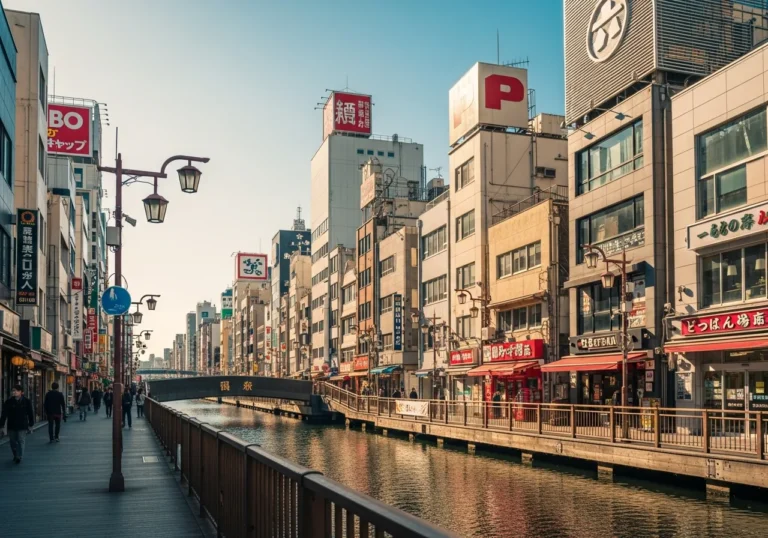
The physical conditions were those of a boarding school run on poverty. Many of the students were struggling financially, and their only recreation was occasional drinking or strolling along the Dotonbori River.
There is a passage in the Fukuō Jiden — preserved in the public-domain translation at the Internet Archive — where Fukuzawa describes the townspeople of Semba looking at the Tekijuku students with something between pity and disgust. In Fukuojiden, the autobiography written in his later years, he describes that the townsmen abhorred the students of Tekijuku in dirty clothes, writing: “The townsmen seem to abhor eta or something, which is not surprising by thinking that the students appear as such to them.” The students were samurai — theoretically the highest caste — but they looked like beggars. The irony was not lost on Fukuzawa.
He also fell seriously ill during his time at Tekijuku. Fukuzawa suffered from typhoid fever when he was a student of Tekijuku.
When he was under treatment at the kurayashiki of the Nakatsu domain in Osaka, Kōan nursed him devotedly back to health. It is said Yukichi never forgot Kōan’s dedication.
This personal debt — a teacher who sat with a sick student through the fever — shaped Fukuzawa’s own approach to education decades later, when he ran Keio Gijuku in Tokyo.
The Interruption: Death, Return, and the Top of the Class
Fukuzawa’s time at Tekijuku was not unbroken. During Fukuzawa’s three-year stay at Tekijuku, both he and his older brother fell ill and were sent back to Nakatsu to recover. But Sannosuke died, and Fukuzawa succeeded him in performing guard duty at the castle, since he had no experience as a treasurer to take over his father’s old job.
The death of his brother — the same brother who had persuaded him to stay in Osaka in the first place — was a genuine crisis. Fukuzawa was now the male head of a family with no money and a feudal obligation to perform guard duty in Nakatsu. The path back to Tekijuku was not obvious.
He begged his mother to let him return again to study at Tekijuku and subsequently received official permission to do so. In the next year, Fukuzawa became the top student at the school, and his autobiography recalls fond memories of his schooldays. With his colleagues, he studied mainly physics, chemistry and physiology, and copied and translated a Dutch book on the art of fort-building.
The detail about fort-building is easy to overlook but worth pausing on. The students were not reading Dutch for its own sake, or even primarily for medicine.
They were reading it for military technology, for engineering, for the hard sciences that would determine whether Japan could defend itself against the Western powers now pressing at its borders. The intellectual project of Tekijuku was, at its core, a survival project.
Fukuzawa understood this. It made the work feel urgent in a way that Confucian classics never had.
Starting with his departure to Nagasaki at age 19 to study Dutch studies, he went on to study at Ogata Kōan’s Tekijuku in Osaka, where he eventually became the President — the head student, the top of the ranking system. For a boy who had spent his childhood being condescended to by the sons of higher-ranking samurai, this was not a small thing. He had beaten them all, and he had done it on merit alone.
Why Did Osaka’s Merchant City Shape an Anti-Feudal Thinker?
Here is the deeper question, the one that most accounts of Fukuzawa’s life skip past: why did three years in a merchant city produce a man whose central intellectual project was the dismantling of the feudal class system?
The answer is environmental as much as intellectual. Osaka in the 1850s was a city where the official hierarchy of Tokugawa Japan was visibly, daily, absurdly inverted.
Samurai — theoretically the ruling class — arrived at the kurayashiki as administrators of their domain’s rice sales, dependent on the expertise of Osaka merchants to convert grain into cash. Regional lords needed to pay taxes to the shogunate and would exchange rice collected through their own land taxation activities and stored at their riverside warehouses in Osaka for money, gauging when rates were most favorable.
The samurai needed the merchants. The merchants knew it.
The samurai knew the merchants knew it.
Fukuzawa had grown up watching his father — a Confucian scholar of genuine learning — spend his life as a bookkeeper in a warehouse, subordinate to men of lower intellectual caliber simply because of birth rank. In Osaka, he could see the same dynamic playing out at a city-wide scale: the merchant class, officially the lowest of the four Confucian castes, was in practice running the economy of Japan.
And then there was Tekijuku itself. Tekijuku’s rigorous, egalitarian environment — admitting students regardless of rank and emphasizing dissection and empirical experimentation — fostered Fukuzawa’s proficiency in translating technical Dutch works.
The school’s ranking system was based entirely on performance in the kaidoku sessions. Your father’s stipend was irrelevant.
Your domain’s prestige was irrelevant. What mattered was whether you could decode the Dutch text and defend your interpretation against the room.
Looking back on his time at Tekijuku, Yukichi Fukuzawa later advocated for “study without a purpose.” He recommended that rather than seeking career advancement or constantly worrying about one’s future while studying, one should purely devote oneself to academic training and develop the understanding and judgment to comprehend all things. This sounds like a platitude until you understand its context: it was a direct attack on the Confucian model of education, in which study was explicitly instrumental — you studied the classics in order to pass examinations, in order to rise in the bureaucratic hierarchy. Fukuzawa was proposing something genuinely subversive: that knowledge had value independent of the social order it served.
Furthermore, his encounter with his affectionate master, Kōan Ogata, can be seen as the origin of Yukichi Fukuzawa’s own warm educational approach toward his disciples. Ogata modeled something Fukuzawa had never seen in Nakatsu: a man of genuine authority who exercised it through care and intellectual example rather than rank. The teacher who nursed a sick student through typhoid fever was demonstrating, in practice, the principle that human worth is not determined by social position.
The Moment Everything Shifted: Yokohama, English, and the Obsolescence of Dutch
In the autumn of 1858, Fukuzawa was appointed teacher of Dutch to the vassals of the domain of Nakatsu. He left Osaka for Edo — now Tokyo — as a credentialed expert in the language that was supposed to be Japan’s window to the West. He was twenty-three years old, and he had spent three years mastering a skill that was about to become obsolete.
The following year, Japan opened three of its ports to American and European ships, and Fukuzawa, intrigued with Western civilization, traveled to Kanagawa to see them. When he arrived, he discovered that virtually all of the European merchants there were speaking English rather than Dutch.
This is one of the great pivot moments in Japanese intellectual history, and it is worth sitting with the shock of it. Fukuzawa had spent three years in poverty, sleeping at his desk, fighting for access to a single dictionary, becoming the top student at the most rigorous school of Western learning in Japan — and the language he had mastered was not the language the world was actually using.
The Dutch had been Japan’s sole Western trading partner for two centuries, but the world had moved on. English was the language of the new global order.
He began to study English, but at that time, English-Japanese interpreters were rare and dictionaries nonexistent, so his studies progressed slowly. But the experience at Tekijuku had given him something more durable than Dutch vocabulary: it had given him a method.
He knew how to crack a foreign language using a dictionary and a shelf of texts. He had done it once.
He could do it again.
He traveled abroad with the first Japanese mission to the United States in 1860 and the first mission to Europe in 1862. The knowledge he gathered on those journeys — about Western political institutions, legal systems, newspapers, universities, insurance companies, banks — became the raw material for the books that would reshape Japan. But the capacity to gather and process that knowledge, the habit of empirical observation over received authority, the conviction that any text in any language could be decoded if you worked hard enough — all of that came from Tekijuku.
What Osaka Made: The Intellectual Architecture of Modern Japan
Fukuzawa’s thinking as an educator and an entrepreneur coalesced in his classic 1872 work Gakumon no Susume (An Encouragement of Learning). The main topic of the book is the need for all citizens to engage in practical study related to everyday needs, so as to ensure independence for individuals, families, and the state.
In Gakumon no Susume, he famously wrote, “Heaven never created a man above another nor a man below another,” arguing that social status was determined by education and practical knowledge (jitsugaku). The book became one of Japan’s best-selling works, with initial printings exceeding 1.5 million copies by the 1880s. In a country of roughly 35 million people, that is an extraordinary reach.
But where did this idea come from? The standard account credits the American Declaration of Independence, which Fukuzawa had encountered on his 1860 mission to the United States.
The line “it is said that heaven does not create one person above or below another” is generally considered to have been inspired by the US Declaration of Independence. That is true as far as it goes.
But the conviction behind the line — the bone-deep certainty that birth rank is morally arbitrary — was formed not in San Francisco but in Kitahama, in the kaidoku sessions where a farmer’s son could outrank a domain lord’s heir if he translated better.
Fukuzawa also advocated his most lasting principle: “national independence through personal independence.” This too has Osaka written through it. A city that had built its entire economy on the practical intelligence of merchants — people who were officially ranked below farmers in the Confucian hierarchy but who were in practice running the financial system of Japan — was a living demonstration that personal capability, not inherited status, was the real engine of social function.
He was the founder of Keio Gijuku, the foundation of the modern Keio University, and the newspaper Jiji Shinpō. The learning methods of Tekijuku are said to have had various influences on the early days of Keio University.
The kaidoku system — competitive, merit-based, adversarial — became the template for how Fukuzawa organized learning at his own institution. The lamp that never went out in the Doeff Room in Kitahama was still burning, in a different form, in Mita.
Why the Building Still Stands, and What It Means That It Does
The Tekijuku building, located in the business district in Kitahama, Chuo-ku, Osaka, is Japan’s only Edo-period school building of Western learning still in existence. The building, designated as a National Historical Landmark and as a National Important Cultural Asset, is currently open to the public.
Tekijuku was designated as an Osaka Prefectural Historical Landmark in 1940, as a National Historical Landmark in the following year, and as an Important Cultural Asset in 1964. The Ogata family donated the building to the nation — to Osaka Imperial University — in 1942. The institution that received it, Osaka University, is itself a direct institutional descendant of Tekijuku: in time, Tekijuku evolved into Osaka Prefecture Medical School, then into Osaka Prefecture University Hospital, and finally into today’s Osaka University.
A record of signatures of Tekijuku students (Seimei roku) lists the names of 636 people who enrolled at the school in 1844 and later. Fukuzawa’s name is among them, in his own hand.
You can see it today, in the display cases on the ground floor. It is a peculiar experience — standing in the room where he slept at his desk, looking at the signature he wrote when he enrolled, knowing what came after.
The building itself is a two-storey merchant townhouse of the kind that once lined every street in Semba. The interior of this modest but meticulously designed old Japanese house, which has stood since the Edo period, is more than enough to make it worth a visit.
The steep stairs to the second floor — where the students lived, studied, and competed — are exactly as they were. The low ceilings, the narrow rooms, the sense of compression: this is where Japan’s intellectual revolution was conducted, in conditions that would embarrass a modern university dormitory.
There is also a birthplace monument, across the city in Fukushima Ward, where the Nakatsu domain’s kurayashiki once stood. The Monument to Yukichi Fukuzawa’s Birthplace stands on the south side of the Asahi Broadcasting Corporation headquarters building.
The current birthplace monument and the stone marker for the former Nakatsu domain storehouse residence were erected in 1954, inspired by voices from Tekijuku alumni living in the Kansai region. The Fukuzawa birthplace monument has a shape reminiscent of a bird spreading its wings, and beside it is another stone engraved with his famous line: “Heaven does not create one person above another, nor one person below another.”
The line on the stone is the line from Gakumon no Susume. But the stone stands on the site of the kurayashiki — the warehouse where his father spent his life as a frustrated accountant, where the feudal system’s absurdities were most visible, where Fukuzawa was born into a world he would spend his life dismantling. The geography is its own argument.
Why the Discerning Traveler Should Care: What Tekijuku Is Actually About
There is a version of this story that presents Tekijuku as a charming historical curiosity — a well-preserved old building in a financial district, worth twenty minutes of your time between the Nakanoshima museums and lunch in Kitahama. That version is wrong, or at least radically insufficient.
Tekijuku is one of the few places in Japan where you can stand inside the physical space that produced a specific, traceable intellectual revolution. Most of the ideas that shaped modern Japan — the meritocratic university system, the independent press, the concept of individual rights as the foundation of national strength — were not imported wholesale from the West. They were developed by Japanese thinkers who had encountered Western knowledge under conditions of extreme constraint and had been forced to think hard about what it actually meant.
Fukuzawa’s encounter with Western science at Tekijuku was not the encounter of a tourist or a diplomat. It was the encounter of a man who had to decode a foreign language with a single dictionary, compete for access to that dictionary against students from across Japan, and defend his interpretations in public sessions where failure was marked in black circles next to your name.
The knowledge he gained was not received — it was fought for. And that fighting shaped what he did with it.
The students were completely devoted to their studies, so much so that Fukuzawa later wrote in Fukuō Jiden: “The students of Ogata never neglected their studies in the slightest.” This is not the nostalgia of an old man for his youth. It is a description of a specific pedagogical environment — one in which the absence of external authority forced students to develop internal discipline, and in which the only currency that mattered was intellectual performance.
The affluent Western traveler who visits Tekijuku today is, in a sense, visiting the origin point of the Japan they are traveling through. The universities, the newspapers, the banking system, the public health infrastructure, the concept of individual dignity as a political principle — these things did not emerge from the Meiji government’s top-down modernization program alone. They emerged from a generation of young men who had spent years in cramped rooms in Osaka, decoding Dutch texts by lamplight, arguing about translations, and learning — in practice, in their bones — that what you know matters more than who your father was.
That is not a small thing to encounter in a twenty-minute visit. But you have to know what you are looking at.
Frequently Asked Questions
Q: Is Tekijuku the same building where Fukuzawa actually studied?
A: Yes. The Tekijuku building in Kitahama, Chuo-ku, Osaka, is Japan’s only Edo-period school building of Western learning still in existence. The structure has been preserved and restored, but the physical building — including the steep stairs and the second-floor dormitory rooms — dates to the period when Fukuzawa was a student there.
Q: How long did Fukuzawa actually spend in Osaka?
A: Fukuzawa studied under Ogata Kōan between 1855 and 1858, learning Dutch in order to access Western knowledge. His time was interrupted by his brother’s illness and death, which required him to return to Nakatsu, but he came back to Osaka and eventually reached the top of the school’s ranking system before leaving for Edo in 1858.
Q: What is the connection between Tekijuku and Osaka University?
A: Although officially founded in 1931 as Japan’s sixth imperial university, Osaka University’s roots reach back to 1838 and Tekijuku, a private “place of learning” founded by Ogata Kōan. The school evolved through several institutional forms — Osaka Prefecture Medical School, Osaka Prefecture University Hospital — before becoming Osaka University. The university now manages the Tekijuku building as a heritage site and museum.
Q: What is the connection between Tekijuku and Keio University?
A: The school was one of the predecessors of both Osaka University and Keio University, through the work of Ogata Kōan and Fukuzawa Yukichi respectively. Fukuzawa founded Keio Gijuku in Edo in 1858, the same year he left Tekijuku, and explicitly modeled aspects of its pedagogy on the kaidoku system he had experienced in Osaka.
Q: Where is Fukuzawa’s birthplace in Osaka, and can I visit it?
A: The Monument to Yukichi Fukuzawa’s Birthplace stands on the south side of the Asahi Broadcasting Corporation headquarters building in Hotarumachi, Fukushima Ward. The nearest station is JR Shin-Fukushima Station, about a four-minute walk away. The monument is outdoors and freely accessible at any time.
Tekijuku — Visitor Information
Address: 3-3-8 Kitahama, Chuo-ku, Osaka 541-0041 / 大阪府大阪市中央区北浜3丁目3−8
Nearest station: Kitahama Station (Osaka Metro Midosuji Line / Keihan Railway) — approx. 5-minute walk; Yodoyabashi Station (Osaka Metro Midosuji Line / Keihan Railway) — approx. 5-minute walk
Hours: 10:00 a.m. – 4:00 p.m. Closed Mondays (open if Monday is a public holiday, then closed the following day), days following public holidays, and New Year holidays (28 Dec – 4 Jan). May close without notice in severe weather.
Admission: Approx. ¥260 (general); Osaka University students free. Prices subject to change — confirm on the official site before visiting.
Official site: tekijuku.osaka-u.ac.jp