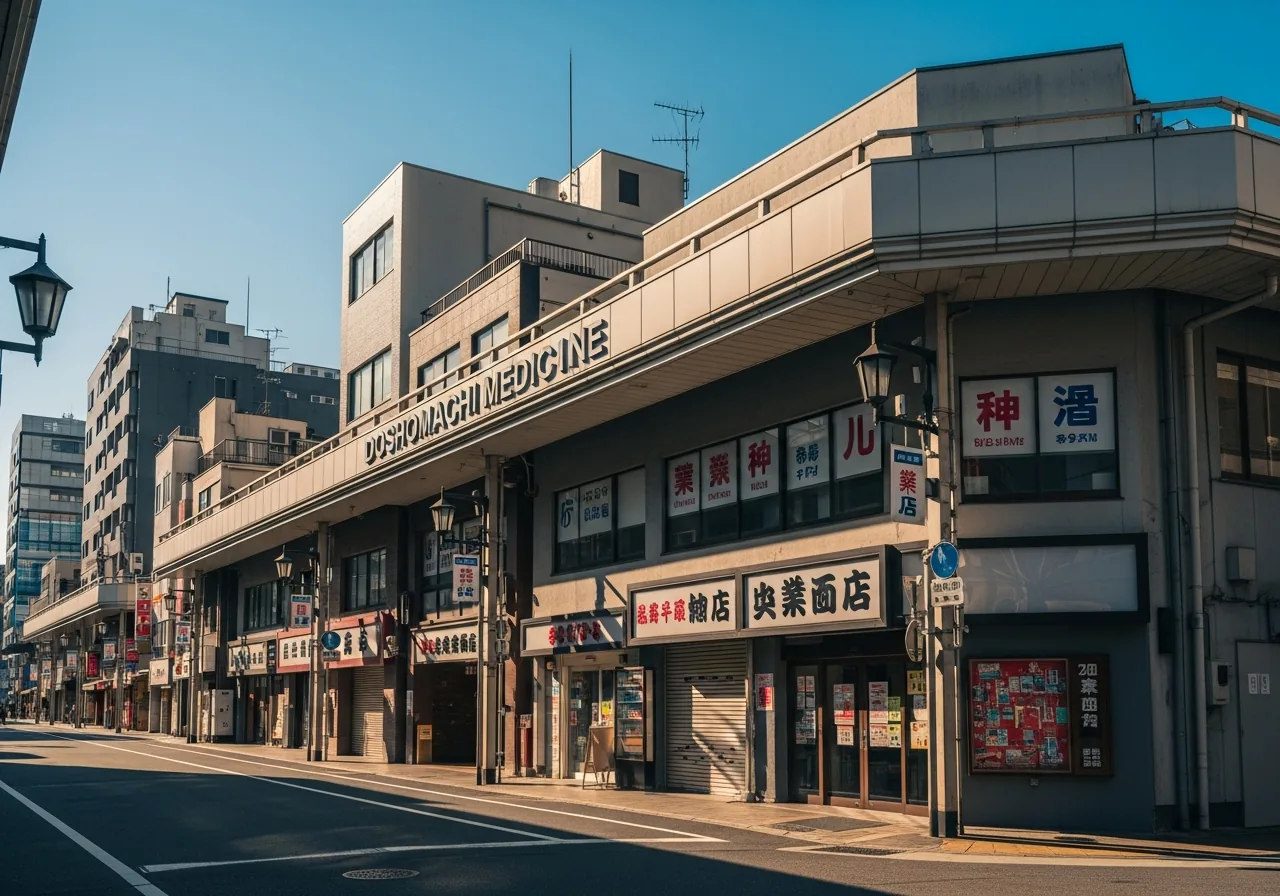
Doshomachi — a 300-metre strip of Osaka’s Senba merchant quarter — became Japan’s pharmaceutical capital not through accident but through a precise sequence of state power, geography, and commercial ingenuity: in 1722, the eighth shogun Tokugawa Yoshimune formally licensed 124 drug wholesalers there as the Yakushu Nakagai Nakama, granting them the exclusive right to inspect, price, and distribute every medicinal ingredient traded in Japan. That single edict transformed a street that had already been accumulating apothecaries for a century into the nation’s mandatory drug-clearing house — and the companies that grew from those original 124 stalls still occupy the same addresses today.
Why we can tell you this — MICHI is written and edited in Osaka, and Doshomachi is a neighbourhood our team walks through regularly: the Sukunahikona Shrine courtyard, the Mitsubishi Tanabe Pharma Historical Museum, and the Chuo Ward heritage panels along Doshomachi-dori are all within fifteen minutes of our office. This piece draws on the Chuo Ward Nigiwai Panel archive, a peer-reviewed business-history paper published on J-STAGE, corporate histories from Shionogi, Takeda, Ono Pharmaceutical, and Mitsubishi Tanabe Pharma, and the Osaka Bio Headquarters life-science cluster documentation. Where the historical record is genuinely contested — particularly the origin of the street’s name and the precise date Konishi Kichiemon opened his shop — we say so plainly rather than papering over the uncertainty.
Walk east from Yodoyabashi Station on a weekday morning and you will pass, within the space of three city blocks, the headquarters of Takeda Pharmaceutical, Sumitomo Pharma, Shionogi, Ono Pharmaceutical, and Mitsubishi Tanabe Pharma. Their towers are glass and steel, indistinguishable at first glance from any other Osaka office district.
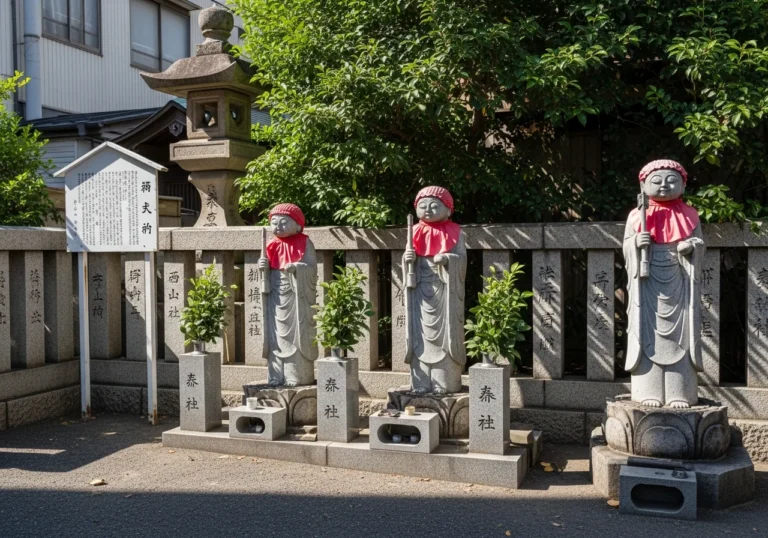
Then, wedged between two corporate facades, you notice a torii gate and the smell of incense. A bronze tiger guards a staircase.
Suits file past it without breaking stride, the way commuters pass a church they have stopped seeing. This is Sukunahikona Shrine — “Shinno-san” to everyone in the neighbourhood — and it is the hinge on which the entire story of Doshomachi turns.
Why Did a Single Street Corner Become Japan’s Drug Market?
The answer begins not with medicine but with castle-building. In 1583, Toyotomi Hideyoshi broke ground on Osaka Castle on the site of the Ishiyama Hongan-ji temple, simultaneously embarking on an ambitious urban plan that would make Osaka the commercial capital of a unified Japan. The origins of the Senba merchant district trace directly to that moment: as a large number of retainers and warriors gathered around the new castle, demand for weapons, food, and daily necessities exploded, and Hideyoshi forcibly relocated merchants from Sakai, Kyoto, and Fushimi to meet it.
Doshomachi — the fifth block north of the river in the Senba grid — was one of the streets carved out of that deliberate resettlement. It sits in a corner of the Senba commercial district that Toyotomi Hideyoshi developed, a landing-stage quarter where goods arrived by water. The canal network that Hideyoshi’s engineers dug gave the district its commercial logic: bulk goods, including the heavy, perishable, and often imported raw materials of traditional medicine, moved most efficiently by boat.
The name itself is contested, which is itself revealing. The origin of “Dōshōmachi” is said to come either from a former temple called Dōshōji or from the name of an early Edo-period pharmacologist, Kitayama Dōshū.
A third theory, recorded in the Nihon Rekishi Chimei Taikei encyclopaedia, holds that the area was originally called Dōshū-dani — “Dōshū valley” — because it occupied a low-lying gap between the Uemachi Plateau and the old river delta, and that the toponym gradually corrupted into the current reading. A fourth tradition traces it to the many dōshū (temple workers) who settled here after the Hongan-ji’s destruction.
None of these can be definitively proved. What is certain is that the street was already named and populated by 1588, when a document from the Mōri clan records a fire there.
Why Here, and Why Medicine?
The Sakai connection is the key. It is said that Doshomachi became an area for medicine in the Kan’ei era (1624–1644), when a wealthy merchant from Sakai named Konishi Kichiemon opened an apothecary there.
Sakai, the great port city just south of Osaka, had been Japan’s pre-eminent trading hub for over a century before Hideyoshi’s rise. Its merchants had direct experience with Chinese and Southeast Asian trade goods — including the tōyakushu, the imported Chinese and continental medicinal ingredients that formed the backbone of Edo-period pharmacopoeia.
Konishi did not arrive in a vacuum. In the middle Edo period there were two powerful merchant clans in Doshomachi: one was the Konishi family, originating from Sakai, and the other was the Fushimiya family, who had been allowed to accompany Hideyoshi Toyotomi from Fushimi, Kyoto upon the construction of Osaka Castle. These two lineages effectively seeded the district’s pharmaceutical identity from opposite directions — one bringing the Sakai trading networks that connected to Nagasaki and the China trade, the other carrying the patronage relationships of the Toyotomi court.
By 1658, the street had enough critical mass to act collectively. The oldest surviving document from Doshomachi dates to that year — 1658, in the Meireki era — and bears the signatures and seals of 33 drug merchants petitioning the magistrate’s office about the suppression of counterfeit medicines. Thirty-three shops, acting in concert, demanding quality standards: this is already the guild instinct that would define the district for the next three and a half centuries.
Why did the drug trade concentrate here rather than dispersing across Osaka? Three structural reasons.
First, the canal access made it practical to receive bulk shipments of dried roots, minerals, and animal products from Nagasaki, where the Dutch and Chinese trade was funnelled. Second, the existing Sakai merchant networks gave Doshomachi dealers preferential access to the import chain.
Third, and most importantly, the shogunate’s own administrative logic demanded a single point of control — and Doshomachi was already the most organised cluster of drug dealers in the country.
Why Did the Shogunate Intervene in 1722 — and Why Did That Change Everything?
The year 1722 is the hinge on which Doshomachi’s entire subsequent history turns. To understand why, you need to understand the crisis that preceded it.
The Genroku era (1688–1704) had been a period of conspicuous prosperity, but it left the Tokugawa shogunate financially exhausted and the country battered by repeated epidemics. The background to the 1722 reforms was a decade-long survey of medicinal plants across Japan, conducted under the eighth shogun Tokugawa Yoshimune, who was attempting to expand domestic drug production and reduce dependence on expensive Chinese imports. Yoshimune was a reformer by temperament — his Kyōhō Reforms touched everything from currency to agriculture — and he understood that the drug supply was a public-health problem as much as a commercial one.
Yoshimune actively encouraged the expansion of wayaku — domestically produced medicines, which were less expensive than Chinese imports and affordable for common people. But this also led to the circulation of counterfeit medicine, and the shogunate decided to establish the Wayaku Aratamekaisho — an inspection office — to prevent fakes from entering the market.
The mechanism was elegant in its simplicity. In 1722, 124 pharmacies in Osaka’s Doshomachi district were subsumed into a guild of wholesale pharmacists — the yakushu nakagai nakama — and in the same year, the shogunate established the Office for Drug Inspection (Wayakushu aratame kaisho), an institution entrusted with ensuring the quality of medical products traded in the five major cities under shogunal control.
The practical effect was a national monopoly. These merchants gained the privilege of testing and pricing not only imported medicines from Qing China and the Netherlands but also domestically sourced herbal drugs, and distributing them nationwide. Every medicinal ingredient entering Japan — whether a dried root from Fujian, a mineral compound from Korea, or a domestically grown herb from the Kii Peninsula — had to pass through Doshomachi’s inspection and pricing system before it could be sold anywhere in the country.
In the Edo period, medicines traded in Japan were first gathered in Doshomachi, where their quality and weight were guaranteed before being distributed nationwide. This was not merely a commercial arrangement. It was a public-health infrastructure, the Edo-period equivalent of a national medicines agency, run by private merchants under shogunal licence.
Why did Yoshimune choose Doshomachi rather than Edo, the shogunal capital? Because the expertise was already there.
The guild’s knowledge of Chinese materia medica — accumulated over a century of Sakai-rooted trade — was irreplaceable. With a trade association of 124 apothecaries sanctioned as a monopolistic guild by the shogunate, all domestic medicines entering Osaka became subject to testing in Doshomachi.
The position of the first president of the inspection office was reportedly taken by Ichibei Fushimiya I, head of one of the two dominant merchant clans in the district. The shogunate was not imposing a new institution; it was formalising and empowering one that had already organised itself.
Why Did the Guild Survive the End of the Shogunate?
In 1868, the Meiji Restoration abolished the Tokugawa order. The new government, in a burst of free-trade liberalism, initially dissolved the merchant guilds that had structured Edo-period commerce. Though the new government abolished the wholesale guilds of Edo, Kyoto, and Osaka, the representatives of the newly founded Pharmaceutical Trade Association were brought back into official business two years later, as supervisors of their own drug trade, at the National Pharmaceutical Laboratory.
This rapid reversal was not sentimentality. It was pragmatism. The Meiji government had adopted Western medicine as the basis of its new health system, but the required drugs were expensive and had to be imported from the West, resulting in unstable supply — and the medicine dealers in Osaka were the people best positioned to adapt.
The transition was wrenching. Doshomachi’s merchants had spent two centuries mastering Chinese and Japanese materia medica.
Now the government was telling them that German pharmacology was the future. Tanabeya — the firm that would become Mitsubishi Tanabe Pharma — truly thrived during the Meiji period when, in advance of most competitors, it began providing Western medicines in addition to traditional Sinic treatments.
The key word is “in addition”: the shrewdest Doshomachi merchants did not abandon their existing knowledge base but layered Western imports on top of it, using their established distribution networks to move the new products.
Shionogi’s founding story captures this transition precisely. On March 17, 1878 — Gisaburo Shiono’s 24th birthday — he launched his own drug wholesaler, Shiono Gisaburo Shoten, at Doshomachi 3-chome 12, Osaka.
At the time of its founding, the store dealt mainly in Japanese and Chinese medicines. But Gisaburo was watching the market.
Over the next eight years, Western medicine gained gradual but widespread popularity, and in 1886 Gisaburo decided to make a dramatic shift. Western medicine was already in distribution via foreign trading houses in Yokohama and Kobe, but prices were high.
Gisaburo sought the help of an experienced, English-proficient businessperson, enabling direct import of pharmaceutical products from overseas.
Takeda followed a parallel trajectory. Takeda Pharmaceutical’s founding story traces back to 1781 in Osaka’s Doshomachi district.
Chobei Takeda I’s initial business focused on distributing herbal medicines, quickly gaining a reputation for integrity and quality. A century later, his descendants were importing quinine from Europe and, by 1907, Takeda had obtained exclusive sales rights in Japan for products from the German company Bayer.
The Doshomachi address was continuous; the product catalogue was entirely transformed.
Ono Pharmaceutical’s history adds another layer. Ono Pharmaceutical originated in 1717 when Ichibei Fushimiya I opened a shop under the name “Fushimiya Ichibei” at the age of 20.
This was the same Fushimiya family that had held the presidency of the shogunate’s drug inspection office in 1722. The continuity of family, address, and institutional role across more than three centuries is not coincidental — it is the product of a deliberate strategy of embedding commercial identity in place.
Why Did World War I Forge the Modern Pharmaceutical Industry Here?
The Meiji transition had made Doshomachi’s merchants importers of Western drugs. World War I forced them to become manufacturers.
While the Meiji government built the framework for a modern industry, it was the geopolitical shock of World War I that served as the catalyst for establishing a self-sufficient domestic manufacturing base. With Japan’s entry into the war in 1914, the supply of Western medicines — still heavily imported from Germany — was abruptly halted, creating a severe national drug supply crisis. In a move characteristic of its interventionist approach, the government stepped in directly to foster domestic production.
For Doshomachi, this was the moment of transformation from trading district to manufacturing powerhouse. In 1914, Takeda established a research division, and around the time when imports from Germany ended due to World War I, the company began the sales of its own products.
Shionogi had already moved in this direction: the construction of Shiono Seiyakusho, a manufacturing plant in Osaka, commenced operations in 1910, marking a significant evolution from wholesaler to research-based pharmaceutical entity. The company’s first self-developed drug, Antacidin, an anti-indigestion medication, was launched in 1909.
The war did not merely create urgency — it created the institutional infrastructure for a domestic industry. The government publicly disclosed manufacturing methods for key drugs, issued subsidies, and established temporary production facilities. Doshomachi’s merchants, with their century-long networks, their capital, and their understanding of both the supply chain and the customer base, were perfectly positioned to absorb this state support and convert it into permanent manufacturing capacity.
By the 1920s, the district’s identity had shifted decisively. The old yakushu nakagai nakama model — inspect, price, distribute — was giving way to something new: research-based pharmaceutical companies that happened to share a postcode.
The address was the same. The business model was entirely different.
Why Did the Shrine Become the District’s Spiritual Centre — and What Does the Paper Tiger Mean?
No account of Doshomachi is complete without Sukunahikona Shrine, and no account of the shrine is complete without the cholera epidemic of 1822.
The shrine is said to have originated in 1780, when druggists enshrined a branch of Sukunahikona-no-mikoto from Kyoto’s Gojō Tenjin Shrine, along with Shinnō, who had previously been enshrined at the Nakamakaisho — the guild’s own meeting hall — in Doshomachi. The decision to build a shrine was not piety for its own sake. It was a quality-control measure.
The guild of 124 dealers had been entrusted by the Tokugawa shogunate with conducting the drug trade. As medicine can have both good and bad impacts on human life, careful scrutiny of what it is was essential, and for help in this the Association turned to the deities. In October 1780, the kami of the Gojo-Tenjin-sha in Kyoto was brought to Osaka through the bunrei process and housed, along with Shennong — the traditional god of Chinese medicine — in the Association’s headquarters.
The decision to enshrine both deities together reflects Doshomachi’s historical role as the meeting point of Japanese and Chinese medical traditions. Sukunahikona-no-mikoto is the Japanese god of medicine, credited in the oldest chronicles with establishing the foundations of healing alongside the great land-shaper Ōkuninushi.
Shennong — the Divine Farmer — is the legendary Chinese emperor who personally tasted hundreds of herbs to determine their medicinal properties, and whose name graces one of the oldest pharmacopoeias in the world. To enshrine both in the same building was to claim authority over the entire spectrum of medicine available to Edo-period Japan.
Then came 1822. In 1822, an outbreak of cholera affected the whole city of Osaka.
Local apothecaries sold pills containing a compound of ground tiger cranium to help cure the disease. At the same time, people made paper tiger figures and prayed for their health at the Sukunahikona Shrine.
Due to the success of the medicine, the tiger — Hariko-no-Tora — then became a figurehead of the shrine and the festival.
The paper tiger is now the most recognisable symbol of Doshomachi, distributed at the annual Shinno-sai festival every November 22nd and 23rd. The Shinnosai Festival is held at Sukunahikona Shrine, where the deities of medicine and trade are enshrined, and every November participants attend in the hopes of being blessed with good health and business success. Traditionally, the yearly calendar of festivals in Osaka begins with the Ebisu Festival in early January and ends with the Shinnosai Festival, so it is referred to as Tome-no-matsuri — the last festival.
The festival’s character is unlike any other in Osaka. The Shinno Festival has been held since the Edo period when pills were made to treat cholera epidemics.
It is supported by the Yakuso-ko, an association of around 400 pharmaceutical-related companies, and many local companies attend to pray for the safety of medical care. Walk along Doshomachi-dori on the evening of November 22nd and you will find the street transformed: food stalls selling takoyaki and yakisoba, bamboo branches hung with paper tigers and red prayer tags, and — most distinctively — suited pharmaceutical executives and their staff, still in work clothes at nine in the evening, drinking beer and praying for the health of their pipelines.
It is the only festival in Japan where the mascots of competing drug companies parade together down the same street.
Why Did the Name Survive When Almost Everything Else Changed?
This is perhaps the deepest question. Doshomachi has been, in sequence: a castle-town residential block, a mixed artisan and merchant quarter, a Chinese-medicine wholesale district, a shogunate-licensed drug monopoly, a Western-medicine import hub, a domestic manufacturing base, and now a global pharmaceutical cluster.
The street grid has barely changed since Hideyoshi’s engineers laid it out in the 1580s. The name has been continuous since at least 1588.
What explains this extraordinary institutional persistence? Three mechanisms, operating simultaneously.
The first is the guild’s own self-reinforcing logic. Once 124 merchants were licensed as the national drug inspection authority, every new entrant to the trade had a powerful incentive to locate in Doshomachi — proximity to the guild meant access to the inspection system, to the pricing network, and to the accumulated expertise of neighbours. The cluster grew because clustering was economically rational.
The second is the educational infrastructure the merchants built for themselves. Since the Edo period, people living in this area had been pooling their resources to build schools and institutions for young people and apprentices.
The roots of schools such as Osaka University of Pharmaceutical Sciences and the Osaka University School of Pharmaceutical Sciences also lie in Doshomachi. Japan’s first specialised pharmacy school — the Osaka Doshomachi Pharmaceutical School, founded in 1904 — was established here by merchants who understood that the transition to Western medicine required a new kind of trained workforce.
In 1888, sixteen Osaka pharmaceutical merchants established the Osaka Pharmaceutical Testing Company to maintain quality assurance after the shogunate’s inspection system was dissolved. The instinct to self-organise around quality standards, first expressed in that 1658 petition to the magistrate, never disappeared.
The third mechanism is the shrine. Sukunahikona Shrine is not merely a religious institution — it is a territorial marker.
Its presence in the centre of the district signals, to anyone who knows how to read Japanese urban space, that this is a place with a specific, consecrated identity. Companies that locate in Doshomachi are not just renting office space; they are affiliating with a 400-year-old brand.
The persistence of the name has its own irony. Since 2016, Mitsubishi Tanabe Pharma has been conducting annual surveys to find out how well the name “Doshomachi” is recognised.
In the eighth survey conducted in 2023, a mere 29.1% of respondents were able to read the name correctly. Even among those living in Osaka, where recognition was highest, only 36.5% gave the correct answer.
The street that defined Japanese pharmaceutical history for four centuries is, to most contemporary Japanese, an unreadable combination of characters. The companies know this, and they are worried about it.
Why Does the District Still Matter — and to Whom?
The numbers are stark. The Doshomachi district flourished as the “Town of Medicine” during the Edo period, as it was responsible for pricing and exclusively distributing medicinal ingredients. Even after 350 years, it remains a major pharmaceutical hub, home to over 300 pharmaceutical companies, including the headquarters of leading Japanese pharmaceutical firms such as Shionogi, Mitsubishi Tanabe Pharma, Sumitomo Pharma, Takeda Pharmaceutical, and Ono Pharmaceutical.
The district encompasses more than 300 pharmaceutical companies. Five of Japan’s top ten pharmaceutical companies are headquartered in this district and neighbouring areas.
To put this in comparative perspective: there is no equivalent concentration anywhere else in the world. London’s pharmaceutical companies are scattered across the city.
Basel’s are clustered but spread across a metropolitan area. Doshomachi fits its entire pharmaceutical universe into a grid of blocks you can walk end-to-end in under ten minutes.
The modern institutional expression of this concentration is the Osaka Bio Headquarters, established by Osaka Prefecture in 2008 as a coordination body for the region’s life-science industry. Osaka has a history spanning approximately 400 years as the “City of Medicine.” Today, it is home to a compact cluster of outstanding universities, research institutions, and pharmaceutical companies, all within a 20-kilometre radius centred around Osaka. Leveraging these strengths, Osaka Prefecture established the Osaka Bio Headquarters in 2008 as a command centre to further develop the health and medical industries.
The cluster logic that Yoshimune’s 1722 edict set in motion is still operating. Companies locate in Doshomachi because their competitors, their suppliers, their regulators, and their talent pool are all there. The yakushu nakagai nakama is long dissolved, but its spatial logic endures.
The Museum Street: History Made Walkable
Along Doshomachi-dori, a roughly 300-metre stretch of road connecting multiple exhibition facilities is known as Doshomachi Museum Street, where visitors can learn about the history of medicine. The institutions along this corridor are not tourist attractions in any conventional sense — they are corporate archives that happen to be open to the public, and they reward the visitor who arrives with some prior knowledge.
The Mitsubishi Tanabe Pharma Historical Museum occupies the second floor of the company’s headquarters and traces a lineage that begins in 1678, when Tanabeya Gohei the First launched a business producing and selling Tanabeya Infusing Medicine, opening a store at the south end of Tanabeya bridge in Tosabori, Osaka. The museum is free, bilingual, and — if you visit on a quiet weekday — you may find yourself alone with a staff member who will walk you through the exhibits personally.
The Kusuri no Doshomachi Archive, housed in the Sukunahikona Shrine building, is the district’s primary historical repository. Opened on the third floor of the Sukunahikona Shrine office, it displays medicine materials from the Edo period, signboards from the Meiji, Taisho, and Showa periods, and other medicine-related materials from the area.
The archive holds original guild documents, including petitions and price-setting records from the yakushu nakagai nakama era. These are not replicas.
They are the actual paper on which the national drug trade was administered.
Shionogi’s Kyōhaku Library — the Kyōu Shooku — holds one of Japan’s finest collections of historical pharmaceutical texts and botanical illustrations, some dating to the seventeenth century. Access requires advance arrangement, but for a reader with serious interest in the history of East Asian medicine, it is among the most significant private collections in the country.
Why Should a Discerning Traveller Care?
The honest answer is that Doshomachi will disappoint a visitor who arrives expecting the visual drama of Kyoto or the sensory overload of Dotonbori. There are no temples with sweeping rooflines, no neon-lit food stalls, no Instagram compositions waiting to be made. What there is, instead, is something rarer: a place where the logic of a city’s economic history is still physically legible.
Stand at the intersection of Doshomachi-dori and Sakaisuji and look in any direction. Every building you can see is occupied by a company whose business model descends, in a traceable line, from the 124 merchants Yoshimune licensed in 1722.
The Takeda tower to your east: founded 1781, same street. The Shionogi building to your west: founded 1878, same block.
The Sukunahikona Shrine between them: established 1780, still operating. The continuity is not metaphorical.
It is structural.
For a traveller who has spent time in other great commercial cities — in the City of London, in Amsterdam’s canal district, in the financial quarter of Singapore — Doshomachi offers something those places have largely lost: the sense of a commercial identity that has not been disrupted by redevelopment, war, or financial crisis into something unrecognisable. Osaka’s pharmaceutical district survived the 1837 Ōshio Heihachirō uprising, the Meiji dissolution of the guilds, the Allied firebombing of 1945, and the post-war restructuring of Japanese industry. It survived because the knowledge, the networks, and the address were too valuable to abandon.
There is also a more personal dimension. Medicine is the most intimate of industries.
Every drug that has passed through Doshomachi — from the dried roots of the Edo period to the sulfonamide antibiotics Shionogi developed in the 1950s to the contemporary oncology compounds being researched in the towers around you — was intended to enter a human body and change what happens inside it. The street’s history is, at its core, a history of how a society organises its response to illness and death.
That is not a narrow commercial story. It is one of the central stories of human civilisation, and Doshomachi is one of the few places in the world where you can read it in the built environment.
The paper tiger at Sukunahikona Shrine is the best emblem of this. In 1822, Osaka’s pharmacists faced a cholera epidemic with the tools available to them — tiger-bone compounds, prayer, and collective action — and they turned the experience into a festival that is still celebrated two centuries later.
The coincidence that the day a coronavirus treatment drug was approved coincided with the Shinno Festival symbolises that the 200-year-old tradition of praying for medical safety continues to this day, and that Doshomachi plays a role in protecting people’s lives. The shrine’s paper tigers now hang from bamboo branches alongside the corporate logos of the companies that make antivirals and cancer treatments.
The continuity is not ironic. It is the whole point.
Frequently Asked Questions
Q: How do I pronounce “Doshomachi”?
A: The correct reading is dō-shō-ma-chi (道修町), with equal stress on each syllable. It is one of Osaka’s most notorious difficult readings — a 2023 Mitsubishi Tanabe Pharma survey found that only 29.1% of Japanese respondents could read it correctly, and only 36.5% of Osaka residents. Do not feel embarrassed if you need to show the kanji on your phone.
Q: When is the best time to visit?
A: The Shinno-sai Festival on November 22nd and 23rd is the most atmospheric time — the street is transformed with stalls and lanterns, and the paper tiger amulets are distributed. For a quieter visit focused on the museums, any weekday morning works well; most facilities are closed on weekends and public holidays, so check in advance.
Q: Which museum should I prioritise?
A: The Kusuri no Doshomachi Archive at Sukunahikona Shrine is the essential stop — it holds original guild documents and covers the full sweep of the district’s history. The Mitsubishi Tanabe Pharma Historical Museum is the most polished and visitor-friendly, with bilingual exhibits and free admission. Both can be visited in a single morning.
Q: Is there anything to eat or drink in the area?
A: Doshomachi is a business district and sparse on restaurants by Osaka standards. The Kitahama and Yodoyabashi areas, a five-minute walk north, have a good range of cafés and lunch spots. The neighbourhood rewards combination with a walk along the Nakanoshima riverside.
Q: Can I visit the Shionogi or Takeda archives?
A: Shionogi’s Kyōu Shooku library requires advance arrangement and is not a standard tourist facility. Takeda’s Doshomachi headquarters has limited public access. The Mitsubishi Tanabe Pharma Historical Museum and the Kusuri no Doshomachi Archive are the most accessible options for independent visitors.
Sukunahikona Shrine (Shinno-san) & Kusuri no Doshomachi Archive — Visitor Information
Address: 2-1-8 Doshomachi, Chuo-ku, Osaka 541-0045 / 大阪府大阪市中央区道修町2丁目1-8
Nearest station: Kitahama Station (Osaka Metro Sakaisuji Line / Keihan Main Line) — approx. 5 min walk; Yodoyabashi Station (Osaka Metro Midosuji Line) — approx. 10 min walk
Hours: Shrine grounds open daily 6:00–18:30; Shrine office (charms, seals) 10:00–17:00; Kusuri no Doshomachi Archive hours vary — confirm on the official site before visiting
Admission: Free (shrine worship and archive entry); charms and amulets available from approx. ¥500 — confirm current prices on the official site
Official site: sinnosan.jp