On June 12, 1781, a 32-year-old Osaka merchant named Chobei Takeda opened a small herb shop on a single street in the city’s Doshomachi district — and that act of commerce eventually produced the company that completed a $62 billion acquisition of Irish-American biotech Shire in 2019, becoming Japan’s largest pharmaceutical firm and one of the top ten drugmakers on earth. The mechanism was not genius alone but geography, philosophy, and a dynasty of men who each inherited both the business and the name.
Why we can tell you this — MICHI’s editorial team works from Osaka’s Chuo Ward, which means we can walk the 300-metre stretch of Doshomachi-dori that still carries the headquarters of Takeda, Shionogi, and Mitsubishi Tanabe Pharma on the same street where Chobei I opened his counter in 1781. This piece draws on Takeda’s own corporate history archive, the Osaka City Central Ward heritage panels at osaka-chushin.jp, the Osaka Bio Headquarters district profile, and the Wikipedia entry for Chobei Takeda cross-referenced against primary corporate filings. Where the historical record is thin — particularly around Chobei I’s personal biography before 1781 — we say so plainly rather than filling the gap with inference.
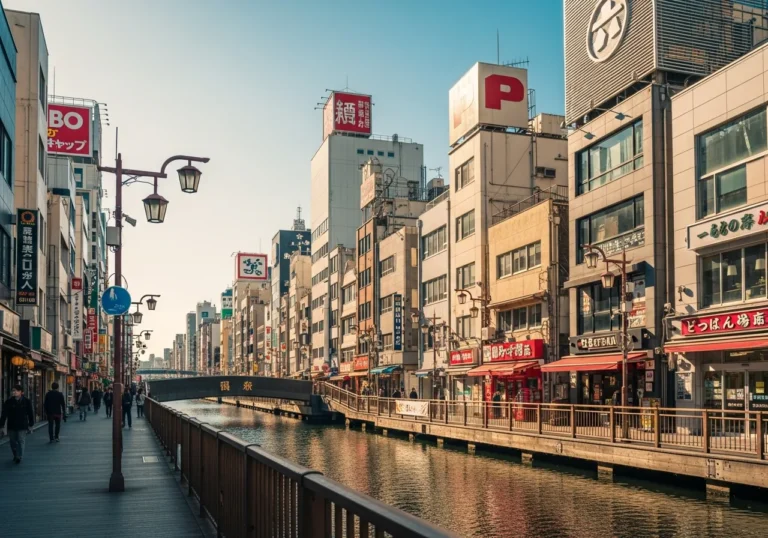
Walk south from Kitahama Station on a weekday morning and Doshomachi looks, at first, like any other block of mid-century office buildings in central Osaka. The signage is corporate, the suits are pressed, the coffee shops are functional.
Then you notice the names on the buildings: Takeda. Shionogi.
Mitsubishi Tanabe Pharma. Ono Pharmaceutical.
Every major Japanese drug company has a presence on this one street, and most of them have been here, in some form, for well over a century. The street is barely 300 metres long.
It is, by any reasonable measure, the most consequential strip of pharmaceutical real estate in Asia.
It did not become that by accident. And the story of how it got there begins, as so many Osaka stories do, with a single merchant making a single decision about where to set up his counter.
Why Did a Herb Shop Open on This Particular Street in 1781?
Over two centuries ago in 1781, 32-year-old Chobei Takeda I started a business selling traditional Japanese and Chinese medicines in Doshomachi, Osaka, the center of the medicine trade in Japan. The date is precise: June 12, 1781. But the choice of location was not arbitrary — it was the only rational choice for anyone who wanted to trade in medicine.
It is said that Doshomachi became an area for medicine in the Kan’ei era (1624–1644), when a wealthy merchant from Sakai named Konishi Kichiemon opened an apothecary there. By the time Chobei arrived, the street had been the country’s pharmaceutical hub for over a century and a half. The Tokugawa shogunate had formalized that status with something more powerful than reputation: a legal monopoly.
Drugs were initially sold widely around the middle of the Edo period when the Bakufu encouraged drug production and sales to help improve the health of citizens. As drug production grew and distribution efforts gained momentum, the merchants who dealt in drug ingredients grew in power.
The Bakufu awarded special monopoly rights to those who paid a special tax. There were 24 publicly approved drug wholesaler unions in the Honcho neighborhood of Edo (present-day Tokyo), and 124 drug traders in the Doshomachi neighborhood of Osaka.
That asymmetry — 24 in the capital, 124 in Osaka — tells you everything about where the real pharmaceutical power resided. There were two types of drugs: Tang drugs imported to Japan from China, and Japanese drugs produced domestically. Since all of the Tang drugs followed a single distribution course from the Tang drug wholesalers in Osaka to the drug traders of Doshomachi to drug wholesalers nationwide, drug quality was reasonably reliable.
Doshomachi was not merely a marketplace. It was the national quality-control system for medicine, the point through which every herb, root, and compound had to pass before it could reach a patient anywhere in Japan.
The Doshomachi district in Osaka City flourished as the “Town of Medicine” during the Edo period, as it was responsible for pricing and exclusively distributing medicinal ingredients. The guild that ran this system — the Doshomachi Yakushu Nakagai Nakama (Medicine Traders Guild) — inspected medicines collected in Doshomachi, set proper prices for them, and supplied them exclusively around the country.
Why Osaka rather than Edo? The answer is structural.
During the Edo period (1603–1868), Osaka earned the nickname “the nation’s kitchen” (tenka no daidokoro), as rice and other goods from all over the country flowed here for further distribution. Its location at the mouth of rivers flowing into the Seto Inland Sea made the city a natural hub for trade.
Medicinal ingredients — many of them imported from China through Nagasaki, or harvested from mountain provinces and shipped down river — followed the same logic as rice: they moved through Osaka because Osaka was where Japan’s commercial arteries converged.
When Chobei Takeda I chose Doshomachi, he was not pioneering anything. He was joining the most sophisticated pharmaceutical supply chain in the pre-modern world, in the city that ran it.
Why Did the Business Model Work — and Why Did It Survive?
His small shop bought medicines from wholesalers, then divided them into smaller batches and sold them to local medicine merchants and doctors. This sounds simple.
It was, in fact, a precision operation. The value Chobei added was not manufacturing — he made nothing — but verification.
In a market where adulteration was common and the consequences of a bad compound could be fatal, a merchant who could be trusted to source correctly and measure accurately was worth paying a premium for.
As a merchant, Takeda developed a reputation for business integrity and high-quality products and services. That reputation was the business. It was also, as it turned out, a philosophy with a name.
The ethical framework Chobei I operated by was sanpo yoshi — “three-way satisfaction.” Their success stemmed from their adherence to a spirit known as sanpo-yoshi, literally “three-way satisfaction,” which advocated benefits to the seller, to the buyer, and to the local community. The principle was associated with the Omi merchants — the great traveling traders of what is now Shiga Prefecture — but it had spread through Osaka’s merchant culture as a practical code of conduct.
Being accepted by communities was an integral part of their success. The Omi Shonin had to build long-term, trusting relationships and ensure that they were liked and respected by the communities in which they operated.
This may have been one major driver behind the emergence of their unique business philosophy — Sanpo Yoshi.
Chobei I was explicit about this. As a merchant, Chobei I was noted for his business motto, the “Sanpo Yoshi Philosophy,” which posited: “There should be benefits on all three sides: Benefits for the buyer, Benefits for the seller and Benefits for society.” This was not corporate branding — the term “sanpo yoshi” was not even coined until after World War II. It was a working principle, the kind of thing a merchant in Edo-period Osaka would have absorbed from the commercial culture around him and expressed in daily practice.
The result was growth that compounded across generations. By 1805, during the time of the first family head Chobei Takeda I, the inventory asset had become about fifty times larger.
Chobei Takeda II expanded the family business. The sales amount grew about six times larger.
These are extraordinary numbers for a business that was still, at its core, a wholesaler dividing herbs into smaller packets.
The succession mechanism was itself a piece of institutional design. Into the 19th century, Takeda expanded under the leadership of Chobei I and his successors.
Successive leaders inherited the name Chobei, until Chobei VI. The name was not a family name in the Western sense — it was a title, a brand, a guarantee.
When a new head of the house took the name Chobei, he was not just inheriting property; he was inheriting a reputation that customers had trusted for decades. The continuity of the name was the continuity of the promise.
Why Did Osaka Produce This Kind of Merchant in the First Place?
To understand Chobei Takeda I, you have to understand the city he was born into. Osaka maintained the position of the national trade hub. During the Edo Period (1603–1868), it was called tenka-no daidokoro (“Japan’s Kitchen”) and was known as the city of merchants, while Edo was the city of samurais and Kyoto was of nobles and artisans.
That tripartite division was not just cultural — it was structural. Merchants were still considered to be at the bottom of the Confucian hierarchy put in place by the ruling samurai.
Over time, this social distinction gave rise to a unique Osakan mercantile culture which separated the city from Edo, its eastern rival. Osaka’s merchants, formally ranked below farmers and artisans in the official hierarchy, responded by developing an extraordinarily sophisticated commercial culture.
Status in Osaka was earned not by lineage but by acumen.
During the Edo period, the wealthy merchant class of Osaka was restricted by strict laws from showing off their wealth through fancy clothes or architecture. Instead, they poured their money into lavish, high-quality dining.
But they also poured it into education. An active economic development nurtured a rational spirit among the people’s minds.
The people became more interested in learning and thought. Various educational facilities were set up and developed by their own efforts.
At first there was more emphasis on practical science for their own business, but this soon led to further studies such as Confucian thought, philosophy, religious studies, natural history and astronomy.
Doshomachi itself was a node of this educational culture. Since the Edo period, people living in this area had been pooling their resources to build schools and institutions for young people and apprentices so that they could balance their work and education.
The roots of schools such as Osaka University of Pharmaceutical Sciences and the Osaka University School of Pharmaceutical Sciences also lie in Doshomachi. The street that produced Japan’s largest pharmaceutical company also produced the institutions that trained the scientists who would eventually work there.
Chobei I was a product of this environment. He was not an outlier — he was an expression of what Osaka’s merchant culture, at its best, could produce: a man who understood that trust was a form of capital, that quality was a competitive advantage, and that a business which served its community would outlast one that merely extracted from it.
Why Did the Family Survive the Meiji Revolution?
The Meiji Restoration of 1868 was an existential threat to every business built on the old order. The shogunate’s guild system — the very legal architecture that had made Doshomachi’s monopoly possible — was dismantled.
Japan opened to foreign trade. Western medicine, backed by the prestige of a modernizing state, began to displace the Sino-Japanese herbal tradition that had been the Takeda family’s entire product line for nearly ninety years.
Most businesses in Chobei’s position would have been destroyed. The Takeda family pivoted.
Chobei Takeda IV led other medicine retailers in turning his attention to Western medicine. He formed a cooperative union for purchasing Western medicines in Yokohama and began transactions with foreign trading companies. Western medicines imported at the time included quinine, an anti-malaria drug, and phenol, an anti-cholera drug.
The year was 1871. Japan had been open to the West for less than two decades.
Chobei IV was not simply importing new products — he was making a bet that the entire epistemological framework of Japanese medicine was about to change, and positioning his family to profit from that change rather than be destroyed by it. The cooperative union he formed in Yokohama was a piece of institutional innovation: by pooling purchasing power with other Doshomachi merchants, he could negotiate with foreign trading companies on terms that a single shop could never achieve.
In 1895, while Japan was at war with China in the First Sino-Japanese War, the company established its own factory in Osaka and became a pharmaceutical manufacturer. In parallel with the factory construction, Takeda began direct imports from England, the U.S., Germany, Spain, and other countries. Thus, the business that began as a shop selling old-fashioned Japanese and Chinese remedies quickly shifted its basic orientation toward Western medicines.
The factory was acquired by purchasing Uchibayashi Drug Works. In 1895, the Company acquired Uchibayashi Drug Works to establish its own factory in Osaka and became a pharmaceutical manufacturer.
Products such as bismuth subgallate (an antidiarrheal agent) and quinine hydrochloride were produced at this factory. In 1907, the Company became the first company in Japan to produce saccharin.
That last detail — saccharin — is easy to overlook but significant. Saccharin was not a medicine; it was a food additive, a chemical product.
By 1907, Takeda was already thinking beyond the pharmacy counter toward the broader chemistry of human health. Takeda, for instance, began importing Western medicines like quinine in 1871, established its own pharmaceutical manufacturing factory in 1895, and by 1907 had secured exclusive sales rights in Japan for products from the German giant Bayer.
The exclusive Bayer arrangement was another institutional coup: it gave Takeda access to the most advanced pharmaceutical research in the world at a time when Germany led global drug development.
Then World War I cut the German supply lines. In 1914, a research division was established.
Around the time when imports from Germany ended due to World War I, Takeda began the sales of its own products. The war that destroyed Takeda’s supply relationship with Bayer forced the company to become a manufacturer and researcher in its own right.
Catastrophe, again, became the engine of transformation.
Why Did the Name “Chobei” Matter So Much — and What Did the Fifth Generation Build?
The fifth Chobei — Chobei Takeda V — is the figure who transformed a family trading house into a modern corporation. Formal incorporation as Chobei Takeda & Co., Ltd.
in 1925 under Chobei Takeda V modernized the corporate structure. The company went from being a family business — legally owned by a single household — to a joint-stock corporation with formal governance, a research division, and a manufacturing operation.
Chobei V was also a scholar and a philanthropist in the tradition of Osaka’s merchant class. Chobei V recognized the importance for both academia and public society of preserving herbal and medical texts of Japanese and Chinese origin.
Throughout his life, Chobei V collected books and manuscripts that promoted the development of medical sciences. He was, in other words, doing what the Doshomachi community had always done: investing in knowledge as a form of public good.
Shoshisha dates back to 1923 when Chobei Takeda V started using his own money to support deserving students with financial needs. The Shoshisha Foundation was established in 1960 to carry on this work. This was sanpo yoshi made institutional: the profits of commerce returned to the community as education.
The company rules that Chobei V codified in 1940 are worth pausing on. Takeda’s original company rules were stipulated by Chobei Takeda V, the fifth head of the family, in 1940.
They reflect the influence of the teachings of Prince Shotoku (Ruler of Japan from 594 to 622 CE): Business is meant for the benefit of enhancing public good and contributing to the nation. The reference to Prince Shotoku — Japan’s great early lawgiver — was not decorative.
It placed the company’s commercial activity within a framework of civic obligation that stretched back to the earliest period of Japanese statecraft. A herb shop in Doshomachi, it turned out, had always been about something larger than herbs.
The 1933 establishment of the Takeda Garden for Medicinal Plant Conservation in Kyoto was another expression of this philosophy. In 1933, Takeda Garden for Medicinal Plant Conservation was established.
Herbs and other plants with medicinal value from around the world have been collected, grown, and used at this conservation garden. Currently, the garden has more than 2,882 species of plants, including 104 endangered species.
The garden was research infrastructure, yes — but it was also a living archive of the herbal tradition that Chobei I had sold from his counter in 1781. The company had not abandoned its origins; it had institutionalized them.
Why Did the Street Itself Survive — and What Does It Mean That It Did?
Osaka was devastated by Allied bombing in 1945. Large portions of the city were destroyed. Yet Doshomachi, and the pharmaceutical companies concentrated there, survived with enough continuity to resume operations almost immediately after the war.
Part of the reason was physical — the district’s dense, low-rise commercial buildings were less catastrophically flammable than residential neighborhoods. Part of it was institutional: the companies had the organizational capacity to rebuild quickly. And part of it was the peculiar resilience of a street whose identity had been defined by a single industry for more than three centuries.
After the war, Takeda moved fast. With a licence from the GHQ, Takeda converted the bombed-out ruins of a naval arsenal in Hikari, Yamaguchi Prefecture, into a factory.
This marked the first private use of publicly owned land after the war. It became Takeda’s second main plant, following the Osaka Plant, and primarily manufactured vaccines, which were acutely needed by society at the time.
In May 1949, Takeda opened its stock and became a publicly traded company. In 1950, Takeda produced Panvitan®, which was Japan’s first multivitamin.
The multivitamin was a product perfectly calibrated to post-war Japan: a country rebuilding its health from the ground up, where nutritional deficiency was widespread and the idea of preventive medicine was gaining traction. Chobei I had sold herbs to doctors.
His successors were now selling vitamins directly to the public.
Today, the Doshomachi district in Osaka City flourished as the “Town of Medicine” during the Edo period, as it was responsible for pricing and exclusively distributing medicinal ingredients. Even after 350 years, it remains a major pharmaceutical hub, home to over 300 pharmaceutical companies, including the headquarters of leading Japanese pharmaceutical firms such as Shionogi & Co., Ltd., Mitsubishi Tanabe Pharma Corporation, Sumitomo Pharma Co., Ltd., Takeda Pharmaceutical Company Limited, and Ono Pharmaceutical Co., Ltd.
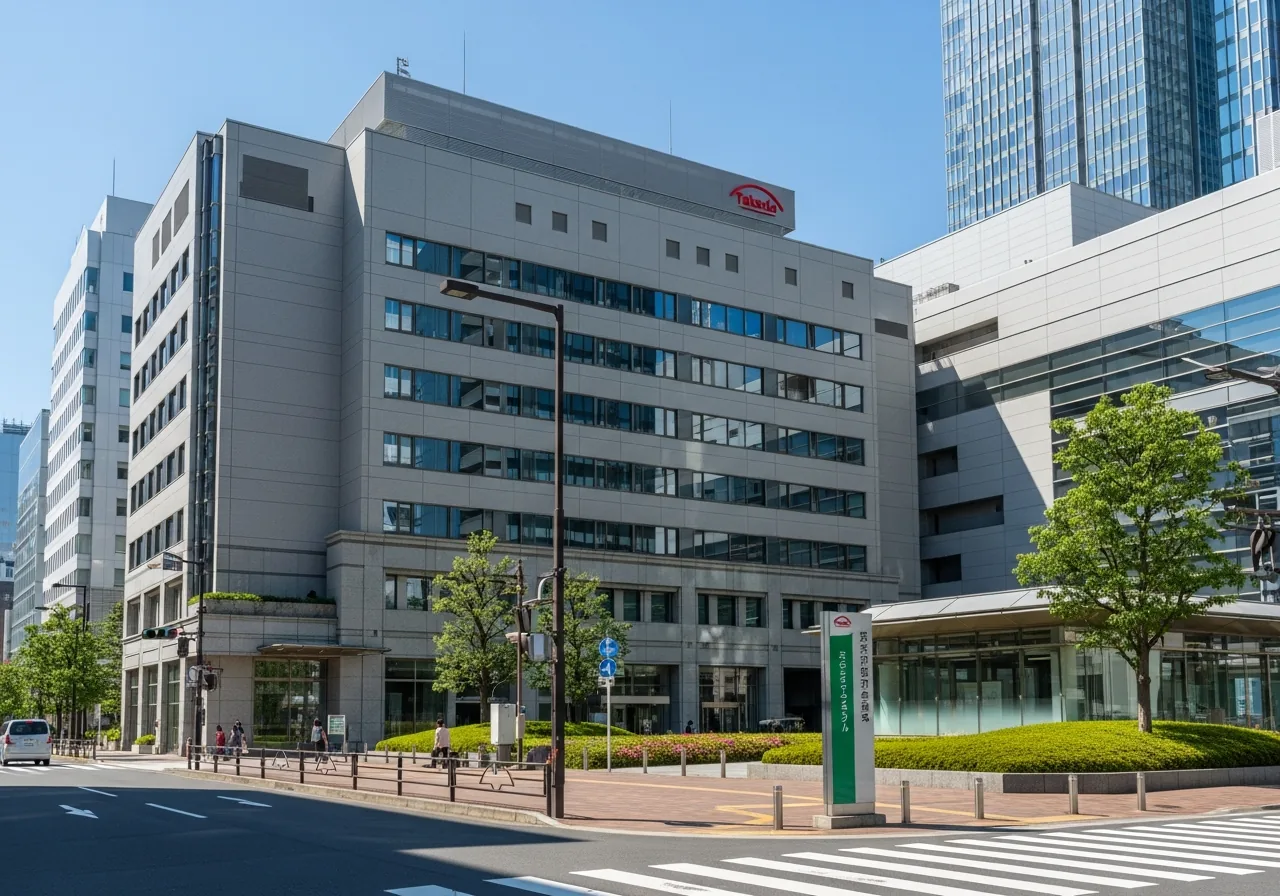
The Osaka headquarters of Takeda sits at 1-1, Doshomachi 4-chome, Chuo-ku, Osaka — on the same site, according to the company’s own records, where Chobei I opened his shop in 1781. The Osaka headquarters is standing on the same site where the company was founded in 1781.
This is not a heritage claim or a marketing flourish. It is a fact of urban geography: the building that houses one of the world’s top pharmaceutical companies occupies the ground where a 32-year-old merchant once weighed out packets of Chinese herbs.
Why Did the $62 Billion Deal Happen — and What Does It Have to Do With an Herb Shop?
The acquisition of Shire plc in January 2019 was the largest foreign acquisition ever made by a Japanese company. The deal was worth $62bn, making it Japan’s largest foreign acquisition to date, by a significant margin and one of the largest pharmaceutical deals of the 21st century. It transformed Takeda from a large regional pharmaceutical company into a genuinely global biopharmaceutical leader.
Takeda announced the completion of its acquisition of Shire plc, becoming a global, values-based, R&D-driven biopharmaceutical leader headquartered in Japan. Takeda now has an attractive, expanded geographic footprint and leading position in Japan and the U.S., bringing its highly-innovative medicines to approximately 80 countries/regions with dedicated employees worldwide.
The logic of the deal was straightforward: Shire gives Takeda scale in the U.S. — crucial as Japan’s share of the global pharmaceutical market declines.
Just under half of the combined company’s revenue will come from the U.S. Japan’s domestic pharmaceutical market, while large, was not growing fast enough to sustain a company with Takeda’s ambitions.
The Shire acquisition was Chobei IV’s 1871 pivot replayed at a scale that would have been incomprehensible to any of the five Chobeis who preceded it: instead of forming a cooperative to import quinine from Yokohama, the sixth-generation company was absorbing an Irish-American biotech for sixty-two billion dollars.
But the continuity is real. It makes Takeda the first Japanese pharmaceutical company to rank among the top 10 pharmaceutical companies with revenues exceeding $30 billion.
And the company that achieved this was still, formally, headquartered on the same street in Osaka’s Chuo Ward where everything began. The global headquarters moved to Tokyo, as large Japanese corporations tend to do.
But the Osaka address — Doshomachi 4-chome — was kept. It is not sentiment.
It is identity.
Why the Shrine Next Door Is Part of the Story
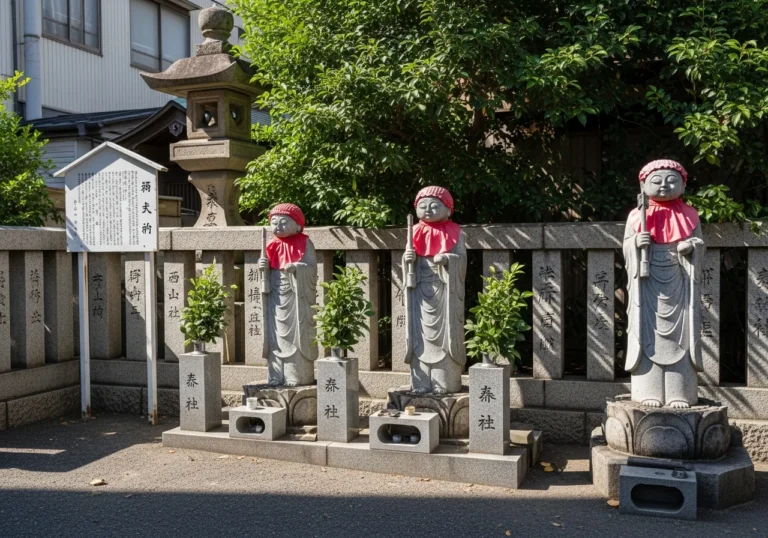
No account of Doshomachi is complete without its shrine. Located among the buildings of Doshomachi, known as the “town of medicine,” Sukunahikona Shrine is known as the god of health and medicine.
It enshrines Sukunahikona-no-mikoto, the Japanese god of medicine, and Shinno-en-tei, the Chinese god of medicine. It is said to have originated in 1780, when druggists enshrined a branch of Sukunahikona-no-mikoto from Kyoto’s Gojō Tenjin Shrine, along with Shinno, who had previously been enshrined at the Nakamakaisho in Doshomachi.
The timing is striking: the shrine was established in 1780, one year before Chobei I opened his shop. The medicine merchants of Doshomachi were building their spiritual infrastructure at the same moment they were consolidating their commercial one.
They initially worshipped Shinno at their guild hall before inviting the spirit of Sukunahikona-no-Mikoto from Gojo Tenjin Shrine in Kyoto to join the Chinese deity. This merger created Japan’s only major shrine dedicated equally to both Japanese and Chinese medical traditions.
The shrine is a physical expression of what made Doshomachi distinctive: it was a place where the two great traditions of East Asian medicine — Japanese and Chinese — were held together rather than set against each other. The merchants who built it were not ideologues; they were pragmatists who understood that the best medicine drew from both traditions.
Chobei I sold both Japanese and Chinese herbs. The shrine honored both gods.
The logic was the same.
The “Paper Tiger,” a popular Osaka souvenir, is a talisman for protection from illness at this shrine. During a cholera epidemic in Osaka in 1822, a pill called “Toratousaki-o-kouen” was created to ward off the disease.
It was distributed free of charge along with the paper tiger talisman, offering prayers for protection, and it is said that the illness was cured. The cholera epidemic of 1822 was the same crisis that would have tested every medicine merchant on the street, including whoever was running the Takeda shop at that moment.
The shrine’s response — free medicine, distributed to the community — was sanpo yoshi in its most literal form.
During the “Shinnō Festival” held every year on November 22 and 23, visitors receive “hariko no tora” (papier-mâché tigers), which are believed to bring protection from illness. Because the festival is seen as the event that closes out the year in Osaka, it is also called the “Tome no Matsuri” (the year’s closing festival).
The festival still draws crowds. The pharmaceutical company executives who work in the towers above still attend.
The continuity is not performed — it is lived.
Why the Discerning Traveler Should Care
There is a version of this story that presents itself as business history — the rise of a pharmaceutical giant, the mechanics of Meiji-era modernization, the logic of a $62 billion M&A deal. That version is accurate but incomplete. The deeper story is about what it means for a city to have a commercial identity so strong that it shapes the behavior of businesses for two and a half centuries.
Osaka is not Tokyo. This is not a cliché — it is a structural fact.
This city was not one of samurai and aristocrats; rather, it was a city of merchants, traders, and artisans. Money, practicality, and the tangible quality of goods were the languages spoken here.
Status was earned not by lineage, but through sharp business acumen and the ability to provide quality products at a fair price. Chobei Takeda I was a product of that culture, and the company he founded is its most globally visible expression.
When you walk down Doshomachi today, you are walking through a place where the Edo-period logic of commerce — quality, trust, community benefit — was never fully displaced by the shareholder-value logic that came to dominate global business in the late twentieth century. The sanpo yoshi principle that Chobei I practiced in 1781 is now cited in World Economic Forum papers on stakeholder capitalism.
The success of Omi shōnin comes from the business philosophy “sanpō yoshi,” or “three-way satisfaction” between the seller, buyer and society. For merchants to be successful traveling throughout various regions and cultures, it was vital for them to gain the trust of their buyers.
Japan, it turns out, had a version of ESG before ESG had a name.
The traveler who comes to Doshomachi looking for a photo opportunity will find a fairly ordinary-looking business district. The traveler who comes looking for an argument — about how commerce works, about what makes a business durable, about the relationship between a city’s culture and the companies it produces — will find one of the richest sites in Osaka.
The Doshomachi Pharmaceutical and Historical Museum, housed in the Sukunahikona Shrine building, is free to enter. On display are medicine materials from the Edo period (1603 to 1867), signboards from the Meiji (1868 to 1912), Taisho (1912 to 1926) and Showa periods (1926 to 1989), and other medicine-related materials from this area.
The roughly 300-metre stretch of Doshomachi-dori that connects the museum, the shrine, and the corporate headquarters of Japan’s largest pharmaceutical companies is officially designated Doshomachi Museum Street. You can walk it in ten minutes.
It will take considerably longer to absorb what it means.
The Osaka Bio Headquarters, which tracks the district’s continuing role as a pharmaceutical cluster, notes that even after 350 years, it remains a major pharmaceutical hub, home to over 300 pharmaceutical companies. Three hundred companies on one street, in a city that was already the center of Japan’s medicine trade when Chobei I was born. The concentration is not coincidence — it is the compounding effect of two and a half centuries of institutional knowledge, professional networks, and a shared commercial culture that rewards integrity over short-term extraction.
That is what Chobei Takeda I built when he opened his herb shop on June 12, 1781. Not just a business. A template.
FAQ
Q: When was Chobei Takeda I born, and what do we know about his early life?
A: Chobei Takeda I (武田長兵衛, Takeda Chōbei) was born around 1749 in Osaka, Japan, and died in 1858. Beyond his Osaka birth and the 1781 founding of his shop, the historical record of his personal biography before that date is thin. We know he was 32 when he opened the Chobei Omiya Store, and that he lived to see the business grow substantially under his own leadership before passing it to his successors.
Q: Is the Takeda Pharmaceutical headquarters in Osaka or Tokyo?
A: Both. The company’s global headquarters is at 1-1, Nihonbashi-Honcho 2-chome, Chuo-ku, Tokyo, while the original Osaka headquarters remains at 1-1, Doshomachi 4-chome, Chuo-ku, Osaka 540-8645. The Osaka address is on the same site where Chobei I founded the business in 1781.
Q: Can visitors enter the Takeda Pharmaceutical building in Doshomachi?
A: The headquarters building is a working corporate office and is not open to the general public. However, the nearby Doshomachi Pharmaceutical and Historical Museum (inside the Sukunahikona Shrine complex) is free to enter and displays Edo-period medicine materials and signboards from the district’s history. The Mitsubishi Tanabe Pharma historical archive and Shionogi’s exhibition corner on the same street are also open to the public at no charge.
Q: What is the Shinnosai Festival and when does it take place?
A: The Shinnosai Festival is an annual festival held at Sukunahikona Shrine, at which the deities of medicine and trade are enshrined, and every November participants attend in the hopes of being blessed with good health and business success. Traditionally, the yearly calendar of festivals in Osaka begins with the Ebisu Festival in early January and ends with the Shinnosai Festival, so it is referred to as “Tome-no-matsuri” (the last festival). It takes place on November 22 and 23 each year.
Q: How large is Takeda Pharmaceutical today?
A: By 2024, it was the largest pharmaceutical company in Japan and Asia, and ranked 15th worldwide in revenue, with approximately $28.2 billion for the fiscal year ending March 31, 2024. The company operates in more than 80 countries and employs approximately 50,000 people worldwide — all of it traceable, in an unbroken institutional line, to a herb shop on a single street in Osaka’s Chuo Ward.
Doshomachi (道修町) — Visitor Information
Address: Doshomachi, Chuo-ku, Osaka 541-0045 / 大阪府大阪市中央区道修町
Nearest station: Kitahama Station (Keihan Line / Osaka Metro Sakaisuji Line) — approx. 3 minutes’ walk
Hours: Doshomachi Museum Street is an open public street, accessible at all times. The Doshomachi Pharmaceutical and Historical Museum (inside Sukunahikona Shrine, 2-1-8 Doshomachi) is generally open during daytime hours; confirm current hours via the Osaka Chuo Ward official page.
Admission: Free (Doshomachi Pharmaceutical and Historical Museum; confirm on official site before visiting)
Official site: osaka-bio.jp