Every summer, Osaka’s festival season opens not with fireworks or a river procession but with a three-day Buddhist ceremony at a small temple on the Uemachi Plateau — and it has done so, in one form or another, since 593 CE, when Prince Shōtoku founded the Seyakuin welfare hall that would eventually become Shōman-in Aizendō. The Aizen Matsuri is therefore not merely the oldest summer festival in Osaka; it is the oldest in Japan, a claim supported by the fact that the temple itself predates the country’s first written legal code, and that the festival’s hoekago palanquin procession is documented in literature before the Tōka Ebisu parade that most Osakans would name as the city’s oldest street spectacle. The festival endures because it was never purely entertainment: it was, from the beginning, a public prayer against summer disease, and that original purpose — protection, purification, the turning of worldly suffering into something manageable — is still performed at the Tahōtō pagoda on the evening of June 30th, every year, without exception.
Why we can tell you this — MICHI is written by an Osaka-based editorial team that can walk the Aizen-zaka slope to the temple gate on any given morning, stand inside the Tahōtō courtyard, and observe the neighbourhood that hosts and, occasionally, argues with the festival. This piece draws on the temple’s own official site at aizendo.com, the Osaka City tourism authority’s documentation at osaka-info.jp, the Agency for Cultural Affairs’ Cultural Heritage Online database (which lists the festival as an Osaka City-designated Intangible Folk Cultural Property since 2015), the Metropolitan Museum of Art’s scholarly notes on Aizen Myōō iconography, and a peer-reviewed study of medieval Osaka’s religious geography published in City, Culture and Society. Where the festival’s precise pre-Edo history is a matter of temple tradition rather than independent documentation, we say so.
On the last evening of June, the slope called Aizen-zaka fills with the sound of wooden palanquin poles and a chant that has not changed in centuries: Aizen-san ja, Hoekago! Beppin-san ja, Hoekago!
Shōbai hanjō, Hoekago! — “It’s Aizen-san, the treasure basket! A beautiful lady, the treasure basket!
Business prosperity, the treasure basket!” The women in the palanquins are dressed in yukata, their obi tied in the Osaka style, their faces composed into the particular expression of someone who is simultaneously a religious participant, a civic symbol, and a minor celebrity for three days. The crowd lining Tanimachi-suji is thick enough that you can smell the takoyaki stalls before you can see the procession.
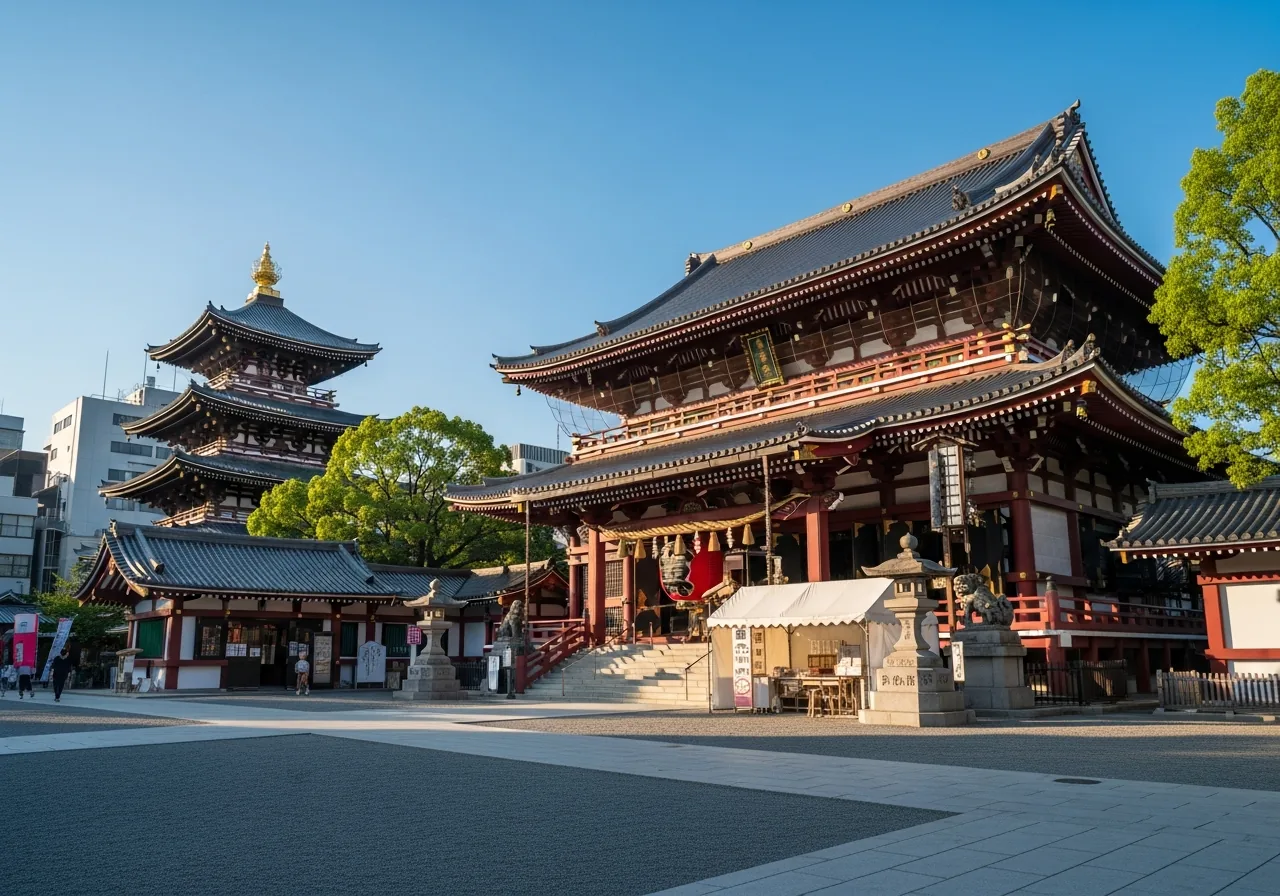
Above it all, on the plateau’s western edge, the Tahōtō pagoda — the oldest wooden building in Osaka City, rebuilt by Toyotomi Hideyoshi in 1597 — stands open for the only three days of the year when its doors are unlocked.
This is the Aizen Matsuri. To understand why it exists, why it happens here, why it takes the form it does, and why it still matters in a city that has rebuilt itself from rubble twice in living memory, you have to go back to a moment in 593 CE when a twenty-year-old regent decided that Buddhism was not just a religion but a system of public administration.
Why Does This Festival Exist at All? The Welfare State That Became a Temple
During the reign of Prince Shōtoku, 46 Buddhist monasteries and temples were built across Japan, the most important of which was Shitennōji, constructed in 593 CE. Shōtoku ruled as regent from 594 to 622 CE and was a great supporter of Chinese culture and Buddhism, spreading both during his reign by encouraging closer ties with China and building temples across Japan.
But Shitennōji was not simply a place of worship. Alongside the main temples for worshipping Buddha images, Prince Shōtoku established four institutions to promote organised social welfare: the Keiden-in (Institute for Religion), the Ryōbyō-in (Hospital), the Hiden-in (Welfare institution), and the Seyaku-in (Pharmacy).
The Seyaku-in was a facility that Prince Shōtoku, based on the Buddhist philosophy of mercy, allegedly erected within the premises of Shitennōji, where medicinal herbs were cultivated to relieve people who suffered from injuries or diseases. This was not a minor annex. The Seyaku-in has occasionally been described as the beginning of social welfare in Japan and actually marked the establishment of housing facilities.
The site of that original pharmacy is where Shōman-in Aizendō stands today. Today there exists the Aizen-dō Hall of Shōman-in Temple in Tennoji Ward, Osaka City, at the site where Seyaku-in used to be. The continuity is not symbolic — it is physical, the same ground, the same institutional purpose of caring for people who are suffering, expressed first in medicinal herbs and later in prayer.
The temple’s name evolved in layers. Prince Shōtoku later lectured on the Sutra of the Victory and enshrined a statue of Lady Śrīmālā in the main hall, leading to the temple’s nickname “Shōman-in.” The main hall then came to house the principal image of Aizen Myōō, renowned for his ability to find love and bring harmony to marriage, leading to the temple’s further nickname “Aizen-dō.”
So the full name — Aizendō Shōman-in — carries two histories inside it: the welfare hall of a sixth-century regent, and the esoteric Buddhist deity of love who moved in during the Heian period. The festival that bears the deity’s name is therefore the annual expression of an institution that has been caring for Osaka’s people, in one form or another, for over fourteen centuries.
Why Here? The Uemachi Plateau and the Geography of Sacred Osaka
The temple’s location is not incidental. It sits on the Uemachi Plateau, a narrow ridge of high ground that runs north to south through the centre of what is now Osaka City.
The Uemachi Plateau extends from the Osaka Castle and Tenmabashi area to Tennōji in the south. Based on post-war university studies of geological strata, it is assumed that by around the fifth century a sandbank had formed that eventually became the plateau.
In the Jōmon period, the Uemachi Plateau was a sandbank that separated the Inland Sea to the west from Kawachi Bay to the east.
That geography is everything. In the classical and medieval periods, the area of Osaka connected the capitals of Nara and Kyoto with the Seto Inland Sea and areas beyond.
The city of Osaka developed centred on the Uemachi Plateau, which was 15 metres higher than the surrounding area. The first area to flourish following the decline of the ancient capital of Naniwa-no-miya was Shitennōji Temple and its gate town, because it was believed to be the gate to paradise, and many pilgrims came there.
The plateau was, in other words, the only dry ground in a landscape that was largely water and marsh. During the Jōmon period, present-day Osaka was mostly submerged, and the Uemachi Plateau formed a 12-kilometre-long and 2.5-kilometre-wide peninsula separating Kawachi Bay from the Seto Inland Sea. Building a temple complex here in 593 was not a spiritual gesture alone — it was a statement about permanence in a landscape defined by impermanence.
As a peer-reviewed study in City, Culture and Society notes, the cities in the Osaka region in the medieval period, and especially those around the Uemachi Plateau, were established and developed in connection to religious faith, the temple, and Buddhist influence. In the medieval period of Japan, religion influenced not only faith but other aspects of society such as the economy, military, and culture.
The slopes descending from the plateau’s eastern edge are still named for the temples and shrines they lead to. These slopes — Shingon-zaka, Genshoji-zaka, Kuchinawa-zaka, Aizen-zaka, Kiyomizu-zaka, Tenjin-zaka, and Ou-saka — form a scenic walking route that winds through the Teramachi temple district, blending ancient pathways with cultural landmarks.
Aizen-zaka, the fourth of the seven, leads directly to the temple gate. The slope exists because the plateau exists.
The plateau exists because of geology. The festival exists because of the slope.
These are not metaphors — they are the literal topography of how Osaka was built.
Why This Deity? Aizen Myōō and the Theology of Transformed Desire
The festival is named for a deity who looks, at first encounter, alarming. Aizen Myōō is a wrathful deity, as suggested by his fearsome expression, his red skin, the bow and arrow he holds in two of his six hands, and the roaring lion’s head he wears as a crown.
Aizen — the two characters of whose name mean, literally, “dyed in love” — is, in fact, a force for good in Esoteric Buddhism. Practitioners pray to him to transform human desires, especially sexual ones, into powerful spiritual energy that, through ritual, can be harnessed to help them escape suffering.
This is the theological core of the festival, and it is more sophisticated than the “love deity” shorthand suggests. Aizen Myōō is known in Sanskrit as Rāgarāja, which translates roughly as the “King of Passion” or “King of Tinted Desire.” While mainstream Buddhism often taught the suppression of desire to achieve enlightenment, Esoteric Buddhism introduced a radical concept: Bonnō Soku Bodai, meaning “Earthly desires are themselves enlightenment.”
Aizen Myō-ō, translatable as “Lust-tainted Wisdom King,” is a wrathful embodiment of Buddha whose purpose is to teach through fear by warning against the depravity of earthly desires. Introduced to Japan in the ninth century, the Esoteric Wisdom Kings were originally Hindu deities, later adopted into the Buddhist pantheon, each emphasising the expulsion of a particular form of degeneracy.
The iconography encodes the doctrine. The earliest description of Aizen Myō-ō’s iconography and ceremonial purpose is found in the eighth-century scripture Yugi kyō, which instructs: “The colour of his body is like the rays of the sun; he resides in a blazing circle, and his three eyes gaze in fierce rage.” The red skin is not aggression — it is the colour of love and compassion in esoteric Buddhist symbolism.
The three eyes see past, present, and future simultaneously. The six arms hold implements that subdue passion rather than indulge it.
While Aizen Myō-ō’s startling appearance was meant to directly warn the viewer against passion and lust, artistic renditions of the deity in Japan were typically hidden objects, used for consultation and intercession by only a few select monks, giving lay people little or no access to Aizen’s image. This is why the festival matters so much: for three days each year, the hidden image is revealed. The deity who is normally sealed away — whose power is precisely that of the unseen — becomes visible to anyone who walks through the gate.
The principal image at Shōman-in is a hibutsu, a secret Buddha. Aizen Myō-ō is revered as the deity of matchmaking, and the principal image is only exhibited during the festival period.
The Tahōtō pagoda, which houses a second sacred image, is similarly locked for 362 days of the year. The pagoda enshrines a statue of a very rare twelve-armed Buddha called Dainichi-Daishō-Kongō-Son.
The statue was enshrined in the pagoda by order of Hideyoshi. Throughout most of the year, the pagoda is tightly closed and only open during the Aizen Matsuri festival.
The scarcity is the point. A deity you can see every day is a decoration. A deity you can see only three days a year is an event.
Why Did the Temple Survive? War, Warlords, and the Pagoda That Outlasted Everything
The history of Shōman-in is a history of destruction and reconstruction, and the fact that it stands at all is largely due to two men who had very different relationships with Osaka: Oda Nobunaga, who destroyed it, and Toyotomi Hideyoshi, who rebuilt it.
Aizen-dō burned down during the Ishiyama War, the conflict between the Ishiyama Honganji and Nobunaga. Many years later, Tokugawa Hidetada, the second shogun of the Edo Period, rebuilt the temple’s main hall. But it was Hideyoshi who left the most lasting mark on the physical site.
The Tahōtō pagoda is the oldest building in Osaka City. The current pagoda was rebuilt by the well-known warlord Toyotomi Hideyoshi in 1597.
That date is significant: 1597 is the year of Hideyoshi’s second Korean campaign, and the statue he enshrined inside the pagoda — the twelve-armed Dainichi-Daishō-Kongō-Son — is said to have been placed there in connection with that military venture. During the festival, the temple hosts special public viewings of Aizen Myō-ō and Dainichi Nyorai, the latter enshrined by Toyotomi Hideyoshi during his Korean campaigns.
The pagoda’s architectural form is itself a statement. A tahōtō — literally “many-jewelled pagoda” — is a form of Japanese pagoda found primarily at Esoteric Shingon and Tendai school Buddhist temples.
It is unique among pagodas because it has an even number of stories (two). The square lower section and cylindrical upper section represent the union of earth and heaven, the fundamental and the transcendent — a cosmological diagram in wood and tile.
The Tahōtō pagoda is an important Momoyama-period masterpiece rebuilt by Toyotomi Hideyoshi and designated an Important Cultural Property of Japan. It survived the firebombing of Osaka in 1945 that destroyed most of the city’s older structures.
It survived the Meiji-era suppression of Buddhism. It survived the Ishiyama War.
It is, as of the publication of this article, the oldest wooden building in Osaka City, and it opens its doors for exactly three days each summer.
As the Osaka City Tourism Authority notes, the temple grounds are home to the Tahōtō Pagoda — a nationally important cultural property, a masterpiece of the Momoyama period rebuilt by Toyotomi Hideyoshi — as well as the “Aizen no miraculous water,” said to grant love when drunk, making it popular among young women.
The miraculous water — the Aizome no Reisui — deserves a moment. There is a small well on the grounds called “Aizome no Reisui.” It is believed that you can find true love if you drink this spiritual water from the well.
The well is not a modern addition. It is part of the same logic as the festival itself: the idea that the sacred can be ingested, absorbed, made part of the body.
You do not merely observe Aizen Myōō. You drink the water from his ground.
You wear the yukata that marks the season he opens. You receive the love bracelet from the hands of the Aizen Musume.
The festival is participatory theology.
Why the Hoekago? The Geisha, the Palanquin, and the Parade That Predates Tōka Ebisu
The most visible element of the Aizen Matsuri — the element that fills Tanimachi-suji with crowds on the evening of June 30th — is the hoekago parade: a procession of palanquins carrying the Aizen Musume, the festival’s selected young women, from Tennoji Station to the temple gate.
The parade’s origins lie in the entertainment districts of Edo-period Osaka. During the Edo period, geisha would ride in hoekago palanquins to pray for business success and marriage, and the “Hoekago Procession” was held, with geisha from Kitashinchi and Imazato-Shinchi playing the leading role in the parade until the early Shōwa period.
The hoekago is a type of palanquin named after the Edo period’s Hōei era (1704–1711). The name is embedded in the chant: Hoekago — the treasure basket of the Hōei era. The geisha who originated the tradition were not performing for tourists; they were making a genuine religious pilgrimage to a deity associated with love, relationships, and the kind of professional charm that their livelihood depended on.
The hoekago procession — the custom of Osaka’s entertainment-district geisha fitting out palanquins and parading to the temple — is documented in literary sources earlier than the Tōka Ebisu festival’s equivalent procession, according to the Agency for Cultural Affairs’ Cultural Heritage Online database. This is a significant claim: it means that the Aizen Matsuri’s street spectacle is, in documented terms, the oldest parade tradition in Osaka.
The same database records that the festival’s scenes are depicted in the works of Ihara Saikaku and Chikamatsu Monzaemon, confirming that it was continuously observed from at least the early Edo period. Saikaku, the seventeenth-century novelist who chronicled Osaka’s merchant class with forensic precision, wrote about the Aizen Matsuri as a social event — a moment when the city’s hierarchies briefly dissolved in the heat and the crowds. Chikamatsu, the playwright who turned Osaka’s domestic tragedies into art, set scenes against its backdrop.
The parade today has evolved from its geisha origins. On June 30th, a parade featuring twelve Aizen Maidens selected annually carries them in seven hoekago palanquins, decorated with red and white cloth and “Aizen Katsura” flowers, from Tennoji Station to Aizendō Shōman-in.
Upon arrival, the palanquins are lifted high in front of the temple, creating a lively spectacle. Visitors pray for prosperity, love, and charm, receiving “Hana-mamori” (flower amulets) and smiles from the Aizen Maidens.
The selection process for the Aizen Musume is itself a small institution. Each year, 300 to 400 applicants enter, with ten finalists chosen through document screening and interviews. One requirement that distinguishes this from a standard beauty contest: contest hopefuls are required to be able to put on a yukata without assistance — very difficult — so this contest is unique to Aizen Matsuri and is different from a simple beauty pageant.
Why the Yukata? The Festival as Seasonal Threshold
The Aizen Matsuri is known throughout Kansai by a second name: the Yukata Festival. The connection is not decorative. Since the festival marks the start of summer in Kansai, many visitors wear yukata, earning the event the nickname “Yukata Festival.”
The logic runs deeper than fashion. In traditional Japanese life, the yukata — the light cotton summer kimono — was not worn year-round.
It was a seasonal garment, and the Aizen Matsuri was the moment when you brought it out of storage for the first time. It is a local practice to wear a yukata on this day, and there is a meaning to it: showing your first yukata of the year to Aizen-san, as a kind of presentation to the deity.
This is the festival functioning as a calendar marker — a threshold between seasons that is simultaneously a religious act. The yukata is not a costume. It is a declaration that summer has arrived, made in front of a deity who has been witnessing Osaka’s summers for fourteen centuries.
The three great summer festivals of Osaka are remembered by a mnemonic that is itself a piece of Osaka wit. Because all three festivals are known by affectionate nicknames — Aizen-san, Tenjin-san, Sumiyoshi-san — the saying goes: “Osaka’s summer festivals begin with Aizen-san and end with Sumiyoshi-san,” which gives rise to the phrase Ai-sumi-masen — a homophone of the polite apology “I’m sorry” — as a way of remembering all three. The pun is quintessentially Osaka: a mnemonic that doubles as a joke, a joke that encodes a genuine sequence of sacred time.
The sequence matters. Aizen Matsuri on June 30th–July 2nd opens the summer.
Tenjin Matsuri on July 24th–25th marks its height. Sumiyoshi Matsuri in late July closes it.
The city moves through summer not as a single undifferentiated season but as a structured ritual calendar, and the Aizen Matsuri is its opening ceremony.
Why the Nagoshi no Harae? The Buddhist Temple That Performs a Shinto Rite
On the evening of June 30th, before the hoekago parade reaches the temple, something unusual happens inside the Tahōtō courtyard. The head priest of Shitennōji — the mother temple, not Shōman-in itself — leads a ceremony called the Nagoshi no Harae: the Great Purification of Summer’s End.
During the Nagoshi no Harae, people go to shrines in hopes of purging themselves of sin and pray for health and well-being for the remainder of the year. This festival takes place in many shrines throughout Japan.
However, because this festival is exclusive to Shinto shrines, it is a little unusual that Aizen-san, a Buddhist temple, holds a special prayer service on this day. High-ranking monks from Shitennōji come to perform the service, which is very rare.
This is the festival’s most theologically interesting feature, and it is not an accident. The temple tradition positions the Aizen Matsuri as a Nagoshi no Harae ceremony in the context of shinbutsu-shūgō — the syncretic fusion of Shinto and Buddhist practice that governed Japanese religious life until the forced separation of 1868.
The Meiji government’s order to separate Buddhism and Shinto was one of the most disruptive acts of cultural policy in modern Japanese history, and most institutions complied. Shōman-in, quietly, did not entirely comply.
The Nagoshi no Harae is still performed here, by Buddhist monks, in a Buddhist temple, on the same night that Shinto shrines across Japan perform the same rite.
This is why the festival matters beyond its surface spectacle. It is a living document of pre-Meiji Japanese religious practice — of the world before the government decided that Buddhism and Shinto were separate things. Standing in the Tahōtō courtyard on June 30th, you are standing in a space that has refused, for over a century and a half, to accept that particular piece of modernisation.
Why Did It Nearly Disappear? The 2018 Crisis and the Question of What a Festival Is For
In 2018, Shōman-in made a decision that shocked Osaka. The temple announced that the Aizen Matsuri would be scaled down dramatically: no food stalls, no hoekago parade on public streets, no Aizen Musume recruitment. The religious ceremonies would continue — the deity unveiling, the Nagoshi no Harae, the prayers — but the public spectacle that drew hundreds of thousands of visitors would be suspended.
In 2018, the festival was scaled down. While religious ceremonies, deity unveilings, and blessings continued, food stalls and the hoekago parade were cancelled.
This decision aimed to reaffirm the festival’s spiritual purpose. Concerns over noise, reckless motorcycle behaviour, illegal parking, littering, and public urination had prompted complaints from local residents, leading to the decision.
The temple’s statement was pointed. The festival had, in its view, lost the plot.
The crowds were coming for the spectacle, not the prayer. The streets around the temple were becoming ungovernable on festival nights, with motorcycle gangs treating Tanimachi-suji as a performance space and the surrounding residential streets as a toilet.
The temple decided it would rather have a smaller, quieter, more genuinely religious event than a large, chaotic one that had forgotten why it existed.
The decision provoked a genuine civic debate in Osaka about the nature of matsuri. A festival is, by definition, a public event — it belongs to the community as much as to the institution that hosts it.
But a festival hosted by a Buddhist temple is also a religious ceremony, and the temple has the authority to determine what that ceremony requires. The 2018 scaling-down was, in effect, the temple asserting its own definition of what the Aizen Matsuri was for.
The temple’s own website, aizendo.com, now describes the festival as “a special time where prayers for welcoming summer and the energy of the city intersect,” and notes that after the disruptions of the COVID-19 pandemic, the full vitality of the event — including the hoekago parade and the festival stalls — has returned. The revival was not automatic.
It required negotiation between the temple, local residents, and the city. The parade now starts from a slightly different point, the crowd management is more structured, and the temple has been clearer about what it expects from participants.
What the 2018 crisis revealed is that the Aizen Matsuri is not a heritage performance that runs on autopilot. It is a living institution that can be wounded, that requires active maintenance, and that depends on a social contract between the temple and the neighbourhood it inhabits. That fragility is, paradoxically, a sign of its authenticity.
Why the Aizen Katsura? The Sacred Tree and the Novel That Made It Famous
On the temple grounds, behind the main hall, there is a katsura tree — a Japanese Judas tree — around which a trumpet vine has grown so completely that the two plants appear to have merged into a single organism. This tree, called the “Aizen Katsura,” has the way the vines drape around it suggestive of a lovers’ cuddle. The tree is therefore a symbol of matchmaking.
The tree became famous far beyond the temple in 1938, when the novelist Kawaguchi Matsutarō published Aizen Katsura, a melodrama set partly at the festival, which became one of the most popular films of the prewar period. The novel’s title — and its romantic associations — drew a new generation of visitors to the temple who came specifically to see the tree that had inspired the story. The tree predates the novel by centuries; the novel gave it a second life in popular consciousness.
This is the festival’s cultural ecology: a 1,400-year-old institution that has accumulated layers of meaning — welfare hall, esoteric temple, geisha pilgrimage site, literary setting, civic calendar marker — each layer added without erasing the one beneath. The katsura tree is a physical emblem of that accumulation: two organisms that have grown together so completely that you cannot separate them without destroying both.
Why Should a Discerning Traveller Care? The Significance Beneath the Surface
The honest answer is that most of what makes the Aizen Matsuri significant is invisible to a visitor who arrives without context. The hoekago parade is colourful and loud and genuinely fun.
The food stalls — when they are operating — offer the full range of Osaka street food in a compact space. The temple grounds are beautiful in the evening light, with the Tahōtō rising behind the main hall and the trumpet vine flowering orange against the old stone.
But the deeper significance is this: the Aizen Matsuri is one of the few places in modern Japan where you can observe, in a single evening, the full depth of what Japanese religious culture was before the Meiji government decided to rationalise it. A Buddhist temple performing a Shinto purification rite.
A hidden deity revealed for three days to anyone who walks through the gate. A parade whose origins lie in the Edo-period entertainment districts but whose chant encodes a genuine prayer for love, prosperity, and protection.
A pagoda that Hideyoshi built in 1597 and that has been opened every summer since.
Since 2015, the Aizen Festival has been recognised as an Intangible Folk Cultural Property by the city of Osaka — a designation that acknowledges not just the festival’s age but its ongoing vitality as a living practice. The designation matters because it comes with obligations: the city and the temple are now formally committed to maintaining the festival’s essential character, which means the negotiation between spectacle and ceremony, between public event and religious rite, is now a matter of official cultural policy.
For the affluent, intellectually curious traveller who can go anywhere: the Aizen Matsuri offers something that Kyoto’s more famous festivals do not. Kyoto’s great ceremonies are magnificent, but they are also, increasingly, performances staged for an audience that is largely external to the community that created them. The Aizen Matsuri is still, fundamentally, a neighbourhood event — a festival that the people of Tennoji Ward attend because it is their festival, because it opens their summer, because the temple at the top of Aizen-zaka has been part of their lives in a way that no amount of tourist infrastructure has yet managed to displace.
The 2018 crisis proved this. The temple did not scale down the festival because it was losing money or losing visitors.
It scaled down because the neighbourhood was suffering. The festival’s relationship to its community is not decorative — it is structural.
And that structural relationship, maintained across fourteen centuries of war, fire, political upheaval, and now the pressures of mass tourism, is the most remarkable thing about the Aizen Matsuri.
Come on June 30th. Wear a yukata if you have one, or rent one in Tennoji — there are several shops within walking distance of the station.
Walk up Tanimachi-suji from the south and let the crowd carry you toward the temple gate. When the hoekago arrives and the carriers lift the palanquin in front of the main hall, the chant will go up from several hundred throats simultaneously: Aizen-san ja, Hoekago! It is not a performance.
It is a prayer. It has been a prayer for a very long time.
Frequently Asked Questions
Q: When exactly does the Aizen Matsuri take place?
A: The Aizen Festival is held annually from June 30 to July 2 at Shōman-in Temple, commonly known as “Aizen-san,” located in Tennoji Ward, Osaka. The hoekago parade on June 30th is the main public spectacle; July 1st and 2nd are quieter, focused on religious ceremonies and the Aizen Musume talent contest.
Q: Is admission free?
A: Admission is free, and June 30 is the best day to experience the hoekago parade, while the following days offer a more relaxed opportunity to explore the temple grounds and festival activities. Confirm current details on the official site before visiting, as arrangements can change.
Q: What is the Aizen Musume contest?
A: On July 1st, the Aizen Maidens showcase their hidden talents in a competition featuring calligraphy, karaoke, cheerleading, and magic tricks. Candidates are required to be able to put on a yukata without assistance, so this contest is unique to Aizen Matsuri and is different from a simple beauty pageant.
Q: What is the “Aizen Parapara”?
A: During the Aizen Festival, a light rain often falls, colloquially known as “Aizen Parapara.” It is said that couples who encounter this rain on their way to or from visiting Aizen-san will be bound together.
Q: How do I get to the temple?
A: The temple is easily accessible on foot from Shitennoji-mae Yuhigaoka Station or Tennoji Station on the Osaka Metro Tanimachi Line. The hoekago parade route runs along Tanimachi-suji between the two stations, so arriving at Tennoji and walking north gives you the full parade experience.
Aizendō Shōman-in Temple (Aizen-san) — Visitor Information
Address: 5-36 Yūhigaoka-chō, Tennoji-ku, Osaka-shi, Osaka 543-0075 / 大阪府大阪市天王寺区夕陽丘町5-36
Nearest station: Osaka Metro Tanimachi Line — Shitennoji-mae Yuhigaoka Station (approx. 3 min walk); also accessible from Tennoji Station (approx. 10 min walk north along Tanimachi-suji)
Hours: Temple grounds open daily 9:00–16:30; festival hours extended during Aizen Matsuri (June 30–July 2). Hours may vary — confirm on the official site.
Admission: Free (approx.; confirm on official site before visiting)
Official site: aizendo.com