In 1948, a fruit-shop owner named Ichiro Tsunekawa, working a narrow stall in Shinsekai’s Janjan Yokocho alley, solved a daily commercial problem — what to do with perfectly ripe fruit that could no longer be sold — by blending it with milk and serving it at his counter. That improvisation became mixed juice (ミックスジュース), a drink so thoroughly absorbed into Osaka’s kissaten culture that it now functions as the city’s unofficial liquid signature, sold everywhere from Showa-era cafés to Hankyu station underpasses. The invention was not accidental genius; it was the direct product of Osaka’s centuries-old merchant philosophy of shimatsu no kokoro — the ethic of letting nothing go to waste — applied to a glass.
Why we can tell you this — MICHI is written and edited in Osaka, and Janjan Yokocho is a street our team walks regularly; Sennariya Coffee sits at its southern end, and the story of its near-closure and revival is one we have followed since 2017. This article draws on Sennariya’s own English-language archive at sennariya-coffee.jp, reporting by Grape Japan and Nippon.com, Japanese-language food journalism from Umekiki, and the broader cultural record of Osaka’s merchant food philosophy documented by Time Out Osaka and the city’s own OSAKA-INFO portal. Where the precise date of the first blending cannot be independently verified — sources place it variously in 1948 and “the early 1950s” — we note the discrepancy rather than paper over it.
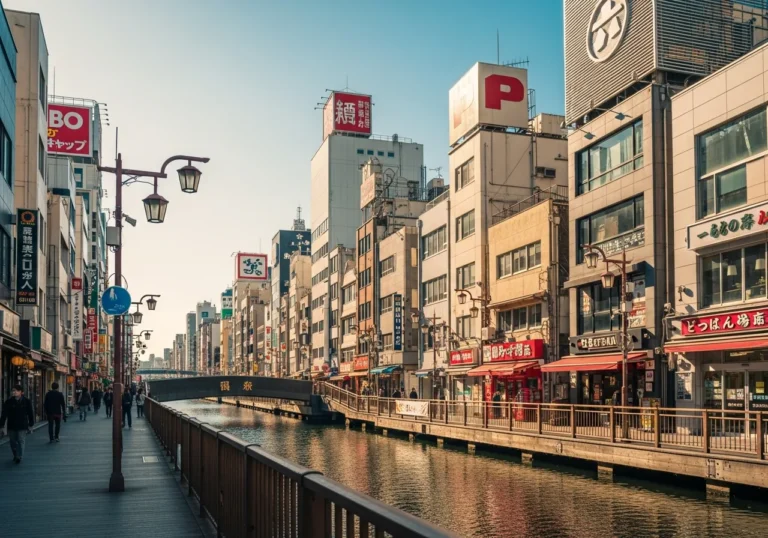
Stand at the southern entrance of Janjan Yokocho on any weekday morning and the alley still smells the way it has for decades: charcoal from the kushikatsu fryers, old timber, the faint sweetness of something cold and fruity drifting out of a narrow doorway. The neon signs are faded to a warm amber.
The shopfronts lean slightly, as if the buildings have been exhaling slowly since the 1960s. Somewhere inside one of those doorways, a blender is running.
That blender is the sound of a city’s identity being made. Mixed juice — a thick, cold tumbler of blended banana, mandarin, peach, and apple in whole milk — is not a sophisticated drink by any objective measure.
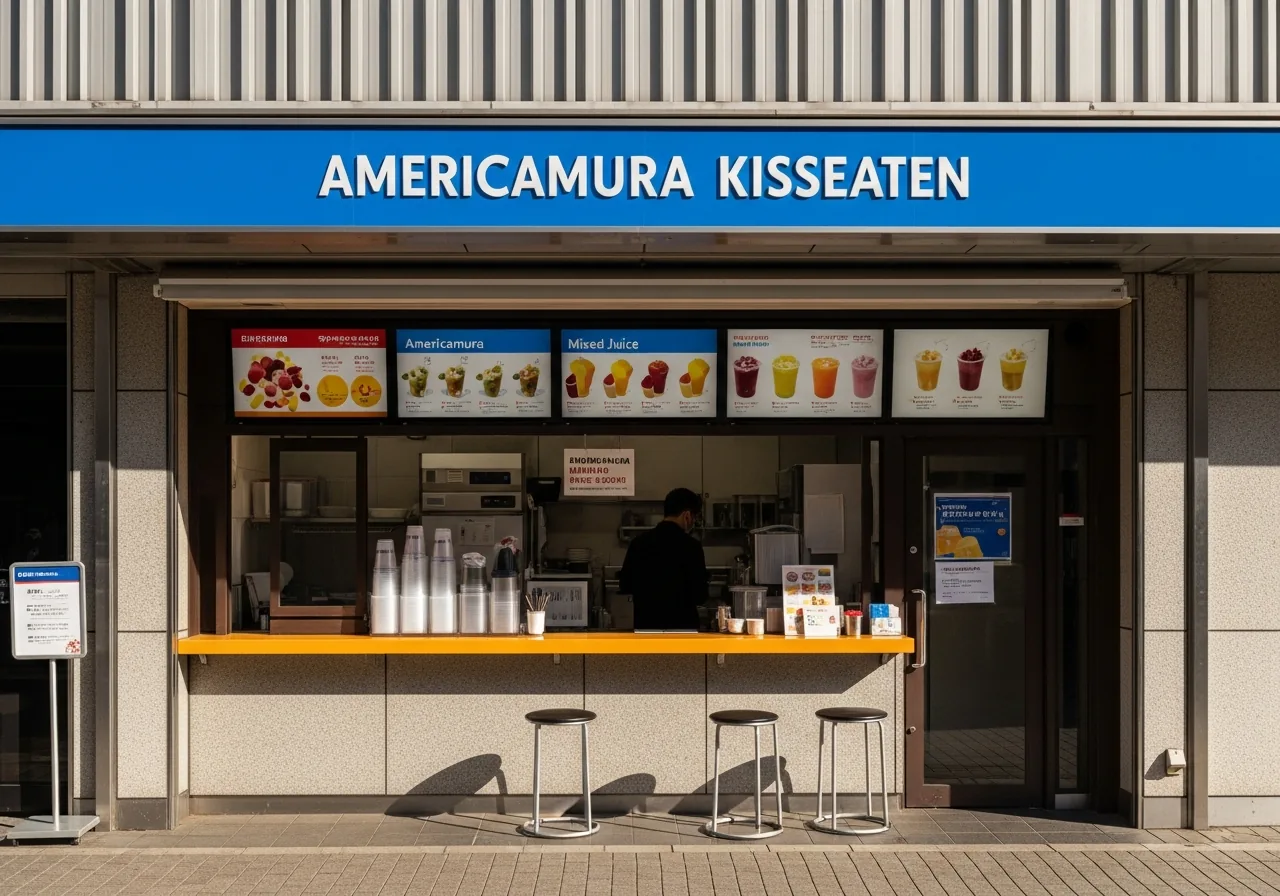
It contains no rare ingredient, requires no particular technique, and costs between 500 and 700 yen. Yet it has outlasted every café trend of the past seventy years, survived the Starbucks invasion of the 1990s, and is currently enjoying a revival so vigorous that the shop that invented it has opened a satellite branch beneath Hankyu Umeda Station.
To understand why, you have to go back much further than 1948.
Why Did This Drink Exist at All? The Logic of Waste and the Merchant City
Osaka has been a trading city since the seventh century, when it was called Naniwa and served as the imperial capital’s port. By the Edo period (1603–1868), it had become what the Japanese called tenka no daidokoro — the nation’s kitchen — a wholesale hub where rice, dried goods, and produce from across the archipelago converged before redistribution. The city’s dominant class was not samurai but merchants, and merchants think differently about resources.
When Osaka emerged as Japan’s commercial centre in the early 1600s, the values of diligence and thrift — the guiding principles of the city’s merchant class — permeated society. In the world of food as well, frugality took hold, inspiring a philosophy that remains a core element of Osaka’s culinary culture. Shimatsu no kokoro, the ethos of letting nothing go to waste, is a practical axiom that has over the centuries guided Osaka’s chefs not only to think sustainably and honour the bounty of land and sea, but also to develop recipes that allow every piece of every ingredient to be used without sacrificing flavour or presentation.
This is not a romantic abstraction. It produced real dishes.
In traditional Osaka cuisine, it is a rule rather than an exception to utilise the peel and ends of vegetables and the bones, skin, and intestines of fish. One dish representative of this philosophy is hamokawa zakuzaku, in which the skin of the hamo sea eel — left over after the flesh is removed — is lathered with teriyaki sauce, grilled, and served.
Another frugal Osaka speciality is horumon, or off-cuts of beef or pork grilled over charcoal; rather than disposing of a butchered animal’s guts, generations of local carnivores have perfected the cutting and seasoning of offal, making it an integral element of the city’s meat-eating culture.
Mixed juice belongs to this same tradition. It is not a luxury beverage that trickled down to the masses; it is a waste-reduction strategy that tasted good enough to become a cultural institution.
Osaka’s merchants cultivated two seemingly contradictory traits: a dislike of waste (shimatsu no seishin) and a willingness to spare no expense when it comes to good food (the spirit of kuidaore). This culture of making the most of limited resources while still pursuing high-quality cuisine was closely tied to the lives of ordinary people, reflecting the distinctly Japanese notion of mottainai — “waste not.”
The drink that Ichiro Tsunekawa invented in 1948 was, in this sense, the most Osakan thing imaginable: it solved a commercial problem, it tasted genuinely good, and it cost almost nothing to produce. The city recognized itself in it immediately.
Why Here? The Specific Geography of Shinsekai
The address matters. Tsunekawa did not open his fruit stall in Shinsaibashi, Osaka’s prosperous shopping corridor, or in Namba, the entertainment district. He opened in Shinsekai — literally “New World” — a neighbourhood whose name was already ironic by the time he arrived.
The neighbourhood was created in 1912 with New York — specifically, Coney Island — as a model for its southern half and Paris for its northern half. At this location, a Luna Park amusement park operated from 1912 until it closed in 1923.
The original Tsutenkaku Tower, built in 1912, was designed to resemble the Parisian Eiffel Tower on top and the Arc de Triomphe at its base. At 64 metres high it was the second biggest structure in Asia at the time, and it became a symbol of pride for Osaka.
The ambition did not survive intact. The first tower was badly damaged by a fire in 1943 and disassembled shortly afterwards.
When the original tower burned down in 1943, its 300 tons of iron were donated to the war effort. The amusement park had already closed two decades earlier.
By the time the war ended, Shinsekai was a district whose grand promises had been cancelled, and it filled instead with the people the rest of Osaka preferred not to think about.
After World War II, Shinsekai served to entertain the labourers who were rebuilding Osaka. The postwar years were lean, and Shinsekai’s reputation shifted.
The area became associated with day labourers, cheap entertainment, and rough edges that the rest of Osaka preferred not to advertise. During certain decades it carried a reputation that kept casual visitors away.
It was into this specific social geography — a working-class entertainment district full of people with little money and large appetites — that Ichiro Tsunekawa brought his fruit stall in 1948. His customers were not wealthy.
They were the workers, the drifters, the regulars of the standing bars and the shogi parlours. They wanted something sweet, cold, and filling.
They wanted, in the language of the era, a treat they could actually afford.
And fruit, in postwar Japan, was still a luxury. Up until the end of the 1950s, Japanese consumers looked on fruit as something reserved for special occasions.
From the 1960s on, as incomes rose and eating habits came under Western influence, Japanese families began incorporating more fruit into their diet. A glass of mixed juice in 1948 or 1950 was not a casual refreshment; it was a small extravagance, a moment of sweetness in a lean decade.
That Tsunekawa could offer it cheaply — because he was using fruit that would otherwise be discarded — was the commercial genius of the thing.
Why Did the Fruit Shop Become a Kissaten? The Postwar Café Boom
The transformation of Sennariya from a fruit stall into a full kissaten did not happen overnight. It was founded in Shinsekai in 1948 as a fruit shop, and its origins date back to the idea of the first-generation owner to put ripe fruit in a blender and serve it at the storefront.
The deliciousness of the juice gained a reputation, and in 1960 the business changed to a coffee shop. That twelve-year gap is significant.
It took more than a decade of reputation-building before the juice was famous enough to anchor an entirely different kind of establishment.
The timing of the 1960 pivot was not coincidental. It landed precisely at the moment when Japan’s kissaten culture was exploding.
Following the end of an import suspension and a rising interest in Western culture, kissaten experienced remarkable growth, reaching over 150,000 establishments by the 1970s and diversifying into various specialized genres. Coffee imports tell the same story: imports reached 15,000 tonnes by 1960, reflecting a surge from near-zero post-war levels, while per capita intake climbed from an average of 400 grams annually in the mid-1960s to 1.1 kilograms in the 1970s.
The kissaten was filling a social need that no other institution addressed. Kissaten emerged in the early 20th century as Japan’s adaptation of European café culture, evolving through the post-WWII era and especially the 1960s–70s economic boom into a distinctly Japanese institution. Through this period, kissaten served as crucial social infrastructure — meeting spaces for businessmen, study halls for students, refuges for women breaking from domestic spheres, gathering spaces for intellectuals and artists.
In Osaka specifically, the kissaten developed its own regional character. In addition to mixed juice, Sennariya Coffee also became known for the excellent coffee they served, and a new invention at the time, iced coffee — or 冷コー (reikō) — a term which soon became a part of the Osaka dialect.
That word, reikō, is a small but telling detail. Osaka’s kissaten culture was sufficiently distinct from Tokyo’s that it generated its own vocabulary.
The city did not simply adopt the national café trend; it inflected it, gave it its own flavour, and mixed juice was the most visible expression of that difference.
When Tsunekawa converted Sennariya to a full kissaten in 1960, he was not abandoning the fruit shop — he was formalizing what the fruit shop had already become. The juice was the draw; the coffee was the infrastructure that allowed people to sit down and stay.
Why Canned Fruit? The Practical Alchemy of the Recipe
One of the most misunderstood aspects of mixed juice is its deliberate use of canned and preserved fruit alongside fresh ingredients. To a contemporary palate trained on smoothie bars and cold-press culture, the use of canned peaches or mandarin segments might seem like a compromise.
It was not. It was a solution to a structural problem.
In the 1970s in Japan, fruit easily accessible for most people was pretty limited. It was a time before different kinds of berries and exotic foreign fruits were common in stores.
Besides that, the Japanese fruit market has always been, even today, heavily dependent on seasonal fruits. They vanish after a couple of months and new ones come in.
Kissaten owners must have had to choose fruits that were stable all year round with a reasonable price range. A lot of canned fruits were used in the juice for that reason.
The canonical Sennariya recipe — a perfectly balanced blend of apples, bananas, peaches, and mandarins, resulting in a refreshing and crisp flavour with a smooth finish — is not arbitrary. Each element plays a structural role.
Banana provides body and sweetness and acts as a natural thickener; mandarin (often canned in syrup) delivers acidity and brightness; yellow peach adds floral depth; apple, used fresh at Sennariya, gives a clean, slightly tart finish that prevents the drink from cloying. The milk binds everything and softens the edges.
Ice, added during blending, creates the characteristic texture: lighter than a smoothie — closer to sherbet — yet thicker than ordinary milk.
The use of canned fruit also had an unexpected quality advantage. Canned peaches and mandarins are packed at peak ripeness, their sugars locked in by the preservation process.
A kissaten owner in January, when fresh peaches are months away, could still produce a glass of mixed juice that tasted of summer. This year-round consistency was part of what made the drink a kissaten staple rather than a seasonal novelty.
The older Shinsekai kissaten that predates Sennariya by two decades takes a different approach. Currently run by the third-generation owner, this long-established coffee shop was founded in 1928 and is said to be the oldest coffee shop in Shinsekai.
Its mixed juice has undergone minor changes and is now made without bananas, which is rare in Osaka. It is made with a mix of apples, yellow peaches, tangerines, and mangoes.
Using fresh apples instead of canned apples, it has a refreshing aftertaste. The divergence between these two recipes — one with banana, one without; one with mango, one without — illustrates how the drink evolved from a single invention into a genre.
Each shop’s version is a commentary on the original.
Why Did Mixed Juice Spread Across the City? The Kissaten as Franchise Without a Franchisor
There was no licensing agreement. No Sennariya Corporation sent representatives to other kissaten with standardized recipes and branded equipment. The drink spread the way all genuinely good ideas spread in a city of merchants: someone tasted it, understood why it worked, and adapted it for their own counter.
Other kissaten across the city took notice and soon added their own versions of mixed juice to their menus. Each establishment refined its own recipe over time.
This decentralized evolution is precisely what gave mixed juice its cultural durability. Because there was no single authoritative recipe, every kissaten owner had creative latitude.
The drink became a canvas rather than a formula.
The mechanism of spread was the kissaten boom itself. Kissaten experienced remarkable growth, reaching over 150,000 establishments by the 1970s.
In Osaka, where the drink had already established itself as a regional signature, the density of kissaten meant that mixed juice was effectively inescapable. It became popular enough to spread to surrounding areas, but it mostly remained as a local favourite in the Kansai region.
All the local kissaten have mixed juice on their menu, and customers expect that.
This expectation — that a kissaten in Osaka will serve mixed juice, full stop — is the mark of a drink that has crossed from menu item to cultural requirement. It is the Osaka equivalent of the Nagoya morning set, or the Tokyo kissaten’s thick-cut toast: a regional institution so embedded that its absence would register as an omission, a failure of identity.
The drink also benefited from the particular social function of the Osaka kissaten. Beyond the coffee in the cup, the space of the kissaten itself was meeting even more diverse community needs.
For university students living in cramped, thin-walled lodging rooms, kissaten served as a welcome escape — providing heated spaces in winter, air conditioning in summer, and crucially, comfortable alternatives to their crowded homes. Salarymen used them as neutral venues for business meetings, away from office hierarchies.
A drink that was sweet, filling, cheap, and visually distinctive — the tall glass, the pale orange-cream colour, the straw — was exactly what this social space needed. It was a drink you could nurse for an hour.
It was a drink that looked like a treat even if it cost less than a beer.
Why Did It Nearly Die? The Crisis of 2016
The story of mixed juice is not a smooth arc of continuous success. It nearly ended in a narrow alley in Shinsekai in the summer of 2016.
The broader context was a structural crisis in Japanese kissaten culture. The arrival of international chains in the 1990s — Starbucks opened its first store in Tokyo’s Ginza district in 1996 — created competition for kissaten.
There was a substantial decline from 155,000 cafés in 1981 to 89,000 by 2001. Many aging kissaten proprietors faced the reality that their establishments might not survive them, as their intimate customer knowledge and carefully developed house blends could not be easily transferred.
Sennariya was not immune. Sennariya Coffee almost disappeared for good in 2016 when the aging third-generation owner fell ill and closed its doors.
The third-generation owner, Toyoko Tsunekawa — daughter-in-law of the founder’s line — had kept the recipe and the atmosphere intact for decades. When illness forced her to close, the shop that had invented mixed juice simply went dark.
What happened next is the kind of story that Osaka tells about itself. A customer named Katsuhito Shiratsuki could not bear the loss.
He had grown up visiting the café with his parents. He took over the business, learned the methods, and reopened in 2017.
Shiratsuki was not a professional restaurateur. He was a regular — someone for whom Sennariya was not a business proposition but a piece of personal memory.
He partnered with a company called LIFEstyle Co., Ltd., negotiated with the Tsunekawa family, received instruction from the third-generation owner on the original recipe, and brought the shop back.
The official Sennariya website frames this succession in explicitly cultural terms: the new management would make “mixed juice” an important culture, open as a shop that warms up old and passes it to the next generation, and promote “mixed juice” to the whole world as one of Showa’s Osaka food cultures — as “kushikatsu” has been disseminated from here to the world. That comparison to kushikatsu is telling.
Kushikatsu — battered and deep-fried skewers — is the other great Shinsekai food export, a dish that went from working-class neighbourhood staple to global Japanese restaurant menu item. The ambition for mixed juice is the same: to make the world understand that this drink is not a local quirk but a genuine culinary contribution.
Why Canned Fruit and Milk? The Deeper Question of What the Drink Actually Is
Mixed juice is sometimes described as a smoothie, and the comparison is worth interrogating because it reveals what the drink is not. Mixed juice is just blended fruit juice like smoothies, but it has been around way longer than today’s smoothies.
The similarity ends there. A smoothie, in its contemporary form, is a health product: it signals virtue, optimizes nutrients, and is typically made with fresh or frozen fruit, no added sugar, and often no dairy.
Mixed juice signals none of these things.
Smoothies aim for health. Mixed juice aims for comfort.
The distinction is not trivial. It explains why mixed juice uses canned fruit in syrup rather than frozen acai, why it contains whole milk rather than oat milk, and why it is served in a tall glass with a straw in a dim room with jazz on the speakers rather than in a paper cup at a counter with a QR code menu.
The drink is the product of a specific social moment — postwar Japan, the kissaten boom, the democratization of small luxuries — and it carries that moment inside it.
The Umekiki food journal, in its detailed account of mixed juice’s history, quotes the fourth-generation Sennariya owner Shiratsuki on why fruit was such a powerful ingredient in the 1950s and 1960s: at a time when fresh fruit was still a luxury item, a glass containing multiple varieties simultaneously was the equivalent of what we would now call a premium dessert. The Umekiki account notes that “ripe fruit is delicious, but when the skin is damaged it can no longer be sold — what a waste,” and that this was the precise thought that led Tsunekawa to the blender.
The drink gained a reputation, people praised it as delicious, and in 1960 — right as the kissaten boom arrived — the business changed to a coffee shop. “The flow of ‘kissaten means mixed juice’ was created, and it spread through Osaka,” the account notes.
There is also a textural argument. The texture feels incredibly thick, smooth, and icy.
Drinkers often compare it to a rich banana milkshake blended with bright tropical fruits. This thickness is not incidental.
In a culture where drinks were often thin — green tea, barley tea, water — a beverage with genuine body was a sensory event. The density of mixed juice was part of its appeal, a signal that you were getting something substantial for your money.
Why Does the Drink Still Matter? The Showa Nostalgia Economy and Its Limits
The revival of mixed juice since the 2010s is real, but it requires careful reading. Part of it is genuine cultural continuity — the drink never disappeared from Osaka’s kissaten, and its local fan base never needed a revival because it never left. Part of it, however, is the broader Showa nostalgia economy, which is a different phenomenon entirely.
Kissaten have experienced an unexpected resurgence since the 2010s. Often via social media, younger people discovered the appeal of “Shōwa nostalgia,” referring to the Shōwa period (1926–89), with the same digital generation that once abandoned these establishments now celebrating their vintage aesthetic.
This nostalgia is partly aesthetic — the marble tables, the leather stools, the siphon coffee apparatus — and partly a reaction against the homogenization of the café landscape. When every city in Japan has the same Starbucks, the kissaten’s idiosyncrasy becomes its value proposition.
Mixed juice has benefited from this, but it has also transcended it. Recently, convenience stores and beverage makers have turned it into packaged products.
Even Lawson’s MACHI café released a Fruit Mix Frappe inspired by this Showa-era staple. The convenience store version is, of course, a different product — shelf-stable, standardized, stripped of the social context that gives the original its meaning.
But its existence is evidence that mixed juice has achieved the rarest thing in Japanese food culture: it has become a reference point, a flavour that people recognize as distinctively Osakan even when they encounter it far from Osaka.
Sennariya Coffee opened its first shop in the Kanto area on August 10th, 2020, at Lazona Kawasaki Plaza. In 2022, a further branch opened beneath the Hankyu Osaka Umeda Station.
These expansions are significant not because they dilute the original but because they demonstrate that the drink’s appeal is no longer purely local. A kissaten from Janjan Yokocho opening in a Kawasaki shopping mall is the same cultural logic as a Neapolitan pizzeria opening in New York: the original context travels with the product, and the product gains meaning from the distance.
Why Should a Discerning Traveller Care? The Argument for Drinking History
There is a version of this story that ends with a recommendation to visit Sennariya and order a glass. That version is true but insufficient. The more interesting argument is about what mixed juice reveals when you look at it as a historical document rather than a menu item.
Every element of the drink is a trace of a specific historical condition. The canned peaches record the seasonality of Japanese fruit markets in the 1950s and the difficulty of sourcing fresh produce year-round.
The milk records the postwar expansion of dairy consumption in Japan, which was itself a product of American occupation-era food policy. The banana — imported, expensive, and exotic in early postwar Japan — records the aspirational quality of the drink, its status as a small luxury in a decade of scarcity.
The blender records the electrification of the Japanese kitchen, which accelerated through the 1950s as the economic recovery gathered pace.
The kissaten itself records something even larger. Kissaten (喫茶店), which translates to “tea-drinking shop,” is more than just a place to get a drink.
It is a cultural archive. To step into a kissaten is to enter a parallel Japan: dimly lit, wood-panelled, vinyl-spun and quietly unbothered by the demands of the modern world.
When you sit in Sennariya and drink a glass of mixed juice, you are not simply consuming a beverage. You are occupying a social space that has been performing the same function — providing a third place, a pause, a small sweetness — for more than seventy years.
The affluent traveller who has eaten at three-Michelin-starred restaurants in Tokyo and Kyoto and drunk single-origin pour-over coffee in Omotesando will find something at Sennariya that none of those experiences offer: the unmediated taste of a city’s working-class ingenuity. Mixed juice was not invented for connoisseurs.
It was invented for people who needed something good and could not afford to waste anything. That origin is still present in the glass.
There is also the question of what the drink’s survival says about Osaka specifically. Rather than being demolished or gentrified into something unrecognizable, Shinsekai simply persisted.
The shopkeepers kept their signs. The restaurants kept their prices low.
The game arcades kept running. A second Tsutenkaku Tower was built in 1956 and became the neighbourhood’s anchor.
By the time tourism to Japan accelerated in the 2010s, Shinsekai had stumbled into something valuable: authentic retro atmosphere that cannot be manufactured. It had survived by accident into becoming exactly what visitors were looking for.
Mixed juice survived the same way. It was never fashionable enough to be killed by fashion.
It was never expensive enough to be priced out of its neighbourhood. It was never so simple that it could be perfectly replicated at home.
It occupied a precise niche — the kissaten drink, the Osaka drink, the drink that costs almost nothing and tastes like a small celebration — and that niche proved to be permanent.
The Fourth Generation and the Question of Authenticity
Katsuhito Shiratsuki, the fourth-generation owner who rescued Sennariya in 2017, faces a question that every custodian of a living tradition eventually confronts: how much can you change before the thing you are preserving becomes something else?
His answer, so far, has been conservative in the right places and innovative in the right places. The core recipe — apples, bananas, peaches, mandarins, milk, ice — remains as Tsunekawa established it.
Sennariya Coffee’s signature mixed juice is made with a perfectly balanced blend of apples, bananas, peaches, and mandarins, resulting in a refreshing and crisp flavour with a smooth finish. The café also takes pride in its coffee selection — serving Dutch-style iced coffee brewed with cold water and offering a choice between siphon or drip-brewed hot coffee.
In addition to drinks, the menu features nostalgic sweets such as classic milkshakes and pudding à la mode, evoking the charm of old-school Japanese cafés.
The innovations are peripheral: a mixed juice soft-serve ice cream, a mixed juice shaved ice in summer, the new retro sandwiches and hot dogs announced in late 2025. These additions do not disturb the original; they extend it into new formats while keeping the flavour profile intact.
This is the correct approach for a drink whose identity is inseparable from its specific taste. Change the recipe and you have a new drink.
Change the format and you have a new product that carries the original’s memory.
The Umeda branch, opened in 2022 beneath Hankyu’s grand station, is the most significant strategic decision of the Shiratsuki era. The shop opened on May 24th, 2022, at the Hankyu Osaka Umeda Station underpass.
Umeda is the commercial heart of Osaka — the department stores, the underground malls, the commuter flows of hundreds of thousands of people daily. Bringing mixed juice to Umeda is an act of cultural assertion: this drink, born in a working-class alley in Shinsekai, belongs to the whole city.
It is also, frankly, good business. The Shinsekai original will always be the pilgrimage site, the place where the story began.
But a city’s food culture does not stay in one neighbourhood. It moves, adapts, and finds new audiences.
The fact that Sennariya can open in Kawasaki and Umeda without losing its identity in Janjan Yokocho is evidence that the drink has achieved genuine cultural depth — it is not dependent on a single location for its meaning.
The Taste of a City’s Philosophy
There is a final layer to this story that goes beyond the drink itself. Mixed juice is, in miniature, a demonstration of what Osaka’s food culture has always done: take something that would otherwise be discarded, apply intelligence and care, and produce something that people want to pay for.
This is not a romantic myth. It is a documented commercial strategy, repeated across centuries and across dishes.
The logical and thrifty thinking of merchants permeated all corners of Osakan society. Although this led to a cultural mindset of frugality and efficiency regarding food, the use of restaurants and establishments for business discussions and negotiations galvanized the haute cuisine industry. Thus, both Osaka’s luxury and modest cuisine markets developed in unison, spurring each other on.
Mixed juice sits firmly in the modest cuisine market. It has never pretended to be haute.
But it has the same intellectual DNA as Osaka’s finest kaiseki: the refusal to waste, the insistence on using every ingredient at its optimal moment, the understanding that the best flavour comes from fruit at peak ripeness rather than fruit that is merely presentable. Tsunekawa’s insight in 1948 was not that overripe fruit could be disguised in a blender.
It was that overripe fruit — fruit at maximum sugar content, at the peak of its aromatic development — was actually the best possible raw material for a cold drink. The waste was not a compromise.
It was the ingredient.
That realization, applied to a glass of milk and ice in a narrow alley in a battered postwar neighbourhood, produced a drink that is still being ordered seventy-eight years later. It is still being ordered because it still tastes right. And it tastes right because the philosophy behind it was right.
When you stand in Janjan Yokocho and watch the blender running at Sennariya, you are watching a city think. The result is cold, sweet, and costs 500 yen. Order it.
Frequently Asked Questions
Q: What exactly is Osaka mixed juice, and how is it different from a smoothie?
A: Mixed juice (ミックスジュース) is a blended drink of banana, mandarin, peach, and apple in whole milk with ice, originating at Sennariya Coffee in Shinsekai in 1948. Unlike a smoothie, it uses canned fruit in syrup alongside fresh fruit, contains no health-food pretensions, and is designed for comfort rather than nutrition. The texture is lighter than a smoothie but thicker than milk — closer to a very cold, fruit-forward milkshake.
Q: Is Sennariya Coffee the only place to try mixed juice in Osaka?
A: No. Mixed juice is on the menu of most traditional kissaten across Osaka, and juice stands at Hankyu Umeda and other major stations also serve versions. Sennariya is the documented origin point and the most historically significant place to drink it, but the drink has spread city-wide and each shop has its own recipe.
Q: When is the best time to visit Sennariya Coffee?
A: Weekday mornings and early afternoons tend to be quieter. Weekends draw larger crowds, particularly from tourists visiting Tsutenkaku Tower nearby.
The café does not take reservations, so walk-in only. Winter visits are particularly recommended by regulars because the fresh apple component — a key ingredient — is at its seasonal best.
Q: Has the recipe changed since 1948?
A: The core recipe — apple, banana, peach, mandarin, milk, ice — has remained consistent through four generations of ownership. Minor adjustments have been made, but the fourth-generation owner Katsuhito Shiratsuki received direct instruction from the third-generation owner before reopening in 2017, specifically to preserve the original flavour profile.
Q: Why does mixed juice use canned fruit?
A: Canned fruit was a practical solution to Japan’s highly seasonal fresh fruit market. In the 1950s and 1960s, fresh peaches and mandarins were unavailable for most of the year.
Canned versions, packed at peak ripeness, allowed kissaten to serve a consistent product year-round. The canned syrup also contributes sweetness without added sugar.
Many shops still use canned fruit today, treating it as part of the authentic recipe rather than a shortcut.
Sennariya Coffee — Visitor Information
Address: 3-4-15 Ebisuhigashi, Naniwa-ku, Osaka-shi 556-0002 / 大阪市浪速区恵比須東3丁目4-15
Nearest station: Dobutsuen-mae Station (Osaka Metro Midosuji / Sakaisuji Lines) — approx. 5 min. walk; Shin-Imamiya Station (JR Osaka Loop Line) — approx. 5 min. walk
Hours: Weekdays 11:30–19:00 / Weekends & public holidays 9:00–19:00. No regular closing day. Hours subject to change — confirm on the official site before visiting.
Admission: Free entry; mixed juice approx. ¥500–¥730 depending on size (confirm current pricing on official site)
Official site: sennariya-coffee.jp