The reason Osaka eats udon while Tokyo eats soba is not a matter of taste — it is a matter of geography, trade infrastructure, and water chemistry, all of which converged during the Edo period (1603–1868) to lock each city into a different noodle. Osaka sat at the terminus of the Kitamae-bune shipping route, which flooded the city with Hokkaido kombu; that kombu shaped a pale, glutamate-rich dashi that made wheat noodles sing, while Edo’s volcanic hinterland grew buckwheat, its hard water extracted inosinic acid from bonito rather than umami from kelp, and a catastrophic fire in 1657 created a demand for fast food that soba — quick to cook, quick to eat — was perfectly positioned to satisfy. The divide has been documented for at least two centuries, and it runs far deeper than noodle preference: it is a record of two cities that were built on entirely different economic and ecological foundations.
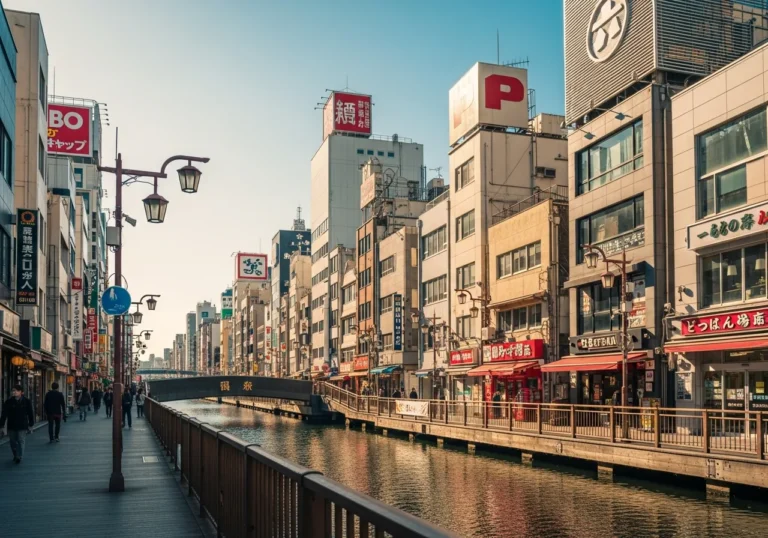
Why we can tell you this — MICHI is written and edited in Osaka, which means we can stand in the Kuromon Market and hold a slab of Hokkaido ma-kombu, walk to Usamitei Matsubaya in Minami to eat the kitsune udon that has been served there since 1893, and trace the canal routes along which the Kitamae-bune cargo once moved into the city’s warehouses. This article draws on the Edo-period encyclopaedia Morisada Mankō as documented by Nippon.com, the Japanese Ministry of Agriculture’s regional cuisine records at maff.go.jp, the Japan Tourism Agency’s Sanuki udon heritage page at mlit.go.jp, the official Kitamae-bune heritage site at en.kitamae-bune.com, and the Japanese government’s dashi culture overview at gov-online.go.jp. Where origin stories are legendary rather than documented — particularly around the monk Kūkai and the invention of udon — we say so plainly.
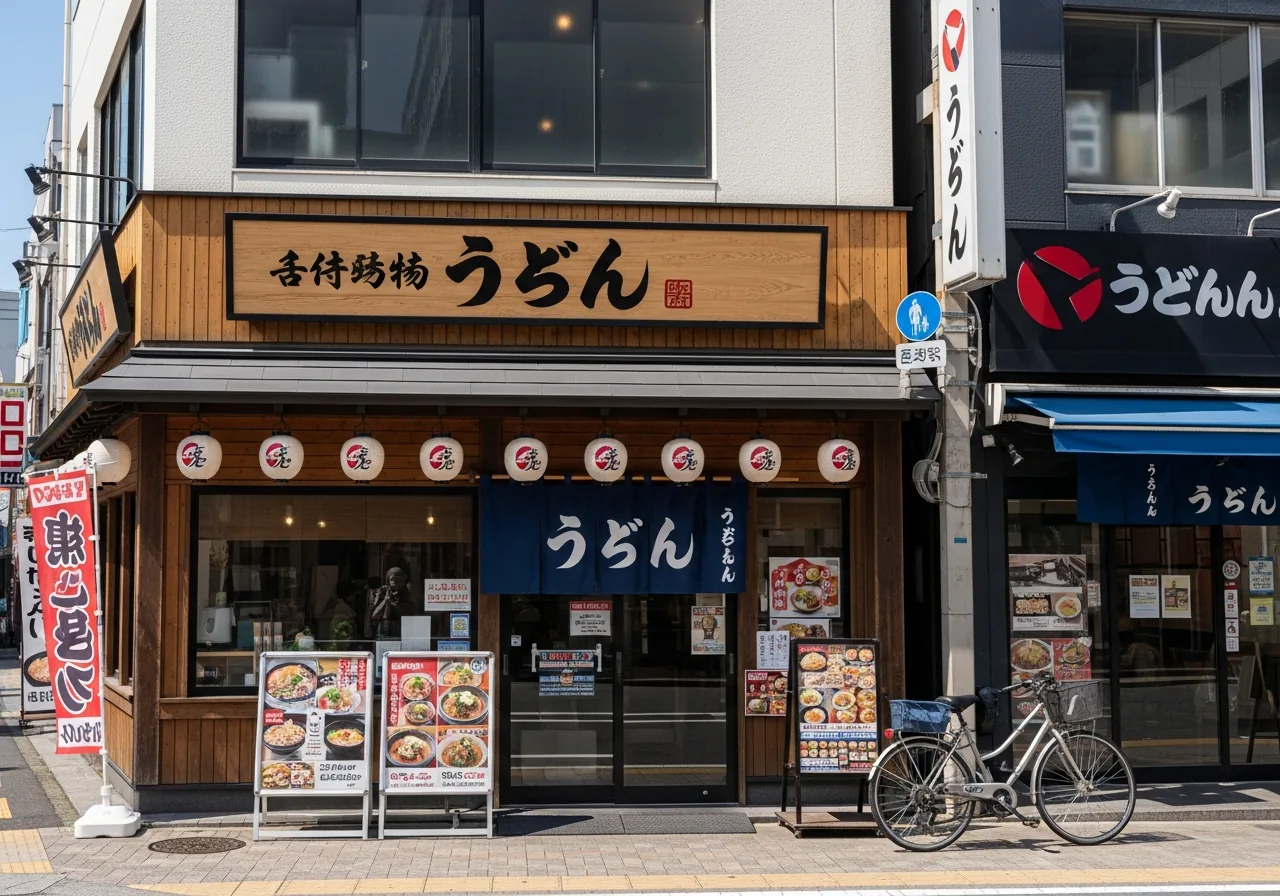
Stand at the counter of any old udon shop in Osaka’s Minami district around eleven in the morning and you will notice something that no guidebook adequately prepares you for: the broth is almost transparent. It is the colour of weak tea, barely tinted by the usukuchi soy sauce that seasons it, and it moves in the bowl like water rather than soup.
A Tokyoite seeing it for the first time often assumes something has gone wrong. Nothing has gone wrong.
That luminous, golden liquid is the point — it is the reason Osaka chose udon over soba, the reason the city built its entire culinary identity around a noodle that exists primarily as a vehicle for broth, and it is the product of a supply chain that stretched from the cold kelp beds of Hokkaido to the canal wharves of Namba across more than a thousand kilometres of sea.
The question of why Osaka eats udon and Tokyo eats soba sounds like a question about food. It is actually a question about trade routes, water chemistry, urban disaster, and the economic logic of two cities that were built to serve entirely different masters during the same historical period. Answering it properly requires going back not just to the Edo period, but further — to the geology of the Kanto plain, to a Buddhist monk who may or may not have carried noodle-making techniques from Tang Dynasty China, and to the moment when a fire destroyed sixty percent of Edo in a single winter and changed the city’s appetite forever.
Why Does the Divide Exist at All? The Oldest Evidence
The east-west noodle divide is not a modern marketing invention. The encyclopaedic Edo-period work Morisada Mankō (Morisada’s Sketches) examined various differences between east and west Japan; in the realm of food, and noodles in particular, author Kitagawa Morisada noted that there had been soba shops in Edo since the middle of the seventeenth century, while udon noodles were more popular in Kyoto and Osaka.
Morisada was a merchant who had moved from western Japan to Edo, and the culture shock of the transition drove him to document everything he found strange about the east. In his voluminous Morisada Mankō, published for nearly three decades through the 1860s, he documented many differences between the east and west of Japan in the late Edo period.
His observations on noodles are among the most precise: both udon in Kyoto and Osaka and soba in Edo were known as nihachi (literally “two-eights”). One theory goes that the original meaning of the word had nothing to do with its ingredients and was related to its price of 16 mon — the cost of two times eight mon was the same for both western udon and eastern soba, and this is the explanation given in Morisada’s Sketches.
The price parity is significant. It tells us that by the early nineteenth century, udon in Osaka and soba in Edo occupied exactly the same social niche — the cheap, fast, everyday meal of the working city — but they had arrived at that niche via completely different routes.
Like today, broth in Kansai was typically light in flavour compared with the stronger broth of Kantō. Morisada declined to judge which was superior, but as he wrote about the presentation in detail, he thought that the Kansai variety was for drinking, while that from Kantō was for dipping the soba.
That distinction — a broth you drink versus a sauce you dip into — encapsulates the entire philosophical difference between the two food cultures, and it begins with the question of what each city had available to cook with.
Why Udon? The Noodle Itself and Its Continental Origins
Before asking why Osaka chose udon, we should ask why udon exists at all in Japan. The most famous origin story involves a monk.
According to legend, the noodles were introduced by the Buddhist priest Kūkai (774–835), a native of Kagawa who studied in China for two years and brought back a wealth of knowledge — including how to make udon. Some sources claim that Kūkai shared his noodle secrets with his nephew Chisen, who then served udon to his family in Takinomiya.
The legend is almost certainly embellished, but it points toward a real historical process. Whatever the case, these ninth-century noodles were not lengthy like modern-day Sanuki udon, but rather short, flat bits of dough made by mixing flour with salt water.
These bits were then boiled and served in a savory sauce. The dish was gradually improved upon, and by the Edo period noodles much like those eaten today were being served to pilgrims from all over Japan who passed through Takinomiya on their way to the renowned Kotohiragu Shrine.
A second, historically better-documented transmission occurred in 1241, when a Rinzai monk introduced flour-grinding techniques learned from Song Dynasty China. This technique contributed to perfecting the dough-kneading process, a crucial factor that created the unique characteristics of udon noodles and quickly made them famous throughout Japan. The spread of stone mills during the Muromachi period (1336–1573) was the real democratising moment: once ordinary households could grind wheat flour, wheat-based noodles became accessible to commoners rather than just temple communities.
The geography of wheat cultivation matters here. The environment of Kagawa Prefecture is fit for producing wheat.
Most of Japan has a lot of rainfall and is humid, so the climate is not fit for producing wheat. However, in Kagawa the climate is mild and dry and has quality soil, which led to an increase in wheat production.
Kagawa — the old Sanuki Province — sits directly across the Seto Inland Sea from Osaka. Its wheat, its salt, and its noodle-making tradition flowed naturally into the Kansai commercial network.
Osaka did not invent udon, but it absorbed and refined it through the same mercantile machinery that processed every other commodity that passed through its warehouses.
Why Here? Osaka as the Nation’s Kitchen
To understand why Osaka became an udon city, you first have to understand what Osaka was. The contemporary reputation of Osaka as a gourmand’s paradise is encapsulated in its historic nickname: Tenka no Daidokoro.
Translated as “the nation’s kitchen,” this term initially referred not to prepared cuisine, but to the prefecture’s unparalleled logistical and commercial authority during the Edo Period (1603–1868). Osaka functioned as the central nexus for Japan’s national rice trade, acting as the primary repository and distribution point for the nation’s most critical commodity.
The city’s position was structural, not accidental. Its location on Osaka Bay and its network of rivers made it a key transportation hub.
Feudal lords from all over Japan sent their local rice and regional specialties to Osaka to be stored, traded, and distributed nationwide. The Dojima Rice Exchange — established during the Edo period — became the world’s first organised futures market, where contracts on future rice deliveries could be bought and sold.
Rice — the tax base of the Tokugawa regime — flowed into Osaka’s warehouses. Daimyo converted rice into currency, merchants speculated on price fluctuations, and urban markets stabilised national supply.
The Dojima Rice Exchange pioneered early forms of futures trading — arguably one of the world’s earliest organised commodity exchanges.
This commercial supremacy had a direct culinary consequence. This logistical supremacy meant Osaka commanded the highest quality, most diverse range of ingredients available within Japan.
Every ship that arrived in Osaka’s port brought something that could end up in a bowl. The city’s merchants were not merely trading commodities; they were, inadvertently, curating the ingredients of a cuisine.
And the most consequential ingredient of all arrived not from the south or east, but from the far north.
Why Kombu? The Shipping Route That Made Osaka’s Broth
The single most important factor in Osaka’s udon identity is a piece of dried seaweed. Kombu — thick, dark kelp harvested from the cold waters of Hokkaido — is the foundation of the pale, umami-saturated dashi that defines Kansai cooking. And the reason Osaka had access to the best kombu in Japan, while Edo did not, comes down to one of the most remarkable trade routes in Japanese history.
The Kitamae-bune (北前船; “northern-bound ships”) was a shipping route — and also the ships involved — in Japan from the Edo period to the Meiji era. The route went from Osaka through the Seto Inland Sea and the Kanmon Straits to ports in Hokuriku on the Sea of Japan and later to Hokkaido. In 1672, this route became official when the Tokugawa shogun ordered Edo merchant Kawamura Zuiken to chart the Sea of Japan passage connecting Hokkaido and Osaka, and the Kitamae-bune route was born.
From Hokkaido, the Kitamae-bune mainly carried marine products to Osaka and ports along the way. This included valuable commodities like kombu kelp, herring, dried sardines, dried sea cucumber, salmon, and cod.
The ships were not passive carriers — they were floating trading houses. The Kitamae-bune made stops and conducted business in each port, buying anything considered cheap and selling anything from the ship’s cargo that could be sold at a profit.
The cultural consequence of this trade was enormous. In the Edo period, kombu kelp gathered in Hokkaido was carried to Osaka, a commercial city often called the “Nation’s Kitchen,” by the Kitamae-bune ships travelling the Sea of Japan, leading to its spread as another ingredient for dashi.
Food culture also experienced significant transformations through the Kitamae-bune trade. The introduction of kombu kelp from Hokkaido led to a thriving industry of kombu-based products in the Kansai region, such as kombu-maki rolls and umami-rich dashi broth.
The popularity of kombu dashi spread throughout the country, and today it is an essential ingredient in Japanese cuisine.
But why did Osaka get the best kombu while Edo got the remainder? The answer lies in the route itself.
Kombu was brought to major consumption centres in Kansai, such as Kyoto and Osaka. As evidenced by kombu being a tribute to the Imperial Court since the Nara period, high-quality kombu was first selected and consumed in Kansai.
It is theorised that what remained was then shipped to Edo (Tokyo), giving Kanto fewer opportunities to refine and develop its kombu dashi culture to the extent seen in Kansai. Osaka had first pick.
The finest grades of ma-kombu — harvested near Hakodate on the southern coast of Hokkaido, considered the highest grade, producing a refined, elegant dashi with clean sweetness — became the preferred kombu in Osaka’s cooking tradition.
The Chemistry Beneath the Preference
There is a deeper reason why kombu dashi took root in Kansai more profoundly than in Kanto, and it has nothing to do with trade routes. It has to do with water.
Differences in water quality are thought to have had a significant impact. Generally, Kanto’s water tends to be harder, containing relatively more minerals, while Kansai’s water is soft, with fewer minerals.
Soft water is ideal for efficiently extracting glutamic acid, kombu’s umami component, without introducing off-flavours. Hard water, on the other hand, is less suited for kombu dashi but is considered relatively good for extracting the inosinic acid from katsuobushi.
This is not a minor technical footnote. It means that the same kombu, steeped in Osaka water and in Tokyo water, produces fundamentally different results.
Osaka’s soft water draws out the clean, sweet glutamate of the kelp without bitterness. Tokyo’s harder water suppresses that extraction and instead favours the smokier, more assertive inosinic acid of dried bonito.
The cities did not simply choose different ingredients — their water chemistry made different ingredients work better. The preference and the geology reinforced each other across centuries.
By the Edo period, cooks had refined the technique of combining kombu with katsuobushi. This pairing turned out to be one of the great culinary discoveries in world food history, because the glutamic acid in the kelp and the inosinic acid in the bonito flakes create a synergistic umami effect that is far more intense than either ingredient alone.
In 1908, this synergy was given a scientific name: Professor Ikeda Kikunae at Tokyo Imperial University extracted glutamic acid from dried kombu and named the taste umami. Five years later, his student Kodama Shintaro identified inosinic acid as the umami compound in katsuobushi.
Osaka cooks had been exploiting this synergy for two centuries before anyone knew what to call it.
Why Soba Won in Tokyo: A Fire, a Workforce, and Fast Food
While Osaka was building its kombu-and-udon culture, something very different was happening in Edo. The story of Tokyo’s soba culture is, at its origin, a story about urban catastrophe and the food that rose to feed a city in crisis.
The Great Fire of Meireki destroyed 60–70% of Edo on 2 March 1657. The fire lasted for three days and, in combination with a severe blizzard that quickly followed, is estimated to have killed over 100,000 people.
The reconstruction that followed was one of the largest building projects in Japanese history, drawing carpenters, labourers, and craftsmen from across the country. As many workers, including carpenters, from all over the country, including Yamanashi Prefecture and Nagano Prefecture, flocked to the area, the demand for quick-to-eat soba increased rapidly.
Thus, in the mid-Edo period, udon, which had been the representative noodle type until then, gave way to soba, and even to this day, when talking about Edo, or Tokyo, soba came to be used.
The workers who came from Yamanashi and Nagano brought their food culture with them. Both prefectures sit on volcanic soil that is ideal for buckwheat cultivation.
Tokyo and the Kanto region have traditionally favoured soba. The soil there is better suited for growing buckwheat, which made soba the natural staple.
The labourers who rebuilt Edo after 1657 were, in effect, importing their home cuisine into the capital — and the capital adopted it.
Modern soba originates from the Edo period, centred around the city of Edo. The earliest references to soba are associated with Buddhist monasteries and tea ceremonies.
The 1643 cookbook Ryōri Monogatari is the first to contain a recipe for making soba. After the Great Fire of Meireki in 1657, soba shops became increasingly common in Tokyo.
At first, soba was considered a low-class food, but its reputation improved by the 18th century, when it began to be eaten by samurai and other high-status people. One estimate states that every city block had one or more restaurants serving soba.
By the late Edo period, the density of soba culture in Edo was extraordinary. By the end of the Edo period, it is said that there were over 700 soba shops in the town of Edo, making them quite numerous as eateries.
In 1860, a meeting in Tokyo concerning the price of buckwheat was attended by 3,726 shops, indicating the popularity of soba. The soba stall had become as fundamental to Edo’s streetscape as the canal was to Osaka’s.
For every noodle shop in the shopping streets of Kyoto and Osaka, there would be four or five in Edo.
Why the Broths Look So Different: The Soy Sauce Question
The visual difference between an Osaka udon broth and a Tokyo soba broth is so stark that it functions almost as a cultural flag. Osaka’s broth is pale gold, nearly transparent.
Tokyo’s tsuyu is dark brown, almost opaque. This difference is not merely aesthetic — it encodes a completely different philosophy of seasoning, and it traces back to a specific town in Hyogo Prefecture.
By the sixteenth century, soy sauce was manufactured throughout Kansai. At that time, a dark variety of soy sauce called koikuchi was made, but in the latter half of the seventeenth century, a light-colour type was developed in the Tatsuno area of Hyogo Prefecture. This light-colour soy sauce was known as usukuchi, and was introduced in Kyoto: it contributed significantly to the development of the unique, refined flavours of Kyoto cuisine.
The process of creating usukuchi shoyu is said to have been developed in Tatsuno in the southwest of Hyogo Prefecture around 1666. The plentiful wheat of the Harima Plain, the quality soybeans from the mountain region, salt from Akō, and pure water with little iron all were best suited for making usukuchi soy sauce.
The result was a condiment that was paradoxically both lighter in colour and higher in salt content than its dark counterpart. Usukuchi is indispensable to Kansai’s refined dashi culture.
It elevates the elegant umami of kombu dashi. It preserves the natural colours of the ingredients.
The cuisine of the Kansai region depends on this Japanese shoyu.
In Tokyo, the dominant soy sauce was koikuchi — dark, assertive, fermented longer. The tsuyu (broth) is made with strong bonito dashi and dark soy sauce (koikuchi shoyu).
It has a bold flavour to stand up to the earthy taste of soba. The logic is circular and self-reinforcing: dark soy sauce suits the strong, nutty flavour of buckwheat; buckwheat suits the dark soy sauce.
Light soy sauce suits the delicate, glutamate-forward kombu dashi; kombu dashi suits the neutral canvas of wheat noodles. Each city’s ingredient ecology produced a cuisine that was internally coherent and mutually incompatible with the other’s.
The divide is so precise that it has been industrialised. If you buy “Instant Udon” or Cup Noodles in Japan, the flavour packet is actually different depending on whether you buy it in Tokyo or Osaka.
The manufacturers draw a line near Sekigahara to distribute the different broths. The Sekigahara line — the same geographic boundary where Tokugawa Ieyasu defeated his rivals in 1600 to unify Japan — turns out also to be the boundary between two flavour worlds.
History and geography have a long memory.
Why Kitsune Udon Is Osaka’s Signature: A Dish Born from Accident
If you want to understand what Osaka’s udon culture actually feels like from the inside, the dish to order is kitsune udon: thick wheat noodles in pale kombu-and-bonito dashi, topped with a single large piece of aburaage — sweet, soy-simmered fried tofu — that slowly releases its seasoning into the broth as you eat. It is a dish of extraordinary simplicity and, when done well, extraordinary depth. And it was invented by accident.
Kitsune udon had its origins in 1893 (Meiji 26) at the udon shop “Matsubaya” (now Usamitei Matsubaya) in the Osaka district of Funamachi. A customer placed a piece of aburaage served as a side dish on plain udon and enjoyed the combination. This marked the beginning of kitsune udon in Osaka.
The fuller story, preserved in the shop’s own account, is more specific. The dish was created at Matsubaya (now known as Usamitei Matsubaya) in Osaka.
The owner of Matsubaya, who had experience working at a sushi restaurant, used to serve inari sushi alongside udon noodle soup. Inari sushi is a dish in which sushi rice is wrapped in a sweet and savory seasoned fried tofu pouch.
However, at this restaurant, inari sushi was served with the fried tofu on a separate plate from the sushi rice. As a result, some customers started placing the fried tofu on top of their udon noodle soup.
Seeing this, the owner began serving udon noodle soup with the fried tofu from the start, giving birth to kitsune udon.
The name comes from Japanese folklore. According to Japanese folklore, aburaage is a fox’s favourite meal.
And since the udon noodle soup in question contains aburaage, it was called “kitsune” (meaning “fox”) udon. Aburaage also has a golden-brown colour, which is similar to that of a fox.
The spirituality behind kitsune udon comes from its link to Inari, the Shinto deity of rice, prosperity, and foxes.
Osaka residents take great pride in their rich broth culture and their deep affection for konamon (flour-based food) culture. Kitsune udon perfectly embodies these two elements, offering a simple yet deeply satisfying culinary experience for the people of Osaka.
The dish is also a precise demonstration of the Osaka culinary philosophy: the dashi is the star, the noodle is the vehicle, and the topping exists to interact with the broth rather than to dominate it. The aburaage soaks up the kombu dashi and releases it back in concentrated form with each bite.
It is a dish engineered around umami synergy, even if no one in 1893 Osaka would have used that word.
Why the Merchant Class Made the Difference: Kuidaore and the Economics of Taste
There is one more layer to this story, and it is cultural rather than geographical. Osaka’s food culture was shaped not by aristocrats or samurai but by merchants — the chōnin class that dominated the city’s commercial life throughout the Edo period. And the merchants operated under a peculiar constraint that, paradoxically, made the food better.
During the Edo period, the wealthy merchant class of Osaka was restricted by strict laws from showing off their wealth through fancy clothes or architecture. Instead, they poured their money into lavish, high-quality dining.
The sumptuary laws that prevented merchants from displaying status through material goods redirected their competitive instincts into the one domain that was harder to regulate: the quality of what they ate and served. This city was not one of samurai and aristocrats; rather, it was a city of merchants, traders, and artisans.
Money, practicality, and the tangible quality of goods were the languages spoken here. Status was earned not by lineage, but through sharp business acumen and the ability to provide quality products at a fair price.
This produced the philosophy known as kuidaore — often translated as “eat until you drop” or “ruin yourself through extravagance in food.” The kuidaore mindset generates a positive feedback loop: discerning customers demand value, which drives fierce competition among vendors, resulting in residents having access to high-quality, affordable options wherever they go. In practice, this meant that even the cheapest bowl of udon in Osaka was subject to intense competitive pressure on quality.
The dashi had to be right. The noodle texture had to be right.
The aburaage had to be properly simmered. A mediocre bowl would simply not survive.
The merchant culture also explains why Osaka’s udon developed in a specific direction: toward transparency, subtlety, and the primacy of broth. Osaka’s wealthy merchants, driven by the philosophy of kuidaore and their commercial power, demanded a profound, immediate, and satisfying flavour impact commensurate with the cost of the high-end ingredients they consumed.
This demand for potency led to the development of awasedashi — a potent, umami-heavy broth derived from the combination of ma-kombu and katsuobushi. This flavour profile became the signature of elite Osaka dining and eventually spread throughout the city, establishing a flavour standard distinct from the rest of the nation.
Why the Divide Persists: What Instant Noodles and Water Chemistry Tell Us About Identity
You might expect that two centuries of railways, refrigeration, and national media would have eroded the east-west noodle divide. It has not. The divide persists because it is not merely a matter of historical accident — it has been continuously reproduced by the same underlying conditions that created it.
Osaka’s water is still soft. Generally, Kanto’s water tends to be harder, containing relatively more minerals, while Kansai’s water is soft, with fewer minerals.
Soft water is ideal for efficiently extracting glutamic acid, kombu’s umami component, without introducing off-flavours. A cook who moves from Osaka to Tokyo and tries to make the same kombu dashi will find that the broth tastes different — flatter, slightly bitter — because the water chemistry works against the extraction.
The geography has not changed.
The Kitamae-bune route no longer operates — the businesses rapidly came to an end in the late nineteenth century as modern transportation methods like trains and steamships were developed, and improved means of communication such as the telegram also emerged, ending the monopoly that seafarers had on price variations. But the kombu trade it established has continued through other channels. Over 90% of Japan’s kombu is harvested in Hokkaido, and the finest grades still flow preferentially to Kansai, where the market for premium kombu is deepest and most sophisticated.
The cultural identity has also been continuously reinforced. Udon is the perfect combination of a delicious dashi (made from kelp and tiny fish) and soft, chewy noodles which slide easily down.
Each region in Japan has its own variation on udon, but Osaka’s quintessential version achieves an exquisite balance of dashi, noodles, and toppings. Among the trio of components, though, it is dashi which enjoys centre stage.
That prioritisation of dashi — the broth as the main event, the noodle as its companion — is a value judgment that Osaka has been making for at least three centuries, and it is one that the city continues to teach its children, its restaurant workers, and its visitors.
The regional difference is so deeply embedded that it shapes even mass-market products. The fact that instant noodle manufacturers produce different flavour packets for eastern and western Japan is not a marketing quirk — it is an acknowledgment that the two populations have genuinely different palates, shaped by centuries of different culinary traditions, and that a single product cannot satisfy both.
Why the Discerning Traveller Should Care: What a Bowl of Udon Actually Teaches You
The affluent traveller who arrives in Osaka having already eaten in Tokyo will notice the difference in the broth immediately, even without knowing its history. The Osaka bowl will seem, at first, almost too restrained — where is the depth?
where is the colour? — and then, a few sips in, the umami will arrive in a way that is qualitatively different from anything in the Tokyo bowl.
It is broader, cleaner, more sustained. It does not announce itself; it accumulates.
That experience is the product of everything described in this article: the Hokkaido kelp that arrived on Kitamae-bune ships, the soft water that extracted its glutamate cleanly, the usukuchi soy sauce from Tatsuno that seasoned without staining, the merchant culture that demanded quality at every price point, and the wheat-noodle tradition that gave the broth a neutral, absorbent vehicle. A bowl of kitsune udon at Usamitei Matsubaya in Minami is not just lunch. It is a document of Edo-period trade, water chemistry, and urban economics, served at 11 in the morning for less than a thousand yen.
Understanding this also reframes the Tokyo experience. The dark, assertive tsuyu of a Tokyo soba shop is not a cruder version of Osaka’s broth — it is a different solution to a different set of conditions.
The volcanic soil that grew buckwheat, the hard water that favoured katsuobushi, the fire that created demand for fast food, the samurai culture that eventually elevated soba from low-class to refined: these are the forces that produced Tokyo’s noodle. Neither city got it wrong.
Both cities got it exactly right for where they were.
The deeper lesson for the traveller is that Japanese regional food culture is not arbitrary. Every difference — the colour of the broth, the thickness of the noodle, the choice of soy sauce — is the residue of specific historical forces acting on specific geographical conditions over several centuries.
When you eat in Osaka, you are eating the city’s history. The bowl is a primary source.
Frequently Asked Questions
Q: Can I find good soba in Osaka, or good udon in Tokyo?
A: Both noodles are available everywhere in Japan, and there are excellent soba shops in Osaka and excellent udon shops in Tokyo. The regional divide describes cultural preference and historical dominance, not exclusivity. That said, the broth style will differ: an Osaka soba shop typically serves a lighter broth than its Tokyo equivalent, and a Tokyo udon shop will often use a darker, more assertive seasoning than Osaka’s standard.
Q: What is the best way to experience authentic Osaka udon?
A: Order kitsune udon — udon with sweet simmered aburaage — at a traditional shop in the Minami or Namba area. Pay attention to the broth colour: it should be pale gold, almost transparent, and the flavour should be clean and umami-forward rather than salty or dark. The noodle texture in Osaka-style udon is softer and more yielding than Sanuki udon from Kagawa.
Q: Why does the broth look so different between Osaka and Tokyo?
A: The primary reason is the soy sauce. Osaka uses usukuchi (light-coloured) soy sauce, developed in Tatsuno, Hyogo Prefecture, around 1666, which seasons without darkening the broth.
Tokyo uses koikuchi (dark) soy sauce, which produces the characteristic deep-brown colour of Kanto-style noodle broth. The dashi base also differs: kombu-forward in Osaka, katsuobushi-forward in Tokyo.
Q: Is the east-west noodle divide still relevant today?
A: Yes, measurably so. Instant noodle manufacturers produce different flavour packets for eastern and western Japan, drawing the boundary near Sekigahara.
Consumer surveys consistently show that Kansai residents prefer udon and lighter broths, while Kanto residents prefer soba and darker, more assertive flavours. The divide has been documented continuously since the Edo period and shows no sign of disappearing.
Q: What is kuidaore and how does it relate to udon culture?
A: Kuidaore (食い倒れ) is an Osaka expression meaning roughly “to ruin yourself through extravagance in food.” It describes the city’s philosophy of prioritising quality and pleasure in eating above other forms of conspicuous consumption — a philosophy that developed partly because Edo-period sumptuary laws prevented merchants from displaying wealth through clothing or architecture. The competitive pressure this created drove continuous improvement in everyday food, including udon.
Where to Experience This in Osaka — Visitor Information
Usamitei Matsubaya (宇佐美亭 松葉家) — the Meiji-era shop credited with inventing kitsune udon in 1893, still operating in Osaka’s Minami district.
Address: 1-7-9 Kawarayamachi, Chuo-ku, Osaka 541-0048 / 大阪府大阪市中央区瓦屋町1-7-9
Nearest station: Tanimachi 6-chome Station (Osaka Metro Tanimachi Line / Nagahori Tsurumi-ryokuchi Line) — approx. 5 min walk
Hours: Approximately 11:00–15:00 (lunch only; hours variable — confirm before visiting)
Admission: No admission charge; kitsune udon approx. ¥800–¥1,000 (prices approximate; confirm on official site)
Official site: maff.go.jp (kitsune udon heritage record)