On 13 November 1895, Osaka opened its first modern waterworks — the fourth municipal system in Japan, after Yokohama, Hakodate, and Nagasaki — drawing filtered water from the Yodo River and pushing it through cast-iron pipes to taps across the city. The system was built not out of civic ambition but out of terror: between 1877 and 1886, cholera had killed more than 30,000 Osaka residents, and in the single epidemic year of 1886 the city’s mortality rate from the disease reached 983 per 100,000 — higher than anywhere else in Japan. Clean water was not a convenience; it was the only thing standing between a commercial metropolis and its own rivers.
Why we can tell you this — MICHI is written and edited in Osaka, and the story of the city’s waterworks is one we can trace on foot: from the banks of the Yodo River at Moriguchi, where the original intake still anchors the Kunijima purification complex, to the Sewerage Science Museum in Nishi-yodogawa, built on the site of the Ebie treatment plant that opened in 1895. This article draws on official technical publications from the Osaka City Waterworks Bureau, a peer-reviewed study of cholera and urban governance in late nineteenth-century Osaka published in Cities (ScienceDirect, 2012), the National Institute for Land and Infrastructure Management’s overview of Japanese drinking-water history, the Cross-Currents e-journal’s environmental history of cholera in Meiji Japan, and corporate archives from Kubota Corporation, the Osaka foundry whose cast-iron pipes made the 1895 system physically possible. Where the historical record is thin — particularly on the internal deliberations of the Osaka prefectural government in the early 1890s — we say so rather than speculating.
Stand on the Yodo River embankment at dusk on a summer evening and you will see the water moving south toward Osaka Bay, flat and brown and unremarkable. Houseboats are moored along the far bank.
Herons stand in the shallows. It is a scene of total ordinariness, and that ordinariness is the point.
For most of Osaka’s history, this river was not a backdrop to daily life but a direct participant in it — the source of the water people drank, the channel into which they poured their waste, and, repeatedly, the vector along which cholera arrived to kill them in their thousands.
The story of how Osaka got clean water is not a story about engineering, though engineering is part of it. It is a story about what it takes to make a city decide to save itself: the particular combination of mass death, commercial panic, foreign expertise, and industrial improvisation that produced, on a November morning in 1895, the first pressurised, filtered tap water in Osaka’s history.
Why Did a City Built on Water Have No Clean Water?
The paradox at the heart of Osaka’s water crisis is geographical. Nippon.com’s history of Osaka as a water city notes that the city developed as an economic and cultural centre supported by water transportation, praised for its “808 bridges” compared to Edo’s “808 towns.” The Yodo River, the Dotonbori canal, the Higashiyokobori, the Nagahori — Osaka was a city of interlocking waterways, a functioning hydraulic network that had moved rice, timber, and people since the Toyotomi era.
But a canal that carries boats also carries everything else. By the early Meiji period, the same waterways that made Osaka commercially magnificent were also its open sewer.
The Water City Osaka heritage project records that domestic and industrial wastewater flowed directly into the city’s canals, polluting the rivers. There was no separation between the water people drank — drawn from wells and river intakes — and the water into which they disposed of waste.
This was not ignorance. It was infrastructure lag.
Edo-period Osaka had functioned tolerably on a system of shallow wells and river water because the population density, while high, had not yet overwhelmed the natural dilution capacity of the waterways. The Meiji era changed that equation violently.
Industrialisation brought factories, factories brought workers, workers brought density, and density brought contamination at a scale the old system could not absorb.
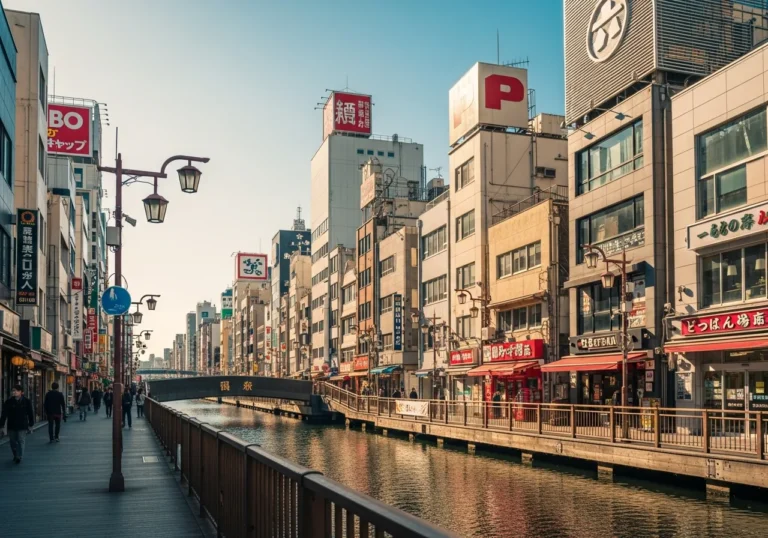
The Dotonbori canal — completed in 1615 by the Tokugawa government after its originator Nariyasu Doton died in the Siege of Osaka — had been built as a commercial artery, lined with kabuki theatres and teahouses. Until the middle of the Meiji period, people would arrive at the theatres directly by boat from the river. By the 1870s, that same water was carrying something far more lethal than theatregoers.
Why Did Cholera Hit Osaka So Hard?
Cholera is a disease of contaminated water, and Osaka was a city of water. The logic is brutal and direct. But the specific severity of Osaka’s experience requires a deeper explanation — one that runs through global trade routes, the geography of the Inland Sea, and the particular density of the city’s poor districts.
Nippon.com’s account of cholera in modernising Japan traces the disease’s arrival: cholera was endemic in the Ganges Delta, and as Britain brought India under its control and traded across Asia in the early nineteenth century, the disease spread worldwide. It reached Japan in 1822, travelling from China via the Ryūkyū islands to Kyūshū. The port cities — Nagasaki, Osaka, Kobe — were the first points of entry every time a new wave arrived, because they were the places where foreign ships docked.
Osaka was not just a port. It was the commercial capital of Japan, the city through which the rice economy of the entire country was mediated.
Ships arrived constantly. Merchants, labourers, and goods moved through in continuous circulation.
Every arrival was a potential vector.
According to the National Institute for Land and Infrastructure Management’s overview of Japanese water history, in the first 20 years of the Meiji era, more than 410,000 Japanese were infected by cholera bacteria, and more than half of those infected lost their lives.
The epidemics came in waves. The 1877 outbreak spread from Kyūshū to Yokohama and Tokyo.
The 1879 epidemic was catastrophic nationally, killing more than 100,000 people. Then 1882.
Then 1886 — the worst of all. William Johnston’s environmental history of cholera in nineteenth-century Japan, published in the Cross-Currents e-journal, provides the precise figures: in the epidemic of 1886, Osaka Prefecture experienced a cholera mortality rate of 983 per 100,000 — higher even than Tokyo’s 926 per 100,000.
Nationally, the 1886 epidemic killed 108,405 people.
Within Osaka, the disease was not distributed evenly. It concentrated in the poorest districts, particularly Nagamachi, a dense slum near the Dotonbori canal.
A peer-reviewed study of poverty, disease, and urban governance in late nineteenth-century Osaka — published in the journal Cities — documents that during the 1885 epidemic, nearly half of the 1,071 cholera cases reported in Osaka occurred in Nagamachi alone. The neighbourhood sat directly on the canal.
Its residents drew their water from the same source into which they discharged their waste. The geography of poverty and the geography of infection were identical.
The same study records that between 1877 and 1886, cholera outbreaks occurred nearly every year, resulting in the death of more than 30,000 local residents. Beyond the human cost, the economic damage was staggering: cholera outbreaks were responsible for nearly two million yen in losses to the Osaka economy between May and October 1886 alone, according to figures compiled by the Osaka Chamber of Commerce. In a city whose identity was mercantile, this was an existential threat.
Why Did the Crisis Produce a Political Response — and Why That Response Was Complicated?
On 3 August 1886, at the height of the deadliest cholera epidemic in Japanese history, Osaka Police Chief Inspector Ōura Kanetake issued an urgent memo to the heads of Osaka’s four city wards. The memo outlined a plan for Osaka’s first large-scale slum clearance. Characterising the city’s slums as “dens of poverty, crime and disease,” it called for their demolition and the mass relocation of thousands of poor urban dwellers to a walled residential compound southwest of the city.
This is the first and most important thing to understand about the political response to cholera in Osaka: it was not initially a response about water. It was a response about the poor. The Cities study traces how frequent cholera outbreaks gave rise, in both the popular press and official circles, to a discourse identifying the city’s slums as the root cause of urban epidemics — a discourse that supported efforts to permanently segregate the poor and raze the slums.
The logic was not entirely wrong. Nagamachi was genuinely the epicentre of infection.
But the mechanism was water contamination, not poverty itself — and the distinction mattered enormously for what kind of solution would actually work. Slum clearance, as Ōura proposed it, would move the poor but leave the contaminated water supply in place.
It would not stop cholera. It would merely relocate it.
The debate that followed Ōura’s 1886 proposal — which was eventually executed as Osaka’s first slum clearance in April 1891 — ran in parallel with a separate, more technically sophisticated conversation about waterworks. By the mid-1880s, the Meiji government had already seen Yokohama begin planning its modern water system, and the connection between contaminated water and cholera was becoming scientifically established.
Robert Koch had identified the cholera bacillus in 1883. The germ theory of disease was no longer speculative.
The question for Osaka was not whether to build a waterworks but how, and who would pay. The city’s commercial elite had every incentive to support it — the 1886 epidemic had cost them two million yen in a single season.
The prefectural government was under pressure from Tokyo to modernise. And there was, by the late 1880s, a foreign expert in Japan who knew exactly how to do it.
Why Was a Scottish Engineer the Key to Osaka’s Water?
William Kinnimond Burton arrived in Japan in May 1887, invited by the Meiji government to assume the post of first unofficial professor of sanitary engineering at Tokyo Imperial University. His Wikipedia entry notes that his appointment was unusual: Burton was largely self-educated, without the impressive credentials many of his contemporaries carried. What he had instead was practical experience — he had spent years designing water supply systems in London, working first with his uncle Cosmo Innes and then as Resident Engineer to the London Sanitary Protection Association.
Burton arrived at precisely the moment Japan needed him. The country was dealing with several serious epidemics, notably cholera, and had no domestic tradition of sanitary engineering.
As the Grokipedia profile of Burton documents, appointed consulting engineer to the Japanese Home Department in 1888, he oversaw the modernisation of water supply and sewerage systems in 17 major towns, including Tokyo, Osaka, and Nagasaki. He lectured for nine years and trained numerous Japanese students who would become foundational figures in the nation’s water and sanitation infrastructure.
Burton’s approach was grounded in slow sand filtration — a technology developed in Britain in the early nineteenth century that passed water through beds of fine sand to remove bacteria and particulate matter. It was not the most dramatic technology, but it worked.
The cholera bacillus, which could survive in untreated river water, could not survive the filtration process. The mechanism was physical removal, not chemical treatment: chlorination would not become standard in Japan until after the Second World War.
For Osaka specifically, Burton’s role was as consultant and designer. The city’s waterworks project, which began serious planning in the early 1890s, drew on his expertise in adapting British filtration technology to Japanese conditions.
The source water — the Yodo River — presented particular challenges. The river was turbid, carrying significant sediment load from the Lake Biwa watershed upstream.
Filtration beds would need to be designed to handle that load without clogging.
Burton did not live to see the full flowering of his work in Japan. He died in Tokyo on 5 August 1899, aged 43, from a liver infection.
But by then, Osaka’s waterworks had been operating for nearly four years, and the cities he had advised — Nagasaki, Osaka, Hiroshima, Kobe — were building systems that would transform Japanese public health. His former students built a large monument at his grave in Aoyama Cemetery.
The sand filtration system he designed for Shimonoseki, as a remarkable footnote, remains operational today — and water bottled there for emergencies carries his portrait on the label.
Why Did the Pipes Themselves Require an Industrial Revolution?
Designing a waterworks and building one are different problems. Burton could specify the filtration beds and the distribution network.
But the pipes that would carry the water from the purification plant to the city’s taps had to be manufactured — and in the early 1890s, Japan had no domestic capacity to make cast-iron water pipes. All water pipes used in Japan at the time were imported from Europe, at considerable cost and with long lead times.
This is where the story of Osaka’s waterworks intersects with one of the city’s most consequential industrial births. Kubota Corporation’s own account of its founding records that Gonshiro Kubota — born Gonshiro Oide — witnessed the outbreak of cholera and other waterborne infectious diseases, and in 1893 the company began producing the first domestic cast-iron water pipes in Japan. He had started his foundry in Osaka in February 1890, at the age of 19, renting one corner of an old tenement house.
The timing is not coincidental. Kubota launched his pipe production in 1893, two years before Osaka’s waterworks opened in 1895.
Kubota’s own technology history confirms that the company’s iron pipes were used for Osaka City’s waterworks expansion project and gathered the industry’s attention. The foundry that would become one of Japan’s largest industrial corporations was, in its origin, a direct response to the cholera crisis — a young Osaka craftsman seeing a city that needed pipes and deciding to make them.
The technical challenge was formidable. Kubota started producing deform pipes in 1893 and did not succeed in manufacturing straight pipes until 1897, using the “joint-type casting method.” Even then, productivity was low. The mass production of seamless cast-iron pipes — the kind needed for a city-wide distribution network — required further innovation: the vertical round-blow casting method, invented in 1990, and the vertical-blow rotary-type casting equipment of 1904, which finally made domestic mass production viable.
This means that the 1895 waterworks opened with pipes that were, in part, still being perfected as they were installed. The system worked — but it worked at the edge of what Japanese manufacturing could then achieve. The story of Osaka’s clean water is also the story of an industrial sector being born under pressure, learning by doing, and scaling up in real time.
Why November 1895? Why the Fourth, Not the First?
Yokohama’s waterworks opened in 1887, designed by British engineer Henry S. Palmer.
Hakodate followed in 1889, Nagasaki in 1891. Osaka’s own waterworks data records the operation start date as 13 November 1895 — the fourth in Japan, following Yokohama, Hakodate, and Nagasaki.
Why did Osaka, the largest commercial city in western Japan and the second city of the empire, come fourth rather than first? The answer lies in scale and complexity.
Yokohama was a port city with a relatively compact geography and a strong foreign-resident community that had been demanding clean water since the 1860s. Hakodate and Nagasaki were smaller.
Osaka was enormous, dense, and built on a delta of interlocking waterways — a city whose very geography made a centralised water supply system harder to engineer and more expensive to build.
The planning process was also slowed by the political debates that followed the 1886 epidemic. The slum clearance controversy consumed administrative attention and resources through 1891.
The question of who would finance the waterworks — the city, the prefecture, or the national government — required negotiation. And the domestic pipe manufacturing capacity that Kubota was developing in 1893 had not yet existed when Yokohama was building its system in the mid-1880s.
When the system finally opened on 13 November 1895, it used slow sand filtration and pressurised distribution — the same technology Burton had been advocating across Japan. A JICA case study on Japanese water utility collaboration notes that outbreaks of cholera decreased after these systems were built, but waterborne diseases were still prevalent, as slow sand filtration and pressurised distribution was used without chlorination at the time. The 1895 system was a massive improvement over drinking raw river water — but it was not the final answer.
The cholera epidemic of 1895 itself — the last major outbreak, killing tens of thousands nationally — was already underway when Osaka’s waterworks opened. The system came online just as the disease was making its final assault.
The timing was not planned; it was the result of years of construction. But the symbolic weight was enormous: a city that had been dying of its own water supply was, at last, beginning to drink something different.
Why the Yodo River? And Why Does That Choice Still Define Osaka Today?
The choice of the Yodo River as Osaka’s water source was not obvious. The river is the outlet of Lake Biwa — Japan’s largest freshwater lake, in Shiga Prefecture — and flows 75 kilometres south to Osaka Bay.
The Yodo River’s Wikipedia entry notes that its basin sustains over 14 million residents in the Keihanshin metropolitan area, providing water for domestic, industrial, and agricultural uses. It is, in other words, the hydraulic spine of the entire Kansai region.
In 1895, the Yodo was the obvious source because it was the largest, most reliable freshwater supply accessible to Osaka. The Osaka prefectural government’s Yodogawa River landscape document confirms that until the waterworks were completed in Osaka City in 1895, residents drank water from the Yodogawa River — unfiltered, untreated, directly from the same channel that carried the city’s waste downstream. The waterworks did not change the source; it changed what happened to the water before it reached people’s lips.
But the Yodo River choice created a dependency that would define Osaka’s water politics for the next century and beyond. The river’s quality is determined upstream — by what happens in Lake Biwa, by the forests of Shiga Prefecture, by the agricultural and industrial practices of Kyoto and the Uji River basin.
Osaka has no control over any of that. It is, hydraulically speaking, at the mercy of its neighbours.
This dependency became acute in the postwar economic boom. Kubota’s corporate history of Osaka’s water quality records that the water quality of the Yodo River, fed mainly by Lake Biwa, deteriorated due to population growth and industrial development associated with rapid economic growth.
In the latter half of the 1960s, Lake Biwa experienced abnormal phytoplankton growth due to eutrophication. In the 1980s, metabolites from this phytoplankton caused a musty smell in tap water across Osaka.
Trihalomethane — a carcinogenic byproduct of chlorination — became a major social concern.
The response was a landmark in environmental governance. Wikipedia’s entry on water supply and sanitation in Japan records that since the 1970s, Osaka Prefecture has paid the equivalent of more than US$500 million for sustainable forest management around Lake Biwa — one of the earliest applications of the payments for ecosystem services concept, implemented long before the English term became widely used. Osaka was, in effect, paying Shiga Prefecture to keep its forests healthy so that the water flowing south would remain clean enough to treat.
This is the long tail of the 1895 decision. Choosing the Yodo River as a water source meant committing Osaka to a relationship with an entire watershed — a relationship that would require political negotiation, financial transfer, and ecological management across prefectural boundaries for generations.
Why Did the System Keep Failing to Keep Up — and How Did It Adapt?
The 1895 waterworks served a city of perhaps 500,000 people. By 1970, Osaka’s daily water supply capacity had reached its historical peak of 2,417,700 cubic metres per day — a number that reflects not just population growth but the industrialisation of the postwar decades, when Osaka was manufacturing everything from textiles to steel to the cast-iron pipes that Kubota had pioneered.
Each phase of growth required a new engineering response. The original slow sand filtration system was adequate for bacterial contamination but could not handle the chemical pollution of the industrial era. The Yodo River’s high biochemical oxygen demand — a measure of organic pollution — from the late 1950s through the late 1960s meant that the water arriving at the purification plants was qualitatively different from what the 1895 engineers had designed for.
The solution came in stages. Chlorination — introduced by the American occupation authorities after 1945 and made mandatory in 1957 — addressed bacterial contamination definitively. But it created new problems: chlorine reacting with organic matter in the water produced trihalomethanes, and the musty odour from Lake Biwa’s phytoplankton blooms made Osaka’s tap water unpleasant even when it was technically safe.
In 1986, Kubota — the same company whose founder had made the pipes for the original 1895 system — installed a highly advanced water purification pilot plant at the Kunijima purification facility in Osaka. The new system combined ozone treatment with granular activated carbon adsorption, removing the musty odour completely and reducing trihalomethane concentrations by 60 to 70 percent. The result, as Kubota’s own documentation records, was tap water that could be drunk directly from the faucet — a standard that had been unimaginable in 1895.
The institutional structure evolved in parallel. The Osaka City Waterworks Bureau, founded in 1895, has operated continuously for over 130 years.
Its own technical publication describes a total system covering from water sources to faucets — an integrated approach that treats the entire chain from Lake Biwa to the household tap as a single managed system. Today the bureau serves 2,716,989 people across 1,596,512 households, with 100 percent water supply coverage.
Why the Sewerage System Is the Other Half of the Story
Clean water in is only half the equation. The cholera crisis of the 1870s and 1880s was caused by contaminated water going in — but the contamination came from waste water going nowhere. Osaka’s sewerage system, which developed in parallel with the waterworks, is the less celebrated but equally essential half of the public health revolution.
Atlas Obscura’s entry on the Sewerage Science Museum records that the museum was built on the site of the Ebie Sewage Treatment plant in 1995 to celebrate the 100th anniversary of Osaka’s modern sewage works — meaning the sewerage system, like the waterworks, dates to 1895. The two systems were conceived together, as two sides of the same public health intervention.
The museum itself — located in Nishi-yodogawa ward, near the Yodogawa Station — offers a six-floor journey through the history and technology of wastewater management, from ancient sewers to the modern Maishima sludge centre. Admission is free.
Most exhibits are in Japanese, though a translation app handles the gap adequately. It is not a glamorous destination, but it is an honest one: the basement includes a labyrinth of actual sewer pipes and a 4D audiovisual capsule that takes visitors through underground sites around the world.
The sewerage system’s ongoing challenge is the same one that has always defined Osaka’s water management: the city’s canals. Kubota’s documentary on Osaka’s water describes current efforts to improve the water quality of the Dotonbori River, including the construction of a large storage tunnel — the “Heisei no Taiko Gesui” — to prevent combined sewer overflows from being discharged into the river during heavy rain. The Dotonbori, which was a cholera vector in 1886, is still a water quality management challenge in 2026, though the nature of the problem has changed entirely: the concern now is aesthetic and ecological rather than epidemiological.
Why the Discerning Traveller Should Care — The Significance Beneath the Surface
There is a version of this story that a guidebook would tell: Osaka built a waterworks in 1895, cholera declined, the city modernised. That version is true but insufficient. The deeper significance of what happened between 1877 and 1895 in Osaka is about the relationship between infrastructure and freedom — about what a city can and cannot do without clean water.
Osaka in the 1880s was commercially sophisticated, culturally rich, and architecturally ambitious. It had kabuki theatres, rice futures markets, and a merchant class that had been financing Japanese commerce for two centuries.
It also had a cholera mortality rate that, in 1886, exceeded 983 per 100,000 — meaning that in a single year, roughly one in every hundred Osaka residents died of a waterborne disease. The city’s sophistication and its lethality coexisted because infrastructure had not caught up with density.
The waterworks of 1895 did not just reduce mortality. It changed what the city could become.
A city where people die of their water supply cannot attract the investment, the migration, and the institutional development that a modern metropolis requires. The decline of cholera after 1895 — major epidemics causing more than ten thousand deaths occurred in 1879, 1882, 1886, 1890, and 1895, and then effectively ceased as a mass-casualty event — correlates directly with the expansion of filtered water supply across Japan’s cities.
For the traveller standing in Dotonbori today, watching the neon reflections in the canal water, the relevant question is not “what is this place?” but “what made this place possible?” The answer is, in part, a Scottish engineer who died at 43 in Tokyo, a 19-year-old Osaka foundry worker who decided to make pipes, and a prefectural government that was frightened enough by 30,000 deaths to finally spend the money on infrastructure.
The Yodo River, which you can see from the expressway heading north out of the city, is the same river that supplied Osaka’s first waterworks. It is also the river whose quality Osaka has been paying to protect — through forest management payments to Shiga Prefecture — for more than fifty years.
The water that comes out of a tap in Namba or Umeda or Tennoji has travelled from Lake Biwa, through 75 kilometres of river, through ozone treatment and activated carbon filtration, through Kubota’s iron pipes, to that faucet. It is, by any measure, a remarkable piece of collective engineering.
It is also the reason the city is alive.
The Sewerage Science Museum is the most direct place to encounter this history physically. It is free, it is genuinely interesting, and it sits on the actual site of the 1895 sewage works — the ground beneath it is the ground where Osaka’s public health revolution began.
The exhibits are aimed at schoolchildren, which means they are clear, concrete, and unafraid of the subject matter. Adults who can read a translation app will find more here than they expect.
For those who want the water side of the story rather than the sewerage side, the Kunijima Purification Plant in Moriguchi — on the Yodo River, northeast of the city — is the direct descendant of the original 1895 intake facility. It is not a tourist site in the conventional sense, but the Osaka City Waterworks Bureau occasionally opens its facilities for public visits, and the river embankment at Moriguchi offers a view of the intake structures that have been drawing water from the Yodo for over 130 years.
Frequently Asked Questions
Q: When did Osaka get its first modern waterworks?
A: On 13 November 1895, making it the fourth modern municipal water system in Japan, after Yokohama (1887), Hakodate (1889), and Nagasaki (1891).
Q: What caused the cholera epidemics that drove Osaka to build the waterworks?
A: Cholera spread through contaminated water. Osaka residents drank directly from the Yodo River and from shallow wells, both of which were contaminated by the city’s own waste. The disease arrived repeatedly via the port, carried by ships from China and Korea, and spread through the city’s dense canal-side neighbourhoods.
Q: Who designed Osaka’s waterworks?
A: The system drew on the expertise of William Kinnimond Burton (1856–1899), a Scottish sanitary engineer who served as consulting engineer to the Japanese Home Department from 1888 and advised on water and sewerage systems for 17 major Japanese cities, including Osaka.
Q: What is the connection between Kubota Corporation and Osaka’s waterworks?
A: Kubota was founded in Osaka in 1890 by Gonshiro Kubota, who began producing Japan’s first domestic cast-iron water pipes in 1893 — directly in response to the cholera crisis and the demand created by the waterworks construction programme. Kubota’s pipes were used in Osaka’s waterworks expansion and the company remains a major water infrastructure manufacturer today.
Q: Where does Osaka’s water come from today?
A: The Yodo River, which originates at Lake Biwa in Shiga Prefecture. The water is treated at three purification plants — including the Kunijima plant in Moriguchi — using ozone and activated carbon filtration before distribution. Osaka Prefecture has paid over US$500 million since the 1970s for forest management around Lake Biwa to protect the watershed.
Q: Can visitors see anything related to this history today?
A: Yes. The Osaka City Sewerage Science Museum in Nishi-yodogawa ward is built on the site of the 1895 Ebie sewage works, is free to enter, and covers the history of Osaka’s water and sewerage systems. The Yodo River embankment at Moriguchi offers views of the original waterworks intake area.
Osaka City Sewerage Science Museum — Visitor Information
Address: 2-3-25 Sanbonmatsu, Nishiyodogawa-ku, Osaka 555-0013 / 〒555-0013 大阪市西淀川区三本松2丁目3番25号
Nearest station: Yodogawa Station (JR Osaka Loop Line / Osaka Metro Namba Line) — approx. 5 minutes on foot
Hours: Tuesday–Sunday, 9:30–17:00 (closed Mondays and year-end/New Year holidays; confirm current hours on the official site as the museum has undergone renovation)
Admission: Free
Official site: city.osaka.lg.jp