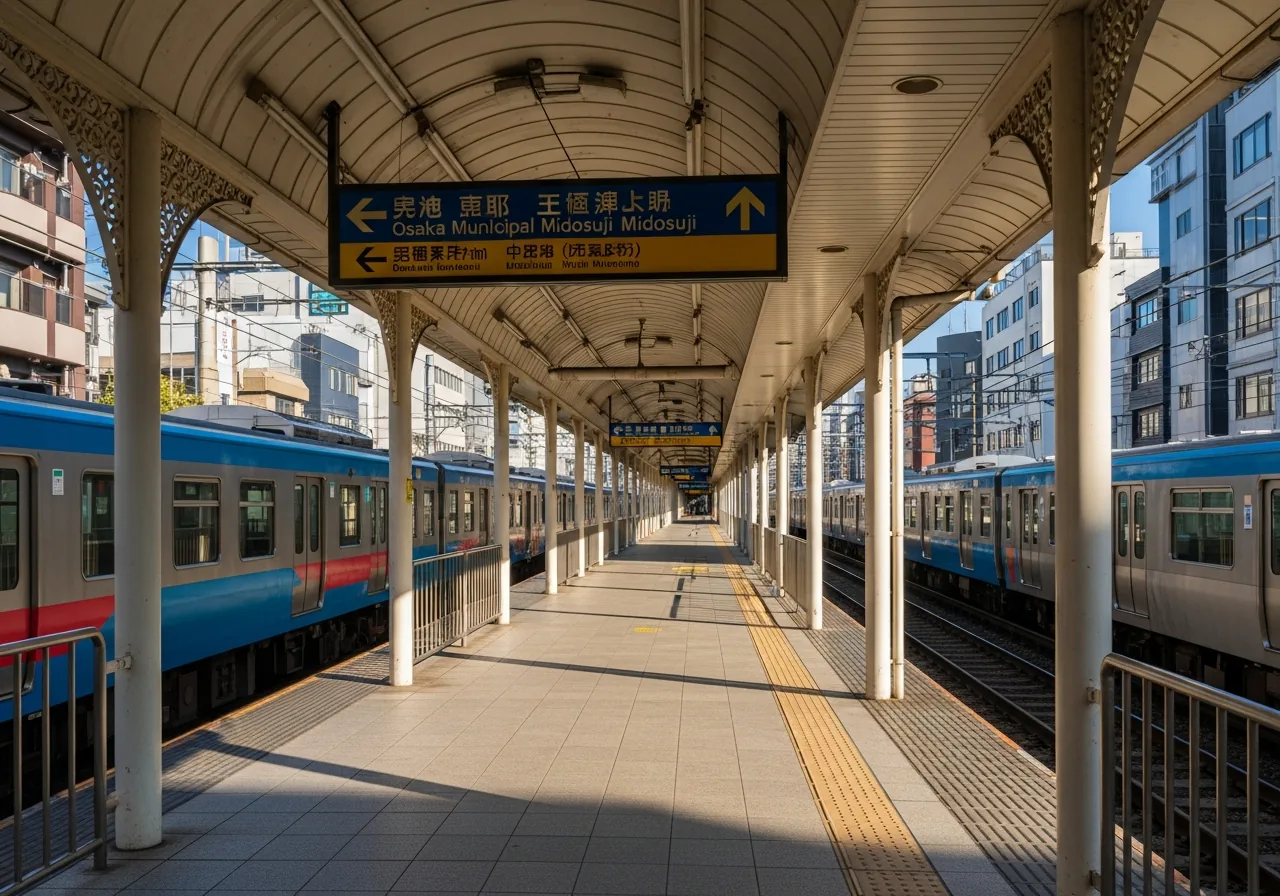
On 20 May 1933, Osaka City opened a 3.1-kilometre stretch of underground railway between Umeda and Shinsaibashi — the first municipally operated subway in Japan, predating any comparable city-run system in the country by years. It was built not because the technology was ready, or the money was easy, but because a scholar-mayor named Hajime Seki had decided that the city owed its poorest workers a way out — literally underground, beneath the streets they could no longer move through.
Why we can tell you this — MICHI is written and edited in Osaka; our team rides the Midōsuji Line daily, from Umeda to Namba and back, and can stand at the original 1933 platform level at Shinsaibashi and feel the scale of what was built. This article draws on the Wikipedia corpus for Osaka Metro and the Midōsuji Line, the photographic archive and contextual research at Old Photos of Japan, the Japan Subway Association’s official Osaka page, academic scholarship on Mayor Seki Hajime via the University of Oregon and published by the University of California Press, and contemporary reporting from Railway Pro on the 2018 privatisation. Where the record is thin — particularly on the internal deliberations of the 1925 planning committee and the precise wartime damage to individual stations — we say so rather than filling the gap with inference.
Stand at the top of the escalator at Umeda Station on a Tuesday morning and count to ten. In those ten seconds, roughly 350 people will have passed through the turnstiles below you. Multiply that across a network of eight lines, 134 stations, and a city that has been doing this since the depths of the Great Depression, and you begin to understand what the Osaka Municipal Subway actually is: not a convenience, not a tourist amenity, but the circulatory system of one of the world’s great commercial cities, installed at a moment of maximum civic ambition and maximum economic despair.
The story of how it got there — why Osaka and not Tokyo, why 1933 and not 1923, why the city itself and not a private railway company — is a story about a particular kind of urban politics, a particular kind of mayor, and a particular kind of city that has always preferred to do things its own way.
Why Was Osaka the Right City for This?
To understand why Osaka built Japan’s first city-run subway, you have to understand what Osaka was in the 1920s. It was not, as many Western visitors assume, Tokyo’s smaller, quirkier cousin.
During the 1920s, Osaka was the largest city in Japan in terms of population, area, and industrial output, surpassing even Tokyo. Its population reached 2,114,800 by 1925, edging past Tokyo’s 1,995,500.
The city had earned the nickname “Dai-Osaka” — Big Osaka — and was ranked the sixth most populous city in the world. It was also called the “Manchester of the East,” a comparison that captured both its industrial ferocity and its social costs. The city had exploded from a town of about 350,000 residents to approximately 2.2 million during the half century beginning in 1870 — a rate of growth that no surface transport system could absorb.
Osaka had always been a city of water. Its old identity as Japan’s “Venice” — a dense grid of canals threading between merchant warehouses — had made it the nation’s commercial heart for centuries.
But that same canal network, so useful for Edo-period rice barges, was a catastrophic obstacle for modern surface transport. The city had a crowded urban center cut up by a tight grid of canals, while streets were extremely narrow.
When Tokyo began its first horse-drawn streetcar service in 1882, Osaka was still relying on ferries. The city only started constructing streetcar lines in 1903 — two decades behind.
When the streetcar network finally came, it came under municipal control. Uniquely, the city ran the system itself, using the money it earned to pay off the huge debts it had made to fund the construction.
This was not an accident. Osaka had a deep civic tradition of municipal enterprise — the city ran its own utilities, its own markets, its own transport.
When the question of a subway arose, the answer was never going to be “let a private company do it.”
The Streetcar That Couldn’t Keep Up
As the city expanded, the streetcar network grew to provide service across most of Osaka, eventually reaching a total length of 118 km, making it one of Japan’s largest tram systems, second only to the Tokyo Metropolitan Tram. But by the late 1920s, even 118 kilometres of tram track was not enough.
The First World War had prompted rapid growth in Osaka’s commerce and industry. However, existing transportation systems — primarily streetcars and the municipal bus network — proved insufficient to meet rising demand. The streets were gridlocked.
The canals were being filled in. The city was eating itself alive with its own success.
The answer, the city’s planners concluded by 1925, was to go underground. Osaka City formulated a plan in 1925 for a subway network consisting of four lines totalling 54.5 km. The ambition was extraordinary for a city that had only just mastered the streetcar. But the man behind it was not an ordinary municipal administrator.
Who Was Hajime Seki, and Why Does He Matter?
The intellectual architect of the Osaka subway was Mayor Hajime Seki (関一, 1873–1935), and understanding him is essential to understanding why this subway was built the way it was — and why it was built at all.
Seki was not a career politician. Trained as a political economist in the late 1890s, when Japan was focused single-mindedly on “increasing industrial production,” he distinguished himself early on as a people-centred, rather than a state-centred, national economist. He studied in Europe at the height of the Progressive movement, absorbing ideas about social reform, garden cities, and the obligation of municipal government to its working-class residents. He was, in the language of his era, a social progressive — affiliated with the Japanese branch of the German Association for Social Policy.
Appointed Senior Deputy Mayor of Osaka in 1914, he assumed his new position with a broad mandate to assess the city’s needs and create new “facilities” (shisetsu) to meet them. By the time he became mayor in 1923, he had made residential reform the pillar of his urban social reformism and the creation of working-class garden suburbs its central objective.
The subway was the mechanism that would make those suburbs possible. He saw the transportation system as an opportunity to link Osaka’s inner city with newly planned suburbs and eradicate Osaka’s appalling poverty in its many buraku and ethnic enclaves. A subway was not, in Seki’s mind, a transport project. It was a social project that happened to require tunnels.
This is the first trapdoor in the story. The Osaka Municipal Subway was not built primarily to move commuters.
It was built to move the poor — to give workers in the overcrowded inner city access to new housing on the periphery, and to give the city a mechanism for redistributing its population more equitably. The fact that it became a commuter artery was almost incidental to its original purpose.
Why Did Construction Begin During the Great Depression?
The planning was done by 1925. Construction did not begin until 1930. The gap is explained by the same economic catastrophe that was reshaping the entire industrialised world: the Great Depression.
But here is the second trapdoor. The Depression did not delay the subway — it accelerated it. Because construction commenced during the Great Depression, the city government deliberately adopted labour-intensive policies as an economic countermeasure, prioritising the employment of large numbers of unemployed workers in order to alleviate joblessness and stimulate the economy.
The construction of the Midōsuji line was seen as an opportunity to create work for Osaka’s many unemployed during the Great Depression. This was not a side effect — it was a design principle. Seki’s administration chose to dig by hand rather than use machinery wherever possible, precisely because the point was to put men to work.
The consequences of that choice were written into the earth itself. The initial tunnel from Umeda to Shinsaibashi, as well as the Umeda depot, were constructed entirely by hand and opened in 1933 after being initially plagued by cave-ins and water leakage caused by the poor composition of the earth below northern Osaka and the equally poor engineering skills of the work crew.
The ground beneath northern Osaka is notoriously difficult — soft alluvial soil, high water tables, the legacy of centuries of canal-building and land reclamation. Workers digging by hand in 1930 were fighting the city’s own geology. The Umeda-Shinsaibashi section was dug entirely by hand and plagued by the terrible composition of the earth and poor engineering skills. The combination caused much water leakage and cave-ins in the northern construction site during the start of the project.
That the tunnel was completed at all, in three years, by hand, through waterlogged ground, during a global economic depression, is a feat that deserves more recognition than it gets.
Why Was the First Line Built Where It Was?
The choice of route for the first line was not arbitrary. The construction of the subway coincided with the widening of the road from 6 to 44 metres, making Osakans joke that an airplane could land on the newly named Midōsuji Avenue. The subway and the boulevard were conceived together — the underground line and the surface road as a single integrated infrastructure project, the most ambitious urban engineering undertaking in Osaka’s modern history.
Midōsuji — the name means “the road of the temple of the green way” — runs north to south through the commercial heart of the city, connecting the great Buddhist temples of Kitamido and Minamimido. It was already the city’s most important commercial axis. Running the subway beneath it was not just logical; it was a statement about what kind of city Osaka intended to be.
On 20 May 1933, the Osaka Municipal Subway opened the first stretch of the Midōsuji Line between Umeda and Shinsaibashi, making Osaka the first Japanese city to have a publicly operated metro. The context, as one transport historian has noted, matters: Osaka was then the country’s largest industrial and commercial city, a port and textile powerhouse whose urban traffic had become unmanageable for trams alone.
The opening day must have been extraordinary. The stations had been built to handle trains of up to eight cars — a remarkable act of forward planning for a city that had never run a subway before. The stations were built to handle up to eight cars, but only single cars were used at first, making people on the long platforms scramble to the spot where the short trains stopped. Imagine the scene: a single carriage rattling through a platform built for eight, passengers sprinting down the platform to reach the doors, the whole enterprise simultaneously magnificent and slightly absurd.
The first cars were hauled onto the line by manpower and pack animals from the Government Railway tracks near Umeda. Oxen pulling subway cars through the streets of Osaka in 1933 — it is an image that captures the strange threshold moment between one era and the next.
Why Did the City Choose Municipal Operation Over Private Enterprise?
This is perhaps the most consequential decision in the subway’s history, and it deserves its own interrogation. Tokyo’s first subway — the Ginza Line, which opened in 1927 and predates Osaka’s by six years — was built and operated by a private company, Tokyo Underground Railway Co. Osaka chose a different model entirely.
The reasons were structural, ideological, and financial, all at once. Structurally, Osaka already operated its trams municipally and had the administrative apparatus to run a transit system.
Ideologically, Seki’s progressive politics made private profit from public infrastructure philosophically unacceptable — the subway was a social instrument, not a commercial one. Financially, the city calculated that the long-term revenue from a successful subway would be better retained in public hands, where it could cross-subsidise other civic services.
There was also a practical argument about planning. A private operator would build where profit was greatest — along the densest, most commercially lucrative corridors.
A municipal operator could build where the city needed it most, including into areas that were not yet profitable but that the city wanted to develop. Seki’s vision of garden suburbs connected to the inner city by subway required exactly this kind of planning flexibility.
The result was a system that, from its first day, was answerable to the city rather than to shareholders. Japan’s first public streetcar service had begun in Osaka in 1903, and the city had spent thirty years learning how to run public transport. The subway was the natural extension of that tradition.
The Japan Subway Association records that Osaka’s municipal subway system was the first government-operated subway in Japan — a distinction that shaped not just Osaka’s transport history but the template for municipal transit governance across the country.
Why Did the System Survive the War — and What Did Survival Cost?
By the time Japan entered the Pacific War, the Midōsuji Line had been extended south through Namba to Tennoji. Although work on the subway was suspended during World War II, progress quickly resumed in the postwar period. The suspension was total — no new construction, minimal maintenance, the entire system operating under wartime conditions.
What those conditions meant for the tunnels themselves was, paradoxically, a kind of salvation. The Midōsuji Line ran deep enough beneath the city that it served as a de facto air-raid shelter during the American bombing campaigns of 1945.
The bombing of Osaka during the Pacific War resulted in over 10,000 civilians killed and over 500,000 made homeless, with raids beginning on the night of 13–14 March 1945 and continuing until the last day of the war. One-third of the city was destroyed.
The subway tunnels, dug deep into that difficult northern Osaka soil, offered shelter that the surface city could not. The infrastructure that had been built to move the poor now sheltered them from the sky. This was not a designed function — but it was a consequence of the decision to build deep, which had itself been a consequence of the difficult geology that the hand-diggers had fought in 1930.
Above ground, the city was devastated. One-third of Osaka was destroyed by American air raids during World War II, including many commercial and industrial districts. The population that had reached 3.3 million by the early 1940s was scattered, the industrial base shattered, the merchant city that had been the “Manchester of the East” reduced to rubble and ash.
The subway, when it reopened, was running through a city that no longer existed in the form it had been built to serve. The question was whether it could help build the new one.
Why Did the Postwar Decades Become the System’s Defining Era?
The answer is Expo ’70 — but the real answer is deeper than that.
Japan’s postwar economic recovery was, by the mid-1950s, producing growth rates that were transforming the country. In 1955, along with improvements in socio-economic conditions and ever greater demands for transport infrastructure, motorisation rapidly took hold. Cars were filling the streets that had been cleared of rubble. The subway, which had been a Depression-era employment scheme and a wartime shelter, was now becoming something else entirely: the only viable way to move through a city that was growing faster than its surface could absorb.
The city launched an ambitious construction programme. New lines were added decade by decade: the Tanimachi Line through the 1960s, the Chūō Line from 1961, the Sennichimae and Sakaisuji lines in 1969. Each new line addressed a specific urban corridor. The system was being built not as a single grand plan but as a series of responses to the city’s growth — pragmatic, incremental, and always municipally controlled.
Then came the Expo. Japan World Exposition Osaka 1970 — Expo ’70 — was the first World Expo held in an Asian country, and it attracted a record 64 million visitors.
Some 650 billion yen was invested in roads, railways, and other infrastructure in the run-up to the event. The subway was the centrepiece of that investment.
Subway development was strongly promoted, resulting in the completion of a 64.2 km network of six lines forming a grid pattern across the city centre by 1970, the year of the World Expo. The system that had opened with a single 3.1-kilometre line in 1933 was now a grid covering the entire city. It had grown twenty-fold in thirty-seven years.
The Expo also drove the extension of the Midōsuji Line northward to Shin-Osaka and then to Esaka, connecting the subway to the Shinkansen terminus and to the Expo site itself. The line that Seki had conceived as a social instrument for the poor had become the spine of a world-class transit system serving tens of millions of visitors from across the globe.
The 1970 Gas Explosion: A Tragedy That Changed Everything
The postwar expansion was not without cost. On 8 April 1970, during construction of the Tanimachi Line at Tenjimbashisuji 6-chome Station, an underground gas explosion killed 79 people and injured 420. It was the worst accident in the history of Japanese metro construction, and the catalyst for major reforms in underground safety regulations.
The disaster forced a complete overhaul of underground construction safety standards across Japan — not just in Osaka, but nationally. The tragedy was the price of building fast through a city that had been growing faster than its engineers could safely manage. It remains a largely forgotten chapter in the subway’s history, but its consequences — in the form of the safety protocols that now govern underground construction across Japan — are still felt every time a new tunnel is dug.
Why Did Osaka Keep Innovating After the Network Was Built?
By 1987, the Midōsuji Line had reached its current length of 24.5 kilometres, completing its final extension to Nakamozu. The network was, in broad outline, the system that exists today. But the city was not finished experimenting.
In 1981, the New Tram arrived — an automated guideway system serving the Nankō Port area, one of Japan’s earliest driverless transit systems. Rubber-tyred, elevated, fully automated, it was a glimpse of a different kind of urban transit — and it was, again, a municipal project, built to serve a new port development area that private operators had no interest in serving.
Then, in 1990, came the most technically significant innovation in the system’s history. Coinciding with the 1990 International Garden and Greenery Exposition was the opening of Osaka’s seventh subway line — the Nagahori Tsurumi-ryokuchi Line — from Kyobashi to Tsurumi-ryokuchi Station. It was the first linear motor rapid transit line in Japan.
It was the first linear motor rapid transit line constructed in Japan — and the first outside North America, predated only by the Intermediate Capacity Transit System in Toronto and Vancouver. The technology allowed smaller tunnels and smaller trains, reducing construction costs in a city where underground space was increasingly expensive and archaeologically sensitive. (The original plan had routed the line near Osaka Castle, but the presence of underground artefacts around the castle area made this plan impractical — a reminder that Osaka’s history runs deep in more than one sense.)
The linear motor technology was not chosen for its novelty. It was chosen because it solved a specific engineering problem: how to build new lines through a city that was already saturated with underground infrastructure, at a cost the city could afford. The same pragmatic logic that had driven the hand-digging of 1930 was still operating sixty years later.
Why Was the System Privatised — and What Does That Mean?
For eighty-five years, the Osaka Municipal Subway was exactly what its name said: a municipal subway. Then, on 1 April 2018, it ceased to exist in that form.
Osaka’s municipal metro system was privatised on 1 April 2018 with the launch of the new operator, Osaka Metro Co., marking the first privatisation of a public metro network in Japan. The new company was a kabushiki kaisha — a stock company — but one in which all shares remained owned by Osaka City. It was, in the language of Japanese administrative reform, a “corporatisation” rather than a true privatisation: the city retained ownership, but the operator was freed from the constraints of municipal bureaucracy.
The political context was the rise of the Osaka Restoration Association (Osaka Ishin no Kai), the reformist local party that had been pushing for a radical restructuring of Osaka’s governance since 2010. The party emerged with the aim of overhauling Osaka’s inefficient administrative structure through bold reforms emphasising fiscal discipline, reduced bureaucracy, and economic revitalisation. The subway privatisation was one piece of a much larger project.
The practical arguments for corporatisation were real. A municipal bureau operates under civil service rules that make it difficult to respond quickly to commercial opportunities, to hire specialists at market rates, or to develop the non-transit revenue streams — retail, real estate, advertising — that modern urban transit systems increasingly depend on. The privatisation aimed to improve efficiency, speed up modernisation and open commercial possibilities that were impossible under municipal administration.
The first president of Osaka Metro Co. was Hideaki Kawai, a former executive of Panasonic Corp. — a signal that the new entity was to be run with corporate discipline rather than bureaucratic caution. The brand was redesigned, the stations began to be renovated with commercial sensibility, and the system started to behave more like a private railway company than a public utility.
But the deeper question — whether the corporatisation has changed what the subway is for — remains genuinely open. Seki built it to serve the poor.
The new Osaka Metro is building it to serve the Expo, the tourist economy, and the commercial corridors of a city competing for international investment. These are not incompatible goals, but they are not the same goal.
The Legal Quirk That Tells You Everything
There is a detail about the Osaka Metro that is so strange it deserves its own paragraph. Osaka Metro is the only subway system in Japan to be partially legally classified as a tram system, whereas all other subway systems in Japan are legally classified as railways.
This is not a technicality. It is a fossil — a remnant of the administrative regulations that were in force when the first lines were built in 1933, when the legal category of “subway” did not yet exist in Japanese law and the closest available classification was “rapid electric tramway.” The system has been running as a full metro for ninety years, but the law still calls it a tram.
It is, in miniature, the story of the whole system: built under one set of assumptions, operating under another, classified under a third, and somehow working perfectly well despite all of it.
What Does the System Look Like Today, and Why Should You Care?
As of August 2026, the network transports approximately 2.5 million passengers daily, functioning as the primary urban transport backbone for Osaka City and surrounding municipalities including Higashiosaka, Kadoma, Moriguchi, Sakai, Suita, and Yao. Eight lines, 134 stations, 141 kilometres of track. The Midōsuji Line alone — the original 3.1-kilometre stretch, now extended to 24.5 kilometres — carries approximately 1.3 million passengers per day.
The most recent major expansion came in January 2025, when the Chūō Line extended to Yumeshima, the artificial island in Osaka Bay that hosted Expo 2025. The pattern holds: every major event in Osaka’s modern history — the 1970 World Expo, the 1990 Garden Expo, the 2025 World Expo — has been accompanied by a subway extension. The city builds its ambitions underground.
The system has also accumulated a set of technical firsts that, taken together, make it one of the most innovative transit networks in the world. First municipally operated subway in Japan (1933).
First linear motor rapid transit line in Japan (1990). First automated guideway transit system in Japan (1981, the New Tram).
And now, with the Yumeshima extension, the first subway line to serve an artificial island built for a World Expo.
Why Should a Discerning Traveller Care About Any of This?
The honest answer is that you will use the Osaka Metro whether you care about it or not. You cannot move through this city without it. The question is whether you move through it as a passenger or as someone who understands what they are riding.
When you descend into Umeda Station on the Midōsuji Line, you are descending into a tunnel that was dug by hand, by unemployed workers, in 1930, through waterlogged soil, under the direction of a mayor who believed that public transport was a social right. The platform you stand on was designed for eight-car trains before a single car had ever run. The line you are riding was built to connect the poor of the inner city to suburbs that Seki hoped would give them a better life.
That history is not decorative. It is structural.
The reason the Midōsuji Line runs exactly where it runs — under the widest boulevard in the city, connecting Umeda to Namba to Tennoji in a straight north-south line — is because a scholar-mayor in 1925 decided that the city’s most important commercial axis should also be its most accessible public corridor. Every shop on Midōsuji, every hotel, every department store, every restaurant that a visitor to Osaka will encounter along that boulevard, exists in its current form because of a decision made underground ninety years ago.
The Nagahori Tsurumi-ryokuchi Line, the lime-green line that cuts east-west through the city, is worth riding for its own sake. It was the first linear motor rapid transit line constructed in Japan — and the first outside North America — and you can feel the difference: quieter, smoother, the train sitting lower in the tunnel, the whole experience slightly uncanny compared to the older lines.
It is also the line that was rerouted away from Osaka Castle because archaeologists found too much history in the ground. The subway that could not go where it wanted because the past was in the way.
And the 2018 privatisation, which might seem like a dry administrative event, is actually the latest chapter in a ninety-year argument about what public transport is for. Seki built it for the poor.
The Restoration Association corporatised it for efficiency and commercial development. The city still owns every share.
The argument is not resolved — it is ongoing, and the outcome will shape Osaka’s social geography for the next century.
A traveller who understands this is not just a tourist using the metro. They are a witness to one of the longest-running experiments in urban governance in the modern world: the question of whether a city can own its own infrastructure, run it for the public good, and still make it work.
Osaka has been trying to answer that question since 1933. The answer, so far, is yes — with complications.
Frequently Asked Questions
Q: Is the Osaka Metro the oldest subway in Japan?
A: No. Tokyo’s Ginza Line, opened in 1927, is the oldest subway line in Japan. The Osaka Municipal Subway, which opened in 1933, is the second oldest — but it was the first to be operated by a city government rather than a private company. After Osaka’s 2018 privatisation, the title of Japan’s oldest existing public subway passed to the Nagoya City Subway Higashiyama Line.
Q: Why is Osaka Metro legally classified as a tram?
A: When the first lines were built in 1933, Japanese law had no category for “subway.” The closest available classification was “rapid electric tramway” (高速電気軌道), and the system was registered under that category. The classification has never been updated, making Osaka Metro the only subway in Japan legally classified as a tramway — a legal fossil with no practical impact on passengers.
Q: Who was Hajime Seki and why does he matter to the subway’s history?
A: Seki (1873–1935) was Osaka’s mayor from 1923 until his death, and the intellectual force behind the subway’s creation. Trained as a political economist in Europe, he saw the subway not as a transport project but as a social instrument — a way to connect the city’s poorest residents to new suburban housing and break the cycle of inner-city poverty. His vision shaped the route of the Midōsuji Line and the decision to build it under municipal rather than private control.
Q: What was Japan’s first linear motor subway line?
A: The Nagahori Tsurumi-ryokuchi Line, opened by the Osaka Municipal Subway on 31 March 1990 in conjunction with the International Garden and Greenery Exposition. It was the first linear motor rapid transit line in Japan, and the first outside North America. The technology allowed smaller tunnels and lower construction costs, and has since been adopted for the Imazatosuji Line (2006) and influenced transit design across Japan.
Q: Is Osaka Metro truly private now?
A: In structure, yes — it operates as a kabushiki kaisha (stock company) under corporate law. In ownership, no — all shares are held by Osaka City.
The 2018 change was a corporatisation rather than a full privatisation: the operator gained commercial flexibility while the city retained ultimate control. It is best understood as a hybrid model, neither fully public nor fully private.
Q: How do I get around Osaka using the Metro?
A: For most visitors, the Midōsuji Line (red, Line 1) covers the essential destinations: Shin-Osaka for the Shinkansen, Umeda for the northern commercial district, Shinsaibashi and Namba for shopping and dining, Tennoji for the southern area. IC cards (ICOCA, Suica) are accepted at all turnstiles. Note that the metro does not serve Kansai International Airport — take the Nankai Rapi:t from Namba or the JR Haruka from Shin-Osaka instead.
Osaka Metro (Midōsuji Line / Umeda Station) — Visitor Information
Address: Umeda Station, 3-chome Umeda, Kita-ku, Osaka 530-0001 / 大阪府大阪市北区梅田3丁目 梅田駅(御堂筋線)
Nearest station: Umeda (Midōsuji Line M16) — this is the station itself; also connected to Osaka Station (JR), Hankyu Umeda, and Hanshin Umeda by underground walkways (3–8 min walk)
Hours: First trains approx. 05:00; last trains approx. 00:30 (varies by line and direction — confirm on the official app or at station)
Admission: Fares from ¥190 (adult, approx. as of August 2026); IC card recommended. One-day passes available — confirm current pricing on the official site before travel.
Official site: osakametro.co.jp/en