Tokuji Hayakawa lost his wife, his two children, his factory, and every patent he had built over a decade — all in a single afternoon on September 1, 1923. He rebuilt from nothing in Osaka, a city he had never intended to call home, and the company he founded there became Sharp Corporation: the first Japanese firm to mass-produce a crystal radio, the first to put a television set into Japanese living rooms, and the pioneer of the LCD calculator that seeded every flat screen you have ever touched.
Why we can tell you this — MICHI is written and edited in Osaka, and the Abeno-ku district where Hayakawa re-established his workshop in 1924 is a neighbourhood our team walks through regularly; the streets around Tennoji Station still carry the industrial character he helped shape. This article draws on Sharp Corporation’s own centenary archive and founder biography pages, the Wikipedia entry for Tokuji Hayakawa cross-referenced against corporate timelines, the Asianometry analysis of Sharp’s corporate history, and contemporaneous earthquake scholarship from the Association for Asian Studies and the Smithsonian. Where the personal record is thin — particularly the interior experience of Hayakawa’s grief and recovery — we say so rather than embellish.
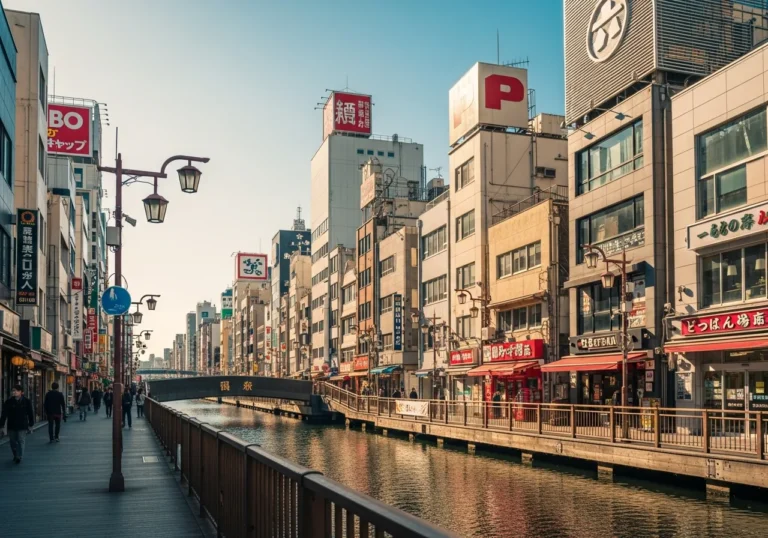
Stand at the south exit of Tennoji Station on any weekday morning and you are standing, more or less, on the ground where one of the twentieth century’s most consequential second acts began. The Abeno-ku neighbourhood around you is dense, practical, and unremarkable to the eye — a tangle of covered shopping arcades, small workshops, and the looming glass column of Abeno Harukas rising above the old Kintetsu terminus. Nothing marks the spot where, in 1924, a thirty-year-old man who had just lost everything arrived from Tokyo with a six-month work contract, a borrowed reputation, and no particular plan beyond survival.
That man was Tokuji Hayakawa. What he built here — first a radio workshop, then a television factory, then a calculator laboratory, then a company that would pioneer the liquid crystal display — is the reason the name Sharp exists at all.
His story is not a simple rags-to-riches arc. It is something stranger and more instructive: a story about what catastrophe does to a certain kind of mind, and why Osaka, specifically, was the city that made the second beginning possible.
Why Did a Boy From Tokyo End Up Making Buckles?
According to the Wikipedia biography of Tokuji Hayakawa, he was born on November 3, 1893, in Tokyo. Hayakawa was born in Tokyo in 1893, and due to difficult domestic circumstances, he was adopted by the Ideno family; he left primary school after second grade due to his family’s poverty and was apprenticed to a maker of metallic ornaments.
The adoption was not a rescue. Just 23 months after his birth, Tokuji was placed in the care of the Deno family, who later formally adopted the boy; he was poor, endured a harsh childhood, being underfed and mistreated by his adoptive stepmother. Fortunately, help arrived in the form of Mrs. Inoue, an old, visually impaired woman from his neighbourhood, who helped Tokuji become an apprentice before the age of eight in a metalworking business that made decorative metal ornaments.
The detail of Mrs. Inoue matters. She was blind, and she would later inspire one of Hayakawa’s most significant acts of philanthropy — but that comes later. For now, what matters is that her intervention gave a malnourished, barely-schooled child access to a craft tradition that was, in Meiji-era Japan, still one of the few reliable ladders out of poverty.
The apprenticeship lasted over seven years until April 1909, followed by an additional year of unpaid service, immersing him in the demanding world of traditional Japanese metalworking during the early stages of the country’s Meiji-era industrialization. Daily life as an apprentice was gruelling, involving long hours of manual labour under the strict guidance of master craftsman Yoshimatsu Sakata, who balanced discipline with compassion, fostering in Hayakawa not only technical proficiency but also a sense of human kindness. Hayakawa learned foundational metal processing techniques, including shaping and ornamenting metals like gold, silver, and copper, often working from dawn until late at night in a workshop environment that emphasised precision and endurance.
Why did this matter? Because the craft knowledge Hayakawa absorbed — the feel of metal under pressure, the logic of tolerances and fits — was not merely vocational.
It was the cognitive toolkit he would apply, again and again, to problems that had nothing to do with ornaments. When he later disassembled an American crystal radio set and rebuilt it from scratch, he was doing exactly what Sakata had taught him: understand the object by taking it apart.
Why Did a Belt Buckle Start a Technology Empire?
The first invention came from observation, not theory. Hayakawa happened to notice a silent film actor whose belt had come undone.
This inspired him to spend time after work inventing a new belt that could be fastened to any length. As a result, he developed a buckle that used a roller to fasten a belt without puncturing it.
His master admired his inventiveness and recommended that Tokuji apply for a patent. He suggested the name “Tokubijō,” adopting one character of Tokuji.
The timing was not accidental. When Hayakawa launched his buckle in 1912, demand in Japan for the buckle increased with the spread of Western-style fashions.
Japan in 1912 was in the middle of a cultural pivot: the Meiji emperor had just died, the Taisho era was beginning, and Western dress was moving from the elite to the aspirational middle class. A belt buckle that did not require punching holes — that could be adjusted to any waist, on any day — was a product perfectly calibrated to a moment of social flux.
The first order for the Tokubijō buckle was huge — 33 grosses, or 4,752 in total. Because of the pressures to deliver his product on time, Tokuji decided to go independent.
He borrowed most of the capital independently and launched his own shop in September 1912. In September 1912, Tokuji Hayakawa, then 18 years old, borrowed 40 yen as a loan to supplement his savings, establishing an initial capital of approximately 50 yen to launch his independent metalworking business in central Tokyo.
He leased a modest six-tatami-mat house at 30 Matsui-cho 1-chome in Honjo-ku, where he began operations as Hayakawa Metal Works.
Fifty yen. Six tatami mats.
That is the entire material foundation of what would become one of Japan’s most significant electronics companies. The buckle sold well enough that Hayakawa could expand, hire workers, and introduce industrial presses.
But the buckle was never going to be the thing. It was a proof of concept — proof that a boy with no formal education and a metalworker’s hands could identify a gap in the market, patent a solution, and manufacture it at scale.
Why Did the Pencil Change Everything — and Why Was It Called “Sharp”?
By 1915, Hayakawa had turned his attention to a different problem. By 1915, dissatisfied with existing products, he developed the Ever-Ready Sharp mechanical pencil, a durable, twist-mechanism innovation that became a commercial success and inspired the future name of his company.
Hayakawa developed the Hayakawa Mechanical Pencil in 1915, featuring a novel twist-type thrusting mechanism for lead advancement that enabled precise writing without sharpening. This device, later marketed as the Ever-Ready Sharp Pencil, marked the company’s entry into precision metalworking and became an export success to Europe and the United States, laying the foundation for Sharp’s name and reputation for sharpness in engineering.
The pencil was not merely a clever gadget. It was a statement about what Japanese precision manufacturing could do.
Consisting of a retractable graphite lead in a metal rod, the Ever-Sharp pencil won patents in Japan and the United States. Demand for this simple and durable instrument was immense.
To facilitate greater production, Hayakawa first adopted an assembly line and later moved to a larger factory.
Why an assembly line? Because Hayakawa had grasped something that most Japanese manufacturers of his generation had not: that the bottleneck in precision manufacturing is not skill, it is system.
Committed to modernisation, Tokuji Hayakawa was among the first to introduce assembly line manufacturing to Japan. This was 1916 or 1917 — Ford had only introduced the moving assembly line at Highland Park in 1913.
Hayakawa was watching, reading, and adapting with a speed that belied his lack of formal education.
By 1919, annual production of these pencils reached approximately 10,000 units, supporting shop expansion before the Great Kantō Earthquake of 1923 destroyed facilities and prompted relocation to Osaka. The pencil business was thriving.
Hayakawa had a wife, two young children, a factory employing over 200 people, and a product selling on three continents. He was thirty years old and, by any measure, had already succeeded beyond anything his childhood circumstances could have predicted.
Then came September 1, 1923.
Why Did Catastrophe Become the Pivot Point?
The Great Kantō Earthquake struck at 11:58 in the morning, when most of Tokyo was cooking lunch. The earthquake struck the Kantō Plain on the main Japanese island of Honshu at 11:58:32 JST on Saturday, 1 September 1923.
It had an approximate magnitude of 8.0 on the moment magnitude scale, with its epicenter located some 100 km southwest of the capital Tokyo. The earthquake devastated Tokyo, the port city of Yokohama, and the surrounding prefectures of Kanagawa, Chiba, and Shizuoka.
The shaking was terrible. The fire was worse.
Fires that raged in the days following the earthquake killed roughly 90% of the 105,000 people who perished in and around Tokyo, making it one of the deadliest natural disasters in history. Hayakawa’s factory was in Honjo-ku — the same ward that Brown University’s Kanto Earthquake archive identifies as suffering the highest casualty rate in all of Tokyo: only about one half of one percent of the population of Akasaka ward were casualties, while Honjo, the largest of all the Tokyo wards, saw 22 percent — more than one in five — killed or missing.
For Hayakawa, the statistics were personal. Tokuji lost his factory, and his two children, who were more important to him than anything else, perished.
His wife was badly burned, and also died soon thereafter. To add to the misfortune he found himself in, a dealer company saw a risk that Hayakawa Brothers Shokai would not survive, and demanded repayment of loans, including deposits made for unfulfilled contracts.
The financial dimension of the disaster is easy to overlook when the human dimension is so staggering. But it is crucial to understanding what happened next.
Amidst this devastating societal and personal tragedy, the Hayakawa Brothers pencil factory burned down. Hayakawa still owed 20,000 yen worth of pencils to his pencil sales distributor which he could no longer produce.
He had lost his family. He had lost his factory.
He had lost his inventory. And now his creditors were calling in their loans.
Hayakawa endured severe depression; it was a year before he re-established his factory. The corporate histories tend to move quickly past this year.
We should not. A man who had clawed his way from a six-tatami workshop to a 200-person factory, who had watched his children and wife die in a firestorm, who owed money he could not repay — that man’s decision to rebuild rather than disappear is not a given.
It is a choice, and it tells us something essential about the character that would later build Sharp.
Why Osaka? Why This City, This District, This Moment?
The answer is partly contractual and partly emotional, and the two are inseparable. Hayakawa still owed 20,000 yen worth of pencils to his pencil sales distributor which he could no longer produce.
To compensate for this, Tokuji transferred over all his pencil-making equipment and granted them free use of his patents. He then moved to Osaka for six months to help them produce these pencils themselves.
Tokuji enjoyed his time in Osaka, and resolved to rebuild his business there.
This is the hinge moment. Hayakawa did not choose Osaka from a spreadsheet of comparative advantages.
He chose it because, in the wreckage of his life, it was the place that felt possible. Osaka in 1923 and 1924 was absorbing a significant wave of industrial migration from the devastated Kantō region.
Roughly 7,000 factories were destroyed in the earthquake, including major spinning, dyeing, and tool manufacturing plants. Many of those manufacturers, like Hayakawa, looked west.
But Osaka was not merely a refuge. It was, and had been for centuries, Japan’s commercial capital — the city of merchants, of dōjō traders, of the maxim ōsaka no kuiōre (ruin yourself on food in Osaka).
It was a city that understood the logic of the market in its bones, a city where a man with a good product and a willingness to sell it aggressively could find buyers, suppliers, and capital. For someone with Hayakawa’s temperament — restless, practical, always looking for the next product — it was the right soil.
In 1924, after fulfilling his six-month contract, he established Hayakawa Metal Laboratories and started tinkering with a new product — the crystal radio. The company was established as the Hayakawa Metal Works Institute in Abeno-ku, Osaka, in 1924.
The address is significant. Abeno-ku sits just south of Tennoji, historically one of Osaka’s working-class industrial districts, close to the rail connections that made distribution possible and far enough from the city’s commercial core that land and labour were affordable.
It was exactly the kind of neighbourhood where a man starting over with limited capital would set up a workshop.
Why Radio? Why Did a Pencil Maker Pivot to Electronics?
The pivot was not as abrupt as it looks on a timeline. It was, in fact, the same cognitive move Hayakawa had been making since he was a teenager: identify a gap, understand the object, manufacture it cheaper and better than the competition.
The trigger was a newspaper article. Tokuji, who had stuck in the back of his mind a newspaper article that said radio broadcasting would begin in Japan the following year in 1925, went on business to the Shinsaibashi neighbourhood of Osaka and decided to visit the Ishihara Clock Shop owned by a distant relative located nearby.
There, he had a fateful encounter. The shop had just received two of the very first crystal radio sets from the United States.
Tokuji, who happened to be there only by chance, exclaimed, “This is it!” and promptly bought one. With his employees, he immediately disassembled it and began studying how it was made.
The disassembly is the key act. Even though they were thoroughly familiar with metal processing techniques, for this, they were only amateurs with no understanding of the principles of radio, let alone electricity. Disassembling the parts one by one, they examined the form and materials, and were able to re-create the same things, ultimately succeeding in assembling a crystal radio set with their own hands.
This is Sakata’s apprenticeship applied to electronics. The method is identical: take the object apart, understand each component, rebuild it.
The fact that Hayakawa had no formal training in electrical engineering was, in a sense, irrelevant. He understood metal.
He understood tolerances. He understood what it meant to make something that worked reliably at scale.
In April 1925, the company assembled and began mass-producing Japan’s first crystal radio set, priced at around 3.50 yen — significantly lower than imported alternatives — enabling widespread domestic adoption following the launch of NHK’s Osaka station broadcasts in June. The price point is the strategy.
With a selling price of 3 yen 50 sen, they cost less than half that of foreign products. Hayakawa was not trying to make the best radio.
He was trying to make the radio that every Japanese household could afford. This distinction — between premium and accessible — would define Sharp’s market position for the next half-century.
Why did it work? Because Japan’s radio moment was arriving at exactly the right time.
NHK began broadcasting in 1925, and the government actively promoted radio ownership as a tool of national cohesion and public information. After moving to Osaka, the press announced in 1920 that radio broadcast would begin in Japan in 1925, lighting a spark in Hayakawa.
By April 1925, his team had a crystal radio, Sharp-branded and ready to sell in June, marking Hayakawa’s first step into the electronics business. The timing was not luck.
It was the result of a man who read newspapers carefully and acted on what he read.
Why Did the Company Keep Reinventing Itself?
The pattern that emerges from Hayakawa’s career is not one of steady accumulation but of repeated reinvention, each triggered by a new technology arriving at a moment when the previous product line was maturing. Radio in 1925.
Television in 1953. Calculators in 1964.
LCD displays in 1973. Each time, the company entered a field it had no prior expertise in, learned by doing, and then competed on price and reliability rather than prestige.
The television pivot is instructive. Sharp’s research into television goes back to 1931, a time when radios were just beginning to take off in Japan.
Thanks to ultra-short wave technology gained from research during and after World War II, Sharp was able to build Japan’s first TV set prototype in 1951. At the end of 1952, Sharp put Japan’s first TV sets on the market and in 1953 became the first company in Japan to mass produce them.
Sharp’s first TV set, the TV3-14T, was priced at 175,000 yen — at that time the initial salary for high school graduates was 5,400 yen a month.
That price — roughly 32 months of a new graduate’s salary — tells you everything about where Japan was in 1953. The television was a luxury object, a status symbol, something that appeared in department store windows and drew crowds.
With the goal of putting a TV set in every household, Sharp took the industry lead in bringing down costs so that this new appliance could be affordable to as many people as possible. This was Hayakawa’s radio strategy applied to a new medium: democratise the technology, not by making it worse, but by making it cheaper.
The calculator story is where Sharp’s technical ambition becomes most visible. In 1964, the company developed the world’s first transistor calculator, the Sharp CS-10A, which was priced at JP¥535,000 (US$1,400).
It took Sharp several years to develop the product as it had no experience in making computing devices at the time. The admission of inexperience is remarkable in a corporate history.
Most companies would elide it. Sharp’s own records preserve it because it is, in fact, the point: Hayakawa built a culture that treated ignorance as a starting condition, not a disqualification.
On 1st December 2005, Sharp Corporation was awarded the prestigious IEEE Milestone in Electrical Engineering and Computing by the Institute of Electrical and Electronics Engineers, in recognition of its pioneering work on electronic calculators, 1964–1973. The IEEE Milestone applies to the CS-10A all-transistor calculator of 1964.
The LCD calculator that followed in 1973 was the culmination of a decade of incremental engineering. In 1972, Sharp produced the EL-801, the first calculator to use very low power consumption CMOS integrated circuits.
In 1973, Sharp produced the first pocket-sized LCD calculator, the Sharp EL-805, which also combined the display and electronics on a single glass substrate, known as ‘COS’.
The COS technology — Calculator On Substrate — is the direct ancestor of every flat-panel display manufactured today. The MOS-LSI and LCD technologies established by this calculator were the starting point for the development of the low-power mobile appliances and personal computers of today.
This is not marketing hyperbole. It is a straightforward description of the technological lineage.
The screen you are reading this on exists, in part, because a man who lost everything in 1923 rebuilt his workshop in Abeno-ku and decided to make radios.
Why Did Hayakawa Give So Much Away?
The philanthropy is not incidental to the story. It is, in many ways, its moral centre. And it is explicable only by reference to the childhood — to Mrs. Inoue, to Sakata, to the specific texture of being helped when you have nothing.
He founded the Hayakawa Commercial School for Youth in 1937 (revived in 1957) to provide commerce and industry training for undereducated employees and youth, enrolling over 100 students to build skills amid recovery. The school was not a vanity project.
It was a direct response to his own experience: the recognition that the accident of Mrs. Inoue’s intervention had been the difference between a life of exploitation and a life of invention. He was trying to institutionalise that accident.
In 1962, he donated funds for the Osaka Municipal Hayakawa Welfare Hall, a recreational space for the disabled and elderly to promote relaxation and community activities during reconstruction. The welfare hall for the disabled is inseparable from Mrs. Inoue, who was blind.
Hayakawa never forgot that a visually impaired woman had saved his life. When he had the means to do something about it, he did.
In 1968, Hayakawa was commended by the City of Osaka for his outstanding business achievements, particularly in fostering industrial growth and employment in the prefecture through Sharp Corporation’s expansion. By this point, Sharp was not merely a company. It was a significant part of Osaka’s economic identity — an employer, a taxpayer, and a symbol of what the city’s industrial culture could produce when given the right conditions.
Why Did the Company Name Itself After a Pencil?
The naming question is worth pausing on, because it reveals something about how Hayakawa thought about identity and legacy. Hayakawa invented the Hayakawa Mechanical Pencil, soon to become the Ever-Ready Sharp Pencil in his metalwork shop. As it became known, the Ever-Sharp pencil inspired the name of the business we know today as Sharp.
The pencil was the product that had made Hayakawa’s name internationally — the product that had been selling in Europe and America before the earthquake destroyed everything. When he rebuilt in Osaka and began making radios, he could have started fresh with a new brand.
Instead, he carried the pencil’s name forward, into electronics, into television, into calculators. On January 1st, 1970, Hayakawa Electric Co.
Ltd was reborn as Sharp Corporation. Hayakawa wanted a name to reflect their continuous research and innovation in new electronics, such as semiconductors.
The renaming in 1970 — from Hayakawa Electric to Sharp Corporation — was also a kind of self-effacement. Hayakawa removed his own name from the company he had built.
The brand became the pencil, not the man. This is unusual in Japanese corporate culture, where founder names tend to persist (Matsushita, Honda, Suzuki).
It suggests that Hayakawa understood something about the relationship between personal identity and institutional longevity: that a company outlasts its founder only when it stops being about the founder.
Why Did Sharp Eventually Falter — and What Does That Tell Us About Hayakawa’s Legacy?
Tokuji Hayakawa retired from the day-to-day operations of his company in 1970, assuming the title of chairman. He died on June 24, 1980, at the age of 86. The company he left behind was, by any measure, a success: a global electronics manufacturer with subsidiaries across the world, a pioneer of LCD technology, and a brand recognised from Memphis to Manila.
What happened after his death is a separate story, but it casts a long shadow over his legacy. Sharp’s aggressive investment in LCD manufacturing plants — particularly the enormous Sakai facility opened in 2009 — left the company dangerously exposed when the global LCD market collapsed under competition from Korean and Chinese manufacturers.
Sharp’s finances deteriorated as competition from Asian rivals drove down prices of LCD panels. Sharp suffered a 108 billion yen ($964 million) loss over the nine months through December.
Foxconn, the Taiwanese manufacturing behemoth, announced that it would acquire Japanese consumer electronics company Sharp for $3.5 billion. The deal gave Foxconn, formally known as Hon Hai Precision Industry Co., a 66 percent stake in the company, in what was the first major foreign acquisition of a marquee firm in Japan’s insular technology industry. The agreement between Sharp and Foxconn was largely significant in two ways: it was the first foreign takeover of a major Japanese electronics manufacturer, and Sharp’s rejection of a public bailout demonstrated that Japan’s private sector was reaching the understanding that it must be self-sufficient.
The irony is almost too neat. When Sharp was founded in 1912, Taiwan was a Japanese colony.
A century later, a Taiwanese company owned the Japanese firm. The wheel of industrial history had turned in ways that Hayakawa, rebuilding his six-tatami workshop in Honjo-ku, could not have imagined.
But the Foxconn acquisition does not diminish Hayakawa’s achievement. It contextualises it.
The decisions that led to Sharp’s financial crisis were made decades after his death, by managers operating in a competitive environment he never encountered. What he built — the culture of reinvention, the willingness to enter fields where the company had no expertise, the obsession with making technology affordable — was sound.
The failure came when his successors abandoned the affordable-technology strategy in favour of premium LCD manufacturing at a scale that required everything to go right.
Why Should a Discerning Traveller Care About Any of This?
The honest answer is that Hayakawa’s story is one of the clearest illustrations available of how Osaka’s specific character — its merchant pragmatism, its tolerance for reinvention, its indifference to pedigree — shaped a global industry. Tokyo is where Hayakawa started. Osaka is where he became Sharp.
The Abeno-ku district where he rebuilt is not a heritage site. There is no plaque on the street corner, no preserved workshop, no tourist infrastructure built around the fact that one of Japan’s most consequential companies was born here. This is, in its own way, very Osaka: the city tends to be unsentimental about its industrial past, more interested in what is being made now than in what was made then.
But the neighbourhood still carries the character that made it right for Hayakawa. Walk south from Tennoji Station through the covered arcades of Abeno and you are walking through a district that has always been about making and selling — not about prestige, not about spectacle, but about the practical transaction between a maker and a buyer. This is the environment that allowed a man with no capital, no connections, and no formal education to build a company that would eventually employ tens of thousands of people and put the first television sets into Japanese living rooms.
For a traveller interested in how technology actually happens — not in the mythology of the lone genius, but in the specific social and economic conditions that make invention possible — Hayakawa’s Osaka story is essential reading. It is a story about what a city does for a person when that person arrives with nothing. And it is a story about what a person does for a city when they have the means to give something back.
The Sharp Technology Innovation Museum in Tenri, Nara — about an hour from Osaka by train and taxi — holds the physical record of this history: the museum showcases the rich history of Sharp Corporation, highlighting its innovative products and technological advancements, featuring a diverse range of exhibits from the company’s first mechanical pencils to their modern output. Entrance is 1,000 yen for adults, and there is also a museum gift shop that sells replicas of the original mechanical pencils. It requires advance reservation and is closed on weekends — conditions that, in a different light, feel appropriate for a museum about a man who spent his life working when others were resting.
The Asianometry analysis of Sharp’s corporate history provides a useful counterweight to the official narrative: a rigorous account of how the company’s later LCD strategy, however technically brilliant, ultimately overextended the firm that Hayakawa built. Reading it alongside Sharp’s own founder biography pages gives you the full picture — the achievement and the aftermath, the man and the institution.
What Hayakawa’s story ultimately offers the thoughtful visitor is a framework for understanding Osaka itself. This is not a city that produces Sonys or Toyotas — companies built on the mythology of the visionary founder and the pursuit of perfection.
It is a city that produces Sharps: companies built on the pragmatic recognition that the market exists, that technology is a tool for serving it, and that the person who makes something affordable will always outlast the person who makes something merely beautiful. Hayakawa understood this instinctively.
He had no choice but to understand it. When you have started over from nothing, you cannot afford to make things only for people who can afford anything.
Frequently Asked Questions
Q: Where was Sharp Corporation actually founded — Tokyo or Osaka?
A: Both, in sequence. Tokuji Hayakawa founded his metalworking shop in Tokyo’s Honjo district in September 1912.
After the 1923 Great Kantō Earthquake destroyed his factory and killed his family, he relocated to Osaka and re-established the company as Hayakawa Metal Works in Abeno-ku in 1924. The Osaka operation is where the company entered electronics and became the firm we know as Sharp today.
Q: What does the name “Sharp” actually refer to?
A: The name derives from the Ever-Ready Sharp Pencil, the mechanical pencil Hayakawa invented in 1915. The pencil was his most successful pre-earthquake product, and he carried the “Sharp” brand name forward when he rebuilt in Osaka. When the company was formally renamed Sharp Corporation in 1970, it was cementing a brand identity that had been in use for over fifty years.
Q: What were Sharp’s most significant technological firsts?
A: Sharp produced Japan’s first crystal radio set in 1925, Japan’s first mass-produced television set in 1953, the world’s first all-transistor calculator in 1964, and the world’s first pocket-sized LCD calculator in 1973. The LCD calculator technology is the direct ancestor of modern flat-panel displays.
Q: Who owns Sharp now?
A: Since 2016, Sharp has been majority-owned by Foxconn (Hon Hai Precision Industry Co., Ltd.), a Taiwanese manufacturer. Foxconn acquired a 66 percent stake for approximately 389 billion yen in what was the first major foreign takeover of a significant Japanese electronics company.
Q: Can visitors see Sharp’s history in Osaka today?
A: Sharp’s headquarters moved from Abeno-ku, Osaka to Sakai, Osaka in 2016, and there is no dedicated public museum at the original Abeno-ku site. The Sharp Technology Innovation Museum is located at the company’s Tenri facility in Nara Prefecture, about an hour from central Osaka, and requires advance reservation. The Abeno-ku district itself — particularly the area around Tennoji Station — retains the industrial and commercial character that made it the right environment for Hayakawa’s rebuild.
Where to Experience Tokuji Hayakawa’s Osaka — Visitor Information
Sharp Technology Innovation Museum (primary destination): 2613-1 Ichinomoto-cho, Tenri-shi, Nara 632-8567 / シャープ技術・文化遺産館、奈良県天理市一ノ本町2613-1
Nearest station: Tenri Station (JR or Kintetsu lines) — approximately 15 minutes by taxi
Hours: 9:30 AM – 4:30 PM (admission until 4:00 PM); closed Saturdays, Sundays, national holidays, and Sharp company holidays. Advance reservation required — contact Sharp directly.
Admission: Approx. ¥1,000 adults / ¥800 seniors (65+) / ¥300 students — confirm current pricing on the official site before visiting.
Official site: global.sharp/corporate/info/gallery/tenri
Hayakawa’s Osaka neighbourhood (Abeno-ku): The district around Tennoji Station, Abeno-ku, Osaka 545-0051 / 大阪市阿倍野区天王寺駅周辺 — no dedicated museum, but the commercial and industrial streetscape around the station reflects the environment where Hayakawa rebuilt his company from 1924.