On 1 April 1912, a twenty-two-year-old woman from Hyogo named Sei Yoshimoto scraped together borrowed money, bought a failing third-rate rakugo hall in Osaka’s Tenma district, and launched what would become Japan’s largest entertainment conglomerate — not because she had a passion for comedy, but because her feckless husband had already spent the family’s savings chasing performers around the country. When he died in 1924, she ran the company alone, and under her hand it grew from a single leaking yose theater into an empire of forty-plus venues stretching from Osaka to Tokyo, with more than five hundred performers under contract. The comedy industry Japan has today — the manzai duos on every prime-time channel, the NSC school that produced Downtown, the Namba Grand Kagetsu that draws over a million visitors a year — traces its entire institutional DNA to one widow’s refusal to be ruined.
Why we can tell you this — MICHI is written and edited in Osaka; our team can walk the Tenma streets where the Second Arts Building once stood, and stand in the Namba Sennichimae block where Sei’s empire eventually anchored itself at what is now the Namba Grand Kagetsu. This article draws on Yoshimoto Kogyo’s own corporate history archive at yoshimoto.co.jp, the Japanese-language Wikipedia entry for Sei Yoshimoto (which cites family records and contemporary sources), the biographical site nihonshimuseum.com, reporting from The Japan Times, academic work published by Cambridge University Press on the history of Japanese theatre, and coverage of the 2025 TV Asahi drama Hana Noren — the most recent major cultural reckoning with Sei’s legacy. Where sources conflict on precise dates or the exact division of labour between Sei and her husband in the early years, we note the ambiguity rather than paper over it.
There is a photograph that does not exist, and its absence is itself a kind of argument. Osaka’s comedy world has produced thousands of promotional images — grinning duos in matching suits, rakugo masters in formal kimono, variety-show hosts frozen mid-punchline.
But there is no famous photograph of the woman who made all of it possible. Sei Yoshimoto — “Osei-san” to the performers who feared and adored her — died in 1950 at sixty years old, having spent nearly four decades building the infrastructure of Japanese laughter, and she did it in an era when a woman running a major entertainment company was so anomalous that contemporaries reached for comparisons to Toyotomi Hideyoshi and Kobayashi Ichizo just to find a frame for what they were seeing.
She was called the “female Taiko” and the “female Kobayashi.” Nobody had a better word for what she actually was.
Why Did a Chopstick Merchant’s Wife End Up Running a Comedy Empire?
Sei Yoshimoto was born on 5 December 1889 in Akashi, Hyogo Prefecture, the third daughter of a rice merchant. The family later moved to Osaka’s Kita Ward, where her father ran a grain and money-lending business near Tenjinbashi. She was, by every account, the capable one: she managed the household, looked after her younger brothers, and showed a commercial instinct sharp enough that her father reportedly considered keeping her home permanently and bringing in a son-in-law to run a branch business under her direction.
Instead, she was married off. In April 1910, at twenty years old, she married Kichibei Yoshimoto — known by his nickname Taizo — the son of a well-established chopstick wholesaler called Hashikichi in Osaka’s Higashi Ward.
The Hashikichi supplied lacquered chopsticks to the city’s high-end restaurants and had done well enough off the Russo-Japanese War boom to venture into trade. On paper, it was a solid match.
In practice, Taizo was a problem. He had abandoned the family business to chase performers, eventually becoming the impresario of a travelling theatrical troupe, accumulating debts on every tour.
Creditors came to the house. When Sei answered the door and negotiated them away, Taizo would scold her for not being firm enough — and then disappear again.
The marriage, by multiple accounts, was miserable in its early years.
The question worth asking is why she stayed. The answer is partly structural — Meiji-era women had almost no exit from marriage — and partly temperamental.
Sei was not the type to absorb a situation passively. If her husband was going to spend money on entertainment, she was going to make entertainment pay.
The Specific Logic of Tenma in 1912
Yoshimoto Kogyo originated in 1912 when Kichibei Yoshimoto and his wife Sei acquired and operated a small theater in the precincts of Osaka’s Tenmangu Shrine, initially focusing on performances of rakugo — a traditional Japanese form of comic storytelling delivered by a seated performer using minimal props like a fan and hand towel. This venue, known as a yose, catered to local audiences seeking light entertainment amid the Taisho-era cultural shifts toward urban leisure.
The Tenmangu area was home to eight vaudeville theaters clustered around the shrine, which was famous for the Tenjin Festival. This concentration mattered: it meant audiences were already in the habit of coming to the neighbourhood for entertainment, but it also meant ferocious competition.
The Second Arts Building — Dai-ni Bungei-kan — that the Yoshimotos acquired was the lowest-ranked of the eight. It had a leaking roof, a cramped stage, and a reputation for mediocrity.
The purchase was possible only because Sei went around borrowing money from her family and from moneylenders, since the Yoshimoto household had no capital of its own. This detail matters: the founding of what became Japan’s largest entertainment company was financed by a woman’s personal credit, not by any male patron or institutional backer. From the first day, the business ran on Sei’s relationships and Sei’s nerve.
Why Tenma specifically, and why 1912? The timing was not accidental.
During the Meiji period, rakugo experienced a decline influenced by rapid modernization, Western cultural influxes, and the rise of competing entertainment forms. The number of yose theaters in Tokyo had dropped from 230 in 1886 to 80 by 1901, exacerbated by economic depression and the Russo-Japanese War, while new media like cinema and sound recordings further eroded audiences.
A declining market sounds like a bad moment to enter — unless you understand that declining markets are also cheap markets. Distressed theaters could be bought at distressed prices.
Sei understood this before most of her competitors did.
Why Did the Cheapest Seat in Osaka Become the Most Powerful One?
The first strategic insight Sei brought to the business was pricing. To give itself the needed edge to compete against larger and more established entertainment theatres, Yoshimoto Kogyo marketed itself as “the cheapest place for laughs” by offering tickets to comedy shows at a third of the cost of its competitors.
This was not a loss-leader tactic in the modern sense — it was a volume play. Pack more bodies into the hall, turn the program over faster, and the aggregate revenue exceeds what a half-empty premium venue earns.
Along with its affordable entry price, the company ensured audiences varied comedic performances by continuously showcasing and nurturing new talent. This plan proved itself with its high return in sales and the company quickly grew and expanded by opening more theatres and hiring the entertainers as employees. Not only did this strategy ensure the company’s success, but also pushed it to develop as a talent agency with a focus in comedy.
The second insight was more radical: treating performers as employees rather than independent contractors. In the yose world of 1912, performers were essentially freelancers who moved between halls, negotiated their own fees, and owed loyalty to their school lineage rather than to any venue.
Sei changed this. By putting comedians on salary — a fixed wage in exchange for exclusivity — she created something that had not existed in Japanese entertainment: a stable, manageable roster of talent that a single company could program, promote, and develop.
This was not purely benevolent. Sei herself worked the floor of the theater, helping with audience management and assisting performers with their costumes and preparation.
She understood that the relationship between an impresario and a performer was not merely contractual. When she showed personal care for the artists — fetching them cold drinks after a sweating performance, noticing when someone was struggling — they reciprocated with better work.
The performers called her “Osei-san” and the affection was genuine, even if the power dynamic was not symmetrical.
The Acquisition Machine: How One Hall Became Forty
In January 1913, the couple formalized operations by establishing Yoshimoto Kogyo-bu in Osaka’s Shinsaibashi district, which served as the core entity managing talent bookings, theater programming, and rudimentary production for rakugo artists. The formal company structure gave Sei a legal instrument for what she was already doing operationally: running a chain.
The acquisition strategy was methodical. After the initial purchase of the Second Arts Building, the Yoshimotos began buying up other yose theaters, rebranding them under the “Kagetsu” name — a word combining the characters for flower and moon — and building what they called the Kagetsu school, a coalition of performers who did not belong to the established Katsura or Sanyu factions.
The name itself was a statement of ambition: “will it bloom like a flower, or fade like the moon? We stake everything on it.”
By the early 1920s, the scale was remarkable. During the Taisho era, the company operated not only in Osaka but in Tokyo, Yokohama, Nagoya, Kyoto, and Kobe — roughly twenty yose theaters in Osaka alone, and dozens more across the country. The company had moved from a single leaking hall to a national entertainment network in barely a decade.
Then, in 1924, Taizo died. Kichibei Yoshimoto died of acute myocardial infarction — some sources say cerebral hemorrhage — and the young widow Sei was left to run the business alone. She was thirty-four years old, with eight children (most of whom would not survive to adulthood), a national entertainment company, and a set of rivals who almost certainly expected her to sell or collapse.
She did neither.
Why Did a Widow Consolidate an Entire Industry Rather Than Retreat?
The years immediately after Taizo’s death were the most consequential in the company’s history, and they were years in which Sei was unambiguously in charge. Her two younger brothers — Shonosuke Hayashi, who had joined the business at eighteen and ran the Osaka operation, and Hiroshi Hayashi, who would later head the Tokyo branch — were her lieutenants, not her replacements. The structure was clear: Sei above, brothers below.
The great consolidation came in the early 1920s. The Yoshimoto couple had been in a long-running conflict with the established “Naniwa Sanyu-ha” faction, one of the dominant schools of Osaka rakugo.
In 1921, they allied with a dissident group within the Sanyu-ha, absorbed them, and then — in the following year — purchased the Kobaitei, the symbolic home theater of the Sanyu-ha itself, effectively taking over the entire Osaka entertainment world. This was not a friendly merger.
It was a hostile absorption, executed with the precision of a merchant who understood that controlling the venue meant controlling the performer, and controlling the performer meant controlling the audience.
By 1932, when the company formally reorganized as Yoshimoto Kogyo Gomei Kaisha, it controlled 47 theaters spanning eastern, western, and central Japan. By 1935, the company supported over 1,300 talents across more than 40 theaters.
These numbers would be impressive for any entertainment company in any era. For a company run by a woman in 1930s Japan, they are extraordinary.
Why did she push so hard rather than consolidate what she had? Part of the answer is structural: in a market with low barriers to entry and no intellectual property protection, the only durable competitive advantage was scale.
If a rival could simply open a theater next door and poach your performers, the only defense was to own every theater and employ every performer. Sei understood this logic before it had a name.
Part of the answer is also personal. She had grown up watching her father’s business, had served as an apprentice in some of Osaka’s most demanding merchant households, and had absorbed the city’s commercial culture at its most rigorous.
The Hayashi family — Sei’s birth family — had roots as lower-ranking samurai of the Akashi domain who had turned to commerce after the Meiji Restoration. The combination of samurai discipline and merchant pragmatism was not unusual in Meiji Osaka, but Sei embodied it with unusual intensity.
Why Did Yoshimoto Invent Modern Manzai — and Why Does That Matter?
The company’s most lasting cultural contribution was not the acquisition of theaters. It was the reinvention of manzai.
Manzai in its traditional form was a New Year’s ritual: two performers visiting homes to deliver congratulatory chants, songs, and dances. Originally, a pair of performers would visit homes to deliver congratulatory speeches for the New Year along with chanting and dancing.
This became a popular custom all over the country and over time developed into a more comedic form by adding wise-cracking jokes and dialogue infused with riddles. By the late Meiji and early Taisho periods, it had migrated to the yose stage, but it retained its ceremonial costume, its slow pace, and its archaic vocabulary.
It was respected and moribund.
What happened in 1930 changed everything. Yokoyama Entatsu (1896–1971) and Hanabishi Achako (1896–1974) are generally credited as the first to perform purely dialogue-based, stand-up comedy — called shabekuri-manzai — while working under the Yoshimoto Entertainment Company.
The two men ditched the traditional robes, the instruments, and the ceremonial structure. Dressing in western-style clothing that wildly contrasted from the traditional garb of Japanese entertainers, Entatsu Yokoyama and Achako Hanabishi burst onto the comedy scene with their “unusual clothes” and rapid-fire dialogue.
They formally divided their roles onstage between the tsukkomi — the sharp straight man — and the boke — the fool.
The costumes were not accidental. Credit can be given to Shonosuke Hayashi — Sei’s brother and the company’s general manager — who instructed Entatsu and Achako to wear Western suits to mimic characters from English and American film comedies.
He also suggested Entatsu “wear glasses like Lloyd’s” and “a moustache like Chaplin’s.” This was a deliberate act of cultural translation: taking the visual grammar of Hollywood comedy and grafting it onto an Osaka street-talk tradition. The result was something that felt simultaneously modern and local — urban, fast, and unmistakably Kansai.
In 1933, the advertising department of Yoshimoto Kogyo coined the term “manzai” in its current kanji form and shaped it to its present meaning. The old characters for the word had ceremonial connotations; the new ones — 漫才, combining “manga” (free-flowing, comic) and “sai” (talent) — reframed the form as a modern art of comic skill rather than a ritual performance. This was branding in the deepest sense: not just naming a product, but defining a category.
Why did this happen under Yoshimoto specifically, and not under any of the other yose operators? The answer returns to Sei’s structural innovation.
Because Yoshimoto employed its performers rather than booking them as freelancers, the company could afford to take risks on new formats. A salaried comedian who bombs for three months is a manageable cost.
A freelancer who bombs for three months simply stops being booked. The employment model created the conditions for artistic experimentation that the traditional yose system could not.
Yoshimoto is said to be almost single-handedly responsible for the development of Japanese manzai after World War II, and the kanji that are now used for the word manzai were introduced by Yoshimoto in 1933, spelling a new era for the comedy style. — AniDB / Yoshimoto Kogyo company profile
Why Did the Company Survive the War — and at What Cost?
The 1930s and 1940s present the most morally complex chapter in the company’s history, and one that is often elided in celebratory accounts. As Japan moved toward total war, the entertainment industry was not exempt from mobilization.
During World War II, stand-up comedians and comic-chat artists were sent as “Warawashi-tai” — the “Funny Group” — to China and other fronts to entertain the soldiers. Yoshimoto’s performers were among those dispatched.
During the Sino-Japanese War, the Ministry of the Army deployed entertainment troupes of comfort who were professional performers to entertain soldiers stationed in the Japanese occupation area. The company cooperated with this mobilization, and its performers toured occupied China and Southeast Asia under military auspices.
This was not unique to Yoshimoto — the entire Japanese entertainment industry was conscripted into the war effort — but it is a dimension of the company’s history that the official corporate narrative handles carefully. The company also cooperated with the Asahi Shimbun in forming the Warawashi-tai, and when the Tsutenkaku tower in Osaka was damaged, provided materials to the state. The war years were years of institutional survival, and survival required accommodation.
The bombing campaigns of 1944 and 1945 destroyed much of what Sei had built. Theaters across Osaka were reduced to rubble.
The company that had controlled forty-seven venues found itself with almost nothing standing. And in 1947, the personal blow that may have broken something in Sei arrived: her son Eisuke — the heir she had been grooming, the young man who had been romantically involved with the popular singer Kasagi Shizuko — died of illness at twenty-four years old.
Sei Yoshimoto died on 14 March 1950 of tuberculosis, at the age of sixty. Her grave is at Hattori Cemetery in Toyonaka.
She had lived long enough to see the company formally reconstituted as a joint-stock corporation in 1948, and to take the title of chairman. She did not live to see the television era that would make Yoshimoto’s comedians into national celebrities.
Why Did the Company Become a Cultural Monopoly After Sei’s Death?
The institutional structures Sei built proved more durable than the buildings the bombs destroyed. Her brothers — particularly Shonosuke Hayashi, who served as president multiple times and ran the Osaka operation with an iron hand until his death in 1991 at ninety-two — carried the company through the postwar reconstruction and into the television age.
The pivot to television was not smooth. The company’s initial instinct was to resist radio, on the grounds that broadcasting performances for free would empty the theaters.
When the rakugo master Harudanji I broke the ban and appeared on Osaka’s JOBK radio station in 1930, Yoshimoto banned him from its venues. But when audiences flocked back to see him live, the company reversed course and embraced broadcasting as a promotional tool.
The same logic applied to television when it arrived in the 1950s.
When Mainichi Broadcasting launched in 1959, it broadcast live from the Umeda Kagetsu theater, and the show that would become Yoshimoto Shinkigeki — the company’s signature comedy sketch program — began its run. Television did not replace the theater; it advertised it.
The comedians who appeared on screen drove audiences into the venues, and the venues gave the comedians the live experience that made them worth watching on screen. It was a flywheel that Sei had designed without knowing television would exist.
The most consequential postwar innovation was the NSC — Yoshimoto New Star Creation — comedy school, established in Osaka in 1982. The Yoshimoto New Star Creation, commonly called NSC or Yoshimoto Academy, is the comedy school established by Yoshimoto Kogyo in Japan.
There are currently two campuses: the original NSC, established in 1982 in Osaka, and the Tokyo branch NSC established in 1995. Students enroll for the purpose of becoming a comedian, and the school is meant to be a systematic entry into the entertainment industry as a Yoshimoto Kogyo-affiliated comedian after graduation.
The NSC was, in structural terms, an extension of Sei’s original insight: control the pipeline of talent, and you control the industry. Instead of acquiring theaters, the company was now acquiring comedians before they were comedians — shaping them from the beginning, embedding them in the Yoshimoto culture, and ensuring that the most promising performers in Japan would emerge already under contract.
Amongst the class of 1982, there were two teenagers from the Kansai region who went on to become the most popular comedians of their generation: Hitoshi Matsumoto and Masatoshi Hamada. Together the two formed a manzai duo known as Downtown, and their raw talent was quickly noticed — by 1987 they were hosting their first TV program.
In 2011, teachers at the NSC comedy school reportedly noted that 70 percent of students named Matsumoto and Hamada as being among their key inspirations. The chain runs directly from Sei’s employment model to the NSC to Downtown to the comedians who are on Japanese television every night in 2026.
Why Did Japan’s Most Serious Novelist Choose Sei as Her Subject?
The clearest measure of Sei Yoshimoto’s cultural significance is not corporate revenue but literary attention. In 1958, Toyoko Yamasaki won the Naoki Prize — Japan’s most prestigious award for popular literature — for her second novel Hana Noren, the story about the founder of an entertainment group. The novel’s protagonist, Taka Kawashima, is a barely disguised portrait of Sei.
Yamasaki Toyoko was born in 1924 in the merchant town of Senba, Osaka. Her family were merchants specializing in the kelp industry, but she graduated with a degree in Japanese literature from Kyoto Women’s University and joined the Osaka bureau of the Mainichi Shimbun, where she worked in the arts and sciences section. She was, in other words, an Osaka merchant’s daughter writing about an Osaka merchant’s daughter — and she understood the world she was depicting from the inside.
Hana Noren is an exploration of the founding of a yose entertainment group — but it is also a study of what it cost a woman to exercise power in a world that had no category for her. The novel was adapted into a film the same year it won the prize, and it has been staged and filmed repeatedly since. The most recent adaptation, a 2025 TV Asahi drama starring Keiko Kitagawa, depicts the life of Taka Kawashima — a female impresario who dedicated her life to show business during the turbulent era from the Meiji to the Showa eras — and is explicitly modeled after Yoshimoto Sei, the founder of Yoshimoto Kogyo.
The persistence of this story in Japanese culture is itself significant. Yoshimoto Sei is known as the “mother of the Japanese entertainment world,” credited with building the foundation of modern entertainment strategies — including adopting what is now called the audition system early on, and gaining fans through merchandise sales.
These are not small claims. The audition system and merchandise-driven fandom are the structural foundations of the entire contemporary Japanese entertainment industry, from idol groups to comedy agencies.
Sei did not invent them in their modern form, but she pioneered the logic that made them inevitable.
Why the Discerning Traveler Should Care — and What Is Actually at Stake
It is easy to visit the Namba Grand Kagetsu and experience it as a pleasant afternoon of incomprehensible comedy — the rapid-fire Kansai dialect, the physical slapstick of Yoshimoto Shinkigeki, the audience’s laughter arriving a beat before you can parse the joke. That experience is real and worth having. But it is also, without context, a surface.
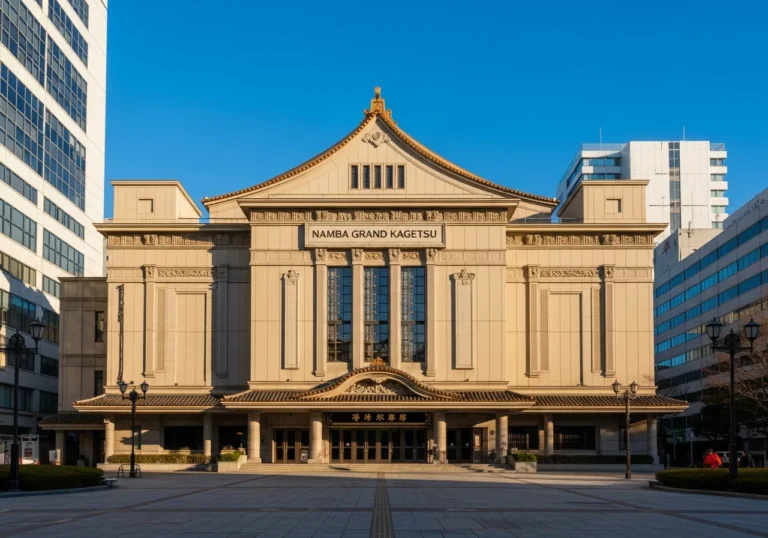
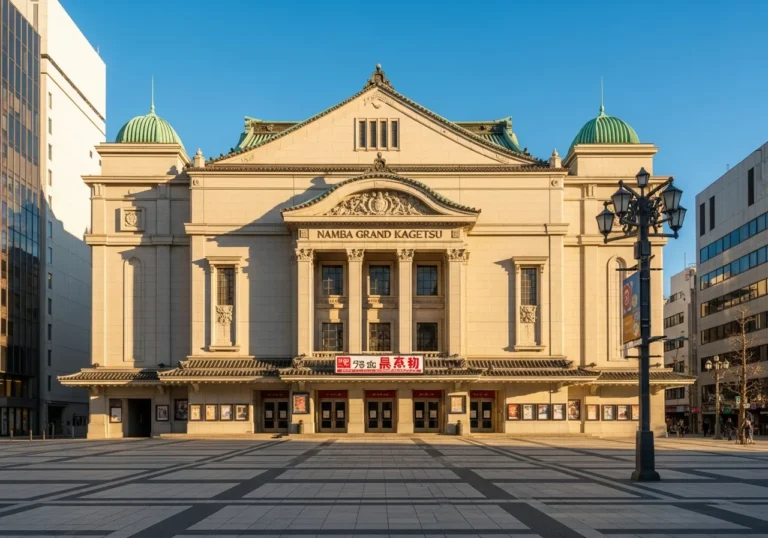
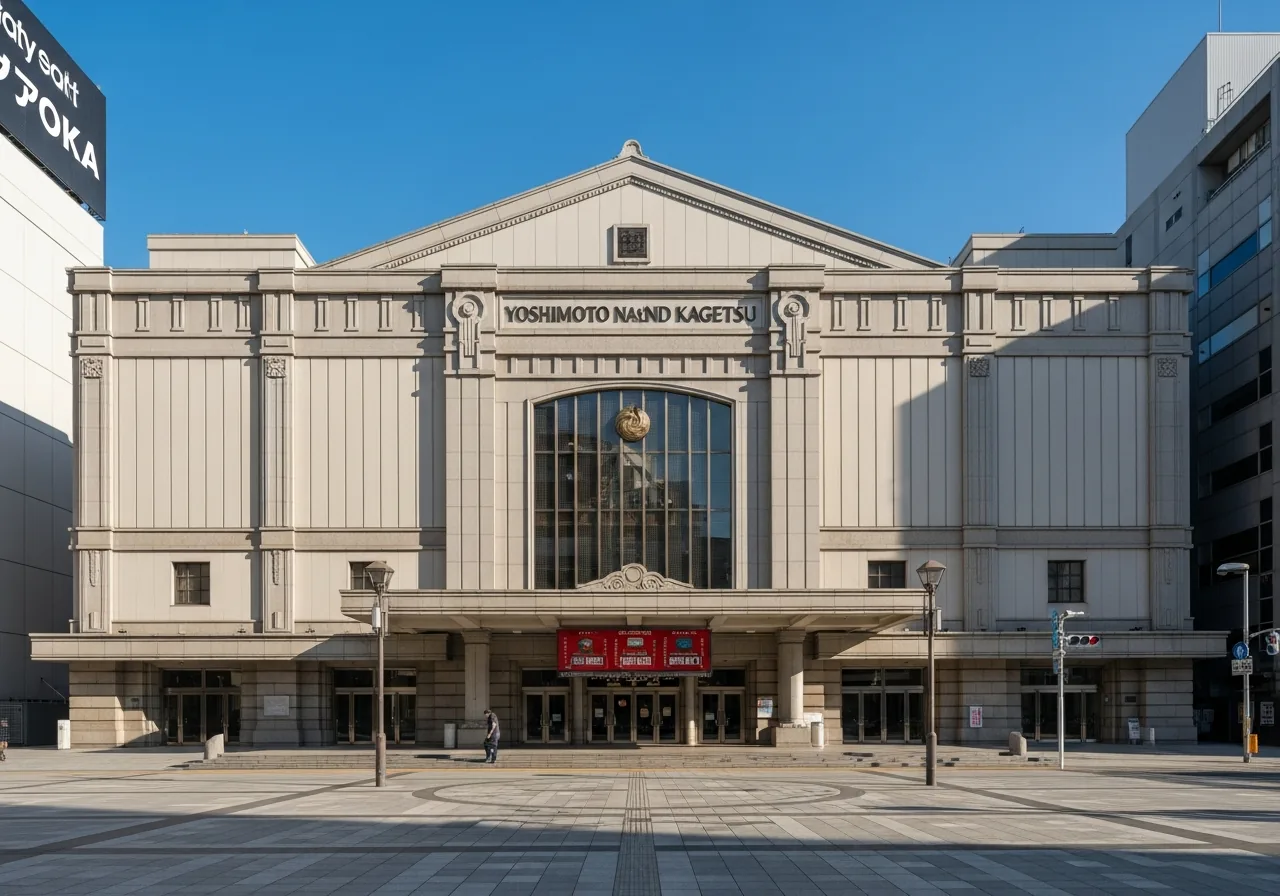
Yoshimoto Kogyo started out in 1912 by operating a comedy hall. The Namba Grand Kagetsu, which inherited that legacy and was opened in November 1987, continues to bring laughter to the world as a base for Yoshimoto Kogyo’s proud comedy culture.
With 858 seats, it is the largest comedy theater in Japan, and the retro-style interior creates a “good old Japan” atmosphere. In 2016, the number of annual visitors exceeded one million.
What the Namba Grand Kagetsu actually represents, understood historically, is the endpoint of a chain of decisions made by a woman who had no institutional support, no precedent, and no safety net. The building sits roughly where Sei’s southern expansion — the Namba district — anchored her empire in the 1910s and 1920s.
The performers on its stage are the inheritors of a talent-development system she designed. The manzai format they perform was standardized under her company’s management.
Even the word “manzai” in its current written form was coined by her company’s advertising department.
There is a deeper argument here about Osaka itself. The city’s identity as the comedy capital of Japan — the place where the Kansai dialect became synonymous with wit, where being funny is a social virtue rather than a frivolity, where people genuinely evaluate each other’s conversational skill — is not an accident of geography or temperament.
It is partly the product of institutional choices made by one company over more than a century. Although pure manzai is no longer the dominant form of entertainment in Japan, Yoshimoto’s influence remains, and the spirit of manzai lives on in modern Japanese comedy, as can be seen by the prevalence of the Kansai dialect in many owarai productions.
The Kansai dialect’s association with comedy is not natural; it was cultivated, amplified, and broadcast by Yoshimoto’s performers for generations until it became self-reinforcing.
For a traveler who wants to understand why Osaka feels the way it does — why strangers on the street are quicker to make a joke, why the city has a different social temperature from Tokyo, why laughter is treated here as a form of intelligence rather than a distraction from it — the answer begins with a twenty-two-year-old woman borrowing money to buy a failing theater in Tenma in 1912.
Sei Yoshimoto never appears in the standard Western accounts of Japanese modernization. She is not in the histories of Meiji business, not in the surveys of Taisho culture, not in the English-language literature on Japanese women’s history except in passing.
This is a failure of those accounts, not a reflection of her importance. She built something that outlasted her by three-quarters of a century and shows no sign of stopping.
Today, Yoshimoto Kogyo has become Japan’s largest entertainment agency, and its tarento are so popular that it is almost impossible to watch prime-time or late-night television without seeing one of them.
The comedy you watch on Japanese television tonight — the manzai duo trading insults in Kansai dialect, the sketch comedian doing a pratfall, the variety-show host whose timing is so precise it seems effortless — all of it flows through an institution that a widow built from borrowed money and sheer commercial intelligence, in a city that understood, better than anywhere else in Japan, that making people laugh was serious business.
Frequently Asked Questions
Q: Was Sei Yoshimoto the sole founder of Yoshimoto Kogyo, or did her husband Kichibei found it?
A: Both names appear in the official founding record — on 1 April 1912, Kichibei Yoshimoto and his wife Sei Yoshimoto purchased the Second Arts Building in Osaka — but the historical consensus, supported by Japanese-language biographical sources and the company’s own corporate history, is that Sei was the operational driver from the beginning. She arranged the financing, managed the theater, and after Kichibei’s death in 1924 ran the company alone.
The Wikipedia entry for Sei Yoshimoto designates her as the founder; the English-language Wikipedia entry for the company lists Kichibei. The discrepancy reflects a broader pattern of crediting male names to enterprises that women built.
Q: What is the Namba Grand Kagetsu, and is it worth visiting if you don’t speak Japanese?
A: The Namba Grand Kagetsu is an entertainment hall created by Yoshimoto Kogyo at 11-6 Namba Sennichimae, Chuo-ku, Osaka. Performances are held morning to night daily, featuring a diverse array of veterans and newcomers in manzai, rakugo, and the Yoshimoto Shinkigeki television program.
Non-Japanese speakers will miss the verbal comedy but can follow the physical comedy of Shinkigeki reasonably well. The building itself — its retro interior, its souvenir shops, its atmosphere of concentrated popular culture — is worth the visit as an experience of Osaka’s entertainment identity even without linguistic access to the jokes.
Q: What happened to Yoshimoto Kogyo after Sei’s death?
A: Her brothers Shonosuke and Hiroshi Hayashi ran the company through the postwar reconstruction and into the television era. Shonosuke Hayashi served as the 2nd, 4th, and 7th president of Yoshimoto Kogyo and had a profound influence on Japanese comedy until his death in 1991 at ninety-two.
The company went public, was taken private again in 2009, and restructured as a holding company in 2007. Today it manages approximately 6,000 performers and is part-owned by Japan’s major television networks.
Q: Where can I learn more about Sei Yoshimoto’s life in English?
A: The most accessible English-language entry point is the 2025 TV Asahi drama Hana Noren, based on Toyoko Yamasaki’s Naoki Prize-winning novel of the same name, which fictionalizes Sei’s life under the name Taka Kawashima. The novel itself has not been translated into English.
The Japan Times profile from 2001 provides a useful overview of the company’s history. For the corporate timeline in Japanese, Yoshimoto Kogyo’s official history page is the primary source.
Namba Grand Kagetsu — Visitor Information
Address: 11-6 Namba Sennichimae, Chuo-ku, Osaka 542-0075 / 〒542-0075 大阪市中央区難波千日前11-6
Nearest station: Kintetsu Nippombashi Station (Kintetsu Namba Line) — approx. 2 min walk; Namba Station (Nankai Line) — approx. 5 min walk
Hours: Performances run daily from morning to evening; specific show times vary. Check the official site for the current schedule.
Admission: Approx. ¥4,500–¥5,500 per performance (varies by show and seat type); confirm current pricing on the official site before visiting.
Official site: yoshimoto.co.jp/ngk