On August 25, 1958, a 48-year-old bankrupt entrepreneur named Momofuku Ando walked out of a ten-square-metre wooden shed in the Osaka suburb of Ikeda carrying the world’s first commercially viable instant noodle — a product that would eventually be consumed at a rate of more than 120 billion servings a year. The shed cost him almost nothing; the year of solitary, sleepless experimentation inside it cost him everything else he had, and the flash-frying technique he discovered there remains the foundational technology of a global industry now valued at roughly $64 billion.
Why we can tell you this — MICHI is written by an Osaka-based editorial team that can stand in Ikeda, walk the five minutes from Hankyu station to the site of Ando’s original backyard, and trace the exact streets near Osaka Station where he first watched people queue for black-market ramen in the ruins of 1946. This article draws on the official Nissin Foods corporate history, the CupNoodles Museum Osaka Ikeda‘s primary exhibition materials, reporting by Japan’s Government Online publication Highlighting Japan, the academic framing of George Solt’s The Untold History of Ramen (University of California Press), and contemporary food-industry data from the World Instant Noodles Association. Where the biographical record is contested — particularly around the precise date of Ando’s black-market encounter and the disputed question of whether a rival product preceded Chicken Ramen — we say so plainly rather than smoothing the ambiguity away.
The shed is gone. What stands in its place, on a quiet residential street in Ikeda, is a low-slung museum that draws visitors from across the world to stare at a faithful reconstruction of the original workspace: a rough wooden bench, a one-metre wok, a secondhand noodle-making machine, and the ghost of a man who slept four hours a night for a year and refused to stop until he had solved the problem of hunger.
That problem, and the specific chain of circumstances that made one particular man in one particular Osaka suburb the person to solve it, is what this article is about. Not the noodle itself — though the noodle is extraordinary — but the seven-layer deep answer to the question of why it exists at all.
Why Did Instant Ramen Need to Exist? The Hunger Behind the Invention
To understand Momofuku Ando, you have to understand what Osaka looked like in the winter of 1946. The city had been one of Japan’s primary industrial centres, and that made it a primary target. American firebombing raids over the course of the war had reduced vast swaths of the city to rubble, killing an estimated 10,000 civilians and destroying the factories and office buildings that Ando himself had constructed as business ventures.
Into this devastation came hunger on a scale that is difficult to comprehend from the vantage of 2026. Japan’s domestic rice production plummeted by 68.8% in 1945 due to wartime disruptions, drought, and crop failures, exacerbating malnutrition across urban and rural populations reliant on rationing systems that often failed amid black markets and hoarding. The government’s food distribution system was running approximately twenty days behind schedule, which in practice meant that many urban families simply did not eat.
Bombers from the United States had either destroyed or damaged over two million buildings, causing hordes of hungry Japanese citizens to be increasingly reliant on black markets for food. Within these sprawling urban black markets, ramen emerged as a critical part of Japanese cuisine.
The wheat that fed those black-market stalls came, paradoxically, from the occupying power. Post World War II, with the American military occupying the country, the food shortage was addressed by heavy importation of wheat into Japan.
Bread consumption between 1948 to 1951 increased from 262,121 tons to 611,784 tons. But the Japanese did not want bread.
They wanted noodles. Wheat was not only used for bread, but also found its way in ramen noodles which most Japanese ate at illegal market food stalls.
The political dimension of this wheat flood was not neutral. Ando wondered why bread was recommended instead of noodles, which were more familiar to the Japanese.
The Ministry’s response was that noodle companies were too small and unstable to satisfy supply needs, so Ando decided to develop the production of noodles by himself. That exchange — a bureaucrat’s dismissal, a businessman’s refusal to accept it — is the precise moment the instant noodle industry was born as a concept, even if the product itself would take another decade to materialise.
It was near Osaka Station, in the ruins of the black market district, that Ando witnessed the scene that would define the rest of his life. As Ando was passing by a black market area near Osaka Station one day, he happened to see people form a long line in the cold at a makeshift stall to wait for a bowl of ramen noodles.
The sight reminded Ando of how much Japanese people like noodles and at the same time filled him with conviction that the long line was a sign of enormous hidden demand. This experience became the catalyst for what would later be a groundbreaking invention.
The image lodged in him. He did not act on it immediately — he was a busy man with multiple businesses — but it did not leave him either. It waited, patient as hunger itself, for the moment when he would have nothing else left to do.
Why This Man? The Improbable Biography of Go Pek-Hok
Momofuku Ando was not Japanese by birth. He was not even, for most of his life, Japanese by citizenship.
Momofuku Ando was born as Go Pek-Hok on March 5, 1910, in what is now Chiayi County, Taiwan, then known as Kagi under Japanese rule. Hailing from a wealthy family with Hokkien roots, his early life was marked by loss.
Both of Ando’s parents died when he was a child, leaving him to be raised by his grandparents.
Those grandparents ran a small textiles shop, and from them Ando absorbed something more durable than any specific skill: the habit of commerce, the instinct that problems were also opportunities, and the understanding that a family business was a form of survival. His grandparents owned a small textiles store, which inspired him, at the age of 22, to start his own textiles company, using 190,000 yuan, in Daitōtei area in Taipei.
In 1933, he traveled to Osaka, where he established a clothing company while studying economics at Ritsumeikan University. He was twenty-three years old, studying in a foreign city, running a business simultaneously, and operating in a language that was not his mother tongue. The pattern of his life — multiple ventures, multiple failures, relentless forward motion — was already established.
Between his arrival in Osaka and his moment in the shed, Ando tried an extraordinary range of occupations. He made slide projectors, produced charcoal and salt, founded a school, and even served as a director for a credit union.
Each venture taught him something. Each failure cost him something.
The tax evasion conviction of 1948 — Ando was convicted of tax evasion in 1948 and served two years in jail. In his biography, Ando said he had provided scholarships for students, which at the time was a form of tax evasion — stripped him of his reputation and two years of his freedom.
He rebuilt.
Then came the catastrophe that finally pushed him into the shed. In 1957 a credit union where Ando was working as a director went bankrupt.
Ando lost all of his property except a rented house in Ikeda City, Osaka. Nevertheless, Ando cheered himself up with the thought that all he had lost was property and that the experience of failure had strengthened him.
He was forty-seven years old. He had been a textile merchant, a projector manufacturer, a salt producer, a school founder, a convicted tax evader, and a credit union director.
He had been wealthy and he had been ruined, more than once. What he had never been was a food scientist.
That, it turned out, was an advantage.
The credit union role was one he had been asked to take on by a friend; he would later recall his “bitter regret” at having gone into the finance business, which he knew little about to begin with. But the bankruptcy, as Ando framed it, was not an ending. Then, recalling the sight of the people forming a line at the black market ramen stall and the fact that noodles were a favorite food of the Japanese people, he resolved to create “Ramen that can be quickly prepared and eaten at home with only hot water.” This marked Ando’s first step toward realization of an idea he had been incubating for a long time in order to claw his way out of a life of poverty.
The outsider’s perspective mattered enormously. A trained food scientist would have known all the reasons why flash-frying noodles was impractical. Ando did not know those reasons, so he ignored them and kept experimenting until he found a way through.
Why Ikeda? Why a Backyard Shed?
The question of location is not incidental. Ikeda is a small city in the northern reaches of Osaka Prefecture, quiet and residential, the kind of place where a man with no factory and no investors could rent a modest house and build a wooden shed in the garden without attracting much attention. It was precisely the anonymity of the place that made it possible.
In the spring of 1958, Ando built a simple shed of less than 10 square meters in the backyard of his home in Osaka to serve as an instant noodle research laboratory. He obtained an old noodle-making machine, bought a wok with a diameter of 1 meter, along with ingredients like flour and edible oil, and immersed himself in the wooden shed, starting early and finishing late to conduct various experiments leading up to the creation of instant noodles.
The shed was not a laboratory in any formal sense. It was a workspace of radical simplicity: a bench, a wok, a machine, a man.
The shed was roughly 10 square meters, barely large enough for a stove, a workbench, and the man himself. His goal was deceptively simple: create a ramen that anyone could prepare at home by just adding hot water.
It had to be tasty, inexpensive, safe to store at room temperature, and ready in minutes.
Around 10 years later, when Ando was 47 years old, he recalled the sight of the ramen stall at the black market and decided to create “Ramen that can be quickly prepared and eaten at home with only hot water.” In a shed he built in the backyard of his home, he conducted non-stop development alone for an entire year, without taking a single day of rest and sleeping only four hours a night on average.
The constraints of the shed were also its discipline. There was no team to defer to, no committee to consult, no budget to request.
There was only the problem and the man. The development process faced two challenges that Ando had set himself as non-negotiable: the noodles must be capable of long-term storage, and they must be quick and easy to prepare.
Everything else was negotiable. The flavour, the shape, the packaging — all of that could be refined later.
First he had to solve the physics of preservation.
Why Flash-Frying? The Tempura Epiphany
The breakthrough, when it came, arrived not from a laboratory but from a kitchen. It is one of the great moments of accidental observation in food history, and it happened in Ikeda.
One day Ando went into the kitchen when his wife was deep-frying tempura and discovered a hint that led to the production technology that became the basis of instant noodles: flash-frying. By frying noodles in hot oil, the moisture in them is forced out by the high-temperature oil, making them nearly completely dehydrated.
This process made it possible to store the noodles at room temperature for up to six months. The reduction in moisture helped prevent the growth of bacteria that damages the noodles.
The physics of the insight are elegant. If he could flash-fry noodles in hot oil, the water would evaporate instantly, creating a porous structure throughout the noodle. When hot water was later added, it would rush into those tiny holes, rehydrating the noodles in minutes.
Ando developed the entire manufacturing process — from noodle-making, steaming and seasoning, to dehydrating the noodles in oil heat, a process now known as flash frying — creating what we now know as the first “instant” noodle.
He called the technique shunkan yuki kanso ho — “flash-frying dehydration” — and it was not merely a clever trick. It was a genuine technological innovation.
He called it “flash-frying dehydration” (shunkan yuki kanso ho), and it remains the foundational technology behind most instant noodles produced worldwide today. Nearly seventy years later, the basic principle Ando worked out in a ten-square-metre shed in Ikeda is still the engine of a global industry.
The seasoning question was equally deliberate. Ando understood from the beginning that he was not making a product for Japan alone.
Believing that the Asian flavor of soy sauce wouldn’t resonate with Western customers, he opted for the universal appeal of chicken soup, since chicken is eaten in almost every culture. This was not a culinary decision; it was a geopolitical one.
As Ando himself later reflected, chicken soup could cross religious and cultural borders that pork or beef could not. Ando would reflect on his decision to use chicken flavor, saying, “By using chicken soup, instant ramen managed to circumvent religious taboos when it was introduced in different countries.
Hindus may not eat beef and Muslims may not eat pork, but there is not a single culture, religion or country that forbids the eating of chicken.”
The man who had spent his career moving between Taiwan and Japan, between Chinese and Japanese identities, between multiple industries and multiple failures, had developed an instinct for universality. He knew how to make something that could belong to everyone.
Why Did It Succeed? The Collision of Product and Moment
On August 25, 1958, Chicken Ramen, the world’s first instant noodles, was launched. Since Chicken Ramen, a food ready to eat in just two minutes after adding hot water, was a product inconceivable under the conventional wisdom of the times, it was dubbed “magic ramen.” When Chicken Ramen was introduced, the price was ¥35 per serving.
The price was the first obstacle. At a time when the price of a bundle of udon noodles was ¥6, the owners of food wholesalers were reluctant to stock the product on the grounds that it wouldn’t sell.
Six times the cost of fresh noodles, from an unknown bankrupt, in a format nobody had ever seen before. The skepticism was rational.
But the skepticism missed what Ando understood: he was not selling noodles. Ando understood something others didn’t: he wasn’t selling noodles.
He was selling time, convenience, and reliability. In a rapidly modernizing Japan where people were working longer hours, instant ramen was a revelation.
Students could eat between classes. Factory workers could have a hot meal during breaks.
Families could feed their children quickly and affordably. Within months, Chikin Ramen became a sensation.
Production couldn’t keep up with demand. By 1959, Nissin Foods was producing 13 million packages annually.
The timing was not accidental. Chicken Ramen went on sale at just the time when the number of double-income households and nuclear families in Japan began to increase.
Instant noodles, which can be prepared simply by adding hot water and can be stored for long periods of time, were a boon to homemakers. In addition, the first supermarket had appeared in Japan the year before the release of Chicken Ramen.
The introduction of a Western-style distribution system completely different from the previous distribution model opened up a channel for high-volume sales of processed foods, including instant noodles.
Japan in 1958 was not the Japan of 1946. The economy was accelerating.
The dankai no sedai — the postwar baby boom generation — was entering the workforce. Cities were growing.
Women were entering paid employment in larger numbers. The nuclear family was replacing the extended household.
Each of these social shifts created a new kind of consumer: time-poor, cash-conscious, and living in a small apartment without the infrastructure for elaborate cooking. Ando had not merely invented a product.
He had invented the right product for a society in the process of becoming something new.
Chicken Ramen increasingly gained a reputation among the people who actually ate it as being tasty and convenient, and before long wholesalers were inundated with orders. In the end, Chicken Ramen became such a hit product that a long line of wholesaler trucks formed in front of the factory to wait for it to come off the production line.
The same wholesalers who had refused to stock the product were now queuing for it. August 25 is now officially celebrated in Japan as “Instant Ramen Day” (Insutanto Ramen no Hi), a recognition of the date that changed how the world eats.
The Patent Question and the Competitors
The story of Chicken Ramen’s primacy is not entirely without complication. As food historian George Solt notes in The Untold History of Ramen, a company called Matsuda Sangyō had debuted what Solt describes as “an identical product” three years earlier, under the name Aji Tsuke Chūka Men, or Flavored Chinese Noodles.
They never received a patent, though, and stopped making the product after a few months of weak sales. Where that company failed, though, Ando thrived.
The distinction matters. Invention and commercialisation are different acts.
Ando’s genius was not merely technical — it was entrepreneurial. He understood that a product nobody buys has not changed the world.
He took his invention directly to consumers through tasting events when wholesalers refused to stock it. He refined the flavour based on feedback.
He built a factory, registered a trademark, and in 1962 obtained the patent for the manufacturing process. Nissin Foods began to apply for trademarks and patents to the government, and in 1961 officially registered “chicken ramen” as a trademark, and obtained a patent for the manufacture of instant noodles the following year.
The patent, crucially, was later made public. In 1964, he made his patents public to promote industry standardisation.
This was a decision of extraordinary consequence: by releasing his intellectual property, Ando seeded an entire industry rather than merely protecting a single product. Competitors could now make instant noodles legally, which meant the category grew faster than any single company could have grown it alone.
The market Ando created was larger than the market he could have monopolised.
Why Cup Noodles? The Second Revolution
By the mid-1960s, Chicken Ramen was a domestic phenomenon but an international puzzle. In the mid-1960s, Japanese sales of his Chikin Ramen — and spinoff products like “Spagheny,” an instant spaghetti created in 1964 — declined, in part, because of market saturation. Ando then sought a new market for instant ramen: the United States.
The American market presented a problem that Ando had not anticipated. He had observed that Americans ate noodles by breaking the noodles in half, putting them into a paper cup, and pouring hot water over the noodles.
They also ate them with a fork instead of chopsticks. This was not ignorance or clumsiness on the part of American consumers.
It was a rational adaptation to a different material culture — one without the ceramic bowls and bamboo chopsticks that Japanese kitchens took for granted.
Ando’s response to this observation is the moment that separates a good inventor from a great one. Rather than insisting that the world adapt to his product, he adapted his product to the world.
Watching those Americans eat noodles from disposable cups, Ando realized his next invention would not be a better noodle. It would be a better container.
Ando was inspired, and felt that a Styrofoam cup — with a narrower bottom than the top — would be the ideal vessel for holding noodles and keeping them warm. Eating the noodles would then be as easy as opening the lid, adding hot water and waiting.
The engineering challenge was formidable. The noodle block had to be suspended in the middle of the cup — not resting at the bottom — so that hot water could circulate beneath it and rehydrate the noodles evenly.
The Styrofoam cup combined three functions: a packaging material, a cooking container, and an eating vessel itself. This was made possible by suspending the flash-fried noodles halfway in the upright Styrofoam container so that hot water can circulate thoroughly from below to cook the noodles evenly.
The assembly process required a manufacturing inversion. Ando’s team flipped the process on its head — literally.
In what became known as the “reverse engineering” method, the noodle block was placed on a platform, and the cup was lowered down over it from above, like a hat being placed on a head. This upside-down assembly meant the noodle block sat suspended in the middle of the cup rather than resting at the bottom — a positioning that turned out to have profound functional benefits.
The cup’s design was commissioned from Takeshi Otaka, the graphic designer who had created the logo for the 1970 Osaka World’s Fair. Otaka Takeshi, who created the logo for the Osaka 1970 world’s fair, designed the cup to look cosmopolitan and cutting edge, with large English words in a red psychedelic font above small Japanese words and with gold bands inspired by expensive dinner plates.
The design was deliberately international — it was not trying to look Japanese. It was trying to look like the future.
Launched on September 18, 1971, Cup Noodles revolutionised the food industry. The product was sold in over 100 countries within decades.
The cup had a pull-back lid inspired by a container of macadamia nuts Ando had eaten on his transpacific flight. Every element of the design had a story.
Nothing was arbitrary.
The marketing strategy for Cup Noodles in Japan was itself a cultural intervention. Nissin held tasting events in Japan to promote Cup Noodle and teach people how to eat it.
The most successful was held on November 21, 1971, in Tokyo’s Ginza shopping district. Notably, Nissin held its Ginza Cup Noodle event in front of Japan’s first McDonald’s, which had opened on the Pedestrian Paradise four months earlier, on July 20, 1971.
The juxtaposition was not accidental. Cup Noodles was positioning itself as Japan’s answer to American fast food — equally convenient, equally modern, but rooted in a flavour that was unmistakably its own.
Why Does the Scale Still Stagger? The Numbers Behind the Noodle
The statistics of instant noodle consumption are genuinely difficult to hold in the mind. Today, global demand for instant noodles has reached an all-time high of 123 billion servings per year. That is roughly sixteen servings for every human being on earth, every year, produced from a technology invented in a ten-square-metre shed in Ikeda.
According to the latest data, China is the largest consumer overall, devouring some 43,802 million packs per year — outslurping Indonesia (14,680 million servings) and India (8,320 million servings), the other two countries in the top three. But in terms of per capita, Vietnam’s love for the dish is unrivaled, with each citizen eating an average of 81 servings per year. South Koreans closely follow in second place at 79 servings, while Thailand rounds out the top three at 58 servings annually per person.
The growth in markets that Ando never visited is particularly striking. As per data published by the World Instant Noodles Association, consumption of these products witnessed a staggering growth of 53% in Nigeria, 160% in Kenya, 150% in Colombia, and 110% in Egypt during the period 2018 to 2022. The product that Ando designed to feed postwar Osaka is now feeding the urbanising populations of sub-Saharan Africa and Latin America — populations facing, in different forms, the same problem he identified in 1946: the need for a hot, filling, affordable meal that requires minimal infrastructure to prepare.
The industry Ando seeded is projected to grow from roughly $64 billion in 2025 to nearly $98 billion by 2032. Today, Nissin Foods is a global corporation with operations in over 20 countries and annual sales exceeding 700 billion yen. The company that began in a backyard shed now employs thousands of people across multiple continents.
And the original product? Chicken Ramen is still in production today, essentially unchanged.
The flat block of noodles, the faint golden color from flash-frying, the salty chicken broth that emerges when hot water hits the seasoned surface — it all tastes like 1958. In Japan, it holds a nostalgic status that no other instant noodle can touch.
Why Does Ando’s Story Belong to Osaka Specifically?
There is a temptation, when telling the story of a global product, to abstract it from its place of origin. Instant noodles are everywhere; why does it matter that they came from Ikeda?
It matters because Osaka is not an incidental backdrop to this story. It is the reason the story happened the way it did.
Osaka has been Japan’s commercial capital for centuries — the city of merchants, of kuidaore (eating until you drop), of a food culture that prizes practicality and flavour in equal measure. The city’s identity is built around the idea that food is not a luxury but a necessity, not a performance but a pleasure.
Ando absorbed that ethos.
He arrived in Osaka in 1933 as a young Taiwanese entrepreneur, and the city shaped him. He watched it burn during the war.
He watched it rebuild. He watched people queue for ramen in its ruins.
He built his shed in its suburbs. He launched his product from its streets.
The instant noodles were first produced and sold in Ikeda, Osaka, from a small factory after initial development in Ando’s backyard shed.
The connection between Ando and Osaka is also a connection between Osaka and the world. The city that gave Japan its commercial DNA gave the world its most democratic food. There is a directness to that lineage that feels right to anyone who knows this city — the same directness that produces takoyaki vendors who argue passionately about batter ratios, and ramen shops that open at 6am for workers who need a hot meal before a shift.
Ando’s own philosophy was explicit about this. The experience convinced him that “Peace will come to the world when the people have enough to eat.” That is not the philosophy of a food scientist. It is the philosophy of a merchant who has seen hunger and decided to do something about it — the philosophy, in other words, of Osaka.
Why Does Ando’s Taiwanese Identity Matter to the Story?
Ando’s biography is frequently simplified into a Japanese success story, but the full picture is more complex and more interesting. He was born Go Pek-Hok in colonial Taiwan, raised in a Hokkien Chinese family, educated partly in Japanese, and spent his adult life navigating between multiple cultural identities.
After World War II, Japan surrendered colonies and territories it occupied during its imperial expansion, and Taiwan was received by the Republic of China. Ando had to choose between becoming an ROC citizen or remaining a Japanese subject.
Ando chose the former in order to keep his ancestral properties on the island, as all Japanese nationals had to forfeit their properties in Taiwan. Nevertheless, in 1966, Ando naturalized through marriage and became a Japanese citizen.
This biographical complexity is not merely biographical. It shaped the product.
It was the unity of Ando’s Taiwanese entrepreneurial heritage and his integration into Japanese society that supported Japan’s national relief efforts and later catapulted instant noodles to international success. A man who had spent his life moving between cultures had an instinctive understanding of what could cross cultural borders and what could not.
His choice of chicken flavour, his design of the Cup Noodles packaging, his insistence on adapting the product to each market rather than demanding that each market adapt to the product — all of these decisions reflect the perspective of someone who has never had the luxury of assuming that his own culture is the default.
The instant noodle is, in this sense, a genuinely transnational invention: conceived by a Taiwanese-born man, developed in an Osaka suburb, launched into a Japan occupied by American forces, and carried to the world on a wave of US surplus wheat. It belongs to no single nation, which is precisely why it belongs to all of them.
Why Should a Discerning Traveller Care? The Deeper Significance
The CupNoodles Museum in Ikeda is easy to dismiss as a corporate vanity project — a theme park for a product that costs less than a dollar. That dismissal would be a mistake.
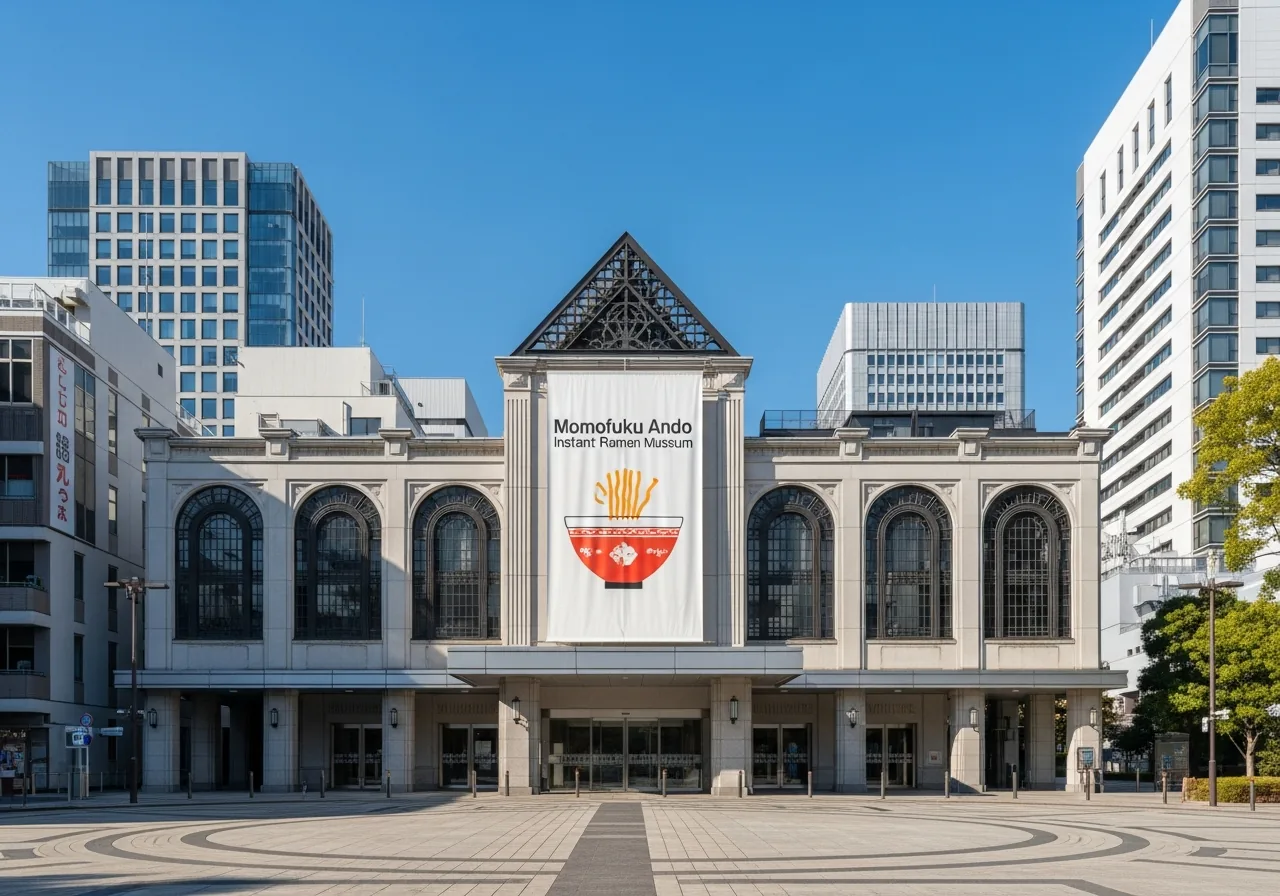
The CupNoodles Museum Osaka Ikeda, opened on November 21, 1999, serves as a primary memorial to Ando’s legacy at the exact site of his original backyard shed laboratory. This interactive facility recreates the modest shed where he conducted over a year of experimentation to perfect the world’s first instant noodles, allowing visitors to experience the invention process through hands-on exhibits.
What the museum actually offers — if you approach it with the right frame — is a case study in the relationship between individual will and historical circumstance. Ando did not invent instant noodles because he was a genius in a vacuum. He invented them because a specific set of conditions — postwar hunger, American wheat surpluses, a government bureaucracy that dismissed noodles in favour of bread, a personal bankruptcy that left him with nothing but time and a backyard — converged at a specific moment in a specific place, and he was the person standing at the intersection of all of them.
That is a story about how the world actually changes. Not through grand institutional programmes or well-funded research laboratories, but through individuals who refuse to accept that the problem in front of them is unsolvable.
Ando’s invention has been voted “the greatest Japanese innovation of the 20th century,” beating the CD, Pokémon, and the works of Akira Kurosawa. That vote — taken by Japanese citizens — says something important about what a culture values when it reflects on its own history.
The museum also offers something more tactile. At the “Chicken Ramen Factory” attraction, you can experience the process of making “Chicken Ramen” from kneading the wheat flour to drying the noodles with the “Instant Oil Heating Drying Method.” This is not a simulation.
You are performing, with your own hands, the same sequence of steps that Ando performed alone in his shed in 1958. The flour, the steam, the oil, the heat — the physics have not changed.
The experience of understanding a technology by doing it, rather than reading about it, is one that no amount of exhibition text can replicate.
For the traveller who has already done the temples and the castle and the Dotonbori food crawl, Ikeda offers something rarer: the chance to stand in the place where a single human decision changed the diet of the planet, and to understand, in some small physical way, how it was done.
Why Did Ando Keep Going? The Final Chapter
Ando did not retire after Cup Noodles. He did not slow down after the international expansion of the 1970s and 1980s. He continued working, continued innovating, and continued eating instant ramen every day of his life — a habit he maintained until his death.
The final chapter of his career was, in its way, the most extraordinary. Ando, who never lost his enthusiasm for product development even in his declining years, was 91 years old when he declared that the company would develop space food.
He formed a project team that he himself headed and began development. The team perfected Space Ram, instant noodles to be consumed in space, coming up with ingenious ideas such as thickening the soup to prevent it from escaping in zero gravity and making noodles in a size and shape to be eaten in a single bite.
In the end, however, the technology that became the foundation of product development was the flash-frying process that Ando discovered in 1958. The Space Ram project attested that instant noodles is an excellent food that has met needs from the time of its development into the space age.
Astronaut Soichi Noguchi enjoying Space Ram aboard the space station. Space Ram journeyed into space in July 2005 aboard the space shuttle Discovery.
The man who had watched people queue for ramen in the ruins of Osaka lived to see his invention eaten in orbit. He was ninety-four years old when the shuttle launched.
He died eighteen months later, on January 5, 2007, of heart failure, in Ikeda — the same city where he had built his shed nearly fifty years before. From 1964 until 2007, when he passed away at age 96, Momofuku Ando wrote his New Year’s resolutions in writing brush on these plaques.
The last one, written in the final weeks of his life, expressed the same ambition as the first: to make food that serves the world.
Nearly seven decades later, Nissin says the group’s business decisions are still heavily directed by Ando’s founding principles: “Peace will come to the world when there is enough food”; “Create foods to serve society”; “Eat wisely for beauty and health”; and “Food-related jobs are a sacred profession.”
These are not the slogans of a corporation. They are the convictions of a man who had been hungry, who had watched others be hungry, and who had decided that hunger was a problem he could solve.
He was right. The shed in Ikeda was where he proved it.
Frequently Asked Questions
Q: When and where exactly was instant ramen invented?
A: In 1958, Momofuku Ando invented the world’s first instant noodles, “Chicken Ramen,” after an entire year of research using common tools in a shed he had built in his backyard in Ikeda-city, Osaka Prefecture. The precise launch date was August 25, 1958.
Q: What was the key technical breakthrough?
A: Ando developed the production method of flash frying noodles after they had been made, creating the “instant” noodle. This dried the noodles and gave them a longer shelf life, even exceeding that of frozen noodles. The technique was inspired by watching his wife fry tempura.
Q: How much did Chicken Ramen cost when it launched, and why was that controversial?
A: Each noodle block was pre-seasoned and sold for 35 yen. Initially, due to its price and novelty, Chikin Ramen was considered a luxury item, as Japanese grocery stores typically sold fresh noodles for one-sixth their price. Consumer demand eventually overwhelmed the skepticism of wholesalers.
Q: How did Cup Noodles come about?
A: During a business meeting on a trip to the United States in 1971, Ando observed business managers breaking the noodle block into smaller pieces, putting it in a cup with hot water, and then eating it with a fork. Instead of being offended, he saw the need to adapt to cultural differences while making his ramen more accessible and convenient. Back home, it inspired him to invent CupNoodles — pre-packaging his instant noodles into a waterproof styrofoam cup.
Q: How large is the global instant noodle market today?
A: Today, global demand for instant noodles has reached an all-time high of 123 billion servings per year. The industry is projected to grow from roughly $64 billion in 2025 to nearly $98 billion by 2032, driven by urbanisation and demand for affordable convenience food across Asia, Africa, and Latin America.
Q: Is the CupNoodles Museum in Ikeda free to visit?
A: General museum admission is free. There is a fee for experiences: advance reservations are required for the “Chicken Ramen Factory” (1,200 yen for junior high school students and above, 600 yen for elementary school students).
No reservations are required for “My Cup Noodle Factory” (numbered tickets distributed on the day) at 500 yen per meal. Confirm current pricing on the official site before visiting.
CupNoodles Museum Osaka Ikeda — Visitor Information
Address: 8-25 Masumi-cho, Ikeda-shi, Osaka 563-0041 / 〒563-0041 大阪府池田市満寿美町8-25
Nearest station: Ikeda Station (Hankyu Takarazuka Line) — approx. 5 min walk. From Hankyu Osaka-Umeda Station, take the express to Ikeda (approx. 20 min).
Hours: 9:30–16:30 (last admission 15:30); closed Tuesdays (or Wednesday if Tuesday is a public holiday). Hours may vary — confirm on the official site.
Admission: Free (general museum). Chicken Ramen Factory: approx. 1,200 yen (advance reservation required). My CupNoodles Factory: approx. 500 yen per cup (no reservation needed; numbered tickets on the day). Prices approximate — advise confirming on the official site.
Official site: cupnoodles-museum.jp