When the Dojima Rice Exchange was dissolved in 1939 and absorbed into Japan’s wartime controlled economy, it did not erase Osaka’s claim on the world’s financial imagination — it merely paused it. The institution that replaced it, the Osaka Stock Exchange, founded in June 1878 by the samurai-turned-entrepreneur Tomoatsu Godai, had already been running for sixty years, quietly translating three centuries of rice-futures expertise into the grammar of modern equity markets. By 1990, the exchange’s derivatives floor was briefly the largest futures market on earth — a fact almost no one outside the industry remembers, and that almost every serious investor should.
Why we can tell you this — MICHI is written and edited in Osaka, and the Kitahama financial district — where the exchange’s cylindrical white dome still anchors the riverfront — is a neighbourhood we walk through regularly. This article draws on the Japan Exchange Group’s own published institutional history at jpx.co.jp, the Osaka Dojima Exchange’s official heritage documentation at odex.co.jp, the National Diet Library’s biographical record of Godai Tomoatsu, the Osaka Tourism Bureau’s architectural and historical materials at osaka-info.jp, and the Osaka Chuo Ward heritage panel series. The history of the exchange’s wartime consolidation and postwar reconstitution is well-documented; the precise internal deliberations behind the 2013 JPX merger are less so, and we have relied on publicly available regulatory filings and contemporary financial reporting rather than claiming access to internal records.
Stand at the corner of Kitahama and Sakaisuji on any weekday morning and you will see the building before you understand it. The dome is white, cylindrical, almost Roman in its self-assurance, and it rises from a twenty-four-storey tower that was grafted onto its back in 2004 like a glass-and-steel parasite.
In front of the entrance, cast in bronze, a man in Meiji-era dress looks out across the Tosabori River with an expression that manages to be both visionary and slightly impatient. That is Tomoatsu Godai.
He has been waiting there since 1990, and he has reason to look satisfied: the institution he founded in 1878 has outlasted empires, asset bubbles, and two attempts by Tokyo to absorb it entirely.
The story of the Osaka Stock Exchange is not simply the story of a building or a market. It is the story of a city’s financial identity — how Osaka turned a rice-pricing mechanism into a securities exchange, how that exchange briefly ruled the global derivatives world, and how it survived being merged out of existence to emerge, paradoxically, as Japan’s sole dedicated futures hub. To understand why any of that happened, you have to go back much further than 1878.
Why Did a Rice Market Become the World’s First Futures Exchange?
The Japanese economy grew rapidly throughout the seventeenth century, culminating in the Genroku period (1688–1704), during which merchants prospered like never before. It was at this time that rice brokers and moneychangers gathered their shops and warehouses in the Dōjima area, and the Rice Exchange can be said to have been established in 1697, the year it received a license from the shogunate.
The structural reason for Dojima’s existence was a fiscal contradiction built into the Tokugawa state. Members of the samurai class, including daimyō, were paid in rice, not cash, so the rice brokers and moneychangers played a crucial and incredibly profitable role in the emerging early modern economy. Over the course of the Edo period, the entire economy would not only shift from rice to coin, but would also see the introduction and spread of paper money initiated and facilitated by the men of Dōjima.
Someone had to bridge the gap between a tax system denominated in grain and a commercial economy increasingly denominated in coin. The merchants of Dojima became that bridge — and in doing so, they invented instruments that would not appear in Western markets for another century.
In 1730, the Tokugawa shogunate authorized a spot market to trade rice bills and a futures market to trade representative brands of rice in Dojima. This marked the inception of an official market known as the Dojima Rice Exchange, which was equipped with a membership system and clearing function similar to exchanges in the modern era and is widely known as the forerunner to organized futures exchanges in the world.
The mechanics were sophisticated. Securities called “rice bills,” issued in exchange for the rice, were traded actively — rice was, in effect, securitized.
These rice bills also covered unharvested rice, and trading participants could trade futures by contract for difference simply by preparing a margin called “shikigin.” This is not a loose analogy to modern derivatives. It is the same instrument, operating on the same logic, 118 years before the Chicago Board of Trade opened its doors.
Tours of the Chicago Board of Trade, a pioneering futures exchange first opened in 1848, cite the Japanese market’s legacy. The intellectual lineage is direct: the rules, customs, and functions in Dojima form the basis of those in modern exchanges, and the CBOT is said to have been developed based on the Osaka Dojima market.
Why Here, in Osaka, and Not Edo?
The question of geography matters. Edo was the political capital; Osaka was the commercial one.
In the Edo period, most of the rice collected by feudal domains as tax was transported to major cities such as Osaka. Feudal domains sold tax rice stored at kurayashiki — combined warehouses and residences — around Nakanoshima to rice brokers through auctions and issued rice bills to successful bidders.
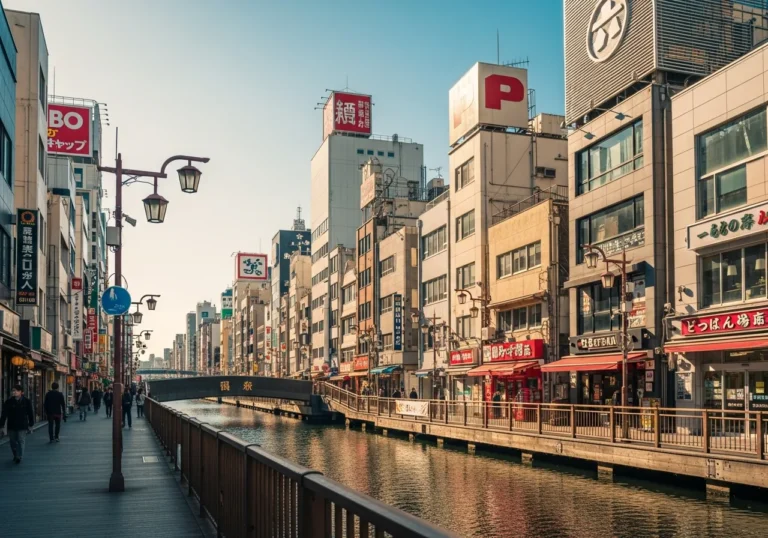
Nakanoshima, the river island that still sits between the Dojima and Tosabori rivers a short walk from where the exchange stands today, was essentially a national clearing house. Every domain in Japan had a warehouse there.
The physical geography — a city of waterways, accessible by sea from the entire western coast of Honshu — made Osaka the natural terminus for rice flowing from the provinces. Where the rice went, the money followed.
Where the money went, the instruments for pricing it followed.
The Osaka merchants developed an increasingly monopolistic grasp on the rice trade, determining prices not only within Osaka but in the entire Kinai area, and indirectly having a great effect on prices in Edo. This was not merely commercial dominance. It was informational dominance — and the exchange’s operators understood that price information was itself a commodity worth transmitting at speed.
Early on, dedicated couriers called kome bikyaku conveyed information to and from merchants in different economic centers. Although speedier than other types of courier services, they still took many hours to relay information from Dōjima to neighboring rice exchanges. Telescopes had been introduced in Japan in the 1600s, and flag-waving communication arose from the demand for even quicker transmission of information, utilizing the technology to rapidly send market prices and other news over long distances.
A semaphore network, built by rice brokers, stretching from Osaka into the mountains of Nara — this is the infrastructure that preceded the telegraph. The Dojima exchange did not merely invent futures contracts. It invented the information architecture that makes markets function.
Why Did the Rice Exchange Die, and What Replaced It?
The Dojima Rice Exchange did not fall to a single blow. It was eroded by the same forces that eroded the Tokugawa order itself: the arrival of Western capital, the Meiji Restoration of 1868, and the state’s decision to rebuild Japan’s economy on industrial rather than agricultural foundations.
The nineteenth century marked a significant evolution from commodity-focused exchanges to securities trading, driven by Japan’s rapid modernization following the Meiji Restoration. As the feudal system gave way to a capitalist economy, rice and crop markets in Osaka began incorporating elements of stock trading, reflecting broader shifts toward industrial development and foreign influence.
The man who made the transition concrete was Tomoatsu Godai — and understanding him is essential to understanding why the exchange exists at all in its modern form.
Godai Tomoatsu (五代 友厚, February 12, 1836 – September 25, 1885) was a samurai-born entrepreneur and economic pioneer who drove Osaka’s industrialization in the early Meiji era. His biography reads like a novel. Originating from a samurai family in Kagoshima of the Satsuma domain, he studied naval training at the Kaigun Denshujo in Nagasaki starting in 1857 and later led a clandestine group of Kagoshima students to Europe in 1865 to study Western technologies amid Japan’s Bakumatsu-era isolation.
What Godai saw in Europe — the stock exchanges of London and Paris, the industrial infrastructure of Britain, the organized capital markets that were funding railways and factories — convinced him that Japan needed the same institutions. Under the new government after the Meiji Restoration, he successively served as a junior councilor and judge of the foreign affairs office before resigning from government office in 1869 to start a new life as an entrepreneur based in Osaka.
He chose Osaka deliberately. The city had the commercial culture, the merchant networks, and the institutional memory of Dojima.
What it lacked was a formal securities market capable of channeling capital into the new joint-stock companies the Meiji state was creating. In 1878, Godai established the Osaka Stock Exchange and Commercial Meeting Hall, and later the Osaka Commercial Training School, contributing in these and other ways to the expansion and modernization of business activities in Osaka.
This transition culminated in the enactment of Japan’s first Stock Exchange Regulation in May 1878, which provided the legal framework for formal securities markets. On June 1, 1878, the Osaka Stock Exchange Co., Ltd.
was established. The Tokyo Stock Exchange opened the same month — but it was Osaka, with its deeper commercial roots, that moved faster into equity trading.
This commodity trading heritage evolved into the modern OSE with the establishment of the Osaka Stock Exchange Co., Ltd. in June 1878, which began equity trading in August of that year and introduced share listings by June 1879.
The JPX’s own institutional history, published at jpx.co.jp, frames this transition plainly: “The origin of securities exchanges stems from the Edo period, when the exchange for rice and crop was established in Osaka, center of Japanese economy.” The new exchange did not replace Dojima so much as translate it — the same city, the same riverfront, the same instinct for pricing risk, now applied to cotton, silk, and eventually industrial shares.
Godai died in 1885, at forty-nine, of diabetes. He had founded the Osaka Stock Exchange, the Osaka Chamber of Commerce, and the Osaka Commercial Training Institute — later the Osaka University of Commerce — contributing to the economic development of Osaka.
The bronze statue outside the exchange is not merely decorative. It marks the spot where one man’s encounter with European capitalism was translated into permanent institutional form.
Why Did the Exchange Survive the Wars That Destroyed Everything Else?
The twentieth century was not kind to Japanese financial institutions. The exchange that Godai built was tested by the Great Kanto Earthquake of 1923, the global depression of the 1930s, and finally by the Pacific War — which did not merely damage the exchange but legally abolished it.
In June 1943, the exchange became the Osaka Division of the Japan Securities Exchange during the Pacific War. Japan Securities Exchange suspended operations in August 1945, and was dissolved in April 1947.
For two years after Japan’s surrender, there was no formal securities market in Osaka at all. The Allied occupation forces had suspended trading; the institutional framework of prewar finance was being dismantled.
The building itself — the magnificent cylindrical structure completed in 1935 that still defines the Kitahama skyline — survived the war physically intact, which is remarkable given what American bombing did to the surrounding city. Its magnificent cylindrical white exterior and beautiful stained-glass entrance lobby are distinctive features; completed in 1935, it was designed by the Hasebe Takekoshi Architects.
The 1935 building replaced an earlier brick structure completed in 1911, which itself had replaced the original 1878 exchange. Each generation of the building was more ambitious than the last — a physical record of the institution’s growing confidence.
The postwar reconstitution was swift by the standards of institutional rebuilding. The Osaka Securities Exchange was re-established on April 1, 1949, as part of Japan’s postwar financial reforms aimed at reconstructing the securities market under the oversight of the Allied occupation forces. Equity trading commenced in May 1949, initially focusing on cash market operations.
Why did Osaka get its own exchange back, rather than simply becoming a branch of Tokyo? The answer is partly political — the occupation authorities wanted to distribute financial power rather than concentrate it — and partly practical.
Osaka had the brokers, the infrastructure, and the institutional memory. The city’s commercial culture had not been bombed out of existence.
In the early Edo period, this area was home to a rice market and a gold exchange market, and thrived as a financial center where money changers, rice wholesalers, and rice brokers gathered. After the Meiji Restoration, the Osaka Stock Exchange was built by Tomoatsu Godai on the site of the gold exchange market, and the Kitahama area developed as a financial district centered around the exchange.
Three centuries of commercial geography do not dissolve in a decade of war.
Why Did Osaka Briefly Rule the World’s Derivatives Markets?
The most astonishing chapter in this institution’s history is also the least known outside specialist circles. For two years — 1990 and 1991 — the Osaka Securities Exchange was the largest futures market on earth.
Not the largest in Asia. The largest anywhere.
To understand how that happened, you need to understand what Japan’s economy was doing in the 1980s. The Nikkei 225 index, tracking Japan’s 225 most liquid listed companies, had grown sixfold during the decade.
During the Japanese asset price bubble, the average hit its bubble-era record high on 29 December 1989, when it reached an intraday high of 38,957.44, before closing at 38,915.87. Japanese companies were, briefly, worth more than American ones.
The Tokyo Stock Exchange at its peak accounted for over 60 percent of the world’s stock market capitalization.
In that environment, institutional investors needed instruments to hedge their equity exposure. Osaka provided them.
Institutional investors began to demand hedges against price fluctuations in their stock holdings. In response, Osaka Stock Exchange launched Nikkei 225 Futures in September 1988 and Nikkei 225 Options in 1989.
The timing was not accidental. The Nikkei 225 Futures had been introduced at Singapore Exchange in 1986, the Osaka Securities Exchange in 1988, and Chicago Mercantile Exchange in 1990.
Singapore moved first — a fact that stung Osaka’s pride and accelerated the domestic launch. When OSE finally listed the contract, it had the advantage of being the home market: Japanese institutional investors preferred to trade in yen, in their own time zone, on their own exchange.
The result was explosive. In its first three years, Nikkei 225 Futures surpassed the Chicago Mercantile Exchange S&P 500 Futures to become the world’s largest futures contract.
In contrast to the Tokyo Stock Exchange, which mainly dealt in spot trading, the Osaka Securities Exchange’s strength was in derivative products. The OSE was the leading derivatives exchange in Japan and it was the largest futures market in the world in 1990 and 1991.
This was not a fluke. It was the direct consequence of three centuries of institutional evolution.
Dojima had invented the futures contract; the Meiji-era exchange had translated that expertise into equity markets; the postwar exchange had rebuilt the infrastructure; and the 1988 derivatives launch had given the world’s largest equity bubble a hedging instrument calibrated precisely to its needs. The chain of causation runs unbroken from 1697 to 1990.
Why Did the Bubble’s Collapse Not Destroy the Exchange?
The Nikkei subsequently lost nearly all its bubble-era gains, reaching a post-bubble intraday low of 6,994.90 on 28 October 2008 — 82 percent below its peak nearly nineteen years earlier. The collapse of the asset bubble in the early 1990s was catastrophic for Japanese finance broadly. Banks failed, property values imploded, and the “Lost Decade” — which turned into two lost decades — began.
But the exchange survived, for a reason that is counterintuitive: derivatives markets are most valuable precisely when prices are falling. When Japan’s bubble burst in the early 1990s, futures contracts were instrumental for global investors seeking to manage downside exposure to Japanese equities.
The same instrument that had served as a speculative vehicle during the boom became a hedging vehicle during the bust. Volume remained high because the need for risk management remained high.
According to statistics from 2003, the Osaka Securities Exchange handled 59 percent of the stock price index futures market in Japan, and almost 100 percent of trading in the options market. Even in the depths of Japan’s postbubble stagnation, Osaka’s derivatives franchise was essentially a monopoly. That monopoly would prove to be both the exchange’s greatest asset and the reason Tokyo eventually came for it.
Why Did the Exchange Merge with Tokyo — and What Did Osaka Lose?
The 2013 merger between the Osaka Securities Exchange and the Tokyo Stock Exchange to form the Japan Exchange Group is usually described as a rationalization — two exchanges doing overlapping things, combining to cut costs and compete globally. That framing is accurate but incomplete. It obscures a more uncomfortable truth: Osaka’s equity market was absorbed by Tokyo, and what remained in Osaka was the derivatives franchise that Tokyo had never managed to build.
Created by the merger of the equities-dominated Tokyo Stock Exchange and the derivatives-focused Osaka Securities Exchange on 1 January 2013, the new exchange group was promoted partly for political reasons in Japan, as the country’s political leadership sought to revitalise trading volumes by creating a combined derivatives and equities market that would allow for cost synergies and more cross-asset trading opportunities, as well as attract international investors.
The mechanics of the merger were precise. In January 2013, Japan Exchange Group was formed through a merger between Tokyo Stock Exchange Group and Osaka Securities Exchange. On July 16 of the same year, the markets for trading stocks and other cash equities were integrated into Tokyo Stock Exchange, and on March 24, 2014, the markets for trading futures and other derivatives were integrated into Osaka Exchange.
Read that carefully. Osaka gave up its equity market — the listed companies, the cash trading, the 477 listed firms that had made it Japan’s second-largest bourse.
In return, it received something more durable: the exclusive mandate to run all of JPX’s derivatives trading. Osaka Exchange merged its cash-equity trading platforms with the Tokyo Stock Exchange in July 2013, which added 1,100 stocks to the Tokyo Stock Exchange, making it the third biggest bourse by listed companies.
Osaka Exchange serves as the primary listed derivatives market for JPX.
The irony is structural. Since merging with the Tokyo Stock Exchange in 2013 and becoming part of the Japan Exchange Group, the Osaka Exchange has inherited the Dojima DNA and specializes in futures and options trading.
The institution that began as a rice futures market in 1697 is now, in 2026, a pure derivatives exchange. The circle is complete — though it took 316 years to close.
What Osaka lost is harder to quantify than what it gained. The city no longer has a stock exchange in the conventional sense.
Companies list in Tokyo. The equity market that Godai built, that survived two world wars and a catastrophic asset bubble, now operates from Nihonbashi.
Today, despite its name, trading for the Osaka Stock Exchange takes place in Tokyo. That sentence, from the Wikipedia entry on the Osaka Exchange, carries a weight that its matter-of-fact tone does not acknowledge.
Why Does the Building Still Matter — and What Does It Tell You About Osaka?
The building at 1-8-16 Kitahama, Chuo-ku, is doing something unusual for a financial institution: it is being honest about its own history. Most exchanges hide their past behind glass and steel. This one preserved its 1935 dome when the tower was rebuilt in 2004, and it opens the resulting space to the public.
The magnificent white cylindrical exchange completed in 1935 was reborn in 2002 as a high-rise building with 24 floors above ground and two below, but the facade of the old exchange building has been preserved. The dome’s interior — the circular entrance hall with its original stained glass — was faithfully recreated.
The former Osaka Securities building, built in 1935, deteriorated and was replaced with a 24-storey high-rise building. It inherited the dome facade, which was a symbol of the former building, and the securities plaza inside the dome.
Both wings of its external facade were faithfully reproduced to resemble the original.
The OSE Gallery, on the fifth floor, is open to the public on weekdays without reservation. The OSE Gallery, the western base of the Japan Exchange Group, is a facility where you can learn about securities markets such as stocks and futures, and is open to the public.
The exhibits trace the full arc from Dojima to the Nikkei 225 mini contract. It is one of the few places in Osaka where financial history is presented as the serious intellectual subject it deserves to be.
Outside, the Godai statue has become something of a pilgrimage site since an NHK morning drama dramatized his life. A statue of Tomoatsu Godai, a late-Edo-era entrepreneur who became well known through an NHK morning drama, stands here and has made the building a sightseeing spot — many visitors come after taking interest through the drama.
Godai is credited with involvement in establishing various institutions in Osaka. The drama brought tourists; the history rewards them.
The Kitahama district itself is worth understanding as a landscape. In the early Edo period, this area was home to a rice market and a gold exchange market, and thrived as a financial center where money changers, rice wholesalers, and rice brokers gathered.
The streets between the exchange and the Tosabori River still carry that density — securities firms, bank branches, the occasional old merchant building surviving between glass towers. It is not a preserved historic district in the museum sense.
It is a working financial neighborhood that happens to be three centuries old.
The Osaka Chuo Ward heritage panels installed in the area describe Kitahama as “the financial heart of the city” — a designation that has been accurate, with brief interruptions, since the 1650s. No other district in Japan can make that claim with the same continuity.
Why Should a Discerning Traveler Care About a Derivatives Exchange?
The honest answer is that you should care because the Osaka Exchange is evidence of something that guidebooks consistently underestimate about this city: Osaka’s commercial culture is not a charming quirk. It is a sophisticated, centuries-long project of institutional innovation that shaped the global financial system.
The futures contract — the instrument that underlies every commodity hedge, every currency swap, every interest rate derivative traded anywhere on earth today — was not invented by Wall Street or the City of London. It was invented by rice merchants on the north bank of the Dojima River, in a city that the Tokugawa shogunate had designated as the nation’s commercial capital precisely because it understood that commerce required its own geography.
Osaka is characterised by the history of the Dojima Rice Market, widely known as the origin of Japanese exchanges and the pioneer of organised futures exchanges in the world, as well as the current Japan-US Futures Exchange. The Osaka Exchange is the centre of listed derivatives in Japan today.
That continuity — from 1697 to 2026, from rice bills to Nikkei 225 micro futures — is not a marketing claim. It is a verifiable institutional lineage, documented in the exchange’s own records and in the academic literature on financial history.
For the traveler who comes to Osaka for the food, the castle, the neon of Dotonbori: all of that is real and worth your time. But the city that produced takoyaki also produced the world’s first futures exchange, and the building where that lineage terminates is a ten-minute walk from Yodoyabashi Station.
The stained glass in the dome is original. The bronze man outside built the institution that stands behind it.
The gallery on the fifth floor will show you, in English, exactly how a rice bill became a Nikkei futures contract.
That is a story worth an hour of your afternoon.
What Happens Next — and Why It Matters That It Happens in Osaka
The Osaka Exchange is not a museum. As of July 2026, it is an active, evolving institution.
The Nikkei 225 mini, launched in July 2006, ranked number one in the Asia-Pacific region and fourth largest trading volume in stock index futures worldwide as of 2021. Foreign investors now dominate the market: foreign investors account for more than 70 percent of trading volume in Nikkei 225 futures, both large and mini.
The exchange has also been expanding its product range. On October 1, 2019, JPX acquired Tokyo Commodity Exchange, Inc., making it a wholly-owned subsidiary and marking the group’s entry into commodity derivatives trading.
This acquisition integrated TOCOM’s precious metals, energy, rubber, and agricultural products under JPX’s umbrella, with subsequent transfers of non-energy commodities to Osaka Exchange in July 2020. Gold, silver, rubber, oil — commodities that Dojima’s merchants would have recognized as tradeable assets — are now part of the Osaka Exchange’s portfolio.
Meanwhile, a few blocks away in the Dojima district itself, the institution that carries the rice exchange’s direct name has been reconstituted. In August 2021, the corporate name became “Dojima Exchange Co.” After receiving a two billion yen investment from eight companies including SBI Holdings, the company was reorganized into a joint-stock corporation.
On August 13, 2024, ODEX listed Dojima Rice Average futures, Japan’s first-ever rice futures price index, linked to the Dojima Rice Average published monthly on the ODEX homepage. Rice futures, in Dojima, in 2024.
The Osaka Dojima Exchange describes itself as the direct heir to the 1730 market — and the claim is not unreasonable.
There is also a monument at the original Dojima site. The Osaka Exchange has installed a new monument, “A Grain of Light,” at the former site of the Dojima Rice Market, with a dedicated website in thirteen languages set up to make it known to as many people as possible.
The monument is modest — a rice-grain-shaped stone, as described by Nippon.com — but its placement is precise. It marks the spot where the global derivatives market began.
The question of what Osaka’s financial future looks like is genuinely open. The city has been pushing, with varying success, to establish itself as an international financial center — a project that the national government has supported as part of a broader effort to attract foreign capital to Japan.
The Osaka Exchange’s derivatives franchise is the strongest argument in that case. You cannot build a financial center from scratch; you can only cultivate one that already exists.
Osaka’s has been growing since 1697.
Frequently Asked Questions
Q: Is the Osaka Exchange the same as the Dojima Rice Exchange?
A: They are institutionally related but legally distinct. The Dojima Rice Exchange operated from 1697 to 1939, when it was dissolved into Japan’s wartime controlled economy.
The Osaka Stock Exchange was founded separately in 1878 by Tomoatsu Godai, and it inherited Dojima’s commercial geography and expertise. Since the 2013 merger with the Tokyo Stock Exchange to form Japan Exchange Group, the Osaka Exchange has been the JPX’s dedicated derivatives arm — a role that mirrors Dojima’s original function as a futures market.
Q: Can visitors enter the Osaka Exchange building?
A: Yes. The OSE Gallery on the fifth floor is open to the public on weekdays (Monday to Friday, excluding national holidays and New Year holidays) from 9:00 to 16:30, with admission until 16:00.
No reservation is required for individual visitors; groups of ten or more should contact the exchange in advance. The stained-glass lobby and the circular entrance hall of the 1935 building are also accessible.
Confirm current hours on the JPX official visit page before going.
Q: Where exactly was the original Dojima Rice Exchange?
A: The original exchange stood on the north bank of the Dojima River, in what is now the Dojima district of Kita-ku, Osaka — a short walk northwest of the current Osaka Exchange building in Kitahama. A rice-grain-shaped stone monument called “A Grain of Light,” installed by the Osaka Exchange and the City of Osaka, marks the site today. The area is now dominated by the Hanshin Expressway, but the monument and an information placard remain.
Q: Why does Osaka have a derivatives exchange rather than a full stock exchange?
A: The 2013 merger that created Japan Exchange Group divided functions between the two legacy exchanges: Tokyo took cash equities (listed companies, spot trading), and Osaka took derivatives (futures and options). This reflected each exchange’s existing strengths — Tokyo had the larger equity market, Osaka had the dominant derivatives franchise built around the Nikkei 225 futures launched in 1988. The arrangement means that while Japanese companies list in Tokyo, the instruments used to hedge and speculate on those companies’ values are traded in Osaka.
Q: Who was Tomoatsu Godai, and why is his statue outside the exchange?
A: Godai Tomoatsu (1836–1885) was a Satsuma-domain samurai who studied in Europe in 1865, observed Western financial institutions, and returned to Japan determined to build equivalent ones in Osaka. After the Meiji Restoration, he resigned from government service and founded the Osaka Stock Exchange (1878), the Osaka Chamber of Commerce, and the institution that became Osaka University of Commerce.
The National Diet Library’s biographical record describes him as one of the foundational figures of Osaka’s modern commercial identity. He died at forty-nine and is buried in Abeno Cemetery.
The bronze statue outside the exchange was erected in 1990.
Osaka Exchange (大阪取引所) — Visitor Information
Address: 1-8-16 Kitahama, Chuo-ku, Osaka 541-0041 / 大阪府大阪市中央区北浜1丁目8番16号
Nearest station: Kitahama Station Exit 1B (Osaka Metro Sakaisuji Line) — direct connection; also Kitahama Station Exits 27 & 28 (Keihan Electric Railway) — direct connection
Hours: OSE Gallery open Monday–Friday (excluding national holidays and New Year holidays), 9:00–16:30 (last admission 16:00). Confirm exchange holidays on the official site before visiting.
Admission: Free (approx.; confirm on official site)
Official site: jpx.co.jp