Osaka cooks with kelp from Hokkaido because a 17th-century maritime trade system called the kitamaebune — a fleet of merchant ships that sailed the Sea of Japan — deposited the finest dried kombu at Osaka’s doorstep first, before any other city on Honshu could claim it. The city’s soft water then drew out the kelp’s glutamates with an efficiency that hard-water Edo could never match, locking in a culinary identity so deep that when a Tokyo chemist isolated the fifth basic taste in 1908, he did it by boiling Osaka’s ingredient.
Why we can tell you this — MICHI is edited in Osaka, and our writers can stand in the Tanimachi shopfront of Konbu Doi, walk the Karahori shotengai where it has traded since 1903, and take the train south to Sakai to watch an artisan shave oboro kombu with a blade forged a few streets away. This piece draws on the Sakai City Industrial Promotion Center‘s industry records, the Osaka Convention & Tourism Bureau’s gastronomy archive, Kikkoman’s Food Forum on kombu trade history, peer-reviewed food science from the Journal of Nutrition, and current harvest data from Nippon.com’s reporting on Hokkaido fisheries. Where the historical record is thin — particularly the precise volumes of kombu traded at individual Edo-period ports — we say so rather than invent precision.
Pull a strip of dried kombu from its paper sleeve and hold it to the light. It is almost black, dusted with a pale bloom that looks like frost — that is mannitol, a natural sugar that concentrates on the surface as the kelp dries.
The frond is leathery, faintly oceanic, and completely inert until you lower it into water. Then something remarkable happens.
The cell walls begin to release glutamic acid, the amino acid that registers on the human tongue as depth, roundness, the sensation of a broth that seems to coat the mouth and linger. Osaka built a civilization of flavor on this reaction.
The question is why — why this city, why this ingredient from an island 1,200 kilometers to the north, and why the relationship has endured for four centuries while the rest of Japan’s food geography shifted around it.
Why Does Kombu Grow Only in the Far North?
Edible kombu is produced only along the coasts of Hokkaido and the northeastern part of Japan’s main Honshu island in the Sanriku area, where warm and cold currents of the ocean meet. That geographic constraint is the first trapdoor in this story.
Kombu is not a plant that tolerates warmth. Kombu thrives in the cold waters off Hokkaido in the north of Japan, tending to inhabit waters around five to eight meters deep and generally takes around two years to reach the level of maturity required for harvesting.
The reason Hokkaido’s waters are so productive is geological as much as climatic. Most of Japan’s kombu is harvested in Hokkaido, accounting for around 90% of all production.
The sea ice that drifts over to Hokkaido from Siberia is rich in minerals and provides an environment that produces delicious kombu. The Oyashio current, sweeping down from the Sea of Okhotsk, carries iron and nitrogen from the deep Pacific in concentrations that fuel the kind of kelp growth impossible in the warmer, nutrient-poorer waters of central and southern Japan.
The Ainu people, Hokkaido’s indigenous inhabitants, understood this long before any Japanese merchant arrived. The word kombu is probably derived from kompu, an Ainu word referring to things that grow on underwater rocks.
The study of the remains of Ofune, in Minamikayabe, of a settlement dating back to the Jomon period (about 14,000 to 400 BC), revealed that the Japanese were already consuming kombu in the Jomon period. The ingredient is older than Japan as a political entity.
What changed, over centuries, was the machinery that moved it south.
Why Did Osaka Become the Terminus?
Records show that in the eighth century, the native Emishi people of northern Japan presented gifts of kombu to the Imperial Court in Nara; this food did not circulate as a market product, however, until centuries later. For most of the Nara and Heian periods, kombu was a tribute item — precious, controlled, moving through political channels rather than commercial ones.
In the middle Kamakura period, ships for trading kombu started coming and going. At that time kombu was so precious that no commoner could buy it.
The shift from tribute to trade required two things: a reliable sea route and a city wealthy enough to absorb large quantities of a luxury commodity. Around the mid-fourteenth century, the island of Hokkaido, then known as Ezochi, was developed and routes of transport connected it to ports in Honshu, along the Japan Sea. After arriving at ports such as Obama and Tsuruga (both in present-day Fukui Prefecture), kombu was transported overland to Kyoto and Osaka, and it became more widely known.
The overland leg was the bottleneck. At first, kombu was only shipped as far as Tsuruga and Obama.
It was then carried across land to Otsu, from where it was transported to Osaka by boat using the Yodo-gawa River. Every transfer point added cost and spoilage risk.
The breakthrough came in the 17th century, when the sea route was extended all the way around the western tip of Honshu and through the Seto Inland Sea. Originally, kelp was unloaded at Tsuruga or Obama and transported to Otsu by road and then went down the Yodogawa River to Osaka.
However, in the 17th century, the sea route to Osaka and Sakai was opened and a large amount of kelp started being unloaded at the Port of Sakai.
Osaka was not an accidental terminus. By the Edo period it was the commercial capital of Japan — the city that warehoused rice from the domains, set commodity prices, and housed the merchant class that the Tokugawa shogunate simultaneously needed and distrusted.
It is said that Osaka shipping wholesaler Konbuya Ihei brought kelp back from Hokkaido on the Kitamaebune ships, trading it for specialty products like Kawachi cotton, and landed it in Sakai. The kombu trade was not an accident of geography.
It was a deliberate commercial decision made by Osaka merchants who understood that controlling the supply of a flavor-essential ingredient was as profitable as controlling any other staple.
Why Did the Kitamaebune Make It Possible?
The word kitamaebune (北前船) translates literally as “northern-bound ships,” though the vessels were just as important on the southbound leg. The kitamaebune was a shipping route (and also the ships involved) in Japan from the Edo period to the Meiji era. The route went from Osaka through the Seto Inland Sea and the Kanmon Straits to ports in Hokuriku on the Sea of Japan and later to Hokkaido.
What made these ships commercially revolutionary was their operating model. These ships carried goods on their outbound and return journeys, unlike the vessels that transported daily necessities from the Kansai region to Edo via the Pacific coast.
The holds of the Edo-bound ships were empty on their return, limiting profits. The kitamaebune captains, by contrast, were not mere carriers.
The trade route of the kitamaebune featured multiple calls along the Sea of Japan coast, including ports in Toyama, Niigata, and Yamagata Prefectures, and these stops allowed merchants to maximize the income from the journey. The merchant sailors acted as kaizumisen (merchant carriers), selling anything from their hold that could turn a profit and buying anything considered a bargain, which they could then sell at the next stop.
The ships evolved dramatically over the two centuries of their operation. Early kitamaebune were small, single-sail boats that could only make one round trip between northern Japan and Osaka per year.
By the 1870s, they had up to four sails, could transport hundreds of tons of goods, and made three or four return journeys per year. The route was formalized in 1672.
In 1672, this route became official when the Tokugawa shogun ordered Edo merchant Kawamura Zuiken to chart the Sea of Japan passage connecting Hokkaido and Osaka, and the Kitamaebune route was born.
By the mid-1800s, kitamaebune owners were among Japan’s wealthiest merchants, their business fueled by high markups on goods bought and sold along their route. Among the most profitable goods from Hokkaido were herring, used for oil and fertilizer, and kombu kelp, used for dashi cooking stock.
The ships carried Osaka’s cotton, sake, and salt northward; they returned with Hokkaido’s marine wealth. Goods ferried to Osaka included seafood such as kombu and herring, while return ships were loaded with items including rice, salt, saké and used clothing.
The Geography of First Access
Here is the mechanism that explains Osaka’s culinary dominance over Edo (present-day Tokyo) in kombu culture, and it is more mundane than any myth: the ships stopped at Osaka first. Ships carrying kombu from Hokkaido first stopped at Osaka, where many merchants lived.
Those in the Kansai region, which includes Osaka, were thus able to use the high-quality kombu first, while the leftovers were then sent to the Kanto region. Therefore, kombu dashi did not develop in Kanto like it did in Kansai.
The second mechanism is water chemistry. The second reason is water quality.
The water in Kansai, with its low hardness, is ideal for bringing out the flavor of kombu dashi, while the hard water of Kanto is not as suitable. Soft water extracts glutamates from kombu more efficiently because calcium and magnesium ions in hard water compete with the extraction process, binding to the cell walls and suppressing the release of flavor compounds.
Osaka’s water, drawn from the Yodo River system fed by the soft-water mountains of Shiga and Nara, was chemically predisposed to make better dashi. The city did not choose kombu.
Kombu chose Osaka, and the kitamaebune delivered it.
Why Did Osaka’s Kombu Culture Become So Specific?
Not all kombu is the same, and Osaka’s merchants understood this with the precision of wine merchants grading terroir. Ma-konbu (真昆布, Saccharina japonica) grows along the coast near Hakodate in southern Hokkaido.
Thick-bladed and wide, it produces a clear dashi with an elegant sweetness and subtle depth. It is the premium grade and the preferred kombu in Osaka, where it is also used for the finest oboro-konbu (朧昆布, shaved kelp sheets).
Kyoto, by contrast, settled on Rishiri kombu — thinner, harder, producing a clearer and more austere broth suited to the delicate aesthetics of kaiseki. Rishiri kombu (Rishiri island in Hokkaido) found popularity in Kyoto.
The two cities, separated by forty kilometers, developed distinct kombu cultures from the same supply chain, each selecting the variety that matched its culinary personality. Osaka wanted richness.
Kyoto wanted refinement. The kitamaebune supplied both.
Among all kinds of kelp, “true kelp,” which became established in Osaka, is considered the highest quality, and has a history of being presented to the shogunate and imperial court. Ma-kombu from the waters near Hakodate was, in effect, Osaka’s luxury good — the ingredient that signaled a cook’s seriousness, a restaurant’s ambition, a household’s prosperity.
Once harvested, the kombu is aged for a minimum of two years, allowing it to reach its peak flavor and quality. Aging deepens the glutamate concentration and smooths the raw oceanic edge of fresh-dried kelp — a process that Osaka merchants understood empirically centuries before anyone could explain it biochemically.
The Sakai Processing Revolution
The kombu that arrived at the Port of Sakai did not go directly to kitchens. It went to workshops.
The existence of a transportation route for kombu from Hokkaido played a major part in developing the kombu processing industry in Sakai. “Kombu Road,” as it was called, was the route by which the kombu was brought from Hokkaido to Sakai.
It followed the more calm marine route along the Japan Sea from Hokkaido to Tsuruga, Obama, Shimonoseki, Osaka, and finally Sakai.
Sakai had something no other city in the region possessed: the finest knife-making tradition in Japan. In Sakai, thanks to its excellent knife artisanship, the production of oboro kombu and tororo kombu — which are made by shaving a block of kombu — took hold. By processing kombu using sharp Sakai blades, kombu products that melt as soon as they hit your mouth were made possible.
The two signature products of Sakai’s kombu industry are worth understanding in detail. Tororo kombu is machine-shaved from a compressed block of vinegar-soaked kelp, producing fine, silky strands.
Oboro kombu is something else entirely. There are mainly two types of kombu that are produced in Sakai: tororo and oboro, both of which are finely shaven kombu.
Tororo kombu is produced by machine; however, oboro kombu is hand-shaven by skilled craftsmen in order to maintain its high quality. A master artisan takes a block of softened kelp and draws a Sakai blade across its surface in long, controlled strokes, producing translucent sheets so thin they dissolve on the tongue.
The knives used to cut the konbu are also made in Sakai.
At its peak, around the 1920s, there were some 150 kombu processing plants in Sakai. The city’s old maps, as the Sakai Film Office notes, show the word kombu appearing regularly across the historic center — a cartographic record of an industry that had colonized an entire district.
Today only a handful of processors remain, but the craft persists. At Goda Shoten, one of the last surviving hand-shaving workshops, the technique is unchanged from the Edo period.
The blade angle, the pressure, the rhythm — these are not written down. They are transmitted hand to hand, generation to generation, the way all serious culinary knowledge travels.
Why Did Kombu Reach Okinawa — and Fund a Revolution?
The Kombu Road did not stop at Osaka. It continued south and west, through a chain of transactions that eventually reached the Chinese imperial court — and, in doing so, helped finance the overthrow of the Tokugawa shogunate.
Kombu was primarily consumed in Kyoto and Osaka, and the remainder was shipped eastward to Edo (present-day Tokyo), the seat of the shogunate government, or exported to Qing Dynasty (China) via the Ryukyu Dynasty (Okinawa). The Ryukyu Kingdom — present-day Okinawa — occupied a unique position in the Edo-period political order. The Ryukyu Kingdom became a vassal state of the Satsuma Domain of Japan after the invasion of Ryukyu in 1609 but retained de jure independence until it was transformed into the Ryukyu Domain by the Empire of Japan in 1872.
This dual status — nominally independent, actually controlled by Satsuma — created an extraordinary commercial loophole. The financially strained Satsuma domain in southern Kyushu used kombu as an unofficial export commodity, channeling it through the Ryukyu Kingdom to Qing China — a form of sanctioned smuggling that circumvented the Tokugawa shogunate’s trade restrictions through Nagasaki. Toyama served as a critical intermediary: its itinerant medicine merchants supplied kombu to Satsuma in exchange for Chinese medicinal ingredients — an arrangement that enriched both parties at the shogunate’s expense.
The profits were not trivial. In the late nineteenth century, it is said that the highly profitable kombu trade via Okinawa, then controlled by the Satsuma domain of Kyushu, was the source of vast wealth that was eventually used in overthrowing the shogunate.
The Meiji Restoration of 1868, which ended 265 years of Tokugawa rule and opened Japan to the modern world, was partly bankrolled by kelp. A seaweed that grew in cold northern waters, dried on Hokkaido beaches, processed in Sakai workshops, and shipped through Osaka’s commercial networks had become a geopolitical instrument.
The Kombu Road was not merely a culinary supply chain. It was a financial artery running through the entire body of Edo-period Japan.
The Okinawan consequence of this trade is still visible on the island’s dinner tables. Okinawa, where kombu does not grow naturally, developed kombu-heavy dishes such as kūbu irichī (昆布の炒め物, stir-fried kelp with pork) as a direct consequence of its role as a transshipment point in the Satsuma-China trade. Okinawa today consumes more kombu per capita than almost any other prefecture in Japan — a dietary habit born not from proximity to the ingredient but from its role as a commercial waystation on a route that connected Hokkaido to the Chinese mainland.
Why Did Kombu Give the World a New Taste?
In 1907, a professor of physical chemistry at the Imperial University of Tokyo sat down to a bowl of tofu in kombu dashi and became convinced that what he was tasting could not be explained by the four known basic tastes — sweet, sour, salty, bitter. Kikunae Ikeda, a professor of physical chemistry at the University of Tokyo interested in the unique taste of kelp and meat, suspected that there was an unknown, unidentified taste component in these foods.
Accordingly, in 1907 he began a project to attempt to identify this taste component in dried konbu. Within a year, he had discovered the sodium salt of glutamic acid to be the taste component and termed it umami.
The experiment was precise and laborious. After much effort, in February 1908 he succeeded in extracting approximately 30 grams of the umami substance from 12 kilograms of kelp, and analysis revealed this substance to be glutamic acid.
The name he gave to the taste — umami, from umai (旨い, delicious) and mi (味, taste) — has since entered every major language on earth. Umami has been shown to be the fifth basic taste, in addition to sweet, sour, salty, and bitter.
What is rarely noted in Western accounts of this discovery is that Ikeda’s starting material was not arbitrary. He chose kombu dashi because it was the clearest, most concentrated expression of the flavor he was investigating.
And kombu dashi was the clearest expression of that flavor precisely because Osaka’s culinary tradition had spent two centuries refining the technique of extracting it. Ikeda did not invent umami.
He named it, isolated its molecular basis, and gave the rest of the world the tools to understand what Japanese cooks had been doing all along.
The synergy that Osaka cooks had discovered empirically — combining kombu dashi with katsuobushi (dried bonito flakes) — turns out to have a precise biochemical explanation. Glutamate from kombu and inosinate from bonito interact synergistically, each amplifying the other’s umami effect many times beyond what either produces alone.
Dashi, the basic cooking stock of the local cuisine, has developed over centuries, the fundamental ingredients being kombu (seaweed) from Hokkaido and dried skipjack tuna flakes from Kochi prefecture. The combination was not a culinary accident.
It was the result of centuries of empirical refinement by cooks who could taste the difference, even if they could not yet name the chemistry.
Why Does Osaka Still Lead Japan in Kombu Culture?
The kitamaebune stopped sailing commercially around the turn of the 20th century. Kitamaebune fell into decline around the turn of the twentieth century.
The development of the telegraph meant commodity prices could be communicated quickly across the country, limiting the freedom of kitamaebune owners to mark up their goods. Meanwhile, the spread of railways introduced competition in the market for transport along the Sea of Japan.
The ships that had carried kombu for two centuries were replaced by rail freight and, eventually, refrigerated trucks. The supply chain modernized.
The culinary identity it had created did not.
Osaka has the highest kombu consumption in all of Japan. The city’s relationship with the ingredient runs deeper than preference — it is structural.
Dashi, the soup stock indispensable to washoku, or Japanese cuisine, was originally developed in the Kansai region centering around Osaka and Kyoto. In fact, Osakans often describe a delicious dish by declaring that “the dashi is just right,” indicating how deeply-rooted dashi is in culinary traditions.
The phrase tenka no daidokoro — “the nation’s kitchen” — has been attached to Osaka since the Edo period, and it is not merely a marketing slogan. The reason Osaka acquired its lofty food reputation came from undersea, as the city was able to secure the best kelp crop over centuries of successful maritime trade.
The city’s famous kuidaore culture — the willingness to spend extravagantly on eating — was not simply a personality trait. It was the natural expression of a city that sat at the intersection of Japan’s finest supply chains, and knew it.
Kombu’s influence on Osaka’s specific dishes is pervasive and often invisible to the casual visitor. In Osaka, udon noodles are famed for the way that their softness harmonizes gently with the kombu and skipjack-accented broth.
One age-old favorite is salty-sweet kitsune udon, where the noodles are topped with fried tofu boiled to plump perfection. The dashi in that bowl — pale gold, faintly sweet, with a depth that seems to come from nowhere — is the direct descendant of the kombu that arrived at Sakai’s docks in the holds of kitamaebune ships.
In Osaka, the use of kombu led to the creation of side dishes such as tsukudani, soy sauce-flavored kombu. Even the city’s street food — takoyaki, okonomiyaki — is built on a dashi foundation that would not exist without the Kombu Road.
The Living Tradition: Konbu Doi
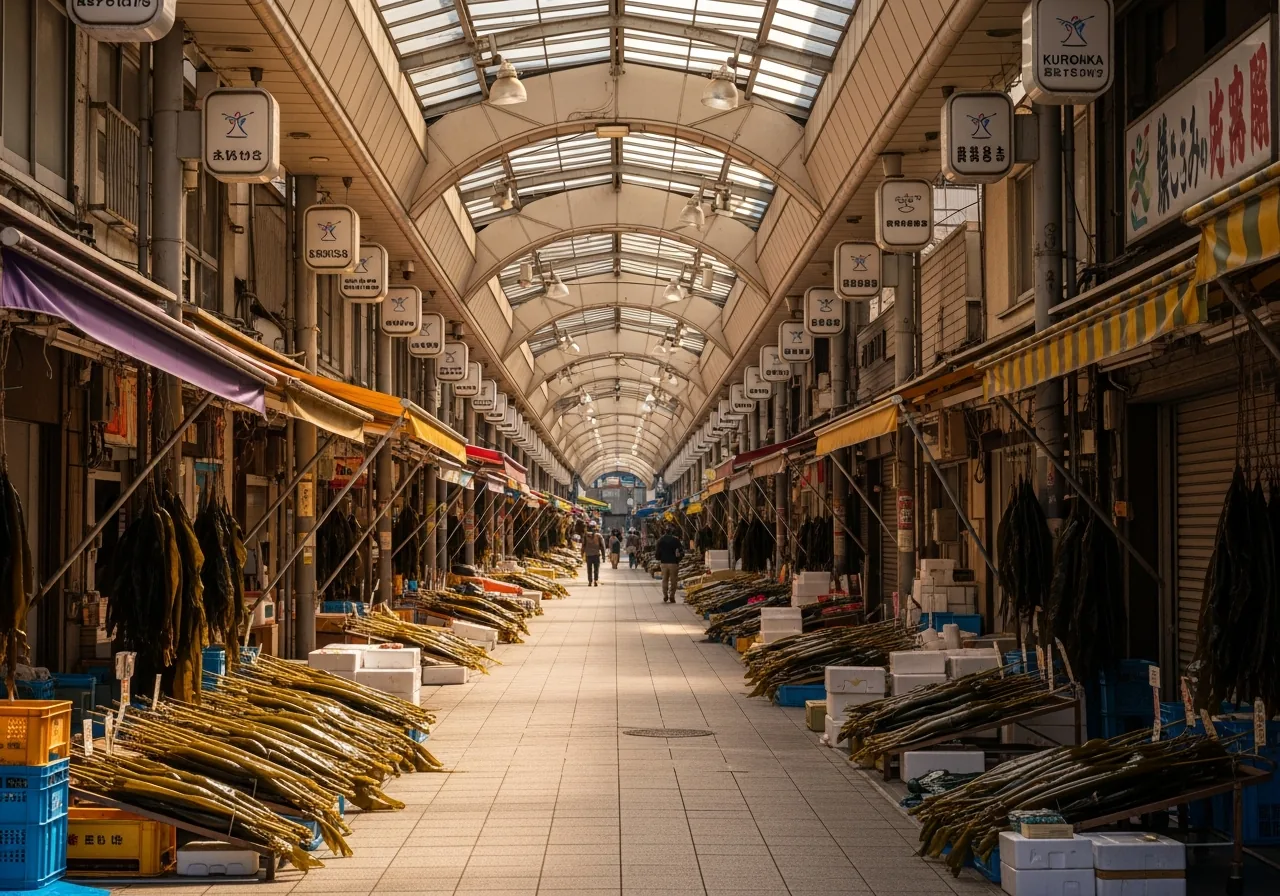
On the Karahori shotengai, a covered shopping street in Chuo Ward that has the slightly faded dignity of a neighborhood that peaked in the Showa era and is quietly proud of it, there is a kombu shop that has been operating since 1903. Konbu Doi is a konbu specialty shop established in 1903. With a discerning eye, Doi Junichi, the fourth-generation owner of the shop, selects high-quality konbu that has been carefully aged.
Operating out of their charming shop on a historic street in Osaka’s Tanimachi district, Konbu Doi specializes exclusively in Ma Konbu — sourced from the pristine, cold waters off Kakkumi-hama in Hokkaido. The shop does not sell convenience dashi packets or flavored kombu snacks.
It sells the real thing, aged and graded, to restaurants, home cooks, and the international chefs who make pilgrimages to Osaka specifically to understand what Japanese cuisine is built on. In business since 1903, the shop functions as an all-round source of konbu expertise, often welcoming top chefs from abroad seeking to heighten their knowledge of Japanese food culture and organising lectures and seminars overseas to spread the word about its product.
Next door, konbu kelp, an essential ingredient in Osaka cuisine and an integral component of Japanese food culture for millennia, is given pride of place at a one-of-a-kind museum run by the venerable Konbu Doi. On the first floor, visitors are treated to an exhibition of equipment used to harvest kelp in southern Hokkaido, where the highest-grade product originates from, along with a panel display describing the harvesting process and industry.
Stored on the second floor are specimens of natural and cultivated kelp from various parts of Hokkaido, categorised according to the year and region in which they were collected. And on the fourth floor you can participate in dashi-making workshops that’ll help you recreate authentic Osaka flavours at home.
Doi Junichi makes the journey to Hokkaido every summer. With supplier relations firmly established, the current owner makes annual visits to the town of Kakkumi-hama in the northernmost island of Hokkaido to review crop and harvest conditions.
His long-standing partnerships with the great kelp cultivators of the north ensure Konbu Doi receives the very best ma-konbu of the season consistently. The Kombu Road, in this sense, has never closed.
It has simply changed its mode of transport from sail to aircraft.
Why Should a Discerning Traveler Care?
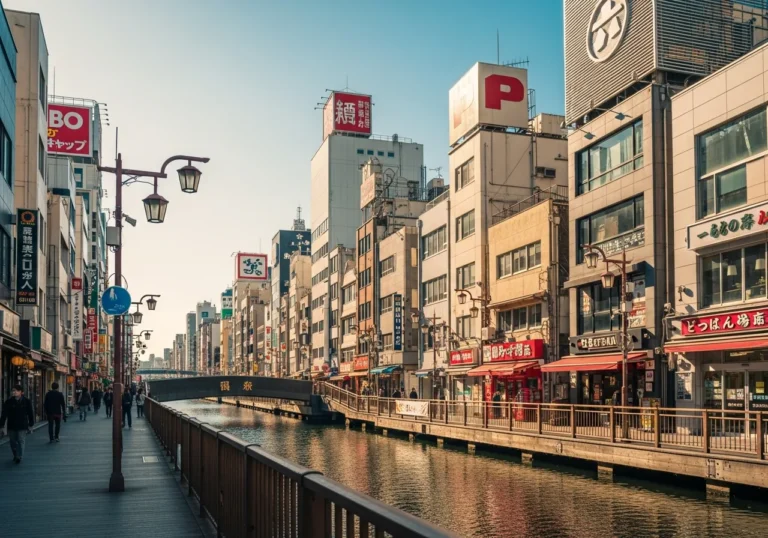
There is a version of Osaka tourism that is entirely legible and entirely satisfying: the takoyaki, the neon, the Dotonbori crowds, the department store basement food halls. That version is real, and it is genuinely pleasurable. But it is the surface of a city whose culinary identity was forged by something far more consequential — a maritime trade system that connected the cold seas of Hokkaido to the commercial intelligence of Osaka’s merchant class, and in doing so created the flavor foundation of an entire national cuisine.
When you eat kitsune udon in Osaka and find the broth inexplicably more satisfying than any you have tasted elsewhere, you are tasting the accumulated consequence of four centuries of commercial and culinary decision-making. The softness of the water.
The preference for ma-kombu over cheaper varieties. The aging process that concentrates glutamates.
The combination with bonito that multiplies the umami effect. None of these choices were accidental.
All of them were made by people who cared about flavor with the same seriousness that a Burgundy négociant cares about terroir.
The kombu story also opens a window onto the political economy of Edo-period Japan that no castle or shrine can provide. The kitamaebune were not merely ships.
They were the circulatory system of a pre-industrial economy, moving goods, prices, and cultural practices across an archipelago that was officially closed to the outside world. The fact that a dried seaweed from Hokkaido ended up financing the revolution that opened Japan to modernity is not a footnote.
It is one of the stranger and more illuminating facts in Japanese history.
And the story is not over. It is, in fact, entering its most precarious chapter.
Why Is the Kombu Road Now Under Threat?
The cold waters that made Hokkaido’s kombu possible are warming. As rising sea temperatures are affecting marine life in the waters around Japan, konbu (kelp) harvests in Hokkaido have fallen by two-thirds in the past 30 years.
The numbers are stark. The overall amount of kombu caught in Hokkaido has decreased by more than half over the past couple of decades.
In 1995, there were 28,000 tons produced; in 2019, that number had decreased to 13,000.
According to data released in April 2025 by the Hokkaido Marine Products Grading Corporation, 8,213 tons of konbu was harvested in the prefecture in fiscal 2024. The amount has fallen below the 10,000 ton mark.
The impact of recent increases in ocean temperature due to global warming is seen as a major cause of the decreasing harvest. In autumn 2023, the ocean surface temperature off the coast of Rausu — one of Hokkaido’s premium kombu-producing areas — reached 25 degrees Celsius.
Konbu is a seaweed that grows in cold waters. If the water temperature is too high, it grows poorly, due to issues like weakened roots causing the plant to break free.
The projections from Hokkaido University are sobering. Kombu populations near Hokkaido will only continue to decrease because of climate change.
Research from Hokkaido University predicts that 11 types of kombu in the region will disappear from Hokkaido’s coasts between year 2040 and 2090. The purchase price of kombu has doubled in the past five years.
Doi Junichi, the fourth-generation owner of Konbu Doi, has watched this unfold from his annual visits to Hokkaido. He laments that konbu production has declined in recent years due to a lack of young workers, global warming, and less attention on this edible kelp as eating habits in Japan have changed. “But once you get a taste of the real thing, you understand that we must preserve this konbu culture,” he adds.
A professor at Mie University who studies climate dynamics put it plainly in a December 2025 interview with CNN: “What matters most is the foundation of Japan’s most important food culture, which is the flavor made out of Kombu seaweed — it can only be harvested in Hokkaido, near Japan.” The Kombu Road was built on the assumption that cold northern waters would always produce what the warm southern city required. That assumption is now in question.
What is at stake is not merely a supply chain. It is the flavor of Osaka itself — the dashi in the udon, the base of the takoyaki batter, the stock that a cook tastes and adjusts before any dish leaves the kitchen. If the kombu disappears, something irreplaceable disappears with it: not just an ingredient, but the accumulated culinary intelligence of four centuries, the taste that a chemist named in 1908, the flavor that the kitamaebune carried south through every season for two hundred years.
That is why a strip of dried kelp in a Tanimachi shop window is worth more than a passing glance. It is a document of history, a product of geography, and, increasingly, a thing to be treated with the seriousness we reserve for things that may not always be there.
Frequently Asked Questions
Q: What is the Kombu Road?
A: The Kombu Road (昆布ロード, konbu rōdo) is the historical network of sea routes that carried dried kelp from Hokkaido southward to Osaka, Kyoto, and eventually Okinawa and China. It flourished from the Kamakura period onward and was formalized during the Edo period through the kitamaebune merchant shipping system.
Q: Why does Osaka use kombu dashi rather than bonito dashi?
A: Primarily because the kitamaebune ships stopped at Osaka first, giving the city first access to the highest-quality Hokkaido kombu. Osaka’s naturally soft water also extracts glutamates from kombu more efficiently than the harder water of Edo (Tokyo), reinforcing the city’s preference for kombu-based stocks.
Q: What is ma-kombu, and why does Osaka prefer it?
A: Ma-kombu (Saccharina japonica) is the premium grade of Japanese kelp, grown near Hakodate in southern Hokkaido. It produces a clear, sweet, deeply flavored dashi and is the preferred variety for Osaka’s finest cooking and for hand-shaved oboro kombu. Kyoto, by contrast, typically uses Rishiri kombu for a more austere, clear broth.
Q: Where can I experience Osaka’s kombu culture as a visitor?
A: Konbu Doi in Tanimachi (Chuo Ward) is the essential address — a specialist shop founded in 1903 with an adjacent museum covering the full history of the Kombu Road. The Sakai City area, accessible by train from Namba, is where the oboro kombu processing tradition survives; Goda Shoten offers demonstrations of hand-shaving. The Oguraya kombu shop in Ebisubashisuji shopping arcade, founded in 1848, is another long-established option in the city center.
Q: Is Hokkaido kombu production really declining?
A: Yes, significantly. According to data from the Hokkaido Marine Products Grading Corporation released in April 2025, the 2024 harvest fell to 8,213 tons — below the 10,000-ton threshold for the first time — compared to 28,000 tons in 1995.
Rising sea temperatures are the primary cause. Research from Hokkaido University projects that multiple kombu species could disappear from Hokkaido’s coasts between 2040 and 2090 under current warming trajectories.
Konbu Doi & Osaka Konbu Museum — Visitor Information
Address: 7-6-38 Tanimachi, Chuo-ku, Osaka 542-0012 / 大阪市中央区谷町7-6-38
Nearest station: Tanimachi 6-chome Station (Osaka Metro Tanimachi Line / Nagahori Tsurumi-ryokuchi Line) — approx. 3 min walk
Hours: Shop hours variable; museum open irregularly — confirm by phone or email before visiting (approx. 10:00–17:00 on open days)
Admission: Shop: Free to browse. Museum: Approx. free–nominal fee (advise confirming on the official site, as hours and admission are subject to change)
Official site: konbudoi.jp