Osaka’s role in building Japan’s modern merchant fleet was not incidental — it was structural. The city had spent two centuries as the nation’s commercial clearing-house, moving rice and goods by water, so when the Meiji government decided in the 1870s and 1880s that Japan needed steel ships of its own, Osaka already had the rivers, the capital, the merchant networks, and the appetite for industrial risk. The result was a cluster of shipyards — Fujinagata (founded 1689), Osaka Iron Works (1881), and the shipping combine that became Osaka Shosen Kaisha (1884) — that together gave Japan the infrastructure to challenge Western maritime dominance within a single generation.
Why we can tell you this — MICHI is written by an Osaka-based editorial team that can walk the Aji River embankment in Taisho-ku where Hunter’s first dock stood, and cross the high-arched bridges whose very elevation was engineered to clear the masts of cargo ships. This piece draws on corporate histories from Kanadevia (the successor to Osaka Iron Works), academic shipping history from the London School of Economics and Keio University, the Mitsui O.S.K.
Lines corporate archive, and contemporary English-language reporting on the Kitakagaya post-industrial arts district. Where the record is thin — particularly on the daily lives of the tens of thousands of workers who built these ships — we say so rather than invent colour.
Stand at the mouth of the Aji River on a clear morning and look south toward Osaka Bay. The water is calm now, flanked by expressway pillars and container-handling cranes.
But for the better part of a century, this stretch of waterfront was one of the loudest places in Asia: the percussion of riveting hammers, the groan of steel plate being rolled, the deep bass note of a hull sliding into the river for the first time. The ships that left these banks did not merely carry cargo.
They carried the logic of a city that had always understood, in its bones, that commerce moves by water.
Why Did Osaka Become a Shipbuilding City at All?
The answer begins not with iron or steam but with rice. Osaka’s role as Japan’s merchant city was reinforced through official policy: during the Edo period, all rice throughout the whole of the country was required to be sent to Osaka before being redistributed, which made it a vibrant city for business and gave rise to its moniker as “the kitchen of the nation” (天下の台所, tenka no daidokoro).
That phrase — the kitchen of the nation — is usually read as a compliment to Osaka’s food culture. It is that.
But it is also a precise description of a logistics system. During the Edo period, Osaka served as a major “distribution hub” for goods from across the country, acting as a transshipment hub between the producing regions of western Japan and Kyoto and the consuming region of Edo, making it Japan’s largest commercial city.
Every domain lord in the archipelago needed to convert his rice tax into cash, and the place to do that was Osaka.
Rice does not move itself. It moves by boat.
Stretching along Osaka Bay and crisscrossed by rivers and canals, Osaka is known as the “city of water,” and its abundant waterways spurred its development. The city’s canal network was not decorative infrastructure — it was the circulatory system of a national economy.
Boats of every size worked the rivers constantly, and the craftsmen who built and repaired them formed a permanent, skilled workforce concentrated in the city’s western wards.
Kelp was transported to Osaka from its source in Hokkaido via the Kitamaebune shipping route, a shipping route on the Sea of Japan that began during the Edo period. This single supply chain — kelp from the far north, arriving at Osaka to flavour the city’s cuisine — illustrates the scale of the maritime network that Osaka sat at the centre of. By the mid-nineteenth century, the city’s merchant class had accumulated both the capital and the practical knowledge of maritime trade that would make the transition to industrial shipbuilding not a leap into the unknown, but a logical extension of what they already did.
Why Here, and Why in 1689? The Oldest Shipyard in Japan
The continuity of Osaka’s shipbuilding tradition is startling. Fujinagata Shipyards (藤永田造船所) was a shipyard and railroad car manufacturer in Osaka, Japan.
Fujinagata claimed to have been founded in 1689, making it one of the oldest shipbuilders in Japan. Originally called Hyōgo-ya, and located in central Osaka, it was contracted in 1854 by officials representing the Tokugawa shogunate to produce sail warships for the new Tokugawa feudal navy.
Think about what that date means. Fujinagata was already 165 years old when Commodore Perry’s black ships appeared in Edo Bay in 1853.
It had been building vessels for the Kishu Domain, for coastal traders, for the rice-shipping networks of the Seto Inland Sea, through the entire locked-down era of sakoku. This establishment marked the beginning of operations focused on crafting wooden vessels essential for domestic maritime trade and transport along Japan’s inland seas and rivers, at a time when Osaka served as a central hub for rice shipping and commerce under the Tokugawa shogunate’s controlled economy.
Initial activities centred on traditional ship carpentry, producing smaller coastal and riverine boats suited to the sakoku (closed country) policy, which restricted large-scale oceanic voyages but necessitated robust local fleets for inter-domain logistics.
The restriction on large ships was, paradoxically, good for Osaka’s shipbuilding trade. The shogunate’s prohibition on ocean-going vessels meant that domestic coastal shipping — the kind of work Osaka’s yards excelled at — was the only game available.
Demand was constant and captive. When the prohibition was finally lifted, the yards were ready.
In 1869, with the assistance of German engineers, western-style warships were designed and produced at Fujinagata. After the Meiji Restoration, the shipyards concentrated on civilian applications, and in 1870 launched its first western-style commercial steam vessel — a first for a privately held shipbuilder in Japan. That moment — 1870, one year after the Restoration, a private Osaka yard launching Japan’s first privately built commercial steamer — is the hinge on which the entire subsequent story turns.
Why Did a Northern Irishman Build Japan’s Most Important Shipyard?
The second great Osaka shipbuilding story belongs to a man from Northern Ireland. Kanadevia’s origins go back to April 1, 1881, when British entrepreneur Edward H.
Hunter established Osaka Iron Works (大阪鉄工所, Ōsaka Tekkosho) in Osaka to develop the Japanese steel-making and shipbuilding industry. Hunter was not a government agent or a zaibatsu insider.
He was a practical engineer who had come to Japan in 1865, worked his way up through the Kobe shipyards, and seen an opportunity that the Japanese establishment had not yet seized.
Hunter had come to Japan in 1865 and had established the Onohama Shipyard in Kobe before moving to Osaka and establishing a new shipyard at the junction of the Nakatsu and Aki rivers, which could construct ships of under 1,000 tons displacement. His first vessel, the Hatsumaru, was launched in 1882.
The location was deliberate. The confluence of two rivers gave the yard water access in multiple directions; the proximity to the bay meant finished ships could be floated out without the complications of a narrow channel.
The Osaka Iron Works’ first yard, a six-acre facility with a dock 72 metres long and 11.5 metres wide, could construct wooden and iron ships weighing up to 1,000 tons. By the standards of British or German yards of the era, this was modest.
But in the context of Japan in 1881, it was transformative. Hunter’s stated ambition was equally bold.
Hunter said the company should “conceive and construct everything ourselves” — a philosophy that would guide the Hitachi Zosen Corporation through much of its history.
Why did Hunter choose Osaka over Kobe or Yokohama? The answer is capital and customers.
Osaka’s merchant class had money and a demonstrated willingness to invest in new industrial ventures. The city’s shipping networks — the coastal traders, the rice carriers, the Seto Inland Sea operators — represented a ready customer base for a yard that could build and repair steam vessels.
Kobe was the international port, but Osaka was where the money was made and where the demand originated.
Hunter’s primary business was shipbuilding, and yet he named his company not Osaka Shipyard but Osaka Iron Works. He must have been confident that iron would be a source of growth for Japan, as it was for Great Britain. The name was a statement of industrial ambition: this was not a boatyard but a heavy-industry enterprise, one that would produce engines, boilers, and eventually bridges alongside ships.
The Irishman Who Became Japanese
Hunter’s integration into Osaka society went beyond business. Hunter changed his name to “Hanta” in 1915 after marrying a Japanese woman, and after transforming the company into a joint stock company, turned it over to his son, Ryūtarō Hanta in 1915.
His wife, Aiko Hirano, was his essential partner in navigating a society that was simultaneously welcoming foreign expertise and deeply suspicious of foreign ownership. Aiko served as his liaison with the Japanese community, and their son Ryutaro grew up to be the proprietor of Osaka Iron Works as well as Hunter’s business partner in various fields.
Hunter also had a Japanese business partner from the beginning: a former samurai of the Kishu Domain named Seijuro Akizuki. Akizuki seemed to have gone on detachment and handled activities outside the foreign settlement, where Hunter was not allowed to operate.
Akizuki also served on the prefectural assembly and had a strong influence over economic and political circles. The partnership was a model of Meiji-era pragmatism: Western technical knowledge married to Japanese political access, with Osaka’s commercial culture providing the environment in which both could flourish.
Why Did the Merchants of Osaka Form Their Own Shipping Company?
While Hunter was building the yards, Osaka’s shipowners were reorganising themselves. The story of Osaka Shosen Kaisha — the company that would eventually become part of Mitsui O.S.K. Lines, one of the world’s largest shipping groups — begins with a crisis of overcompetition.
In the Osaka region, many firms acquired small steam vessels. By the early 1880s, seventy companies were involved with over a hundred steamers, but the unco-ordinated growth of tonnage was tending to make the business unprofitable.
The logic of the market had produced its own contradiction: too many ships, too many operators, rates driven to the floor. The solution was consolidation.
Osaka Shosen Kaisha was founded in 1884 by a combination of 55 Osaka ship owners, who between them owned 93 small coastal vessels operating in western Japan. The capital raised was ¥1.2 million — a substantial sum for the era, assembled by pooling the resources of dozens of Osaka merchant families who understood that their individual survival depended on collective action. This was the Osaka merchant tradition operating at its most sophisticated: not the romantic individualism of the lone entrepreneur, but the rational coalition of people who knew how markets worked.
In 1890, OSK inaugurated services to Korea, and in 1894 the Japanese government of Formosa (present-day Taiwan) provided a subsidy for OSK to operate an Osaka-Formosa liner service. This subsidy was increased in 1898 when the service was extended from Formosa to the Yangtze River.
From 1908, OSK opened ocean-going services to Hong Kong, Northwest USA, and Bombay. Within a quarter-century of its founding, a company born from the consolidation of 55 small coastal operators was running scheduled services to three continents.
The trajectory matters. OSK did not begin as an ocean-going line.
It began as a solution to a domestic pricing problem. The expansion to Korea, then Formosa, then the Yangtze, then Bombay and the American Pacific coast — each step followed from the previous one, driven by the logic of scale and the pull of government subsidy.
The Osaka merchant instinct was not to dream of empire but to follow the money, and the money, in the late Meiji era, was in the government’s shipping subsidy programmes.
Why Did the Government’s 1896 Laws Change Everything?
The Meiji government understood, with unusual clarity, that a modern nation-state required a modern merchant marine. The strategic calculation was not purely commercial: the policy was such that it encouraged the development of a merchant fleet so designed and constructed that it would meet both the commercial and naval needs of the nation.
Merchant ships could be requisitioned in wartime. A strong merchant fleet was a latent naval reserve.
In pursuit of this policy, the government adopted the subsidy laws of 1896. Two laws were promulgated.
The Navigation Encouragement Law provided for direct subsidies to Japanese-owned steel and iron ships plying in foreign trade. The companion measure was equally powerful: the Shipbuilding Encouragement Law, an indirect aid to shipowners, by which shipbuilders were granted a construction bounty of 12 yen per ton for vessels between 700 and 1,000 gross tons, and 20 yen per ton for larger vessels.
In addition, a bounty of 5 yen per horsepower was granted on all engines constructed in Japan.
The effect was immediate and dramatic. The obvious result of these liberal subsidies was to expand enormously the merchant fleet and shipbuilding industry.
Foreign services expanded, coastal services developed, new companies came into being, and Japanese-built steel ships began to appear. For the Osaka yards, the 1896 laws were the accelerant that turned a promising industrial cluster into a national powerhouse.
The key players in this transformation were already in place. The key players in the development of shipbuilding were the Ishikawajima Hirano Shipyard, begun by Hirano Tomiji in October 1876; the Tokyo Tsukiji Shipyard, started by Kawasaki Seizo in April 1878; Osaka Ironworks, established by E.
H. Hunter in 1881; and the Nagasaki Shipyard, sold at a discount by the Ministry of Finance to Mitsubishi in June of 1887.
Osaka Iron Works was not the largest of these yards, but it was the one most deeply embedded in the commercial logic of the Osaka merchant economy — building ships for the operators who were themselves building the routes that would carry Japan’s exports to the world.
The First Steel Ship and What It Meant
Modern shipbuilding began in May 1890 when Mitsubishi Shipyard built Japan’s first steel cargo ship, the Chikugogawa Maru, which was delivered to Osaka Shosen. The customer was Osaka Shosen Kaisha.
The ship was built for the Osaka-based shipping company, to serve the routes that Osaka merchants had pioneered. Even when the builder was Mitsubishi in Nagasaki, the commercial logic ran through Osaka.
Osaka Iron Works followed quickly. The Kumagawa Maru, Japan’s first steel-hulled ship, was built for Osaka Shosen (now Mitsui O.S.K.
Lines). The relationship between the yard and the shipping company was symbiotic: OSK provided the orders that justified investment in new capacity; the yards provided the ships that allowed OSK to expand its routes.
This virtuous circle — Osaka capital building Osaka ships to carry Osaka trade — was the engine of the city’s industrial transformation.
Somewhat later the industry began to take on great activity, and in 1898 a 6,000-ton steel steamer, the Hitachi Maru, was turned out. From 1898 to 1904, Mitsubishi, the Kawasaki Shipbuilding Company, the Osaka Iron Works, and a few others built thirty steamers above 1,000 tons.
Thirty large steel steamers in six years, from yards that had been building wooden coastal boats a generation earlier. The speed of the transformation was extraordinary.
Why Did the Sakurajima Works Change the Scale of Everything?
By 1900, Hunter’s original yard at the Nakatsu-Aki river junction was too small for the ships the market demanded. The solution was a second yard, further west, closer to the bay.
In 1900, Osaka Iron Works began operating a second yard, the Sakurajima works, at the mouth of the Aji River to build ships weighing over 1,000 tons. A passenger-cargo ship, the 1,568-gross-ton Taigi Maru, was the first ship launched from the new yard and the first ship weighing over 1,000 tons built by the company.
The Sakurajima site was chosen with the same geographical logic that had guided Hunter’s original location: deep water access, proximity to the bay, room to expand. To meet the steadily increasing volume of business, the works made successive extensions, more especially after 1895, and in 1899 nearly 16 acres of land, with a water frontage of more than 1,000 feet, were secured at Sakurajima, a mile from the mouth of the Aji River, and lying close to the new Osaka Harbour.
Eight years later came another milestone. In 1908, Osaka Iron Works launched the first tanker built in Japan; its 531-gross-ton Tora Maru joined the Standard Oil fleet.
Japan’s first tanker, built in Osaka, for the American oil company that was then the world’s largest corporation. The transaction encapsulates the paradox of Meiji industrialisation: the technology was Western, the capital was partly American, but the manufacturing capability was now Japanese, and it was concentrated in Osaka.
The Taisho-ku waterfront, where Fujinagata had relocated its main yard in 1884, was by this point a continuous industrial landscape. The sound of a huge number of shipyards, lumber factories, and iron works energised the entire Taisho town.
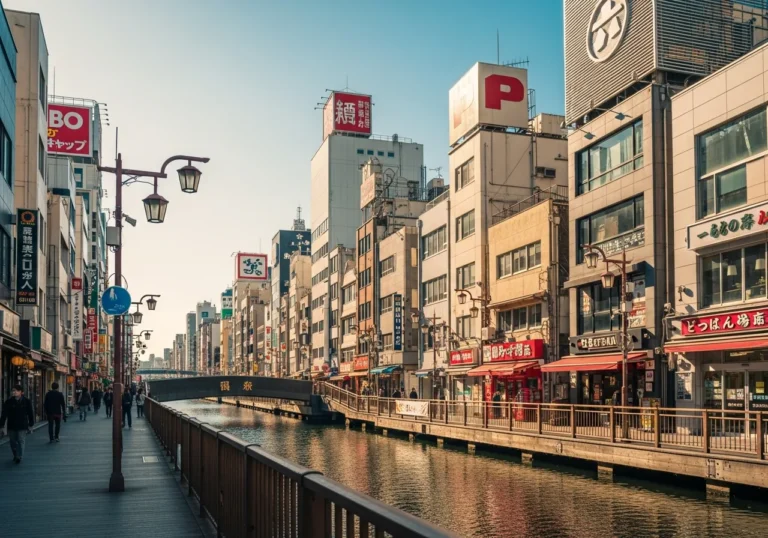
The bridges over the Kizu River were built high — deliberately high — to allow the masts and superstructures of cargo ships to pass beneath them. You can still see this today: the bridges of Taisho-ku are among the most steeply arched in Osaka, a permanent architectural record of the industry that shaped the district.
Why Did World War I Make Osaka’s Shipyards Rich — and Then Dangerous?
The First World War was, for Japan’s shipbuilding industry, an extraordinary windfall. Europe’s yards were building warships or had been bombed into rubble; European shipping companies were losing vessels faster than they could replace them.
Japan was far from the fighting, allied with the winning side, and possessed of a rapidly maturing industrial capacity. The orders flooded in.
OSK made very substantial profits during World War I, enabling it to extend its Bombay route to Marseilles in 1918 and to open new services to San Francisco, Australia, and South America. The war transformed OSK from a regional Asian carrier into a genuinely global shipping line. The profits from wartime freight rates funded the fleet expansion that made peacetime global competition possible.
At the end of the nineteenth century, government subsidies to shipbuilders encouraged the industry, but it was only the pressures of the First World War that gave Japanese shipping companies the lion’s share of Japanese foreign trade. The war did in four years what decades of subsidy policy had been trying to accomplish: it forced Japanese exporters to use Japanese ships, because no one else’s ships were available.
For Fujinagata, the wartime boom led to overextension. On May 31, 1921, the Momi-class destroyer Fuji was launched, marking the first of 56 destroyers that Fujinagata would eventually build for the Imperial Japanese Navy.
With new naval contracts, Fujinagata moved its head office into new facilities and expanded its capability rapidly. However, it expanded too quickly and soon fell into financial difficulties, causing its shipbuilding business to come under the accounting supervision of the Ministry of the Navy of Japan in December 1928.
The pattern was common across Japanese heavy industry in the 1920s: wartime profits funding peacetime overexpansion, followed by the brutal correction of the post-war depression. The yards that survived were those, like Osaka Iron Works, that had diversified beyond pure shipbuilding — into bridges, hydroelectric equipment, and industrial machinery — and those that had the backing of the great zaibatsu conglomerates.
Why Did the War Consume What It Had Created?
The merchant fleet that Osaka’s yards had spent sixty years building was, in the end, consumed by the war that Japan’s militarists had been preparing for since the 1930s. The logic was circular and catastrophic.
The Meiji policy had encouraged the development of a merchant fleet so designed and constructed that it would meet both the commercial and naval needs of the nation. When the naval needs became total, the commercial fleet was requisitioned, converted, and sunk.
A number of old merchant ships built by Osaka Iron Works, known as Hitachi Shipbuilding after 1934, were converted to naval use. While most of the large ships were built by Hitachi’s competitors like Mitsubishi, Ishikawajima, Kawasaki, Mitsui, and Harima, the company did produce smaller vessels designed for military use.
The yards themselves were not spared. In June 1945, Fujinagata’s main shipyards were destroyed during large-scale air raids towards the end of World War II.
The human cost at the yards was also severe, and morally complicated. In December 1944, Fujinagata had 16,508 employees.
It is estimated that perhaps half of the employees at that time were ethnic Koreans, and at least 150 were Australian prisoners of war, who were supplying forced labour in violation of the Geneva Conventions. The industrial achievement of Osaka’s shipyards cannot be separated from this history.
The ships were built by workers who had no choice about being there.
By August 1945, the merchant fleet that had once carried Japan’s trade to Bombay, Marseilles, New York, and São Paulo had been reduced to a fraction of its pre-war tonnage. OSK, which had peaked at 112 vessels aggregating 557,126 gross registered tons in 1941, had lost most of its ships by the end of the war.
The yards were bombed. The fleet was sunk.
The entire structure that Osaka’s merchants and engineers had built over sixty years had to be rebuilt from almost nothing.
Why Did Osaka’s Yards Recover Faster Than Anyone Expected?
The post-war recovery of Japan’s shipbuilding industry is one of the most remarkable industrial stories of the twentieth century, and Osaka was at its centre. The mechanism was the Keikaku Zosen — the Planned Shipbuilding Scheme — launched by the Japanese government in 1947.
From 1950 onward, the Japanese shipping industry grew rapidly along with the Japanese economy as a whole, partly as a result of the 1947 state shipbuilding policy, the Keikaku Zosen (Programmed Shipbuilding Scheme). The scheme provided low-interest government loans to shipping companies to order new vessels from domestic yards, simultaneously rebuilding the fleet and keeping the yards employed. It was, in effect, a second iteration of the 1896 subsidy laws — the same logic of state-directed industrial development, applied to a country starting from rubble rather than from feudalism.
While other industries received government assistance to rebuild in the 1950s, the shipbuilding industry was left more on its own. Japanese shipbuilders like Hitachi had to be flexible to survive — management sometimes put high-level engineers to work on the assembly line to fill orders on time. The industry developed extremely efficient methods to compete with European shipyards, and Japanese rock-bottom prices and top quality increased foreign orders.
The efficiency gains were real and structural. In 1915, Ryutaro Hanta had successfully completed a licensing agreement to use the Isherwood method to build ships.
The technique, which originated in Great Britain, significantly reduced both costs and construction time. Methods like this, absorbed and refined over decades, gave the Osaka yards a productivity advantage that European competitors could not easily replicate.
The result was staggering. By 1955, Japan was the greatest shipbuilding nation in the world, and Hitachi was one of the busiest shipbuilders in Japan.
Ten years after the yards had been bombed flat, Japan had overtaken Britain — the country that had invented the iron steamship — as the world’s leading shipbuilder. And the Osaka yards, rebuilt on the same riverbanks where Hunter had laid his first keel in 1882, were central to that achievement.
In the space of two decades, Japan had become the world’s lowest-cost producer of ships and by the mid-1960s was launching close to 50 percent of all shipping tonnage constructed worldwide. Half the world’s new ships, built in Japan. It is a statistic that still seems improbable, even knowing the history that produced it.
Why Did the Suez Crisis Make Osaka’s Yards Even More Powerful?
The 1956 Suez Crisis — when Egypt nationalised the canal and briefly closed it to shipping — created an unexpected demand for very large tankers. If oil could not move through the canal, it had to go around the Cape of Good Hope, a route that required much larger vessels to be economically viable.
Political uncertainties in the Middle East after the Suez Canal was closed temporarily in 1956 forced oil producers to seek economical means of bypassing the canal. Japanese shipbuilders were ready to meet the demand for larger oil tankers.
In the shipbuilding field, Hitachi began to specialise in ever larger sizes of oil tankers, pioneering methods for computer-assisted design and modular, automated construction techniques. The Sakurajima yard, which had launched its first 1,000-ton ship in 1900, was now building vessels of 250,000 tons. The scale increase over sixty years was not incremental — it was a transformation of an entirely different order.
The tanker boom also accelerated the concentration of shipbuilding in fewer, larger yards. The Kitakagaya district in Suminoe-ku, south of the original Osaka Iron Works site, became a dense cluster of yards.
From the Taisho to the Showa era, Osaka was one of the world’s leading industrial centres, known as the “Manchester of the Orient.” The repeated wars increased the demand for ships, and many shipyards sprang up around the Kizu River estuary in Kitakagaya. One of these was Namura Shipbuilding Co.
After World War II, Kitakagaya was a vibrant place, with as many as 20,000 people working at Namura and three other shipyards.
Why Did It All End — and What Replaced It?
The oil crisis of 1973 ended the tanker boom with brutal abruptness. The global oil crisis of 1973, with its consequent reduction in ship demand, resulted in financial difficulties for the company.
Orders for supertankers collapsed overnight. Yards that had been booked solid for years suddenly had empty slipways.
With about 50 percent of its turnover continuing to come from shipbuilding, Hitachi was hit hard by declining orders and cancelled orders for supertankers as the 1970s went on.
The yards that had defined Osaka’s industrial waterfront began to close or relocate. After around 1970, the shipbuilding industry went into decline.
Shipyards disappeared one after another, and the Namura Shipyard was finally relocated to Saga Prefecture in 1972 to build larger ships. The logic of scale that had driven the industry’s growth now worked against the Osaka sites: the bay was too shallow, the river mouths too narrow, the urban surroundings too dense for the truly enormous vessels that the market now demanded.
What happened to the land the yards left behind is one of the more interesting stories in contemporary Osaka. Kitakagaya in Suminoe-ku, a town in the western bay area of Osaka City, which until the 1970s was bustling with the shipbuilding industry, is now attracting attention as a hotbed of art. The site of an old shipyard has become a venue for young artists to showcase their work, and renovated cultural residences have become a meeting place for people.
Creative Centre Osaka (CCO) was established on the site of the former Namura Shipyard Osaka factory. After the Namura Shipyard left, the landowner Chishima Land Co.
decided to turn the site into a centre for art and culture after the “NAMURA ART MEETING,” an art project looking 30 years ahead, was held in 2004. In 2005, part of the former shipyard site was turned into the Creative Centre Osaka (CCO).
The drawing room where naval architects once laid out hull plans is now a gallery. The cranes still stand.
The docks are still there, filled with water and silence.
As for Osaka Iron Works itself — the company Hunter founded in 1881 — it survived by doing exactly what Hunter had always intended: making itself indispensable to whatever the economy needed. Despite its former name, Hitachi Zosen, of which the last word literally means shipbuilding, no longer builds ships, having spun off the business to Universal Shipbuilding Corporation in 2002.
Reflecting this, the company changed its name to Kanadevia in October 2024. The company that built Japan’s first tanker now builds waste-to-energy plants and solid-state batteries.
Hunter’s instruction to “conceive and construct everything ourselves” turned out to be a philosophy capacious enough to survive the end of the industry it was born in.
Why Should a Discerning Traveller Care About Any of This?
The honest answer is that you cannot understand modern Japan — its industrial discipline, its capacity for rapid technological adoption, its complex relationship with state direction and private enterprise — without understanding the shipbuilding story. And you cannot understand the shipbuilding story without understanding Osaka’s particular role in it.
Osaka did not build ships because the government told it to. It built ships because it had been moving goods by water for two centuries, because it had the capital and the merchant networks and the practical knowledge, and because when the opportunity came — in the form of Meiji-era subsidy laws and a global demand for tonnage — it was ready.
The shipyards were not imposed on Osaka from above. They grew from the city’s own commercial logic, the same logic that had made it the kitchen of the nation.
In the Meiji era, the capital was moved to Tokyo and Osaka’s economy went into decline, but Osaka, which had always been the centre of the distribution economy, began to industrialise, with spinning, machinery manufacturing, shipbuilding, and other industries, and it emerged as a centre of new industries. The shipyards were Osaka’s answer to the political marginalisation of the Meiji era: if Tokyo was going to be the political capital, Osaka would be the industrial one.
The traveller who walks the Taisho-ku waterfront today, or who takes the subway to Kitakagaya to visit the Creative Centre Osaka in the shell of the old Namura yard, is walking through a landscape that shaped the modern world. The ships built here carried Japanese cotton to India, Japanese emigrants to Brazil, Japanese machinery to every port in Asia. They carried the Meiji dream of national self-sufficiency to its logical conclusion — and then, in the 1940s, they were requisitioned and sunk in service of a very different dream.
The cranes at Kitakagaya are listed as industrial heritage. The bridges of Taisho-ku are still arched high over the Kizu River, built for ships that no longer pass beneath them.
These are not ruins. They are the physical grammar of a city that built the modern world and then had to figure out what to do next.
That is a story worth knowing before you arrive — and worth looking for, in the landscape, once you are here.
Frequently Asked Questions
Q: Where was the original Osaka Iron Works shipyard located?
A: Hunter established the original yard at the junction of the Nakatsu and Aki rivers in Osaka, which could construct ships of under 1,000 tons displacement. The Sakurajima expansion yard, opened in 1900, was located at the mouth of the Aji River, closer to Osaka Bay.
Q: What was the Osaka Shosen Kaisha, and what became of it?
A: Osaka Shosen Kaisha was founded in 1884 by a combination of 55 Osaka ship owners, who between them owned 93 small coastal vessels operating in western Japan. It grew into a global shipping line and merged with a number of others to form Mitsui O.S.K.
Line in 1964. That company, now known as MOL, remains one of the world’s largest shipping groups.
Q: When did Japan become the world’s largest shipbuilder?
A: By 1955, Japan was the greatest shipbuilding nation in the world. The recovery from wartime destruction, driven by the government’s Keikaku Zosen planned shipbuilding programme and the efficiency innovations of yards like Hitachi (Osaka Iron Works), took less than a decade.
Q: Can visitors still see evidence of Osaka’s shipbuilding history today?
A: Yes. The Creative Centre Osaka (CCO) in Kitakagaya, Suminoe-ku, occupies the site of the former Namura Shipyard, with original cranes and dock infrastructure still standing.
The site of the former Namura Shipyard was selected as one of the “Industrial Heritage Sites of Modernisation” (33 sites nationwide). The high-arched bridges of Taisho-ku are another visible legacy, built to accommodate the masts of cargo ships.
Q: What happened to Osaka Iron Works / Hitachi Zosen?
A: Hitachi Zosen no longer builds ships, having spun off the business to Universal Shipbuilding Corporation in 2002. The company changed its name to Kanadevia in October 2024. It now focuses on environmental engineering, waste-to-energy plants, and advanced battery technology — a complete transformation from its origins as a shipyard.
Where to Experience Osaka’s Shipbuilding History — Visitor Information
Primary site — Creative Centre Osaka (CCO) / Former Namura Shipyard: 4-14-70 Kitakagaya, Suminoe-ku, Osaka 559-0011 / 大阪市住之江区北加賀屋4-14-70
Nearest station: Kitakagaya Station (Osaka Metro Yotsubashi Line) — approx. 5 min walk
Hours: CCO gallery spaces vary by exhibition; the outdoor industrial heritage structures (cranes, docks) are viewable at any time from the surrounding streets
Admission: Outdoor heritage area free; gallery events vary — confirm on the official site before visiting
Official site: creative-center-osaka.jp
Also worth visiting: Taisho-ku waterfront (Taisho Station, Osaka Loop Line) — walk the Kizu River embankment to see the high-arched bridges built for cargo ships; Kanadevia (former Hitachi Zosen / Osaka Iron Works) Chikko Works, Suminoe-ku — visible from the waterfront road