Looking for the history behind Dotonbori’s bridges in Osaka? This guide covers six bridges spanning the canal — from the widest road bridge in the city to a footbridge that once carried a playwright’s curse. All are free to walk, open around the clock, and together they tell 400 years of Osaka’s story better than any museum could. If you want to pair the walk with a meal, check out the best food in Osaka right along the same stretch.
MICHI’s Pick — Selected by our Osaka-based team, based on places we’ve visited and on research using Tabelog and Google Maps ratings. In Japan, a Tabelog score of 3.4+ is genuinely high — Japanese reviewers are famously strict, and most locals consider anything above 3.4 a place worth a detour. We feature venues meeting at least one of: Tabelog 3.4+, Google Maps 4.3+, or 100+ reviews — the kind of spots locals quietly trust.
Tabelog and Google Maps scores are accurate as of the time of writing.
1. Ebisubashi (戎橋)
📍 Dotonbori, Chuo Ward, Osaka 542-0071 (spanning the Dotonbori Canal between Shinsaibashi-suji and Ebisubashi-suji)
🕐 Open 24 hours (as of May 2026)
💰 Free
🚃 Namba Station (Osaka Metro Midosuji Line) (3 min walk)
⭐ Rating: Google 4.4 (5,000+ reviews) (as of writing)
🗺 Open in Google Maps
📋 Tabelog
What to order: N/A — this is a free public landmark
Ebisubashi was first built in the early 17th century, immediately after the excavation of the Dotonbori River. Its first incarnation was a wooden bridge, which became an iron bridge in the Meiji era and then a reinforced concrete arch bridge in the Taisho era. The current version, with its circular plaza and sloping ramps down to the Tombori Riverwalk, was completed in 2007. It was designed through an open competition — the winning concept conceived of the bridge as the “navel” of Osaka’s Minami district.
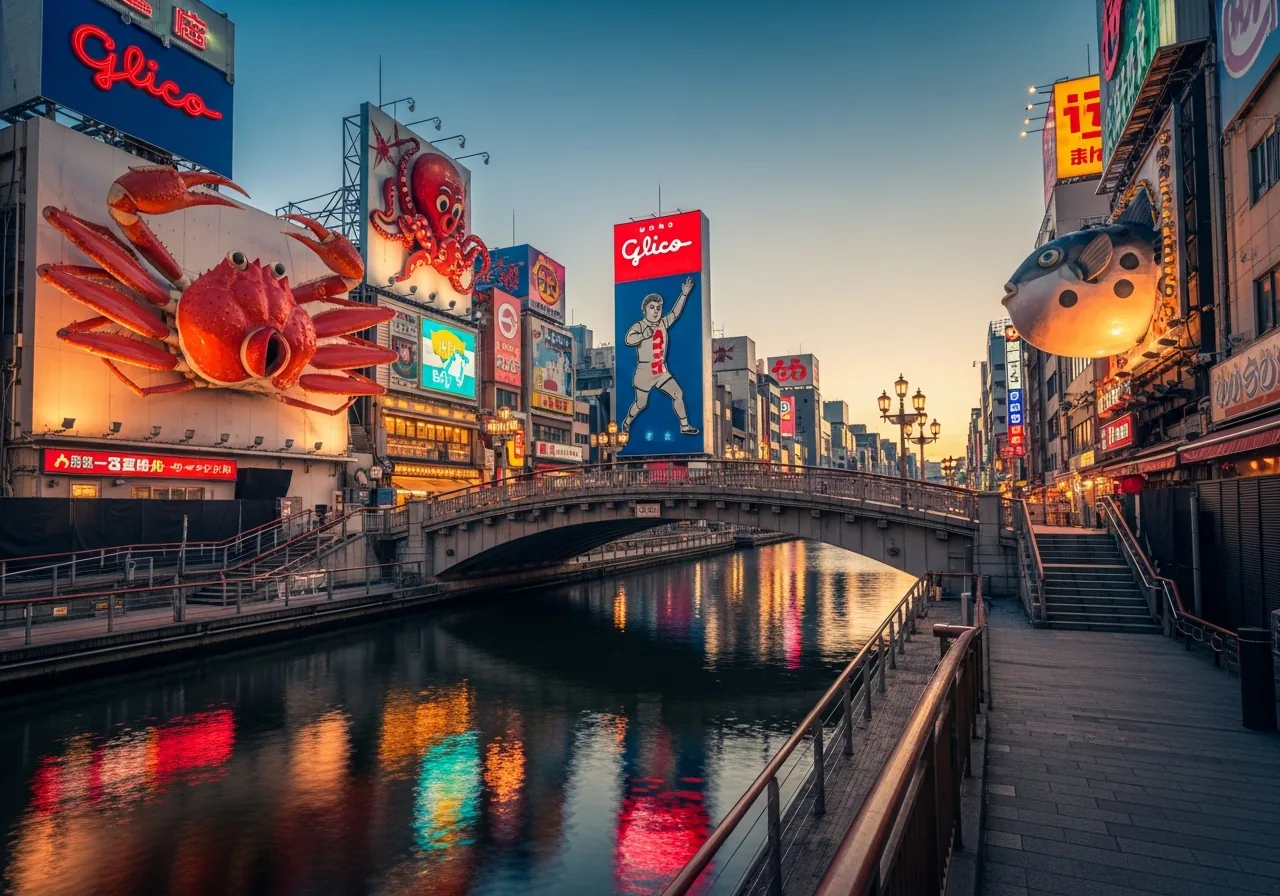
The bridge was originally constructed to provide access to the nearby Ebisu Shrine, and it is also the location of a legendary curse — considered broken in 2023 — on Osaka’s baseball team, the Hanshin Tigers. Locals know it by two nicknames: nanpa-bashi (flirting bridge) among foreigners, and hikkake-bashi (the pulling bridge) among Japanese. The Glico Man sign just to the west — installed in 1935, depicting a runner crossing the finish line — has become a symbol of Osaka, with the latest LED version installed in 2014. Come at dusk: the neon hits the water and the crowd on the bridge is half the show.
2. Dotonboribashi (道頓堀橋)
📍 Dotonbori 1-chome / Nishi-Shinsaibashi 2-chome, Chuo Ward, Osaka (Midosuji crossing of the Dotonbori Canal)
🕐 Open 24 hours (as of May 2026)
💰 Free
🚃 Namba Station (Osaka Metro Midosuji Line) (1 min walk)
⭐ Rating: Google 4.3 (1,000+ reviews) (as of writing)
🗺 Open in Google Maps
📋 Tabelog
What to order: N/A — free public landmark
Dotonboribashi is the widest bridge in Osaka, built in 1936 as part of the construction of Midosuji. At 38.2 metres long and 43.6 metres wide, its foundations are integrated with the Osaka Metro Midosuji Line running directly beneath it — an engineering decision that makes it unlike any other bridge on the canal. From 2011 to 2020, it served as the turnaround point for the Osaka International Women’s Marathon.
Stand here on a weekday morning before the crowds arrive and you get the clearest view east along the canal — all the way to Ebisubashi and the Glico sign. The ginkgo trees lining Midosuji overhead turn gold in November, framing the bridge in a way that makes even seasoned Osaka visitors stop walking.
3. Tazaemonbashi (太左衛門橋)
📍 Dotonbori / Soemoncho, Chuo Ward, Osaka 542-0084
🕐 Open 24 hours (as of May 2026)
💰 Free
🚃 Namba Station (Osaka Metro Midosuji Line) (5 min walk)
⭐ Rating: Google 4.2 (500+ reviews) (as of writing)
🗺 Open in Google Maps
📋 Tabelog
What to order: N/A — free public landmark
The bridge takes its name from Osaka Tazaemon, an entertainer who opened a kabuki theatre on the southeast corner of the bridge. The current structure was built in 1958 using the latest technology of the time. To the south was an area packed with theatres, their yagura towers lined up in a row; to the north, the Soemoncho teahouse district. When the bridge was renovated, its origins and the presence of numerous theatres in the area were taken into consideration for its wood-based design — look at the timber-toned railings and you can see the deliberate nod to the old theatre district.
This is also the departure point for the Tombori River Cruise, which boards from the pier on the north bank right beside the Don Quijote Dotonbori store. Tickets cost ¥2,000 for adults, ¥1,000 for students, and ¥500 for children.
4. Aiaibashi (相合橋)
📍 Dotonbori / Soemoncho, Chuo Ward, Osaka 542-0084
🕐 Open 24 hours (as of May 2026)
💰 Free
🚃 Namba Station (Osaka Metro Midosuji Line) (6 min walk)
⭐ Rating: Google 4.1 (300+ reviews) (as of writing)
🗺 Open in Google Maps
📋 Tabelog
What to order: N/A — free public landmark
During the Edo period, Aiaibashi was called Nakabashi or Shin-Nakabashi Bridge. It even appeared in a passage of the joruri play “Shinju Kasane Izutsu” by Chikamatsu Monzaemon — the Shakespeare of Japanese puppet theatre. The name aiai (meaning “together” or “mutual love”) sounds romantic, but the bridge carried a darker reputation: it was known as a “severance bridge” (enkiri-bashi), and people of the pleasure quarters refused to cross it, believing it would sever romantic ties. Wedding processions avoided it too. The current bridge has stone paving and glass-block lighting built into the railings — it’s now considered a date spot, which is either ironic or a full rehabilitation depending on your view.
5. Nipponbashi (日本橋)
📍 Soemoncho through Dotonbori 1-chome, Chuo Ward, Osaka 542-0071
🕐 Open 24 hours (as of May 2026)
💰 Free
🚃 Nipponbashi Station (Osaka Metro Sakaisuji Line) (10 min walk) / Namba Station (5 min walk)
⭐ Rating: Google 4.3 (2,000+ reviews) (as of writing)
🗺 Open in Google Maps
📋 Tabelog
What to order: N/A — free public landmark
At the foot of the bridge was a dock that flourished as a key point in land and water transport, with the Shogunate’s official notice board standing on the west side of the southern end. At the time, records suggest the bridge was approximately 40 metres long, 7 metres wide, and made of wood. Following repairs carried out since the Meiji era, it was rebuilt in its present form in 1969 when the subway was constructed. The old bridge’s anchor post can still be found at the foot of the current bridge.
The area around Nipponbashi flourished as a shopping district with secondhand bookshops in the Meiji era. After the war, stores selling homemade radio parts and tools sprang up, transforming the area into the electronics district now known as Den Den Town. The bridge marks the eastern boundary of the main Dotonbori strip — cross it and the neon thins out fast, replaced by anime shops and retro electronics. To explore more of Osaka beyond the tourist corridor, Nipponbashi is a good place to start.
6. Tombori Riverwalk (とんぼりリバーウォーク)
📍 Dotonbori River, Chuo Ward / Nishi Ward / Naniwa Ward, Osaka 541-0055 (Ebisubashi to Nipponbashi section and Minatomachi section)
🕐 Open 24 hours (as of May 2026)
💰 Free (River Cruise: ¥2,000 adults)
🚃 Namba Station (Osaka Metro Midosuji Line) (3 min walk)
⭐ Rating: Google 4.3 (3,000+ reviews) (as of writing)
🗺 Open in Google Maps
📋 Tabelog
🌐 Official site
What to order: N/A — free public promenade (River Cruise tickets at Tazaemonbashi Pier)
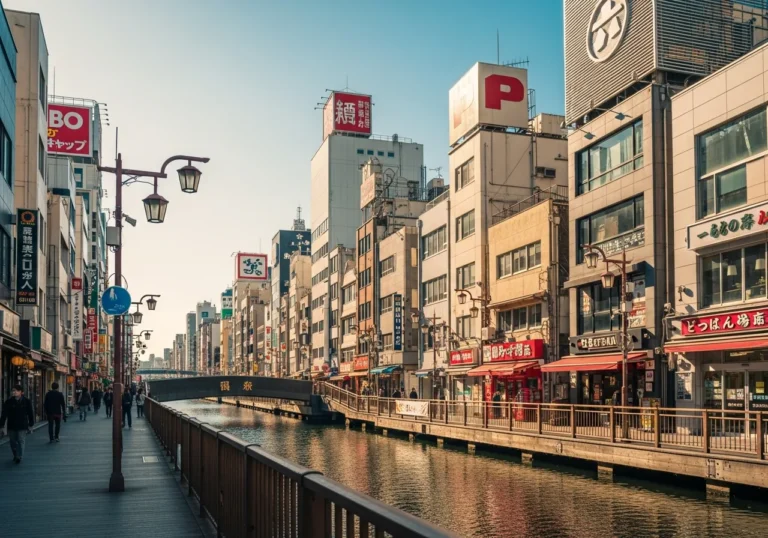
The Tombori Riverwalk is not a bridge — it’s the promenade that connects them all. Established in December 2004, it runs along the Dotonbori River as part of Osaka’s “Water City” revitalisation project. The Ebisubashi–Nipponbashi and Minatomachi sections total 600 metres of open walkway. Walking it east to west at night, you pass under each bridge in sequence — Nipponbashi, Aiaibashi, Tazaemonbashi, Ebisubashi, Dotonboribashi — and each one frames a different slice of the neon skyline above you.
The Tombori River Cruise departs from Tazaemonbashi Pier, heads east under Tazaemonbashi, Aiaibashi, and Nipponbashi, then turns around and covers the full length of the canal west, passing under Ebisubashi, Dotonboribashi, Shin-Ebisubashi, Daikokubashi, Fukaribashi, and Ukiniwa Bridge. Nine bridges in roughly 20 minutes, from water level — it’s the most efficient way to understand how the canal and its crossings fit together as a system. The MICHI Osaka travel guide recommends booking the evening departure for the full neon effect.
FAQ
Q: What is the best bridge to visit in Dotonbori, Osaka?
A: Ebisubashi is the one most visitors come for — it’s where you get the Glico Man shot and the full Dotonbori panorama. But Dotonboribashi, just one bridge west, is actually the widest single bridge in Osaka and far less crowded. Go to Ebisubashi for the photo, then walk to Dotonboribashi for the view.
Q: How many bridges are in Dotonbori?
A: The main Dotonbori canal has around nine bridges spanning it between Dotonboribashi in the west and beyond Nipponbashi in the east. The six covered in this guide — Ebisubashi, Dotonboribashi, Tazaemonbashi, Aiaibashi, Nipponbashi, and the Tombori Riverwalk connecting them — are the ones with the most historical and architectural interest.
Q: Do Dotonbori bridges have English signage?
A: Most bridges have bilingual plaques in Japanese and English, though the detail varies. The Osaka Chuo Ward historical panel project (osaka-chushin.jp) has published English-language histories of each bridge online, which are worth reading before you walk the canal.
Q: What should I look for at Dotonbori’s bridges in Osaka?
A: Each bridge has a distinct character: Ebisubashi for the Glico Man and the circular plaza; Dotonboribashi for its sheer width and Midosuji ginkgo trees; Tazaemonbashi for its timber-toned theatre-district design; Aiaibashi for its glass-block lighting and Edo-era literary connections; and Nipponbashi for the anchor post of the original wooden bridge still visible at its base. Walk the Tombori Riverwalk at night to see all of them from below.
Last updated: July 19, 2026 · Corrections: [email protected]