Sakai’s knife industry did not begin with knives at all: it began with tobacco. When Portuguese traders arrived at the port of Sakai in 1543 carrying matchlock firearms and cured tobacco leaf, the city’s blacksmiths — already the finest metalworkers in Japan — pivoted to produce the specialist blades needed to shred those leaves, and the Tokugawa shogunate was so impressed by the result that it granted Sakai an official quality seal and a national sales monopoly, making it the only government-certified blade-making region in the country. That single administrative act, issued sometime in the early seventeenth century, locked in a competitive advantage that six centuries of industrial change have never quite undone: as of 2026, Sakai still produces roughly ninety percent of the professional-grade kitchen knives used in Japan.
Why we can tell you this — MICHI is edited from Osaka, and Sakai is thirty minutes south of us by the Nankai line — close enough that we can walk the old-city workshops of Sakai-ku, stand in the forge heat, and watch a togishi grind a yanagiba on a water-cooled stone before the morning service rush. This piece draws on the official tourism and heritage materials published by Sakai City’s Tourism and Convention Bureau, the traditional-craft designation records held by Japan’s Traditional Crafts Aoyama Square, the Sakai City municipal government’s own cutlery pages, the Sakai Denshokan (Traditional Crafts Museum), and the historical record of Sakai as a medieval free city. Where precise dates for the Tokugawa monopoly grant are contested in the secondary literature, we note that ambiguity rather than paper over it.
Stand at the corner of Zaimokucho-nishi in Sakai-ku on a weekday morning and you will hear, before you see, what six hundred years of industrial continuity sounds like. The clang of a hammer on hot steel comes through a half-open shutter.
A grinding wheel hums in a damp room behind it. Somewhere further down the lane, a handle maker is fitting a magnolia-wood grip onto a blade that has already passed through two other pairs of hands.
The street looks like any other low-rise Osaka suburb — vending machines, a convenience store, a bicycle leaning against a wall — and yet the workshops tucked into these buildings are doing something that no factory in the world has managed to replicate at the same level of precision.
This is not nostalgia. It is competitive advantage, and understanding why it exists here, in this specific city, at this specific latitude on Osaka Bay, requires drilling through several layers of history that most visitors never reach.
Why Here at All? The Five-Century Foundation
The standard story of Sakai knives begins in the sixteenth century, with tobacco and Portuguese traders. That is accurate as far as it goes, but it skips a foundation that was already fifteen hundred years in the making.
The foundations of the craft go back to the fifth century, when the construction of the Nintoku Emperor’s burial mound — the largest in Japan — led to the settlement of blacksmiths in the area. The Daisen Kofun, as it is known today, is believed to be the grave of the Emperor Nintoku and is the largest grave in the world by area. Building it required an enormous engineering workforce, and that workforce needed tools.
This enormous burial mound, with a maximum length of 840 metres and a maximum width of 654 metres, is said to have taken more than fifteen years to build. At that time, there was a need for a large number of hoes and shovels for tilling the soil and digging holes, so it is said that blacksmiths were gathered from all over Japan and settled in Sakai to make them.
Those blacksmiths did not leave when the tomb was finished. They stayed, passed their skills to their children, and over the following centuries developed Sakai into one of the most technically sophisticated metalworking centres in the archipelago. These craftsmen specialised in making iron tools such as hoes and spades, and this laid the groundwork for the development of advanced metalworking techniques in the region.
Then, in the fifteenth century, a second wave arrived. A group of knife blacksmiths descended from swordsmiths moved from Kaga Province — modern-day Ishikawa Prefecture — to Sakai.
These were not agricultural toolmakers. They were blade specialists, trained in the demanding metallurgy of the Japanese sword tradition, and they brought with them techniques for forge-welding hard steel to soft iron — the same composite construction that defines a Sakai knife today.
Why did they come to Sakai specifically? The answer is geography and commerce.
During the late Muromachi period and the Sengoku period, from about 1450 to 1600, Sakai developed into one of the richest cities in Japan as a centre of foreign trade. It sat at the mouth of the Yamato River, connecting the inland provinces of Nara and Yamato to Osaka Bay, and its harbour gave it access to the China trade, the Ryukyu trade, and eventually the Portuguese.
Skilled craftsmen followed wealth, and wealth followed trade.
Why Did Sakai Become a Free City — and Why Does That Matter for Knives?
To understand why Sakai’s blade industry could develop the way it did, you need to understand what kind of city Sakai was in the fifteenth and sixteenth centuries. It was not a castle town controlled by a samurai lord. It was something much rarer in feudal Japan: a self-governing merchant republic.
The city was governed by a board of thirty-six merchant councillors called egōshū, and was walled off and surrounded with moats, not unlike some of the free cities of Europe. The Jesuit missionary Gaspar Vilela, who visited in 1561, described the town as one of the safest places in the region and noted that it was “governed by consuls like Venice in Italy.”
This autonomy had direct economic consequences. In a city run by merchants rather than samurai, commercial innovation was rewarded rather than taxed into submission.
Craftsmen could organise their own guilds, set their own standards, and develop the kind of specialised division of labour that would eventually become Sakai’s defining competitive advantage. The city’s independence also meant it could trade freely with whoever arrived at its docks — including the Portuguese.
After the arrival of Europeans, Sakai became a centre for the production of matchlock firearms, and the daimyō Oda Nobunaga became one of their major customers. Nobunaga, the warlord who came closer than anyone before him to unifying Japan, understood that Sakai’s metalworkers were strategically irreplaceable. What Nobunaga sought from the merchants of Sakai was their enormous wealth, as well as their expertise in the Nanban trade and their own trade routes to obtain raw materials for guns and gunpowder.
The gun industry mattered for knives in a way that is easy to miss. There were a lot of factories to produce guns, and they accumulated and improved technologies of forging.
There is a town named Teppo-cho — meaning “the town of gun” — in Sakai city. It is said that there were more than thirty gun factories in Sakai at its peak in the Edo era.
Every one of those factories was a school of precision metalwork. When the guns eventually became redundant — the Tokugawa peace made warfare obsolete — the skills did not disappear.
They were redirected.
Why Tobacco Changed Everything: The Portuguese Pivot
The Portuguese arrived at Tanegashima in 1543 carrying two things that would reshape Japanese material culture: the matchlock musket and tobacco. Osaka and Sakai is a port town, and the Portuguese sailed to this area and began trading guns and tobacco to the Japanese starting in 1543. The Japanese took well to both items, and Japanese farmers began tobacco farming soon thereafter.
Tobacco, once it spread from the elite to the general population, created a specific and urgent demand. The tobacco leaves were cut finely and smoked in pipes.
Of course they needed a good sharp knife to process the leaves, and some entrepreneurial blacksmiths developed the necessary techniques to manufacture a high-quality tobacco knife for the task. The knife resembled a tall cleaver.
What happened next was the decisive moment in Sakai’s industrial history. In the latter half of the sixteenth century, “tobacco knives” for cutting tobacco leaves began to be made in Sakai, and the Tokugawa shogunate granted Sakai a quality certification mark called “Gokuin” and authorised a monopoly on sales, so the sharpness and reputation of Sakai cutlery spread throughout Japan.
The Gokuin — sometimes rendered as “Sakai Kiwame,” meaning roughly “extreme Sakai quality” — was not merely a marketing stamp. It was a government guarantee, the early modern equivalent of a protected designation of origin.
The quality of these knives led the Tokugawa shogunate to stamp them with the Sakai Kiwame mark and create a government monopoly. The excellent reputation of the Sakai traditional blades soon spread throughout Japan.
Why did the shogunate care? Partly because tobacco had become a significant revenue stream, and controlling the quality of the tools used to process it was a form of quality control over the product itself.
Partly because the Tokugawa government was deeply interested in regulating commerce — the monopoly system was a standard tool of Edo-period economic management. And partly, one suspects, because the knives were genuinely extraordinary.
The tobacco knives made by the craftsmen of Sakai were of high quality and considered better than imported knives.
The monopoly had a compounding effect. Because Sakai was the only legally authorised source of certified tobacco knives, demand flowed exclusively to its workshops.
That concentrated demand funded further specialisation, which produced better knives, which reinforced the monopoly’s justification. It was a self-reinforcing loop that ran for roughly two centuries.
Why the Industry Survived the End of Tobacco: The Pivot to the Kitchen
By the nineteenth century, the tobacco knife trade was dying. With the mechanisation of tobacco production, the demand for tobacco knives dropped, but craftsmen shifted to the production of cooking knives and gained lots of support from professional chefs.
This pivot was not as dramatic as it sounds, because the transition had been underway for generations. In the middle of the Edo period, the deba-bōchō or pointed knife appeared and was followed by knives of every description, mainly used in the preparation of food. During the Genroku era — the end of the seventeenth century — the single-edged style knife that remains a characteristic of Sakai knives was born in Sakai.
The Genroku era (1688–1704) is significant. It was a period of extraordinary urban cultural flowering in the Osaka-Kyoto-Edo corridor — the age of Matsuo Bashō, of kabuki, of the merchant-class arts.
It was also the period when Japanese cuisine began to formalise into the distinct regional traditions we recognise today. Professional cooks in the great cities needed professional tools, and Sakai’s workshops were already the most technically capable blade producers in the country.
The 1876 Sword Abolishment Edict — which banned the carrying of swords in public — sent a wave of swordsmiths looking for new work. When sword-carrying was banned in 1876, thousands of swordsmiths transitioned to making kitchen knives, bringing their centuries of expertise with them. Many of them came to Sakai, where the infrastructure — the suppliers, the distributors, the quality-certification systems — was already in place.
By the early twentieth century, the transformation was complete. The city that had once supplied tobacco knives to the whole of Japan was now supplying kitchen knives to the whole of Japan’s professional culinary world. The Gokuin seal had been replaced by the broader reputation of the Sakai name, but the underlying logic — concentrated expertise, government-backed quality standards, and a captive professional market — remained intact.
Why the Division of Labour Is the Real Secret
Ask any serious cook why Sakai knives are different, and they will usually say something about sharpness or steel quality. Both are true, but they are symptoms of a deeper cause: an organisational structure that no other blade-making region in the world has replicated at the same scale.
Unlike many other knife-making centres where a single craftsman might handle multiple stages, Sakai operates on a highly specialised system. Here, the process is divided among distinct master artisans: the blacksmith (kajiya) forges the steel, the sharpener (togishi) grinds and sharpens the blade, and the handle maker (tsukashi) crafts and attaches the handle. This specialisation allows each artisan to dedicate their entire life to perfecting a single aspect of the knife-making process, leading to an unparalleled level of mastery and consistency.
There is a fourth figure in this system who is often overlooked: the wholesaler (toiya), who commissions the work, ensures quality control, and connects the craftsmen to the market. The toiya is the general contractor of the Sakai system — the entity that holds the brand name, coordinates the separate workshops, and takes responsibility for the finished knife. This is why, as most Sakai blades carry the inscription “Sakai Hamono” rather than an individual blacksmith’s name — the knife is a collaborative product of the entire system.
The forging process itself begins with a fundamental material choice. Sakai Uchihamono is characterised by its construction by forge-welding the base metal and the blade steel.
The base metal is made from extremely soft steel, while the blade steel, which forms the cutting edge, is made from a carbon-rich steel that is hardened through heat treatment. Because the hard cutting edge and the soft base metal are joined and forged together, the resulting blades are unbreakable, unbendable, and cut very well.
The forging happens at extreme temperatures. After being heated with coke burning at a temperature of 2,000°C, the ferrite and steel are layered on top of one another and hammered together.
The most difficult aspect of the smith forging process is the maintenance of the hearth at the optimum temperature. If the coke is too hot, the blade will chip easily; too cool, and the ferrite and steel will fail to bond properly.
Craftsmen must observe the heating of the red steel and adjust the hearth temperature accordingly, and the ability to discern the optimum temperature is the mark of a true blacksmith.
Then the blade passes to the togishi, and this is where Sakai’s competitive advantage becomes most visible. When the blade leaves the blacksmith’s hands, it is a rough, blackened form, its potential hidden beneath a scale of oxide.
It is the togishi, the sharpening master, who uncovers its soul. Sharpening in Sakai is not merely a final step; it is a transformative art.
The togishi works through a sequence of stones, from coarse (arato) for initial shaping, to medium (chū-to) for refinement, and finally ultra-fine (shiage-to) for finishing. This extreme specialisation means a Sakai togishi may spend thirty years doing nothing but sharpening. The result is a level of edge refinement that a generalist blacksmith, no matter how skilled, simply cannot match.
The handle, finally, is fitted by a third specialist. A haft made of rot-resistant magnolia wood is attached with a wooden mallet and stamped with the brand of the manufacturer. The magnolia — ho no ki in Japanese — is chosen not for aesthetics but for function: it is light, slightly absorbent of moisture, and gentle on the tang of the blade, preventing the micro-corrosion that a tighter-fitting wood might cause.
Why Single-Bevel? The Geometry of Japanese Cuisine
The most technically distinctive feature of a Sakai knife — and the one that most confuses Western buyers — is the single bevel. Almost every professional knife produced in Sakai is sharpened on one face only.
The other face is either flat or very slightly concave (the urasuki). This is the opposite of how virtually every Western knife is made.
Because Sakai’s craft matured around professional Japanese cuisine, it became the heartland of single-bevel knives — blades sharpened on one face only, with a flat or hollow back. The three classics are the yanagiba, the deba, and the usuba.
The yanagiba is a long, slender slicer for sashimi and sushi, designed to part fish in one clean draw. The deba is a heavier blade for breaking down whole fish and cutting through small bones.
The usuba is a thin vegetable knife for precise, paper-thin peeling and cutting.
Why does the single bevel produce a better cut for these tasks? The physics is elegant.
Because the back of this type of knife is concave, the back side of the blade stays away from the pressure that is generated in the food when it is being cut. This contributes to the knife’s exceptional sharpness.
When a yanagiba draws through a piece of tuna, the hollow back face creates a tiny air gap between the blade and the fish, reducing drag and preventing the flesh from tearing. The result is a cut surface that is smooth at the cellular level — which is why sashimi sliced with a single-bevel knife tastes different from sashimi sliced with a double-bevel one.
The cells are not crushed; the umami stays where it belongs.
These knives can cut even extremely soft ingredients such as sashimi without damaging their fibres or cell membranes, which helps to retain the umami of the ingredients while also preserving their texture.
The single bevel also has a maintenance logic. Because the flat back can be laid perfectly flush against a whetstone, the sharpening geometry is self-correcting in a way that a double-bevel edge is not.
A skilled togishi can restore a single-bevel edge to its original geometry repeatedly over decades. A forty-year-old Sakai knife that has been sharpened so many times it looks like a paring knife can still cut through a tomato like it’s air.
The trade-off is that single-bevel knives are handed — a right-handed yanagiba cannot be used left-handed without re-grinding the entire blade geometry. Since single-edged knives have a cutting edge that is only sharpened on one face, they are designed to match the user’s dominant hand, strictly divided between right-handed and left-handed versions. Left-handed versions are rarer and typically more expensive due to lower production volumes, and the extra work required to grind and finish the reverse geometry of the blade.
Why the Shogunate’s Seal Became a Modern Brand: The Formal Recognition of Sakai Uchihamono
The Tokugawa monopoly ended with the Meiji Restoration, but the quality infrastructure it had created did not. What replaced the Gokuin seal was something more durable: a collective reputation so strong that it eventually attracted formal state recognition in the modern era.
Sakai forged blades were designated a “Traditional Craft Product” by the Minister of International Trade and Industry — now the Minister of Economy, Trade and Industry — in March 1982, and in October 2007, “Sakai Hamono” and “Sakai Uchihamono” were registered as regional collective trademarks.
The 1982 designation under Japan’s Traditional Craft Industry Promotion Act is significant because it imposes legal requirements on what can carry the name. The Ministry of Economy, Trade and Industry’s official designation of a “traditional craft” is laid out in detail in the law, and even a slight variation from the description means that an item cannot be a “traditional craft.” To carry the Sakai Uchihamono designation, a knife must be produced using the traditional forge-welding and hand-sharpening methods, in the designated production area. A stamped-out stainless blade, however sharp, does not qualify.
This creates a two-tier market that visitors to Sakai need to understand. There are two kinds of knives — those that are hand-forged by craftspeople, and those that are mechanically produced by punching out the shapes using moulds.
Sakai has grown to excel at the former of these two. The mechanically produced knives are cheaper and perfectly serviceable.
The hand-forged Sakai Uchihamono are something else entirely — objects that carry the weight of a formal legal definition, a six-hundred-year production tradition, and the accumulated skill of three separate specialist trades.
The regional trademark registration of 2007 added another layer of protection, functioning similarly to a European PDO (Protected Designation of Origin). It means that a knife cannot be marketed as “Sakai Hamono” unless it actually comes from Sakai and meets the production criteria. In a global market full of imitation Japanese knives, this matters.
Why the Global Moment Is Now: Washoku, Export Booms, and the Paradox of Domestic Decline
The story of Sakai knives in the twenty-first century is a paradox. The domestic market is contracting — with fewer households cooking daily, an aging population, and declining restaurant numbers, domestic demand has contracted sharply.
The number of registered knife makers fell from over 2,000 in 2007 to around 1,500 by 2013. Meanwhile, the international market has never been stronger.
Exports have soared from 2.5 billion yen in 2000 to a record 11.8 billion yen in 2021 — an increase of more than 370%. This growth is tied not only to global culinary trends but also to the UNESCO recognition of Washoku — traditional Japanese cuisine — in 2013, which ignited worldwide curiosity about the tools behind Japanese cooking.
The UNESCO designation of washoku on 4 December 2013 was a cultural milestone that had immediate commercial consequences. When the world decided that Japanese cuisine was a form of intangible heritage worth preserving, it also decided that the knives used to make that cuisine were worth owning. It can be said that the 600 years of dedication of Sakai knife craftsmen is behind washoku, which has been designated a UNESCO Intangible Cultural Heritage.
The export boom has created a new dynamic in Sakai’s workshops. Makers who once sold exclusively to Japanese professional chefs now receive orders from Michelin-starred restaurants in Paris, Copenhagen, and New York.
In Osaka’s Doguyasuji shopping street, 20–30 knives are sold daily, mostly to foreign visitors. The inbound tourist market has become a significant revenue stream — which is one reason the Sakai Denshokan museum and shop has invested heavily in English-language staff and signage.
The paradox cuts both ways. The global demand is sustaining workshops that domestic demand alone could not.
But it is also pulling production toward styles that international buyers prefer — double-bevel gyuto and santoku knives, stainless steel rather than carbon — at the expense of the traditional single-bevel forms that built Sakai’s reputation. Sakai makers also produce double-bevel knives now, but the single-bevel tradition is what built the city’s reputation.
Whether that tradition can survive the market pressure of globalisation is the central question facing Sakai’s craftsmen today.
Why the Discerning Traveller Should Go Beyond the Museum
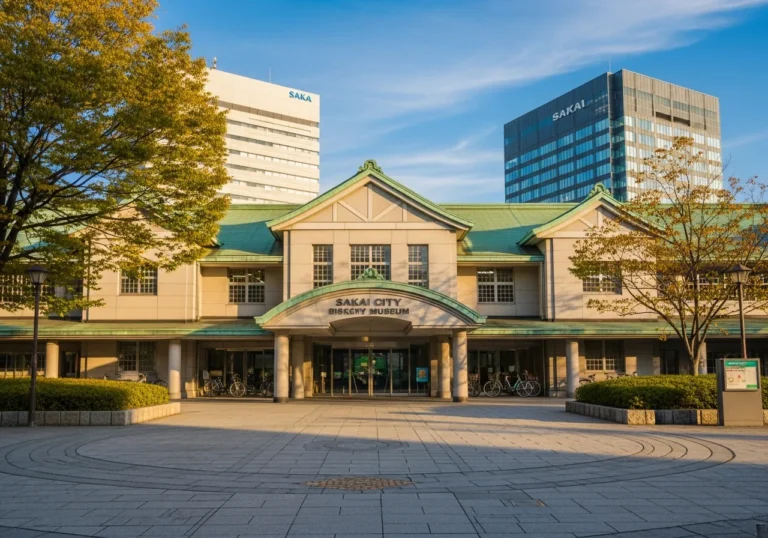
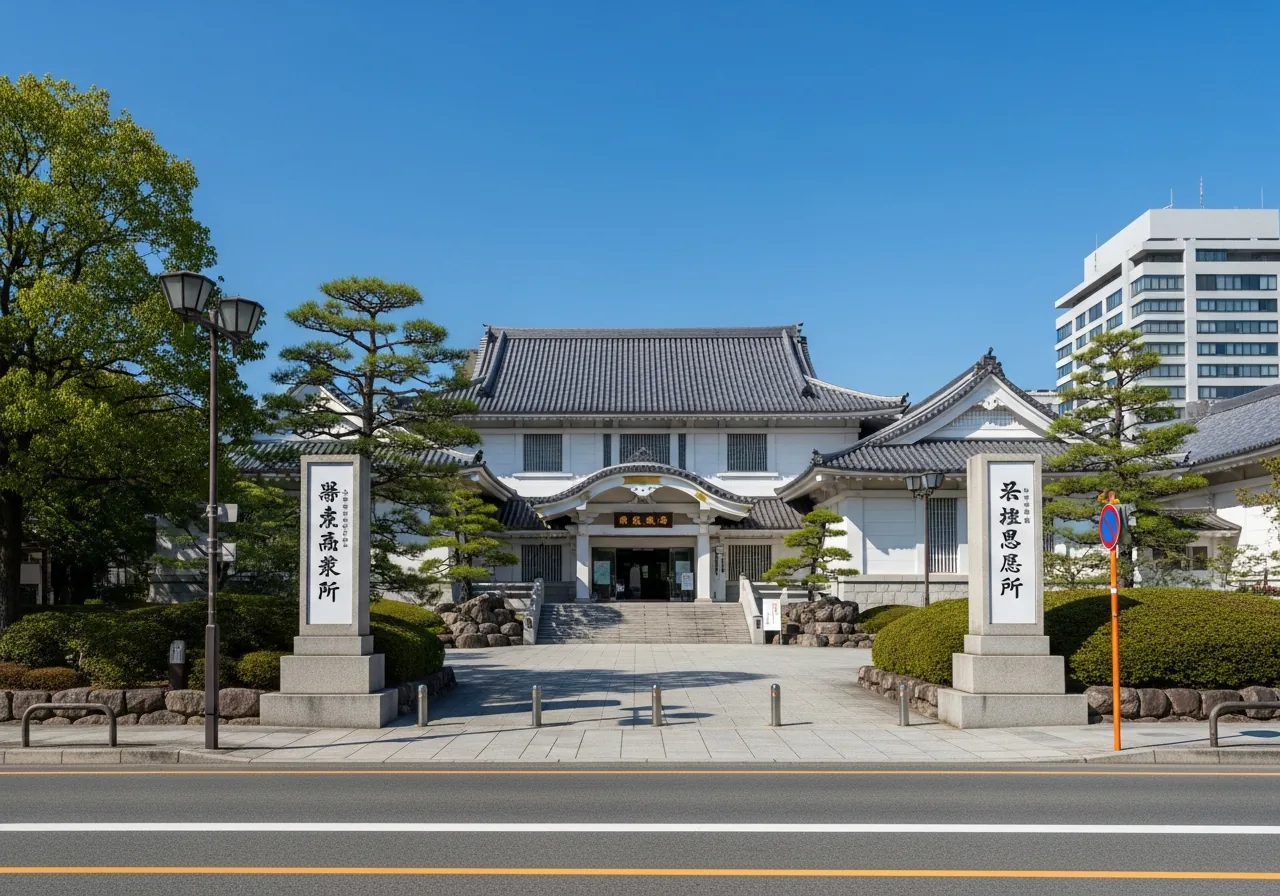
The Sakai Denshokan — the Traditional Crafts Museum — is the obvious starting point, and it is genuinely excellent. The Sakai Knife Museum CUT on the second floor exhibits the history, techniques, and tools of knife production, featuring numerous models and illustrations.
Don’t miss the HIBANA chandelier, made from materials used in the knife-making process. Admission is free, and it is a recommended tourist spot where you can experience Sakai’s history and craftsmanship up close.
But the museum is not the point. The point is what surrounds it.
Knife making in Sakai has a long history, the majority of which developed centred around the area now known as the “old city” — Sakai-ku, Sakai. This place remains the home of many knife studios and wholesalers even today.
Walking those streets — past the half-open shutters, the smell of hot metal, the sound of a togishi at work — is an encounter with a living industrial tradition that has no equivalent anywhere in the world.
The serious traveller should go further still. Some studios have a small retail store attached to the premises for welcoming tourists inside, and some even offer the option to have your name carved onto the purchased knife. There are also exhibits of materials and tours of studios, as well as places offering knife-making and sharpening experiences.
Buying a knife in Sakai is not a souvenir transaction. It is a negotiation with a craftsman about what you actually need — what you cook, how you hold a knife, whether you are right- or left-handed, whether you want carbon steel (sharper, more demanding) or stainless (more forgiving).
There are permanent staff skilled in English, which makes things easy for visitors from overseas. The staff at the Denshokan shop, in particular, will ask you these questions before they show you a blade, and the conversation itself is worth the journey.
What you are buying, when you buy a Sakai knife, is not just a kitchen tool. This system fosters extreme specialisation, enabling each artisan to devote a lifetime to mastering their specific role, pushing the limits of quality to remarkable heights.
It is a community of craft, a network of trust and mutual respect built over generations, and it is the real secret behind the enduring excellence of Sakai uchihamono. The knife in your hand passed through three pairs of specialist hands before it reached you.
Each of those hands spent a career doing one thing. That is what you are holding.
Why This Matters Beyond the Kitchen: What Sakai Tells Us About Industrial Survival
Sakai is not just a story about knives. It is a story about how a pre-industrial craft tradition survives into the twenty-first century — and what conditions make that survival possible.
The answer, in Sakai’s case, is a combination of factors that are almost impossible to replicate deliberately. First, a genuine technical advantage that cannot be easily automated: the togishi’s ability to read the steel through his fingertips, sensing the geometry of an edge that is invisible to the eye, is not a skill that a machine can reproduce at the same level.
Second, a formal quality-certification infrastructure — the 1982 traditional-craft designation, the 2007 trademark registration — that protects the name from dilution. Third, a global market that has, for the first time in Sakai’s history, come to the product rather than requiring the product to go to it.
And fourth — perhaps most importantly — the division of labour. This is not how most Western knife production works, where a single factory or smith often owns the whole process.
Sakai’s specialisation means each artisan does one demanding job for a lifetime and gets extraordinarily good at it. That structure is not just a production method.
It is a social contract between craftsmen, a form of mutual dependency that has kept the community coherent across six centuries of political upheaval, industrial revolution, and two world wars.
The city that Gaspar Vilela compared to Venice in 1561 — self-governing, commercially sophisticated, defended by its own moats — is gone. In 1615, Sakai was razed to the ground in the summer campaign of the Siege of Osaka between the Toyotomi clan and Tokugawa Ieyasu.
The free republic did not survive the unification of Japan. But the workshops survived.
The skills survived. The division of labour survived.
And the knives — which began as tobacco cutters for a Portuguese-introduced habit, which became the tools of the Tokugawa monopoly, which outlasted the samurai who once commissioned the swords from which their techniques descend — are still being made, in the same streets, by the same methods, thirty minutes south of where you are reading this.
Frequently Asked Questions
Q: What makes a Sakai knife different from other Japanese knives?
A: The combination of three factors: forge-welding of hard steel to soft iron (giving both sharpness and flexibility), a strict division of labour between specialist blacksmiths, sharpeners, and handle makers, and a tradition centred on single-bevel professional blades. No other knife-making region uses all three together at the same scale.
Q: Are Sakai knives only for professional chefs?
A: The traditional single-bevel knives (yanagiba, deba, usuba) require skill to use and maintain, and are genuinely designed for professional kitchens. However, Sakai makers also produce double-bevel knives — gyuto, santoku, nakiri — that are excellent for home cooks and require no special technique.
Q: How much should I expect to spend on a Sakai knife?
A: Entry-level hand-forged Sakai knives start at around ¥10,000–¥15,000 (approximately $65–$100). Mid-range professional knives in carbon steel typically run ¥30,000–¥80,000.
Premium honyaki (single-steel) knives by named masters can exceed ¥200,000. The Denshokan shop sells at artisan-direct prices, typically 20–30% below retail.
Q: Can I visit a working forge in Sakai?
A: Some workshops in the old city (Sakai-ku) welcome visitors, and the Denshokan museum hosts live demonstrations. Visiting an active forge usually requires advance arrangement — the museum staff can advise. Guided tours for non-Japanese speakers are also available in the neighbourhood.
Q: What is the Sakai Kiwame mark?
A: The Sakai Kiwame (堺極) was the official quality seal granted by the Tokugawa shogunate, making Sakai the only government-certified blade-making region in Edo-period Japan. The modern equivalent is the Sakai Uchihamono traditional-craft designation, awarded by Japan’s Ministry of Economy, Trade and Industry in 1982.
Q: Is carbon steel or stainless steel better for a Sakai knife?
A: Carbon steel (shirogami or aogami) takes a sharper edge and is easier to re-sharpen, but requires drying after use and will develop a patina. Stainless steel is more forgiving and rust-resistant, better for home cooks who cannot commit to careful maintenance. Both are available from Sakai makers; the shop staff will help you choose based on your actual cooking habits.
Sakai Denshokan (Traditional Crafts Museum) — Visitor Information
Address: 1-chōme-1-30 Zaimokuchōnishi, Sakai Ward, Sakai, Osaka 590-0941 / 〒590-0941 大阪府堺市堺区材木町西1丁1-30
Nearest station: Myōkokuji-mae Station (Hankai Line tram) — 3-minute walk southwest; Sakai Station (Nankai Main Line) — approx. 10-minute walk northeast
Hours: 10:00–17:00 daily; closed every third Tuesday of the month (or the following Wednesday if Tuesday is a public holiday), and during New Year holidays. Hours subject to change — confirm on the official site before visiting.
Admission: Free (museum and permanent exhibition). Hands-on workshops (knife handle fitting, sharpening, engraving) are ticketed separately — approx. ¥15,000 for the knife-assembly experience. Confirm current pricing on the official site.
Official site: sakaidensan.jp