Sakai’s dominance of Japan’s bicycle industry is not an accident of geography or policy — it is the direct consequence of a 1,500-year chain of metalworking expertise that began with the construction of the world’s largest burial mound and ran, without interruption, through sword-forging, gunsmithing, and knife-making before arriving at the bicycle frame. Sakai produces 40% of the bicycles manufactured in Japan, making it the nation’s leading producer. The deeper story is why that figure exists at all: because when imported bicycles began breaking down on Meiji-era streets, the only craftsmen in Japan with the precision metalwork skills to fix them — and then to build them — were the gunsmiths of Sakai, heirs to a tradition that Oda Nobunaga himself had mobilized in the sixteenth century.
Why we can tell you this — MICHI is written and edited in Osaka, and Sakai is twenty minutes south by Nankai train — close enough that our team has walked the moat path around Daisen Kofun, stood inside the Shimano Bicycle Museum on Minamikoyocho, and talked to the city’s tourism office about its industrial heritage. This article draws on the official pages of Sakai City’s municipal government, the Sakai City Industrial Promotion Center, the Sakai Denshokan (Traditional Crafts Museum), the Institute of Developing Economies’ academic archive on the formation of Japan’s bicycle industry, Shimano’s own centennial corporate history, and contemporary reporting from specialist cycling press. Where the historical record is genuinely thin — particularly on the precise transition from gunsmith repair shops to full bicycle assembly in the Meiji period — we say so rather than paper over it.
Stand at the southern edge of Daisen Park on a clear morning and the scale of what Sakai once was becomes briefly legible. The moat surrounding the Nintoku Mausoleum stretches further than you can see from ground level; the forested mound behind it rises like a small mountain.
Somewhere inside that keyhole-shaped hill, buried in the fifth century, lies the emperor whose tomb required so much earth-moving, so much iron tooling, so much organized labor, that it seeded an entire industrial tradition. The bicycle factory you can see from the park’s north gate — its loading bays busy, its workers in company jackets — is, in a very real sense, that tradition’s latest chapter.
Why Does a City Build the World’s Largest Tomb — and What Does That Have to Do With Bicycles?
The 49 burial mounds of the Mozu-Furuichi Kofun Group were constructed from the late fourth to the late fifth centuries. They include the 486-meter-long, keyhole-shaped Daisen Kofun — the largest burial mound in Japan — where Emperor Nintoku is said to be buried. To put that in perspective: it is one of the three largest tombs in the world, alongside the mausoleum of the first Qin emperor in China and the Great Pyramid of Giza in Egypt.
Building something on that scale in the fifth century required engineering, logistics, and above all, iron. You cannot move hundreds of thousands of cubic meters of earth without iron tools — picks, shovels, wedges, chisels — and you cannot make iron tools without smiths who know what they are doing.
In order to create tools to move massive amounts of soil, skilled iron workers from China and other parts of Japan moved to the area and developed advanced metalworking techniques. The Kofun period, in other words, was Sakai’s first industrial recruitment drive.
This is the first “why” in the chain. The flat, coastal plain south of what is now Osaka was ideal for monumental construction — the terrain gave the tomb-builders room to work.
The flat terrain surrounding Sakai was best suited to these massive construction projects. To this day, Sakai City has the most impressive examples.
But the consequence of that suitability was a concentration of metalworking skill that would persist for fifteen centuries. The smiths who came to build the tombs stayed.
Their descendants built swords. Their descendants’ descendants built guns.
And eventually, their descendants built bicycles.
Why Did Sakai Become Japan’s Sword Capital — and Then Its Gun Capital?
The city of Sakai had a long tradition as a centre for metal forging, going back to at least the middle ages, and in the late 19th century there were a large number of persons working as artisans in the production of cutlery and edged tools, as gun forgers, and as specialists in metal castings. That continuity is the key. Sakai did not reinvent itself with each new technology — it adapted an existing skill base.
The medieval city that emerged from this metalworking foundation was extraordinary by any measure. Medieval Sakai was an autonomous city governed by merchant oligarchs.
During the late Muromachi period and the Sengoku period, from about 1450 to 1600, Sakai developed into one of the richest cities in Japan as a center of foreign trade. It was also a leading producer of textiles and ironware.
The comparison that contemporaries reached for was Venice — a self-governing commercial republic that answered to no feudal lord and traded with everyone.
Sakai was a leading seaport and commercial centre from the mid-14th to the mid-17th century. Its rich merchants traded with China, Korea, the Ryukyu Islands, and Europe.
The tribute missions to Ming were important financial projects for Sakai merchants, who were financiers. This was not a backwater craft town; it was a sophisticated entrepôt where capital, materials, and technical knowledge circulated freely — exactly the environment in which new industries take root.
Then came the gun. Portuguese traders arrived at Tanegashima Island in 1543, and the matchlock spread across Japan with startling speed.
When matchlock guns arrived in Tanegashima Island during the Sengoku period, it took no time for the new blacksmithing techniques to reach Sakai, then the center of trade and exchanges for surrounding regions. Aided by its accessibility to saltpeter, an ingredient used in making gunpowder, manufacturing of matchlock guns began in Sakai where there already was a foundation for smithery.
The scale of what followed is still startling. In the 16th century, the introduction of matchlock guns revolutionized warfare.
Recognizing the power of firearms, Oda Nobunaga commissioned Sakai’s craftsmen to mass-produce matchlock guns, propelling Japan to become the world’s largest firearms manufacturer within just 30 years. By the 1580s, historians estimate Japanese armies may have fielded between 250,000 and 500,000 guns.
Japan possessed more firearms than any European nation. Sakai alone had hundreds of gunsmiths producing weapons for competing lords.
The technical demands of gunsmithing were severe — and they mattered enormously for what came later. Manufacturing guns required techniques that did not yet exist in Japan at the time, and even for the group of blacksmiths skilled in forging iron, creating a perfectly cylindrical gun barrel and using screws as the breech plug involved unfamiliar techniques that had to be mastered anew. Mastering those techniques — precision boring, screw-cutting, controlled heat treatment — gave Sakai’s smiths a repertoire that no other city in Japan could match.
By the 1560s, armourers in Sakai and Kunitomo produced thousands of matchlock guns annually to meet demand. The precision required to bore a perfectly straight barrel — so that the ball would fly true — was the same precision that, three centuries later, would be required to cut a reliable bicycle freewheel.
The tools changed. The underlying discipline did not.
Why Did the Gun Industry Collapse — and What Happened to the Smiths?
The Tokugawa peace that settled over Japan after 1600 was catastrophic for the gun trade. The shogunate had no interest in an armed populace, and it moved systematically to bring firearms production under central control.
Starting in 1607, the shogun ordered that all gunsmiths in Japan move their workshops to Nagahama. The gunsmiths of Sakai were exempted from this edict because the shogun’s influence was too weak there.
Even so, demand collapsed. A city that had supplied hundreds of thousands of guns to warring daimyo now had almost no customers.
The metalworking skills developed by generations of craftsmen had been used by gunsmiths, creating a flourishing firearms industry in Sakai. However, sales dried up after the central government took over the production of firearms in the early Meiji Period and metal workers lost their jobs. Many of these workers used their skills to forge knives, while others repaired imported bicycles or produced bicycle components.
This is the pivot point that the standard tourist narrative tends to compress into a single sentence, but it deserves more attention. The smiths of Sakai did not simply “switch” from guns to bicycles as if changing a product line.
What they preserved, across two centuries of Tokugawa peace, was a culture of precision metalwork — applied first to knives, then to a growing variety of iron goods — that kept the underlying skill alive until a new technology arrived that needed it. With the decline in demand for swords following the end of the Sengoku period, Sakai’s craftsmen shifted their expertise to everyday tools, most notably the tobacco knife.
The blacksmithing tradition of Sakai began with iron tools in the Kofun period, evolved into sword-making, adapted to firearms, transitioned to tobacco knives, and ultimately led to the creation of world-class kitchen knives.
The knife industry is not a digression from the bicycle story — it is the bridge. In modern times, Sakai boasts a 90% share of the Japanese knives used by professional chefs. That dominance exists because the knife industry kept the precision-forging tradition alive through the long Edo-period interlude, maintaining workshops, training apprentices, and refining techniques, until the Meiji era opened Japan to Western technology and the bicycle arrived.
Why Did the Bicycle Arrive in Sakai Specifically — and Not in Osaka or Tokyo?
The bicycle reached Japan in the late nineteenth century as an expensive imported curiosity. Bicycles were first introduced to Japan during the Keio era near the end of the Edo period. Although imports began gradually around 1870, the contraptions remained beyond the reach of the average Japanese, who nonetheless enjoyed the extremely popular practice of renting them by the hour.
The problem was that early imported bicycles were unreliable. As a result of the fact that the first imported bicycles to arrive in Japan lacked brakes, a seemingly endless series of breakdowns and accidents ensured a brisk business in repairs and replacement parts.
Someone had to fix them. And the question of who was best placed to do that fixing is where Sakai’s accumulated advantage becomes decisive.
At that time, it was gunsmiths, who had good knowledge and deep experience in machinery and metal, who were engaged in repairing bicycles and manufacturing bicycle parts in Sakai City. This was not a planned industrial strategy.
It was an organic response: the people with the right skills happened to be concentrated in one city, and that city happened to be adjacent to the largest consumer market in western Japan. The fact that the city of Sakai was located within the very important consumption centre which is formed by the cities of Osaka and Kobe and their environs was a factor which greatly favoured the rapid development of parts manufacture by small producers.
The academic record on this transition is illuminating. Sakai’s industrial structure had an already existing capacity to respond to new types of metal and machine industries, such as the bicycle industry.
Pioneer entrepreneurs borrowed, during the initial stages of their businesses, the skills of gunsmiths like Kondo Kaichi for carrying out bicycle repairs and other manual operations. The Institute of Developing Economies’ working paper on the formation of Japan’s bicycle industry is one of the few academic sources to document this transition in detail, and its conclusion is unambiguous: Sakai’s pre-existing metalworking ecosystem was the decisive factor.
Repair led to parts manufacture, and parts manufacture led to assembly. In the beginning many were imported, which also meant many malfunctions, and it was the gunsmiths of Sakai with their excellent metalworking abilities who contributed most to the required repairs and manufacturing of parts. Eventually the bicycles started being produced domestically, and the Japanese bicycle industry developed from Sakai.
Why Did World War I Seal Sakai’s Position?
The transition from repair shop to manufacturing hub was gradual through the Meiji era. What accelerated it into dominance was a geopolitical event on the other side of the world.
World War I triggered the establishment of the bicycle industry in Japan. By that time, Japan still relied heavily on imported bicycles; however, most imports stopped due to the war and Japan had to domestically manufacture products, including entire bicycles. During this period, Sakai dramatically developed as a major bicycle production area.
The logic is straightforward but worth unpacking. European bicycle manufacturers — primarily British and German — were the dominant suppliers to the Japanese market.
When the war consumed their production capacity and disrupted shipping, Japan faced a sudden, total shortage of bicycles and parts. The question was not whether domestic production would fill the gap, but where in Japan it would happen.
The advent of World War I brought imported bicycle imports to a halt, creating a need for domestically produced bicycles. With its long history of skilled iron workers, Sakai soon became the center of bicycle production in Japan.
The industrial structure that emerged from this wartime pressure was distinctive. Rather than a few large factories, Sakai developed a dense network of small and medium-sized specialists.
The group making bicycle parts in Sakai consists of many medium- and small-size parts factories and related manufacturers densely clustered in a limited geographical area; these enterprises complement one another and are organized in an intricate network based on social division of labour and the parent enterprise-subcontractor relationship. Even a major manufacturer produces on its own only a limited variety of specific parts; moreover in many instances one finished component is the outcome of a relay of different manufacturing procedures by a number of factories.
This is the Institute of Developing Economies’ analysis of what economists now call an industrial cluster — a geographic concentration of interdependent specialists whose proximity creates efficiencies that no single large factory can replicate.
The freewheel is a useful case study. In the area of freewheel production, in 1913 only Sanko succeeded in manufacturing frame joints, and it was not until World War I that the first success in producing a complete freewheel was achieved.
Tokyo was behind Sakai in this respect. The freewheel — the ratcheting mechanism that allows a bicycle wheel to spin freely when the rider stops pedaling — was the most technically demanding component of a bicycle to manufacture.
That Sakai was ahead of Tokyo in mastering it tells you something important about the depth of the city’s metalworking culture.
It is said that without bicycle parts manufactured in Sakai, Japan’s bicycle industry would not function. That claim, made by the Sakai Denshokan (Traditional Crafts Museum), is not boosterism. It reflects a genuine structural reality: the cluster of specialists that formed in Sakai during and after World War I became so deeply embedded in the national supply chain that no other city could easily replicate or replace it.
Why Did One Man’s Workshop Become the World’s Largest Bicycle Component Company?
Into this already-thriving industrial ecosystem, in the winter of 1921, walked a twenty-six-year-old apprentice metalworker with a borrowed lathe and a very specific ambition.
Shozaburo Shimano opened the Shimano Iron Works at Higashi Minato in the city of Sakai in February 1921. Shimano’s ambitions were to produce the most technological component for the time: the freewheel. The financial resources were very scarce, so much so that the lathe to start production was borrowed, and the premises, rented for 5 yen per month, had an area of 40 square meters.
Why the freewheel? Because it was the hardest thing to make well.
In the second year, Shozaburo began producing bicycle freewheels to realize his long-nourished aspiration. He selected this product since its production was particularly challenging even in Sakai, home to a thriving bicycle industry, and product quality needed radical improvements.
This is a revealing choice of strategy. Rather than competing in a crowded market for simpler parts, Shimano targeted the component where quality was worst and the barrier to entry was highest.
It is the same logic that had driven Sakai’s smiths for centuries: master the hardest technique, and the market comes to you.
In his youth, Shozaburo Shimano had apprenticed as a knife maker, a traditional industry in his home city of Sakai. The connection is not incidental.
The knife-making apprenticeship gave him the precision metalwork foundation — the feel for tolerances, the understanding of heat treatment, the discipline of finishing — that he then applied to freewheels. He was, in the most literal sense, the product of Sakai’s accumulated craft tradition.
The Shimano centennial history records that Shozaburo’s quality philosophy was almost aggressively simple: he firmly believed that no products of poor quality would sell no matter how hard he tried to sell them. To put it the other way around, he believed that high-quality products would sell without sales activities. He was so confident about the quality of his product that he decided to launch an innovative initiative for the time: every defective freewheel would be replaced by two more.
The growth that followed was not explosive — it was steady, disciplined, and compounding. In ten years, Shimano was exporting freewheels to China.
The business was incorporated as a limited corporation in January 1940 under the name Shimano Iron Works Co., Ltd. In 1951, it was renamed Shimano Industrial Co., Ltd.
Shimano began making its famous derailleurs in 1956. Shozaburo’s sons — Shozo, Keizo, and Yoshizo — assumed leadership roles and held equity stakes as the firm expanded.
Growth was financed via disciplined profit reinvestment and local credit, characteristic of Japanese craft-based enterprises. Informal family agreements prioritized manufacturing quality and long-term projects like the 1961 three-speed hub and 1973 Dura-Ace.
The American bicycle boom of the 1970s was the moment Shimano went global. When the 1970s United States bike boom exceeded the capacity of the European bicycle component manufacturers, Japanese manufacturers SunTour and Shimano rapidly stepped in to fill the void.
While both companies provided products for all price ranges of the market, Shimano initially paid more attention to rethinking the basic systems and bringing out innovations at the low end of the market. In the 1980s, with Shimano pushing technical innovation and lower prices, the more traditional European component manufacturers lost significant market presence.
Today, Shimano sales constitute an estimated 85% of the global bicycle component market by value. In 2024, Shimano recorded revenue of US$2.87 billion. The headquarters remain in Sakai, at the same address they have occupied for over a century, a few kilometers from the workshop where Shozaburo borrowed his first lathe.
The Cluster That Shimano Built — and That Built Shimano
It would be a mistake to tell this story as if Shimano were the whole of it. Shimano is the most visible expression of Sakai’s bicycle industry, but the industry is larger than any single company.
Sakai produces 40% of the bicycles manufactured in Japan, making it the nation’s leading producer. Sakai is home to 15 bicycle part manufacturers, each of them known inside and outside their industry for high quality and internationally competitive technologies.
The assembly process itself reflects the cluster logic. About 1,000 individual parts must be assembled to build a single bicycle.
Those parts come from dozens of specialists, each expert in their narrow domain, each embedded in a web of relationships — supplier, subcontractor, assembler, inspector — that has been refined over more than a century. Assembly is a manual process extending from the attachment of each part to brake adjustment and final inspection.
Training, skill, and intuition are required by each stage of the manufacturing process, particularly in the final inspection when workers make an instantaneous judgment regarding the quality of each bicycle, one product at a time. Veteran employees with at least 10 years’ experience use their finely honed powers of observation to check for loose parts, unusual sounds, and other potential defects.
This is not a production line in the conventional sense. It is a craft system that has been scaled — which is precisely what Sakai’s metalworking tradition has always been.
Why Does This History Still Matter — to Sakai, to Japan, and to the Traveler?
The easy answer is Shimano: a company headquartered here generates nearly three billion dollars in annual revenue and equips the bicycles of Tour de France pelotons, weekend mountain bikers in Colorado, and commuters in Amsterdam. That alone would make Sakai significant. But the more interesting answer is structural.
Sakai is a case study in what economists call path dependency — the way that early choices and accidents of geography create self-reinforcing advantages that persist across centuries. The iron workers who came to build Emperor Nintoku’s tomb in the fifth century could not have imagined that their descendants would be making bicycle freewheels for export to China. But the skills they established, the culture of precision metalwork they embedded in the city, created a trajectory that bent consistently toward the same outcome: Sakai makes the hardest metal things, better than anyone else.
As the time progressed and the firearms manufacturing died out, its ironmaking technology was applied to the production of bicycle parts, exercise equipment, hand trowels, and such, and Sakai’s excellent craftsmanship has been preserved through them. The Sakai Film Office’s account of the city’s industrial history frames this as a continuous thread rather than a series of separate industries — and that framing is correct. Each technology was new; the underlying competence was ancient.
There is also a contemporary dimension. The global bicycle market is in a period of significant transition, driven by e-bikes, electronic drivetrains, and the post-pandemic cycling boom and its subsequent correction.
Starting with the 3.3.3 freewheel and moving onto innovations such as 3-speed hubs, indexed shifting, Dual Control levers, Hyperglide cassettes, Di2 shifting and SPD pedals, these technologies became ubiquitous in the cycling industry. Shimano’s challenge now is to maintain its position in a market where electronic systems and e-bike motors require different engineering competencies than mechanical components — and where competitors like SRAM are gaining ground at the high end.
For Sakai itself, the bicycle industry is one pillar of a broader effort to redefine the city’s identity after decades of being overshadowed by Osaka. The Mozu-Furuichi Kofun Group was registered as a UNESCO World Heritage Site in 2019, bringing belated international attention to a historical phenomenon that had been hiding in plain sight in southern Osaka for 1,600 years. The kofun and the bicycle museum are now being marketed together — ancient and modern expressions of the same underlying story about what this city has always been good at.
What the Discerning Traveler Actually Gains Here
Most visitors to the Osaka region do not make it to Sakai. Those who do tend to come for the kofun — the UNESCO designation has done its work — and leave without understanding that the burial mound and the bicycle factory are the same story told at different speeds.
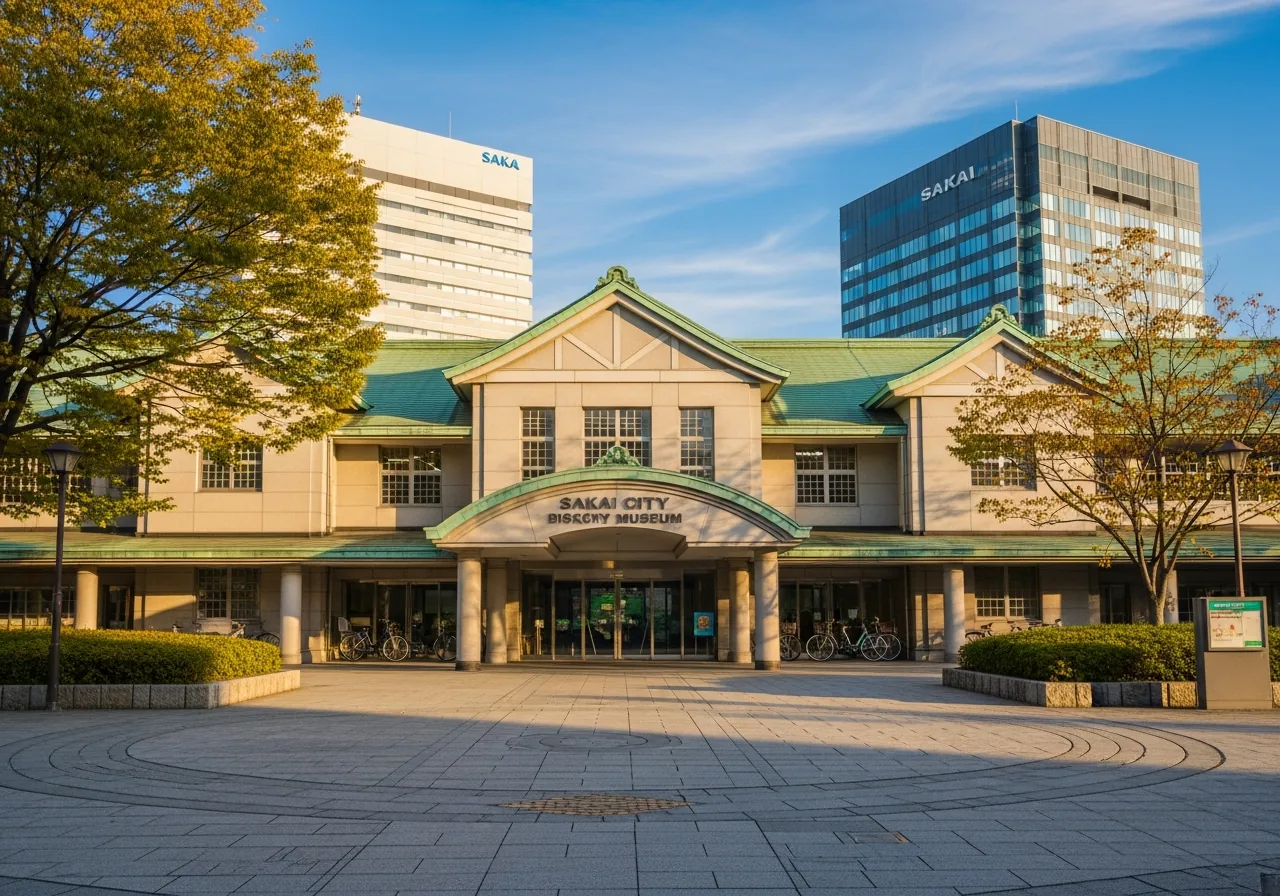
The Shimano Bicycle Museum, which relocated and expanded in March 2022, is the best single place to grasp the full arc. The Shimano Cycle Development Center was renovated and re-opened in March 2022 as the Shimano Bicycle Museum in Minamikoyocho, Sakai Ward, Sakai City.
Taking as its theme the beginnings, spread, and future of bicycles, this is the only museum in Japan packed with the appeal of bicycles for the enjoyment of everyone from children to adults. The museum features dynamic displays of a wide selection of bicycles, including some of the oldest in the world and some other incredibly unique examples.
The experience zone on the first floor, which is free, allows for a casual dive into the relationship between Sakai and the bicycle.
But the museum is most rewarding if you arrive having already walked the moat path around Daisen Kofun. The fifteen-minute walk from the kofun to the museum is, in miniature, the fifteen-century walk from the iron tools that built the tomb to the precision components that equip the world’s bicycles. The city’s official bicycle industry page frames this continuity explicitly, tracing the industry’s roots through gunsmithing to the Sengoku period — but standing in the landscape, the connection becomes visceral rather than merely intellectual.
For the traveler who cares about how industrial excellence actually happens — not as a matter of policy or planning but as the slow accumulation of skill across generations — Sakai offers something that no amount of reading can fully substitute for. You can see the tomb that started it.
You can walk through the museum that documents where it ended up. And if you time your visit right, you can watch a worker on a fifty-meter assembly bench spend twenty minutes building a bicycle by hand, checking each component with the unhurried attention of someone who knows that their judgment is the last line of quality control before the machine reaches a rider.
Training, skill, and intuition are required by each stage of the manufacturing process, particularly in the final inspection when workers make an instantaneous judgment regarding the quality of each bicycle, one product at a time. Veteran employees with at least 10 years’ experience use their finely honed powers of observation to check for loose parts, unusual sounds, and other potential defects.
That description — from the City of Sakai’s own account of its bicycle industry — could have been written about a Sengoku-era gunsmith checking the bore of a matchlock barrel. The technology is different.
The discipline is the same.
That is what Sakai offers the intellectually serious traveler: not a heritage attraction, but a working demonstration of how craft knowledge survives, adapts, and compounds across time. The bicycle capital of Japan is not a marketing slogan. It is the latest name for something that has been true of this city, in one form or another, for fifteen hundred years.
Frequently Asked Questions
Q: How did Sakai become Japan’s bicycle capital?
A: Through a 1,500-year chain of metalworking expertise. Iron workers who came to build the Kofun-period burial mounds established a precision-smithing tradition that evolved through sword-making and gunsmithing.
When imported bicycles began breaking down in the Meiji era, Sakai’s gunsmiths — the most technically skilled metalworkers in Japan — were best placed to repair and then manufacture them. World War I cut off European imports and forced domestic production, cementing Sakai’s position as the national center.
Q: What share of Japan’s bicycles does Sakai produce?
A: According to the City of Sakai’s official figures, Sakai produces approximately 40% of all bicycles manufactured in Japan, making it the country’s leading producer.
Q: Is Shimano really based in Sakai?
A: Yes. Shimano was founded in Sakai in February 1921 by Shozaburo Shimano and its headquarters remain there today, at 3-77 Oimatsu-cho, Sakai-ku. The company’s roots in Sakai’s metalworking tradition are not incidental — Shozaburo himself apprenticed as a knife-maker in the city before founding his ironworks.
Q: What is the Shimano Bicycle Museum and is it worth visiting?
A: The Shimano Bicycle Museum, which reopened in its current expanded form in March 2022, is Japan’s only museum dedicated entirely to bicycles. It covers 200 years of cycling history with real bicycles from around the world, interactive exhibits, and a free ground-floor zone on Sakai’s relationship with the bicycle. It is genuinely worth a half-day, particularly combined with a walk around the Daisen Kofun moat nearby.
Q: Can I visit Sakai as a day trip from Osaka?
A: Easily. Sakai is approximately 20 minutes from Osaka’s Namba Station on the Nankai Koya Line.
The Shimano Bicycle Museum, the Daisen Kofun moat path, and the Sakai City Museum can all be covered in a full day. The city also has a bicycle rental system if you want to explore on two wheels.
Shimano Bicycle Museum — Visitor Information
Address: 2-2-1 Minamikoyo-cho, Sakai-ku, Sakai, Osaka 590-0073 / 〒590-0073 大阪府堺市堺区南向陽町2丁2-1
Nearest station: Sakaihigashi Station (Nankai Koya Line) — approx. 5 minutes on foot
Hours: 10:00–16:30 (last admission 16:00); closed Mondays (and Tuesday when Monday is a public holiday), year-end and New Year holidays — confirm on the official site before visiting
Admission: Adults ¥500 / High school & university students ¥200 / Under 15 and over 65 free — approx. figures, confirm on official site
Official site: sakai-tcb.or.jp