The ground you walk across in Osaka Castle Park — the jogging paths, the concert lawns, the cherry-blossom picnic spots — was, for 75 unbroken years, the largest weapons factory in Asia. From 1870 until a single day in August 1945, the Osaka Army Arsenal occupied the entire eastern flank of the castle grounds, employing at its peak some 66,000 workers and producing the artillery that armed Japan through every war of its imperial era. Almost nothing of that industrial colossus remains above ground, and the park’s own signage barely mentions it.
Why we can tell you this — MICHI is written and edited in Osaka; our team walks the castle park regularly and has stood at the fenced perimeter of the surviving chemical-laboratory building on the park’s northern edge. This piece draws on the National Diet Library’s photographic archive of the Meiji and Taishō eras, the peer-reviewed architectural study published in the Journal of Asian Architecture and Building Engineering on military and civil uses of Osaka Castle in the modern age, the Japan Tourism Agency’s heritage record for the surviving laboratory structure, and a July 2025 report in The Japan Times on the current preservation debate. Where the record is thin — particularly on the internal social history of the arsenal’s workforce — we say so rather than speculate.
Stand at the north end of Osaka Castle Park on a weekday morning and you will see joggers, dog-walkers, a few tourists consulting their phones. What you will not immediately see is a two-story red-brick building behind a chain-link fence, its neo-Renaissance facade slowly being consumed by ivy.
Most visitors pass it without a second glance. It is the last standing structure of what was once, by any reasonable measure, the industrial heart of imperial Japan’s military machine — and the fact that almost no one stops to look at it is itself a historical argument worth unpacking.
Why Was a Weapons Factory Built Inside a Castle Park?
The short answer is that in 1870 there was no castle park. There was a ruined castle, a traumatized city, and a new government in desperate need of guns.
The Meiji Restoration of 1868 had ended the Tokugawa shogunate, but it had not ended Japan’s vulnerability. As the National Diet Library’s archive records, for the newborn Meiji government, establishing armament modernization and weapons self-sufficiency was one of the highest priorities.
The lesson of the previous two decades was brutally clear: after Admiral Matthew C. Perry forced the signing of the Treaty of Kanagawa in 1854, Japanese elites concluded that they needed to modernize the state’s military capacities or risk further coercion from Western powers.
The shogunate had dithered. The new government would not.
The man who proposed the specific solution — a weapons complex at Osaka Castle — was Ōmura Masujirō, the military reformer now remembered as the father of the modern Japanese army. Ōmura focused attention on the superiority of Osaka Castle as a military base and proposed the idea of basing central military organizations there, though quite a lot argued to use the capital, Tokyo, as the base.
His reasoning was geographic and logistical: the central location of Osaka favored transport routes over land and water. Osaka sat at the confluence of Japan’s inland sea routes and its river networks — a natural distribution hub for heavy materiel.
Ōmura never lived to see his proposal enacted. On November 5, 1869, he became a victim of an assassin and was killed.
He had been targeted by conservative samurai who understood, correctly, that his reforms — conscription, Western-style organization, industrial weapons production — would end their class’s monopoly on military power. However, Ōmura’s petition for installing the Naval and Army Academy and establishing production factories for guns, ammunition and explosives in Osaka was adopted to some degree.
The dead reformer’s blueprint survived him.
Why Osaka Castle Specifically — and Why Did the Castle Survive?
The castle itself was in a parlous state. Osaka Castle had burnt down during the Meiji Restoration in 1868, and the site had various uses since.
The Tokugawa-era keep was gone. The grounds were a patchwork of scorched stone walls, empty warehouses, and abandoned administrative buildings — the detritus of a feudal order that had just collapsed.
This desolation was, paradoxically, what made the site so attractive to the new military planners. There was space, there were existing stone fortifications that could serve as perimeter walls, and there were structures that could be repurposed immediately.
In February 1870, an office for weapons production — the Zōheishi — was established, and in March of that year the first employees moved into an empty rice warehouse in the northeastern part of Osaka Castle. Machines and workers came mainly from the Nagasaki Iron Works.
The choice of the northeastern corner was deliberate. It was the section of the grounds furthest from the city’s residential districts, closest to the Ōkawa river for water transport, and sheltered by the existing castle moats.
For transportation of the heavy castings and big guns, a canal had been dug only for the utilization of the arsenal, starting from its grounds and navigating under the massive rampart and going through a secluded section of the country and to the seacoast. The castle’s own defensive geography — the moats, the stone walls, the elevated ground — became the arsenal’s security perimeter and its logistics infrastructure simultaneously.
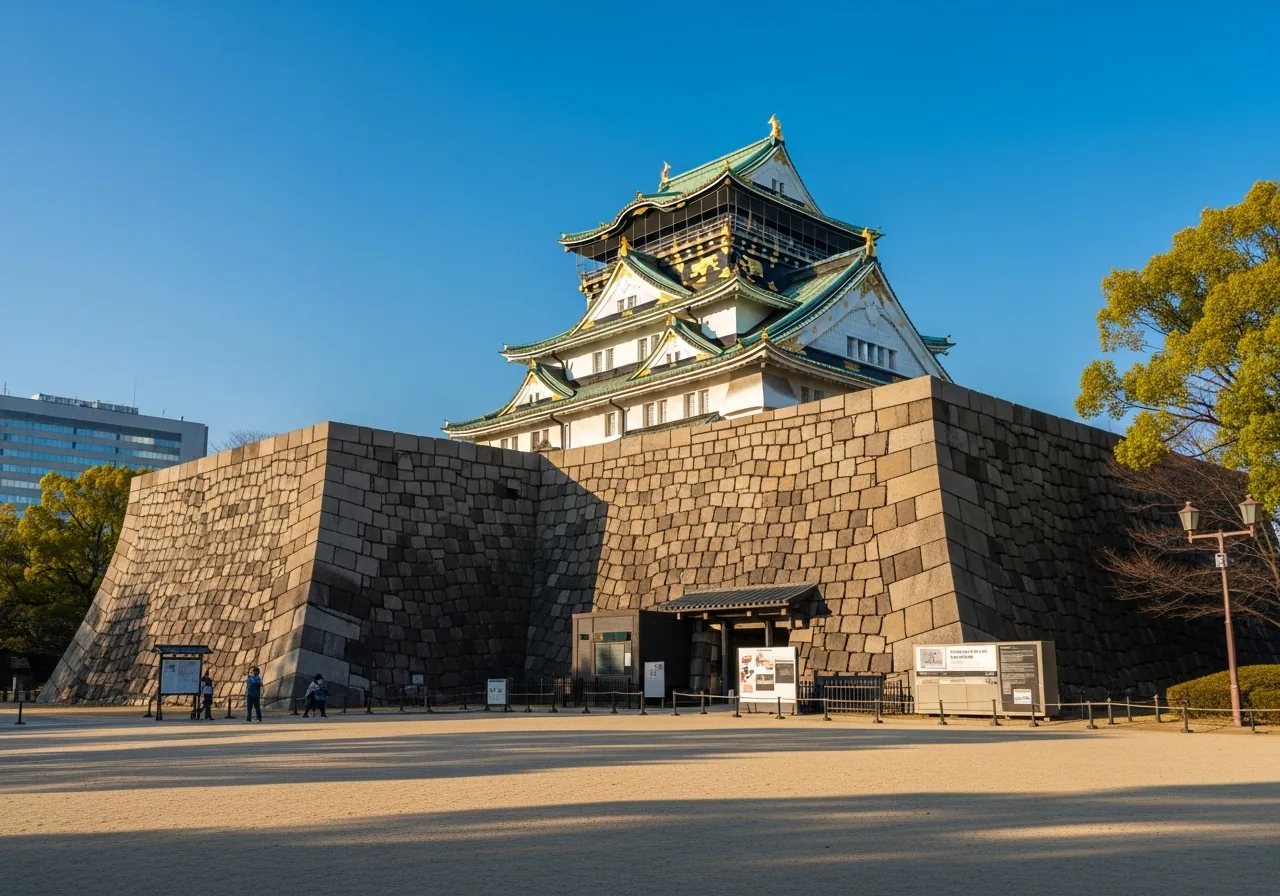
This is the first deep irony of the site: a castle built to project feudal military power was repurposed to produce the industrial weapons that made feudal military power obsolete. The stone walls that Tokugawa Hidetada had raised in the 1620s to intimidate rival daimyō now enclosed the machinery that would arm a conscript army of commoners.
Why Did the Arsenal Grow So Rapidly — and What Did It Actually Make?
The arsenal’s early years were, by its own later admission, improvised. The 1902 institutional history, the “Osaka Hohei Kosho Enkakushi,” says in its preface that the arsenal was incomplete in its organization system and businesses in the beginning: “the business of our arsenal had not always been operated under a specific policy. In most cases, according to military requirements and the trend of the time, but only to achieve a specific task, we made plans and performed our duties.”
That reactive quality — building capacity in response to each successive crisis — is precisely what drove the arsenal’s explosive growth. During the Satsuma Rebellion in 1877, the arsenal was very active to meet the high demand.
The rebellion, the last armed uprising of the samurai class, was suppressed by a conscript army that needed enormous quantities of ammunition. The arsenal supplied it.
Each war thereafter produced the same dynamic: demand spiked, the facility expanded, and when the war ended, workers were laid off until the next emergency.
The institution changed names repeatedly as it grew: in 1871, “Office for weapons production Osaka”; in 1872, “Osaka Factory”; in 1875, “Artillery Office of the 2nd Artillery Military District”; and finally, in 1879, “Artillery Osaka” as the state production center for guns and grenades, while the Arsenal Tokyo was production center for handguns. The division of labor was explicit: Osaka made the heavy weapons, the artillery that would define modern warfare.
The heavy artillery guns, mortars, long-barrelled guns, howitzers, and navy cannons were cast at the arsenal of Osaka. This was not merely assembly work.
The arsenal was a vertically integrated industrial complex that had to master metallurgy, precision engineering, and chemistry from near-scratch. Established at Osaka Castle in 1870, the arsenal was at the forefront of modern Japanese industry.
After installing Japan’s first open-hearth furnace, it started mass production of steel in 1890. That open-hearth furnace — a technology then at the cutting edge of European steelmaking — was not just a production tool.
It was a statement of industrial ambition, and it gave the arsenal the capacity to produce the alloy steels needed for reliable gun barrels without depending on imports.
Other wars, such as the First Sino-Japanese War (1894–1895) and the Russo-Japanese War (1904–1905), allowed the arsenal to expand, so that it captured the entire eastern side of the castle grounds. In the initial stage, the premise was situated in the northeast corner of Osaka Castle, but towards the end of the Meiji era, after the expansion during the Russo-Japanese War, the site expanded to the Tamatsukuri gate located in the south edge of the Castle so that it covered the entire eastern side. What had begun in a single rice warehouse now occupied a territory that would take twenty minutes to walk across.
The Arsenal as Industrial Incubator
The arsenal’s significance to Osaka’s economy extended far beyond its own walls. The production skills gradually improved and it became a power to promote the development of private industries.
The metallurgical techniques developed at the arsenal — the open-hearth steelmaking, the precision casting, the chemical analysis — diffused outward into the private sector. Osaka’s broader industrialization, which earned the city its reputation as the “Manchester of the East,” was seeded in part by the technical knowledge that the arsenal generated and the skilled workers it trained.
Osaka’s industrialization began with the establishment of the Osaka Arsenal in 1870 and the Japan Mint a year later. These two state institutions — one making weapons, one making money — were the twin engines of Meiji Osaka’s transformation from a merchant city into an industrial one. The arsenal was not a parasite on the city’s economy; it was one of its founding institutions.
Why Did the Arsenal Become a Site of Labor Conflict?
The arsenal’s workforce was not simply a passive instrument of state power. It was, from the beginning, a volatile social formation — a concentration of skilled industrial workers in a city that was simultaneously developing the political consciousness to demand rights.
The growth of the economy because of the wars sometimes brought hard times to workers. As a result of the repeated mass employment through special military procurements and mass lay-offs after the end of each war, large-scale labor disputes sometimes occurred.
The pattern was structural: the state hired massively when it needed guns, then discarded workers when the fighting stopped. This boom-and-bust cycle, repeated through the Satsuma Rebellion, the Sino-Japanese War, and the Russo-Japanese War, created a workforce that understood its own expendability.
Labour unions emerged in Japan in the second half of the Meiji period, after 1890, as the country underwent a period of rapid industrialization. The arsenal’s workers were among the most technically skilled in the country — machinists, metallurgists, chemists — and they were concentrated in a single location, which made collective action both possible and threatening to the state. Until 1945, however, the labour movement remained weak, impeded by a lack of legal rights, anti-union legislation, management-organized factory councils, and political divisions between “cooperative” and radical unionists.
The tension between the arsenal’s workers and the state that employed them was a microcosm of the broader contradiction at the heart of Meiji modernization: the government needed an industrial proletariat to build its military power, but an industrial proletariat was precisely the social formation most likely to challenge state authority. The arsenal created the workers who would eventually demand the rights that the system denied them.
Why Did the Park and the Arsenal Coexist — and How Did That Happen?
The story of how Osaka Castle Park came to exist alongside — and eventually replace — the arsenal is one of the more revealing episodes in the site’s history. It illuminates the tension between military necessity and civic aspiration that defined the Taishō and early Shōwa periods.
The academic study published in the Journal of Asian Architecture and Building Engineering on the modern uses of Osaka Castle notes that civil and military uses of the site occurred competitively throughout time. In the beginning of the Meiji era, military and civil uses began to coexist, with several modern buildings appearing in a Western style. During the Meiji era, military use was constantly expanding, while the Taishō era saw a decrease in military use in accordance with the international tendency towards military reduction.
The park that visitors know today was born from a specific political moment: the enthronement of Emperor Hirohito in 1928. In 1931, to commemorate Emperor Hirohito’s enthronement, Osaka Castle underwent a renewal.
Using funds donated by the public — 1.5 million yen at the time — the Main Tower was reconstructed, Osaka Castle Park was opened, and the military headquarters of the 4th Division of the Imperial Japanese Army was built. The park was not a concession to civilian life at the expense of military use; it was a carefully managed coexistence, with the army retaining the eastern grounds while a public park was created on the western and central areas.
The building that housed the 4th Division headquarters — now the restaurant and shopping complex known as MIRAIZA OSAKA-JO — is the most visible surviving artifact of this military-civilian negotiation. It is a historic building that was built in 1931 as the military headquarters of the 4th Division of the then Imperial Japanese Army.
It managed to escape getting damaged from the air raids in the Pacific War that lasted until the end of the war, so it remains intact today. Its Romanesque exterior — turrets, arched windows, the grandeur of a medieval European fortress — was a deliberate architectural statement: the army presenting itself as the guardian of Japanese civilization, not merely its instrument.
In 1931, Osaka Castle Park was opened to the public, but most of the area was used by the Imperial Japanese Army. The park was, in a real sense, a public-relations gesture grafted onto a military installation. Visitors could stroll among the cherry trees and admire the newly reconstructed castle keep, while a few hundred meters away, the arsenal continued producing the weapons of empire.
Why Did the Arsenal Survive So Long — and How Was It Destroyed?
The arsenal’s survival through the early years of the Pacific War was a function of geography and Allied targeting priorities. Osaka was not the first city on the American bombing list; the industrial complexes of Nagoya, the naval facilities of Kure, and the urban centers of Tokyo drew attention first. The arsenal, despite its enormous size and strategic importance, was initially spared the worst.
In 1945, downtown Osaka often became the target of intensive aerial attacks. Fortunately, however, the Osaka Army Arsenal received only slight damage.
By this point, the arsenal had reached its peak workforce. Osaka Army Arsenal, which manufactured artillery for the now-defunct Imperial Japanese Army, employed up to around 66,000 people, including mobilized students, across its approximately 6-million-square-meter site.
The mobilized students — teenagers pulled from schools to work the production lines — were a measure of how desperate the situation had become. The arsenal was simultaneously at the height of its physical scale and in the early stages of its collapse.
Towards the end of the war, the production yield sank due to material and labor shortages. The raw materials that the arsenal needed — steel, copper, chemical precursors — were no longer arriving reliably.
The merchant shipping that had supplied Japan’s industrial base was being systematically destroyed by American submarines. The arsenal was a machine running out of fuel.
Then came August 14, 1945.
Shortly after noon on the 14th of August, a large formation of B-29 bombers arrived and attacked the Osaka Army Arsenal. It was the last large attack, just one day before the last day of war, so the Osaka Army Arsenal was relentlessly bombed and 90 percent of its facilities was destroyed. It is said that workers other than air defense members had evacuated the premise at the sounding of the air-raid alert, so the number of deaths inside the premise was reported to be 382 people; however, the total number of casualties in the surrounding areas is unknown.
The timing is almost unbearable in retrospect. The war ended the following day, August 15, with Emperor Hirohito’s radio broadcast announcing Japan’s surrender.
The arsenal that had armed Japan’s imperial ambitions for 75 years was destroyed on the penultimate day of the conflict it had helped to sustain. With the end of the Pacific War, the 75-year history of the arsenal came to an end.
Why Did the Military Presence Persist Even After the War?
The end of the arsenal did not immediately mean the end of the military’s presence on the castle grounds. The American Occupation forces took over the site, and the transition from imperial military installation to public park was neither immediate nor straightforward.
After World War II, most of the military complex was removed and replaced by the public urban park. The 4th Division headquarters building had a particularly layered postwar career.
After World War II, the building was used as both the Osaka City Police Headquarters and later, the Osaka Prefectural Police Headquarters. The interior then underwent a remodeling and, between 1960 and 2001, was the site for the Osaka City Museum.
The building that had commanded Japan’s western military district became, in sequence, a police headquarters, a history museum, and eventually a dining and shopping complex — each transformation reflecting the priorities of its era.
The surviving chemical laboratory building on the park’s northern edge had a similarly ambiguous postwar existence. After the war, it was used as a facility for Osaka University and the Self-Defense Forces.
The Japan Tourism Agency’s heritage record for the structure notes that large sections of the arsenal were destroyed by American bombing raids during the final days of the conflict, and most of what remained was later torn down. This structure, which housed a chemical analysis unit, is the only surviving building.
The park that emerged from this process was, in a sense, a deliberate act of forgetting. The city needed green space, the army’s claim on the land had been extinguished, and the psychological imperative to move past the war years was overwhelming. The arsenal’s physical traces were cleared away with a thoroughness that now reads as ideological.
Why Does So Little Remain — and What Survives?
Walk the park today with the arsenal’s footprint in mind and the scale of what has been erased becomes vertiginous. The remnants of the Osaka Arsenal are integrated into Osaka Castle Park, with portions of the former site now encompassing areas such as Osaka Business Park, Morinomiya, and the east side of the Osaka Loop Line. The gleaming office towers of Osaka Business Park — the headquarters of NEC, Panasonic, and other major corporations — stand on land that was, within living memory, a weapons factory.
What physically survives is fragmentary. A few remnants of the Osaka Army Arsenal can be found today.
One is just to the north side of the Osaka Castle grounds and moat. This is the chemical laboratory building — a two-story red-brick structure in a neo-Renaissance style, its windows bricked up, its facade colonized by vegetation.
It is a two-story neo-renaissance-style building made of red brick. Japan’s largest military factory — one of the few remains of the Osaka Artillery Arsenal — is surrounded by a fence and cannot be approached.
There is also a small monument near Osaka Castle Hall. Next to Osaka Castle Hall in the park is a commemorative monument with an inscription reading “Army Arsenal site” and an explanatory plaque, but few people stop to look at it. A monument to Emperor Meiji’s inspection of the arsenal also survives, as does the remains of an unloading quay gate — physical evidence of the canal system that once carried finished artillery pieces from the factory floor to the coast.
Walk the perimeter to see how massive this operation was — it stretched from Osaka Business Park to half of Osaka Castle Park. Some of the original steel pipes still carry the city’s water supply. The infrastructure of the arsenal is literally still embedded in the city’s body, invisible and functional.
Why Is This History Being Contested Now?
The question of what to do with the surviving structures has become, in 2025 and 2026, an active debate rather than a settled one. The catalyst is a single researcher and a concept borrowed from German memory culture.
In the 2020s, preservation efforts have centered on researcher Koji Miyake, a professor emeritus at Mukogawa Women’s University specializing in the history of science and technology, who advocates designating the ruins as a “negative legacy” — the Japanese term for sites that bear witness to difficult or shameful history, analogous to the German concept of Mahnmal, or warning monument. The argument is that the chemical laboratory building and the other surviving fragments should be preserved not despite their association with imperial militarism but because of it.
The Japan Times reported in July 2025 that a military factory that was said to be the largest in the Orient was once in operation at a site now part of Osaka Castle Park, and a researcher is calling for the remaining buildings to be preserved as a “negative legacy.” Osaka Army Arsenal, which manufactured artillery for the now-defunct Imperial Japanese Army, employed up to around 66,000 people, including mobilized students, across its approximately 6-million-square-meter site.
The obstacles are bureaucratic as much as political. Currently, it is owned by the government, so it is left unattended with Osaka unable to do anything about it.
The chemical laboratory sits in a jurisdictional gap between national and municipal ownership, deteriorating while the question of who is responsible for its fate remains unresolved. It’s a very attractive building, and I feel like it’s a wonderful place where you can enjoy the various atmospheres of the time, but if it stays as it is, it’s likely to become obsolete.
The contrast with the 4th Division headquarters — now the thriving MIRAIZA complex — is instructive. That building was preserved because it was architecturally impressive and commercially adaptable.
The chemical laboratory is neither: it is a utilitarian industrial structure associated with weapons research, and its commercial potential is limited. It survives not because anyone has chosen to preserve it but because no one has yet gotten around to demolishing it.
Why Should a Discerning Traveler Care?
There is a version of Osaka Castle Park that is entirely satisfying as a tourist experience: the golden keep, the cherry blossoms, the moat reflections, the takoyaki at MIRAIZA. That version is real and it is genuinely pleasurable. But it is also, in a precise sense, a managed amnesia — a landscape that has been curated to foreground the feudal romance of Hideyoshi and Tokugawa while quietly erasing the 75-year industrial chapter that preceded the park’s existence.
Understanding the arsenal years changes what you see when you walk the grounds. The stone walls that look like feudal fortifications were also, for three-quarters of a century, the perimeter of a weapons factory.
The open lawns where families picnic were once covered by forge buildings and ammunition stores. The gleaming office towers of Osaka Business Park, visible from the castle keep’s observation deck, stand on the exact footprint of the empire’s largest munitions complex.
This matters for reasons that go beyond historical completeness. The arsenal’s story is the story of how Japan became modern — not the sanitized version of Meiji modernization as enlightened Westernization, but the actual version, in which industrial capacity and military power were developed simultaneously and inseparably.
The arsenal’s setup aligned with the broader fukoku kyōhei — “rich nation, strong army” — policy, prioritizing self-sufficient arms production to bolster national defense. That policy produced the Japan of the 1930s and 1940s as surely as it produced the Japan of the economic miracle.
The park you are walking through is the physical residue of that entire arc.
The surviving chemical laboratory building — fenced off, ivy-covered, slowly collapsing — is one of the most historically significant structures in Osaka. It is also one of the least visited.
When we examine the history of utilization of the site through the modern age, we find that the site is a mirror that reflects the times. What the current state of that mirror reflects — a building left to decay while the debate about its significance continues — is itself a statement about how Japan relates to the difficult parts of its modern history.
The traveler who takes the time to find the chemical laboratory, to walk the perimeter of the fenced compound, to stand at the small monument near Osaka Castle Hall and read the plaque that almost no one reads, is doing something that most visitors to this park do not do: they are seeing the place whole. That wholeness — the feudal castle, the Meiji arsenal, the wartime factory, the postwar park, the current preservation debate — is what makes Osaka Castle Park one of the most layered historical sites in Japan, rather than merely one of the most photogenic.
How to Read the Park as a Palimpsest
A palimpsest is a manuscript that has been scraped clean and written over, with traces of the earlier text still visible beneath the new. Osaka Castle Park is a palimpsest in stone and soil. Each layer of its history is still present if you know where to look.
The Toyotomi layer: the massive stone walls, the moats, the basic geometry of the honmaru. The Tokugawa layer: the reconstruction of those walls in the 1620s, the stones still bearing the carved marks of the daimyō who quarried them.
The Meiji layer: the canal gate, the chemical laboratory, the monument. The 1931 layer: the MIRAIZA building, the concrete keep.
The postwar layer: the park itself, the concert hall, the baseball diamond.
The Osaka City Government’s own heritage materials acknowledge the military past of the MIRAIZA building — an existing historical building that was once the headquarters of the 4th Division of the Imperial Japanese Army was renovated into the MIRAIZA OSAKA-JO, where visitors can enjoy meals with close-up views of the castle. What they do not do is connect that building to the broader arsenal complex of which it was a part, or explain that the park itself was carved out of a military installation that occupied the same ground.
That connection — between the elegant Romanesque headquarters and the industrial weapons factory it commanded — is the thread that, once pulled, unravels the comfortable narrative of the park as simply a place of leisure and heritage. The 4th Division did not exist in isolation; it existed to command and protect the arsenal.
The arsenal did not exist in isolation; it existed to arm the empire. The empire did not exist in isolation; it existed in a world of competing imperial powers, all of whom had forced Japan’s hand in 1854 and continued to shape its choices for the next century.
Walking Osaka Castle Park with that chain of causation in mind is a different experience from walking it with a guidebook that stops at 1615. It is, we would argue, a more honest one — and for the intellectually curious traveler, considerably more interesting.
Frequently Asked Questions
Q: Can I visit the surviving arsenal buildings?
A: The chemical laboratory building on the park’s northern edge can be viewed from outside its perimeter fence, but entry is not permitted due to structural instability. The MIRAIZA OSAKA-JO building — the former 4th Division headquarters — is fully open as a dining and shopping complex and is the most accessible surviving military-era structure on the grounds.
Q: Is there a dedicated museum about the arsenal?
A: There is no dedicated museum. The Osaka Castle Museum inside the keep covers the castle’s history primarily through its feudal-era significance.
The small monument near Osaka Castle Hall marks the arsenal site with a brief explanatory plaque. The Osaka Museum of History, a short walk from the park, provides broader context for the city’s modern industrial development.
Q: How large was the arsenal at its peak?
A: At its wartime peak, the arsenal occupied approximately six million square meters — an area that today encompasses not only much of Osaka Castle Park but also the entire Osaka Business Park district to the east, extending to the Osaka Loop Line. It employed up to 66,000 workers, including mobilized students in the final years of the war.
Q: What happened to the arsenal’s workers after 1945?
A: The workforce was abruptly demobilized following the August 14, 1945 bombing and Japan’s surrender the following day. The historical record on the postwar fate of individual workers is sparse. The broader pattern of postwar industrial demobilization in Osaka contributed to significant social disruption in the late 1940s.
Q: Is the preservation debate likely to result in formal protection for the surviving structures?
A: As of August 2026, no formal designation has been made. The chemical laboratory remains in a jurisdictional limbo between national and municipal ownership. Researcher Koji Miyake’s advocacy for “negative legacy” designation has raised the profile of the issue, but the political will and funding for preservation have not yet materialized.
Osaka Castle Park (Former Osaka Army Arsenal Site) — Visitor Information
Address: 1-1 Ōsakajō, Chūō-ku, Osaka 540-0002 / 大阪府大阪市中央区大阪城1-1
Nearest station: Osakajōkōen Station (JR Osaka Loop Line) — direct park access; Tanimachi Yonchōme Station (Osaka Metro Tanimachi/Chūō lines) — approx. 10 min walk; Morinomiya Station (JR/Osaka Metro) — approx. 5 min walk to east entrance
Hours: Park grounds open 24 hours, free access. Osaka Castle Main Tower (museum): 9:00–17:00 daily (last entry 16:30); closed Dec 28–Jan 1. Hours extended during cherry blossom season and Golden Week — confirm on official site.
Admission: Park grounds — Free. Castle Main Tower — approx. ¥1,200 adults, ¥600 high school/university students, free under 15 (as of April 2025; confirm current pricing on official site). Nishinomaru Garden — approx. ¥200.
Official site: osakacastle.net