Sumiyoshi Taisha’s Otaue Shinji — the rice-planting rite performed every June 14th in a paddy that has not moved since the third century — is not a prelude to the Sumiyoshi Matsuri; it is the Matsuri’s theological engine, the act that makes the summer festival’s purification logic coherent. The two events are separated by six weeks on the calendar but are a single argument in ritual: plant the sacred grain with the gods’ blessing in June, then carry those same gods through the streets in late July to cleanse the city that will eat the harvest. Without the paddy, the procession is pageant; with it, the whole sequence becomes a closed liturgical loop that has been running, with only wartime interruption, for close to two millennia.
Why we can tell you this — MICHI is written and edited in Osaka; our team can stand at the Sorihashi Bridge on a Tuesday morning, walk the perimeter of the Onda paddy in June, and watch the dai-mikoshi being shouldered over that same bridge on August 1st. This piece draws on the official Sumiyoshi Taisha website and its rituals pages, the Japan Tourism Agency’s multilingual heritage database, the Shinto Wiki documentation of the Otaue designation, the Japanese Wiki Corpus list of Important Intangible Folk Cultural Properties, and the Osaka City historical overview published by the City of Osaka — all retrieved and linked below. Where the founding date of 211 CE is concerned, we note plainly that historians regard Empress Jingū as most likely a mythological figure; the date is traditional, not archaeological.
On the fourteenth of June, a pair of oxen wearing ceremonial brocade are led into a paddy the size of a suburban garden in the southern reaches of Osaka. The city presses in on every side — a convenience store is visible over the shrine wall, the Nankai line rumbles two hundred metres to the east — and yet here, in this one stubborn rectangle of flooded earth, the year is still measured in seedlings.
The women who plant them, the ueme, wear white robes and red hakama. Drummers and flute players stand at the paddy’s edge.
The music they perform is not decorative; according to Sumiyoshi Taisha’s own account of the rite, the energy of the dancers is believed to pass directly into the seedlings, imbuing them with the vitality they will need to survive until autumn. This is not metaphor.
It is the operating premise of a ceremony that the Japanese government has designated a National Important Intangible Folk Cultural Property — and it is the premise on which the entire festival calendar of Osaka’s most ancient shrine rests.
Why Does a Sea Shrine Have a Rice Paddy?
Sumiyoshi Taisha was founded by the legendary empress-regent Jingū in the third century, and it honors four deities: a trio of sea gods called the Sumiyoshi Sanjin, and Empress Jingū herself, whose spirit was enshrined alongside them after her death. The shrine’s maritime identity is emphatic. Its four main halls face west toward the bay — a configuration that sets them apart from most Shinto shrines, which face south or east in accordance with geomancy rules adopted from China during the Nara period.
So why does a shrine dedicated to sea gods maintain a rice paddy and perform one of Japan’s most elaborate agricultural rites? The answer requires drilling through several layers of Japanese cosmology.
According to Japanese mythology recorded in the Kojiki and Nihon Shoki, the Sumiyoshi Sanjin were born together with the three Watatsumi deities when Izanagi performed a misogi — a purification rite — after returning from Yomi, the underworld. Purification, in other words, is the gods’ origin story.
They were born from the act of cleansing. Every ritual at Sumiyoshi Taisha — whether it involves seawater, grass rings, or rice seedlings — is a re-enactment of that primal moment.
Within Shinto, rice is revered not just for its nutritional value but for its symbolic significance in rituals and offerings to the kami. Rice is often viewed as a life-giving source, representing fertility and abundance — especially significant in agricultural societies where the success of the rice harvest is directly linked to the community’s prosperity.
The paddy at Sumiyoshi Taisha is not an agricultural anomaly grafted onto a maritime shrine. It is the same logic expressed in a different medium: the sea gods who purify the sailor also purify the grain.
Why Here? The Geography of Sacred Ground
The shrine’s location in what is now Sumiyoshi-ku, southern Osaka, was not arbitrary. Sumiyoshi Taisha was built within a few metres of Osaka Bay, but natural silt buildup and land reclamation projects have moved the shoreline almost seven kilometres to the west.
When the shrine was established, it stood at the water’s edge. In its early days, the entrance to the shrine stood at the water’s edge in what is now the adjacent Sumiyoshi Park.
Among Japan’s earliest international ports was Suminoe-no-tsu, which began as a fishing village near the site of Sumiyoshi Grand Shrine, an important Shinto shrine built in the 3rd century CE in what is now southern Osaka City. As well as being the main departure point for envoys and military vessels in the time before the Yamato clan secured control, Suminoe-no-tsu is said to have been Japan’s access point to the Silk Road.
The shrine was therefore positioned at the precise hinge between the interior of Japan and the wider world — the last sacred threshold a ship’s crew would pass before committing to open water, and the first they would reach on return. Between the seventh and ninth centuries, the nearby port of Naniwa was the departure point for trade and diplomatic missions to China, and also the beginning and end point of the domestic trade route that connected Osaka to northern Japan.
The paddy fits this geography exactly. The alluvial plain around Naniwa Bay was among the most fertile land in ancient Japan.
As Naniwa’s time as the capital coincided with the introduction of new administrative laws, it was also the centre for taxation. Taxes and tributes in the form of rice and local products from different regions of ancient Japan were transported in and out of Naniwa.
Rice and sea were not separate economies here. They were the same economy, moving through the same port.
Why Did Empress Jingū Plant Rice? The Founding Legend and Its Layers
The Otaue Shinji rite is said to date back to 211 when Sumiyoshi Taisha’s founder, the legendary empress-regent Jingū, ordered a new rice paddy to be created and dedicated to the shrine’s gods. She invited specially trained “planting maidens,” or ueme, from western Honshu to tend the field. The same paddy, just southwest of the main shrine area, is still used for the rite today.
The founding legend, as recorded in Japan’s two oldest chronicles, the Kojiki and the Nihon Shoki, runs as follows: Jingū, regent after the death of her husband Emperor Chūai, led a military expedition across the sea to the Korean peninsula. The Sumiyoshi Sanjin — the three sea gods — protected her fleet.
On her return, she founded the shrine in their honour. According to the Nihon Shoki, the founding of Sumiyoshi Taisha is attributed to Empress Jingū, who established it in gratitude for the protection provided by the Sumiyoshi Sanjin upon her return from the conquest of the Three Korean Kingdoms.
Through this anecdote, the Sumiyoshi Sanjin strengthened their character as “guardian deities of the nation” and “deities of victory in war,” going beyond being mere deities of the sea.
The rice paddy was then established as a mita — a sacred field whose produce would feed the gods. When the god was enshrined at Sumiyoshi Taisha, “Mita” was set up to make rice for offering to this god. The festival began to pray for a healthy harvest for this god.
Historians are appropriately cautious here. There is little historical evidence to go on.
Empress Jingū is now considered to be most likely mythical rather than historical, and the first Sumiyoshi Shrine was probably located in Hakata (Fukuoka), not Osaka. The last detail tends to cast some doubt on the historical veracity of that claim, and many researchers now believe Jingū to be a mythical rather than historical figure.
The shrine celebrated its 1,800th anniversary in 2011, placing its foundation in 211 CE — but that date is traditional, not archaeological.
What matters for our purposes is not whether Jingū existed but what the founding myth does. It binds sea-crossing and rice-planting into a single sacred act.
The gods who protect sailors also receive grain. The empress who crosses the sea also plants the field.
The shrine that faces the ocean also maintains a paddy. This is not contradiction; it is the coherent cosmology of a society that depended equally on maritime trade and wet-rice agriculture, and that needed its gods to span both.
Why Does the Rite Look the Way It Does? The Otaue Shinji in Detail
The Otaue Shinji is held annually on June 14th at the First Main Sanctuary and the sacred rice paddies south of the shrine grounds, and is designated as a National Important Intangible Folk Cultural Property. On February 3, 1979, Sumiyoshi no Otaue was designated as a National Important Intangible Folk Cultural Property. That designation is not honorary; it carries legal obligations of preservation and documentation.
The ceremony begins before the paddy is touched. On the morning of the event, ceremonies called the Powder Ceremony and the Sake Offering Ceremony take place at the shrine’s inner sanctum, where planters, children attendants, and ceremonial women don special attire, apply makeup, and partake in sacred sake.
Following this, all participants undergo purification at the Stone Stage and attend a dedication ceremony at the First Shrine. The procession — including musicians, yaotome, ceremonial women, planters, substitutes, children attendants, warriors in colourful garb, and dancers of the Sumiyoshi Odori — then heads to the rice field.
At the paddy itself, the sequence is precise. The sacred paddy is tilled by oxen pulling a wooden plow, then sprinkled with consecrated water. During the ritual, early seedlings received from the altar are passed from the ueme to the kaeueme — substitute rice-planting women — who then plant the seedlings in the sacred paddy field while singing rice-planting songs.
As the ueme plant the rice, dancers and musicians in colourful costumes perform at the edges of the paddy. Their energy is said to imbue the seedlings with health and vigour.
This is the theological core of the rite: performance is not accompaniment, it is agriculture. The music does not celebrate the planting; it is the planting, in the sense that the gods’ attention — drawn by the dance — is what makes the grain grow.
The Otaue Shinji held at Sumiyoshi Taisha is one of Japan’s three major rice-planting festivals. While rice-planting ceremonies are held across Japan, Sumiyoshi Taisha’s Otaue Shinji is renowned for its strict adherence to tradition and its elaborate and colourful execution.
The Yūjo and the Ueme: A Social History Hidden in the Rite
The role of the ueme has a social history that most visitors never learn. During the Edo period, women from the travellers’ inns of nearby Sakai served as ueme.
Many of these women, who were called yūjo, were skilled dancers and musicians, and the most accomplished were celebrities. In addition to planting rice, the yūjo would perform in the Otaue Shinji, receiving ritual purification through this display of their artistic talents.
This is a remarkable social arrangement. Women whose profession placed them outside conventional respectability were invited into the shrine’s most sacred agricultural rite — not despite their status, but because of their artistic skill.
The performance was the purification. By dancing for the gods, they were cleansed; by being cleansed, they made the rice sacred.
The logic is circular in the best possible way.
Today, the role of ueme is taken by women in the performing arts from the Osaka area. The social category has changed; the structural logic has not. Artistic skill remains the qualification for tending the sacred grain.
Why Does the Rice Paddy Still Exist in the Middle of Osaka?
This is perhaps the most practically astonishing fact about Sumiyoshi Taisha. Onda is a rare outpost of agricultural Japan amid the metropolitan sprawl of Osaka. Even in the countryside, few rice fields are still tilled by oxen or planted by hand, but the tradition is preserved in the rituals performed at Sumiyoshi Taisha.
The paddy has survived because it is not merely agricultural land — it is liturgically indispensable. The rice grown there is considered sacred and is offered to the deities enshrined at Sumiyoshi Taisha.
The rice is also used in the Minori Mairi — a series of rites performed at the four subsidiary shrines to pray for success in business. Remove the paddy and the entire ritual economy of the shrine collapses.
The Otaue Shinji cannot be performed in a car park.
There is also a botanical footnote that deserves attention. Sumiyoshi Taisha’s own website notes that researchers have found a unique mix of plants in this paddy — a living archive of pre-modern agricultural biodiversity preserved precisely because the field has never been converted to modern monoculture farming. The sacred paddy is, incidentally, a seed bank.
Why Does the Matsuri Happen When It Does? The Calendar Logic
The Sumiyoshi Matsuri runs from July 30 to August 1. It is held every year from July 30 to August 1, and is also called the Oharae, meaning “purification,” because its ceremonies ward off disease and other misfortunes.
The timing is not arbitrary. It falls at the midpoint of the agricultural year — after the June planting, before the September harvest — at the moment of maximum vulnerability for the growing rice.
The festival’s three-day structure maps onto a theological sequence. On the evening of July 30, the Yoimiyasai ceremony is held to transfer the kami to portable shrines.
On July 31, the Nagoshi no Harae Shinto rite and annual grand festival are performed. During the Nagoshi no Harae rite — designated as a folk cultural property of Osaka Prefecture — children and women in ceremonial dress pass through a large ring of reeds to cleanse away sins and impurities from the first half of the year.
The chinowa — the grass ring — is the festival’s most visually arresting element, and its logic connects directly to the paddy. The first half of the year has been lived; its impurities have accumulated.
Before the harvest can be received, those impurities must be expelled. The ring is a threshold, and passing through it is a reset.
Then comes August 1st. The highlight is the Mikoshi Togyo procession: a portable shrine weighing about two tons is carried from Sumiyoshi Taisha in Osaka City to Shukuin Tongu in Sakai City. The most impressive moment is when the carriers wade across the Yamato River — the boundary between the two cities — while bearing the mikoshi.
The highlight is the grand mikoshi procession on August 1, where a nearly two-ton portable shrine is carried by many participants across the Yamato River to Tonogū in Sakai City. This festival is more than entertainment — it functions as a citywide oharai (purification ritual), symbolically cleansing Osaka and protecting the region.
Why the Yamato River? The Boundary and What It Means
The Yamato River crossing is the festival’s most physically dramatic moment, and it is also its most theologically precise. The river marks the ancient boundary between Settsu Province (Osaka) and Izumi Province (Sakai). When the mikoshi crosses it, the gods are not merely travelling — they are extending their protection across a jurisdictional line.
On August 1, the grand mikoshi departs from Sumiyoshi Taisha and is carried about 4.6 km to Tonogu in Sakai City. The scene of the mikoshi crossing the Yamato River is particularly breathtaking and draws cheers from spectators along the route. The procession then returns to Sumiyoshi Taisha, completing the circuit.
The route has deep historical roots. This is a beloved summer tradition in the Sakai area that has continued for approximately 700 years.
It originally began when local fishermen gathered fresh fish to offer as a tribute to the gods during the summer festival of Sumiyoshi Taisha. Sakai was once called the “Venice of the East” during the medieval period, a thriving international trading city.
The mikoshi procession to Sakai is, among other things, a memory of the commercial relationship between the shrine and the port city that grew up beside it.
The mikoshi togyo is a historic part of Sumiyoshi Matsuri, but it was suspended around World War II. The traditional mikoshi togyo did not take place again until 2005.
That sixty-year gap is worth pausing on. The procession was not merely inconvenient during wartime; it was impossible.
The river crossing requires hundreds of participants, a functioning civic infrastructure, and a city at peace. Its restoration in 2005 was not nostalgia — it was a statement about what kind of city Osaka had chosen to be again.
Why Does the Dai-Mikoshi Cross the Sorihashi? The Bridge as Argument
Before the procession reaches the Yamato River, it must first cross the Sorihashi — the steeply arched bridge at the shrine’s entrance. The official name of this steeply curved bridge is Sorihashi, or “arched bridge,” but the structure is often called Taikobashi, or “drum bridge,” after the shape created by its reflection in the water below.
According to popular tradition, crossing the bridge is an act of spiritual purification. The bridge is thought to have been constructed by shipwrights, as the circular construction is reminiscent of an upside-down ship’s hull.
The bridge is approximately 21 metres long, 5 metres tall, and 6 metres wide, with a slope of more than 40 degrees at its steepest point. The metalwork on the bridge’s railings has been preserved since the Edo period.
Before the steps were added in 1955, the only footholds were the gaps between the wooden slats, open to the water. The modern bridge has a steel frame and cypress-wood boards.
Carrying a 2.6-tonne mikoshi over a 40-degree slope is not a logistical challenge that the festival organisers failed to engineer around. It is the point.
The difficulty is the purification. The effort required to haul the gods over the bridge is the proof of devotion that makes the subsequent procession sacred.
Nobel Prize-winning author Kawabata Yasunari (1899–1972) made the bridge famous in his short story that bears its name. “Sorihashi” is narrated by a man recalling a childhood incident in which his mother revealed a painful secret to him at the top of the bridge.
The literary monument features a passage from Kawabata’s work signed by the author himself: “It is more difficult to descend the Sorihashi Bridge than to ascend it. I was in my mother’s arms.” The bridge that the gods cross in August is the same bridge where Kawabata’s narrator lost his innocence.
Sacred geography and literary geography occupy the same physical space.
Why Does the Architecture Matter? The Shrine That Predates Buddhism
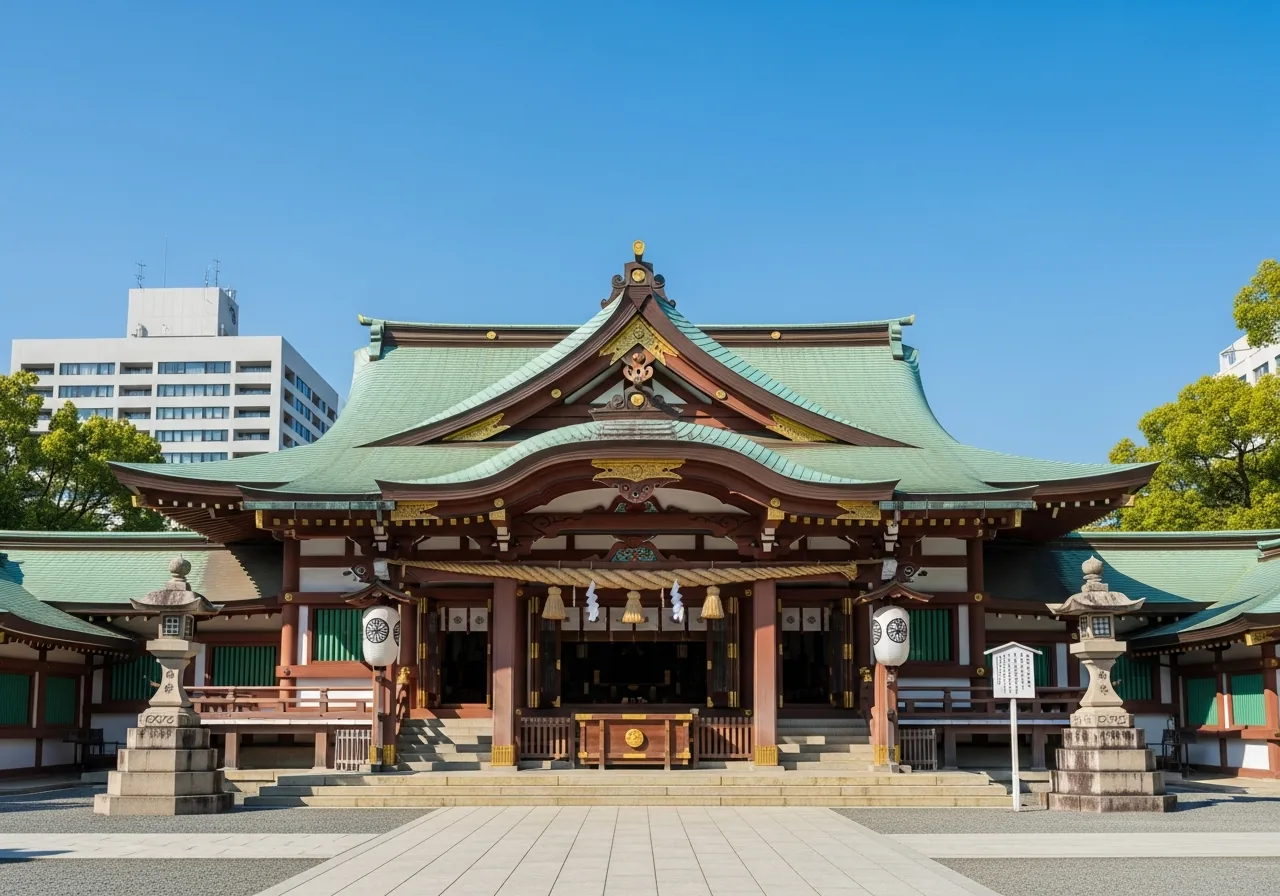
The four main halls of Sumiyoshi Taisha are National Treasures — not because they are old in the conventional sense, but because they preserve a design that predates the arrival of Buddhism and Chinese architectural influence in Japan. Sumiyoshi-zukuri is an ancient Japanese Shinto shrine architectural style which takes its name from Sumiyoshi Taisha’s honden in Osaka. As in the case of the taisha-zukuri and shinmei-zukuri styles, its birth predates the arrival of Buddhism in Japan.
Sumiyoshi-zukuri is characterised by straight roofs (as opposed to the curved roofs commonly built in later centuries), which are decorated by two sets of forked finials and five horizontal billets. Furthermore, buildings constructed in Sumiyoshi-zukuri style have their entrance under the gable and are surrounded by a fence.
Originally, Sumiyoshi Taisha’s four main halls were rebuilt every 20 years, as is the case for Ise Jingū, the most sacred shrine in Japan. The practice was interrupted by civil war in the 16th century and was abandoned entirely in the early 19th. The current four main halls of the shrine were last built in 1810 and are designated as National Treasures.
The ritual rebuilding — shikinen sengū — is itself a form of purification. The gods are not housed in old wood; they are transferred to new wood at regular intervals, the structure renewed while the design remains identical.
According to the tradition of Shikinen sengū-sai, the buildings or shrines were faithfully rebuilt at regular intervals adhering to the original design. In this manner, ancient styles have been replicated through the centuries to the present day.
The 1810 buildings are therefore simultaneously the newest and the oldest things on the grounds — new wood, ancient form.
The westward orientation of the halls is the detail that rewards the attentive visitor. The ancient Sumiyoshi Taisha shrine still brings to mind the maritime roots of the city.
The sacred space hosts a line of three halls that face westward to the sea like a fleet of ships, their respective deities either masters of the water or patrons of sailors. Stand in front of the First Shrine on a clear morning and you are looking in the direction of the bay that is no longer there — toward the water that the silt and the land reclamation have taken away.
The shrine faces a sea that has retreated seven kilometres. It has been doing so for seventeen centuries.
Why Does Sumiyoshi Taisha Head 2,300 Shrines? The Network and Its Logic
One of Japan’s most renowned shrines, Sumiyoshi Taisha is the head of approximately 2,300 Sumiyoshi shrines throughout Japan. This is not a franchise in the commercial sense; it is a network of protection.
Every port town, every fishing village, every coastal community that needed the sea gods’ favour established a Sumiyoshi shrine. The Osaka shrine is the head because it is the original — the one that Jingū (or whoever actually built it) established at the mouth of the bay that was Japan’s gateway to the continent.
The network also explains why the Otaue Shinji matters beyond Osaka. Rice-planting festivals can be found all over Japan, but this festival is the most famous and unique due to its faithful reproduction of ancient procedures and rituals used to plant the seedlings in a grand ceremonial style. When the ueme plant rice at Sumiyoshi Taisha, they are performing the rite on behalf of all 2,300 shrines in the network — and, by extension, on behalf of all the communities those shrines protect.
Sumiyoshi Taisha is mentioned in Murasaki Shikibu’s The Tale of Genji and is believed to be the entrance point of the Silk Road into Japan. The shrine appears in the Genji chapters set in Suma and Akashi, where the exiled Hikaru Genji prays at Sumiyoshi for deliverance. The shrine’s literary presence is not incidental; it reflects the fact that for a thousand years, Sumiyoshi Taisha was the most prominent sacred site visible to anyone arriving in Japan by sea from the west.
Why Should a Discerning Traveller Care? The Deeper Argument
The honest answer is that Sumiyoshi Taisha and its festivals offer something that almost no other site in Japan can provide: the experience of a ritual system that has not been simplified for tourism, that has not been aestheticised into performance, and that has not been interrupted long enough to lose its internal logic.
Most great religious sites in the world are either living institutions (in which case tourists are peripheral) or heritage sites (in which case the religion is peripheral). Sumiyoshi Taisha is genuinely both.
Two million people come to Sumiyoshi Taisha each January for hatsumōde, the traditional first shrine visit of the year. With more than 200,000 attendees every year, the Sumiyoshi Matsuri showcases Japan’s traditions and energy through portable shrine processions, formal rituals, and parades.
These are not heritage tourists; they are Osaka residents performing obligations they take seriously.
The Otaue Shinji on June 14th is the more intimate of the two events, and arguably the more revealing. The paddy is small enough that you can stand close.
The ueme are real women from the Osaka performing arts community, not actors hired for the occasion. The oxen are the shrine’s own animals.
The rice that is planted will be harvested in autumn and offered to the gods. The chain of consequence is unbroken and visible.
What the Matsuri in late July offers is scale and spectacle — the dai-mikoshi over the Sorihashi, the river crossing, the 300 food stalls, the crowds that line the route to Sakai. Traditional performances include Kagura court music, Sumiyoshi-odori dancing, and Kumano dancing at the main shrine. The festival is genuinely large and genuinely old, and the combination is rarer than it sounds.
But the deeper reason to care is structural. The Sumiyoshi Matsuri and the Otaue Shinji together constitute a complete argument about what a city owes its gods and what its gods owe the city.
The gods protect the sailors and the grain; the city plants the grain and carries the gods through its streets; the gods purify the city in return. This is not superstition — it is a social contract expressed in ritual form, and it has been renewed every year in southern Osaka for longer than most European cities have existed.
It is said that Osaka’s summer festival season begins with the Aizen Festival, continues via the Tenjin Festival, and ends with the Sumiyoshi Festival. The Sumiyoshi Matsuri is therefore not just a festival — it is a conclusion.
The city’s summer of ritual culminates here, at the oldest shrine, with the oldest gods, in the act of carrying them across a river boundary and bringing them home. The rice planted in June will be harvested in September.
The loop closes.
Frequently Asked Questions
Q: When is the Otaue Shinji rice-planting rite held?
A: Every year on June 14th at Sumiyoshi Taisha. The ceremony begins in the morning with purification rites at the First Main Sanctuary and moves to the sacred paddy south of the shrine grounds in the afternoon.
Admission to the grounds is free; reserved seating near the paddy costs approximately ¥1,000. Confirm current details on the official shrine rituals page.
Q: When is the Sumiyoshi Matsuri held?
A: July 30 to August 1 annually. The Yoimiya eve festival is on July 30th; the Nagoshi no Harae purification rite (including the chinowa grass-ring walk) is on July 31st; the Mikoshi Togyo procession to Sakai is on August 1st. The procession departs Sumiyoshi Taisha in the afternoon and crosses the Yamato River before returning.
Q: Is Empress Jingū a historical figure?
A: Most contemporary historians regard her as mythological rather than historical. The founding date of 211 CE is traditional, derived from the Kojiki and Nihon Shoki chronicles. The shrine celebrated its 1,800th anniversary in 2011 on that basis, but no archaeological evidence confirms the date.
Q: What is the Sorihashi Bridge and can visitors cross it?
A: Yes — the arched bridge at the shrine entrance is open to visitors year-round. It is approximately 21 metres long with a slope exceeding 40 degrees at its steepest.
Steps were added in 1955; before that, the only footholds were gaps between wooden slats. The bridge is also the setting of a short story by Nobel laureate Kawabata Yasunari, and a literary monument stands beside it.
Q: What is the significance of the four main halls facing west?
A: The westward orientation is unique among major Japanese shrines and reflects the shrine’s maritime origins — the halls face the direction of Osaka Bay and, beyond it, the Asian continent. Most shrines built after the Nara period face south or east, following Chinese geomantic convention. Sumiyoshi Taisha predates that convention and has never adopted it.
Sumiyoshi Taisha — Visitor Information
Address: 2-9-89 Sumiyoshi, Sumiyoshi-ku, Osaka 558-0045 / 〒558-0045 大阪府大阪市住吉区住吉2丁目9−89
Nearest station: Sumiyoshi Taisha Station (Nankai Main Line) — 3 min. walk east; Sumiyoshitorii-mae Station (Hankai Tramway) — directly in front of the torii gate
Hours: 6:00 AM–5:00 PM (April–September); 6:30 AM–5:00 PM (October–March). Opens at 6:00 AM on the first day of each month. Hours may vary during major festivals — confirm on the official site.
Admission: Free (shrine grounds). Reserved seating for Otaue Shinji approx. ¥1,000 — confirm on official site.
Official site: sumiyoshitaisha.net