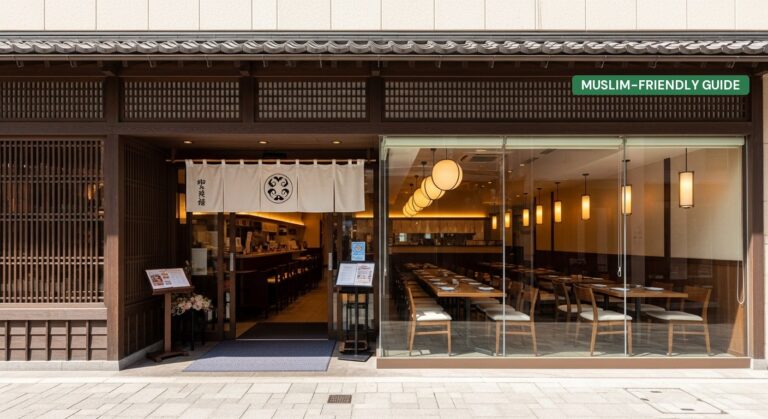
Looking for halal food in Kitashinchi, Osaka? The upscale nightlife district has historically been a tough spot for Muslim diners, but three verified halal and Muslim-friendly venues now operate within walking distance — a halal-certified wagyu cutlet specialist, a halal wagyu ramen bar, and a Moroccan restaurant run by a Muslim owner. Best for couples, business travelers, and anyone wanting a proper Japanese dining experience without compromise. For a broader overview, see our Osaka halal guide.
MICHI’s Pick — Selected by our Osaka-based team, based on places we’ve visited and on research using Tabelog and Google Maps ratings. In Japan, a Tabelog score of 3.4+ is genuinely high — Japanese reviewers are famously strict, and most locals consider anything above 3.4 a place worth a detour. We feature venues meeting at least one of: Tabelog 3.4+, Google Maps 4.3+, or 100+ reviews — the kind of spots locals quietly trust.
Tabelog and Google Maps scores are accurate as of the time of writing.
1. HALAL WAGYU GYUKATSU SHINJUKU-TEI Osaka Umeda
The only halal-certified A5 wagyu cutlet restaurant in the Kitashinchi corridor — a rare chance to grill premium Japanese beef at your own table, with a prayer room on-site.
- ☪️ Halal status: halal-certified
- 🥩 Must-order: Premium Gyukatsu Set (¥5,000)
- 📍 Access: Higashi-Umeda Station (3 min walk) — Pont Nouveau Bldg 7F, 2-5-30 Sonezaki, Kita-ku; adjacent to Kitashinchi
- 🕒 Hours: 12:00–21:00 (Open daily)
- 📞 Reservation: Recommended
- 🧎 Prayer room: Available on-site
- 🍷 Alcohol served: No
- 🗣 English menu: Yes
- ⭐ Rating: Google 4.9 (1,500+ reviews) (as of writing)
- 🗺 View on Google Maps
- 🔗 Source: halalfoodinjapan.com
What to order: The Premium Gyukatsu Set arrives lightly breaded so you finish each slice on a personal iron grill — the A5 wagyu stays pink and buttery inside. Pair it with the Wagyu Yakiniku Steak combo (¥6,000) if you want both cutlet and sizzling steak in one sitting.
2. Osaka Buyu-Den Halal Wagyu Ramen Higashi-Umeda
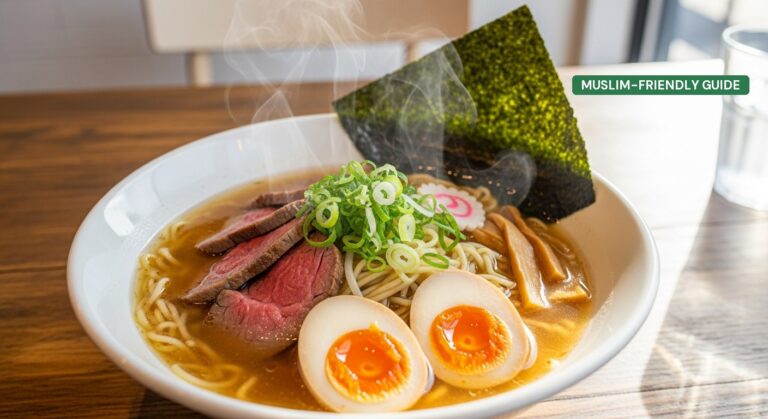
A fully halal-certified ramen restaurant with a prayer room and wudu facilities, serving A5 wagyu ramen just minutes from Kitashinchi — one of the most Muslim-complete dining spaces in Osaka’s north.
- ☪️ Halal status: halal-certified
- 🍜 Must-order: White Wagyu Ramen Premium Set (¥2,500)
- 📍 Access: Higashi-Umeda Station (5 min walk) — SUNSUN Higashi-Umeda 2F, 5-16 Doyamacho, Kita-ku; adjacent to Kitashinchi
- 🕒 Hours: 12:00–21:00 (Open daily)
- 📞 Reservation: Not needed
- 🧎 Prayer room: Available on-site
- 🍷 Alcohol served: No
- 🗣 English menu: Yes
- ⭐ Rating: Google 4.9 (779 reviews) (as of writing)
- 🗺 View on Google Maps
- 🔗 Source: halalfoodinjapan.com
What to order: The White Ramen features a creamy chicken broth topped with tender halal A5 wagyu slices — silky, rich, and nothing like the pork-based tonkotsu you’ll find everywhere else in Osaka. Upgrade to the Premium Set to add wagyu beef sushi and karaage for a full spread. If you want to explore more of Kitashinchi after dinner, this spot makes an ideal early-evening stop before the district’s bars fill up.
3. Le Marrakech
A Moroccan restaurant owned and run by a Muslim chef near the Umeda Sky Building — all food is halal, the kitchen is pork-free, and the lantern-lit interior transports you far from Osaka’s neon streets.
- ☪️ Halal status: Muslim-friendly
- 🍛 Must-order: Lamb Tagine course (¥5,000–¥5,999)
- 📍 Access: Nakatsu Station (5 min walk) — 1-17-7 Oyodonaka, Kita-ku; approx. 10 min walk from Kitashinchi Station
- 🕒 Hours: Lunch & Dinner (Closed: Sunday and 2nd & 4th Mondays)
- 📞 Reservation: Recommended
- 🧎 Prayer room: None
- 🍷 Alcohol served: No
- 🗣 English menu: Yes
- ⭐ Rating: Tabelog 3.53 / (116 reviews) (as of writing)
- 🗺 View on Google Maps
- 🔗 Source: halalgourmet.jp
What to order: The lamb tagine — slow-cooked with preserved lemon and Moroccan spices — is the dish that keeps regulars coming back, and the Tabelog score of 3.53 with 116 reviews confirms it punches well above its weight. The Moroccan-born chef speaks English, French, and Arabic, making it one of the most genuinely welcoming tables in Osaka for international Muslim diners. For more dining ideas across the city, browse the best food in Osaka on MICHI.
Frequently Asked Questions
Q. Is it easy to find halal food in Kitashinchi, Osaka?
Kitashinchi is primarily an upscale evening district built around expensive sushi, bars, and private clubs — halal options are limited but growing. The three restaurants above are all within a 10-minute walk of Kitashinchi Station, so with a little planning you won’t go hungry.
Q. What does “Muslim-friendly” mean in Japan?
In Japan, “Muslim-friendly” typically means a restaurant uses no pork and no lard, and often avoids alcohol in cooking — but it does not necessarily mean the venue holds formal halal certification from a recognised body. Always check whether the kitchen is halal-only or shared, and whether cross-contamination controls are in place. Halal-certified venues (like Shinjukutei and Buyu-Den above) have been audited by a certifying organisation and offer a higher level of assurance.
Q. Are there prayer rooms near halal restaurants in Kitashinchi, Osaka?
Both SHINJUKU-TEI Umeda and Osaka Buyu-Den have dedicated prayer rooms with wudu facilities on-site — a rare convenience in this part of Osaka. Le Marrakech does not have a prayer room, but the Osaka Masjid (Nakazaki-cho) is reachable within about 15 minutes by foot or one subway stop.
Q. What hidden ingredients should Muslim travelers watch out for in Japan?
The most common pitfalls are mirin (sweet rice wine used in sauces and glazes), sake (added to broths and marinades), and pork-derived dashi (stock). Even dishes that appear meat-free — like miso soup or vegetable tempura — can contain these. At non-certified restaurants, always ask specifically about the broth base and any cooking wine used, and carry a dietary card in Japanese to make the conversation easier.
Last updated: July 4, 2026 · Corrections: [email protected]