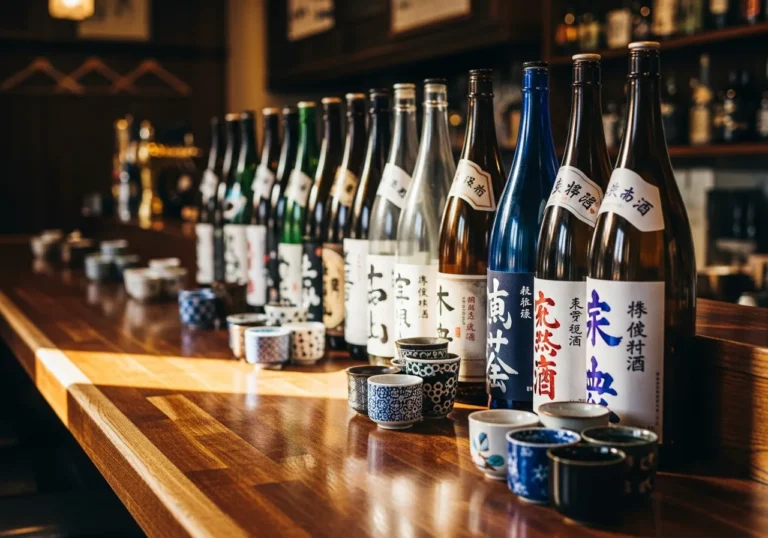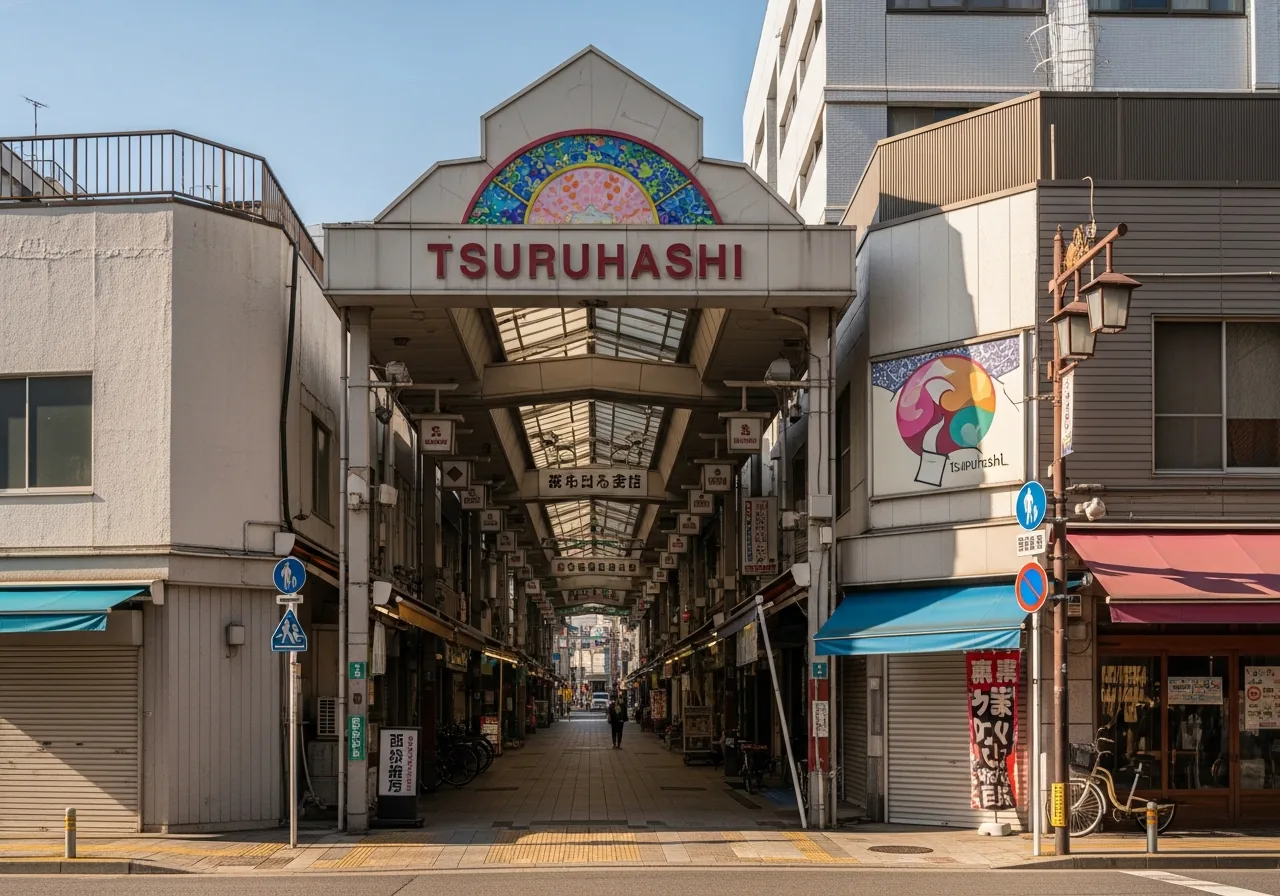
Horumon — the grilled offal that Osaka claims as its own — was born from dispossession. After 1945, Zainichi Korean residents of Tsuruhashi, barred from formal employment and denied citizenship, grilled the intestines and organs that Japanese abattoirs discarded, adapting the Korean gopchang tradition to the cheapest available protein in a rationed city. That act of survival became a cuisine, and the neighbourhood built around it became Japan’s largest and oldest Koreatown — a place whose very name, Tsuruhashi, echoes a bridge built by immigrants from the Korean kingdom of Baekje more than fifteen centuries ago.
Why we can tell you this — MICHI is written and edited in Osaka; our team walks the covered arcades of Tsuruhashi Station and the Miyuki-dori shopping street regularly, and we have drawn on the Osaka Korea Town Museum‘s founding materials, an Osaka University academic paper on Zainichi food culture in Ikuno Ward, the Asia-Pacific Journal’s scholarship on the Jeju–Osaka ferry route, and the official Osaka-Info guide to yakiniku and horumon. The deeper history of colonial-era migration is well documented; the precise moment horumon crossed from Korean gopchang into Japanese cuisine is contested, and we say so in the text.
Stand at the west exit of Tsuruhashi Station on any afternoon and the air does the explaining for you. Smoke rises from a dozen grills before you can see them.
The smell — charcoal, rendered fat, something fermented and sharp — arrives like a physical argument. You are still in Osaka, still on the JR Loop Line, sixteen minutes from Osaka Station.
But the city you have stepped into is not quite the one you left.
The covered arcades that fan out from the station are low and dark, their corrugated roofs unchanged since the late 1940s. Butchers display trays of tetchan (beef large intestine), shiro (small intestine), and liver with the matter-of-fact confidence of people who have been selling these cuts for three generations.
Korean script runs alongside Japanese on hand-painted signs. The smell of fermenting kimchi drifts from shops where ceramic crocks line the back walls.
This is Tsuruhashi — and understanding why it exists, why it smells the way it does, and why a dish of grilled offal carries the weight of an entire community’s history requires drilling through seven layers of cause.
Why Is There a Korean Neighbourhood in Osaka at All?
The short answer is infrastructure. The modern community flourished during the 1920s when thousands of Korean laborers migrated to Osaka, many of whom came via a regular ferry service from Jeju Island, to work on large-scale infrastructure projects like the excavation of the Osaka Ikuno canal.
But the short answer conceals the mechanism. The roots of this community are closely linked to the period of Japanese colonial rule over Korea from 1910 to 1945, during which many Koreans were forcibly brought to Japan as laborers or migrated in search of economic opportunities. Japan’s annexation of Korea restructured the peninsula’s economy in ways that pushed rural Koreans off their land — and pulled them toward Osaka’s factories, construction sites, and drainage projects.
Why Osaka specifically, rather than Tokyo or Fukuoka? Because Osaka was Japan’s industrial engine, and because a direct maritime link made the journey possible.
Japanese recruitment of industrial laborers from Jeju Island started in 1914. They went particularly to Osaka but also to the Hanshin industrial belt and Kita-Kyushu.
There was a shortage of labor in these areas and the practice of hiring Jeju Islanders was already established in the fisheries sector. Industrial labor migration was behind the establishment in 1922 of a regular ferry service between Osaka and Jeju called the Hansai ferry.
The ferry was not a courtesy. It was a logistics solution for an industrial economy that needed cheap bodies.
80,000 to 150,000 Koreans came to Japan every year from the late 1920s to the 1930s on these ferries. The Jeju–Osaka route was so heavily used that a labour union, the East Asian Transport Union, grew up specifically to contest the monopoly held by the private ferry companies operating it.
With deep roots in the migrant and activist communities of both of these locations, the East Asian Transport Union quickly grew to include almost 12,000 members.
Why did so many Jeju islanders specifically end up in Ikuno Ward? Because chain migration follows the path of least resistance.
Once a critical mass of Jeju workers settled near the Hirano River drainage works, they became the social infrastructure for the next wave. Miyuki-dori, now the main shopping street of the district, has hosted Korean merchants since the Japanese occupation of Korea.
Around the 1920s, Koreans, particularly from Jeju Island, moved into the area. A letter from home, a cousin’s address, a shared dialect — these were the threads that wove a neighbourhood out of a labour camp.
Why Here — What Is the Deeper Geography of Tsuruhashi?
The name itself is the first clue. Tsuruhashi derives its name from Tsuru-no-hashi (“Cranes’ Bridge”) over the Hirano River.
The river still exists, though it’s some distance away from the site of the original bridge, now marked with a stone monument. The Hirano River was also known as the Kudara River, after the ancient Korean kingdom of Baekje (Kudara in Japanese), and Ikaino was also called Kudarano.
The Korean presence in this corner of Osaka is not a twentieth-century accident. In this area of Osaka, the Korean presence dates back to the fifth century, when the Japanese Emperor Nintoku increased trade with the Korean kingdom of Baekje.
The river that runs through what is now Ikuno Ward was named for a Korean kingdom. The bridge that gave the neighbourhood its modern name was built by immigrants from that same kingdom.
The twentieth-century migration did not create a Korean presence in Tsuruhashi — it intensified one that was already ancient.
The railway mattered too. The history of Tsuruhashi begins in 1914 with the opening of the Osaka Electric Railway (now Kintetsu Railway).
A station creates a node. A node attracts commerce.
Commerce attracts settlement. By the time the Jeju ferry was running, Tsuruhashi already had the bones of a transit hub — and transit hubs are where migrants land.
Originally part of Higashinari Ward, Ikuno became a separate entity in 1943. Many wards were subdivided in this way as Osaka’s population surged in the early 20th century.
Prior to those years, Ikuno was countryside dotted with small villages and home to less than 5,000 households. By 1940 the population had increased nearly tenfold, and by the 1950s Ikuno was the most populous ward in Osaka, with almost 10% of the city’s people.
That demographic explosion was not organic growth. It was the human consequence of colonial labour policy.
Why Did the Community Stay After 1945?
This is the question that most guidebooks skip. The war ended.
Korea was liberated. Why did hundreds of thousands of Koreans remain in Japan?
The answer is that “remaining” was not a simple choice. Initial migration in the 1920s was largely voluntary, driven by economic disparities, with numbers swelling to over 800,000 by the late 1930s amid wartime mobilization that included coerced labor drafts. Following Japan’s defeat in 1945, roughly 600,000 ethnic Koreans opted to stay rather than repatriate, stripping them of Japanese nationality under the San Francisco Peace Treaty and rendering them stateless until special permanent resident status was established via the 1965 Japan-South Korea normalization agreement.
Many who wanted to return found the peninsula in chaos. After World War II, many people moved through the existing Zainichi Korean network in this area to avoid the political and social turmoil, as well as economic poverty, caused by the Korean War and military dictatorships on the Korean Peninsula.
Then came the Jeju April 3rd Uprising of 1948, a massacre that sent another wave of refugees across the Korea Strait. 20,000 to 40,000 Koreans fled Syngman Rhee’s forces during the Jeju uprising in 1948.
Many of them had family already in Tsuruhashi. The network absorbed them.
What they arrived into was a community that had already lost its legal footing. A 1952 government directive stripped Koreans in Japan of their Japanese nationality, cutting them off from welfare, healthcare, and other public services, and leaving many in a state of legal limbo. People who had lived in Japan for decades, paid taxes, sent children to Japanese schools, were reclassified as foreigners in the country where they had built their lives.
After World War II, many found themselves in a stateless limbo, facing considerable discrimination in mainstream Japanese society. In this difficult context, communities like the one in Ikuno Ward, where Tsuruhashi is located, became essential sanctuaries.
They were places where the Zainichi community could support each other, speak their language, and uphold their traditions. The neighbourhood was not a choice of preference.
It was a refuge created by exclusion.
Why Did a Black Market Become a Food Culture?
This is where the story of horumon begins — not in a restaurant kitchen, but on a patch of waste ground near the Hirano River.
The market at Tsuruhashi began humbly. It famously originated on the site of a former pigsty near the Hirano River, a marginal piece of land where the community started selling goods such as scrap metal and food to survive.
The location was not chosen for its charm. It was chosen because nobody else wanted it.
Immediately following the end of the war in 1945, the Tsuruhashi shopping district began supplying goods as an informal market due to the scarcity of resources. The area was able to function as a black market because it sat at a key transportation and logistics junction where Kintetsu and JR intersected, and it had suffered almost no damage from air raids. It developed as a venue for the unofficial trading of goods that were unavailable through official distribution channels.
The black market was not a Zainichi invention — they sprang up across Japan in the weeks after surrender. But Zainichi Koreans had particular reasons to operate outside official channels.
Post-World War II Japan saw Zainichi Koreans confronting severe socioeconomic exclusion, including barriers to employment in formal sectors and public jobs reserved exclusively for Japanese nationals until 1972. This discrimination confined many Zainichi to informal economies, such as meat processing and street vending in urban centers like Osaka, where they accessed discarded offal and low-grade cuts unavailable or undesirable to ethnic Japanese under rationing constraints.
That last detail is the key to horumon. Under Japan’s postwar rationing system, the cuts of meat that mattered — muscle meat, the cuts that Japanese consumers recognised — were controlled and scarce.
But offal was different. Abattoirs discarded it.
Nobody in the official distribution system was tracking intestines. Zainichi Koreans, facing post-World War II economic hardships and discrimination, established small eateries in urban areas like Osaka and Tokyo, serving affordable grilled offal (horumon-yaki) derived from discarded beef and pork innards.
They were not inventing something from nothing. They were translating.
Korean immigrants introduced dishes such as gopchang, makchang, and daechang — grilled small and large intestines — to the Japanese market. In the early days, the intestines were prepared in their original tubular Korean form, which means the culinary roots of horumon clearly lie in Korean traditional offal grilling.
Why Is the Word “Horumon” Itself Contested?
The etymology of horumon is a small but revealing argument about who gets to name a cuisine.
The official story, registered in trademark law, is that horumon derives from the English word “hormone.” Kitazato Shigeo, the chef of a yōshoku restaurant in Osaka, devised this dish and registered a trademark in 1940. It was originally derived from yakiniku. The name horumon is derived from the word “hormone,” with the intended meaning of “stimulation,” as in the original Greek.
But there is a second etymology, rooted not in Western science but in Osaka street speech. The name horumon is also similar to the Kansai dialect term hōrumon (放る物), which means “discarded goods.” In Osaka dialect, hōru means to throw away.
Mono means thing. Horumon: the thing you throw away.
Both etymologies are plausible. Both may be true simultaneously — a deliberate pun, a word that could pass as scientific while encoding the social reality of its origins.
Japanese offal is said to have originated in the Kansai region. The Kansai expression ‘horumon’ literally translates to ‘discarded bits.’ Instead of discarding them, people from Osaka decided to utilise them in yakiniku.
What the trademark story does, however, is erase the Korean contribution. A Japanese chef in a Western-cuisine restaurant registers a name in 1940.
The dish becomes “Japanese.” The Zainichi cooks who had been grilling gopchang in the alleys of Tsuruhashi for years before that registration — and who would continue to define the cuisine after the war — disappear from the official account. This is the pattern that the food scholar Christopher Laurent has called, in his 2020 essay published in Food and Power, “making yakiniku Japanese” — the systematic erasure of Korean contributions from Japan’s food culture.
Why Did Yakiniku Become Japan’s National Grill Culture?
The postwar trajectory of horumon and yakiniku is a story about how a marginalised community’s survival food becomes a nation’s comfort food — and what gets lost in that translation.
The term yakiniku originally referred to Western-style barbecue, but later became popular as a dish of Korean origin in the early Showa period. The current style of Japanese yakiniku restaurants is derived from Korean restaurants opened around 1945 in Osaka and Tokyo by Koreans living in Japan.
The mechanism of spread was economic necessity on one side and appetite on the other. During Japan’s postwar recovery period, horumon gained popularity as an affordable and nutritious source of protein. From Osaka, the cuisine spread across Japan, and horumon-yaki became recognised as a distinct Japanese-style grilled dish.
As the restaurants grew more successful, their owners could afford better cuts. Originally, these restaurants used to serve grilled organ meat that would be discarded otherwise.
As restaurant owners grew more affluent, they began to serve more expensive cuts of meat. Yakiniku restaurants began as smoky drinking joints which then became a family fare in part due to the invention of the smokeless grill, a vacuum chimney that hovers over tables.
The smokeless grill is not a trivial detail. It moved yakiniku from the margins — the smoky, low-ceilinged joints under the Tsuruhashi tracks — into the mainstream.
Families could now sit around a table without coming home smelling of charcoal. The cuisine became respectable.
And as it became respectable, its origins became inconvenient.
Job discrimination was an unquestioned fact in the postwar period. All public-sector jobs were reserved for Japanese nationals until 1972.
Outside of baseball for boys and singing for girls, self-employment in the ethnic economy, whether scrap recycling or running yakiniku restaurants, was regarded as the fated lot of Koreans in Japan. The yakiniku restaurant was not a career choice.
It was what you did when every other door was closed.
By the 1970s, yakiniku establishments represent another key niche, popularised by Zainichi Koreans who adapted traditional Korean grilling techniques to Japanese tastes post-1945, often starting as small family-run outlets serving ethnic communities before attracting broader clientele. By the 1970s, yakiniku chains proliferated in urban areas like Osaka and Tokyo.
The chains that proliferated were often Japanese-owned, or Zainichi-owned businesses that had adopted Japanese names and presentation. The Korean origin was not advertised.
Some of the dishes introduced by Zainichi Koreans are not considered foreign any longer in Japan. Yakiniku is the most popular food among young Japanese who for the most part consider it native to Japan.
Why Did Tsuruhashi Survive When Other Black Markets Did Not?
Most of Japan’s postwar black markets were cleared within a decade. Ameyoko in Tokyo survived by gentrifying into a tourist market. Tsuruhashi survived by being something more than a market: it was a community’s entire infrastructure.
The district’s Korean roots trace back to the early 20th century, when large numbers of Korean workers migrated to Osaka during the period of Japanese colonial rule. Many settled in the Ikuno area around Tsuruhashi, establishing a community that has maintained its cultural identity, language, and culinary traditions with remarkable continuity across multiple generations.
The market survived because the community it served had nowhere else to go. Since many Zainichi Koreans could not get a proper job, they began to get involved in illegal jobs such as “illegal alcohol production, scrap recycling, and racketeering.” As a result, many Zainichi Koreans ended up living in slums or hamlets, a situation aided by Japanese real estate agents’ refusal to let Zainichi Koreans rent houses.
When you cannot rent outside the neighbourhood, you stay in it. When you stay in it, you build it.
When you build it across generations, it becomes irreplaceable.
Since 1951, three shopkeeper associations have managed stores in the area. They made numerous attempts to merge for several decades, but talks stalled due to “the different characteristics of the shops and stubbornness of the vendors.” That stubbornness is not a flaw. It is the stubbornness of people who built something from nothing and are not inclined to let anyone else define it.
The market also survived because it was genuinely useful to Osaka at large. The market comes alive from early morning, attracting chefs from Osaka and even Kyoto who come to purchase ingredients.
Its history traces back to the post-war black markets, and today it is home to approximately 800 shops. A wholesale fish and produce market that draws professional chefs from two cities is not a tourist attraction.
It is infrastructure.
The Kimchi Question
Food was not only sustenance in Tsuruhashi. It was identity maintenance.
Consuming their homeland’s cuisine, including kimchi, provided a hint of normalcy for those who lived in dreadful conditions as colonial subjects and laborers. Communal kitchens, where women continuously produced kimchi, offered gathering spots for migrant workers.
Kimchi in Tsuruhashi is not the sweet, mild product that Japanese supermarkets sell under the same name. It is fermented longer, spiced harder, and made to recipes carried across the Korea Strait in memory rather than in cookbooks.
Zainichi Koreans had to find creative ways to make kimchi adapted to the taste of local consumers with, for example, seaweed kimchi and tomato kimchi. The adaptation was commercial necessity, but the original remained — sold in the back of the shop, made for the community rather than for tourists.
Twenty of the 150 stores in Ikuno Korea Town specifically sell kimchi. That density — one in seven and a half shops dedicated to a single fermented vegetable — tells you something about what kimchi means here.
It is not a condiment. It is a cultural marker, a daily act of not-forgetting.
Why Does the Neighbourhood Look the Way It Does?
The physical form of Tsuruhashi is not accidental. The low roofs, the narrow alleys, the corrugated iron — these are the shapes of improvisation under constraint.
The ‘Old Market’ sits immediately adjacent to Tsuruhashi Station and features dark, narrow, winding alleys. This area focuses heavily on wholesale goods, fresh seafood, and traditional kimchi vendors. Walking through these tunnels feels like stepping back into the mid-Showa era of Japan.
The market was built under and around the railway infrastructure because that was the space available. Nobody planned it.
Dishes were often improvised by necessity; Zainichis often substituted in unorthodox ingredients to which they had access. The same principle that governed the cooking governed the architecture: use what you can reach, make it work, make it last.
The two zones of Tsuruhashi — the old market near the station and the newer Miyuki-dori shopping street a fifteen-minute walk south — represent two different historical moments. The old market is the black market, barely changed.
Miyuki-dori is the community’s later, more confident self-presentation. In 1993, they repaved the roads and added four traditional Korean gates at various entrances to the area.
The gates are a statement: we are still here, and we are not hiding.
Why Does Tsuruhashi Still Matter — and Why Should a Discerning Traveller Care?
The easy answer is the food. The harder answer is what the food represents.
Tsuruhashi is one of the very few places in Japan where you can eat a dish — horumon, yakiniku, cold naengmyeon noodles — and understand, if you choose to, the full weight of its history. Most food has had its origins laundered out of it by the time it reaches a restaurant menu. Here, the origins are still visible in the architecture, in the faces of the vendors, in the Korean script on the signs, in the fact that the market is still run by the descendants of the people who built it.
Even today, approximately 20% (27,960 people) of the total population of Ikuno Ward is non-Japanese, of which about 80% (21,582 people) of the foreign population is Zainichi Korean. The Ikaino–Ikuno area of Osaka first emerged as a concentrated Zainichi Korean region in the early twentieth century, during the period when the Korean Peninsula was under Japanese colonial rule.
These are not statistics about a tourist district. They are statistics about a living community that has maintained its identity across four generations of legal precarity, discrimination, and pressure to assimilate.
The Osaka University academic paper on Zainichi food culture in Ikuno Ward documents how even the neighbourhood’s coffee shops — the morning-service kissaten — carry traces of Korean-Japanese cultural fusion, with set menus that blend Japanese toast culture with Korean communal eating habits. The food culture here is not a theme park recreation of Korea. It is something that does not exist anywhere else: the cuisine of a community that has been living between two cultures for a century, adapting both.
After the growth of the Korean Wave and the joint Korea–Japan hosting of the 2002 FIFA World Cup, the area experienced a boom in popularity and became a major tourist destination. The K-pop wave has brought a new generation of Japanese visitors — young women buying idol merchandise on Miyuki-dori, tourists photographing tteokbokki.
This is not nothing. Tourism has kept businesses alive that might otherwise have closed as the original community aged and dispersed.
But it has also created a tension. In recent years, Ikuno Korea Town has experienced a significant tourism surge, largely fuelled by the global popularity of South Korean pop culture.
Annual visitor numbers reached approximately two million as of 2021. About 80% of tourists are women, and half are under 30 years old, leading to weekend traffic congestion along the main 500-metre shopping alley.
The discerning traveller’s task is to hold both realities at once: the K-pop boutique and the kimchi crock, the Instagram moment and the history behind the corrugated roof. Ikuno “bears the traditional Korean marketplace feel,” with homemade food, narrow streets, and merchandise prominently displayed for passersby.
That feel is not manufactured nostalgia. It is the residue of necessity — the shape left by a community that had to build everything itself because the city it lived in would not build it for them.
The Museum That Opened in 2023
The most significant recent development in Tsuruhashi is not a new restaurant. It is a small museum.
On April 29, 2023, the history museum Osaka Korea Town Museum was opened near the area. The museum discusses the history of the area, showcases Korean popular culture, and houses around 2,000 books on both Korea and Japan.
The Osaka Korea Town Museum (大阪コリアタウン歴史資料館) at 4-4-11 Momodani, Ikuno Ward, is a one-room institution in a white building that looks, from the outside, like a suburban villa. Inside, the exhibits move from the geography of Ikuno to the colonial-era migration, the postwar black market, the discrimination, and the gradual building of a community.
With more than 20 exhibits and hundreds of objects, the museum draws largely from the donations of Zainichi Korean families, and displays personal stories of resilience, loss, and hope. From report cards with erased Korean names to handsewn Taegukgi Korean flags made after news of liberation, each object evokes lives lived between borders.
The museum was established, as its founding statement explains, to create “an open space where people can reflect on our community’s history, meet others with whom we share our world, and realise that everyone has the potential to shape the future.” That is not the language of heritage tourism. It is the language of a community that has decided to tell its own story before someone else tells it wrong.
What Remains, and What Has Changed
The Tsuruhashi of 2026 is not the Tsuruhashi of 1950. The third and fourth generations of Zainichi families are largely Japanese-speaking, often Japanese-educated, sometimes Japanese-named.
Many families from Korea have lived in the Tsuruhashi district for three generations or more. The community’s relationship to Korean identity is now chosen rather than inherited — a matter of active maintenance rather than daily necessity.
The food, paradoxically, has become more Korean as the community has become more Japanese. The K-pop wave brought a renewed interest in authentic Korean cooking — not the adapted Zainichi version, but the contemporary Seoul version.
Tteokbokki stalls and Korean fried chicken shops have opened alongside the old horumon joints. The neighbourhood now contains multiple generations of Korean food culture simultaneously: the 1940s survival cuisine, the 1970s yakiniku restaurant, and the 2020s K-food trend.
While the market is decidedly Korean in character, the signage and spoken language is largely Japanese. You’ll also be able to find Japanese flavours that have uniquely infused themselves into traditional Korean foods.
That fusion is not dilution. It is what happens when a culture lives inside another culture for a century — the edges blur, new things emerge, and the result belongs to neither country and both.
The horumon on the grill outside Tsuruhashi Station is still the cheapest thing on the menu. It is still the cut that nobody else wanted. It still tastes of charcoal and rendered fat and something that is hard to name — the flavour, perhaps, of a community that turned what was thrown away into something worth keeping.
As the Osaka-Info guide to yakiniku and horumon notes, Tsuruhashi is “a yakiniku paradise, where the smell of yakiniku fills the air as soon as you step out of the station” — a description that is accurate and, if you know the history, quietly extraordinary.
Frequently Asked Questions
Q: What exactly is horumon, and how is it different from regular yakiniku?
A: Horumon refers specifically to grilled offal — intestines, liver, heart, stomach, and other organ meats — from beef or pork. Regular yakiniku covers all grilled meat cuts.
Horumon is the older, cheaper, more historically loaded category: the cuts that were discarded by Japanese abattoirs and repurposed by Zainichi Korean cooks in the postwar years. In Tsuruhashi, horumon restaurants are often smaller, smokier, and more neighbourhood-facing than the polished yakiniku chains.
Q: Is Tsuruhashi safe to visit, and is there anti-Korean sentiment I should be aware of?
A: Tsuruhashi is entirely safe for visitors. The neighbourhood does have a history of being targeted by far-right nationalist groups, and that context is worth knowing — it is part of why the community built the Korea Town Museum.
Day-to-day, the area is busy, welcoming, and commercially oriented. The tension between the community’s history and its current tourist-friendly presentation is real, but it does not manifest as danger for visitors.
Q: What is the difference between the old market near the station and Ikuno Korea Town on Miyuki-dori?
A: The old market — the covered arcades immediately around Tsuruhashi Station — is the postwar black market, largely unchanged in structure. It is wholesale-oriented, darker, and focused on ingredients: kimchi, dried goods, fresh fish, and horumon cuts.
Miyuki-dori, a fifteen-minute walk south, is the newer, tourist-facing Korea Town: wider streets, Korean gates, street food stalls, K-pop merchandise, and cosmetics shops. Both are worth visiting; they represent different eras of the same community.
Q: When is the best time to visit Tsuruhashi?
A: Weekday mornings are ideal for the old market — the wholesale fish section is at its best before 10am, and professional chefs from across Osaka and Kyoto shop here early. Miyuki-dori is liveliest on weekends but can become very crowded. The Korea Town Museum is open 10am–5pm, closed Wednesdays (confirm current hours on the official site, as the closing day has changed).
Q: How does Tsuruhashi compare to Tokyo’s Shin-Okubo Koreatown?
A: They are fundamentally different in character. The area has been compared to the Ōkubo Koreatown in Tokyo, which has “big shopping malls with famous Korean franchise stores.” Some restaurants there represent the latest food trends in South Korea.
By contrast, Ikuno “bears the traditional Korean marketplace feel,” with homemade food, narrow streets, and merchandise prominently displayed for passersby. Shin-Okubo is newer, shinier, and more oriented toward contemporary Korean pop culture.
Tsuruhashi is older, rougher, and carries the weight of a history that Shin-Okubo does not have.
Osaka Korea Town Museum (大阪コリアタウン歴史資料館) — Visitor Information
Address: 4-4-11 Momodani, Ikuno Ward, Osaka 544-0033 / 大阪市生野区桃谷4丁目4-11
Nearest station: Tsuruhashi Station (JR Loop Line / Kintetsu / Osaka Metro Sennichimae Line) — approx. 15 min walk; Momodani Station (JR Loop Line) — approx. 12 min walk
Hours: 10:00–17:00; closed Wednesdays (closing day subject to change — confirm on official site before visiting)
Admission: General ¥300; Students ¥100; Preschool children free. Approx. — confirm current prices on the official site.
Official site: oktmuseum.or.jp