Last updated: August 14, 2026
Information changes — always confirm with the venue/source before relying on it.
Introduction
For Muslim travelers transiting through Kansai International Airport (KIX), the question of where to find a satisfying, trustworthy halal meal — ideally something as comforting as a bowl of katsu curry — is one of the most common concerns before or after a long-haul flight. Japan’s airport dining scene has historically been difficult to navigate for halal requirements, but KIX has made genuine strides. Kansai Airport is a Muslim-friendly airport, with halal-certified restaurants and restaurants that offer menus without pork or alcohol.
This guide explains what Muslim travelers can realistically expect at KIX: which terminal floors have halal-certified or Muslim-friendly options, how the katsu (cutlet) format fits into the airport’s current halal dining landscape, where the prayer rooms are, and what to do if you want more variety in nearby Rinku Town. Whether you’re arriving from Southeast Asia or departing after a week in Osaka, check out our Osaka halal guide for the full city picture — and read on for everything you need to know at the airport itself.
Why Katsu Curry at a Japanese Airport Is Worth Understanding
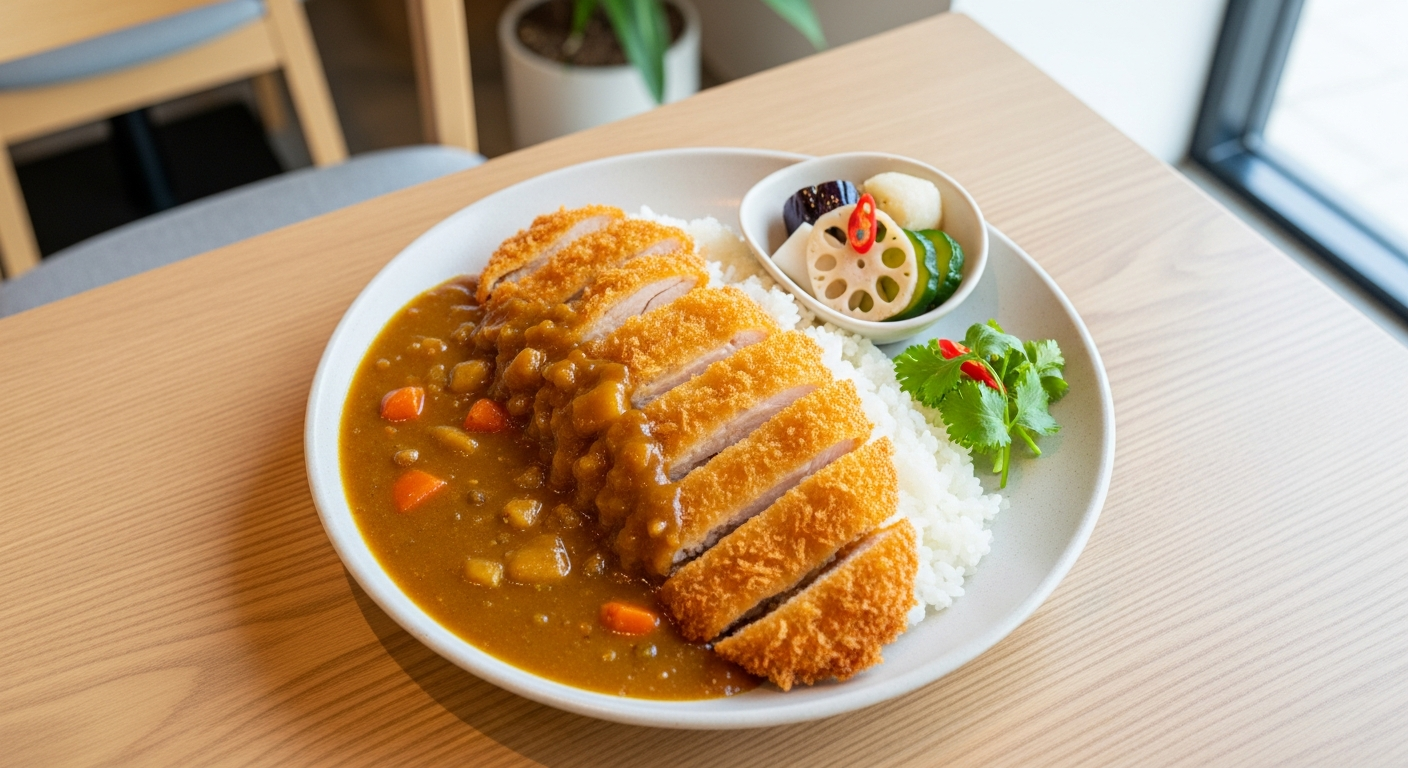
Katsu curry — a breaded, deep-fried cutlet served over Japanese curry rice — is one of Japan’s most beloved comfort dishes. At airport restaurants across Japan, it frequently appears as a set-meal option alongside noodles. The challenge for Muslim travelers is that the standard version uses pork (tonkatsu), and the curry roux at most chains contains lard or pork-derived ingredients. This means that even a dish that looks halal-friendly may not be.
At KIX, the good news is that the halal-certified dining option on the 2nd floor of Terminal 1 serves a chicken katsu format — breaded chicken cutlet — as part of its udon set menu. Above the counter, bright menu boards show steaming bowls of udon and set meals including chicken katsu with udon, beef-and-egg gyu-toji udon, and sukiyaki-style udon with Japanese black beef. This is the closest thing to a halal katsu experience currently available inside the terminal, and it is a genuinely satisfying pre-flight meal. For a broader look at the best food in Osaka, the city itself offers far more halal katsu curry options — but for the airport, knowing exactly what is available and where saves precious time.
🔗 Source: wanderlog.com
Which Terminal Floors Have Halal Options
KIX operates two passenger terminals. Terminal 1 and Terminal 2 are located approximately 4 km apart, and passengers can use the free shuttle service between them. All current halal-certified and Muslim-friendly dining is concentrated in Terminal 1.
- Terminal 1, 2F — Tasty Street (Public Area, before security): Located on the 2nd floor of Terminal 1 (before security), KINEYA MUGIMARU is a must-visit for noodle lovers. This place is fully halal-certified, which is quite rare in Japanese airports, making it a very reliable choice. The self-serve cafeteria format means you pick your udon base, choose toppings including freshly fried tempura, and add a set item such as chicken katsu. Each menu item has a pictogram of the 14 allergen ingredients used, and there is a logo stating “All Our Food is Halal” so that Muslims can enjoy the food at ease.
- Terminal 1, 3F — SOJIBO (Public Area, before security): SOJIBO is located at Terminal 1, 3F, before security. Historically this soba restaurant held halal certification, but travelers should be aware that the previous SOJIBO restaurant located at the 3F of Kansai International Airport was halal, but it no longer exists in that form, and the current SOJIBO at 2F is not halal — however, KINEYA MUGIMARU on the same 2F food court is Muslim-friendly and all its food is halal. Always verify the current halal status of SOJIBO directly before ordering.
- Terminal 2: Terminal 2 serves primarily LCC carriers. SORATERIA, serving Japanese, Western, and Chinese food, is located at Terminal 2. There is no confirmed halal-certified restaurant in Terminal 2 at the time of writing — Muslim travelers departing from T2 should eat before clearing security at Terminal 1, or bring their own food.
🔗 Source: kansai-airport.or.jp
What the Halal-Certified Menu Actually Offers
Understanding what is on the menu at Kineya Mugimaru helps Muslim travelers plan their meal — and manage expectations around the katsu curry format specifically.
Homemade Udon KINEYA MUGIMARU is operated by Gourmet Kineya Restaurant on the 2nd floor of KIX. The noodles are made in-store from flour produced in Mie Prefecture, freshly prepared and boiled, and sold in a self-serve format. The menu is broader than udon alone:
- Udon sets: A variety of udon dishes are available, such as with beef, with onsen egg, and plain udon. They also have fried rice and tempura options including eggplant, shrimp, and calamari.
- Chicken katsu set: The chicken katsu udon combination — breaded chicken cutlet served alongside or over udon — is the closest equivalent to a halal katsu curry experience at the airport. The broth is a dashi-based soup rather than a curry sauce, but the crispy cutlet format is the same satisfying experience.
- Tempura: As a topping for udon, you can choose and take directly from a variety of freshly fried tempuras.
- Rice bowls: Rice bowl options with tuna and other toppings are also available for travelers who prefer rice over noodles.
- Free extras: The seating area is part of a spacious food court, with plenty of tables, making it easy to find a spot and relax while eating. Free cold water refills are also available at the counter.
Portions are generous, so you get good value for money, especially before a flight. Opening hours are 7:00–22:00.
🔗 Source: fooddiversity.today
Prayer Rooms at KIX: Location and Facilities
Finding a clean, accessible prayer space is just as important as finding halal food. KIX has invested in dedicated prayer facilities for Muslim travelers, all within Terminal 1.
There are three prayer rooms at Kansai International Airport. Two of them are located inside, after the checkpoint for international flights (north and south wings), and the last room is situated before the entrance gate to departure or arrival, on the 3rd floor of Terminal 1, on the same floor as the shops and restaurants area.
- 3F Public Area (before security): Located on the 3rd floor of the public area of Terminal 1. All rooms are separated by gender, and facilities for ablution (wudu) are provided so that you may cleanse yourself before prayer.
- International Departure Gate Area (after security): There are 3 prayer rooms separated for men and women, all only available in Terminal 1, with 2 of them located after the checkpoints for international flights.
- Navigation tip: Access to the 3rd floor prayer room involves navigating through Terminal 1, past Lawson and Starbucks, and up a staircase with green rails. You may also ask for the Muslim Friendly Airport Guide Map at the information centre on 2F to find the prayer rooms.
- Prayer accessories: The prayer rooms are spacious and provide ablution facilities, though visitors note the absence of a qibla direction sign and prayer clothes — the space is clean and well-maintained. Bring your own prayer mat and telekung to be safe.
🔗 Source: halalgourmet.jp
Rinku Town: Halal Options One Stop from the Airport
If you have extra time before check-in, or if you’ve just landed and want a more varied halal meal before heading into Osaka, Rinku Town is worth knowing about. Rinku Town is a commercial development in Izumisano, Osaka, adjacent to Kansai International Airport. It is accessible by the Nankai Main Line and JR Hanwa Line, and all train services to and from Kansai Airport (except the Haruka limited express) stop at Rinkū Town Station. That makes it a single train stop from the airport — roughly five minutes.
The first-ever store for halal lunch box services (bento) in Japan opened at Rinku Town Station, just one stop by train from Kansai International Airport. While individual shop availability changes over time, Rinku Town’s proximity and its Rinku Premium Outlets complex make it a practical stop for Muslim travelers who want more dining variety than the airport terminal offers. For a full rundown of what to eat and do in the area, explore more of Kansai Airport on MICHI.
🔗 Source: japantravel.com
Practical Tips for Muslim Travelers
- Go straight to Tasty Street on 2F: Tasty Street is on the 2nd floor of Kansai Airport’s Terminal 1 — look for Stall No. 17, Kineya Mugimaru, which flies a “Halal Food Restaurant” sign. It is in the public area before security, so both arriving and departing passengers can access it.
- Verify SOJIBO’s current halal status before ordering: The halal-certified SOJIBO that previously operated at Terminal 1, 3F has closed. The current SOJIBO on 2F is not halal-certified. Do not assume the halal logo still applies — check with staff or the airport’s official dining page at kansai-airport.or.jp before sitting down.
- Pick up the Muslim Friendly Airport Guide Map: The information centre on 2F distributes a dedicated Muslim Friendly Airport Guide Map that shows prayer room locations and halal dining spots. Grab one as soon as you arrive.
- Budget around ¥900–¥1,200 per person: Kineya Mugimaru’s udon and set meal combinations are priced accessibly for an international airport. A chicken katsu udon set or a rice bowl with tempura will keep you full through a long flight without breaking the budget.
- Bring your own prayer mat and telekung: The prayer rooms at KIX provide wudu facilities and are gender-separated, but prayer accessories such as prayer mats and prayer veils are not reliably stocked. Pack your own in your carry-on to avoid any uncertainty.
- Use Halal Gourmet Japan (halalgourmet.jp) and Halal In Japan (halalinjapan.com) to check for updates: Both platforms list KIX-area halal and Muslim-friendly venues and are updated more frequently than printed guides. Cross-reference before your trip, especially if you are traveling with dietary restrictions beyond halal (e.g., shellfish allergies), since each menu item at Kineya Mugimaru has a pictogram of the 14 allergen ingredients used.
Last updated: August 14, 2026 · Corrections: [email protected]