Last updated: August 14, 2026
Information changes — always confirm with the venue/source before relying on it.
Introduction
For Muslim travelers passing through Kansai International Airport (KIX), the question of where to find safe bread and pastries is surprisingly tricky. Japan’s bakery culture is rich — croissants, melon pan, shokupan, and cream-filled rolls line every café counter and convenience store shelf — but most bread sold in Japanese supermarkets, convenience stores, and ordinary bakeries is not halal. The standard ingredients shortening (ショートニング) and emulsifier (乳化剤) can be derived from pork or other non-halal animal fats, and flavorings may contain trace alcohol. At an airport where you may have only 30 minutes between landing and your next connection, knowing which counters to approach — and which labels to read — can make the difference between a confident breakfast and an anxious one.
This guide explains the bakery and bread landscape at KIX Terminal 1, how to read Japanese ingredient labels for hidden pork derivatives, what the airport’s no-pork-no-lard café options look like in practice, and how to supplement your choices at the in-terminal convenience stores. For a broader picture of eating in the region, see our Osaka halal guide before you fly.
Why Bakery Items at Japanese Airports Deserve Extra Scrutiny
Japan does not have a national mandatory halal-labelling law. Unlike in Malaysia, Indonesia, or the Gulf states, manufacturers in Japan are not required to flag pork derivatives, alcohol, or non-halal gelatine on packaging in any language other than Japanese — and even in Japanese, the disclosure is often buried in a standard ingredient list using abbreviated chemical names.
This matters most for baked goods. Bread is harder to fact-check than most categories of Japanese food because the haram ingredient — usually a pork-derived fatty acid ester inside an emulsifier or shortening — is often legally allowed to be omitted from the label. Specifically, pork and beef are recommended (“sub-specific”) allergens in Japan, not mandatory ones, which is why a pork-derived emulsifier can disappear from the ingredient list.
The three ingredient categories to watch on any airport bakery item are:
- ショートニング (shortening) — may contain lard in some older formulations, though most major brands now use vegetable-based shortening — verify per product.
- 乳化剤 (emulsifier / nyūkazai) — can be derived from pork (e.g., mono- and diglycerides of animal origin); source is rarely disclosed.
- 香料 (flavoring / kōryō) — can include alcohol-based carrier solvents, though amounts are typically trace.
A product labeled “vegan” sidesteps some of these risks, but vegan bread excludes the most common haram-risk ingredients (pork shortening, animal emulsifier, lard) but does not eliminate alcohol-based flavorings, and it gives you no guarantee about cross-contact with non-halal items in shared ovens.
🔗 Source: halal-navi.com
The Halal-Certified Food Anchor at KIX — and What It Means for Bread
Kansai Airport is a Muslim-friendly airport. There are halal-certified restaurants and restaurants that offer menus without pork or alcohol. The most significant halal-certified dining option inside the terminal is Homemade Udon KINEYA MUGIMARU. Located on the 2nd floor of Terminal 1 (before security), KINEYA MUGIMARU is Muslim-friendly and offers halal menu items. There is a logo at the bottom right of the menu stating “All Our Food is Halal”, so that even Muslims can enjoy the food at ease.
While KINEYA MUGIMARU is a noodle restaurant rather than a bakery, its presence matters for the bread question: it demonstrates that KIX has committed to halal-certified food infrastructure, and the airport’s food court on the same floor — Tasty Street — is the zone where Muslim travelers should concentrate their search. This place looks like a nice shopping mall with several food and beverage restaurants, cafes, bakeries, and fast-food joints.
Also worth noting for travelers with more time before departure: Shinshu Soba SOJIBO at the Aero Plaza 3F holds halal certification from the Malaysian Halal Consultancy & Training Agency (MHCT). While soba rather than bread, it confirms that KIX’s halal-certified options span multiple floors and buildings — useful context when you are navigating the terminal complex.
🔗 Source: kansai-airport.or.jp
ESPRESSO & BAKERY and Other Café Counters: What to Know Before You Order
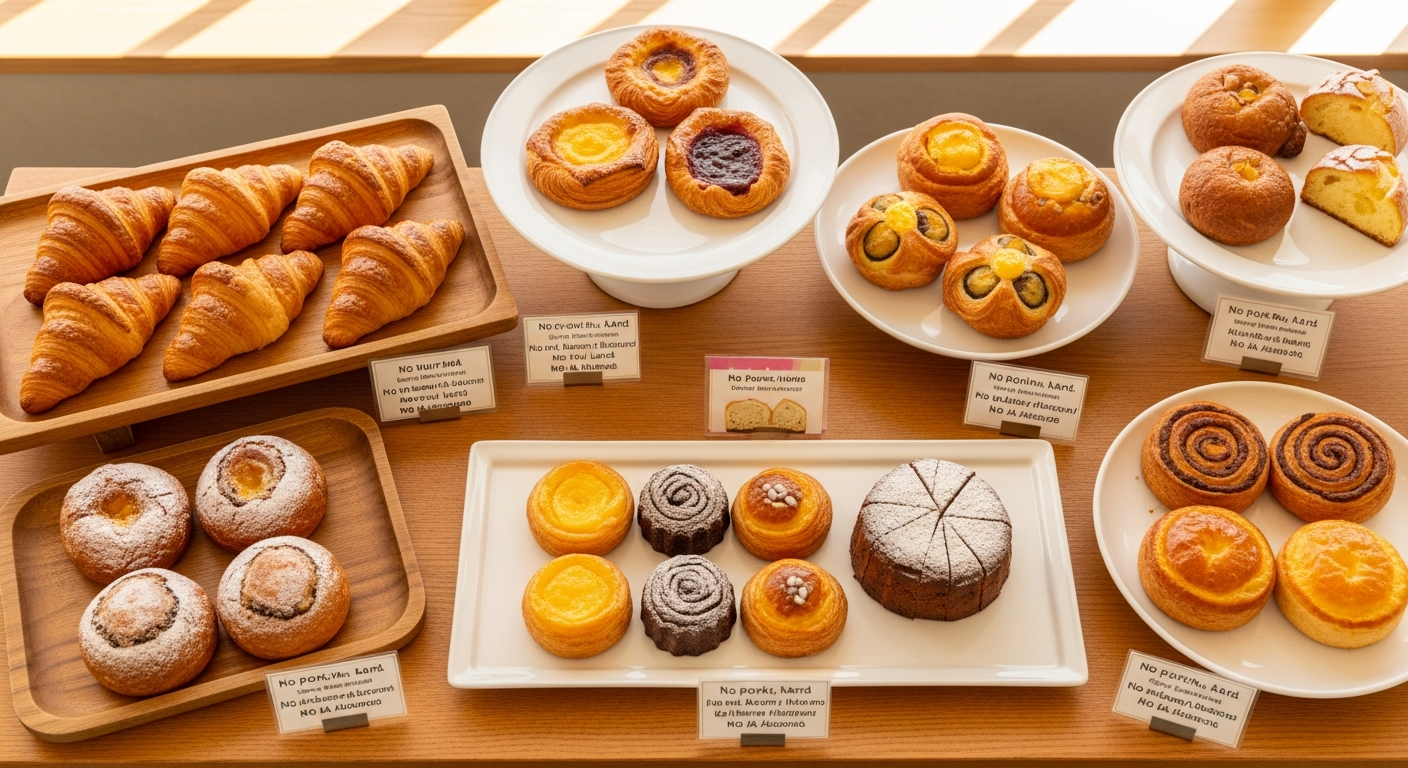
KIX Terminal 1 has several café-bakery counters that Muslim travelers will encounter, particularly in the international departures zone. The most prominent is ESPRESSO & BAKERY, located in Terminal 1, 2F after security (international departures), offering an authentic European-style café experience with Caffè Vergnano espresso. This bakery is open early in the morning (from 6:30 am), so it is recommended for breakfast even if you have an early flight.
However, ESPRESSO & BAKERY does not carry halal certification, and its pastries — croissants, Danish, filled rolls — are standard European-style baked goods whose shortening and emulsifier sources are not publicly disclosed as plant-derived. Travelers who require halal-certified or confirmed no-pork-no-lard baked goods should treat this counter as unverified and ask staff directly about ingredient sourcing before purchasing.
The same caution applies to È PRONTO, San Marc Café (サンマルクカフェ), and other café chains visible in the terminal. Japanese convenience stores are not halal-certified, and none of the three major chains — 7-Eleven, Lawson, or FamilyMart — hold JAKIM, MUIS, or any other internationally recognised halal certification for their private-label products. The Lawson inside KIX Terminal 1 falls under the same framework. That said, many items are naturally free of pork and alcohol, particularly plain rice dishes, certain breads, boiled eggs, fresh fruit, and some snack categories.
For the konbini bread aisle specifically: plain butter bread (食パン) at FamilyMart typically contains flour, yeast, salt, sugar, and butter — no pork gelatin. Confirm the shortening source if listed. Plain sliced white bread is generally the safest bread choice at any airport convenience store, but it is no-pork-no-lard status, not halal-certified.
🔗 Source: halal-navi.com
Reading the Label: A Quick Reference for the Bread Aisle
Whether you are at the Lawson inside the terminal or picking up a packaged roll from a café display, the ingredient panel on the back of the package is your most reliable tool. When in doubt, the printed allergen table on the back of the pack is the authoritative source, not the picture on the front.
Here are the key Japanese terms to scan for on any bread or pastry label at KIX:
| Japanese term | Romaji | What it means for Muslim travelers |
|---|---|---|
| 豚肉 / 豚 | butaniku / buta | Pork — avoid |
| ラード | rādo | Lard — avoid |
| ショートニング | shōtoningu | Shortening — check if plant-derived (植物性) is stated |
| 乳化剤 | nyūkazai | Emulsifier — source often unlisted; ask or avoid if uncertain |
| ゼラチン | zerachin | Gelatin — often pork-derived unless stated otherwise |
| 香料 | kōryō | Flavoring — may contain alcohol-based solvents |
| 植物性 | shokubutsusei | Plant-derived — a positive indicator next to shortening or emulsifier |
| ポークエキス | pōku ekisu | Pork extract — avoid |
If you want to scan labels faster, ingredient lists can be translated and analyzed automatically with apps like Halal Japan — gelatin, emulsifiers, shortening, mirin, alcohol and other risk ingredients are spotted instantly. Download it before you board your outbound flight so it works offline at the gate.
🔗 Source: halaljapan.app
Prayer Rooms and the Full Muslim-Friendly Picture at KIX
Finding safe bread is only one part of a comfortable transit. Prayer rooms are available on the 3rd floor and in the international gate area in Terminal 1. The prayer rooms and ablution spaces for use before praying are separated by gender. Prayer rooms can be freely used by all visitors. More specifically, KIX has three prayer rooms: the first is located on the 3rd floor of Terminal 1 beside the Korean Air Lounge, and the other two are located at the international departure gate area at the north wing and south wing gates.
All rooms are separated by gender, and facilities for ablution (wudu) are provided so that you may cleanse yourself before prayer. The prayer room is open to everyone and available for use 24 hours a day. You may also ask for the Muslim Friendly Airport Guide Map at the information centre (2F) to go to the prayer rooms.
Pairing a visit to the prayer room with a meal at KINEYA MUGIMARU on the 2nd floor makes for an efficient pre-departure or post-arrival routine. For ideas on what to eat once you reach the city, browse the best food in Osaka — many of the spots listed there offer Muslim-friendly menus far broader than anything available airside.
🔗 Source: kansai-airport.or.jp · halalgourmet.jp
Practical Tips for Muslim Travelers
- Go to Tasty Street first. Halal food is found on Tasty Street on the 2nd floor of the airport. This is the most concentrated zone for Muslim-friendly eating at KIX, and it is in the public area — accessible before and after immigration.
- Choose plain shokupan at the konbini over filled pastries. Plain sliced white bread (食パン) at the Lawson or FamilyMart inside the terminal is the no-pork-no-lard bread option most likely to have a clean ingredient list. Avoid cream-filled rolls, melon pan with butter glaze, and any pastry listing 乳化剤 without a 植物性 qualifier.
- Ask staff the right question. Rather than asking “Is this halal?”, ask: “豚肉やラードは入っていますか?” (Does this contain pork or lard?) — staff can answer this more reliably than a general halal question.
- Download Halal Japan or Muslim Pro before departure. Both apps work offline and can scan Japanese ingredient lists in real time — invaluable at a bakery counter where you have 60 seconds to decide.
- Pick up the Muslim Friendly Airport Guide Map. Ask for the Muslim Friendly Airport Guide Map at the information centre on 2F — it shows the locations of prayer rooms, halal-certified restaurants, and no-pork-no-lard dining options across the terminal.
- Plan ahead for Rinku Town. If you have a long layover, explore more of Kansai Airport — the Rinku Town area just across the bridge from the terminal has a broader range of Muslim-friendly dining options than the airside zone, including sit-down restaurants with clearly marked halal menus.
Last updated: August 14, 2026 · Corrections: [email protected]